For Jamie Lee Curtis, the wait for ‘Newlyweds’ is finally over
Raise your hand if your group chat is still talking about “You Can See Everything.”
For anyone who has watched Nathan Fielder and Lance Oppenheim’s documentary about former Theranos CEO (and convicted felon) Elizabeth Holmes and her partner Billy Evans in the past week, every new think piece, funny meme, discussion thread or video parody about the film has been something to revel in. I’ve personally spent several hours messaging or speaking to friends and colleagues over the phone about the documentary, and it seems like a lot of people similarly can’t stop obsessing about it.
The film has sparked renewed interest not only in Holmes, but also in works previously released about her, including “Bad Blood,” written by John Carreyrou, the journalist who exposed Holmes and Theranos’ fraudulent practices, and Alex Gibney’s 2019 documentary “The Inventor,” which senior writer Greg Braxton rewatched and analyzed in the context of the new documentary. Also notable has been the resurgence of Hulu’s “The Dropout,” the 2022 limited series created by Liz Meriwether (“Furious”) that stars Amanda Seyfried — Variety reported this week that the series has seen a jump in viewership over the past month. And of course, there’s been lots of interest in Fielder; we’ve put together a guide to his work if you’re looking to understand him and his style.
But with all the attention on Holmes, Times culture critic Mary McNamara raises an important question: Why are we still so fascinated by Holmes, despite her track record as a con artist and fraudster? There are many answers to the question, but there’s no denying the public’s renewed fascination with Holmes, and now Evans as well.
However, if you prefer to think about lighter relationships that are less perplexing, NBC’s latest sitcom will do the job and remind you of what it’s like to be immediately swept off your feet. “Newlyweds,” starring Téa Leoni, Tim Daly and Jamie Lee Curtis arrives on NBC today. Curtis, who co-created the series, stopped by Guest Spot to talk about what inspired it and the recent changes behind the scenes.
Also in this week’s Screen Gab, our writers recommend a documentary about a saga surrounding one of the greatest hip-hop groups of all time and a cult-classic horror film that’s perfect for spooky season. — Maira Garcia
Turn on
Recommendations from the film and TV experts at The Times

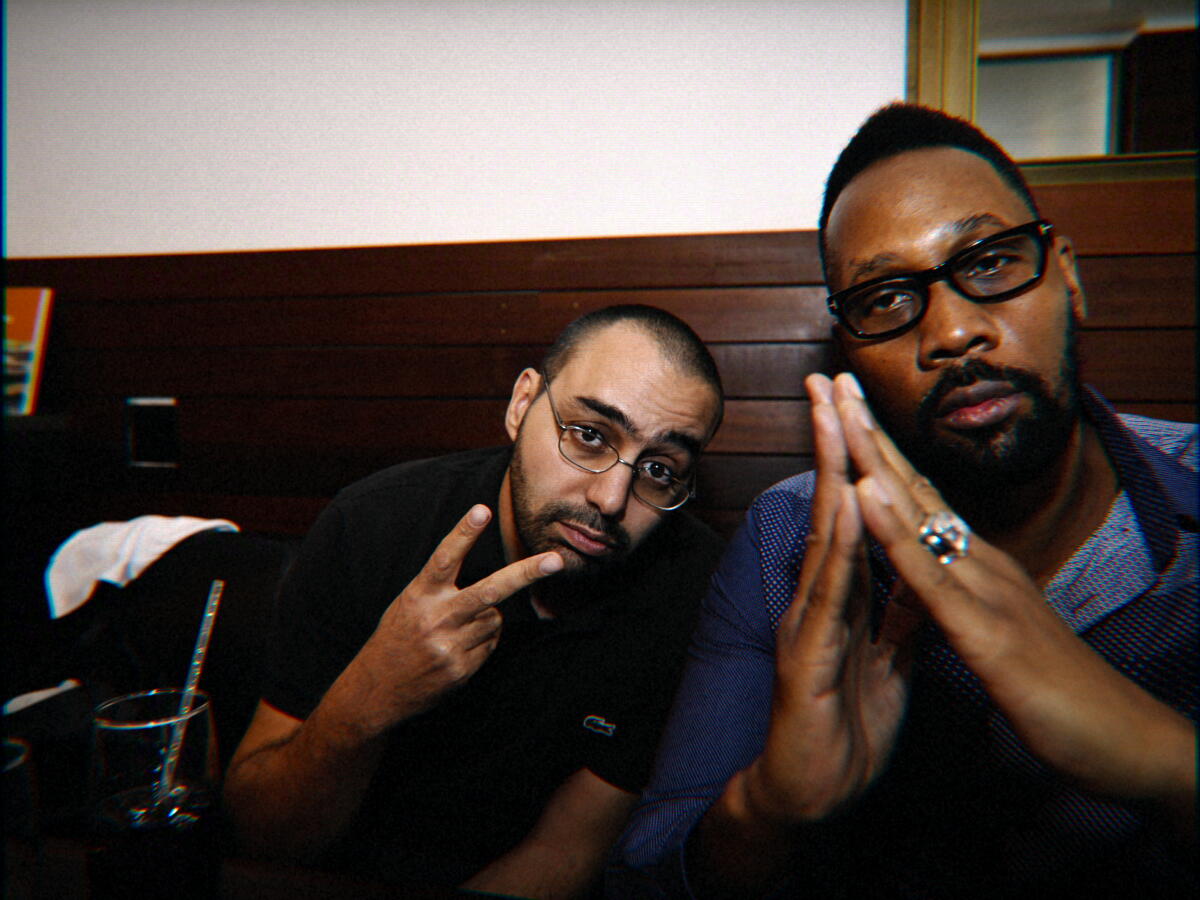
Tarik Azzougarh, left, and the RZA in Netflix’s “The Disciple.”
(Netflix)
“The Disciple: A Wu-Tang Fable” (Netflix)
In 2015, the only copy of the Wu-Tang Clan’s “Once Upon a Time in Shaolin” sold at auction for $2 million. The buyer was revealed to be hedge fund and pharma dirtbag Martin Shkreli, who infamously raised the price of an antiparasitic drug by 5,000% overnight and later went to prison for securities fraud. Joanna Natasegara‘s enchanting documentary “The Disciple” explores the long run-up to this Guinness Book of World Records event, and its aftermath, through the surprising, touching, funny and sometimes sad story of the album’s co-producer, Tarik Azzougarh, a.k.a. Cilvaringz. A Dutch Moroccan superfan whose freestyling and persistence earned him a place in the group’s auxiliary, it was Cilvaringz who first proposed the idea and brought it to fruition with Wu-Tang main man RZA — both a culmination and the beginning of an end. The film raises questions of art and ownership, friendship and business, creativity and capitalism, asking the questions who is music for, and what is it for. — Robert Lloyd
‘Highway to Hell’ (Tubi, Prime Video)
This is the perfect spooky-season flick to pop on when you don’t mind interruptions from trick-or-treaters or your buddy who treats movie night like an audition for “Mystery Science Theater 3000.” Directed by Ate de Jong (“Drop Dead Fred”), this 1992 comedy-horror cult classic stars Chad Lowe and Kristy Swanson as an eloping couple who take the wrong shortcut and wind up in Hades — basically, an even worse version of the drive to Vegas — where a young Ben Stiller works the roadside diner and Gilbert Gottfried plays Hitler. Every shot has a snort-worthy gag: a stop-motion Cerberus, a casino-bar called Hoffa’s, a cop whose handcuffs are literally a pair of severed hands. A flop at the time, “Highway to Hell’s” breakneck mix of smart and stupid was applauded by former L.A. Times film critic Kevin Thomas as “the Greek legend of Orpheus, revved up ‘Mad Max’-style.” Screenwriter Brian Helgeland would eventually win an Oscar for “L.A. Confidential.” Somehow, I never hear him brag about this goofy delight. He should. — Amy Nicholson
Guest spot
A weekly chat with actors, writers, directors and more about what they’re working on — and what they’re watching

Jamie Lee Curtis as Claudia in “Newlyweds,” a sitcom she co-created and executive produces.
(Nicole Weingart / NBC)
Jaime Lee Curtis has been in showbiz for a very long time. And when she sets her mind to something, like returning to a sitcom, she’s going to make it happen.
“It’ll be 50 years next January that I have been a professional actress,” she says over a video call earlier this week. “It’ll be 50 years that I’ve been driving on the lot at Universal.”
Over the course of her long career, Curtis, 67, has developed a lengthy résumé in film and television, winning numerous accolades along the way, including an Oscar and an Emmy (she’s been nominated for a Grammy too — there’s still time for an EGOT). But she longed to return to a sitcom ever since wrapping her lead role on ABC’s “Anything but Love,” a series that premiered in 1989 and ran for four seasons.
While she’s had guest appearances and some recurring roles on sitcoms over the years, including on shows like “New Girl” and “The Drew Carey Show,” NBC’s “Newlyweds” was an idea she had gestated for years, and now it’s set to arrive as part of the network’s Friday prime-time lineup. The actor, who executive produces “Newlyweds” and has a recurring role, took some time to discuss how she came up with the idea for the show, her co-creator’s firing and the political thriller series she’s watching with her spouse, filmmaker Christopher Guest. — M.G.
Jamie, you co-created this series and it’s loosely based on your relationship with your husband, Christoper Guest. Tell me how it came about and how you wanted to tell that story in this show.
It was April 25, 2019. I was in New York City … I was in a car being driven by a man in his 60s in a suit with gray hair on his temples. We were chatting, as one does in the back of a car, and I asked him if he was married, and he said he was divorced. I said, “Do you have kids?” And he said, “No.” And I said, “Well, that’s the blessing that you know you’re not dealing with divorce and children, which I’ve dealt with a lot.” And he then said, “But my new wife.” In that second, I went, “Oh, my new wife.” That’s a sitcom about people in their 60s hooking up, similar to the way my husband and I met, which was we met and married very quickly. And in fact, we would have gotten married had we gone out on our first date. We have said we would have gone and gotten married that night. So the idea popped in my head: What happens if two people in their 60s get married on a whim, and decide to just throw caution to the wind and go for it? What happens to the families and the friends and their own lives and the very routinized lives that they had led leading up to that moment? I knew it was a sitcom.
It wasn’t until years later I was put together with Gail Lerner, and we — during COVID actually — started working on the idea. But much of what’s in that script was kind of what happened to me and my husband … it’s something that’s been around for a while, and I’m just really excited finally that it has turned into this version, “Newlyweds” starring Tim and Téa.
Let’s talk about Tim and Téa. They’re the newlyweds, but they’re also married in real life. What was it like playing off their dynamic and vice versa?
When the pilot got picked up, … it was what they call “cast-contingent,” which means they like the idea, but they want to make sure that the right person gets in … so they wanted us to find Jeanie first, and it was a very short list of actresses they would bank a show on. Téa, luckily, was one of those actresses and had been looking for something on the lighter side. … and it so happens she’s married to a guy IRL who happens to have a lot of experience in the comedy space on TV shows, and all of a sudden we were like, oh, wouldn’t that make a kind of fantastic bit of pairing.
What do you think we’re going to learn about Claudia? She seems so liberated, but we’ve only seen the surface. She’s got a soft spot for Jeanie and even James.
I think you’re gonna see, in fact, that she becomes not just a foil but a friend. I feel like her acceptance of Jeanie … we’re going to mine it for its comedy. I mean, I think at the end of the day, she will always shake things up because that’s just her nature. We get to meet Claudia’s mother. I can’t tell you because we haven’t announced it yet, who plays my mother. I can tell you that she’s over 90.
You’re going to have me Googling.
We get to see a little bit of the oak tree and the acorn. We definitely get the snarky oak tree and the snarky acorn.
I want to come back to your co-creator Gail Lerner, who was recently dismissed from her role as showrunner, and has been replaced with Bruce Helford. Regardless of the news, she has called it “the most joyous TV experience of her life.” How are you and the cast moving forward after these changes?
Well, you can imagine it was a bummer. You know, network television has a whole series of requirements, way beyond … my little creative ideas. It has to do with management of scripts and the amount of early drafts of things, and it’s required within a network structure. And to run a show on television, and to consistently run a show, is a different animal than just the creativity that it takes to think of a show or to develop a show. That’s why Bruce has stepped in very quickly because Bruce has proven over and over again that he’s a guy who can make 100 episodes of a show with a much bigger worldview.
It was beautiful that Gail said the very things she said because we all felt that way too. It was joyous, fun, but there were a lot of things that were way beyond my understanding. What I’ve come to learn, I’m 67, is that creativity is a continuum. That it is not rigid and binary. That I had an idea that then Gail took and built on that idea, and now Bruce has come in and taken Gail’s idea … and is building out another version of the show.
Bruce Helford was the second in charge at the TV show “Anything but Love” when I did it back in the day, so I’ve known him.
So y’all are back together.
The only other time I was ever on a sitcom was “The Drew Carey Show” when Bruce Helford wrote me a part of this crazy hairdresser who … goes on a date with Drew Carey and ends up doing bungee jumping with him on the date. It’s a funny continuum for me to be back with Bruce, who weirdly enough was the actual first person I called when I had the idea [for “Newlyweds”]. I called Bruce because I knew him as a showrunner for sitcoms. We talked about it very briefly, and then he went off to something else. I went off to something else, and it kind of fell apart. So it’s slightly weird to me, and beautiful in that way that the person I actually called when I had the idea is now the one running the show.
It’s a full–circle moment.
Completely full-circle moment.
Has Christopher seen the show? What does he think?
I will say this: Christopher Guest is not a sitcom fan. You know, my husband is a very specific person and makes very specific, very funny movies and television shows. [Sitcoms are] not the thing that he is drawn to. But he genuinely understands that I’ve wanted to do a sitcom for a long time.
Because it’s spooky season right now, and you’re one of the OG scream queens, I have to ask you: Do you watch anything in that vein?
So I’m boring because the truth is, I don’t like scary things. I don’t like scary movies. I have zero interest in scary movies, and I think if someone ended up doing some analysis of me as a human once I’m dead, they would understand that actually my natural fear of scary things is what, in fact, made me such a good actress in them, and I don’t pretend to like them. I like the fans of [scary movies] because there’s a passionate group of people that love them. But I don’t have to love the movies, I just have to love what I do.
Is there anything else you’re watching right now?
My husband and I just started watching the [fourth] season of “The Diplomat” [Netflix], which the writing is so great. Last night we watched an episode written … by Peter Noah, who was the guy who took over “Anything but Love” … and was the showrunner. This episode last night [Episode 4, “Pagliacci”] was what Chris and I watched, and I wrote to Peter last night to say, “Bravo, bravo! Oh, the writing is so gripping.” Of course the writing leads the performances, which lead the filmmaker. It’s always the writing.
ICYMI
Must-read stories you might have missed