LEGENDARY R&B singer Freddie Jackson has died at 70 as family and friends mourn the icon’s passing online.
The singer, known for his hit song Rock Me Tonight (For Old Times Sake), passed away on Monday, just days after his milestone birthday.
R&B legend Freddie Jackson has died, days after his 70th birthdayCredit: Getty ImagesFreddie is known for his hit songs Rock Me Tonight (For Old Times Sake) and You Are My LadyCredit: Getty Images
Freddie’s family announced the sad news on his Instagram on Tuesday.
“It is with profound sadness and heavy hearts that we share the passing of our beloved Freddie Jackson, who went home to rest last night,” the post read alongside a photo of the iconic vocalist.
Sign up for the Showbiz newsletter
Thank you!
“Freddie was more than a legendary voice. He was a kind, generous soul who loved his fans, his family, his friends, and his music with everything he had.
“For decades he gave us the songs that became the soundtrack to our love stories, our celebrations, and our most treasured memories. That gift will live on forever,” the caption continued.
“To everyone who ever sang along, danced, or felt something when Freddie took the stage: thank you. You were family to him, and he carried your love with him always.
“Please keep his family, friends, and loved ones in your prayers during this difficult time. Details regarding arrangements and how to honor his legacy will be shared in the coming days.”
The family concluded the post, writing, “Rest in peace, Freddie. Your legacy and your voice will live on forever.”
They did not reveal the artist’s cause of death.
Most read in Entertainment
Fans shared their grief and condolences to Freddie’s loved ones in the comments.
“Another Legend Gone…Another Legacy left behind. This sucks! Grateful for the gift he shared with an unforgiving world,” professional wrestler Elijah Burke (Da Pope), wrote.
“Oh man Freddie one of. The true greats!!!! I had the pleasure of working on a song duet with him and Natalie Cole! Superb!” singer Narada Michael Walden added.
“Three days after his birthday. Rest well and Thank you for all the wonderful songs throughout the years here with us on earth,” a fan said.
The singer’s cause of death was not disclosedCredit: GettyThe vocalist released his newest album, My First Love, in May 2023Credit: Getty
“Awww man. Such a cool brother. So talented too ! One of the Greats,” chimed in a fourth.
“Heartbreaking news!!! Rest in Paradise Freddie,” a fifth echoed.
Freddie’s music career took off in the 1980s, with his chart-topping hits, You Are My Lady, Have You Ever Loved Somebody, and Jam Tonight.
The New York native kept performing until his death, singing his old hits and songs from his newest album, My First Love, released in May 2023.
He hit the stage in June for a performance at a winery in Philadelphia and was among the headliners at an 80s Night Concert in Fort Worth, Texas, in April, per his recent Instagram posts.
In one of Freddie’s latest posts, he thanked fans “for all the love” on his birthday and shared a photo of himself in a white suit.
This summer, Southern California hiker Mark Orr spotted a hazard he struggled to stop thinking about: a crumbling, narrowing section of the Devil’s Backbone Trail near Mt. Baldy.
Orr wanted to help.
In early August, he trekked about 5.6 miles from the trailhead near Manker Flat campground to the site, hauling 85 pounds of gear with him over two trips. Orr first spent two hours digging out a wider route and then built what he dubbed an “anti-erosion fence” by installing 30-inch rebar stakes, stainless steel wire, clamps, aluminum flashing and zip ties. A few weeks later, Orr posted a video documenting his work to his YouTube channel, where he’d previously shared about hiking and other DIY projects. In the video, which Orr has since made private, he said he’d never performed trail work.
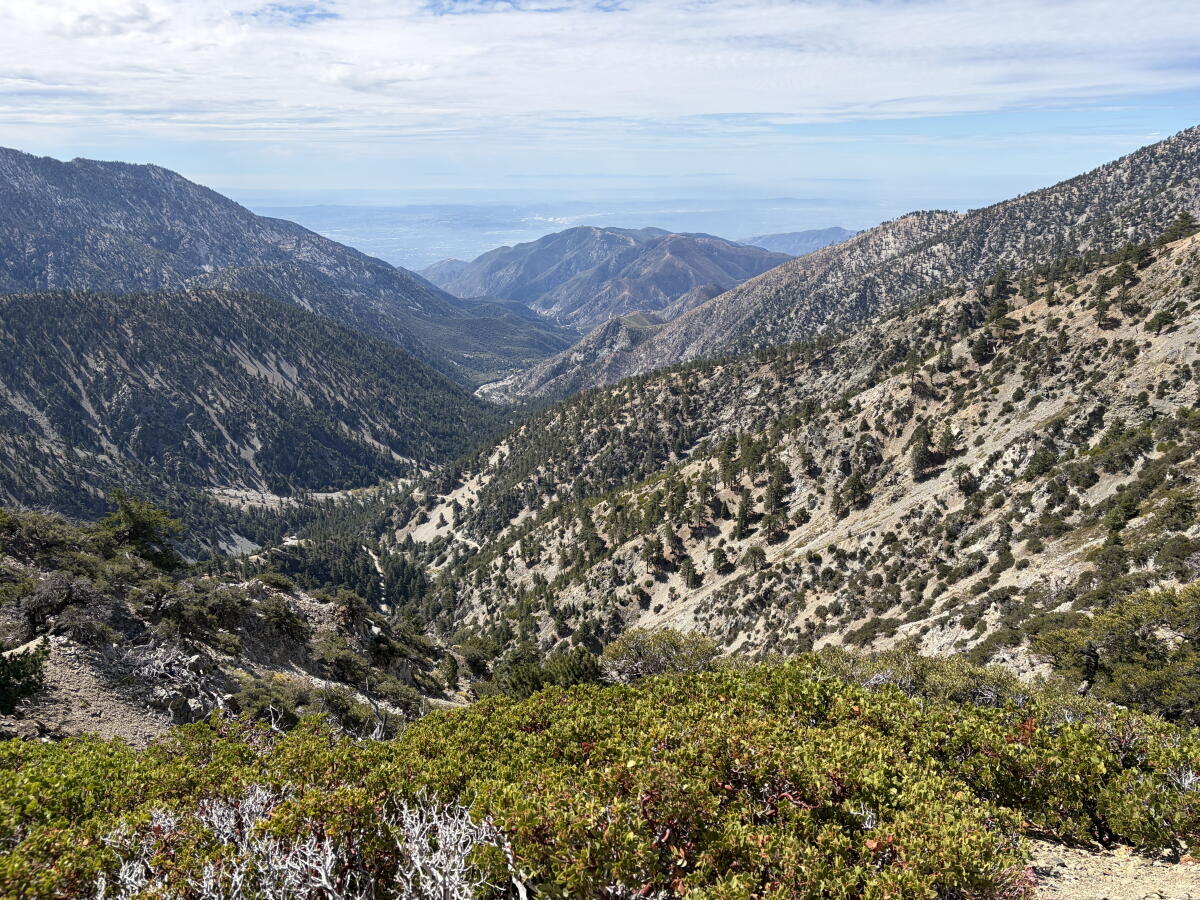
A view from Baldy Road leading up the Mt. Baldy Notch in the San Gabriel Mountains.
(Jaclyn Cosgrove / Los Angeles Times)
The people of the internet were initially grateful. “I can’t imagine doing this in my backyard let alone at 9,350 ft. You are THE MAN,” one YouTube user wrote. “I’ve hiked the backbone dozens of times and will remember you with gratitude every time I come across this section,” another person said. One person said his son was one of the three people who died while hiking the Backbone Trail in late December, and he wanted to connect with Orr.
But, as the video’s view count ticked up, concern over Orr’s work mounted into rage.
Two camps developed: Those who lauded Orr’s efforts and those who felt he should be held accountable for what they argued was damage to the trail. “I give this guy an A+ on his intentions and effort,” a Reddit user wrote on a post about Orr’s video. “If a section is dangerous, it should ‘look’ dangerous. To make it look safe, creates a bigger hazard as people will come to rely/trust in what is actually a DIY retaining wall. What happens when that eventually gives way? What if someone is hurt/killed as a direct result of this DIY project?”
You are reading The Wild newsletter
Sign up to get expert tips on the best of Southern California’s beaches, trails, parks, deserts, forests and mountains in your inbox every Thursday.
By continuing, you agree to our Terms of Service, which include arbitration and a class action waiver. You agree that we and our third-party vendors may collect and use your information, including through cookies, pixels and similar technologies, for the purposes set forth in our Privacy Policy such as personalizing your experience and ads.
In this edition of The Wild, our weekly outdoors newsletter, I will report out the current status of the trail where Orr completed his work. I will discuss how we got here — where an individual, not the U.S. Forest Service, tackled a trail repair — and where we go from here, including how you can do your part without upsetting half the outdoors corner of the internet and violating federal policy.
First, let’s talk about Mt. Baldy and how people usually get there.
A segment of the Devil’s Backbone Trail that hikers take to the Mt. Baldy summit.
(Jaclyn Cosgrove / Los Angeles Times)
Mt. San Antonio, commonly referred to as Mt. Baldy for its appearance, is a 10,064-foot peak in the San Gabriel Mountains and is the highest point in Los Angeles County.
Outside of winter, when much of the trail can become covered in snow and ice, most hikers reach Mt. Baldy via two routes. They start near the Manker Flat campground and walk Falls and Baldy roads until they either turn north-ish onto the Baldy Bowl Trail, often referred to as the “Ski Hut” route because hikers pass the Sierra Club’s green building, or hikers continue on Baldy Road until they reach the Mt. Baldy Notch. From here, hikers start the Devil’s Backbone Trail first by trekking up a fire road and then taking on a grueling, narrow 1.9(ish)-mile jaunt that gains about 1,500 feet and always makes me question my life choices about halfway through.
The Devil’s Backbone is named as such because of its shape, including segments where hikers walk a narrow stretch with steep drop-offs on both sides. This steepness is part of what makes it susceptible to erosion — and why only serious, well-equipped mountaineers should traverse it during the winter.
The Devil’s Backbone Trail, per the U.S. Forest Service, is 3.24 miles long, starting at Baldy Notch and ends at Mt. Baldy Summit.
(Jaclyn Cosgrove / Los Angeles Times)
On Sunday, I headed up Baldy Road to see how Orr’s repairs were holding. I am active in the r/socalhiking Reddit community, where I first learned of the story, and had already seen images showing a hole developing at the start of Orr’s repairs.
But no one had pinpointed exactly where they were.
Once I reached the Devil’s Backbone, a hiker warned me about a particularly steep and narrow section he’d just traversed.
“Is this the part with the repairs?” I asked.
“No, that part is way up, and it is already breaking down,” he told me.
I then chatted with two high schoolers coming back from summiting Baldy, one of whom hopes to attend a University of California school to study environmental science. “A little bit of rain,” and it’s gone, he said of Orr’s repairs.
A segment of a repair performed by a local hiker that has started to fail.
(Jaclyn Cosgrove / Los Angeles Times)
Just over a mile into the Devil’s Backbone, I spotted the shiny aluminum of Orr’s anti-erosion fence. And I spotted the hole where fill dirt has fallen through. Before Orr started his work, the trail was narrow — his work did widen the route, but how long will it hold?
Alan Coles, a trail crew leader with the San Gabriel Mountains Trailbuilders, which maintains routes in the backcountry and Baldy area, told me the answer is probably not long, especially given the rain and snow we could get this winter from El Niño.
A segment of the Devil’s Backbone Trail where a hiker attempted to widen and repair the crumbly trail.
(Jaclyn Cosgrove / Los Angeles Times)
“Taking another look at the video, the problem with the trail may be due to a buildup of material washing down from above,” said Coles, who has 35 years of trail maintenance experience. “Often the best solution is to dig it out and lower the trail to the original alignment, which will also widen it. The problem with the repair is that the hardware he installed would make that difficult. In time, the material he used will come apart, and those stakes will get more exposed, leading to problems with people tripping on them, especially if there is snow.”
Coles said to begin work in Angeles National Forest, he must submit a list of trails that his organization wants to work on to the U.S. Forest Service. The agency’s archaeologist, biologist and other technical experts will review his list. If there are any issues with a particular trail that Coles has identified needs repairs — like if an endangered species is known to live in a creek next to the trail — the Forest Service could deny his request, thus leaving the trail unmaintained.
A hiker walks near the hole created by unauthorized repairs performed in early August.
(Jaclyn Cosgrove / Los Angeles Times)
Coles said the Devil’s Backbone Trail is a “very difficult repair” for a lot of reasons, including its high altitude and the need for a crew to get permission to use the fire roads to shorten the distance they have to haul their gear. Coles said hikers often ask him when his crew will work on the Three T’s Trail, as the route has several downed trees and other issues, and his crew faces similar access issues.
Coles said he sympathizes with Orr’s reasoning for repairing the trail: People died in that area.
“His heart’s in the right place, but it really needs to be done with someone who says, ‘OK, here’s how you properly do a repair like that,’” Coles said.
It’s impossible when thinking about Orr’s repairs not to think about the old adage of, “The road to hell is paved with good intentions,” and the brutal irony is that, once you reach the Devil’s Backbone, you’re going to need more than that.
Two hikers navigate down the Devil’s Backbone Trail after summiting Mt. Baldy, the highest point in L.A. County.
(Jaclyn Cosgrove / Los Angeles Times)
When I spoke to Orr after my hike, he said he hopes that he can join the trail crew to remove what he did and repair the trail properly.
“The first thing is, it was nothing but well intentions by somebody who loves the mountain and wants it to be safer for everybody,” Orr said. “I totally get that my first crack at this, I didn’t do everything right, and I’m actively working with the San Gabriel Mountains Trailbuilders to get it right before this winter.”
The final challenge, though, will be getting officials at the U.S. Forest Service to approve the work plan. A spokesperson at Angeles National Forest did not respond to my request for a comment or an interview for this story.
Orr’s trail repairs come at a time when outdoors lovers are feeling particularly protective of public lands. The Trump administration has continued its efforts to peel back layers of environmental protections, like the Roadless Rule, raising the alarm of park advocates who fear not even Yosemite is safe from development.
The sunset as viewed Sunday on a trail often referred to as the “Ski Hut” route.
(Jaclyn Cosgrove / Los Angeles Times)
At the same time, the U.S. Forest Service and National Park Service have both seen massive staffing cuts during Trump’s second term, and this comes after decades of underfunded trail construction and repair.
In the early 1980s, “each of the five Angeles Forest districts had a full-time, paid trail crew of eight to 10 members. Now there are only summertime crews with three to four members. Forest Service officials and the agency’s critics agree that if it were not for the volunteer corps of 700 trail builders, the mountain paths would not be repaired for years,” according to a 1993 Times story.
Those crews, Coles said, were one of the casualties from a swath of federal budget cuts in the 1980s. A 1986 Times story noted that, in just four years, “the amount of federal money allocated for trail maintenance nationwide and in Southern California … dropped about 50%.”
“For the most part, without the volunteers, you wouldn’t have a trail system today,” Angeles National Forest official Don Gilliland told The Times in 1993.
The sun goes down, casting orange and pink hues through the clouds above the San Gabriel Mountains near Mt. Baldy Village.
(Jaclyn Cosgrove / Los Angeles Times)
The agency continues to rely heavily on volunteers. The U.S. Forest Service estimates that it has about $10.8 billion in deferred maintenance, including $241 million in deferred trail maintenance and almost $70 million in trail-bridge deferred maintenance, according to a recent budget document.
In an analysis of that backlog of work, officials with the U.S. Government Accountability Office heard from one regional official who told them that the trail maintenance program “is held together by Band-Aids and baling wire.”
If you’d like to be part of that baling wire, you can join Orr in joining a local trail crew. There are several who service the San Gabriel Mountains and their foothills.
It is easy to read about Orr’s efforts and point out the obvious mistakes he made. It’s another thing to take action, whether that’s donating to local trail crews or volunteering on their work days. I’ll see you out there, focusing on the latter.
3 things to do
A coyote drinks water puddling near the golf course at Griffith Park.
(Mel Melcon / Los Angeles Times)
1. Document dicots and deer in L.A. The Los Angeles Public Library, along with other city agencies, will launch this year’s L.A. Nature Quest at 9 a.m. Saturday at the Griffith Park Visitor Center. The L.A. Nature Quest is an annual monthlong effort to document as much of L.A.’s flora and fauna as possible using iNaturalist, a citizen science app. Attendees will be guided by rangers and other experts in a morning of outdoor exploration and nature journaling. Downloading iNaturalist beforehand is recommended. Register at eventbrite.com.
2. Sit down and spy birds in Pasadena The Pasadena Audubon Society will host a seated birding experience at 8 a.m. Saturday on the Gamble House lawn (4 Westmoreland Place in Pasadena). Guests should bring water, sunscreen, a lawn chair or blanket, and a hat. Participants can bring their own binoculars, but there will be some to loan out for those without. Register at eventbrite.com.
3. Marvel at mushrooms in Monrovia Monrovia’s Canyon Park Nature Center will host the opening reception for the Mushrooms of the San Gabriel Mountains at 10 a.m. Sunday. Mycologist Aaron Tupac will share with guests about how and why they photographed the specimens shown in the exhibit, along with sharing information about our local fungi populations. Learn more at Tupac’s Instagram page.
The must-read
Biologists collect olive ridley sea turtle eggs from nests on Southern California beaches.
(Huntington Beach Police Dept.)
In mid-September, two heart-shaped olive ridley sea turtles made history when they dug nests on Seal and Huntington beaches, marking the first documented natural sea turtle nests on the U.S. West Coast. Times staff writer Corinne Purtill wrote that biologists and cheloniophiles barely had time to celebrate before realizing that these nests were at risk of being destroyed by incoming storm surges and high tides. Biologists recovered just over 200 eggs. “We had to make some quick decisions,” said biologist Jonathan Snyder of the U.S. Fish and Wildlife Service at the Aquarium of the Pacific in Long Beach on Friday. “This is the decision that we made, and I think it’s the best one for species recovery.”
Happy adventuring,
P.S.
Montrose Search and Rescue recently highlighted the perils of taking the wrong route to hike Strawberry Peak. Strawberry Peak, visible from several L.A. hikes, is the highest point in the front range of the San Gabriel Mountains. Montrose Search and Rescue recently rescued hikers, though, who’ve ended up on the mountaineering route. Their video highlights how crucial it is to know your route before you go — and to ensure you have a physical map with you in case you get lost. Stay safe out there, folks! (And don’t hike Strawberry Peak right now — it’s too hot.)
For more insider tips on Southern California’s beaches, trails and parks, check out past editions of The Wild. And to view this newsletter in your browser, click here.
Chicago Bears linebacker D’Marco Jackson had just delivered a hard hit on Jalen Hurts as the Eagles star quarterback was running out of bounds. Hurts had to leave the game under the NFL’s concussion protocol.
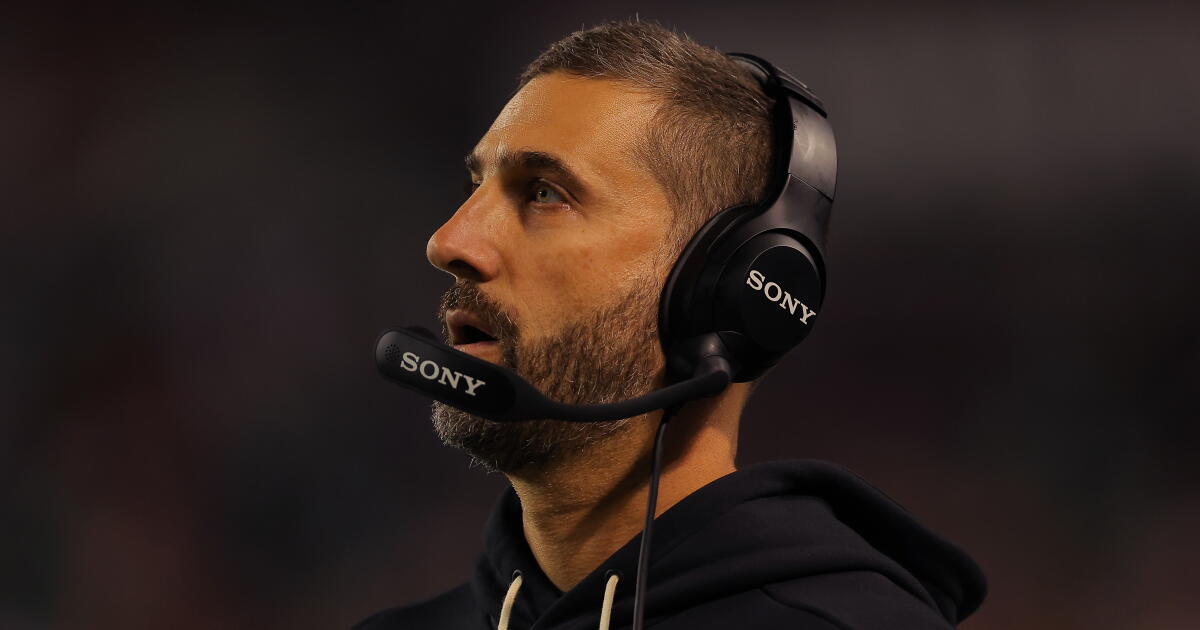
So Sirianni decided to let Jackson know exactly how he felt about him. ESPN’s “Monday Night Football” cameras showed the sixth-year coach screaming an extremely NSFW word apparently at the opposing player — twice — while Eagles backup quarterback Andy Dalton prepared to enter the game.
Hours later, following the Eagles’ 27-7 loss to the Bears, Sirianni expressed regret for how he behaved.
“I always come away when I have a moment like that with remorse,” Sirianni told reporters during his postgame news conference. “I shouldn’t have let my emotions get the best of me. Those guys are out there trying to make a play. It was close on the sideline, ended up being a penalty. Obviously you never want to see your quarterback get hit like that, but it’s in the heat of the moment. I know nobody’s trying to hurt anybody out there, and I always have remorse when I act that way.”
He added: “The emotion of the game probably got the better of me today and I have to learn from that in that particular moment. I have to be more steady in that situation and be able to — like I say to the guys all the time, be able to move on and go to the next play. I didn’t like how I handled that.”
Trailing 7-0 midway through the second quarter, Hurts was forced to scramble out of the pocket on second down for a short gain to the Bears’ 13-yard line. As he was stepping out of bounds, Hurts was hit hard in the shoulder area by Jackson and knocked backward onto the ground. Jackson was flagged for unnecessary roughness, but the penalty was offset by an offensive holding call on Philadelphia’s Lane Johnson.
After the game, Jackson joked that he received “some feedback” over that hit but said that he thought he was making the appropriate play at the time.
“I’m seeing him, I see the first down right there and in my head I’m trying to stop him from [getting] the first down and reaching the ball out,” Jackson told Marquee Sports Network. “I thought it was a clean hit. In the second of the game, I thought it was clean.”
Hurts was able to jog back to the Eagles huddle but was then called to the sideline for concussion testing. Out on the field, Dalton handed the ball off to star running back Saquon Barkley three times to get the Eagles to the Bears’ 2-yard line. But on third and goal, Dalton’s pass intended for Dontayvion Wicks was intercepted by Chicago’s Dillon Thieneman in the end zone to stop the drive.
In his postgame news conference, Hurts didn’t address the hit by Jackson but did express frustration about not being able to clear the concussion protocol and re-enter the game sooner.
“I wish they could have expedited things,” Hurts said. “I felt fine.”
The Bears — led by third-string quarterback Case Keenum, who started in place of injured starter Caleb Williams and backup Tyson Bagent, who was recovering from a conncussion — then drove the ball down the field for a field goal. Hurts returned to the game on the next drive and led the Eagles to their only touchdown of the game.
Los Angeles County officials aim to break ground on the new Eaton Canyon Nature Center before 2028, with plans to construct a facility that can withstand the region’s changing climate and future disasters.
The previous nature center, which replaced the original Robert M. McCurdy Nature Center that burned down in 1993, was destroyed in the Eaton fire last January. The fire not only destroyed the structure but also a large library and several decades’ worth of archives, and it also killed the reptiles that lived inside the center.
It took about five years to rebuild and open the last nature center. L.A. County Parks Director Norma Edith García-Gonzalez said after the design phase is completed, which could be soon, the county and the architect firm hired for the project will plan out the construction phase.
“We modeled 100-year patterns of wind, fire and flood so that when we build back, we are building back with resistance, and that is able to guide how we plant [and] what type of plants, and how we build, [including] how we build back trails,” García-Gonzalez said.
Norma Edith García-Gonzalez, director of L.A. County Department of Parks and Recreation, speaks during an Eaton Canyon design meeting in mid-September.
(Kayla Bartkowski / Los Angeles Times)
The biggest impediment to rebuilding, though, is funding. The county has about $16.2 million in state money, about half of what county officials think is needed to build a new nature center, she said. García-Gonzalez said she hopes the philanthropic community will step up to fill the gaps, but county leaders have noticed that “philanthropy goes from one hot issue to another,” and interest to donate to fire recovery is cooling.
In this week’s edition of The Wild, our weekly outdoors newsletter, I will provide an update on the design plans for the new nature center and when we can expect to hike again in Eaton Canyon — and how you can help with the canyon’s restoration too.
You are reading The Wild newsletter
Sign up to get expert tips on the best of Southern California’s beaches, trails, parks, deserts, forests and mountains in your inbox every Thursday.
By continuing, you agree to our Terms of Service, which include arbitration and a class action waiver. You agree that we and our third-party vendors may collect and use your information, including through cookies, pixels and similar technologies, for the purposes set forth in our Privacy Policy such as personalizing your experience and ads.
First, let’s discuss a little bit of the history of the area.
The Eaton Canyon Natural Area, managed by L.A. County Parks and Recreation, is a 190(ish)-acre swath of land at the foothills of the San Gabriel Mountains near Altadena.
“Originally called ‘El Precipicio’ by the Spanish settlers because of its steep gorges, it is now named after Judge Benjamin Eaton, who built the first Fair Oaks Ranch House in 1865 not far from Eaton Creek,” according to the Eaton Canyon Nature Center Associates, a volunteer-run education and stewardship group. “Judge Eaton was the first to use irrigation from the creek to grow grapes on the slopes.”
The canyon has long been a fascination of adventuresome L.A. residents.
The hike to Eaton Canyon Falls in the San Gabriel Mountains before the Eaton fire last January.
(Myung J. Chun / Los Angeles Times)
In 1921, writer Frances Mathilda Purdy wrote for The Times that few people knew of the “hidden, but very easily accessible waterfall” in Eaton Canyon. Purdy outlined a few ways to access the canyon and reach the falls, including a shorter route where visitors “after alighting from motor, or stage,” could take a small flight of stone steps near the Mt. Wilson Toll Road bridge.
I chuckled when I read Purdy’s suggestion that this particular route was “perfectly comfortable for those who have arrived on the scene in city garb.” Apparently, underprepared hikers have been coming to Eaton Canyon for more than 100 years. What do you think was the 1920s version of hiking in flip-flops?
For the more rugged adventurer, Purdy laid out a “serpentine trail” that leads to “such lovely possibilities for the pleasure-seeking jaded worker, who, from only one afternoon spent in this quietly entrancing corner of the great outdoors, will return, refreshed and invigorated to meet the daily grind with a mind stored full of the charm of Lower Eaton Canyon.”
Architect Anne Mooney of Sparano + Mooney Architecture speaks about a site plan for the next Eaton Canyon Nature Center.
(Kayla Bartkowski / Los Angeles Times)
It wasn’t until 1930 that Pasadena set aside property that the city owned for a bird and game sanctuary in Eaton Canyon and Eaton Wash, preserving the land from development, according to a historical record compiled by the nature center associates.
There was interest in doing more.
Pasadena Park Superintendent Gilbert Skutt, who served from 1923 to 1936, wanted to see a large scenic public park in Eaton Canyon similar to what the city had built along the Arroyo Seco, according to city records. “He sought to correct the imbalance in the distribution of park space in Pasadena, which favored the west side of town,” according to a historical document. “During the Depression, however, the city could not afford to purchase the land.”
Over time, the city started working with county officials on Eaton Canyon Regional Park, eventually giving the entire project to the county.
In 1931, the L.A. County Board of Supervisors considered financing a 1,000-acre “gigantic regional park system” for the area, according to The Times’ archives, but that idea apparently never fully came to fruition.
Thankfully, in 1950, landowner Mary Beatrice Fox sold the canyon portion of her property to L.A. County to use for a park, “with a provision that mammals are not to be kept in cages,” according to a park history compiled by the Eaton Canyon Nature Center Associates.
A hiker slips in a creek in Eaton Canyon after a 2023 storm.
(Wally Skalij / Los Angeles Times)
Then, in 1958, naturalist Louise A. Luckan moved her “nature appreciation operation from the Eaton Canyon Golf Course to Eaton Canyon Park,” according to the organization’s history.
Soon, L.A. County officials set aside $154,797 — about $1.7 million in today’s dollars — for the Robert M. McCurdy Nature Center. They had big plans for the facility, which was to include two classrooms, an office, museum, library, display area, gift shop, laboratory and an auditorium that could seat 200.
“This park will be an outstanding facility — the only one of its kind in magnitude this side of Chicago,” Supervisor Warren Dorn said in a 1962 Times story.
The nature center opened in 1963, and became popular among scouting and school groups, to whom naturalists taught about the local flora and fauna. By the early 1970s, more than 2,000 school children were regularly attending lectures at the nature center, according to Times archives. The students wrote thank-you notes to the park staff, including one that read, “I think it was nice of you to buy this park instead of someone buying it for houses and factories. Because if they did, it would ruin this beautiful land.”
L.A. County sustainability policy director Rebecca Ferdman talks with community stewards about how to educate and engage the public about the goldspotted oak borer, a pernicious invasive beetle that destroys oak trees, during a meeting at Eaton Canyon Nature Center in 2024.
(Brian van der Brug / Los Angeles Times)
But, in 1993, the canyon’s first nature center was destroyed by the Kinneloa fire. The next nature center didn’t reopen until 1998.
Karen Mateer, vice president of the Eaton Canyon Nature Center Associates, said for more than 25 years, that nature center served as a meeting place and an educational hub for the millions who visited the canyon over the years.
Mateer, who started volunteering in 1998, said many local schoolchildren first experienced the concept of “nature” at Eaton Canyon on field trips. Volunteers would regularly hear from adults, who pursued recreation- or nature-focused careers, that the first place they ever hiked or learned about their natural habitat was at Eaton Canyon.
“Eaton Canyon also, for the community, for those of us up here who lost so much, it is familiar and is a place you often go for recreation, for solace,” Mateer said. “It means a lot.”
At a presentation last week, architect Anne Mooney said her firm analyzed where to best place the new nature center, and not wanting to destroy any existing habitat or take down any of the area’s oaks or other trees, recommended the new building be placed east of the previous site.
It was easy for visitors to miss the previous nature center, because it was situated in a thick stand of oaks, and the new location will allow the nature center to serve as a gateway to the park, as it will be near the canyon’s trailhead.
“The nature center has always been more than just a building,” Mooney said. “It’s really been a gateway to an experience of learning about nature, experiencing a connection to the wildlands and developing stewardship of the canyon. We want to continue that tradition.”
A diagram of the wind analysis conducted by architects as they assessed where to place Eaton Canyon’s new nature center.
(Kayla Bartkowski / Los Angeles Times)
The new nature center, as shown in the current design plan, is horseshoe-shaped with a covered entryway. It will be constructed using durable, fire-resistant materials, including stone and steel. Builders would also construct curved walls to serve as windbreaks, which would not only slow gusts but also divert airborne embers during a fire.
The proposed designs also include roof and eave sprinklers that could pre-wet the building and nearby surrounding area with a specialized firefighting foam during a wildfire.
“We recognize that the fire is a recurring part of the ecology, and we will have another fire,” Mooney said. “We’re working to design something that allows us to be more prepared in the future.”
The Eaton Canyon Nature Center, a 7,600-square-foot building, was destroyed in the Eaton fire. It housed live animals, exhibits, classrooms, a gift shop and more.
(Jaclyn Cosgrove / Los Angeles Times)
The design also includes a research lab, a learning lab or classroom, a large multipurpose space that can fit an estimated 150 people when seated (or 300 people when standing), an exhibit space, a gift shop and a large courtyard in the center with shade, seating and live animal enclosures.
Officials stressed that the design is preliminary and dependent on funding. Anyone who wants to see the design for themselves and provide their feedback can attend the next public meeting, From Ashes to Action: Reimagining Eaton Canyon, from 5 to 7 p.m. Oct. 7 at the L.A. County Arboretum.
Kevin Singleton, center, points to the Eaton Canyon Nature Center design during a recent county event where officials discussed the future of Eaton Canyon.
(Kayla Bartkowski / Los Angeles Times)
In terms of when hikers will return to the canyon’s trails, García-Gonzalez said the county needs an estimated $8 million to reestablish the trail system. The county has fundraised and received only $900,000 of that.
“We already put that money to work,” García-Gonzalez said, partnering with L.A. Conservation Corps to start rebuilding trails. “But there are some [trails] that really need significant and heavy engineering.”
The county also has to plan its work around the strong winter storms forecasted as a result of El Niño, she said. “We are bracing ourselves for even more damage,” García-Gonzalez said.
A map of the proposed courtyard of the new Eaton Canyon Nature Center.
(Kayla Bartkowski / Los Angeles Times)
Since the fire, volunteers have donated hundreds of hours to work on restoring the canyon’s habitat.
You can join them. Volunteers meet from 8 to 11:30 a.m. every Friday and the second and fourth Saturday of every month. Participants remove invasive plants that zap up resources for native plants trying to reestablish themselves. Training and tools are provided. You can sign up by visiting signupgenius.com.
“The love, the care, the stewardship, the commitment, the hope, the inspiration of the volunteers is unparalleled,” García-Gonzalez said. “They’re driving us to build back because they’re so committed. They’re all in.”
3 things to do
“MASH,” a military dramedy that aired on CBS from 1972 to 1983, is one of several Hollywood productions filmed at Malibu Creek State Park.
(Courtesy of California State Parks, 2026.)
1. Celebrate 50 years of public land in Calabasas Malibu Creek State Park will celebrate its past 50 years from 4:30 p.m. to 10 p.m. Saturday at 1925 Las Virgenes Road in Calabasas. Attendees can touch fossils, explore the park‘s trees and make art, all while listening to music and eating from local food trucks. At Stories Under the Stars at 6:30 p.m., a diverse cast of storytellers will teach visitors about the park’s history, culture and science. The L.A. Astronomical Society will host a star party at 8 p.m. Guests are encouraged to carpool or use the free shuttle from Juan Bautista de Anza Park to the park. The event is free, but parking is not. Register at eventbrite.com.
2. Repair the river near Azusa Volunteers are needed from 8 a.m. to noon Saturday, which is National Public Lands Day, at the Oaks Picnic Area near the San Gabriel River for a cleanup effort. Organized by five community conservation corps groups, including San Gabriel Valley Conservation Corps, volunteers will pick up trash and help clean the river. Register at docs.google.com.
3. Cast a line under a full moon in Castaic Friends of Castaic Lake will host the organization’s final Moonlight Madness event of the year from 6 p.m. to 12:30 a.m. Saturday at Castaic Lake. Guests can fish from the shore, from a boat or not fish at all as they enjoy an evening in the outdoors. Tickets start at $23. Glow sticks required for each participant. Register at givebutter.com.
The must-read
Jim Crouch stands in a field with Englemann oaks at the Santa Ysabel Open Space Preserve.
(Sandy Huffaker / For The Times)
Jim Crouch, a retired science teacher near San Diego, noticed how the oak trees around him were disappearing, succumbing to disease, drought and development. Times contributor Jessie Schiewe wrote that Crouch, moved to action, collected acorns and gave away the resulting potted seedlings to others. Now, after planting 10,000 acorns, he dreams of the day he completes his 20,000th seedling. “I’ve never been so ambitious,” he says, “and I’ve never done a project with as much love in it and as little ego.”
Happy adventuring,
P.S.
Torrey Pines State Natural Reserve will be closed until March as construction workers upgrade gas, water, wastewater and communication lines. They also will install new accessible parking stalls and an accessible pedestrian path from the upper parking lot to the restroom and park’s lodge. Times staff writer Christopher Reynolds wrote that the park’s 1,750-acre Torrey Pines reserve attracts about 4 million visitors each year (about the same number as visit Yosemite National Park). Torrey Pines State Beach will remain open through the closure. If you’d hoped to visit this particular park in the fall, consider instead one of 13 places in California that Reynolds recently wrote are ideal to check out in autumn. Warning: As I read the piece, I felt the immediate urge to book campsites at several spots around our state! I am so ready for cozy season.
For more insider tips on Southern California’s beaches, trails and parks, check out past editions of The Wild. And to view this newsletter in your browser, click here.
WASHINGTON — As Republicans contend with President Trump’s deep unpopularity, Democrats are attempting to seize the opening to take the U.S. Senate in the Nov. 3 midterm elections. Polls have shown Trump with an approval rating consistently below 40%, with no end in sight to the Iran war and voters expressing deep economic anxiety.
Republicans currently hold a 53-47 edge in the Senate, and 35 seats are on the November ballot.
Months of polling indicate that eight Senate seats — six of which are currently held by Republicans — are now up for grabs. Democrats will need to win at least four of them, while holding on to two contested seats currently held by their party, in order to flip the chamber.
Five key races are unexpectedly close, with some polls giving Democrats a better edge than expected, but the outcomes are still in doubt, as swaths of voters remain undecided. The Cook Political Report, a leading forecaster, rates each one a toss-up. Here’s how they are shaping up:
Michigan: El-Sayed vs. Rogers
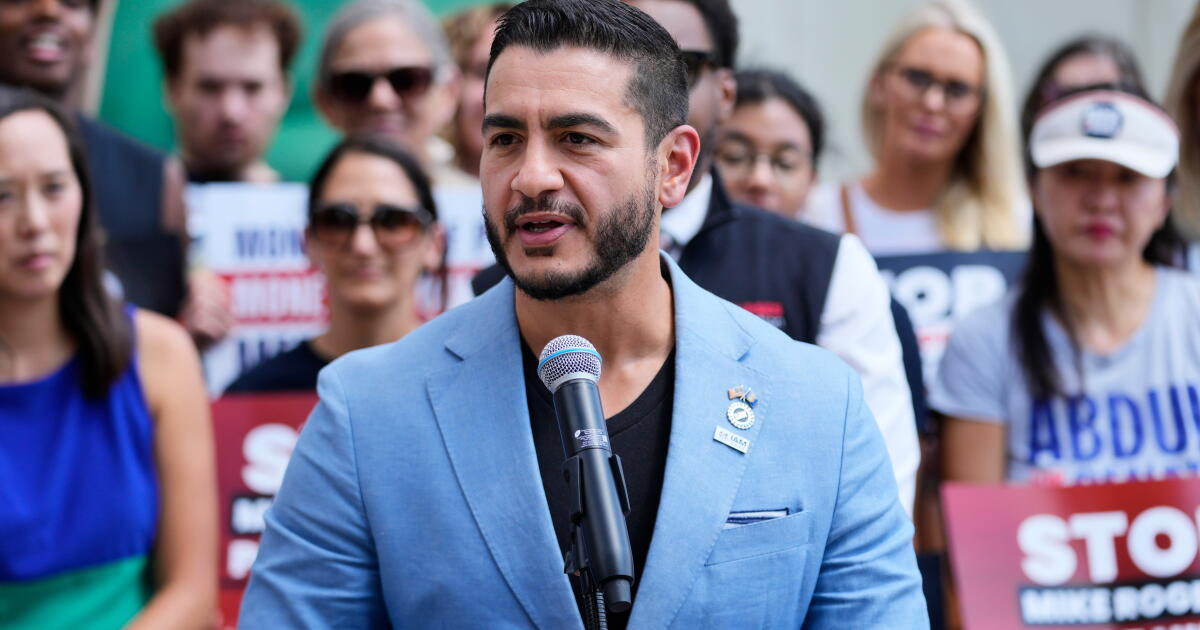
In perhaps the highest-profile contest, former public health official Abdul El-Sayed is facing Republican Mike Rogers for the seat being vacated by retiring Democratic Sen. Gary Peters.
El-Sayed, aligned with the party’s progressive wing, narrowly defeated moderate Rep. Haley Stevens in a heated Democratic primary. He is looking to rally her supporters as well as disaffected Republican voters.
Rogers is courting independents and a cohort of Jewish Democrats who view El-Sayed’s desire to reduce funding to Israel’s military as a dangerous proposition.
According to a CNN/SSRS poll of likely voters released Sept. 9, El-Sayed led Rogers 47% to 44%, a result within the margin of error. Notably, 26% of respondents said they could still be persuaded to vote for either candidate, leaving the race wide open.
The barbs in this race have become deeply personal, with anti-Muslim rhetoric taking center stage.
In a series of ads and artificial-intelligence-generated images, Republican groups — including the National Republican Senatorial Committee and Front Line Action — have cast El-Sayed as a supporter of terrorism. During speeches and interviews, members of the Trump administration, including the president, have repeatedly referred to the candidate by his full name, Abdulrahman Mohamad El-Sayed.
Rogers has continually drawn attention to a campaign event hosted by El-Sayed that included Hasan Piker — a Los Angeles-based online political commentator who recently drew widespread attention for a 2019 comment that “America deserved 9/11” while discussing blowback against U.S. foreign policy in the Middle East.
El-Sayed has railed against Rogers for refusing to debate and for his endorsement by Trump.
This week, El-Sayed stood alone on the Fox 2 Detroit debate stage after Rogers declined an invitation, dubbing his opponent “Mike Dodgers” on several occasions.
Rogers later accused the moderator of bias toward the Democratic candidate. The candidates have agreed to debate on Oct. 8 and 21.
Texas: Talarico vs. Paxton
State Rep. James Talarico is seeking to become the first Texas Democrat elected to the Senate since 1993.
His Republican opponent, state Atty. Gen. Ken Paxton, received Trump’s endorsement and defeated four-term incumbent Sen. John Cornyn in the primary.
While gaining a seat in Texas has long been a far-off dream for Democrats, Paxton’s controversies have dogged him during the race. A Mason-Dixon Research poll showed the Democrat leading Paxton 46 to 43, in a state that Trump won by nearly 14 points in 2024. Other polls, including one from Insider Advantage, had the margin at a single point.
Paxton is seen as a prominent fixture in the MAGA movement, using his position as attorney general to contest Obama-era clean energy and healthcare acts and launching lawsuits against the Biden administration for its immigration policy.
Talarico has made Paxton’s association with the president a key piece of his campaign, slamming Paxton as “the most corrupt politician in Texas” and spotlighting his impeachment by the Texas House of Representatives in 2023 over allegations of bribery, breach of public trust and misuse of his office to aid a donor. (Paxton survived the impeachment vote and denied wrongdoing.)
Several attack ads on Talarico, launched by Republican political action committees, have focused on his past support for transgender youth and accused him of exaggerating his faith to garner the Christian vote.
Maine: Jackson vs. Collins
Six-term incumbent Republican Sen. Susan Collins is hoping to retain her seat as Democratic challenger Troy Jackson attempts to replicate the grassroots success of former nominee Graham Platner’s campaign.
Jackson, a former state lawmaker, was chosen by Maine Democratic Party delegates to run in place of Platner, who dropped out in July after sexual misconduct allegations against him. A former lumberjack, Jackson shares Platner’s working-class background and is running on Medicare for All and increased taxes for billionaires.
Collins has repeatedly demonstrated her staying power and won reelection in 2020 even as the state went blue in the presidential race. Her willingness to stand up to Trump could become a deciding factor this time around; Collins is working to highlight her votes to block Trump’s $1.8-billion Department of Justice anti-weaponization fund and against the Iran war.
She has mostly stuck to promoting her decades-long record on the campaign trail, which has recently focused on increased healthcare access for seniors, workforce development and Social Security benefit increases.
She has faced criticism from Jackson and others over her vote to confirm Supreme Court Justice Brett M. Kavanaugh, who faced sexual assault allegations, which he denied, and later voted to strike down Roe vs. Wade, which had granted a constitutional right to choose an abortion.
Jackson has had difficulty generating the same enthusiasm among voters as his predecessor, Platner, who consistently held town halls across the state and had a viral social media presence. Over Labor Day weekend, Jackson hosted at least a dozen events up and down Maine to make his first public introductions to voters deep into the cycle.
A recent poll from YouGov shows Jackson narrowly leading the incumbent, 46% to 44%, with a crucial 9% undecided.
Alaska: Peltola vs. Sullivan
Former Democratic Rep. Mary Peltola and incumbent Republican Sen. Dan Sullivan are leading a field of candidates — including another Dan Sullivan — ahead of a ranked-choice general vote.
Alaska hasn’t elected a Democratic senator since 1995, giving Peltola an uphill battle in a state that Trump won by 13 percentage points in 2024.
A late July poll by Change Research showed Peltola in the lead by six percentage points. A more recent poll from Alaska Survey Research had the race within 1 point in favor of Peltola.
Much of the media attention surrounding this race, however, has focused on the third-place candidate, who only received 2.5% of the primary vote — and also happens to be named Dan Sullivan.
Dan J. Sullivan, a retired teacher who made the top four in ranked-choice voting, has been accused by Republicans of being a Democratic plant that could potentially confuse voters. Sullivan has denied these accusations and the Alaska Supreme Court decided to keep him on the ballot.
If none of the candidates receive over 50% of first-place ranked-choice votes — which is likely in this race — the last-place candidate will be eliminated, with their vote distributed to their next choice until one candidate receives a majority of the total.
Iowa: Turek vs. Hinson
In a race that has seen the candidates trade political jabs in separate speeches on the same state fairgrounds, Republican Rep. Ashley Hinson and Democratic state Rep. Josh Turek are nearly neck and neck.
According to a Suffolk University poll, Hinson is leading Turek 45% to 40%, in a state where Trump won by 13 points in 2024. A poll conducted by YouGov, however, has Turek in front by a single point.
GOP incumbent Sen. Joni Ernst elected not to run this year, leaving the seat open for a potential flip.
Turek, a two-time Paralympics gold medalist, has attacked Hinson for past campaign ads in which she said: “I don’t trade stocks, and no one else in Congress should either.” Tucker pointed to the fact that Hinson purchased and sold stocks in Amazon, Tesla and insurance firms after she was elected, according to financial disclosure forms.
In return, Hinson criticized Turek for missing over half of his state Legislature floor votes, and labeled him an “anti-ag” activist.
Hikers trekking along trails around Los Angeles know that, by late summer, most creeks and rivers have dried up for the season.
However, recent rainfall across Southern California has replenished our waterways just enough to bring back a little of their spring and early summer glamour.
In this week’s edition of The Wild, our weekly outdoors newsletter, I will highlight three L.A. trails where you can still find water flowing, offering a cool relief in a year when L.A. residents are sick of humidity, heat and high electric bills.
You are reading The Wild newsletter
Sign up to get expert tips on the best of Southern California’s beaches, trails, parks, deserts, forests and mountains in your inbox every Thursday.
By continuing, you agree to our Terms of Service, which include arbitration and a class action waiver. You agree that we and our third-party vendors may collect and use your information, including through cookies, pixels and similar technologies, for the purposes set forth in our Privacy Policy such as personalizing your experience and ads.
Before heading out, here are a few things to remember:
Familiarize yourself with what poison oak looks like, as it will be prominent on all of these trails. Its leaves this time of year range from glossy green to red, orange and yellow.
Practice seven Leave No Trace principles, including never leaving anything behind such as toilet paper or orange peels.
Rocks and boulders in and along creeks will often be slippery from years of erosion. Take good care when climbing them or using them for leverage as you traverse an area.
Riparian habitats, like creeks flowing through canyons, are home to sensitive creatures including California newts, frogs and toads. Take good care to watch where you’re stepping, ensuring you aren’t crushing one of these little sweeties as you tromp along.
Now that we’ve all agreed to recreate responsibly, let’s talk about those hikes!
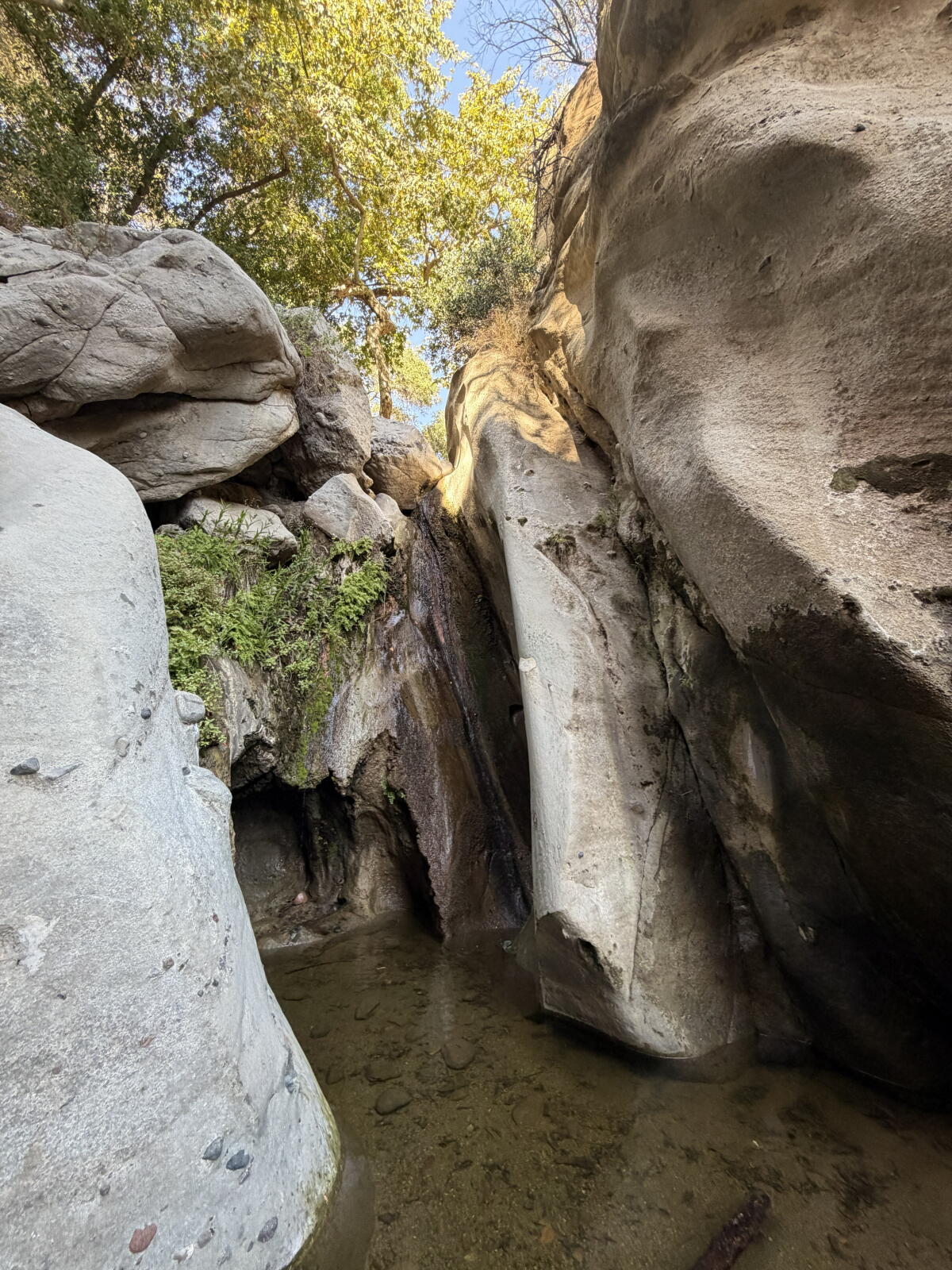
The Santa Ynez waterfall is an 18-foot cascade through a canyon carved by water for thousands of years.
(Jaclyn Cosgrove / Los Angeles Times)
1. Santa Ynez Waterfall Trail
Distance: 2.2 miles out and back Elevation gained: About 200 feet Difficulty: Easy in the beginning with technical aspects near the falls Dogs allowed: No Nearest to: Pacific Palisades Accessible alternative: Inspiration Loop Trail at Will Rogers State Historic Park
The Santa Ynez waterfall trail is a 2.2-mile journey along Santa Ynez Creek in Topanga State Park, shaded by large sycamores, oak trees and the canyon’s walls. You’ll notice a small cave-like structure in the canyon wall shortly upon starting the hike. Unfortunately, other visitors have carved into its sides. Don’t be one of them.
To begin your hike, you will park along Vereda de la Montura. Note that parking isn’t allowed daily between 8 p.m. and 6 a.m.
A small cave-like structure in Santa Ynez Canyon in Topanga State Park.
(Jaclyn Cosgrove / Los Angeles Times)
I thought I was in the wrong place when I first pulled up, given the trailhead sits in the middle of a neighborhood. I walked northwest along the street and found an open gate with stairs leading down. This is where you’ll start the trail.
I was immediately reminded of Sullivan Canyon (which is about 3 miles away, as the crow flies), as the two canyons feature rocky canyon walls and tall old trees. There are a few times when the trail splits off and returns to itself. Just over half a mile in, though, the trail splits in two, with Santa Ynez Canyon Trail to the west (or left) and the waterfall trail, which you will take to the north or northwest-ish.
A lush tree canopy provides shade in Santa Ynez Canyon as hikers head to the waterfall.
(Jaclyn Cosgrove / Los Angeles Times)
The first mile of this trail is primarily a nice stroll northward along a creek, the ground covered in green and brown leaves. However, just over a mile in, if you want to see the waterfall and small cave next to it, you will need to scramble up a large boulder and then rock hop through the creek. As of last week, there was a rope to aid hikers upward. (On my way down, I unintentionally slid quickly down the rock, feeling every peddle in the tuchus until I landed feet first in the creek — so take your time here.)
The waterfall isn’t roaring at the moment, but I found the trickling sound of water soothing. It’s also a geologically interesting area to look around, as the water has carved out the canyon walls into interesting shapes (and created a small cave near the waterfall).
The walls of Santa Ynez Canyon were carved by water, wind and time over centuries.
(Jaclyn Cosgrove / Los Angeles Times)
As I was heading back from the falls, I noticed several bees circling an area high in the canyon wall where it appeared they’d built a nest. Pack accordingly if you are allergic to bee stings.
Slow down and look up as you hike through Santa Ynez Canyon, taking the opportunity to observe rock formations, plants and reptiles.
(Jaclyn Cosgrove / Los Angeles Times)
I only saw three other people along the trail while there on a weekday. I was mostly alone, though, listening to the wrentits and spotted towhees as blue dragonflies darted to and fro.
Cold Creek in the Cold Creek Valley Preserve near Calabasas.
(Jaclyn Cosgrove / Los Angeles Times)
2. Cold Creek Trail
Distance: 2.2 miles out and back (with option to extend) Elevation gained: About 300 feet Difficulty: Easier end of moderate Dogs allowed: Yes Nearest to: South of Calabasas Accessible alternative: Nicholas Flat ADA Trail
The Cold Creek Valley Preserve, cared for by the TreePeople Land Trust, is a shady riparian habitat near Calabasas with a gently flowing creek that features multiple short cascades. The land was saved from development by several local residents and nonprofits, including Timothy B. Schmit, bass player for the Eagles.
The preserve features multiple public hiking routes, including the Cold Creek Trail.
“Located on an ancient trade route, the [I]ndigenous people of Southern California have used the area for hunting and settlement for generations, leaving a lasting influence visible on the land,” according to TreePeople. “The perennial Cold Creek is the keystone feature of the area, one of the cleanest free-flowing streams in the Santa Monica Mountains.”
The tree canopy along the Cold Creek Trail in the Cold Creek Valley Preserve provides a shady cool environment for hikers.
(Jaclyn Cosgrove / Los Angeles Times)
To begin your hike, you’ll park in a bumpy dirt lot just off Stunt Road. Be mindful as you near the trailhead, as there will likely be construction crew members in the area. They’re working to install rumble strips and other infrastructure to slow down drivers and hopefully improve traffic safety.
At the start of the trail, you’ll find a portable toilet near the gate. You’ll walk southeast for a short bit before rounding the curve of the trail. You’ll officially be transported into this sylvan sanctuary (although I could admittedly still hear the construction workers communicating on their walkie-talkies).
The trail mostly runs parallel to Cold Creek, which you will hear flowing and have the opportunity to sit near at multiple points along the route, including on a few wooden benches. The trail crosses the creek about four times, but it isn’t overly technical to maneuver.
The Cold Creek Valley Preserve is open from sunrise to sunset.
(Jaclyn Cosgrove / Los Angeles Times)
About half a mile in, the trail intersects with Lower Stunt High Trail. You can continue northwest along the creek. You will find another option, the Yucca Trail, just under a mile into your hike, a nice .68-mile loop through the preserve.
The park, open from sunrise to sunset, offers a sweet reprieve from the sun and is a great spot to take a deep breath and meditate in the woods.
The Gabrielino Trail is a multi-use trail frequented by hikers, bikers and horseback riders.
(Jaclyn Cosgrove / Los Angeles Times)
3. The Gabrielino National Recreation Trail (multiple segments)
Distance: 28.8 miles Elevation gained: About 6,000 feet Difficulty: Challenging when done in its entirety Dogs allowed: Yes Nearest to: Arcadia and Pasadena, depending on the trailhead Accessible alternative: Gabrielino Trail starting near North Windsor Avenue near Altadena
The Gabrielino National Recreation Trail is a 28.8-mile journey through the San Gabriel Mountains. Most thru-hikers start the trail at Chantry Flat and take the trail on a squiggly N-shaped journey all the way to its western trailhead near NASA’s Jet Propulsion Laboratory near Pasadena.
However, it isn’t necessary to take the entire Gabrielino Trail to enjoy its beauty. The trail has several entry points, offering short day trips, including the following, which run parallel to at least one local creek or river:
Regardless of where you go, I hope you enjoy our last weekend of summer. That’s right: Summer ends Tuesday! Hopefully that means it soon feels like autumn in L.A.
3 things to do
Volunteers walk down the beach at a Heal the Bay coastal cleanup event in 2024 with Water for L.A.
(Heal the Bay)
1. Clean up public lands around L.A. Heal the Bay will host L.A. County’s annual coastal cleanup day from 9 a.m. to noon Saturday in more than 60 sites. Participants should consider wearing closed-toe shoes and sun protection. Cleanup supplies will be available at sites but will run out at popular sites. Volunteers can pick a beach, river, park or trail near them by visiting support.healthebay.org.
2. Portray a bird of prey in San Dimas The San Dimas Canyon Nature Center will host a guided sketch experience from 6 to 7 p.m. Friday at 1628 Sycamore Canyon Road in San Dimas. Participants will learn how to draw a red-tailed hawk. Learn more at the center’s Instagram page.
3. Learn dangers from rangers in Newbury Park Hikers can bring their four-legged besties to Rancho Sierra Vista/Satwiwa from 9 a.m. to noon Saturday for a B.A.R.K. Rangers event where rangers will educate dog owners on how to safely and responsibly enjoy public lands. Rangers will also conduct a special swearing-in ceremony, complete with a Santa Monica Mountains National Recreation Area B.A.R.K. Ranger badge, for pups who complete certain challenges. Learn more at eventbrite.com.
The must-read
A juvenile great white shark in Hermosa Beach in April, seen via drone.
(CSULB Shark Lab)
Yes, El Niño morphed our city’s usually pleasant Mediterranean climate into the largest hot yoga class in L.A. But did you know it has also resulted in our ocean water being warm enough to attract animals not usually seen along our coastline? Those fishing off the Malibu Pier were surprised in mid-August by a hammerhead shark swimming nearby. A giant whale shark was recently documented by a fish spotter between Malibu and one of the Channel Islands, a species that prefers warmer waters (and is the largest known fish on the planet). And in line with our predicted “sharky summer,” a juvenile great white shark was spotted a bit close to a swimmer off the coast of Santa Barbara. The best news is: Nothing bad has happened to any humans or animals during these visits, underscoring how well we can co-exist with these beings, despite our fears of them.
Happy adventuring,
P.S.
More and more wildlife lovers are heading into public lands for “recreational herping,” the practice of looking for amphibians and reptiles. Conservation photographer Mario Ramos recently raised concerns via his Instagram page about how the increase is leading some folks to unintentionally harm the animals they seek to observe. “A harsh truth about field herping is that our interactions with wild herps are often stressful and potentially detrimental to the animals, no matter how you frame it,” Ramos wrote. Ramos then outlined how to ethically look for animals that slither and slide in the wild. Always respect the locals, folks!
For more insider tips on Southern California’s beaches, trails and parks, check out past editions of The Wild. And to view this newsletter in your browser, click here.
As a kid growing up in rural Oklahoma, I feared what lurked beneath the lake water.
I’d listen as my family spun yarns about the massive catfish they’d discovered while noodling. I was terrified that, despite their docile nature that not a single adult told me about, an alligator gar would eat me while I bobbed in the lake. Old timers would recount finding a water moccasin in their boat. And I’ve still never recovered from the concept of a “breeding ball,” which a friend’s cousin’s cousin claimed to have run into while water skiing.
Despite the fact that nothing bad ever happened to me in a lake, my fear stayed with me into adulthood. I’ve met several Californians who hold fears similar to mine, but rather than lakes, their outsized anxieties lie within the ocean. It not only keeps them from swimming at our local beaches but also from venturing beyond the shallow shoreline.
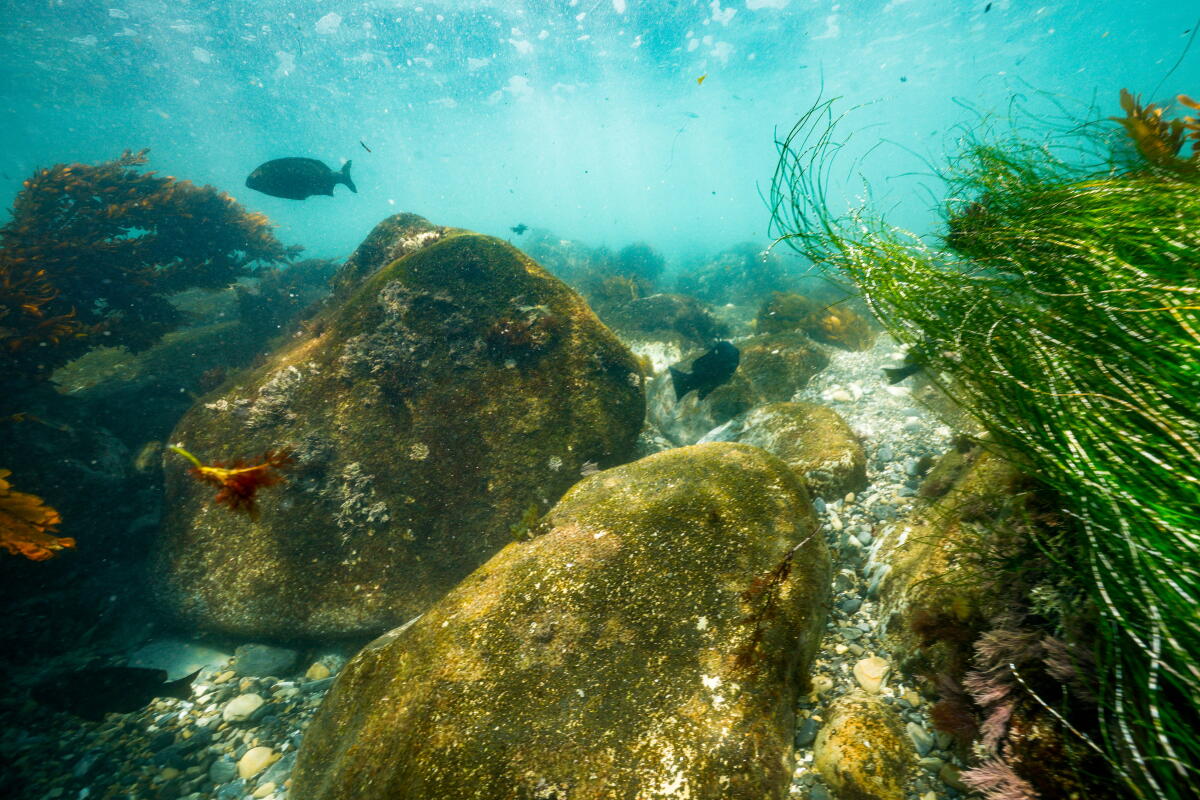
An underwater view near Terranea Resort on the Palos Verdes Peninsula.
(Allen J. Schaben / Los Angeles Times)
In this week’s edition of The Wild, our weekly outdoors newsletter, I will discuss how to safely tackle those fears and start exploring with a snorkeling kit. Get ready to learn about the incredibly diverse and colorful world that lives beneath our local waters — you’re about to feel like Ariel exploring a whole new world! Let’s dive in.
You are reading The Wild newsletter
Sign up to get expert tips on the best of Southern California’s beaches, trails, parks, deserts, forests and mountains in your inbox every Thursday.
By continuing, you agree to our Terms of Service, which include arbitration and a class action waiver. You agree that we and our third-party vendors may collect and use your information, including through cookies, pixels and similar technologies, for the purposes set forth in our Privacy Policy such as personalizing your experience and ads.
I spoke to Ralph Buck, who founded Barnacle Busters, an L.A.-based LGBTQ scuba club, with two others almost 40 years ago. Buck’s passion for helping others learn how to safely explore the ocean was so infectious that by the time we ended our call, I was seriously considering whether I should get my scuba certification (which is a story for another day).
Here’s what Buck advised regarding snorkeling.
The Wild writer Jaclyn Cosgrove snorkels among what appear to be grunion or topsmelt near the coastline of the Palos Verdes Peninsula.
(Allen J. Schaben / Los Angeles Times)
1. Get the right gear
Generally you will need the following gear to get started:
A wetsuit (with booties, as a bonus, to protect your feet): Generally, 7 mm is a great thickness for Southern California, although our water is warmer because of our El Niño season (and climate change).
A life jacket or flotation device: This is considered optional, as the wetsuit will help you float, but there’s absolutely no shame in being extra safe! (And if you don’t have a wetsuit, please do wear a life jacket.)
Fins: It might be too strong to suggest they’re “optional,” but they can be awkward for those new to snorkeling and not necessary if you’re in calm enough waters or an overall strong swimmer.
Camera: Very, very optional. While out at Santa Cruz Island two weeks ago, I took some terrible underwater photos with my iPhone and wished I’d just left it on the shore.
Weight belt: If you want to dive, you might need a weight belt to help you go under. That said, this is a more advanced tool, and it’s good to just focus on the basics as you get more comfortable in the water.
One thing new snorkelers might not realize is the level of buoyancy that a wetsuit gives you. Both times I’ve been in the past month, I wore a 7-mm suit and loved how easy it was to float above the eel grass at Santa Cruz Island and the kelp on the coast of Palos Verdes. I love a sport that includes just lying around.
Kelp, sea grass and various algae grow beneath the water at Terranea Beach Cove in Rancho Palos Verdes.
(Allen J. Schaben / Los Angeles Times)
2. Plan for getting your wetsuit on
For anyone on the shore of Prisoners Harbor two weeks ago, they got the pleasure of watching me groan (and curse) as I maneuvered into a thick wetsuit without anything but my swimsuit on. I told my friend I knew what sausage felt like as it’s shoved into its casing.
Zach Cantrell, owner of Ventura Dive and Sport, gave me a tip I will be eternally grateful for: Bring a plastic bag or something else that will help you slide into your wetsuit, as it helps reduce the friction between your body and the wetsuit. I brought one with me when my colleague, Allen J. Schaben, and I went out last week, and getting my wetsuit on was a breeze. No human sausage vibes (or cursing).
Buck suggested other options might be pantyhose or a long-sleeved unitard. Anything to help you slide into your wetsuit!
3. Before going out, practice in a pool
“I would suggest before hitting the open water, go hop in a pool and maybe find an experienced snorkeler to go with you simply because there are some subtle little pieces to the puzzle, which are” easy to miss for a new snorkeler, Buck said.
That includes the direction to point your snorkel. If it’s pointing too far forward, you will likely find yourself breathing straight saltwater as the waves hit you. But if you point it straight up or tilt it a bit backward, it’ll help your breathing apparatus stay clear.
A variety of marine life living around the rocky bottom of Terranea Beach Cove in Rancho Palos Verdes.
(Allen J. Schaben / Los Angeles Times)
4. Never snorkel alone
You look out at the ocean and see calm waters. You hear the siren’s call. You are alone. Resist.
Despite looking like a fairly chill activity, snorkeling still comes with significant risks that will be exacerbated if swimming alone. While out with my colleague off the coast of Rancho Palos Verdes, he pointed out a massive rock that I thought I could maneuver around. I timed my movements wrong and whacked right into it. I was fine, but also glad someone had my back if I wasn’t.
5. Assess the day’s conditions
Check the weather. If it is a particularly windy day, it’s likely not a good day for snorkeling, not only for safety reasons but also visibility.
Before entering, scan the shore to assess the movement of the water.
Learn how to spot rip currents. Rip currents “most commonly form at low spots or breaks in sandbars and near structures such as groins, jetties, and piers,” according to the National Oceanic and Atmospheric Administration.
“If you’re a beginner, and the waves are higher than knee high, I would just go to brunch,” Buck said. “If the surf’s too big, your visibility is going to suck anyway.”
I do love any excuse to have waffles.
The Wild writer Jaclyn Cosgrove carefully enters the water at Terranea Cove Beach in Rancho Palos Verdes.
(Allen J. Schaben / Los Angeles Times)
6. Choose an area that’s easy to enter and exit
This includes sandy beaches, where you can easily wade into the water without losing your balance. At Prisoners Harbor, I fell over several times because the shore is covered in various fist-sized rocks. (I need to work on my balance.) Snorkeling off the Palos Verdes Peninsula, I took my time, watched the waves and slowly moved into the water as the waves allowed. I found that, when there are rocks around, walking into the water like I’m navigating a balance beam is a good approach.
Also, in terms of looking for the best spots to snorkel, look for kelp forests and rock reefs. And because you’re newer, I would stick to spotsknown for snorkeling.
7. Plan for fog
Buck said before the COVID-19 pandemic, the Barnacle Busters, like most diver clubs, would recommend a simple solution to fog in your goggles: Spit. They still recommend using your spit in bodies of water where your germs won’t immediately affect other swimmers like in the ocean.
You can also buy an anti-fogging agent for your goggles. If you take your goggles off at any point as you snorkel, you’ll need to reapply either spit or anti-fog spray.
While I was out snorkeling, I was amazed at how well spit worked. (And if you want to understand the science behind why this works, check out this blog post from Scuba.com.)
A garibaldi, California’s state fish, at Casino Point Dive Park on Catalina Island in 2016.
(Allen J. Schaben / Los Angeles Times)
8. Check in with yourself and your partner
You should check in with your partner every 30 seconds. That might feel like it’s way too frequent, but you’ll be amazed at how far apart you can float from your friend in that time frame. It can be as simple as making sure you see them and they see you.
9. Keep an eye out for hazards
When entering the water, you’ll want to do the “stingray shuffle” to ensure you alert any nearby rays of your presence. Around L.A. County, you’ll also want to watch out for sea urchins because their spines can prick your skin, which will require treatment if you bump into them.
As our county lifeguards point out, L.A. beaches aren’t typically places you’ll find the most dangerous jellyfish. “Jellyfish in Southern California are usually smaller in scale and have a more mild sting than other species found around the world,” according to the agency’s website.
(And don’t worry. Electric eels don’t live in the ocean.)
I asked Buck how often he and his fellow divers check for hazards like sharks.
He told me that outside of rocks, high surf and going out too deep for one’s skill level, he and his diving partners don’t think too much about hazards in our local waters.
Purple sea urchins grow on a rock near the shore of Prisoners Harbor on Santa Cruz Island in the Channel Islands National Park.
(Jaclyn Cosgrove / Los Angeles Times)
“Well, we don’t consider sharks to be a hazard at all. My husband and I blame Steven Spielberg for the irrational fear of sharks,” Buck said, referencing Spielberg’s 1975 film “Jaws” and the adverse effects the film had on white sharks.
Buck said he and his husband rarely see sharks. He does give some weight to the argument that divers in wetsuits can resemble seals and sea lions when floating on the surface.
“But in areas where you’ll probably be snorkeling, you’ll probably be snorkeling on shallow rocky reefs or shallow kelp. It’s not even a consideration for us,” he said.
Lastly, if you or your partner start to shiver, get out.
The Wild writer Jaclyn Cosgrove snorkels at Terranea Cove Beach in Rancho Palos Verdes.
(Allen J. Schaben / Los Angeles Times)
10. Don’t touch anything
Practice Leave No Trace in the ocean too. “That’s our philosophy for diving too,” Buck said. “Look, but don’t touch.”
And never feed the marine life.
11. Have fun!
Since learning to snorkel, I’ve already found two friends who also enjoy it, and I plan to ping them to go out soon. If you don’t have anyone in your circle who snorkels yet, consider joining a local club.
In a world that feels hard right now, I felt like I had a two-hour vacation as I floated above the bright green sea grass and golden yellow kelp, watching garibaldi and what appeared to be grunion or topsmelt bob and dive around me. I came out refreshed and grateful to live here.
3 things to do
The hike to Eaton Canyon Falls in the San Gabriel Mountains before the 2025 Eaton fire.
(Myung J. Chun / Los Angeles Times)
1. Learn about Eaton Canyon’s future in Arcadia L.A. County Parks and Recreation will host From Ashes to Action: Reimagining Eaton Canyon from 5 to 7 p.m. Wednesday at the L.A. County Arboretum’s Ayres Hall (301 N. Baldwin Ave. in Arcadia). Attendees will learn about design concepts for the next Eaton Canyon nature center along with the latest work completed in the natural area. The event is free, but registration is required. Register at arboretum.org.
2. Service sage in San Pedro Cabrillo Marine Aquarium (3720 Stephen M. White Drive) needs volunteers from 9 to 10:30 a.m. Saturday to work on its native plant garden. Participants will learn about plants as they work. All ages welcome. Learn more at cma.recreation.parks.lacity.gov.
3. Launch into Latino Conservation Week in L.A. The Audubon Center at Debs Park will kick off Latino Conservation Week from noon to 6 p.m. Sunday at Metabolic Studio (1745 N. Spring St.). Activities include a bachata class, panel discussion and guided nature hike. Learn more at act.aubudon.org.
The must-read
Burn damage to the Torrey pine grove at Santa Rosa Island, as seen from a ferry on June 8.
(Kayla Bartkowski / Los Angeles Times)
Last week, the National Park Service announced that up to 80% of the rare Torrey pines on Santa Rosa Island in the Channel Islands National Park could die after being harmed by a wildfire in May. Times staff writer Corinne Purtill wrote that initially park officials were hopeful that because the fire, which charred through 40% of the 18,000-acre island, burned at low intensity through the grove, the trees could recover. Research found the fire hurt the mature trees’ exposed root systems. However, I am holding onto hope — for a few reasons. “Park staff have also collected more than 14,000 seeds released from the pine cones. Viable seeds will be planted and raised in a nursery until the seedlings can be planted in the grove,” Purtill wrote.
Another reason is that volunteers are already actively working to save these trees. You can help with that. The California Institute of Environmental Studies needs volunteers to help with recovery as well as with Channel Islands Restoration. You can also donate to the Channel Islands Park Foundation’s Santa Rosa fire resilience fund.
Now more than ever, it’s on us to protect our public lands.
Happy adventuring,
P.S.
While out kayaking off the coast of Santa Cruz Island last month, I yanked a plastic wrapper out of the ocean. I frequently pick up plastic snack wrappers and corners of wrappers that people have accidentally dropped on the trail. And not infrequently have I found thick plastic bags — those said to be reusable — floating in shallow water near the beach. In recent years, California lawmakers have passed laws to address our state’s plastic consumption, including the Plastic Pollution Prevention and Packaging Producer Responsibility Act, or Senate Bill 54. Starting in 2027, the state will receive $500 million every year for 10 years to address plastic pollution, and state leaders want to hear from you how to best spend that money. You can submit your thoughts through Sept. 30 using this form or send your message using the email listed on the form’s webpage. Times staff writer Susanne Rust recently wrote about how there’s a secretive multimillion-dollar campaign to crush California’s landmark plastics law. If the battle over single-use plastic in California is something you’re passionate about, consider subscribing to Boiling Point, where my Times colleagues explore what’s happening to our climate-changed world. They’ll definitely keep you posted!
For more insider tips on Southern California’s beaches, trails and parks, check out past editions of The Wild. And to view this newsletter in your browser, click here.