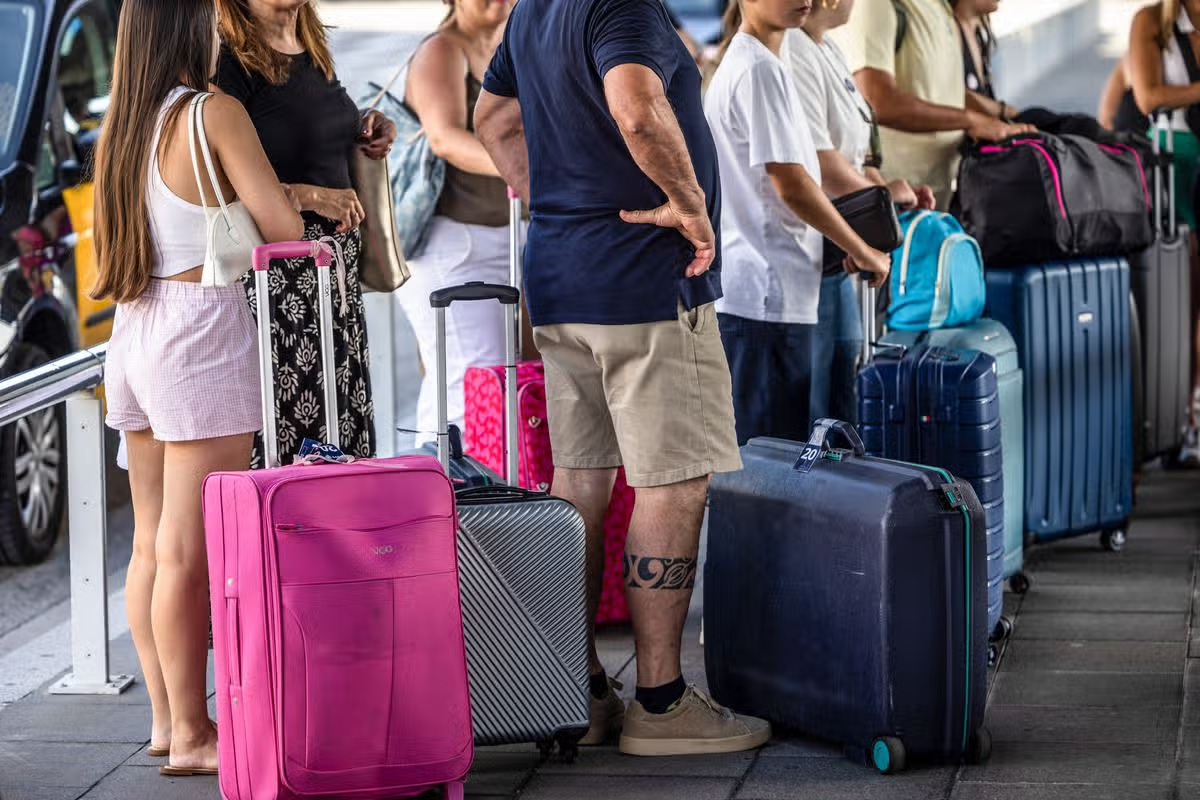
item

Ryanair urges travellers to ‘stop wearing’ one clothing item on flights

For many, having the perfect travel outfit is crucial for a flight. Now, Ryanair has urged travellers to not wear one specific item and it’s left passengers confused

Staying snug and comfortable on a flight can be challenging, especially if you’re cramped up in a seat without moving much for a few hours. Luckily, your choice of outfit could significantly improve your overall comfort on the plane.

Despite being the fastest way to travel around the world, planes aren’t known for being a comfortable way to travel. Passengers will often find themselves squished into a tight seat for hours with no space to stretch their legs or prevent their bottoms from going numb. In reality, the only passengers who enjoy any real comfort are those who fork out for expensive first-class seats.

And if you’re deciding to travel on a more budget-friendly airline, such as Ryanair, the little comfort you already had might be a sacrifice you have to make in order to pay less for your travel, such as having less legroom or smaller seats. Because of this, the little comfort you have will become even more sacred those hours you spend on the flight.

However, the airline has now taken to social media to urge passengers to avoid wearing one type of clothing item on their flights, which has left people confused.

Content cannot be displayed without consent

In the video that was published onto TikTok, the airline shared a video of a plane with the Ryanair logo descending over turquoise waters before landing at what appears to be Corfu airport.

Celebratory music is heard playing over the video, when a voice is then heard saying the classic phrase many passengers will have heard before: “Thank you for flying Ryanair”. This is the music and statement heard after every Ryanair flight.

“It’s 2026, let’s stop travelling in jeans,” the text on the video read, adding a ‘please’ in the caption.

However, this statement left fans confused, as several viewers quickly took to the comment section to question why they shouldn’t wear jeans when travelling.

“What is wrong with jeans please explain,” one viewer asked. To this, the airline replied: “what’s right with them?”

Turns out, several people agreed with the airline’s statement, as jeans aren’t the most comfortable item to wear, especially if you have to sit down for ours on end. In response, one viewer commented: “So real. I’ll never get it.”

“Agreed. It needs to be banned. Comfies only!” another person said, while someone else shared: “always wear leggings.”

Another viewer jokingly said: “Ok I’ll fly in my 18th century historically accurate outfit.”

However, not everyone agreed with Ryanair’s statement, as some went on to say that they would continue wearing jeans on flights.

“no it’s an hour let me live,” another viewer said, showing them wearing a pair of jeans on a Ryanair flight.

Another person said they would continue to wear jeans as they ‘wouldn’t fit’ inside their carry-on bag, and they didn’t want to pay the airline its infamous extra fee for a checked-in bag.

Source link

Author of key report on Palisades fire was upset over changes that weakened it, sources say

The author of the Los Angeles Fire Department’s after-action report on the Palisades fire was upset about changes made to the report, without his involvement, that downplayed the failures of city and LAFD leaders in preparing for and fighting the disastrous Jan. 7 fire, according to two sources familiar with the matter.

The author’s complaints reached Mayor Karen Bass’ office in mid-November, after the LAFD had publicly released the report, said Clara Karger, a spokesperson for Bass.

“The Mayor has inquired with Chief Moore about the concerns,” Karger said last week, referring to LAFD Chief Jaime Moore.

The sources, who requested anonymity to protect their relationships with the LAFD and city officials, said the report by Battalion Chief Kenneth Cook was intended to be a final draft. Cook declined to comment.

The Times posted an article Saturday that analyzed seven drafts of the after-action report, obtained through a public records request. The most significant changes involved the LAFD’s deployment decisions before the fire, as the wind warnings became increasingly dire.

In one instance, LAFD officials removed language saying that the decision to not fully staff up and pre-deploy all available crews and engines ahead of the extreme wind forecast “did not align” with the department’s policy and procedures during red flag days.

Instead, the final report said that the number of engine companies rolled out ahead of the fire “went above and beyond the standard LAFD pre-deployment matrix.”

The deletions and revisions have drawn criticism from some who questioned the LAFD’s ability to acknowledge its mistakes before and during the blaze — and to avoid repeating them in the future.

In the months since the fire, residents who lost their homes have expressed outrage over unanswered questions and contradictory information about how top LAFD officials prepared for the dangerous weather forecast and how they handled a smaller New Year’s Day blaze, called the Lachman fire, which rekindled into the massive Palisades fire six days later.

On Saturday, after the report by The Times was published online, City Councilmember Monica Rodriguez issued a statement about the toning down of the after-action report.

“Today’s reporting makes clear that accountability is optional when after-action reports are conducted in-house with oversight by political appointees,” Rodriguez said. “If these reports are purposefully watered down to cover up failures, it leaves Angelenos, firefighters, and city officials without a full understanding of what happened and what needs to change. After-action reports must be independent to ensure honest assessments in order to avoid repeating disastrous errors and to protect our communities in the future.”

Former interim Fire Chief Ronnie Villanueva, who oversaw the completion of the report before it was made public in October, did not respond to requests for comment.

Karger, the Bass spokesperson, said this month that the report “was written and edited by the Fire Department.” Bass’ office did not demand changes to the drafts and asked the LAFD to confirm only the accuracy of items such as how the weather and the department’s budget factored into the disaster, Karger said in an email.

The LAFD has refused to answer questions about the revisions and Cook’s concerns, citing an ongoing federal court case. Federal prosecutors have charged a former Palisades resident with setting the Lachman fire.

David Loy, legal director of the First Amendment Coalition, said it’s “disingenuous” of LAFD officials to cite the investigation as a reason they can’t respond to The Times’ inquiries.

“There’s nothing about the existence of a federal investigation that prohibits them from commenting,” Loy said. “They just choose not to comment.”

Three of the seven drafts of the after-action report obtained by The Times are marked with dates: Two versions are dated Aug. 25, and there is a draft from Oct. 6, two days before the LAFD released the final report to the public.

Some drafts of the after-action report described an on-duty LAFD captain calling Fire Station 23 in the Palisades on Jan. 7 to report that “the Lachman fire started up again,” indicating the captain’s belief that the Palisades fire was caused by a reignition of the earlier blaze.

The reference was deleted in one draft, then restored in the public version, which contains only a brief mention of the Lachman fire. Some have said that the after-action report’s failure to thoroughly examine the Lachman fire reignition was designed to shield LAFD leadership and the Bass administration from criticism and accountability.

Weeks after the report’s release, The Times reported that a battalion chief ordered firefighters to roll up their hoses and leave the burn area on Jan. 2, even though they had complained that the ground was still smoldering and rocks remained hot to the touch. Another battalion chief assigned to the LAFD’s risk management section knew about the complaints for months, but the department kept that information out of the after-action report.

After The Times’ report, Bass asked Villanueva to “thoroughly investigate” the LAFD’s missteps in putting out the Lachman fire.

Moore, an LAFD veteran who became chief last month, has been tasked with commissioning the independent investigation that Bass requested.

Several key items were wholly deleted from the after-action report. The final version listed only 42 items in the section on recommendations and lessons learned, while the first version reviewed by The Times listed 74.

A section on “failures” was renamed “primary challenges,” and an item saying that crews and leaders had violated national guidelines on how to avoid firefighter deaths and injuries was scratched.

Another passage that was deleted said that some crews waited more than an hour for an assignment the day of the fire.

Two drafts contain notes typed in the margins with suggestions that seemed intended to soften the report’s effect and burnish the Fire Department’s image. One note proposed replacing the image on the cover page — which showed palm trees on fire against an orange sky — with a “positive” one, such as “firefighters on the frontline.” The final report’s cover displays the LAFD seal.

In addition to the mayor’s office, Cook’s concerns made their way to the president of the Board of Fire Commissioners, which provides civilian oversight for the LAFD. Genethia Hudley Hayes, president of the board, told The Times that she heard rumors that the author of the report was unhappy, but that she did not seriously look into the matter.

“If I had to worry about every rumor that comes out of LAFD, I would spend my entire day, Monday through Friday, chasing down rumors,” she said.

She said she raised concerns with Villanueva and the city attorney’s office over the possibility that “material findings” were or would be changed.

“I did not feel like they were lying about anything,” she said. “I didn’t feel like they were trying to cover up anything.”

Pringle is a former Times staff writer.

Source link