Italy’s parliament is voting on Thursday on a new electoral law that would make it easier for election winners to form a majority government.
The law, proposed by Prime Minister Giorgia Meloni, would award extra seats to any party or coalition that obtains more than 42 percent of seats in both parliamentary chambers, ensuring it holds a majority.
Recommended Stories
list of 3 itemsend of list
Meloni has framed the legislation as a route to greater stability in Italy’s political system, which has often been run by fragile coalition governments. Her critics, however, say the move is actually aimed at boosting her own chances in elections next year.
Here’s what we know about the electoral law and what it means for Italian politics:
What is Italy’s current electoral system?
Italy currently has a mixed electoral system for its 600-seat parliament, with about 36 percent of members of parliament elected directly in constituencies where the candidate with the most votes wins, and the rest decided through proportional representation.
The system, called “Rosatellum”, has been in place since 2017. It encourages coalition-building but can produce fractured results that make a governing majority hard to forge.
What would the new law change?
The new legislation would replace the mixed electoral system with a fully proportional one, as well as awarding extra seats to the party or coalition that wins the most seats if it secures at least 42 percent in both chambers.
The bonus would be as many as 70 seats in the 400-member Chamber of Deputies, the lower house, and up to 35 seats in the Senate, which has 200 elected members.
That means if a party or coalition meets the 42 percent share threshold in both chambers, it would have stronger power to govern. If no party or coalition meets the threshold, representation would be decided proportionally.
The new law would also force coalitions to announce their candidates for prime minister before the elections. Rado Fonda, head of research at Italian pollster SWG, told the Reuters news agency this provision could “prove problematic for the centre-left, potentially forcing an early leadership contest and exposing divisions that could weaken the bloc”.
Meloni, who currently leads the country’s longest-serving government since World War II, has said the reform will help stabilise the country rather than serve any one political group. “Whoever wins the elections will have the numbers to govern,” she said.
What stage is the legislation at?
The proposed law has already been approved by the Senate and must now undergo a final secret-ballot vote in the Chamber of Deputies.
Giovanni Orsina, a political scientist at Rome’s Luiss Guido Carli University, predicted that the law is “extremely likely” to pass.
If it fails, Meloni has said she will resign.
Italian Prime Minister Giorgia Meloni speaks during the MED9 Summit, in Split, Croatia, October 7 [Antonio Bronic/Reuters]
Why is the legislation controversial?
Opponents say the law is undemocratic because it could potentially grant a winning coalition a disproportionate level of power in parliament.
They also say that the legislation is intended to favour Meloni, whose Brothers of Italy party (Fdl) is bracing for a tough election battle next year.
Riccardo Magi, head of the liberal More Europe party, who is on a hunger strike to protest the proposed reform, has called it an “anti-democratic law” that risks giving a minority bloc a huge majority in parliament.
Senator Matteo Renzi, who leads the Italia Viva party, has accused Italy’s governing coalition of pushing the electoral reform due to a fear of losing power.
Other critics have pointed out that the law would do little to stabilise the political system if no party or coalition reaches the 42 percent threshold in both chambers – a relatively high bar.
“This could produce a hung parliament, making post-electoral negotiations necessary to form a government,” Vincenzo Emanuele, a political science professor at Luiss Guido Carli University in Rome and a member of the Italian Center for Electoral Studies (CISE), told Al Jazeera. “Even relatively small changes in coalition composition could make the difference between a clear parliamentary majority and a situation of political deadlock.”
When are Italy’s next elections, and what do the polls show?
Italy’s next general election must be held by December 22, 2027, although the government can call elections earlier if it wishes.
Currently, Meloni’s Fdl is polling ahead of all other parties, with 27 percent support, according to Politico’s polling aggregator. Her coalition partners, Lega and Forza Italia, have a combined 12 percent support, according to Politico, bringing the coalition share to 39 percent.
Fdl’s polling has been dented by support for a new far-right group, Futuro Nazionale (National Future), Reuters reported. It currently has 7.8 percent support, according to Italian polling institute SWG.
In opposition, the Democratic Party (PD) has 21 percent support, the Five Star Movement (M5S) has 12 percent and the Alliance of Greens and Left (AVS) has 6 percent, according to Politico. The Italy Viva (IV) and More Europe parties have 2 percent support each.
Emanuele said the current landscape means the proposed electoral law would not necessarily favour Meloni and could even benefit the opposition.
He said recent simulations by the CISE have shown that a centre-left coalition including the PD and M5S could potentially reach 44 percent of the vote, securing a “comfortable parliamentary majority”, though that could change if Meloni allies with National Future.
“The reform does not inherently favour the incumbent government: Its effects will depend crucially on how the competing coalitions are formed,” said Emanuele.
I arrived in Verona, I admit, without a particularly clear idea of what aperitivo meant. In Italy, the ritual – broadly, a drink and something small to eat before a meal – speaks a different dialect in every city.
Milan has turned it into a polished after-work institution. In Venice, it is more itinerant: an ombra (a small glass of wine) along with a cicchetto (a bite-size snack) and then on to the next bacaro (one of the city’s traditional wine bars). Verona follows another logic.
Veronese wine writer Angelo Peretti has described the osteria (the traditional tavern at the heart of the city’s drinking culture) as a Verona institution: somewhere its social life takes shape over a gòto (the local word for a glass of wine), usually with something small to eat at the counter, often while standing.
I thought I understood. Then, at about 9.30am one morning, while drinking coffee opposite the Teatro Filarmonico, I noticed that aperitivo had already begun without me. A woman ordered a bianchetto, a small glass of white wine. A couple, already defeated by the heat, asked for two spritzes. Two friends shared a bottle of sparkling wine.
Nobody had announced that it was “aperitivo time”. More strikingly, nobody seemed to find any of this unusual.
That was when my search really began. I decided not to look for one type of bar, or even one type of drink. What mattered was whether I would actually stop there for an aperitivo – alone, with friends or simply while waiting for dinner.
Photograph: Gabriele Pasca
At Monte Baldo, which opened in 1909, the counter was still being set up, with a man I took to be the owner assembling the day’s tartine (small open sandwiches with various toppings). A very young waitress offered to help me choose a wine. There were more than 30 wines by the glass, mostly priced between €5.50 and €11. I chose an alta langa, a traditional-method sparkling wine from Piedmont, partly because the bottle was still unopened. They opened it without hesitation.
With lunch ahead, I ordered two tartine: baccalà mantecato (Veneto’s creamy stockfish spread whipped with olive oil) and boiled egg with anchovy. Both were excellent: fresh bread, generous toppings, clearly just made. The tartine cost €4.60; the wine €7.
As I was leaving, a man walked in carrying a motorcycle helmet. Before he had time to order came the question: “Your usual?” However many tourists pass through Verona, somebody still has a usual. 8.5/10
Photograph: Gabriele Pasca
This is one of Verona’s great wine institutions. I arrived before 7pm, as the tartine counter was being filled. The mood was formal: staff in crisp uniforms and a queue of slightly bewildered tourists. With one person serving, it moved slowly as he explained the wines, €3 tartine and where to eat them – at the bar, at small indoor tables, or outside.
I chose an €8 glass of franciacorta, Lombardy’s traditional-method sparkling wine, with two tartine: pancetta coppata (cured pork neck wrapped in pancetta) and gorgonzola cream. Both were generously topped, though the bread, while perfectly decent, wasn’t anything to write home about. Total: €14.
As I drank, nearby tables were laid for dinner and reserved signs appeared. I asked whether I should move. “Absolutely not.” Those few aperitivo tables, I was told, stay for drinkers unless the place is exceptionally busy. 6.5/10
Photograph: Gabriele Pasca
A sommelier I trust at one of Verona’s grander restaurants sent me to Tor-Tor, perhaps revealing more interest in wine than in the finer points of aperitivo. Still, it seemed worth a punt. Tucked down a side street behind the Arena, every outdoor table was taken; inside, a regular occupied the counter, deep in wine talk with the owners.
The blackboard and a small wooden menu board revealed a serious selection of natural wines, with plenty from Veneto. I went for a €7 orange wine – white grapes fermented in their skins – which came with popcorn, then added two €2 polpette (small savoury balls, one meat, one aubergine) plus €1.50 olives dressed with oil and chilli.
The polpette did the job nicely; the wine was excellent and expertly recommended. The crowd was overwhelmingly local, and the regular at the counter was still talking wine when I left. 8/10
Just across the Adige river in Veronetta, on the edge of Verona’s main tourist circuit, Ai Preti feels like a neighbourhood local. It is large, with dark wood throughout, and has the sort of retro look that comes from never having tried to look retro.
Two counters divide the food between cold tartine and hot snacks. I chose one with baccalà mantecato, another with caramelised onions, and a horse meat polpetta. Tartine cost €2, the polpetta slightly less; with a €4 glass of wine, the whole aperitivo came in under €10.
By 7.45pm, both displays were almost bare, although my polpetta seemed freshly cooked. The crowd looked entirely local, paying far more attention to one another than to the labels. Magazines lay around for anyone drinking alone. Here, aperitivo felt like the working day quietly unwinding. 7/10
Photograph: Gabriele Pasca
I was early for dinner. The restaurant next door was still closed and I had half an hour to kill. Filling the gap before dinner is, after all, the primary function of the aperitivo.
Velvet occupies part of a 15th-century palazzo. There is a handsome counter with stools, though I chose a small table. Three nearby tables were already occupied by a more dressed-up crowd than I had encountered in Veronetta, drinking and talking without much hurry.
There was plenty of wine on the list, but I went for a €12 negroni. It arrived with fried plantain crisps, cashews and little savoury pastries with tomato – at no extra cost. A separate food menu offers more substantial bites, including edamame falafel and chicken wings.
By the time I’d finished my drink, the restaurant next door was open. Half an hour neatly accounted for. 8/10
Photograph: Gabriele Pasca
Morandin was the only place I visited twice. My first visit was almost accidental – a glass of wine became dinner – so I returned a week later, just before 9pm, to make sure I hadn’t simply got lucky. On paper, its long afternoon closure, from 2.30 to 7pm, had been my only doubt.
It was another punishingly hot evening in Veronetta. Every outside table was taken and the fans inside did little more than move the heat around. I was wearing absurd red-and-blue striped trousers. A man I took to be one of the owners, there as a customer, noticed our near-matching trousers and came over for a high five. “They say we look like we’re in pyjamas. They don’t understand fashion.”
Wines run from €2.50 to €6 and, even at that relatively late hour, the cicchetti display was the fullest I had seen: battered vegetables, frittata, prawn skewers, €1.30 meatballs with tastasal (seasoned pork mince) and €1.80 tartine. I chose a durello, the crisp local sparkling wine from the Lessini hills, a meatball and a tuna-and-egg tartina.
The waiters were run off their feet; regulars greeted one another and foreign voices were scarce. Fifteen minutes later, I asked about dinner. “Full.” Ten minutes on, a table appeared. Aperitivo had not replaced dinner; it had made staying for it irresistible. 10/10
Locals in Rome’s Trastevere district complain that tourists have been making noise in the early hours, leading one frustrated 74-year-old to resort to extreme measures
Trastevere neighbourhood in Rome
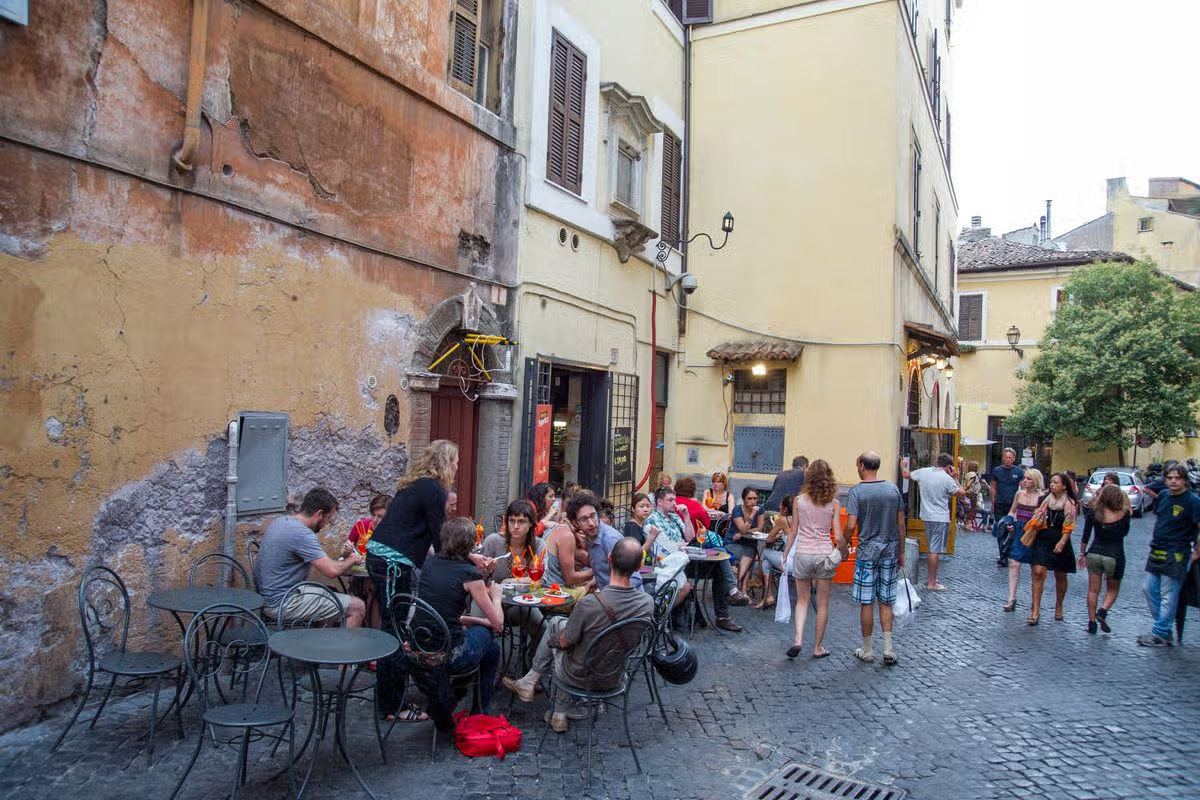
A frustrated Italian local has admitted to dousing rowdy, “drunk” British tourists with buckets of water after they disturbed her in the night. Locals in Rome’s Trastevere district complain that UK and US tourists have been making noise beneath apartments in the early hours, leading one 74-year-old to resort to extreme measures.
Rome has long been a popular holiday destination, drawing in millions of visitors each year. Tourists flock to the Italian capital to soak up the city’s Roman history and art, and enjoy its nightlife and world-famous cuisine.
With the swathes of tourists comes a downside, though: some allegedly get “extremely drunk” and cause a nuisance in the middle of the night. Local Simonetta Marcellini told The i Paper that she keeps buckets of water by her window.
She said: “At first I’m polite, and I point out to them that it is the early hours of the morning and that people will be sleeping. The moment they start arguing back and insulting me, I pour water on them.”
Simonetta, a former radiographer born in the area, has grown frustrated with the changes she’s witnessed. She claims there has been a marked decline in the quality of restaurants, and businesses have been replaced by bars and sandwich shops.
Meanwhile, Rome was inundated with 22.9 million visitors last year, a figure said to be more than seven times the local population. Simonetta decided she’d had enough when she spotted tourists urinating against her building.
She claims that life has “gotten much worse” in relation to tourism since the Covid pandemic. “Regulations are fewer and our complaints from years ago were underestimated.
“So a phenomenon that could have been controlled was practically left unchecked and we’ve arrived today with all the reckless partying.”
It comes after British holidaymakers were warned they could face a 500 euro fine in “some Italian towns”. The Foreign, Commonwealth and Development Office (FCDO) plays a crucial role in keeping Brits informed when travelling.
In its travel advice section for Italy, the FCDO warns that “some Italian towns and cities have specific laws, and you could be fined for breaking them”.
Some of the acts include eating and drinking near certain churches, historic monuments and public buildings. It’s also important to remember that entering or bathing in many public fountains is prohibited – including in Rome.
On the sun-kissed island of Capri (situated off Italy’s Amalfi Coast), a rule is in place regardingdisposable plastic. Visitors are banned from bringing items such as plastic bags, cutlery, cups, trays, or straws onto the island.
Further FCDO guidance reads: “Illegal traders operate on the streets of all major Italian cities. It is illegal to buy items from unlicensed street traders. If you do, you could be stopped by the local police and fined.
“It’s illegal to remove sand, shells or pebbles from coastal areas in Italy. You could face a large fine for doing so. It’s also illegal to collect various species of flowers, plants and herbs from mountain and wooded areas.
“For more information, check with the regional authorities of the area you’re visiting.”
Dove Cameron and Damiano David have tied the knot!
The 30-year-old former Disney star and pop starlet married the 27-year-old Italian rock singer in a civil ceremony Thursday at the town hall in Montalcino, Italy, per Vogue, which first shared details of their nuptials.
The couple began dating in 2023 after meeting at the MTV Video Music Awards a year prior, where they were both contending for best new artist — Cameron took home the prize.
After a long stretch on Disney playing identical twins on the show “Liv and Maddie” and the daughter of Maleficent and Hades in the “Descendants” film series, Cameron successfully entered the mainstream music landscape with her sultry vocal flair. In 2022, she released the smoky electro-pop, queer anthem “Boyfriend,” which reached No. 16 on the Billboard Hot 100 chart, and the theatrical “Breakfast,” a man-eater melody that declares she’s in charge.
David is the frontman of the Italian rock band Måneskin, which formed in Rome in 2016 and won the Eurovision Song Contest in 2021 with their song “Zitti e Buoni.” Now David is focused on his solo career; in 2025 he released his debut album, “Funny Little Fears,” which reached critical acclaim on various European charts, reaching gold status in France, Italy and Poland.
Cameron revealed the pair’s engagement in January, uploading a picture to her Instagram account that zoomed in on the engagement ring. The proposal took place in an “intimate moment” back in October 2025, the “56 Days” star would later tell Vogue in a Jan. 26 article.
The couple — who live in a quiet Rome neighborhood — kept hush about the wedding plan details, sharing with Vogue earlier this month only that a date was set for September.