ISWAP

The War Over Who Is Muslim

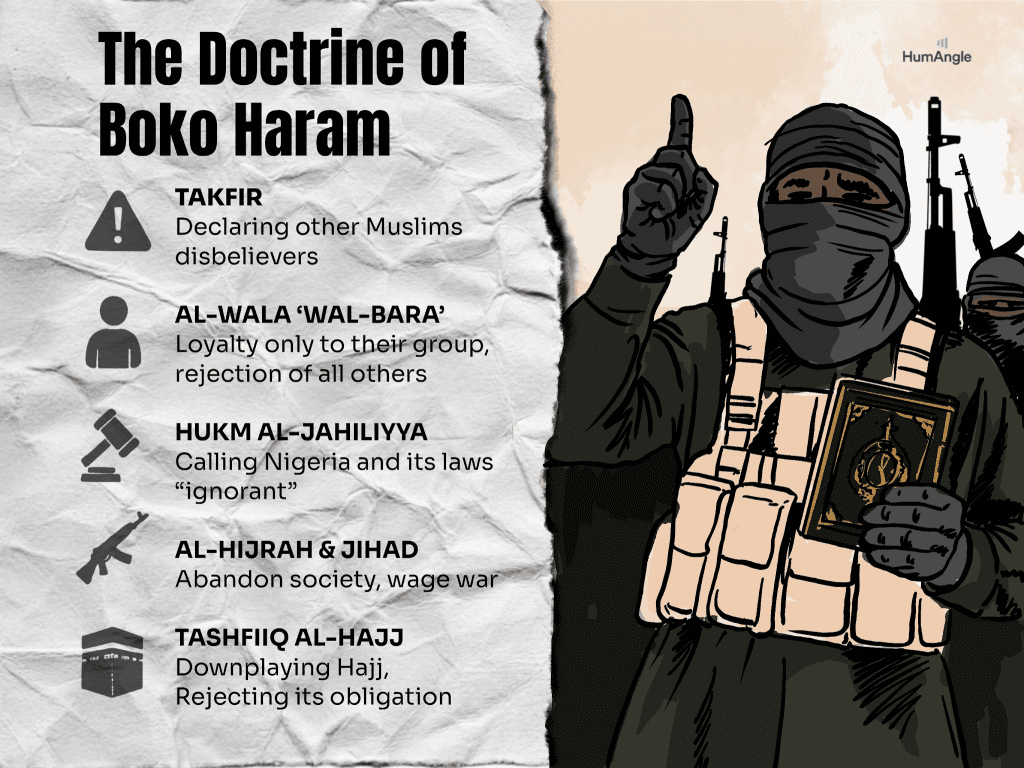
For years, the Boko Haram and the Islamic State West Africa Province (ISWAP) terror groups have told Muslims in Nigeria and the Lake Chad Basin that the world outside their camps is not merely corrupt, but that living in it constitutes unbelief. They reinforce this stance through the misinterpretation of scripture, selective history, and the authority of armed men. They use terms such as tawheed (monotheism), hijrah (migration), bay‘ah (allegiance), jihad, daulah (sovereign state), Darul Islam (abode of Islam), Darul Kufr (abode of unbelief), and takfir (excommunication). 

To the ordinary ear, it may sound like religion, but beneath the vocabulary is a hard political claim: only their authority can certify Islam. Through this doctrine, they decide who is allowed to live, who must die, who is Muslim, who is no longer Muslim, which land is pure, which land is condemned, which ruler is apostate, and why a farmer, teacher, cleric, trader, voter, soldier, journalist, or civil servant can become a target.

The Takfir

At the centre of this war is takfir, the act of declaring a professed Muslim to be an unbeliever. Mainstream Islamic scholarship treats takfir as a grave matter. It requires knowledge, evidence, context, intention, and due process. A Muslim does not leave Islam because he lives under a flawed state, or because he carries an identity card, works in a hospital, teaches in a school, votes in an election, or refuses to migrate to a forest camp – all of which the terror groups view as signs of belief in Western values.

Boko Haram, or Jama’atu Ahlis-Sunna Lidda’Awati Wal-Jihad, shortened as JAS, loyal to Abubakar Shekau, decreed that if you did these things, you were suspect. The most frightening part of Shekau’s doctrine was that he demanded others declare the same people unbelievers, too. If he declared a Muslim in Maiduguri an unbeliever because he lived under the Nigerian state, then ISWAP also had to declare that person an unbeliever. If ISWAP refused, Shekau’s logic turned against the group; they too became unbelievers because they failed to excommunicate those he had excommunicated.

This doctrine explains why JAS could kill villagers, denounce scholars, attack mosques, murder defectors, bomb displaced people, and fight ISWAP while still claiming to defend Islam. In Shekau’s universe, the circle of Islam narrowed until only his faction stood inside it. Everyone else stood outside the gate.

Infographic outlining Boko Haram's doctrines: Takfir, Al-Wala 'Wal-Bara', Hukm Al-Jahiliyya, Al-Hijrah & Jihad, Tashfiiq Al-Hajj.
The doctrine of Boko Haram. Illustration: Akila Jibrin/HumAngle. 

Colonial rupture and the question of authority

Abdulbasit Kassim, assistant professor of religion and classics at the University of Rochester, who specialises in the histories and cultures of Muslim societies in West Africa, places this doctrine inside a longer history. He argues that the question did not begin with JAS but reaches back into debates in Muslim West Africa over land, power, law, colonial rule, and the status of Muslims living under non-Islamic authority.

“Before colonial rule, much of what is now northern Nigeria, southern Niger, northern Cameroon, and western Chad belonged to a wider region known as Central Bilad al-Sudan. Muslim polities such as the Sokoto Caliphate and the Kanem-Borno Empire governed social, economic, political, and legal life through Islamic norms,” he said.

Colonialism disrupted that order. By conquering territory, the British introduced a hierarchy of laws in which Islamic law survived, but with a narrowed jurisdiction. Sharia courts continued in civil matters, especially marriage, inheritance, and family disputes. Criminal punishments under the Islamic canon became restricted, weakened, or rendered practically dormant.

“After 1999, when Zamfara State under Ahmad Sani Yerima revived the criminal aspect of Sharia, old tensions returned,” the professor added. “Some scholars and activists welcomed it as a restoration. Others argued that full Sharia could not operate inside a constitutional democracy where any law inconsistent with the 1999 Constitution could be struck down.”

JAS, evidently, did not emerge in a vacuum. Kassim said, “Mohammed Yusuf rejected Nigeria’s Sharia implementation because, to him, it remained trapped inside a secular constitutional order.” For him, it was not enough for a northern governor to introduce Sharia penal codes. The state itself had to be Islamic. Its sovereignty had to come from Islamic political precepts, not a constitution inherited from colonial rule. This is where the movement’s argument becomes more dangerous. It is not only saying that Nigeria fails to implement Sharia properly, but that the entire political foundation of Nigeria is illegitimate.

To Kassim, figures such as Ibrahim Zakzaky and Mohammed Yusuf shared one major point, even though their methods and movements differed. “They rejected the possibility of fully reconciling the Islamic juridical canon with Nigeria’s inherited secular constitutional order.”

This was the opening JAS exploited.

A series of similar-looking book covers with Arabic text, an ornate border, and a circular emblem.
Screenshot of a 25-page book cover by Abubakar Shekau, where he explains his own interpretation of Islam, his arguments against the people he declared as Taghut and the arguments against Western schools.

Nigeria as Darul Kufr

After JAS’s leaders convinced followers that the Nigerian state was illegitimate, the movement moved to the next step: migration. If Nigeria is Darul Kufr, the abode of unbelief, then Muslims had a duty to leave it, they said. If JAS’s territory was Darul Islam, the abode of Islam, then migration into its territory became a religious obligation. The group took an old legal category and weaponised it to control territory, Kassim argued.

This was not abstract in Borno, Yobe, Adamawa, Niger, Chad, and Cameroon. It meant families were pressured, threatened, abducted, or killed. Villages were told to submit. People who remained under government control became suspects; those who cooperated with the military became enemies; those who joined the Civilian Joint Task Force (CJTF) and their families became legitimate targets in the eyes of the insurgents; and traditional rulers, clerics, teachers, and government workers became exposed.

Shekau then stretched the doctrine further.

According to Kassim, “Shekau held that Muslims living under the Nigerian state were no longer Muslim if they refused to migrate into JAS-held territory. ISWAP contested this. It did not accept Shekau’s blanket takfir against all Muslims living in government territory. ISWAP argued that such Muslims became unbelievers only if they gave material support to the Nigerian state or its security forces in the war against the insurgents.”

This difference shaped the split between the factions. ISWAP still accepted the larger jihadist fiction that the Nigerian state was illegitimate and that true authority flowed from the Islamic State. It still treated soldiers, political rulers, security officials, and those directly supporting the state’s war effort as apostates. It still imposed taxes, punishments, surveillance, recruitment, and control over civilians. It still placed armed authority above the lived Islam of communities that had practised the faith for generations.

The difference between Shekau’s terror and ISWAP’s brutal governance is the difference between reckless excommunication and structured coercion. One faction burned the village and shouted scripture. The other taxed the village, citing the doctrine. Both denied ordinary citizens the right to live safely and peacefully.

The internal civil war

Kassim captured this danger years ago in his 2018 study, JAS’s Internal Civil War: Stealth Takfir and Jihad as Recipes for Schism. He wrote that the internal war between JAS factions could only be understood through “a close reading of the constant stream of primary sources produced by the two factions”.

Kassim wrote a sentence that still sits heavily over this conflict: “Those who kill know why they kill, but the majority of those about to be killed will hardly understand why they are being targeted.”

That is the tragedy of takfir in the Lake Chad war.

A farmer on his way to the field may not know the difference between JAS and ISWAP doctrine. A displaced woman in a camp may not know what Shekau wrote about Darul Kufr. A trader at a market may not have heard of Abu Malik al-Tamimi, Anas al-Nashwan, or the arguments ISWAP sent to Islamic State scholars. A village imam may know the Qur’an, but not the way and manner in which insurgents interpret it. Yet their lives can be judged based on those interpretations.

Shekau saw ISWAP’s caution as a compromise and that is where the blood began to flow inward. Kassim explains that Shekau’s rigidity helped push internal revolt. Ansaru had earlier objected to JAS’s killing of Muslims and the violation of what its leaders considered the ethics of jihad. Later, Abu Musab al-Barnawi and Mamman Nur moved against Shekau from within the Islamic State framework. They accused him of extremism, arbitrary killing, and corruption of the cause.

In the interview for this article, Kassim explained that Shekau was far more reckless on takfir than Muhammad Yusuf. Yusuf laid the ideological foundation for rebellion against the Nigerian state, but he was more cautious about excommunicating Muslims. Shekau removed many of those restraints.

Map of Nigeria with text listing criticisms of the country. Militant figures, a flag, and a sign reading "Unity, Peace, Justice" in the background.
What Boko Haram and ISWAP condemn. Illustration: Akila Jibrin/HumAngle. 

Civilian life as suspicion

Kassim’s 2018 chapter recorded that Shekau viewed people living beyond JAS’s controlled territory as infidels and therefore legitimate targets within Darul Harb (abode of war). He also noted that Shekau’s position was harsher towards those who fled from JAS territory to areas controlled by the Nigerian state. In that logic, their camps, mosques, markets, and places of refuge could be attacked until they repented and returned.

ISWAP challenged part of this logic. Abu Musab al-Barnawi argued that Muslims who had always lived outside JAS territory could not be declared unbelievers merely for that reason. In his view, they crossed the line when they gave active or passive support to the Nigerian Army, the Civilian JTF, or other forces fighting the insurgents.

Abu Musab died in Kaduna, northwestern Nigeria, an area that both JAS and ISWAP consider Darul Kufr. This may partly explain ISWAP’s relative fluidity on the issue, compared with JAS.

HumAngle spoke to a former JAS shura member who later joined ISWAP. He subsequently completed the Nigerian government’s deradicalisation programme and now lives freely in Maiduguri. He says the Shekau faction does not recognise the Islam of Nigerians, Saudis, or anyone outside its creed. “To them, whoever is not with them is an unbeliever. Saudi Arabia is no different from a non-Muslim society in their imagination. It is simply another land of unbelief.”

He said ISWAP classifies Muslims living in Nigeria, Cameroon, Chad, Niger, and other states into categories. Those who can migrate but refuse to do so are sinners, not necessarily unbelievers. Their offence is treated as a major sin. The weak, the elderly, women, children, and those without means may be excused. Those who remain outside insurgent territory while openly challenging secular rule and calling people to Islamic governance may even be rewarded. In his telling, Mohammed Yusuf’s preaching before 2009 fits this category.

But those who join the democratic system, legislate, govern, enforce state authority, or fight under the security forces enter a more dangerous category. Politicians and legislators become tawaghit (false gods). Security officials become direct enemies. Soldiers, police officers, Civilian JTF members, and others who bear arms against the insurgents are treated as apostates whose blood is lawful to be spilt.

Doctors and teachers sit lower in ISWAP’s hierarchy of offence. They are not treated the same way as soldiers or politicians, but they still operate inside a system the group condemns.

This is the cold bureaucracy of ISWAP’s worldview. It sorts society by perceived allegiance, measuring sin by proximity to the state. The former Shura member called JAS a Khawarij-type movement because of its sweeping excommunication of Muslims. He said Shekau and his followers misused verses on oppression, migration, and disbelief. They took verses that classical exegetes treated with care and turned them into proof that any Muslim living in Darul Kufr had committed major shirk.

The key verse in their argument comes from Surah An-Nisa, where angels question those who wronged themselves and failed to migrate when Allah’s earth was spacious. ISWAP reads this as a grave warning against remaining in a land where Islam cannot be practised fully. Still, it leaves room for categories such as weakness, inability, and sin below disbelief.

The former shura member says Shekau’s faction then links this to another Qur’anic discussion of zulm (oppression), or wrongdoing, in which classical explanations connect the greatest zulm to shirk (polytheism). From there, JAS concludes that staying in Darul Kufr is not merely a sin but a state of unbelief. That leap is where the danger sits.

The former Shura member said JAS uses this belief to seize wealth, abduct people, kill travellers, attack farmers, and justify arbitrary violence. 

Why Hajj became secondary to war

ISWAP and the wider Islamic State network, the former shura member explains, take a more layered position on Hajj (pilgrimage to Mecca), which is generally regarded by Muslims as one of the five pillars of faith. “They still recognise Hajj as an obligation for Muslims who have the means. But they argue that tawheed has been corrupted worldwide and that restoring it through jihad takes priority. In practice, a wealthy fighter should not spend money on Hajj. He should donate it for weapons.”

Islam makes Hajj one of its five pillars. ISIS and ISWAP do not always deny that in theory, but they demote it in practice. They turn the battlefield into a higher obligation that suspends pilgrimage, family obligations, learning, work, charity, and ordinary religious life.

The anonymous source says senior Islamic State scholars issued rulings that no mujahid should spend his money on Hajj when he can spend it on arms. 

They take a religion structured around testimony, prayer, fasting, zakat, and pilgrimage, then reorder it around obedience to commanders and permanent war. The recruit is told that the world is corrupt, his parents are ignorant, his old imam is compromised, his country is unbelieving, his passport is a symbol of loyalty to kufr, and his only safe identity is inside the jama‘ah (the jihadists’ community). By the time he is asked to kill, the moral world that could have restrained him has already been dismantled.

Illustrated comparison of Saudi rejection with claims to defend Islam, featuring a mosque and armed figures with a black flag.
Illustration: Akila Jibrin/HumAngle

Saudi Arabia and the battle for religious legitimacy

For Muslims around the world, Saudi Arabia holds Mecca and Medina, the two holiest sanctuaries in Islam. Millions perform Hajj under Saudi administration, yet jihadist ideologues have long denounced the Saudi state as apostate, accusing its rulers of alliance with Western powers, partial application of Sharia, participation in the United Nations system, and military cooperation with the United States and others.

Kassim points to Abu Muhammad al-Maqdisi, the Jordanian jihadist ideologue, whose writings attacked the legitimacy of the Saudi state. The argument is familiar in jihadist circles: Saudi rulers claim Sharia, but rule partly through artificial laws; they belong to the international state system; they support Western military campaigns; they host or cooperate with foreign military power; they have betrayed Muslims.

This is why jihadists can condemn Saudi rulers while still struggling over the status of Hajj. Some declare the rulers apostate but still accept that Muslims may perform Hajj because the holy places remain sacred. Others move closer to rejecting Hajj under Saudi authority or treating it as inferior to jihad.

The anonymous source says ISWAP and Islamic State circles call the Saudi royal and scholarly establishment “Ahl Salul”, a contemptuous distortion linking them to hypocrisy. They do not call them “A’l Saud” or “A’l Sheikh” with respect. They dismiss many Saudi scholars as apostates or compromised because they did not confront the Saudi state.

Who gets to define religion? The scholars of centuries? The community? The custodians of the holy cities? The legal schools? The state? The armed commander in the bush? JAS and ISWAP argue that authority belongs to the armed vanguard. That is why they reject Nigeria’s Sharia states, Saudi Arabia, Qatar, UAE, Afghanistan, Mali, Niger, Chad, and other Muslim-majority or Muslim-populated states. 

The third generation of war

Kassim warned in the interview that the conflict is entering a third generation, which JAS described in one of its propaganda videos as “Jiyalit-Tamkin” (reinforcement generation). Many fighters were born into war and therefore did not sit through the early debates or learn the tradition deeply. They inherited fear, slogans, weapons, commanders, and survival inside an insurgent economy.

The first generation, including Mohammed Yusuf, Shekau, Mamman Nur, and others, had some level of Islamic training. One may reject their interpretations, but they tried to ground their actions in texts. Shekau himself wrote books and cited Usman Dan Fodio, even if, as Kassim notes, the citations were often erroneous and shallow.

The current generation is different. For many of them, jihad is the only economy they know, and now functions as the road to food, wives, money, status, revenge, protection, and belonging. 

The former shura member says this is visible among the Shekau loyalists who remain under Bakura’s orbit. He says they suffer from a dearth of scholars and describes figures around the faction as lacking deep knowledge, with some retained by kinship, money, fear, or coercion rather than conviction. This is one of the most important revelations.

“The war is no longer driven only by men who believe they are restoring an Islamic order. It is also driven by men trapped inside a violent economy that needs theology to keep feeding itself,” the former shura member said. War has become a livelihood.

Ending the conflict requires more than defeating JAS’s ideology. Many actors are bound to the war by power, profit, survival, and identity, making violence harder to end than extremist beliefs.

Why the war endures

The state did not create JAS’s theology, but it gave the movement that emerged in northeastern Nigeria some of its most powerful stories. The killing of Mohammed Yusuf in 2009, mass arrests, military abuses, corruption, abandoned communities, failed justice, and the humiliation of civilians all became material for insurgent propaganda.

Across the Sahel, the same pattern repeats. Jihadist groups exploit weak courts, abusive soldiers, predatory officials, unresolved local disputes, ethnic suspicion, rural abandonment, and poverty. This is why Nigeria cannot bomb its way out of the conflict.

The anonymous former shura member rejected claims linking recent schoolchildren kidnappings in Oyo State to either ISWAP or JAS. According to him, the perpetrators are unlikely to belong to either group. Instead, they may be newly emerging terrorist cells, former Lake Chad insurgents, or criminal networks that have adopted the rhetoric, tactics, and imagery associated with the Lake Chad insurgency.

Nigeria now faces more than one threat. There are jihadist factions with doctrine, command structure, and transnational links. There are armed gangs with local motives. Some kidnappers borrow religious language. Some opportunists understand that the word Sharia can create fear, attract attention, or confuse investigators.

Bad analysis merges them all while good analysis separates doctrine, network, command, territory, language, and motive. 

The need for precision

Experts say mainstream Islamic scholars must speak with more precision and courage. They must confront takfir clearly and explain why residence under a secular state does not erase religion. They must explain why bad governance does not give an insurgent the right to cancel the faith of millions, why Hajj cannot be demoted by men who need money for weapons, and why Sharia without mercy, restraint, due process, and qualified authority becomes rule by fear.

It is not enough to say JAS has nothing to do with Islam. That may comfort outsiders, but it does not answer the recruit who has heard verses, hadith, juristic language, and historical references. 

Kassim admits he does not see a clear solution. The idea of restoring an Islamic state will remain as long as many Muslims see the Nigerian system as chaotic, unjust, corrupt, and unable to serve its people. The dysfunction of democracy strengthens the insurgents’ claim. 

The insurgents do not need Nigeria to fail. They only need it to be failed enough for a young man to feel humiliated and for a farmer to distrust soldiers. It was enough for a displaced family to feel forgotten. Every abuse becomes a sermon for them. 

Submission as the ultimate test

The fight against JAS and ISWAP is often framed as a fight to win back territory in Sambisa, Alagarno, Mandara, Marte, Abadam, Lake Chad, or the borderlands. But it is also about authority: Who defines religion? Who protects life? Who dispenses justice and punishes wrongdoing? Who can call another person an unbeliever?

This explains why the majority of JAS’s victims have been Muslims. The war has devastated Muslim villages, clerics, farmers, traders, women, children, and displaced families.

JAS and ISWAP are defending their monopoly over religion. And inside that monopoly, Daniel the priest, Ibrahim the imam, the displaced mother, the market trader, the farmer, the journalist, and the child on the road can all meet the same fate. 
Source link

ISWAP Used Theology to Absorb the Shock of Its Deadliest Week

For the Islamic State (IS) and its West Africa Province (ISWAP), the third week of May 2026 began with a compound disaster and ended with a theology lesson. The group faced one of its most shocking moments, at least in West Africa or, more specifically, Nigeria. 

With its headquarters in Nigeria, ISWAP has been the most active wing of the Islamic State globally, claiming more attacks than any other IS province since its central operations in Iraq and Syria were largely overpowered. Following the call for its members to migrate to Africa, ISWAP has, in the past two years, temporarily overran Nigerian military installations, including at least one super camp. The group was enjoying relative success when a turning point came: one of its most important first-generation commanders was killed. 

The operation that killed Abu Bilal Al-Minuki between midnight and 4 a.m. on May 16 was described by the Nigerian military as “meticulously planned and highly complex”. It not only left the terrorist dead, but it also caused a crisis of morale that ISWAP’s propaganda machine would spend the following days trying to contain through a theological message. 

Ahmad Salkida, a leading conflict analyst who has been observing the situation since it emerged, described the killing of Al-Minuki as a “serious disruption” to the activities of ISWAP in the Lake Chad region.

Airstrikes and special forces raids followed. More people were killed, and confusion reportedly descended. The operations, according to some reports, may also have killed the likely successor to Al-Minuki, another terrorist commonly known as Ba Shuwa, opening a new and, perhaps, unplanned chapter in the insurgency.

By May 19, Nigeria’s Defence Headquarters reported that 175 ISWAP and Boko Haram militants had been killed since the joint offensive began. According to the report, at least 20 died in a single engagement. By the time Nigerian authorities stopped counting, the joint operation had become the most lethal week the group had faced in years.

The theology of a bloody week

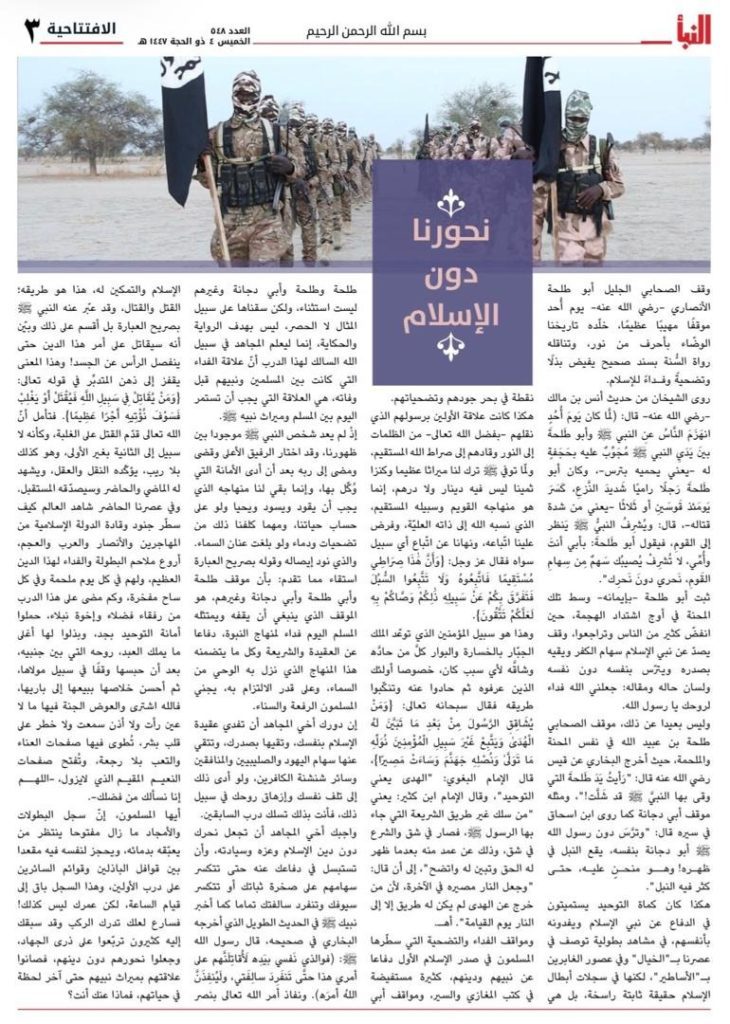
Within that catastrophic week, the Islamic State released its Al-Naba newsletter with a pointed editorial. Although it did not mention Al-Minuki or the numerous fighters killed, the editorial retold a story of a battle that happened 14 centuries ago to boost the morale of a group in disarray.

Reports suggest there was internal suspicion, even before the death of Al-Minuki, that some fighters may have leaked information leading to his death, driven by internal discontent over the unequal treatment between foreign fighters who migrated to the ISWAP and the local fighters in Nigeria. However, the editorial tried to shift away from that and present the losses as a normal sacrifice. 

A group of masked soldiers holding flags marches in a desert landscape, with Arabic text and articles overlaying the scene.
Screenshot from the IS weekly Al-Naba released after the death of Al-Minuki 

Everything in the editorial is deliberate. The piece opens on Talha ibn Ubaydullah, a companion of the Prophet Muhammad, at the Battle of Uhud. The selection is pointed in ways that any reader with a classical Islamic education would immediately recognise. 

Uhud was a near-disaster for early Muslims because of an internal division. It was a battle in which archers abandoned their positions, turning a momentary advantage into a rout that left dozens of companions dead and the Prophet himself wounded. 

What Islamic tradition preserved, and what the Al-Naba propaganda wanted to convey from that valley, however, was not only the memory of tactical failure but of individual men who placed their bodies between the Prophet and death – an important sacrifice for the existence of Islam. 

The editorial tells ISWAP fighters who have fallen into fear, confusion, or doubt after the loss of Al-Minuki and other fighters that a similar situation occurred during the Battle of Uhud. However, because the Prophet’s companions believed they were fighting for Islam, they did not see it as a problem.

In essence, the message is that they may ultimately be killed, suffer injuries, or even think they have already achieved victory and begin collecting spoils of war, only for circumstances to turn against them. Yet, regardless of whatever hardships or setbacks they face, they should not regard themselves as having lost, because they are fighting for their religion.

“Your role, O my mujahid brother, is to make your chest a sanctuary for the religion of Islam and guard it with your body,” the editorial reads. 

This is a recognisable pattern in IS editorial strategy. After senior commanders are killed, Al-Naba invokes early Islamic battles such as Badr, Uhud, and Khandaq as mirrors, casting present losses as the preconditions for eventual triumph. The rhetorical architecture is consistent and has appeared after every major command-level strike against the organisation. What changes each time is only the particular story pulled from the tradition.

In 2019, when Abubakar Al-Baghdadi, the former leader of Islamic State, died, Al-Naba compared the situation with that of early Muslims after the death of Prophet Muhammad, in which many of his companions fell into disbelief until they were calmed by the first caliph Abu Bakr As-Siddiq. Al-Naba issue 207 argued that if Islam could survive the death of the Prophet Muhammad, the Islamic State could also survive the death of Al-Baghdadi. 

The choice of Talha in the recent issue of Al-Naba, specifically after the death of Al-Minuki, adds a layer to the editorial. Talha survived Uhud and fought many more campaigns. The editorial addresses not only those who died but also those who lived through the week. The message to fighters still alive in the Lake Chad Basin, still holding ground, is legible between every sentence. 

“It is the duty of my mujahid brother to walk those same paths in defence of the religion of Islam, its honour, and its sovereignty,” the editorial says. 

The crisis of succession 

The theology in the Al-Naba editorial could steady nerves or explain deaths. It could also transform defeat into sacrifice. However, it could not answer the practical question now hanging over the movement: who would lead after Al-Minuki?

For years, ISWAP’s resilience has rested on its ability to survive leadership decapitation. Commanders and factional leaders have died, been assassinated, or removed. Yet the organisation endured because a pool of experienced first-generation figures remained available to absorb the shock. However, this time may be different.

A HumAngle analysis observed that Al-Minuki’s most likely successor was Ba Shuwa. However, he too may have been killed in the subsequent strikes; if confirmed, the movement would lose not only its most influential commander but also the man widely expected to replace him.

Al-Minuki belonged to a shrinking class of terrorists who entered the movement before the 2009 uprising transformed Boko Haram from a fringe extremist religious organisation into a regional insurgency. He embodied institutional memory, battlefield experience, and personal relationships that spanned multiple generations of fighters. 

Ba Shuwa, although younger in status within the movement, still belonged to that older ecosystem. Their simultaneous deaths would accelerate a transition that many inside ISWAP had anticipated but few expected to happen so suddenly. The names now circulating inside insurgent circles to replace Al-Minuki and Ba Shuwa show the scale of that transition.

Among the strongest contenders, as HumAngle gathered, is Abu Salem, a commander who grew up entirely within the insurgency’s wartime environment.  He reportedly combines military authority with religious credentials, a combination that carries considerable weight inside ISWAP’s hierarchy.

Another frequently mentioned figure is Bana Chingori, long regarded as a close associate of Ba Shuwa and an influential commander in his own right.

However, beneath the movement’s ideological claims lies a complex web of battalion loyalties, personal networks, ethnic affiliations, and historical rivalries. Fighters speak the language of the caliphate, but leadership legitimacy is often negotiated through social structures that long predate the insurgency itself. The question is not merely who is capable of leading, but who can command obedience across the various factions that make up the movement.

This is where the editorial in Al-Naba becomes more interesting. The Islamic State understands that leaders can be replaced. What is more difficult to replace is cohesion.

The editorial’s invocation of Uhud was not simply a sermon about perseverance. It was also an attempt to create continuity at a moment when continuity is under threat. By reminding fighters that early Muslims endured confusion after battlefield losses yet remained united, the editorial implicitly addresses the danger of fragmentation.

For nearly a decade, ISWAP distinguished itself from rival jihadist factions partly through its ability to maintain organisational discipline. While Boko Haram under Abubakar Shekau frequently splintered under pressure, ISWAP developed bureaucratic structures capable of surviving individual losses. The current transition will test those structures more severely than any succession crisis since the death of Abu Musab al-Barnawi and the removal of other senior figures from the Muhammad Yusuf generation. 

The paused migration 

Beyond the succession question lies another bigger development. ISWAP has announced that the flow of fighters migrating from Iraq and Syria to Nigeria has been effectively paused.

For years, the Islamic State’s call for migration to Africa was one of ISWAP’s most reliable sources of experienced foreign fighters. Foreign fighters who had trained and fought in the central theatre arrived in Lake Chad with tactical knowledge, ideological authority, and direct personal connections to IS central command. 

Al-Minuki himself was a product of that ecosystem. The suspension reflects the bigger issue that ISWAP is facing, in which local ISWAP members feel foreigners are given more priority in the insurgency, and they’re being relegated. This, according to some sources, was one of the reasons that opened a loophole that led to the intelligence leading to the killing of Al-Minuki. 

Al-Naba issue 550 addressed the question of migration indirectly. The editorial, titled “Africa Between Yesterday and Today”, spoke in the past tense about those who had already made the journey. “Those who came before you from Iraq walked this path,” the editorial told terrorists currently in Africa, “and they carried the weight of this religion on their shoulders.”

Silhouette of a person with a rifle and document against a sunset. Arabic text with the headline "Africa: Between Yesterday and Today."
Screenshot from Al-Naba 550th issue. 

The joint US-Nigeria strike that killed Al-Minuki demonstrated a targeting capability that ISWAP had not previously faced at this intensity in the Lake Chad theatre. The use of American intelligence assets alongside Nigerian special forces created a surveillance environment that makes the movement of senior figures, especially those arriving from abroad,  significantly more dangerous than before. 

For IS central, sending experienced insurgents into a degraded environment risks losing irreplaceable assets to an adversary that has now demonstrated it can find and kill the most protected figures in the organisation. The pause in migration is both a strategic retreat and a rational response to changed targeting conditions.

The commanders now being discussed as replacements for Al-Minuki are men who grew up entirely inside the Nigerian insurgency. Whatever their capabilities, they appear to lack the cross-theatre experience and IS central relationships that figures as Al-Minuki carried. The migration pause has narrowed the field of who can credibly lead it.

Source link

Terror on the Football Pitch: Adamawa Community Recount ISWAP Attack

The referee blew the whistle a few minutes before 5 p.m., on April 26, to kick off the second half of a football game. The players re-emerged on the field, and the spectators once again gathered to witness the second round of the Guyaku Local Championship Football League in the Sabon Gari area of Guyaku, a small community in the Gombi Local Government Area (LGA) of Adamawa State, northeastern Nigeria. 

Just minutes into the match, another sound pierced the air across the football pitch, but it wasn’t the referee’s whistle this time. It was sporadic gunshots that alerted the players and the spectators that something terrible was about to unfold.

The gunshots continued from different directions, their sound drawing closer. As the confused crowd tried to make sense of the situation, some armed men arrived at the football field on motorcycles. They opened fire on the crowd, and in that instant, people scrambled for safety, while others fell dead on the pitch. 

Within minutes, Istifanus Hassan, an eyewitness who narrowly survived the attack, said that everywhere was thrown into chaos as screams and smoke filled the air. 

“We ran into the bushes, but they [terrorists] followed people with their motorcycles and were shooting them in the bush,” he recalled. Although he survived, Istifanus said what he witnessed while hiding in a nearby bush that evening may haunt him forever. 

The terrorists burnt down houses, motorcycles, shops, and a church. They also looted at least three grocery shops and a chemist. “They used motorcycles to pack the items after killing the shop owners. They packed all the items and burnt the shops down,” he said, adding that they made away with medicines as well.

Empty, dusty shop interior with scattered boxes and papers, bare shelves, and a wooden counter in the foreground.
The terrorists looted a chemist and left with all the medicines, leaving behind an empty store. Photo: Hamman Basmani.

“I watched my community members and relatives fall dead to the ground. The men were targeted and shot in the head, and the women were spared,” Istifanus said.

But not every woman survived the attack. Other residents told HumAngle that all the women captured by the terrorists were left unharmed, but two women lost their lives in the incident. Their deaths were attributed to stray bullets. 

One of the deceased was 28-year-old Sintiki Dimas, who went to the football pitch to sell snacks to spectators. As a petty trader, Sintiki relied on selling local snacks like kuli-kuli to support herself and her younger siblings. 

Her mother, Bata Dimas, said Sintiki was killed while trying to flee, adding that her daughter’s trade was a great source of support to her eight younger siblings and the rest of the family. 

The other woman, who also lost her life in the attack, was fleeing with her toddler strapped to her back when a bullet hit and killed her. “The baby was also shot on his leg, but he’s currently receiving treatment,” an eyewitness, who asked not to be named, told HumAngle. 

The attack continued for hours. 

By the following day, the Islamic State West African Province (ISWAP), a Boko Haram breakaway, had claimed responsibility for the assault. The attack, which killed at least 33 residents and injured seven others, happened barely two months after ISWAP attacked a military base in Hong, a nearby local government area. 

Residents say it exposed longstanding security gaps in the border community, triggered fresh displacement, and revived fears of a return to the deadly years of insurgent violence that have devastated the region. 

The first attack in a decade 

It is not the first time terrorists have invaded Guyaku, but it is the first time since 2015, when the Boko Haram insurgency was at its peak in Adamawa. Then, “they burnt almost the entire village to the ground that year, but luckily, we all fled, and no one was harmed,” said Hamman Basmani, the Wakili (community leader) of Guyaku.

By 2016, most residents who had fled the area had returned and resumed their usual activities. 

Guyaku is an agrarian community, and residents – over a thousand of them, according to Hamman – mainly rely on farming for survival. Since the 2015 attack, he said, the residents had lived peacefully until the recent incident.

Map highlighting regions in Borno and Adamawa, Nigeria, including Sambisa and Chibok. Inset map shows location within Nigeria.
Guyaku sits near the border between Borno and Adamawa states. Map illustrated by Mansir Muhammed/HumAngle

While other residents returned to Guyaku after the 2015 incident, Barnabas Benaiah was among those who did not. He relocated to Hong with his nuclear family, while his extended family remained in Guyaku. 

“I’m not currently staying in Guyaku, but I’m always there,” he said, meaning that he visits regularly. He added that he feels attached to his hometown, which is why he stayed in a neighbouring town. 

When ISWAP attacked Guyaku in April, Barnabas lost three family members. Two were his brothers, and the other was his niece. “They [his brothers] all had families and had left behind pregnant wives,” he told HumAngle. 

Barnabas noted that the attack in Guyaku was tactical. 

“They were after men,” he said, echoing testimonies from other residents. “Mostly young men, so they targeted spots where these men could be found, such as the football pitch, local joints, and front yards. They shot the men in the head, and when they encountered women, they told them to walk away because they had nothing to do with them. The women who died were hit by flying bullets.” 

A recent academic study on gendercide in the Lake Chad insurgency found that such patterns have appeared in previous ISWAP and Boko Haram attacks, where adult men are often perceived as potential fighters, vigilantes, informants, or collaborators with the state.

Residents say the terrorists pursued residents who ran towards neighbouring communities and killed them, while also looting valuables, such as motorcycles. “They went to a commercial charging store and packed all the phones from there. They were still looting shops when soldiers from Garkida town arrived, so they abandoned some of the items and ran,” Barnabas said. 

Tela Bala, Kwari, Kwana, and other communities within Guyaku were also affected. “[Several] people from these communities have now fled to urban centres,” he added. 

Istifanus remained in the bush until the gunshots ceased. He came out and joined other residents in recovering dead bodies. Most of the corpses were found at the football pitch, while some were recovered in front of houses and across the street. 

“The corpses I saw and counted that day were up to 28, but I couldn’t stay to continue identifying the bodies,” he recounted. “I became emotional and left.” 

Hamman, the community leader, told HumAngle that other bodies were recovered in the bushes and roads leading to other villages days afterwards. He said that 33 bodies were found; 30 of them were men, and most were young. 

Map showing locations in northeastern Nigeria, including Guyaku, Kinging, Kwapre, Larh, and Dabna, with a zoomed-out view on the lower left.
Map showing hotspots of terror activities in towns neighbouring Guyaku. Illustrated by Mansir Muhammed/HumAngle.

Guyaku sits in Adamawa’s northwestern region. It is about 20 km from the border with Borno State and less than 15 kilometres from Kwapre, Banga, Larh, and Dabnz Kinging communities, each of which has been abandoned due to Boko Haram attacks over the years.

Guyaku, along with these border communities, falls within known terror hotspots, including forests like Alagarno and towns like Mandaragairu, where terrorists often operate and move through to attack surrounding hinterland communities along the southern Borno-Adamawa border.

In April, HumAngle reported how these abandoned agrarian communities fall within the direct line of influence of terror groups from major enclaves like Sambisa Forest and the other forests connecting local bushes in Adamawa State to those across the border in Borno, allowing them to remain geographically threatened by these groups.

Tale of terror 

For residents in these communities, nowhere is safe anymore. During the April 26 attack, 39-year-old Alheri Gabriel was sitting outside his house, playing cards with his friends, when the terrorists rode towards them on motorcycles. 

“At first, I was confused, and I thought they were trying to catch a thief because someone was running in front of them. I thought he was a thief, and had I tried to help them catch him, but I noticed they had guns,” Alheri recounted. 

Suddenly, the terrorists ordered him to come forward, but he hesitated, and when they pointed a gun at him, he immediately started running as fast as his legs could carry him. 

“While I was running, they shot me in the left shoulder, but I didn’t stop. I continued running, and they pursued me with their motorcycles, but I fled into a house and hid there until they lost track of me,” he told HumAngle. 

Person with a stitched wound on the shoulder, sitting on a bed with patterned sheets, others in the background.
Alheri sustained a gunshot wound to his left shoulder. He underwent surgery but is still unable to move it without pain. Photo: Alheri Gabriel. 

He remained hidden while blood continued to gush from his injured shoulder. When the shooting ceased, he staggered into the street and was assisted by other residents. Alheri was first rushed to a hospital in Gombi town, along with other injured people, before being transferred to the Modibbo Adama University Teaching Hospital in Yola, the Adamawa State capital, for further treatment. 

Later, he learnt the men he had been playing cards with were all shot and their bodies set ablaze by the terrorists in the front yard. 

He underwent surgery on May 1 and is still recovering, but he fears his life will never be the same. “I have a wife and young children. I’m a skilled photographer and a barber, and I don’t think I’ll be able to recover soon or resume work,” he said. 

With a family to feed, Alheri hopes to recover soon so he can return to his business. However, something has changed. “I don’t think I’ll return to Guyaku,” he said.

His wife and children have fled to another town, where they are living with relatives. 

Empty streets 

More than a week after the ISWAP attack, residents – especially women and children – have continued to flee Guyaku despite assurances from the Adamawa State government that security would be strengthened in the area and that justice would be served. 

“Only the men are left here, and we are not more than 20,” Hamman said, adding that residents are worried about the security gaps that exist in the area. 

During an assessment visit two days after the attack, Ahmadu Fintiri, the Governor of Adamawa State, said, “We are intensifying security operations immediately to restore peace and ensure every resident feels safe in their home again. We will rebuild, and we will remain resilient.”

Burned metal structure with charred roof, surrounded by melted glass bottles and blackened debris on the ground under sunny skies.
Grocery shops were looted and then set ablaze by the terrorists who invaded Guyaku. Photo: Hamman Basmani.

Despite those assurances, residents say the security presence in the community has remained inadequate. Although a group of soldiers, local vigilantes, and hunters were stationed there in the early days after the attack, the military officers have since withdrawn. 

“The local security team goes round the community, but there is no security post or unit we can report to during emergencies,” Hamman said. 

For many residents, however, the absence of formal security is not new. Guyaku has long relied on the local vigilante group for security, but they are poorly equipped to repel major terror attacks. The nearest police stations are in Gombi and Garkida, about a 30- to 40-minute drive away.

The lingering insecurity has also disrupted efforts to bury some of the victims. Barnabas said some of the corpses are yet to be buried as their family members have since fled the area. “A mass burial was scheduled, but no agreement was reached, so individuals began burying their dead, and those whose relatives fled were paired with other victims,” he said. “At the cemetery, we got a call that the terrorists had just been spotted, and that was how the burial rites were abandoned. Everyone fled,” he stated. 

Hamman, who continues to lead the community during the crisis, said residents are pleading with the government to deploy more security personnel to the area.

“[They should] send soldiers to join hands with the vigilantes and protect us. If people see security personnel patrolling the area, they will want to come home. But if there are no security personnel, even if the people want to come back home, they will be discouraged.” 

Source link