issue

How Hollywood’s production crisis became a key issue in the L.A. mayor’s race

Los Angeles City Councilmember Nithya Raman, who serves the 4th District, makes her way across an empty, unnamed backlot, presenting her case to be the city’s next mayor.

“Studio lots like this one used to be filled with people, costumers, electricians, set medics, caterers, thousands of Angelenos making a living,” she says in the video posted on social media. “Now these lots are quiet. Since 2018, shooting days in the city have fallen by half.”

After telling voters this issue is “personal” (her husband is a TV writer and producer), criticizing Mayor Karen Bass’ leadership on the matter and outlining her own plans, Raman proclaims, “I’m running for mayor to make sure Los Angeles stays the film and TV capital of the world.”

Placing the concerns of the entertainment industry at the center of the city’s mayoral race would have been unthinkable even in the last election cycle. But the production crisis, which has rocked Hollywood and pummeled its workforce, has reached a critical juncture. The state of L.A.’s signature industry is now a political flashpoint alongside affordability, crime and homelessness in the upcoming election.

A person films an interaction with mayoral candidate Spencer Pratt

A person films an interaction between mayoral candidate Spencer Pratt and another person on his cellphone during a “Community Meet and Greet” event out of a house for sale on Long Ridge Avenue in a residential neighborhood of Sherman Oaks on Saturday.

(Etienne Laurent/For The Times)

In campaign ads, interviews and the recent televised debate, the top three contenders: incumbent Mayor Bass, former reality TV villain Spencer Pratt and Raman, have made the ongoing production slump a pivotal topic, highlighting their plans to revitalize the industry while deploying the issue to undercut one another.

For decades, elected officials have not had to focus on the film and TV business, let alone turn it into a campaign issue. It was simply a given that local production would continue to play a dominant role in the city’s economy as it has for more than a century.

But the cumulative effects of consolidation, runaway production to tax-friendly states and countries and the end of the streaming boom has caused Los Angeles to lose billions in economic activity, shed some 57,000 jobs over the last four years and led to the closing of more than 80 film and television production service businesses across the city since 2022.

“For us, ‘save Hollywood’ is more than a slogan and more than headline. It is what needs to be done,” said Pamala Buzick Kim, one of the co-founders of Stay in LA, a grassroots campaign aimed at increasing film and television production in Los Angeles.

To be sure, the biggest driver of where studios and producers film are state and federal tax credits, over which the city has no control.

But Buzick Kim and others argue that “there is lots the mayor can do, hand-in-hand with the City Council.”

Mayor Karen Bass walks with Nilza Serrano during Avance's politics and tacos event

Mayor Karen Bass, center, walks with Avance Democratic Club President Nilza Serrano, to the right of Bass, during Avance’s politics and tacos event at Ernest E. Debs Regional Park in Los Angeles on Saturday.

(Christina House/Los Angeles Times)

For starters, say filmmakers and advocates, much can be done to tackle the city’s sclerotic bureaucracy, onerous regulations and a slow and costly permitting process that has pushed filmmakers to flee to friendlier and cheaper locales.

While steps have been put in place recently, including a pilot program offering reduced-cost filming permits for shoots that demonstrate a “low impact” to the surrounding community, many complain such steps have come too little and too late.

A man examines woodwork in a shop

Scott Niner, president and owner of Dangling Carrot Creative, checks on woodwork being produced at his shop in North Hollywood.

(Jason Armond/Los Angeles Times)

“The industry is in collapse and people have been talking about fixing things for years, but all we get are incremental little changes,” said Ed Lippman, a location manager of 34 years who lives in Sherman Oaks and has worked on such shows as “ER” and “The X-Files” and movies including “Galaxy Quest.” “And if the city is not being business-friendly, the business will go elsewhere.”

Compounding the problem, the Los Angeles area has more than 100 jurisdictions, many of which have their own set of rules and regulations regarding filming.

“There needs to be universal standards,” said Travis Beck, a location manager for commercials, small films and music videos. “Burbank is different from Glendale, which is different from Pasadena.”

The recent kerfuffle over filming “Baywatch,” the lifeguard reboot at Venice Beach, underscored both the efforts to bring production back to L.A. — enticed by a $21-million tax credit — and the complex, baffling red tape required to film here.

When shooting began in March, the production encountered a number of hiccups, including that it needed nearly double the parking space it had received a permit for, which was not part of the original approvals.

An anonymous crew member claimed on Facebook that government restrictions had forced production to relocate from Venice Beach. Production staff denied they had relocated. However, the incident prompted a backlash, becoming a rallying cry over L.A.’s burdensome filming bureaucracy.

The “Baywatch” team quickly met with city and county officials and resolved the issue, securing an agreement for a 20% parking discount from the city, and the mayoral candidates used it as an opportunity to score political points.

Pratt slammed the city’s permitting problems.

“LA turned its back on Hollywood — now the golden goose needs CPR,” he wrote on his Substack.

Bass highlighted her administration’s leadership on the matter.

“The City of Los Angeles will always clear bureaucratic barriers, making it easier and more affordable to film in the entertainment capital of the world,” she wrote on X last month.

On April 21, the mayor unveiled programs to offer productions 20% discounts on city-owned parking lots and other equipment, reduced filming fees at places like the Griffith Observatory and reopened the Central Library for filming. Last August, she appointed Steve Kang, president of the Los Angeles Board of Public Works, as the city’s film liaison.

Raman has pledged her support for expanding the state’s $750-million tax incentive program, streamlining permitting and lowering fees and eliminating those for small productions. She has also said she will establish a dedicated city film office with a liaison who understands production.

Nithya Raman speaks to a crowd outdoors behind Nithya for Mayor chalk message on ground

Councilmember and mayoral candidate Nithya Raman speaks to a crowd at the “Families for Nithya” event at Vineyard Recreation Center in Los Angeles on Saturday.

(Myung J. Chun/Los Angeles Times)

“Los Angeles is losing Hollywood,” Raman said in a statement. “Not because productions want to leave, but because we’ve made it too hard for them to stay.”

On his Substack and various podcast interviews, Pratt has promised to slash location fees in half, speed up permit approvals, reduce on-set city staff for the majority of productions and waive all fees for shoots with budgets under $2 million.

All three candidates have attacked one another over their approach to Hollywood.

Pratt and Raman have said Bass moved too slowly to address spiraling production and retain film jobs, saying she enacted measures only recently as the mayoral race was heating up.

Speaking on the Monks & Merrill podcast, Pratt criticized Bass’ moves to cut costs to film at the Griffith Observatory, saying, “Who needs that shot right now with the homeless poop all around it?”

The incumbent mayor has defended her administration’s record with the entertainment industry.

Bass and Pratt have taken Raman to task, calling her out for what they say is her lack of advocacy during her time on the City Council.

“She feels very strongly about it. But never offered one motion on the industry, and when motions came up on the industry she either recused herself, or got up and walked out,” said Bass during a debate this month.

Citing a potential conflict of interest over her husband’s work in television, Raman refrained from voting on several motions related to Hollywood.

Many working in the industry would like to see full-throttled support coming from the mayor’s office that will get results. They note how New York City has successfully promoted itself as a leading film destination over the years. (Kang, the city’s chief film liaison, said the city is working on a similar marketing campaign to promote filming that will launch by early fall.)

“For all the talk about, ‘We need to support and bring back filming,’ if they just did basics like lowering the fees and simplifying the process … that would actually help people and get things produced,” said Chris Fuentes, 66, who worked for 30 years as a location manager until he retired last year.

“We’ve heard a lot of great things, but not all things are possible in the mayor’s remit,” said Buzick Kim, noting that tax incentives are a state and federal issue.

Still, she said, “the mayor must understand that Hollywood needs to be made a priority and to find and create inspired thinking to make things easier and cheaper.”

Kang agrees, but says there are limits to what the mayor can achieve.

“We definitely can do a lot to really open up the entertainment industry, but at the same time, we recognize the larger impact needs to come from Sacramento and Washington, D.C., because L.A. just does not have the resources to compete with other jurisdictions in providing millions of dollars in tax incentives,” he said.

For most working in the industry, they just want city leadership that will execute on more than just talking points.

“This is the birthplace of cinema,” Beck said. “It shouldn’t be so hard to film here.”

Source link

England bowler Issy Wong to have scan on hamstring issue month before World Cup

After the ODIs, England play three T20s against New Zealand before another three against India as their World Cup preparations ramp up.

Their World Cup campaign begins on 12 June against Sri Lanka at Edgbaston.

Key spinner Sophie Ecclestone, 27, also sat out Sunday’s win with a quad problem.

The camp has suggested Ecclestone’s injury is only minor, and she was seen in the gym at Chester-le-Street, but it is not clear if she will be fit for Wednesday. She has only played twice for Lancashire this season.

Captain Nat Sciver-Brunt is also missing the New Zealand ODIs because of a left calf tear. She is on course to return for the T20s against the White Ferns.

Should Wong’s issue be worse than feared, the situation is complicated further by a concussion suffered by all-rounder Em Arlott on Sunday.

The 28-year-old would be one of those best placed to take Wong’s place but, after being hit on the head while batting in the nets, has been ruled out of the New Zealand ODI series under concussion protocols.

Source link

‘Our Land’ review: Lucrecia Martel unpacks a killing motivated by property

p]:text-cms-story-body-color-text clearfix”>

In the fragmented mysteries of the great Argentine filmmaker Lucretia Martel, her explorations always start with sensory flashes: faces, spaces, objects, sounds in transfixing procession. The language is its own, resulting in disorienting but undiluted depictions of the worlds of modern elites (“La Ciénega,” “The Headless Woman”) and 18th century colonists (“Zama”) alike.

But now, with her first feature documentary, “Our Land (Nuestra Tierra),” Martel unravels a political crime and the larger offenses behind it with a vital clarity. The film is centered on the 2009 murder of Javier Chocobar, an Indigenous Chuchagasta man from Argentina’s northwestern Tucumán province, who was shot while defending his ancestral homeland from a thuggish incursion. The weight of the issue at hand — stolen land, territorial rights and the overdue recognition of a colonized country’s original peoples — brings out a tantalizing lucidity from the typically elusive Martel on a serious subject that requires discipline.

In one sense, she’s dealing with a rights issue too painful to be aggressively aestheticized, but she’s also exploring a blood-soaked injustice that can’t be treated conventionally. She begins, in fact, with rolling satellite images from space — as if to say: This appropriation of nature is the world’s problem, not just Argentina’s.

What follows, toggling between a courtroom and vast, contested land (filmed with dreamlike urgency by cinematographer Ernest de Carvalho), is a righteous, visually arresting swirl of fact and feeling, past and present. It’s also anchored by the stories of a community desperate to claim territory they’ve cultivated for centuries. “Our Land” is as honorable a documentary as you’re likely to encounter this year about what fighting looks like in today’s era of grab-what-you-can thievery.

First, we hear from the defendants, captured by Martel’s cameras at their 2018 trial in Buenos Aires (an unconscionable nine years after the shooting). The three accused men — a businessman and two ex-cops — flounder at positioning themselves as the true victims when their own handheld video of the incident shows otherwise: The confrontation with the Chuchagastas only escalated because they brought a gun. Their lawyers obnoxiously push a narrative of ownership versus trespassers, backed by reams of documents and tossed-around historical dates.

But as Martel patiently unfolds the Chuchagastas’ perspective — personal narratives that come to life in intimate photos, atmospheric sound design and warm home footage — we begin to understand that documents and files are a bogus battleground given their hundreds of years of careful tending. One community member distrusts dialogue to begin with, calling it a means to “give up something.”

“Our Land” is the work of a director whose attention is rigorous, whose care is genuine, but who is also conscious of her outsider’s perspective. It’s an ally’s respect. There’s no better proof of that than in her drone shots of this embattled community’s sun-soaked valley: elegant, purposeful, even awkward (a bird hits one) visitations from the air. They’re a reminder that she’s the filmmaker, surveying a story that belongs to others. Documentaries don’t get much more honest than that.

‘Our Land (Nuestra Tierra)’

In Spanish, with subtitles

Not rated

Running time: 2 hours, 3 minutes

Playing: Now playing at Laemmle Monica Film Center and Laemmle Glendale

Source link

Top takeaways from fiery, at times ugly, California governor debate

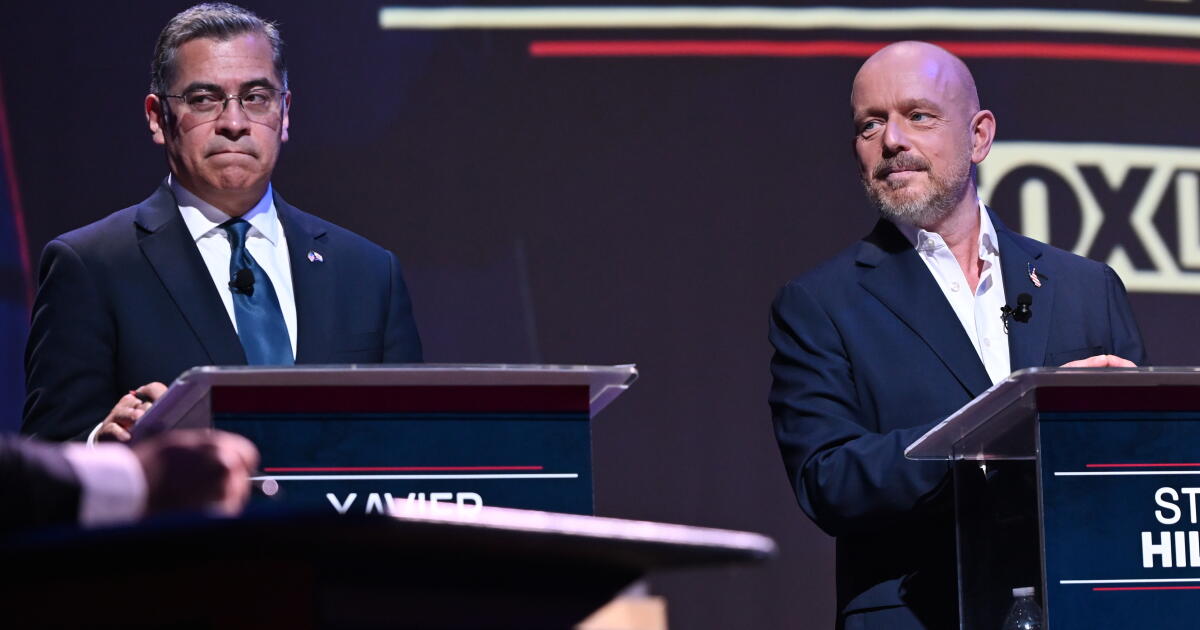
Democrat Xavier Becerra’s rapid rise in California’s race for governor made him a ripe and constant target during a combative nationally televised debate Tuesday evening, his first real test in a high-stakes election that remains highly volatile.

Becerra was ripped throughout the two-hour CNN debate, primarily by his Democratic rivals, who accused him of dodging questions about his stance on single-payer healthcare, falling short as a Biden Cabinet secretary and pocketing a campaign donation from Chevron.

“I think everyone’s invoking my name. It’s nice to hear my name quite a bit,” said Becerra, who served as the U.S. secretary of Health and Human Services during the Biden administration. “I will tell you this: Distorting the facts in your quest to be governor is never good, but using Trump lies to try to damage your opponents is worse, and that’s what we see happening.”

As ballots land in California voters’ mailboxes, the state’s seven top gubernatorial candidates clashed over immigration, President Trump, tax policy, political temperament and a hodgepodge of scandals, mudslinging and other unsavory actions that have risen to the forefront of the hotly contested race.

The snarky, sometimes petulant exchanges reflect how unsettled the race to replace termed-out Gov. Gavin Newsom is, as well as California’s outsize economic and political gravitas on the national and international stage.

Shortly after the debate began, former Orange County Rep. Katie Porter chastised her fellow candidates for their unceasing attacks.

“I can’t believe [the] interrupting and bickering and name calling and shouting and disrespect for everyone up here who’s stepping into public service that anyone wants to talk about my temperament,” said the former Democratic Congress member from Irvine.

Here are the top takeaways from a two-hour debate that somehow seemed even longer:

Becerra takes his lumps

Beccera, who has surged in the weeks before the June 2 primary, faced a barrage of attacks from his Republican and Democratic rivals about his oversight of unaccompanied immigrant minors during his tenure at the Health and Human Services Department and his relationship with a longtime adviser who, along with other consultants, skimmed about $225,000 from one of Becerra’s dormant campaign accounts.

Becerra is not accused of wrongdoing and has been painted as a victim in the prosecutor’s court filings. Still, conservative commentator Steve Hilton, a Republican, suggested Becerra knew about the scheme, and former Los Angeles Mayor Antonio Villaraigosa, a Democrat, questioned why Becerra paid an unusually high fee to one of the consultants named in the indictment.

“It doesn’t pass the smell test,” Villaraigosa said.

Becerra also was accused of changing his position on single-payer healthcare, a top priority of liberal voters that aims to create a healthcare system run and funded by the federal government.

Though Becerra has long supported single-payer healthcare, he recently assured members of the California Medical Assn. — one of the most influential medical lobbyinggroups in California, which has endorsed him — that he would not support it as governor, according to a KQED report.

When asked directly about this, Becerra said “those reports were inaccurate. I continue to be for Medicare for all.”

Becerra sidestepped repeated questions from Porter about whether he supported a state-sponsored single-payer healthcare system in California, saying that he wants to cover “everyone with something like Medicare for all.”

“Covering everyone with something is not single-payer. It’s not even federal Medicare for all. But you won’t say whether you support California having its own state-run single-payer system,” Porter said.

Single-payer healthcare is a telling issue

Democratic billionaire Tom Steyer also has taken heat for changing his position on the issue. The hedge fund founder turned environmental warrior opposed single-payer healthcare during his 2020 presidential bid and now supports a statewide single-payer system called CalCare. He is endorsed by the California Nurses Assn., one of CalCare’s biggest supporters.

A recent analysis by UC researchers estimates CalCare would cost $731 billion to implement in 2027 — a price tag that’s $14 billion larger than all anticipated healthcare spending in California next year.

Villaraigosa said creating a state-sponsored single-payer healthcare system — with a price tag larger than the entire state budget — is a “pie in the sky” proposal. He said he considers healthcare a human right but said a system such as CalCare would require approval from the Trump administration — and that’s not going to happen.

As a former British citizen, Hilton said he is the only candidate who has experienced government-run healthcare.

“As a patient, it nearly killed me,” he said. “That’s another story we don’t have time for. As a policymaker, you end up with the worst patient satisfaction, costs that you can’t afford, taxes, sky-high to pay for it. It is a total disaster.”

Race remains a toss-up

The 2026 gubernatorial contest has been an undulating, unpredictable whirlwind. Unlike every governor’s race for more than a quarter of a century, there is no clear frontrunner, leading to a sprawling field of candidates with notable resumes but little recognition among California’s 23.1 million registered voters.

On Monday, the state Democratic Party released its latest voter survey, which found Hilton and Becerra tied at 18%, and Bianco with 14%. Steyer received the backing of 12%, while support for the other top Democrats in the race — Porter, San José Mayor Matt Mahan, Villaraigosa and State Supt. of Public Instruction Tony Thurmond — was in the single digits. Thurmond did not meet the polling threshold to qualify for Tuesday’s debate or an NBC/Telemundo face-off taking place on Wednesday.

Tuesday’s debate with the leading candidates took place at East Los Angeles College and was hosted by CNN, the first time national media has paid such attention to a California statewide contest since 2010.

Partisan divide on immigration

On the debate stage in Los Angeles, a city that was targeted by Trump administration immigration raids, Bianco criticized California’s sanctuary state laws, which prevent local law enforcement from assisting with federal immigration enforcement.

Villaraigosa defended the undocumented immigrants residing in California, saying they are vital to the economic success of the state. He also accused Bianco of not understanding how California’s sanctuary state policy works — with the former Los Angeles mayor telling him that California has turned over thousands of undocumented immigrants convicted of crimes to federal immigration officials.

Bianco dismissed Villaraigosa’s comment immediately.

“I want Mr. Villaraigosa to tell the mother of the 14-year-old in my county that is dead because of an illegal immigrant that had been deported three times because of DUIs that sanctuary state policy keeps us safe. I don’t think she’s going to agree with you,” Bianco said.

Democrats Porter, Steyer, Mahan and Becerra accused the Trump administration of “terrorizing” Latino communities and targeting people for deportation based on the color of their skin.

Steyer said he would prosecute ICE agents “and the people who send them,” including former Homeland Security Secretary Kristi Noem and Trump advisor Stephen Miller, for illegal racial profiling.

Agreement on need for housing

On the issue of housing, the candidates agreed that California has fallen short of providing enough homes to make the state affordable. Mahan, the mayor of San José, said he has reduced the city’s homeless population by making it easier to build ADUs in people’s backyards, and by reducing red tape for additional types of housing.

Villaraigosa said he built more market-rate, affordable and workforce housing when he was mayor of Los Angeles than anyone else on the stage.

Hilton pressed for building single-family homes in areas of the state with space, rather than forcing more housing into places where residents don’t want them.

Steyer said, “Californians can’t afford to live here,” and there has to be a greater conversation about building more housing, and faster. He also said that cities and counties “do not want new housing” because they can’t afford to pay the health and education costs associated with more residents, and he will solve that issue by closing tax loopholes for big businesses.

Still, housing, homelessness and affordability — top-of-mind issues for California voters — overall received scant attention during the debate, even though CNN debate moderators Kaitlan Collins and Los Angeles-native Elex Michaelson pressed the candidates on the state’s incessant problems with affordability.

Steyer did use the affordability issue to criticize Becerra, currently his greatest political threat, for taking a campaign contribution from Chevron.

“Being in bed with oil companies is a mistake,” Steyer said. “Xavier Becerra has taken the max amount of money from Chevron, and he has said they’re good guys that we need. The truth of the matter is the oil companies are ripping us off at the pump. They’re polluting our air and they’re burning up the climate.”

Becerra responded that it was “a rich response from a guy who made his billions investing in fossil fuels and oil companies, in coal companies.”

“Now he makes the billions, and he has spent more than every other candidate combined in this campaign, using those profits to now try to buy his seat in the governor’s office,” Becerra said.

Where they stand on the proposed billionaire tax

A notable area of policy disagreement among Democrats is a proposal to levy a one-time 5% tax on the wealth and assets of billionaires. Supporters of the measure say they have gathered enough signatures to qualify it for the November ballot.

If approved, the funds would mostly pay for healthcare cuts approved by the Trump administration last year.

Porter said that, although she wants to increase taxes on the state’s wealthiest residents, she doesn’t support the proposal because it is a “one-time tax” that won’t solve the state’s underlying budget issues.

“Yes to a progressive tax code, yes to the wealthy paying more, but this tax is about cheap political points,” Porter said.

Steyer said he would vote for the tax, but he agreed that state leaders ought to go further, including by taxing corporate interests more.

Bianco agreed with Porter that the billionaire tax is a bad idea.

Villaraigosa said California relies too much on the its wealthiest residents to fill state coffers, which leads to “feast and famine” in its budgets. He said businesses and high-earners are leaving the state, and that a plan to tax the wealthiest Americans needs to be enacted at the federal level.

Republican vs. Republican

The two Republicans on stage appeared content to spend their time blasting the Democrats rather than each other.

Bianco was asked if he thought that Republican voters could trust Hilton.

“You’ve called Hilton unethical and dishonest and said that he swindled his way into the Republican side,” Collins said, citing an article from the Atlantic.

“I would never use the word swindled, but the context — yes, I have said that,” Bianco said after some back-and-forth about the particulars of his criticisms. “Have Steve and I disagreed? Absolutely we have.”

He avoided directly criticizing Hilton but said he was the only person on the stage “that their entire existence in their job revolves around honesty, integrity.”

Hilton swerved, saying voters cannot keep voting for the same thing — Democratic leadership — if they want to see change in the state.”

Times staff writers Dakota Smith and Doug Smith contributed to this report.
Source link

Miriam Margolyes says ‘I need help’ as she shares update on 40-year health issue

Miriam Margolyes opened up about the health problems she lives with and issued a warning to others on how one of them could be prevented

Miriam Margolyes has shared an update on a health problem she has lived with for more than 40 years. The 84-year-old revealed she suffers from a long-term shoulder injury that means she is unable to put on a bra by herself.

Reflecting on being filmed in her bra for her latest documentary Miriam Margolyes Made Me Me, she said on The Romesh Ranganathan Show: “I did have that new bra on and it did me the world of good.

I need several people to put it on for me and I’m on my own at the moment.

“The problem is, I’ve got a bad shoulder, I’ve had it for a long time actually because I didn’t know how to fall and I had to fall in a play for six months about 40 years and the rotator cuff doesn’t quite cuff or rotate, whatever it should do.

“So, I can’t put my hands behind my back. I can manage with an apron because it’s lower down, but with a bra it’s a little bit [more difficult] and you have to sort of arrange your t**s into it.

“And I need help basically, so my lodgers do bra duty, but I haven’t got them with me today so I had to do it myself,” the actress shared.

In the same podcast, the Harry Potter star opened up about what she considers the “worst bit” of being in her eighties.

Asked for advice by Romesh’s mother, she said: “The worst bit about being 80 is my weak pelvic floor. I p**s myself all the time and everywhere I go I always take spare knickers because you never know.

“And that’s honestly the truth and I don’t like it and I don’t say it to be funny, I say it because it’s true and it’s a bl***y nuisance,” Miriam added.

“But if I done pelvic floor exercises maybe I wouldn’t be so p***y. So do your pelvic floor exercises,” she warned.

On a more positive note, the actress said the “best thing” about turning 80 is the confidence she now feels when meeting new people.

“The best thing about being 80 and I’m going to be 85 [soon], is not being afraid to meet people, not being afraid to go into a room and just be.

“Sometimes, that’s because people know who I am and they’re sort of starstruck because they think I’m a star, but it gives me confidence.

“I feel more empowered to be and go into a room and talk to people,” she added.

Miriam has faced a number of other health challenges over the years, including undergoing an aortic valve replacement in 2023. She also lives with Spinal stenosis, which has affected her mobility.

She previously told Closer Magazine: “I can’t walk very well, and I’m registered disabled. I use all kinds of assistance. I’ve got two sticks and a walker and they’re such a bore, but I’ve just got a mobility scooter, which is a lot of fun.”

Source link

Clinton Avoids Issue of Congressional OK : Policy: President consults with legislators. ‘Ask my lawyer,’ he says of War Powers Act.

President Clinton consulted congressional leaders Wednesday on his policy toward Bosnia but continued to avoid a firm commitment to seek congressional approval before deciding to send American forces there.

The 1973 War Powers Act requires the President to notify Congress in most cases before sending troops into areas of potential hostilities and requires that the troops be withdrawn within 60 days if Congress does not authorize their presence.

The law was enacted over President Richard Nixon’s veto. Each successive Administration has argued that it represents an unconstitutional infringement on the President’s powers as commander in chief.

During the last 12 years of Republican administrations, Democrats in Congress have made a major issue of support for the War Powers Act. That puts Clinton and his aides in a potentially difficult situation, which they have tried to avoid by evading questions about precisely where they stand.

Clinton continued that approach Wednesday. “Ask my lawyer, I don’t play lawyer,” he said when asked at a White House photo session whether he believes the law is constitutional. “I think it’s worked reasonably well.”

Later, White House Communications Director George Stephanopoulos said: “The President is reviewing the War Powers Act at this time. That is under review by the National Security Council and the counsel’s office.”

White House aides have fallen back on carefully worded pledges to consult with Congress in a manner that is “consistent with” the war powers law but not necessarily “pursuant to” it. Once Clinton decides on a course of action, he “will go to the Congress if it is required,” Stephanopoulos said.

President George Bush followed a somewhat similar path before the Persian Gulf War. Bush argued that he did not need congressional authorization before sending troops to the Gulf but urged Congress to pass a resolution authorizing the use of force against Iraq before the actual war began. Bush insisted, however, that he had the power to go ahead with the attack if Congress voted against him.

Clinton’s less clear-cut position appears to be acceptable to congressional leaders.

Although members of Congress have often touted the War Powers Act as an important safeguard against unbridled executive power, few over the last 20 years have relished the prospect of using it.

One indication of the weakness of the law came in the House on Wednesday when it finally got around to approving a resolution authorizing the sending of U.S. troops to Somalia. The authorization came five months after the troops were dispatched and the day after U.S. forces turned over control of the relief effort to the United Nations.

At a ceremony at the White House to honor troops returning from the African nation, Clinton linked their experiences with the events that may soon unfold in the former Yugoslav republics.

“Your successful return reminds us that other missions lie ahead for our nation,” he said. “You have proved again that our involvement in multilateral operations need not be open-ended or ill-defined, that we can go abroad and accomplish some distinct objectives and then come home again when the mission is accomplished.”

At a later White House ceremony, where he talked about the importance of rapid action on health care reform, Clinton defended his Administration against the charge that monitoring developments in Bosnia-Herzegovina has interfered with his other activities and that it has tried to do too many things at once.

“One of the most challenging things we have to do in this city at this time is to break a mind-set that we have one problem at a time and we’ll get on it and we’ll only think about that,” Clinton said.

Source link

U.S. will issue commemorative passports with Trump’s picture for America’s 250th birthday

The State Department said that it is preparing a limited release of commemorative U.S. passports celebrating America’s 250th birthday that feature a picture of President Trump, who would be the first living president to be featured in the travel document.

The concept for the special passport, including a rendering of Trump’s stern-looking visage, had been under consideration for months before finally being approved late Monday and publicly announced Tuesday. Between 25,000 and 30,000 of the new passports will be available to applicants at the Washington passport office beginning shortly before July 4.

It’s the latest instance of Trump having his name and likeness added to buildings, documents and other highly visible tributes. There are efforts to put Trump’s signature on all new U.S. paper currency, also a first for a sitting president, as well as to include his image on a gold commemorative coin to celebrate the country’s founding.

The commemorative passport will be the default document for people applying in person at the Washington office, although those who want a standard passport will be able to get one by applying online or outside Washington, officials said.

“As the United States celebrates America’s 250th anniversary in July, the State Department is preparing to release a limited number of specially designed U.S. passports to commemorate this historic occasion,” State Department spokesman Tommy Pigott said.

“These passports will feature customized artwork and enhanced imagery while maintaining the same security features that make the U.S. passport the most secure documents in the world,” he said.

The limited release passport will feature Trump’s picture over a gold imprimatur of his signature to an interior page, while the cover will feature the words “United States of America” in bold gold print at the top and “Passport” at the bottom — a reversal of the standard cover.

In addition, a small gold laminate American flag, with the number 250 encircled by stars, will be at the bottom of the back cover.

The Bulwark reported earlier on the commemorative passports.

The only presidents featured in current U.S. passports are in a double-page depiction of Mount Rushmore in South Dakota — George Washington, Thomas Jefferson, Theodore Roosevelt and Abraham Lincoln.

Other depictions include the Statue of Liberty, the Liberty Bell and Independence Hall in Philadelphia, and scenes of the Great Plains, mountains and islands. Current passports also contain quotations from Martin Luther King Jr. as well as Presidents Washington, Jefferson, Roosevelt, John F. Kennedy and Dwight Eisenhower.

The addition of Trump’s picture and signature to the passport book is the newest step his aides have taken to increase the president’s visibility, including adding his name to the U.S. Institute of Peace building and the Kennedy Center performing arts venue.

Trump also has made waves with his plans for a new White House ballroom and a massive arch to be built at one of the entrances to Washington from Virginia.

Lee writes for the Associated Press.

Source link

Virgin Island star forced to look at her own ‘ugly’ vagina after admitting painful issue has stopped her from having sex

A VIRGIN Island star was tonight forced to look at her own “ugly” vagina after admitting to having a painful issue that has stopped her from ever having sex.

The wild Channel 4 reality show is back on the box, and the latest episode continued to shock.

Virgin Island star Joy tonight opened up about a painful condition she has that prevents her from having sex Credit: Channel 4
Joy was then told to look at vagina in a mirror Credit: Channel 4
Joy said she thought her intimate area was ‘ugly’ Credit: Channel 4

Virgin Island sees a group of people, who are yet to take the plunge into the world of nookie, get help from a team of sex gurus, headed up by Dr Danielle Harel and Celeste Hirschman.

On tonight’s episode, it was Joy‘s turn to face her sexual fears.

The 22-year-old event coordinator from Falmouth, suffers from vaginismus – a medical condition that causes the vaginal muscles to involuntarily tighten, which can make sex extremely painful or impossible.

However, Joy was seen heading off for a session with one of the resident sex experts, to try and help her overcome this painful issue.

READ MORE ON VIRGIN ISLAND

virgin territory

Virgin Island cast – meet series 2 participants as Channel 4 show returns


new bonds

Virgin Island signs up bondage expert to coach on kinky S&M romps on new series

Viewers then watched as she was given a mirror by the expert and told to look at her vagina.

The sex guru assured her she was “beautiful” down there, but Joy was not convinced.

Referring to her intimate area, Joy said: “It’s weird because I feel like she looks ugly.”

Before going on Virgin Island, she revealed: “Despite having a Vaginismus diagnosis for years, I had only made minimal progress and was starting to lose hope of ever being healed.”

The new TV star also added that she also signed up to Virgin Island because she wanted to “overcome her religious shame around sex”.

Also on tonight’s show, fans saw shy Bertie, 24, be given a masterclass in sex positions by expert Celeste.

Joy previously revealed how she is weighed down by religious shame Credit: Channel 4 / Rob Parfitt

The event volunteer from Taunton, who suffers from low self-esteem and body confidence issues, was given his first taste of simulating sex by leading expert, Celeste.

The fully clothed pair were seen humping in various positions, in a bid to boost Bertie’s confidence.

At the end of the session a happy Bertie then turned to Celeste and said: “You are an absolute miracle worker! There is no way I’m leaving!”

Before going on the wild Channel 4 reality show, the shy star described himself as a “grade-A virgin” who had never kissed anyone before.

However, he previously admitted that he worried that “sex would feel overwhelming” and was scared of reaching middle age without experiencing intimacy.

Tonight’s episode of Virgin Island also saw Bertie take on a sex positions workshop Credit: Channel 4
Bertie was seen simulating sex on Celeste on tonight’s Virgin Island Credit: Channel 4

This season of Virgin Island sees the 12 participants take on turn-on classes, as well as kink exploration.

Speaking about the new series, expert Celeste said: “I feel like kinks are really really important because so many people have them.

“When I think of it, I think like sex is really play time. And kinks are one way that people play. And a lot of people like to play with power or sensation. 

“And all of that enhances the intensity and arousal and experience. 

“So we wanted people to have access to all these different kinds of feelings.”

Virgin Island continues tonight at 9pm on Channel 4

The show is headed up by sex experts Danielle Harel and Celeste Hirschman Credit: Handout

Source link

Angels: Rodent infestation cleaned at stadium concession stand

Theories abound, but one is fun: Mickey Mouse had hunger pangs and strayed from Disneyland to nearby Angel Stadium where he discreetly raided a forlorn concession stand in a nosebleed section adjacent to the right-field foul pole.

That concession stand — high up in View Level Section 42 — was the only one out of about 160 at Angel Stadium to be flagged by Orange County health inspectors Wednesday for “rodent infestation.”

Not a bad batting average, but with apologies to Mickey, no exceptions are allowed when it comes to rodent infestation and food.

The Angels have been on a road trip all week but a team spokesman said Tuesday that the stand has been cleaned and will be reinspected ahead of a homestand that begins Friday against the New York Mets.

“After receiving guidance from the health department, we acted promptly with our concession partner to resolve the issues at the single stand and expect it to pass inspection and reopen in time for the upcoming homestand,” the Angels said in a statement.

The Orange County Register publishes a weekly list of restaurants and other food vendors ordered to close and allowed to reopen by county health inspectors. Eleven establishments were closed from April 16 to 23, nine for rodent or cockroach infestations, one for insufficient hot water and one for unapproved remodeling. Angel Stadium concessions were on the list.

The team spokesman said rodent activity was not found in any food preparation areas, that it occurred underneath a storage rack and next to a water heater.

The county health services inspection report said that for the stand to reopen, rodent activity must be eliminated and equipment surfaces, food containers, shelves and floors must be cleaned and sanitized. Also, crevices larger than a quarter-inch must be sealed “to prevent vermin harborage.”

The offending stand had most recently passed inspection in June. Rodent issues at Angel Stadium had ceased since a 2007 report in The Times that the stadium had been cited 118 times for vermin violations in the previous two years. Major citations were issued in 33 instances in which rodents or other pests were detected where food was stored, prepared or served.

The Angels blamed the presence of vermin on the stadium’s open-air design and proximity to the Santa Ana River. They said that in 2005 heavy rains drove rats into the stadium and contributed to a high number of citations.

The Angels went to bat against the rats, announcing that cleaning crews would get to work an hour after each game instead of waiting until the next morning.

“The garbage had been sitting in the seating bowl area after games, and that problem is going to be eliminated as of tonight,” said Tim Mead, the Angels spokesman at the time.

By 2009, the team had eliminated the problem.

Until last week, that is.

“The Angels take great pride in delivering a high-quality fan experience at Angel Stadium,” the team said in the statement Tuesday, “including maintaining the cleanliness of our nearly 160 concession locations.”

Source link

BBC viewers issue demand as fans binge-watch Sheridan Smith’s drama in one sitting

BBC’s new crime drama starring Sheridan Smith has been a hit with viewers

BBC viewers are already hooked on the new crime drama starring Sheridan Smith.

The Cage recently made its debut onto our TV screens and a number of fans have already binge-watched all five episodes with many calling for another season.

It comes as no surprise that viewers are gripped on the show. Not only is the cast lead by BAFTA-winner Sheridan but its creator is the BAFTA-winning Tony Schumacher, who created the acclaimed police drama The Responder.

Alongside Sheridan, her co-star Michael Socha also leads the cast of the popular series, which follows two financially struggling Liverpool casino employees who end up confronting dangerous local criminals and the authorities after siphoning money from the casino safe.

Shot in and around Liverpool and Merseyside, the narrative centres on Leanne (Sheridan), a single mother and casino cashier who begins siphoning cash from the safe to rescue her family home.

However, when she discovers that her boss Matty (Muchael), a gambling addict, is engaged in the same activity, both of their lives begin to unravel.

The duo forge an unexpected alliance to conceal their theft, but quickly become entangled with local gangsters and the police.

The synopsis states: “Leanne is the charismatic cashier at an inner-city casino who finds herself threatened with losing the family home and starts skimming cash from the casino safe to secure her family’s future.

“When Leanne discovers her boss Matty is doing the same thing, their lives are set on a collision course; with each other, the local gangster they’re stealing from, and the police.

“As Leanne’s loyalties are pulled in different directions, Matty battles with his inner demons meaning the pair will have to play every hand perfectly.”

Viewers have wasted no time sharing their reaction as one viewer said: “I just finished watching it, so good. I hope they have a season 2.”

Another wrote: “#thecage Just finished binge watching this series and loved it. Great cast especially the performance of Michael Socha.Some great music in there as well.”

A third commented: “Binged The Cage in one sitting, fantastic show! Well done all involved.” Another said: “Binged the whole series tonight. I really enjoyed it, proper good British drama and great cast/performances,”

Meanwhile another added: “Loved it!! It was so good had me on the edge of my seat.” While another called for a second season, writing: “Michael and Sheridan were absolutely phenomenal, can’t wait for series 2?”

You can stream The Cage on BBC iPlayer

Source link

Here’s what to watch for in Tuesday’s California governor debate

Contenders in the race to be California’s next governor will meet on stage Tuesday night for the second of three planned debates before the June 2 primary.

Last week’s meet-up in San Francisco didn’t provide the fireworks or memorable moments the candidates, and many voters, were hoping for — but it did manage to remind us all that ballots will hit mailboxes in coming days and decisions must be made.

Ahead of the forum at Pomona College in Claremont, a trio of our Times columnists — Gustavo Arellano, Mark Z. Barabak and Anita Chabria — weigh in with a cheat sheet on what to look for, what to expect and why it matters.

Chabria: I’ll start us off with the obvious — let’s hope Tuesday gives us at least one breakout candidate who comes with some fire and vision.

After last week’s debate, there was lots of social media posturing about who won and who trolled whom the best. But as one of the six people who actually watched, I can tell you it was mostly bland with no clear winner.

That’s in large part because many of the Democrats have only slivers of daylight between their policies, and ditto for the two Republicans.

So my hope is that at least a single candidate ups their game and comes to voters with not just attacks, but something that inspires, something that sets them apart. This far into the race, that hope is slim, but I’m keeping it alive.

What are your hopes and dreams — and maybe fears — going into this?

Barabak: I know I sound like a broken record. (Google it, kids.) Anita, you and I, in particular, have gone round and round on this one. But I don’t feel a particular need for inspiration from the guys and gal that are running for governor. If I want inspiration, I’ll go back and reread the Rev. Martin Luther King Jr.’s “Letter From Birmingham Jail.” Or listen to a Grateful Dead show from May of ’77.

Give me someone who can work with the Legislature, and as difficult as it may be, President Trump, to get stuff done.

Pursue a “California First” agenda, to borrow a phrase. Put voters and their interests ahead of ego, careerism and personal ambition. Start by pledging, if elected, to serve a full four-year term and not run for president so long as they’re serving as governor.

Of course, that kind of promise can be broken. (See then-Gov. Pete Wilson, who made that vow when he sought reelection in 1994, then turned around and — unsuccessfully — sought the White House in 1995.)

At least we’d have them on the record.

Arellano: I’m all for this morass of democracy. A small part of me wants two Republicans to make it into the general election because the California Democratic Party deserves a meteor-like extinction event. No GOP statewide elected official since Schwarzenegger. Supermajority in Sacramento for most of a decade.

And what do they have to show for their one-party rule? This.

But then I hear Chad Bianco and Steve Hilton mewl, and I’m suddenly hoping alongside Anita that someone vanquishes their foes with an unassailable vision. Problem is, I think all the candidates have reached their ceiling. The only one who has any chance of showing us something new is Xavier Becerra, who needs to drop his Dudley Do-Right shtick for a second and channel the inner cholo we all know is in him.

Instead, he was at a fundraiser in Fullerton over the weekend with professional Latinos — you should’ve been kicking it with my cousins in Anaheim who were watching their Dodgers slaughter the Cubs, loco, because they’re the ones who’ll make or break you.

Chabria: How the first potential Latino governor is failing to excite Latino voters is exactly what I’m talking about. If you don’t give voters something to be excited about, they don’t vote, and our fragile democracy needs every voter it can get.

But if we are forced to vote on nuance, let’s do it informed. Here are some questions I hope these candidates have to answer:

For San José Mayor Matt Mahan, funded in the mega-millions by tech bros, it’s not enough to promise to regulate artificial intelligence, or billionaire influence, for that matter. Tell us what those regulations look like and tell us how you reconcile your own politics with those of big donors such as Joe Lonsdale, co-founder of Palantir, who has called Gen Z the “loser generation.”

For billionaire investor Tom Steyer, who has said he will reform Proposition 13 (which limits property taxes) for corporate land owners: What assurances do homeowners have that they won’t be next?

For former Rep. Katie Porter, polling third among Democrats, the clock is ticking — is there a point where you will drop out and endorse a fellow candidate if you can’t break through? Same-ies for state schools superintendent Tony Thurmond and former L.A. Mayor Antonio Villaraigosa, who are included in this debate but polling in the single digits.

And I agree with you, Gustavo, Becerra is coming across as resolutely bland, but to Mark’s point, he’s using that to position himself as drama-free and experienced. So in an era when fraud and abuse are the words of the day, how does Becerra explain not catching fraud in his own office?

Mark and Gustavo, what are the topics you hope candidates will be grilled on?

Arellano: Slight correction, Anita — California already had a Latino governor: Romualdo Pacheco, the lieutenant governor who replaced Newton Booth in 1875 when the latter became a U.S. senator. Pacheco — a Latino Republican! — served all of 10 months before becoming a Congress member.

See, Californians? Political musical chairs is as much a part of our state as free-spending oligarchs — but enough about Steyer.

Issues? Immigration, of course. I want each one to address the state’s undocumented immigrants for 90 seconds in whatever matter they choose. Water: Believe in climate change or not, but our supply is shrinking faster than the gubernatorial chances of Thurmond. And since I believe that the more random the question, the more you learn about who a candidate truly is: What’s the best song about California, and why? Anyone who says “California Girls” or “California Gurls” deserves disqualification, even if both songs rock.

Barabak: Not an issue, per se. What I’d like to see is a bit of backbone.

The next governor is going to have to make some tough decisions, especially around spending priorities and/or cuts to the state budget. Inevitably, the next governor is going to make some people unhappy. And I’m not talking about just those members of the opposite party, or folks who didn’t vote for them.

So I’d like each of them to name an issue where, for the good of the state, they’re willing to take on their friends and allies, knowing they’ll be displeased. If you’re a Democrat, name something you would do that would, say, tick off organized labor. And for Republicans Bianco and Hilton, what’s an area where you’re willing to say to Trump, “Sir” — the president imagines everyone bowing and calling him sir — “you’re dead wrong about this and California needs to go its own way, whether you like it or not.”

Arellano: Good luck seeing any candidate buck their masters. I think we need to lower our expectations way, way, well, lower. So a simple question to conclude: Who needs to do the most tonight besides Mahan’s beard? I think it’s my fellow Orange Countian, Katie Porter. She’s now to the right of Steyer and left of Becerra, which means she needs to peel off supporters from both of them and grab undecideds if she wants to advance. Not sure how she can pull that off — but if anyone can bring necessary fire, it’s her.

Chabria: Porter definitely has a lot on the line.

One standout moment for her, Steyer or Becerra — good or bad — could tilt this very-much-undecided race — not so much because people will be watching, but because it will fuel the social media and advertising sure to follow. These next two debates are high-stakes, not just to avoid a Biden performance, but to do something, anything, that fires up momentum.

Politics ain’t beanbag, as the old saying goes, and it’s time to bring the heat. So in the spirit of Gustavo’s song request, I’ll leave it with these lyrics from the Rivieras (or the Ramones, if you prefer): We’re out there having fun, in the warm California sun.

Barabak: Not to be the pooper at the party but I think we shouldn’t overstate the import of tonight’s debate. For one thing, as Anita suggested, the audience will be exceedingly small — minuscule, even, relative to the state’s 23 million registered voters.

We know, from experience, that most folks will take away what they do based not on the debate itself but rather the coverage of it and whatever soundbites, memes, chatter and advertising it produces — and that’s only to the extent people are paying attention.

So, yes, what’s said and done in Pomona, will matter some. But we’re still five weeks away from election day, and I suspect many folks will be waiting at least another week or three to start focusing on the race and finally make up their minds.

I’ll end with something that Jerry Garcia sang: All good things in all good time.

Source link

Coupang issue affects South Korea-U.S. security talks

National Security Adviser Wi Sung-lac (L) talks with Foreign Minister Cho Hyun during a Cabinet meeting, chaired by President Lee Jae Myung, at the presidential office Cheong Wa Dae in Seoul, South Korea, 06 April 2026. Photo by YONHAP / EPA

April 24 (Asia Today) — South Korea’s national security adviser Wi Sung-lac said Thursday that the Coupang regulatory dispute is affecting security consultations between South Korea and the United States, while stressing that Seoul is seeking to keep the corporate matter separate from alliance negotiations.

Wi made the remarks during a briefing at a local press center in Hanoi, where he accompanied President Lee Jae-myung on a state visit to Vietnam.

“The Coupang issue is a corporate issue,” Wi said. “But it is true that the Coupang issue is affecting security consultations between South Korea and the United States.”

His comments came after 54 Republican members of the U.S. House of Representatives sent a letter to South Korean Ambassador to the United States Kang Kyung-wha, urging Seoul to end what they called discriminatory regulatory actions against U.S. companies, including Coupang.

Wi said South Korea has been discussing the matter with Washington and has argued that linking the Coupang issue to security talks is not desirable.

“Our position is that the Coupang matter should proceed according to legal procedures, while security negotiations should move forward as security negotiations,” Wi said.

He said delays in security consultations are “also true” and added that such delays do not help the broader alliance.

“We believe they should not be delayed and should resume promptly,” Wi said.

Wi said the security negotiations have their own structure and balance, and Seoul believes they can proceed separately from the corporate dispute.

He also said Seoul has reviewed the letter from U.S. lawmakers and has contacted relevant members of Congress to explain the government’s position.

“We are making efforts to provide explanations and understanding,” Wi said. “There were letters before this as well, and we explained those matters too.”

South Korea’s foreign ministry said Thursday that investigations and measures involving Coupang are being conducted under domestic law and due process, without discrimination based on nationality.

Wi said Seoul will continue efforts to explain its position but acknowledged that U.S. lawmakers may express concerns about American companies.

“Whether that issue is connected to security consultations is another matter,” Wi said. “We are trying to respond to the two issues separately.”

— Reported by Asia Today; translated by UPI

© Asia Today. Unauthorized reproduction or redistribution prohibited.

Original Korean report: https://www.asiatoday.co.kr/kn/view.php?key=20260424010007786

Source link

Amnesty International and rights groups issue a World Cup travel advisory for the U.S.

Amnesty International and dozens of U.S. civil and human rights groups issued a “ World Cup travel advisory” Thursday, warning tournament visitors of “rising authoritarianism and increasing violence” in the United States during President Trump’s aggressive immigration enforcement.

The groups said the advisory was necessary “in light of the deteriorating human rights situation in the United States and in the absence of meaningful action and concrete guarantees from FIFA, host cities, or the U.S. government.”

The advisory says visitors may be arbitrarily denied entry to the country, detained in “inhumane” conditions or subjected to invasive phone and social media searches. It points to the aggressive immigration surges in cities including Los Angeles, Chicago and Minneapolis that led to accusations of racial profiling and the violent suppression of protests.

The message was condemned by tourism officials, who said the groups were threatening the livelihoods of service industry workers in an attempt to achieve their political goals.

Geoff Freeman, president & CEO of the U.S. Travel Association, said there are legitimate concerns about U.S. entry policies but they’re being blown out of proportion. There were 67 million international travelers to the United States last year, he said in a statement.

“The notion that visiting America poses a meaningful safety risk is not a good-faith warning, it’s a political tactic designed to cause economic harm,” Freeman said.

A FIFA spokesperson pointed to several statements and policies, including the federation’s governing documents, which say, “FIFA is committed to respecting all internationally recognized human rights and shall strive to promote the protection of these rights.”

The U.S. has seen a decline in international travelers since Trump returned to the White House last year and offended U.S. allies with talk of making Canada a U.S. state, taking control of Greenland and questioning the value of NATO. The tourism industry is counting on a major boost from World Cup visitors, even as Trump’s travel ban for citizens of 19 countries has injected further uncertainty.

The administration is betting that its push to expedite visa processing for visitors and excitement about the tournament will outweigh concerns that Trump’s immigration messaging undercuts the theme of global unity that the World Cup is meant to represent.

The tournament kicks off June 11 with games spread across North America, including 11 stadiums in the U.S. along with two in Canada and three in Mexico.

Cooper writes for the Associated Press.

Source link

MasterChef fans issue same complaint over latest show challenge ‘are you for real’

MasterChef was back with the first quarter-final of series 22 on Thursday night

MasterChef fans were left scratching their heads over Thursday night’s quarter-final challenge.

Series 22 sees celebrated chef Anna Haugh and restaurant critic Grace Dent take over from Gregg Wallace and John Torode as judges. The pair will test 48 of the country’s best amateur cooks with an array of spectacular challenges.

On Thursday’s first quarter-final of series 22, the first challenge saw the amateur home cooks tasked with creating pancakes, making the most of the fresh produce on offer.

However, it was the second challenge that left viewers baffled. During the episode, legendary food critic Jay Rayner joined the show as a special guest as he set a task for the cooks.

Jay, 59, said: “The challenge I’ve set you sounds very simple. I’ve asked you to make a salad. But we do not want a limp bowl of lettuce, we want structure, texture, we want a killer dressing… something that will rock us back on our feet.” The chefs were then given 90 minutes to create their salads.

However, viewers were left baffled over the salad challenge taking to Twitter, now X, to share their thoughts. One person said: “#masterchef A salad …, a salad, are you for real” to which another account put: “Salad? Or a mix of things #MasterChef.”

Elsewhere, another fan referenced The Simpsons as they joked: “#Masterchef You don’t win friends with salad, you don’t win friends with salad…”

Another baffled viewer simply commented: “A salad?! #MasterChef” while a different fan quipped: “No good story ever started with ‘I was having a salad and then'”.

Following the challenge, Jhané and Sabina left Anna, Grace and Jay blown away with their incredible salads. Jhané opted for a Thai-inspired salad with grilled pork, pork skin, sugar snap peas, lettuce, mint, fennel and thai basil. Jhané served it with deep fried rice paper and a lime sesame dressing, which was praised for being a ‘clever’ presentation.

Guest Jay was left delighted as he gushed: “This is exactly what I was hoping for when I set the salad challenge!”

Meanwhile, Sabina also impressed with her ‘harmony salad’, which was spiced black pea falafel, gem lettuce, carrot, pomegranate, salted chicken skin, beetroot quail eggs, puffed rice and curry leaves. It was served with a confit garlic and mustard oil dressing. Jay praised the salad for being “amazing”.

After all the contestants had shown off their creations, Jay admitted: “It was a tough challenge asking them to make a salad, some of them embraced it brilliantly!”

At the end of the show, it was revealed that Jhané and Sabina had sailed through to the next round, they were joined by fellow contestant Jim.

MasterChef season 22 is available to stream on BBC iPlayer

Source link

‘Clayface’ trailer: Everything to know about DC’s first horror movie

The DC universe is going full on body horror.

DC Studios released its first trailer for “Clayface” on Wednesday, giving audiences a glimpse of the gruesome origins of the shape-shifting Batman villain.

Set to an eerie rendition of the Flaming Lips’ “Do You Realize??,” the teaser flashes among various images of up-and-coming Hollywood actor Matt Hagen (portrayed by Tom Rhys Harries) before and after a violent encounter as the camera slowly zooms toward his haunted eyes and bloody, bandaged face as he is recovering on a hospital bed.

The clip also includes footage of Hagen’s clay-like, malleable face, which he appears to gain after some sort of scientific procedure.

According to the DC description, “Clayface” will see Hagen transformed into a “revenge-filled monster” and explore “the loss of one’s identity and humanity, corrosive love, and the dark underbelly of scientific ambition.”

“Clayface,” set for an Oct. 23 release, will be the third DCU film to hit theaters since James Gunn and Peter Safran took over DC Studios and reset (most of) its comic book superhero franchise. The studio’s upcoming slate also includes “Supergirl,” which will hit theaters June 26, as well as “Man of Tomorrow,” the sequel to Gunn’s 2025 blockbuster “Superman,” announced for 2027.

Who is Clayface?

Clayface is a DC Comics villain usually affiliated with Batman. The alias has been used by a number of different characters over the years, but they all usually possess shape-shifting abilities due to their clay-like bodies. Created by Bill Finger and Bob Kane, the original Clayface was a washed-up actor turned criminal who first appeared in a 1940 issue of “Detective Comics.”

Matt Hagen was the name of the second Clayface, who first appeared in an issue of “Detective Comics” in the 1960s. He was the first to have shape-shifting powers, which he gained after encountering a mysterious radioactive pool of protoplasm.

Other versions of Clayface have been introduced in various media since.

Who is in ‘Clayface’?

The upcoming film stars Tom Rhys Harries as rising Hollywood actor Hagen. The cast also includes Naomi Ackie, who is seen in the trailer, reportedly as the scientist Hagen turns to for help following his disfigurement. Also set to appear are David Dencik, Max Minghella and Eddie Marsan, as well as Nancy Carroll and Joshua James.

Who are the ‘Clayface’ filmmakers?

Director James Watkins, known for horror films including “Speak No Evil” (2024), is helming “Clayface.” The script was written by prolific horror scribe Mike Flanagan (“The Haunting of Hill House,” “Doctor Sleep”) and Hossein Amini (“The Snowman”).

The producers are Matt Reeves, Lynn Harris, James Gunn and Peter Safran. Exective producers include Michael E. Uslan, Rafi Crohn, Paul Ritchie, Chantal Nong Vo and Lars P. Winther.

Source link

RFK Jr. goes before the Senate. One lawmaker’s competing loyalties will be on display

Bill Cassidy’s roles as a lawmaker, a doctor and a political candidate will collide on Wednesday as he questions Health Secretary Robert F. Kennedy Jr. in two high-stakes Senate hearings.

The Louisiana Republican chairs one of the Senate committees that oversees Kennedy’s department and sits on another, giving him two chances to interrogate the secretary about his plans for an agency responsible for public health programs and research. As a doctor, Cassidy has clashed with Kennedy’s anti-vaccine ideas even though he provided crucial support for the health secretary’s nomination last year.

At the same time, Cassidy is fighting for his political future in next month’s primary in Louisiana, where President Trump has endorsed one of his opponents in an unusual attempt to oust a sitting senator from his own party.

How Cassidy handles the hearings could affect his chances at a pivotal moment of his reelection campaign and set the tone for how Congress oversees the nation’s health agenda at a time of rampant distrust and misinformation.

Cassidy hasn’t faced Kennedy in public since September. In the subsequent months, Kennedy has attempted a dramatic rollback of vaccine recommendations that, if not blocked by an ongoing lawsuit, could undermine protections against diseases like flu, hepatitis B and RSV.

After a backlash, Kennedy has also pivoted to spending more time talking about less controversial topics like healthy eating — albeit with his own spin, including sharing exaggerated claims that various ailments can be cured by diet alone.

Cassidy will have to decide on Wednesday whether to grill Kennedy on vaccines, an issue deeply important to him, or put their differences aside and prioritize loyalty to the Trump administration.

“He’s taken a risk showing any sort of resistance to RFK,” said Claire Leavitt, an assistant professor at Smith College who studies congressional oversight. “He may pay an electoral price for that.”

Cassidy has long advocated for vaccines

Cassidy has spent years walking a political tightrope. He’s one of the few Republican senators who voted to convict Trump during an impeachment trial after the Jan. 6, 2021, attack on the U.S. Capitol.

As a liver doctor, he advocated for babies to receive hepatitis B vaccines shortly after birth, a step that could have prevented the disease in his patients. But when Trump nominated Kennedy, a longtime anti-vaccine activist, Cassidy supported him. He did so after securing various commitments, including that Kennedy would work within the current vaccine approval and safety monitoring system and support the childhood vaccine schedule.

The vote for Kennedy did not appear to mollify Trump. The president endorsed U.S. Rep. Julia Letlow, one of Cassidy’s two primary opponents.

Cassidy also faces opposition from Kennedy’s allies in the “Make America Healthy Again” movement, a group that includes both anti-vaccine activists and a wide variety of other crusaders for health and the environment. The MAHA PAC, aligned with Kennedy, has pledged $1 million to Letlow’s campaign. While the organization hasn’t publicly said so, some have questioned whether the support is partly in retaliation against Cassidy for criticizing Kennedy’s vaccine policy agenda.

“I’m not really sure what MAHA’s beef is,” Cassidy told reporters earlier this month. “Let me point out that I am the reason that Robert F. Kennedy is now the secretary of HHS. He would not have gotten there otherwise.”

Cassidy argues that he has “strongly supported” the MAHA agenda, especially when it comes to the fight against ultraprocessed foods. However, the physician-turned-senator acknowledged that he and MAHA have “disagreed on vaccines.”

“We’ve seen, frankly, that I am right,” Cassidy added, pointing to recent measles-related deaths of children who were not vaccinated.

At a hearing in September, he slammed Kennedy’s decision to slash funding for mRNA vaccine development. He interrogated Kennedy over his attempt to replace members of a vaccine committee, suggesting the new members could have conflicts of interest. He also raised concerns that Kennedy’s vaccine policy decisions could be making it harder for Americans to get COVID-19 shots.

Later that month, Cassidy convened a hearing featuring former U.S. Centers for Disease Control and Prevention Director Susan Monarez, who was ousted by Kennedy less than a month into her tenure after they clashed over vaccine policy, and former CDC Chief Medical Officer Debra Houry, who resigned in August citing an erosion of science at the agency.

“I want to work with the president to fulfill his campaign promise to reform the CDC and Make America Healthy Again. The president says radical transparency is the way to do that,” Cassidy said at the time.

Experts say Cassidy’s vaccine stance might not hurt him

Political consultants said they expect Cassidy’s primary opponents, Letlow and Louisiana Treasurer John Fleming, to seize on any sound bites from Wednesday’s hearings that can make Cassidy seem at odds with the Trump administration.

But Dorit Reiss, a vaccine law expert at UC Law San Francisco, said the political risk of advocating for vaccines may not be as strong among Republicans as some people assume.

“He’s probably not alienating voters by focusing on the issue and calling it out,” she said.

Louisiana political consultant Mary-Patricia Wray said she thinks most diehard MAHA voters already know who they are voting for, and it’s probably not Cassidy.

Instead, she said, he may still be able to appeal to Democrats who switch their party registration to vote in the primary, as well as a wide swath of still-undecided Republican voters who care about the same health care affordability issues he advocates for every day in Congress.

“If I was advising Bill Cassidy, I would tell him your goal here is not to get out unscathed,” Wray said. “Your goal is to prove that your consistency on issues regarding public health is an asset in your campaign, not a detriment.”

Election outcome will shape future oversight of HHS

Also at stake if Cassidy doesn’t make it to November’s general election is what will happen to his responsibility to oversee the massive U.S. Department of Health and Human Services as the chair of the Senate Health, Education, Labor and Pensions committee.

Leavitt, the Smith College professor, said seniority typically plays the most important role in who chairs Senate committees. She said another Republican in today’s increasingly hyperpartisan Congress may not be as willing as Cassidy to check Kennedy’s power.

Reiss, the vaccine law expert, said she wishes Cassidy had done more hearings or introduced legislation to rein in Kennedy. And she said the senator bears the blame for allowing Kennedy to bring unfounded vaccine fears into the government in the first place.

“His original sin, of course, was voting for Kennedy at all,” Reiss said.

Swenson writes for the Associated Press. AP writer Sara Cline contributed to this report.

Source link

Mum ‘humiliated’ at Ryanair boarding gate as crew take issue with seven-year-old’s bag

A mum described the moment she was charged £55 for her daughter’s suitcase as ’embarrassing and humiliating’ after Ryanair staff claimed it was too big for the hand luggage sizer

A mum who was forced to pay £55 for her daughter’s suitcase on a Ryanair flight says she was caught out by the airline’s “petty” wording.

Luana Botas was travelling home from a six-day trip to visit family on April 3 when she was stopped at Budapest Airport over her daughter’s case.

The 43-year-old was told to put her seven-year-old’s hardshell case into the hand luggage sizer. She was then ordered to pay £55 when it was too large.

Project manager Luana however pointed out that the airline’s website says Trunki or “Trunki-style” cases can exceed the restrictions and still be accepted on board. A Trunki is a ride-on style suitcase aimed at toddlers.

The Ryanair website states children aged between two and 11 are allowed one Trunki case that can exceed the dimension limits of a small bag – 40 x 30 x 20cm. It says this extends to other brands with “similar dimensions” as well as Trunki cases.

The mum-of-one accepts that her daughter Maia Robinson was carrying a case that was 48 x 26 x 33cm, but believes it fits the description. Ryanair, however, says this exceeds the dimensions of a Trunki suitcase (46 x 20 x 31 cm).

Luana says she was fine travelling through Birmingham Airport, describing the moment as “embarrassing and humiliating”. She said: “I went through Birmingham Airport and no one bat an eyelid, it was absolutely fine.

“We had two backpacks and they were pretty much the same size. On Ryanair’s website, there’s a section that says kid’s luggage, like Trunki and other similar brands, are exempt from the strict limit.

“We were going through the boarding procedure at Budapest when a staff member signalled for me to put my daughter’s luggage in the sizer. My bag was fine, even though it was the same size.

“[My daughter’s case] only went halfway and because it’s a hard shell, it didn’t go all the way down. She asked me to pay the surcharge.

“I tried to explain to her that I had no issues going from Birmingham to Budapest and that a Trunki is allowed. I couldn’t get through to her in any way and boarding was almost complete.

“I said ‘even though I’m trying to explain to you that this is your own policy, you’re still going to charge me? And she said ‘yes I need a passport please’.”

Luana, from Birmingham, continued: “We went through the very embarrassing and humiliating procedure of me paying for a service that was exempt.

“I was genuinely in such shock. This was just a little pull-along for my daughter to enjoy.

“The policy on Ryanair’s website says similar brands are exempt. This was [bought online] and [the website] said it was under-seat cabin approved.

“It’s wrong to have a policy that you make an exemption for and then still charge me.”

A Ryanair spokesperson said: “This passenger’s bag exceeded the permitted dimensions, and they were correctly required to pay a standard gate baggage fee (£55) by the gate agent at Budapest Airport.”

Source link