Trump touts Hamas disarmament deal, but uncertainties remain
WASHINGTON — President Trump reaffirmed Friday that Hamas has agreed to disarm and relinquish control of Gaza to a newly created Palestinian government, a milestone he cast as a critical step in the long-stalled effort to end the war in the territory.
The agreement, which the president initially announced in a Truth Social post Thursday evening, capped months of negotiations overseen by the Board of Peace, a body created by the Trump administration last year to oversee talks with Hamas and Israel over the future of Gaza.
“As disarmament is completed, Israeli forces will withdraw, and the International Stabilization Force will work with a new Palestinian police force to take responsibility for Gaza being safe for its residents and its neighbors,” Trump wrote.
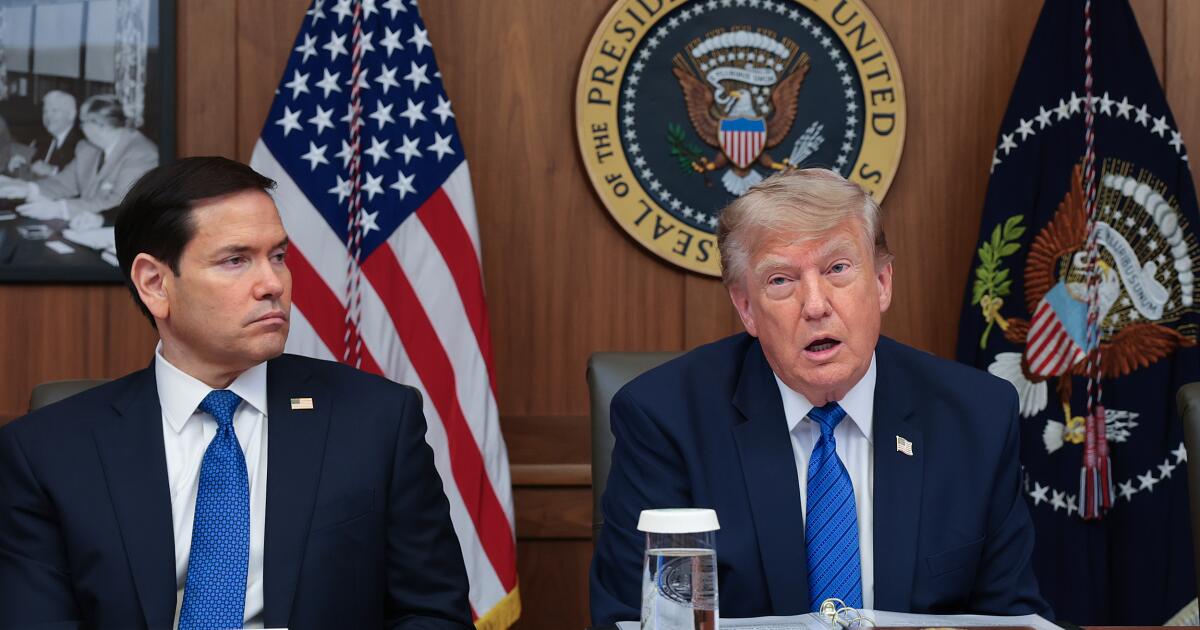
But uncertainty looms over the agreement, with Hamas saying Friday it would begin disarming only if Israel halts all military operations in Gaza and Israeli officials expressing skepticism about the deal in news interviews Friday. Trump, during a Cabinet meeting Friday at Camp David, Md., acknowledged the possibility of the deal going awry, saying it is likely the agreement’s implementation could go through its “ups and downs.”
“It’s a very complex situation over there,” Trump said. “The people are very complex and difficult.”
Trump added that Israel was “very happy” with the deal. He also said that the Board of Peace intends to take possession of Hamas’ weapons when it relinquishes them.
Trump, who faces public pressure over his handling of a broadening war in Iran and the economic impact it is having on Americans, downplayed the unpopularity of his policies and said he hopes Americans vote for Republicans when they head to the polls in November.
At the same time, he defended his military strategies in the Middle East, even as he was unable to provide a clear timeline for when the conflict in Iran will end.
“We’re in for five months, and we have obliterated their military capacity. Again, they’ve got some left, but soon they won’t have some left,” Trump said. He added that he was “losing faith” in Iranian leaders amid negotiations because he said they “lie.”
Trump, however, argued that the deal with Hamas is an indication that his administration’s strategy will succeed in Iran.
“Nobody thought that it would be possible to disarm Hamas. That shows you how much success we’re having with Iran, because if you went four months ago or five months ago, a deal like that would have been impossible,” Trump said.
Hamas, for its part, has confirmed it would begin disarmament, but in a statement Friday said it was contingent on Israel halting all attacks in Gaza and fulfilling provisions of the first phase of a ceasefire deal that was signed in October 2025.
Hamas, which said it was approaching the proposal with “responsibility and positivity,” also took the unprecedented step of agreeing to a sequenced decommissioning of a range of armory, described to include: “police weapons, heavy weapons, military production sites, weapons depots and tunnels, personal weapons and the weapons of militias.”
But the group linked it to a raft of processes, including Israel’s withdrawal from the enclave and the establishment of an independent Palestinian state — both nonstarters for Israel’s government.
Israeli Prime Minister Benjamin Netanyahu had yet to comment on the proposal by Friday afternoon, but several Israeli officials expressed skepticism if not outright rejection of the proposal.
“In response to various publications this morning about political progress in the Gaza Strip, Israel has reiterated that there will be no IDF withdrawal from the current Yellow Line without the genuine disarmament of Hamas,” a senior Israeli official was quoted as saying in the Times of Israel newspaper.
The official referred to the demarcation line behind which Israeli troops withdrew under the ceasefire agreement. When the agreement went into effect in October 2025, the Yellow Line marked off territory comprising about 53% of Gaza. But Israel has repeatedly shifted the line westward, swallowing up more of the enclave with the intent to control 70% of it, according to Israeli officials.
Speaking to CNN on Friday, Danny Danon, Israel’s ambassador to the United Nations, said Israel would have to verify what Hamas is doing with regard to disarmament, “not what they are saying.”
“Disarmament means the weapons are out of Gaza,” he said. He added that the idea of a Palestinian state was “not on the table.”
And in an example of the fervent opposition the deal is likely to face in Israeli political circles, Israeli National Security Minister Itamar Ben-Gvir — a hard-line member of Netanyahu’s government — dismissed the deal as “unacceptable” and that suspending Israel’s attacks on the enclave would only allow Hamas to reconstitute itself.
“The assassinations in Gaza must continue, the encouragement of [Palestinian] emigration [from the enclave] must happen. Israel must win,” he said in a post on Telegram.
The agreement as laid out by the Board of Peace involves a 15-point “roadmap” with several provisions, including security, governance, reconstruction, the deployment of international peacekeeping forces and Israeli withdrawal. Those points, which were agreed to Thursday, are meant to carry out Trump’s broader plan for the territory.
All parties reaffirm their commitment to the “comprehensive plan” announced by Trump in September, which involves stopping the fighting in Gaza, complete Israeli withdrawal from the strip, and “a credible political path that achieves self-determination and [Palestinian] Statehood.”
Israel should “without delay” fulfill its remaining commitments in phase one, including cessation of military attacks. Hamas too should stop all attacks “without delay,” the agreement says.
Once those milestones are reached, the Palestinian-led National Committee for the Administration of Gaza, or NCAG — which Israel has thus far prevented from entering Gaza — would take on responsibilities in the strip, along with an International Verification Committee that will certify progress on both sides.
The NCAG administers the police force and controls its weapons, and will eventually become the only party in Gaza with arms. It will also administer and implement a process to decommission and store heavy weapons, military production sites, depots of weapons, and tunnels.
The process will be linked to a phased Israeli withdrawal.
Regional and Western governments welcomed the proposal’s announcement while acknowledging the difficulties facing its implementation. It also brought a measure of cautious hope in Gaza, where more than nine months after the ceasefire was signed conditions remain nightmarish.
Since Oct. 7, 2023, when Hamas launched an assault on southern Israel in which 1,200 people were killed and 250 others were kidnapped, the enclave has been the target of a furious Israeli military campaign that has killed more than 73,000 people and displaced nearly all of Gaza’s 2.1 million residents. Much of Gaza is a rubble-encrusted moonscape, spurring rights groups and the U.N. to accuse Israel of genocide.
Despite Trump’s optimism, the deal comes at a delicate moment for Israel’s leaders, as the country gears up for an acrimonious election fight at the end of October that could see Netanyahu — who is on trial for corruption charges and could be imprisoned if he loses — dethroned.
Already trailing in the polls, he can ill afford appearing soft on Hamas, especially among a pool of candidates eager to excoriate him for his post-Oct. 7 legacy.
“The outrageous gap between Netanyahu’s promises and reality is exposed. After the heavy prices, the fallen and the wounded, he has capitulated in his political weakness without achieving the war’s objectives, instead of ending it from a position of strength,” said Gadi Eisenkot, an election contender and the former military chief of staff responsible for the Dahiyah Doctrine, the Israeli military’s strategy of targeting large-scale civilian infrastructure.
“The State of Israel must not accept a reality in which Hamas survives, rearms, and waits for the opportunity to carry out the next massacre!” Eisenkot wrote on X.
At the same time, with Trump already facing criticism for joining the Israeli leader in assaulting Iran, Netanyahu can’t be seen as scuttling a Trump-brokered agreement in Gaza.
Ceballos reported from Washington, Bulos from Beirut.