Malak Mahmoud, the heavily pregnant woman filmed being thrown to the ground by a Dutch police officer as her Palestinian husband from Gaza was detained, has spoken to Al Jazeera.
Police in Zeist issued a statement saying they are reviewing the use of force and have opened an investigation, but have not responded to Al Jazeera’s request for comment.
A Gaza-bound ship carrying aid has begun its voyage from Sweden, weeks after Israeli forces abducted activists on a similar mission in international waters. The ‘Handala II’ vessel says it is carrying humanitarian supplies for Palestinians to break the Israeli blockade on the enclave.
At least two Palestinians were killed and around a dozen wounded when an Israeli air strike hit a crowded cafe at Gaza’s seaport. Witnesses said people had gathered there to escape the heat and enjoy a public holiday, as attacks continue despite an October ceasefire.
A provision in a bill before the United States Congress could tie the American and Israeli militaries far more closely together, deepening their cooperation on weapons research, production and technology.
The proposal, titled the “United States-Israel Defense Technology Cooperation Initiative,” appears as Section 224 of the House Armed Services Committee’s version of the fiscal year 2027 National Defense Authorization Act (NDAA), the annual US defence policy bill.
Recommended Stories
list of 2 itemsend of list
The measure is still at an early stage. The NDAA is passed by Congress each year to set US military policy and authorise defence programmes and spending levels.
If enacted, the provision could mark a major change in one of the world’s closest military relationships, shifting the two countries from a partnership centred largely on American military aid towards one in which their defence industries are more deeply intertwined.
Section 224 would require the US defence secretary to appoint an “executive agent”: a single official to coordinate military cooperation between the US and Israel.
That work would cover joint research and development, the shared production of weapons, and the linking of military systems and data.
“What Congress is trying to do now is find different ways of entrenching the relationship so deep in America’s own defence industrial base that it’s impossible to root it out,” Josh Paul, a former US State Department official and founder of the advocacy group A New Policy, said about the controversial provision.
“A new section of law in the National Defense Authorization Act (NDAA) would give Israel unprecedented access to American technology and would force the United States military to integrate Israeli defence technologies into our own critical military supply chain, giving Israel incredible leverage over America’s own defence priorities,” he added in a video posted on social media on Friday.
The two countries already build missile defence systems together, such as the Iron Dome.
The bill would extend their joint work into many more areas of modern warfare, from artificial intelligence (AI) to drones and cyber operations.
In February, US and Israeli forces attacked Iran together, triggering five weeks of war; Iran struck back at Israel and at US bases in the Gulf before a ceasefire took hold in April.
Israel is also facing genocide allegations in a case brought by South Africa at the International Court of Justice, the UN’s top court, over its war on Gaza.
Decades of support
The bill must first clear the House Armed Services Committee, which is due to take it up in early June, and then pass the full House and the Senate.
It was proposed by the committee’s Republican chairman, Mike Rogers, and its most senior Democrat, Adam Smith, giving it support from both main parties, even as opinion polls suggest growing opposition among American Democrats and some Republicans to further military support for Israel.
The US has supported Israel’s military for decades.
Since 2008, US law has required Washington to protect Israel’s “qualitative military edge”, keeping its forces stronger and more advanced than those of any rival in the region, on the grounds that a small country must rely on better weapons rather than greater numbers.
Under the current aid deal signed during the administration of former President Barack Obama, Washington provides Israel with about $3.8bn a year in military assistance. The 10-year agreement runs through 2028.
Israel is the largest recipient of US foreign aid since 1948, almost all of it now military and worth well over $300bn when adjusted for inflation.
The nature of that support may now be changing. Israeli Prime Minister Benjamin Netanyahu said recently that he wants to end Israel’s reliance on US military aid within 10 years, saying his country had “come of age”.
Closer cooperation between the two defence industries, rather than cash, would likely fit that goal.
A Palestinian doctor has been killed and three people injured in an Israeli attack in central Gaza, as Israeli settlers attacked Palestinian homes and property in northern and southern parts of the occupied West Bank.
The attacks across Palestine on Saturday, the fourth day of the Muslim holiday of Eid al-Adha, came amid continued Israeli violations of a United States-backed “ceasefire” implemented in October aimed at halting Israel’s genocidal war on Gaza.
Recommended Stories
list of 3 itemsend of list
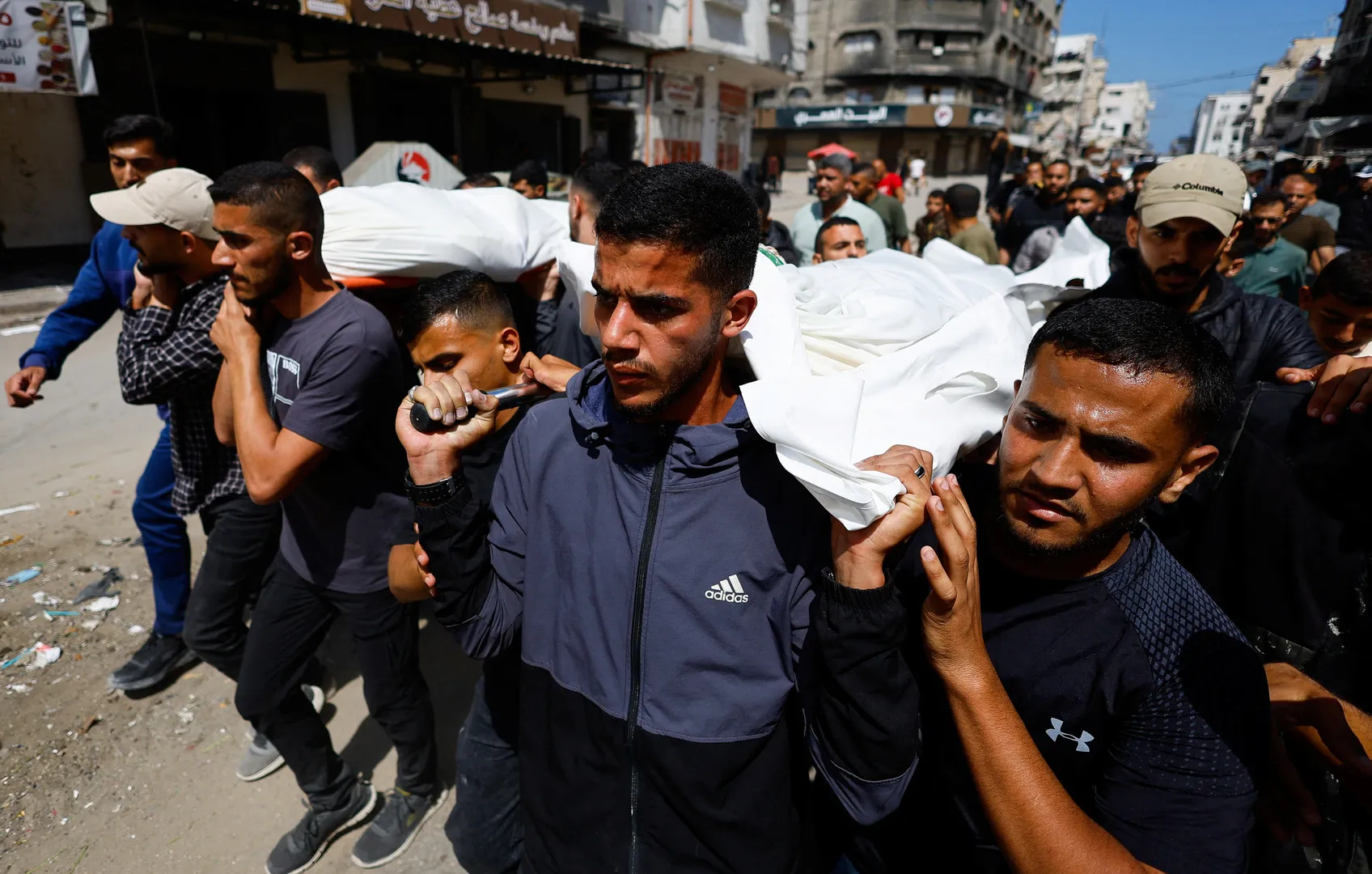
Dr Jamal Abu Aboun, the head of anaesthesia at Al-Yafa Medical Hospital in central Gaza’s Deir al-Balah, was killed in an Israeli strike near the Al-Aqsa Martyrs Hospital, also in Deir al-Balah on Saturday.
“The body of Jamal Abu Aoun and three injured people, including a child, had arrived at the hospital following an Israeli drone strike that targeted a group of civilians near the hospital,” a medical source at Al-Aqsa hospital told the Anadolu news agency.
Earlier, Israeli artillery shelling targeted areas east and south of Khan Younis city in southern Gaza. Another artillery strike targeted al-Bureij refugee camp in central Gaza.
At least 922 Palestinians have been killed and 2,786 others injured in Israeli attacks since the October “ceasefire”, according to the Gaza Media Office.
Israel launched its genocidal war on Gaza in October 2023, killing at least 72,000 Palestinians and injuring over 172,000 others, according to Palestinian figures.
In testimonies to The Associated Press news agency, Israeli soldiers described a climate of dehumanisation, permissive rules of engagement and the routine killing of Palestinians during the “ceasefire”.
Reservists who served in Gaza between last October and January said Israeli troops frequently opened fire on Palestinians approaching or crossing the so-called “Yellow Line”, an often poorly marked boundary separating Israeli-occupied areas from the rest of the enclave.
One soldier said that fellow troops celebrated after a strike on a vehicle carrying Palestinians killed everyone inside. “It was a jungle,” the soldier told AP. “After the ceasefire, the order was: If someone crosses the line, you shoot them.”
Another reservist said commanders repeatedly emphasised holding territory at all costs. “There was a general feeling that human lives are not valuable,” he said.
Settler attacks in occupied West Bank
Elsewhere in occupied Palestine, Israeli settlers attacked several homes early on Saturday in the town of Beita, south of the city of Nablus in the northern West Bank, according to Palestinian news agency, Wafa.
They threw stones at houses and smashed several vehicles, Wafa reported.
State-run Voice of Palestine radio reported Israeli forces firing light bombs into the sky over the town.
In the southern West Bank, settlers attacked Palestinian farmland and damaged several trees in Khirbet el-Muraq in Masafer Yatta, activist Osama Makhamra, who follows Israeli violations south of Hebron, told reporters.
Israeli settlers carried out at least 540 attacks in April against Palestinians and their property in the occupied West Bank, including Jerusalem, according to a monthly report by the Palestinian state-run Wall and Settlement Resistance Commission.
The attacks ranged from “direct physical violence, uprooting trees, burning fields, preventing farmers from accessing their land, seizing property, as well as demolishing homes and agricultural structures”.
Israeli army raids, arrests and settler attacks have intensified across the West Bank since the start of the genocidal war in Gaza.
According to Palestinian figures, Israeli forces and settlers have killed 1,168 Palestinians, injured 12,666, displaced about 33,000, and detained nearly 23,000 in the West Bank since October 2023.
After two years of relentless bombardment and ground invasions, Israel’s future in Gaza had appeared to be settled with the signing of United States President Donald Trump’s 20-point peace plan on October 9, 2025.
Under the terms of that agreement, Israeli forces were meant to withdraw behind what planners called the “Yellow Line”, maintaining control of 58 percent of the territory, with their full withdrawal to be set at a date to be determined.
Recommended Stories
list of 4 itemsend of list
That withdrawal hasn’t happened. In fact, in the months since, as well as killing at least 922 people in near-daily strikes on the enclave during the “ceasefire”, Israel has expanded its territory by about 11 percent.
According to satellite data gathered in March, it has also established at least 32 military outposts, a ground barrier and infrastructure along what was supposed to be a temporary line.
Since October last year, numerous humanitarian agencies, including Oxfam, have accused Israel of compounding the humanitarian crisis in Gaza by restricting deliveries of aid and other essential goods.
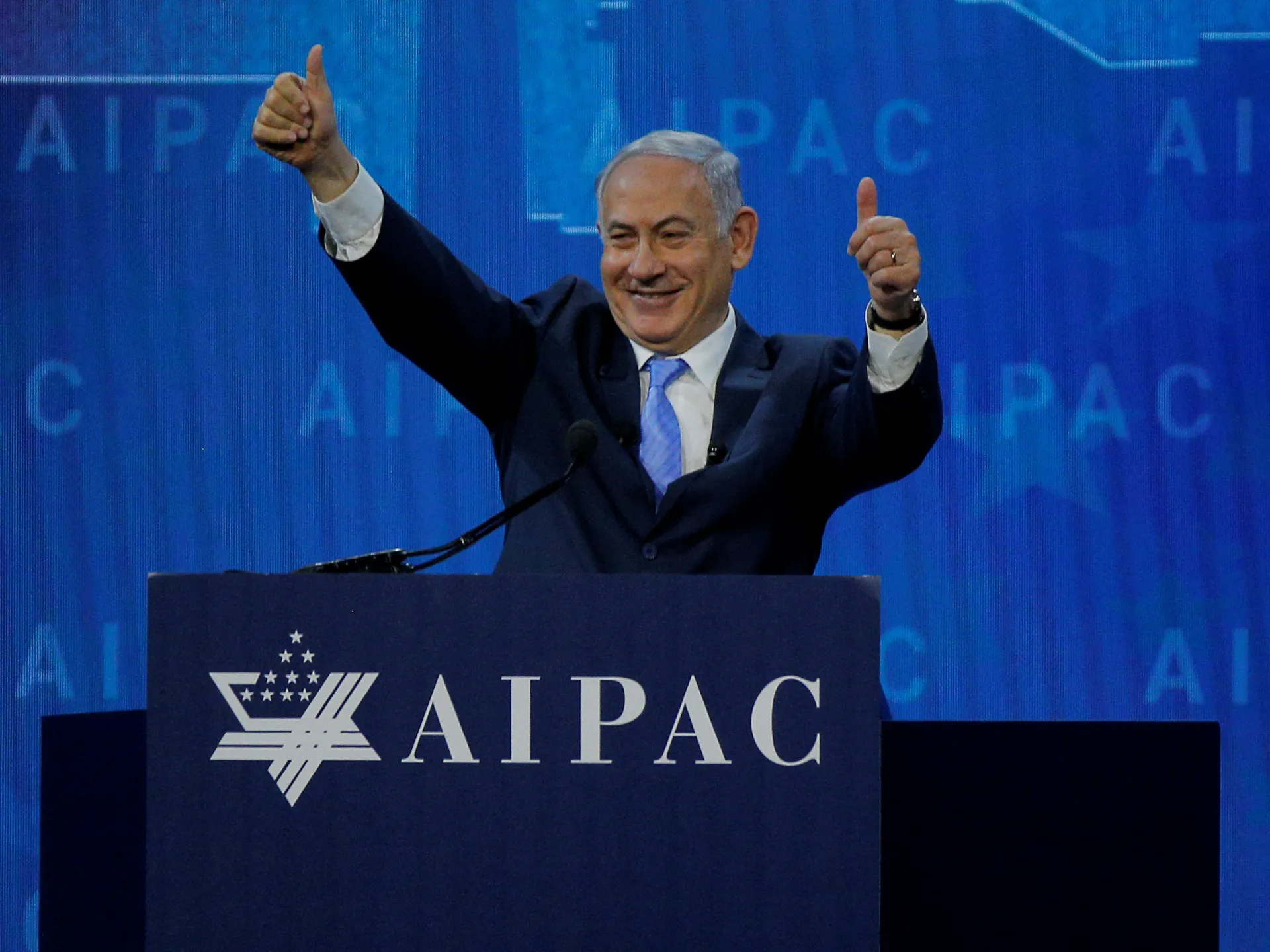
Then, on Thursday, Israeli Prime Minister Benjamin Netanyahu announced that Israel will take over yet more territory in Gaza, telling a conference: “We are currently squeezing Hamas; we now control 60 percent of the territory of the Strip – you know this. We were at 50. My directive is to move to …,” he said, pausing briefly as someone in the crowd yelled, “100!”
“Let’s go step by step,” he responded, “First of all, 70. Let’s start with that. We’re pressing them from all sides, we’ll deal with the remnants.”
Al Jazeera contacted the Israeli prime minister’s office for clarification of this, but received no response by the time of publishing.
Can Israel just grab more land in Gaza?
“If Israel’s ultimate plan is to exercise permanent effective control over the entirety of the Gaza Strip, we are talking about unlawful annexation,” Michael Becker, a professor of international human rights law at Trinity College in Dublin, told Al Jazeera.
“As the International Court of Justice reaffirmed in a 2024 advisory opinion, annexation constitutes a violation of the bedrock prohibition of the acquisition of territory by force.”
Nevertheless, to date, since the onset of its war on Gaza in October 2023, Israeli forces have killed at least 72,819 men, women and children in Gaza, with many thousands more missing and presumed dead under the rubble.
By 2025, Israel had caused a confirmed famine in the enclave and has now decimated nearly all infrastructure needed to support life. It has done all this without experiencing any meaningful international sanctions and still takes part in numerous international sporting and entertainment competitions – despite protests.
Hopes that the US might enforce its own conditions on Israel also appear ill-founded. Since announcing a ceasefire in the enclave in October last year, the US has failed to react as Israel has expanded and entrenched its presence in Gaza, choking off access to about two-thirds of the enclave for its inhabitants by April 2026.
Al Jazeera also contacted the US State Department for comment about this, but received no response by the time of publishing.
Can Gaza’s population survive in such a reduced territory?
It’s very hard to tell. Several agencies, including the UN’s Office for the Coordination of Humanitarian Affairs (OCHA), have expressed deep concern about how Gaza’s remaining population can continue to subsist in an ever-shrinking space.
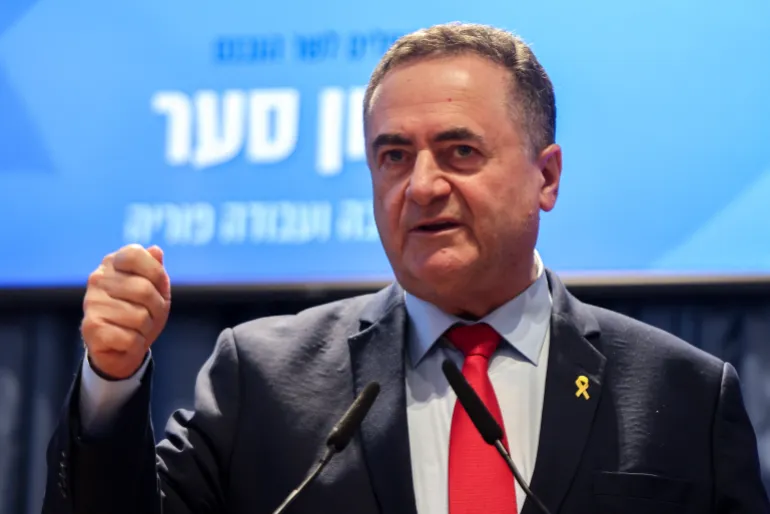
Israel’s answer to this is simple. “The plan for voluntary emigration from Gaza will also be implemented, all at the proper time and in the proper manner,” Defence Minister Israel Katz wrote in a statement marking the killing of Hamas leader Mohammed Odeh on Wednesday this week.
“Voluntary emigration” is a term used by a number of Israel’s government ministers, including National Security Minister Itamar Ben-Gvir and Finance Minister Bezalel Smotrich. Observers typically acknowledge that this means the ethnic cleansing of the enclave.
Israel’s Ministry of Defence did not respond to questions about this from Al Jazeera.
Israel’s Defence Minister Israel Katz has referred to the ‘voluntary emigration’ of Gaza’s population, a term generally regarded as referring to its ethnic cleansing [File: Menahem Kahana/ AFP]
Is any of this legal?
No.
“The idea of permanently removing Palestinians from Gaza smacks of forced displacement and would also violate the fundamental right to self-determination of the Palestinian people,” Becker said. The principle of self-determination serves as a “cornerstone” of the UN Charter, he said.
However, Becker said, the spotlight of international attention has now shifted from the crisis in Gaza to the US and Israel’s war on Iran, as well as Israel’s actions in Lebanon, where it has occupied large swaths of the south of the country.
“While the Trump administration may be willing to diverge from Israel’s interests in seeking a resolution to the disastrous and illegal war that the United States started against Iran, the United States seems to have lost interest in Gaza or pushing for restraint on the part of Netanyahu’s government. It is unclear what role the so-called Board of Peace is willing to play in terms of maintaining a future for the Palestinians of Gaza,” he said.
A digital register of land ownership in the West Bank is seen as an escalation of Israel’s occupation.
Published On 29 May 202629 May 2026
Occupied East Jerusalem, Palestine – A controversial Israeli plan to digitally register property ownership in the occupied West Bank is a “dangerous colonial occupation step that represents a direct assault on the historical and legal rights of the Palestinian people to their land and property”, the Palestinian Land Authority has said.
The Palestinian Jerusalem Governorate and the Colonization and Wall Resistance Commission (CRRC) have urged Palestinians in the West Bank not to engage with any Israeli “entities, committees, platforms, or procedures” of lands and property.
Recommended Stories
list of 4 itemsend of list
Israel reportedly launched the online “Land Registry and Settlement of Rights” platform on which it plans to “update” property ownership in the occupied West Bank on Wednesday this week.
The Jerusalem Governorate and the CRRC have called on the international community, the United Nations, the International Criminal Court and all international human rights and legal institutions to “take their urgent responsibilities to stop these illegal procedures and hold the occupying state accountable for its continuous violations against the Palestinian people, their land, and their resources”, they said.
Moayad Shaaban, head of the CRRC, which is part of the Palestine Liberation Organization, said the move reveals “the occupation’s transition from traditional policies of field control to digital and administrative colonial engineering aimed at imposing permanent legal realities on the occupied Palestinian territory”.
‘Annexation’ by land registry
In May 2025, the Israeli Security Cabinet launched a new, aggressive land settlement process throughout the West Bank, with the aim of “completing the legal and administrative annexation of the occupied territories through fully registering the lands under Israeli authority”, the Jerusalem Governorate said.
Then, in July 2025, Israel’s parliament approved a symbolic measure calling for the annexation of the occupied West Bank. The move was first tabled in 2024 by Israel’s far-right Finance Minister Bezalel Smotrich, who himself lives in an illegal Israeli settlement.
On February 15, 2026, the permanent acquisition and registration of approximately 58 percent of Area C – the part of the West Bank over which Israel exerts total control – began.
(Al Jazeera)
Under that decision, Palestinian land registration in the Israeli “Tabu” – the land registry extract – began for the first time since the occupation of the West Bank in 1967. It is a final measure that will be difficult to challenge in Israeli courts, the Israel Hayom newspaper reported in February.
With the onset of land settlement, the Israeli Land Registry unit will take over the regulation and registration of land ownership in Area C. It also has the power to issue sales permits and to collect fees. Israel aims to complete the full settlement of 15 percent of the West Bank by the end of 2030.
Some 700,000 Israeli settlers already live in the West Bank and East Jerusalem, as illegal settlement has expanded under the government of Prime Minister Benjamin Netanyahu.
Rights groups say settlement approvals, along with rising settler violence against Palestinian communities, have accelerated since Israel launched its genocidal war on Gaza on October 7, 2023.
EU says the sanctioned individuals and groups violated a range of rights, from the right to physical and mental integrity, to the right to education.
Published On 28 May 202628 May 2026
The European Union has sanctioned four entities and three individuals it says are “extremist Israeli settlers” responsible for “serious” human rights abuses against Palestinians in the occupied West Bank.
The EU said they had violated a range of rights, including the rights to physical and mental integrity, privacy and family life, freedom of religion and education.
The sanctions include the Nachala Settlement Movement and its director, Daniella Weiss. The EU says the group “encourages and facilitates coercive acts that lead to the forced displacement of Palestinians”.
Israeli NGO Regavim and its director, Meir Deutsch, are also on the sanctions list for lobbying “for the demolition of Palestinian property” in order to expand Israel’s control over the entirety of the West Bank, plus the demolition of an EU-funded Palestinian primary school.
Also sanctioned is the Hashomer Yosh NGO and its president, Avichai Suissa for supporting “at least 28 violent outposts and settlements”. It also recruits armed volunteers and provides guards who engage in violent attacks, the EU added.
The Amana cooperative association of the settler movement Gush Emunim was also sanctioned, the EU stating it had likewise “played a key role in initiating, financing, and facilitating at least 30 violent outposts and settlements”.
Long-awaited sanctions
With Thursday’s additions, the EU said it now sanctions 136 persons and 41 entities from a range of countries under its Global Human Rights Sanctions Regime.
The regime was created in 2020, and applies to acts such as genocide, crimes against humanity and other serious human rights violations or abuses.
The measures targeting Israeli settlers because of violence against Palestinians were long-awaited, having been blocked by the self-styled illiberal government of Hungary’s former premier Viktor Orban.
However, the appointment of new Prime Minister Peter Magyar saw the veto quickly lifted earlier this month.
Israel earlier condemned the sanctions, asserting that Jews have the right to settle in the occupied West Bank, despite that being in violation of international law.
In 2025, the expansion of Israeli settlements reached its highest level since at least 2017, when the United Nations began tracking data.
Since the start of Israel’s genocidal war on Gaza, the West Bank has been gripped by almost daily violence involving Israeli troops and settlers. More than 1,000 Palestinians have been killed in the territory, according to the UN.
The Israeli army has already expanded its control of Gaza by 11 percent over the ‘Yellow Line’, beyond the terms of the ‘ceasefire’.
Published On 28 May 202628 May 2026
Prime Minister Benjamin Netanyahu has instructed the Israeli army to expand its control of the Gaza Strip to 70 percent, according to remarks aired by Israeli media.
“At this point, we are fully in control of 60 percent of the territory of the Gaza Strip … and my directive is to get to … 70 percent,” Netanyahu said in footage recorded by Channel 12 and aired on Thursday.
Recommended Stories
list of 3 itemsend of list
When someone in the audience shouted that Israel should take the entire besieged enclave, the prime minister said “we are going in order”, according to The Times of Israel. “First 70 percent,” he said without disputing that a complete takeover could take place. “We’ll start with that.”
The Israeli army had in mid-March quietly sent maps to aid organisations showing it had already expanded its control to about 11 percent beyond the so-called “Yellow Line” demarcating areas of the enclave occupied by Israeli troops. That line was agreed in a United States-brokered “ceasefire” in October 2025. That meant it controlled 64 percent of the Palestinian territory, instead of 53 percent.
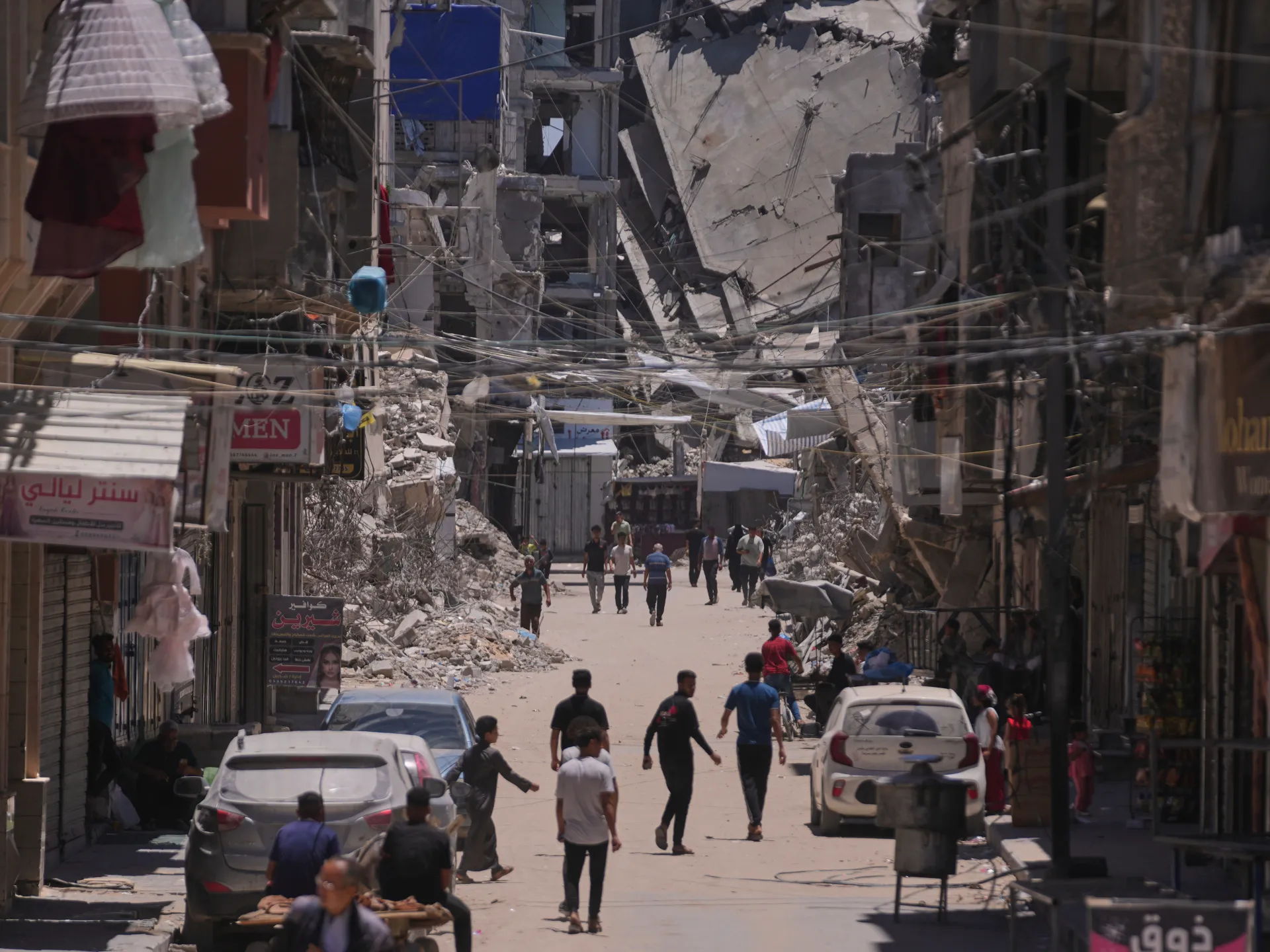
Due to the Israeli army occupation, Palestinians cannot access about two-thirds of Gaza. A further seizure of the territory would force two million of them, already living in disastrous conditions, into an even smaller territory after enduring two years of genocidal war.
Despite the nominal truce reached last year, Israeli bombing in Gaza continues with near-daily attacks. An Al Jazeera tally from October to April counted at least 2,400 Israeli violations. Earlier on Thursday, health authorities said an Israeli air raid killed at least 10 people, including four children, and wounded 20 others.
According to the United Nations Office for Humanitarian Affairs’ (OCHA) latest report, the humanitarian situation for civilians in Gaza remains critical, with displaced families living in overcrowded tents, schools or damaged structures. Clean water is scarce, and poor waste collection is increasing health risks, including the spread of rats and insects. Many neighbourhoods across Gaza are also still dangerous, with frequent air strikes, shelling and shootings happening in or near residential areas, the report said.
Last week, the high representative overseeing the US-founded Board of Peace for Gaza, Nickolay Mladenov, warned that the deteriorating status quo in the enclave risks becoming “permanent”. Speaking to the UN Security Council, he urged the international body to use “every means at its disposal” to press Hamas to disarm and to push Israel to uphold its commitment under the October ceasefire, pointing to its continued killings and restrictions on humanitarian flow.
The war that Israel launched following the October 7, 2023, attacks on southern Israel by Hamas and other armed Palestinian groups has killed more than 72,775 Palestinians. The Israeli military continues to maintain a strict security regime, and many hundreds more have been killed in the past seven months. Conflict monitors warn that since the US-Israel war on Iran started in February, Israeli bombardment of Gaza has accelerated.
Israeli ambassador to the UN says Tel Aviv will cut ties with UN chief Antonio Guterres over the upcoming report.
Published On 28 May 202628 May 2026
The United Nations has “added Israel to the blacklist of sexual violence in conflict zones”, prompting Israel to cut ties with UN chief Antonio Guterres, the country’s ambassador to the UN says.
“We are done with this secretary-general,” Israeli ambassador Danny Danon added in a video posted on X on Thursday, denouncing the upcoming report from Guterres’s office.
Recommended Stories
list of 3 itemsend of list
The UN secretary-general’s annual report on conflict-related sexual violence is customarily presented to relevant states before publication. Last August, the report warned that Israel could be added to the list of parties suspected of, or responsible for, sexual violence in situations of armed conflict.
“The decision to blacklist Israel and accuse us of using sexual violence as a weapon of war is an outrageous decision,” Danon said.
“The secretary-general and his team continue to spread lies against Israel. To put us and Hamas terrorists on the same list, that’s unacceptable.”
The Israeli mission to the UN said in a statement that it will have no contact with the secretary-general’s office as long as Guterres serves as head of the organisation.
The country’s foreign ministry also expressed anger over the upcoming report.
“The shameful and absurd UN decision to include Israeli entities in the annex to the CRSV (conflict-related sexual violence) report is further proof of the UN’s true nature: a politicised and corrupt organisation that has abandoned its founding principles and systematically targets Israel as its primary mission,” Oren Marmorstein, a spokesperson for the Israeli foreign ministry, said on X.
Guterres’s spokesperson said they were aware of Danon’s remarks.
“For our part, the secretary-general’s door remains open,” Stephane Dujarric said.
Systematic pattern of abuse
Last August, the UN cited “credible information” regarding sexual violence committed by Israeli security forces against Palestinian detainees in prisons and other detention centres, and said UN inspectors had been denied access to the facilities.
“We invited the representative of the UN to come to Israel to check those ridiculous allegations. They chose not to come,” Danon said.
Palestinians detained in Israeli prisons, especially those taken from Gaza during Israel’s brutal war since 2023, have long revealed how they suffer dehumanising treatment by guards and soldiers, including torture and sexual violence. According to international human rights organisations, these testimonies are part of a broader and systematic pattern.
Furthermore, a report from the West Bank Protection Consortium last month found that sexual violence and other forms of gender-based abuse committed by Israeli settlers and soldiers are spurring Palestinians to leave the occupied West Bank.
Even foreigners, namely those on board a recent Gaza-bound aid flotilla, say that freed activists who were abducted from international waters faced abuse while in Israeli detention, including at least 15 separate cases of sexual assault or rape.
Earlier this month, Israel also rejected accusations of rape by its forces, which were detailed in a column by longtime New York Times journalist Nicholas Kristof. The Israeli government had responded to the report by stating that it would take the extraordinary step of suing the paper. Kristof’s reporting was based on the accounts of 14 male and female Palestinian victims.
Relations between the UN and Israel are fraught and have reached an all-time low since October 7, 2023, when Hamas launched an attack that preceded Israel’s genocidal war on Gaza, which has killed more than 72,000 Palestinians.
Israeli authorities have criticised Guterres and other UN officials for their condemnation of its brutal conduct in Gaza. The UN chief was declared “persona non grata” in Israel in 2024.
A funeral has been held for Mohammed Odeh, believed to be the leader of Hamas’s military wing, who Israel said was killed in a strike on a busy area in Gaza City on Tuesday. Odeh’s family has reportedly confirmed his death, despite no official comment from Hamas.
Baltimore, United States – Muslim Americans are grieving after two gunmen last week opened fire at the Islamic Center of San Diego, killing three people.
But at the annual conference for the Islamic Circle of North America (ICNA) in Baltimore, community leaders stressed the urgency of turning the sorrow into action.
Recommended Stories
list of 3 itemsend of list
Nearly 25,000 people turned out for the annual event, held on Saturday and Sunday. Speakers addressed the recent shooting, pointing to the courage of the three victims as examples for the broader community in a time of heightened Islamophobia.
“We owe them more than condolences. We owe them resolve,” said Lena Masri, a lawyer at the Council of American-Islamic Relations (CAIR).
She explained how the victims — a security officer, a caretaker and a neighbour — sacrificed their lives to save others. The security officer, Amin Abdullah, exchanged fire with the shooters, while the other two victims, Mansour Kaziha and Nadir Awad, rushed to help and called for emergency services.
“They protected the physical space of our community: the masjid [mosque], the school, the children, the teachers, the worshippers,” Masri explained.
“Our responsibility is to protect the civic space of our community: the right to worship, the right to speak, the right to organise, the right to defend Palestine, the right to build institutions.”
That was the recurring theme of the conference: that the Muslim American community cannot afford to be passive and must draw on its strength to push back against bigotry and hate.
Speakers emphasised voting, organising and donating to community institutions and candidates who align with Muslim Americans. They also underscored the need to hold officials accountable and push for an end to Israel’s atrocities in Palestine.
“We owe Gaza more than grief. We owe Gaza advocacy that cannot be intimidated into silence,” Masri said.
Islamophobia and Palestinians’ dehumanisation
Symbols of Palestine could be seen everywhere at the conference, from bags emblazoned with watermelons and flags to keffiyeh-patterned scarves, shirts and water bottles.
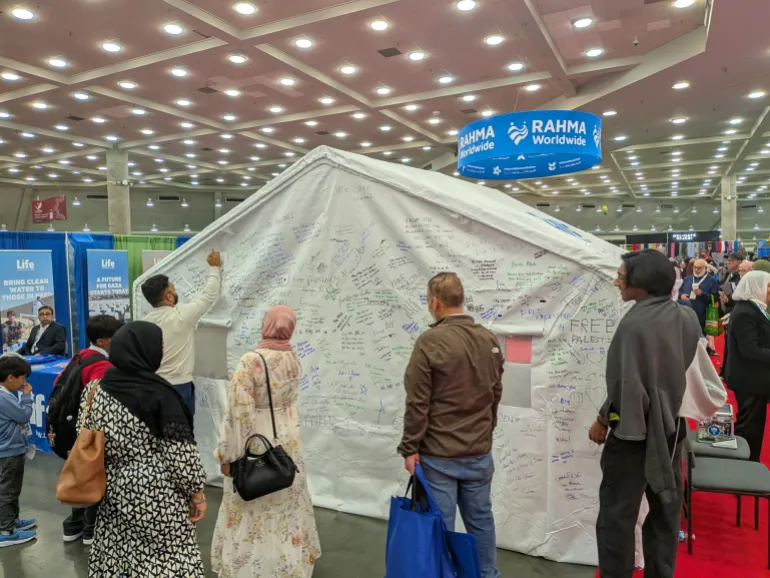
At a bazaar featuring dozens of vendors, conference-goers left messages of solidarity on a tent that will be sent to Gaza by the charity Life for Relief and Development (LIFE).
In speeches and on panels, advocates drew a link between anti-Muslim bigotry in the United States and Israel’s abuses in Gaza, the occupied West Bank and Lebanon.
Some of the loudest promoters of Islamophobia in the US are also staunch Israel supporters, among them right-wing commentator Laura Loomer and Congressman Randy Fine.
Both Loomer and Fine are allies of US President Donald Trump, whose administration has unleashed a crackdown to deport critics of Israel who live in the US but are not citizens.
Altaf Husain, a professor at the Howard University School of Social Work, said anti-Palestinian voices are trying to “scare” Muslims as a means of silencing criticism of Israel.
“They want to shut this down, so it’s a direct connection,” Husain told Al Jazeera.
He said the large turnout at the ICNA conference shows that the community is not intimidated and will not back down.
In the response to the shooting in San Diego, Husain pointed out that the community raised more than $3.5m for the victims’ families and moved to bolster security around Muslim institutions.
ICNA conference attendees on May 24 write messages of solidarity on a tent to be sent to Gaza [Ali Harb/Al Jazeera]
Layers of security
Saad Kazmi, the president of ICNA, said the organisation relied on three layers of protection to secure this weekend’s event: its own security guards, an outside firm and local law enforcement agencies in Baltimore.
While there is anxiety in the community over the rise of Islamophobia and Trump’s immigration crackdown, he said Muslim Americans must take matters into their own hands and work with “sensible” people across the political spectrum to defeat hate.
“We are very thankful that we live in a country that is ruled by the Constitution and law,” Kazmi told Al Jazeera.
Kazmi added that the shooting in San Diego only added to the community’s determination to assert and protect its rights. The Islamic centre in the city, he noted, did not shut down after the attack.
“If anything came out of this, it is that there are more attendees to the masjid, more people who believe that the way forward is to strengthen ourselves, strengthen our community and march on,” Kazmi said.
After the shooting, Loomer doubled down on her anti-Muslim rhetoric, calling on immigration authorities to target the Islamic Center of San Diego.
She also called for the deportation of all Muslims from the US, describing them as an “invasive species”. But few Republicans disavowed Loomer, who maintains close ties to the White House.
Rather, more than 60 Congress members have joined the Sharia-Free America Caucus since it was established in December. CAIR has designated the caucus a hate group.
At the state level, governors and local legislators have disparaged Islam while also pushing to penalise Palestinian rights activism.
Texas and Florida, for example, have labelled CAIR a “terrorist” group, while implementing measures against “Sharia law” that critics consider anti-Muslim dog whistles.
Rights under attack
In March, after CAIR sued Florida Governor Ron DeSantis over its “terrorist” designation, a federal court blocked the label from being imposed.
In his ruling, Judge Mark Walker wrote that DeSantis’s executive order (EO) targets the Muslim community as a whole.
“It should be lost on no one that Defendant’s EO targets one of America’s largest Muslim civil rights organizations for indirect suppression of speech. But, as we all know, it is easy for those in power to target minority groups with little pushback,” Walker wrote.
“Sadly, history teaches that it is often minority religious groups who find themselves in the crosshairs.”
On Saturday, several panels praised the US legal system and the laws that protect freedom of religion and speech. But the panellists argued that human rights do not defend themselves; people must step up to protect them.
“You’ve got to imagine rights are a territory, and you have to occupy that territory. If you do not actively occupy that territory, that territory will be taken from you. And that is exactly what has been happening,” Tom Facchine, an imam from New Jersey, said.
Last year, Palestinian immigrant Leqaa Kordia found her rights in jeopardy when immigration agents knocked on her door and detained her over her activism against Israel’s genocidal war in Gaza.
Kordia spent more than a year in Immigration and Customs Enforcement (ICE) detention before an immigration judge ordered her to be released in March.
But Kordia — who is still fighting deportation — told ICNA conference attendees on Saturday that she has no regrets, encouraging them to remain politically active and engaged.
“Speaking up, it comes with a cost … It cost me my health, my life, literally my freedom, and I’m living in uncertainty that tomorrow I’m going to be here, or I’m going to be deported,” she said.
“It comes with a cost, but it’s worth it. It’s worth it because silence, it costs even way more than speaking.”
Mohammad Abu Mallouh, Alaa Zaqlan and their child, Osama, killed in the attack on the Nuseirat refugee camp, medics say.
Published On 24 May 202624 May 2026
An Israeli air raid on a home in Gaza has killed three members of a family, including a six-month-old child, medical workers said, as Israel continues to violate the “ceasefire” brokered by the United States last year.
Al-Aqsa Martyrs Hospital in Deir el-Balah in central Gaza said it received the bodies of a couple and their young child in the early hours of Sunday morning.
Recommended Stories
list of 3 itemsend of list
Medics identified those killed in the attack on an apartment in the Nuseirat refugee camp as Mohammad Abu Mallouh, his wife Alaa Zaqlan, and their child Osama, the Reuters news agency reported.
Medical workers said about 10 people were wounded in the attack.
There was no immediate comment from the Israeli military.
Since the “ceasefire” came into effect in October, Israel has continued with its near-daily attacks across the besieged Palestinian territory, which Gaza health authorities say have killed nearly 900 people.
Reporting from Gaza City, Al Jazeera’s Hani Mahmoud said Israeli bombing began on Sunday as Palestinians were fleeing following forced displacement orders. He said many people ran while carrying personal belongings, including mattresses.
Separately, Israeli forces continued demolishing homes and civilian infrastructure in eastern Gaza on Sunday behind Israel’s so-called “Yellow Line”, referring to Israeli-designated military zones and buffer areas inside the enclave, he said.
Israeli jets also carried out air raids on Deir el-Balah in central Gaza on Sunday, causing extensive damage near a hospital, Mahmoud said.
Earlier this month, the Gaza Government Media Office said it had documented at least 2,400 Israeli violations in the first six months of the ceasefire, including more than 1,100 air raids and at least 921 shootings targeting civilians.
More than 72,000 Palestinians have been killed since Israel launched its genocidal war on Gaza in October 2023. Israeli officials acknowledged the data was broadly accurate in January, after casting doubt on their credibility for two years.
On Saturday, five police officers and a 13-year-old boy were killed in an Israeli attack.
Talks between Israel and Hamas aimed at reaching a permanent end to the war have stalled, with both sides accusing each other of violating the ceasefire. Israel says Hamas’s refusal to disarm is a key obstacle, while the Palestinian group says negotiations have been paused due to continued violations and restrictions on aid entering Gaza.
Earlier this week, Human Rights Watch said the territory’s humanitarian infrastructure remained in peril, more than six months after the start of the ceasefire.
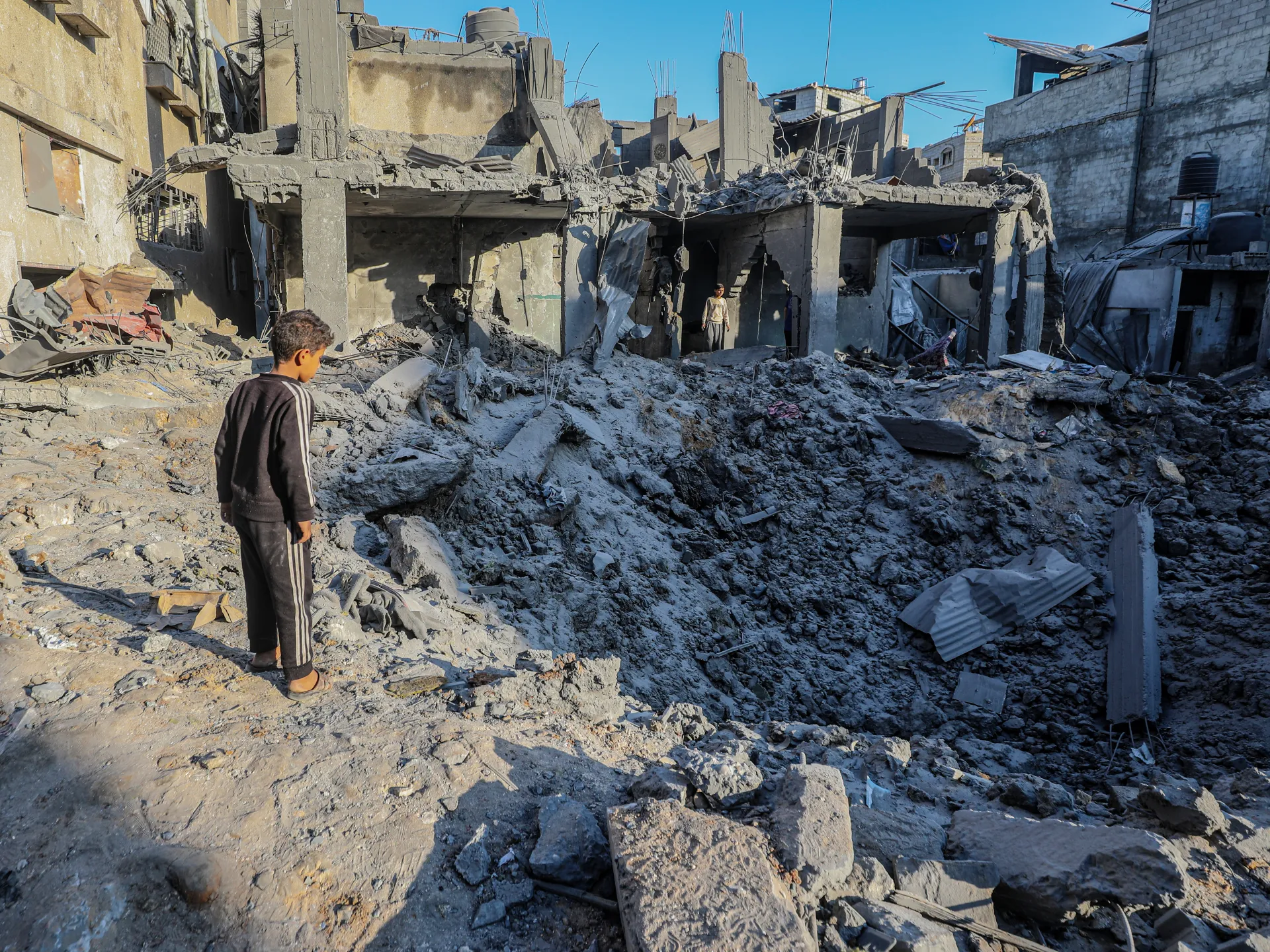
Overnight Israeli strikes devastated the Nuseirat and Bureij refugee camps in central Gaza despite an ongoing ceasefire, injuring dozens. The strikes targeted residential areas, leaving behind piles of rubble. Israel has now destroyed or damaged around 90% of Gaza’s civilian infrastructure.
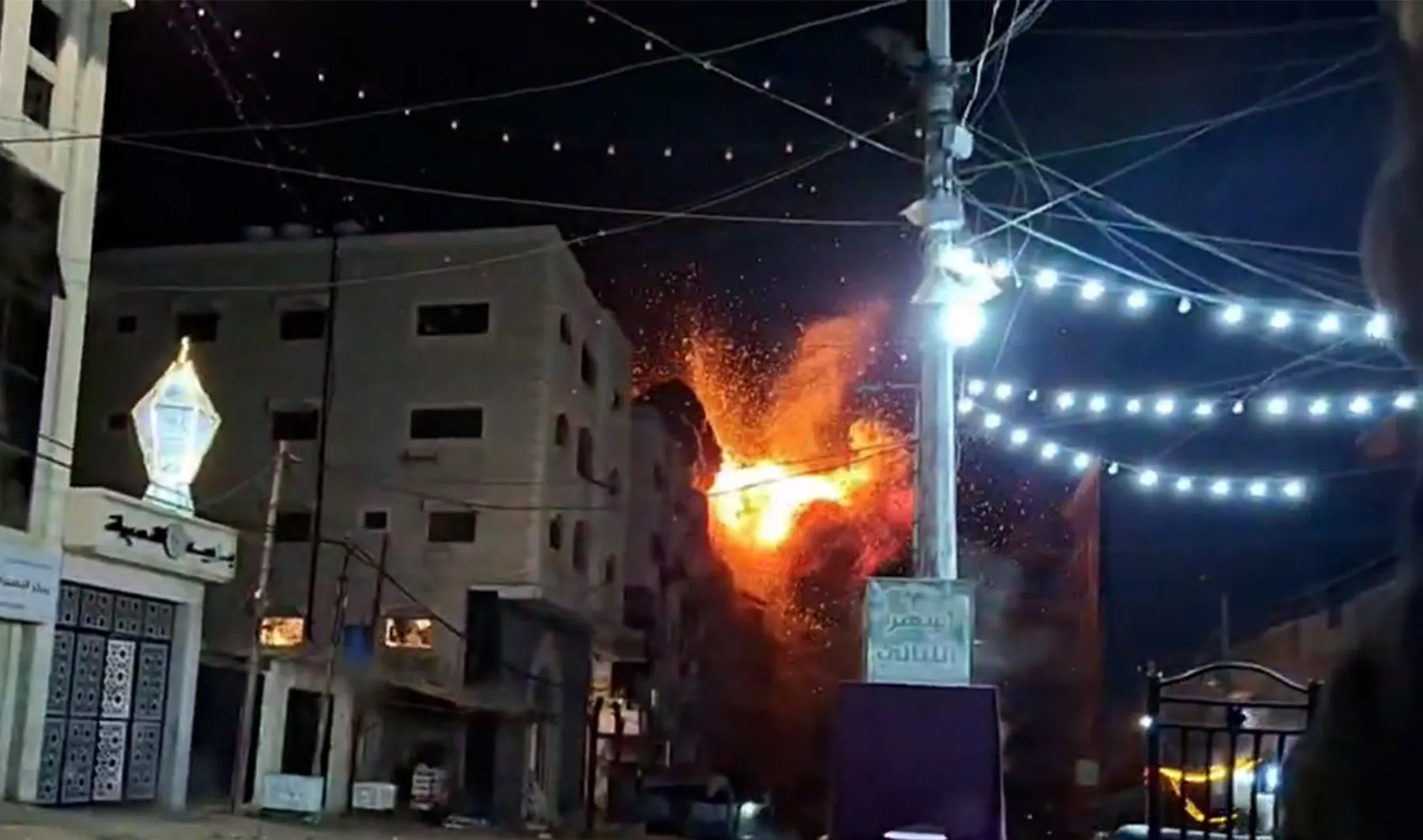
Video shows the moment Israeli forces struck Nuseirat and Bureij refugee camps in central Gaza, injuring dozens despite an ongoing ceasefire agreement.