Islamic State

Afghan woman whose case was the first for a long-dormant court has been deported, officials say

Eric Tucker and Michael Kunzelman

An Afghan woman who was accused of supporting an Islamic State-inspired plot in the United States and whose case was the first for an obscure and long-dormant court has been deported, the Justice Department said Friday.

Nazira Haji Zada, 47, was arrested in July at her Fort Worth home and brought before the Alien Terrorist Removal Court on a Justice Department application to deport her from the U.S. On Friday, the department said that she had waived her rights to challenge her detention and had agreed to be deported to Afghanistan.

Haji Zada’s attorneys said her decision to consent to removal “should not be seen as an endorsement of this court’s legitimacy.”

“Dragging lawful permanent residents into court but refusing to show them or their attorneys the evidence that will be used against them is a plain violation of due process,” the defense lawyers said in a statement Friday. “We are confident that the Alien Terrorist Removal Court will be struck down as unconstitutional as soon as a judge is asked to address the issue.”

Court filings about Haji Zada’s deportation, including a judge’s Aug. 20 removal order, remained under seal until after she reached her destination.

The swift resolution averts what could have been a protracted legal fight testing the authority of the court, which was established in 1996 but until July had not received any petitions, as well as the strength of allegations against Haji Zada.

Atty. Gen. Todd Blanche said the case’s outcome is “a win for national security and the rule of law.”

“Those who support and condone terrorism should not be living in the United States, and this first-ever case before the [court] shows how the Department will use every tool at its disposal to protect our country,” Blanche said in a statement.

The Justice Department has described Haji Zada as a supporter of the Islamic State and identified her at the time as the mother and mother-in-law of two Afghan men who were convicted in Oklahoma of plotting an attack in the U.S. on election day in 2024. The plans were foiled before any attack took place.

Her lawyers at the time of the deportation had been pressing the court to force the Justice Department to share information and other evidence to support the allegations in the case.

The court has specific authority to conduct deportation proceedings for people whom the Justice Department classifies as “alien terrorists.” The court is composed of five federal judges from different districts across the country who are appointed by the U.S. chief justice.

“Those who plot acts of terrorism against the United States have no place in our country,” Homeland Security Secretary Markwayne Mullin said in a statement. “We will find them, and we will use every lawful tool available to remove them.”

On July 30, Judge Joan Ericksen presided over the first hearing for the court’s first case since its creation 30 years ago.

One of Haji Zada’s attorneys argued at the hearing that the Trump administration’s activation of the court violates her constitutional rights. Attorney Matthew Farley urged the judge to dismiss the case and immediately release his client.

An FBI memo dated July 15 said it “developed information” that Haji Zada is an Islamic State supporter who had her children pledge their loyalty to the terrorist group. Her son, Abdullah Haji Zada, was sentenced in November to 15 years in prison and court records show he previously agreed to be removed from the U.S. after his release.

Her son-in-law, Nasir Ahmad Tawhedi, previously worked as a security guard for an American military installation in Afghanistan. He pleaded guilty to conspiring and attempting to provide material support to the Islamic State group. Prosecutors have said he took steps to advance his attack plans by ordering AK-47 rifles, liquidating his family’s assets and buying one-way tickets for his wife and child to travel home to Afghanistan.

Tucker and Kunzelman write for the Associated Press.
Source link

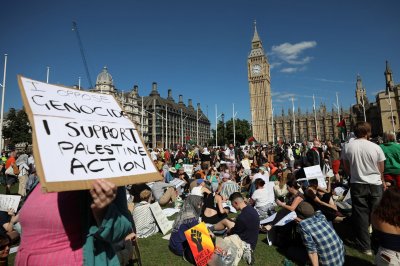
Trump administration names Palestine Action a global terrorist organization

Aug. 26 (UPI) — The U.S. Treasury issued sanctions Wednesday against British-based direct action group Palestine Action and two other organizations it called “violent far-left terrorist networks.”

The treasury declared Palestine Action a “specially designated global terrorist,” meaning that it can freeze the group’s assets, including bank accounts and property. The sanctions also prohibit people from giving funds, goods or services to the organization.

“Far-left extremists, their fronts and their enablers should be on notice: We will bring the full weight of our economic tools to bear,” said Scott Bessent, secretary of the treasury. “Political terrorism has no place in our society, and we will continue to cut the financial lifelines of these groups until they are eliminated.”

In response, Huda Ammori, the co-founder of Palestine Action, said the group’s activities in the United States and other countries “have always been about saving lives by disrupting the Israeli war machine, which is committing a genocide in Gaza with the support of the U.S. government,” The Guardian reported.

“Trump has been at the center of the mass murder of Palestinians, enabling the Zionist regime at every turn,” Ammori said.

Palestine Action was also the first direct action group named under Britain’s Terrorism Act in July 2025. The group is fighting the ban in a legal challenge before the country’s supreme court in November.

“The fact that Trump is now taking inspiration from Britain’s repression of the movement for Palestinian freedom exposes just how dangerous this ban is and should be a wake-up call to anyone who cares about free speech and civil liberties,” Ammori said.

The U.S. Treasury said Palestine Action “has supported numerous acts of terrorism since July 2020, including acts that have physically injured U.K. law enforcement personnel, as well as acts intended to intimidate lawful commercial enterprises and coerce the U.K. government.

“The group’s action include multiple high-profile instances of breaking into defense infrastructure and British military installations and causing millions of dollars’ worth of damage to military equipment,” it said.

In March 2025, Trump’s golf course in Scotland was targeted by Palestine Action supporters who painted graffiti on the clubhouse and damaged the course, spraying “Gaza is not 4 sale.” Trump at the time called those responsible “terrorists.”

Other groups named global terrorist organizations by the United States include Hamas, al-Qaida and the Islamic State.

The groups sanctioned Wednesday also include Autistici Inventati, an Italy-based group “that supplies specialized digital architecture, tools and services for Antifa cells and other violent far-left extremists,” and Masar Badil, “which operates as a front for the Popular Front for the Liberation of Palestine,” the treasury said.

Source link

U.S. officially delists Syria as a state sponsor of terrorism

Aug. 24 (UPI) — The U.S. State Department officially delisted Syria as a state sponsor of terrorism on Monday, marking a significant step toward the country’s reintegration into the global economy and the international community.

The announcement by Secretary of State Marco Rubio comes about a month and a half after President Donald Trump informed Congress of his intent to lift Syria’s decades-old terrorism designation that barred it from most U.S. foreign assistance and clamped down on what could be exported to it. It also meant the United States would oppose foreign institutions, such as the World Bank, granting it loans.

Along with the delisting of Syria, Rubio said he also removed Hay’at Tahrir al-Sham, the coalition of northern Syria-based Sunni Islamist groups that led the military campaign that toppled Syrian President Bashar Al-Assad in late 2024, from its list of specially designated global terrorists.

“These actions were all taken in recognition of the positive actions taken and further commitments by the Syrian government under President Ahmed al-Sharaa to fully distance Syria from acts of international terrorism,” Rubio said in a statement, listing as reasons Damascus’ joining the Global Coalition to Defeat the Islamic State and conducting terrorism-disrupting operations targeting ISIS and Iran-backed Hezbollah.

Rubio said removing the designations “eliminates the final major barrier for private sector investment in Syria and promotes economic recovery and reintegration into the global economy.”

Al-Sharaa issued a statement congratulating the Syrian people on their country’s removal from the U.S. state sponsors of terrorism list.

“Today, Syria is casting off a black mark from its shoulders, and with its own hands, tearing out a page from its painful past, so that it may set out toward development, reconstruction and building,” he said in a recorded statement.

“Great people of Syria, you have done it again. The sanctions have been lifted from you and the restrictions have been removed. I ask almighty God to help us serve you.”

Syria was among the first countries designated by the United States as a state sponsor of terrorism in 1979 over its hostility to Israel, fighting with Lebanon, partnership with Iran, alignment with Russia, support for terrorist groups and development of weapons of mass destruction, according to a Congressional Research Service report.

Since the fall of al-Assad in late 2024, Syria’s relations with the United States — and much of the Western world — have steadily improved. In June, Trump signed an executive order ending most U.S. sanctions on Damascus and informed Congress in July of his intent to delist it as a state sponsor of terrorism, starting the 45-day congressional notification clock before it could be formally removed.

“Lifting Syria’s designation as a state sponsor of terrorism is a historic step that returns it to its natural place within the global economic system,” Safwat Raslan, the governor of the Central Bank of Syria, said in a statement Monday.

“And we at the Central Bank of Syria are working to build a modern and reliable financial system, capable of keeping pace with and benefiting from all opportunities. And what is to come is better, God willing.”

Source link