London debuts new powers targeting state proxies after accusing Iranian military organisation of engineering anti-Semitic attacks.
Published On 13 Jul 202613 Jul 2026
The British government is pressing to use new powers allowing it to criminalise state proxies in order to designate Iran’s Islamic Revolutionary Guard Corps (IRGC) as a threat to national security.
In a statement issued on Monday, the government announced that it was submitting draft regulations to the UK Parliament that would ban support for the IRGC. The move follows a series of anti-Semitic attacks in the United Kingdom.
Recommended Stories
list of 4 itemsend of list
In the statement, the government said the submission of the legislation was part of an attempt to “crack down on foreign state-backed activity in the UK”, noting this would include “espionage, foreign interference in our democracy, sabotage and physical attacks”.
Following the designation, it will be a criminal offence to invite support for or express support for the military organisation, assist them in carrying out UK-related activities, engage in conduct likely to materially assist them, or accept or retain material benefits provided by or on their behalf, according to the report.
Apart from the IRGC, the UK government also listed the Islamic Movement of Companions of the Right (IMCR), an Iran-backed group that claimed seven attacks on Jewish sites in the UK earlier this year, and Russia’s military intelligence agency, the GRU Volunteer Corps, as “the first bodies designated under landmark new state threats powers”.
British police have investigated attacks on Jewish-linked sites in London, including the torching of four ambulances belonging to a community charity in March, as anti-Semitic hate crimes. Three men were charged with arson in April.
Volunteer ambulances run by a Jewish organisation were set on fire overnight in March in London [File: AFP]
“If approved by Parliament later this week, those conducting acts of sabotage including arson on behalf of these groups could face life imprisonment,” the statement added.
Caretaker Prime Minister Keir Starmer said: “These new powers will make it easier to prosecute and lock up anyone carrying out their dirty work here in Britain.”
The new legislation gives the UK government “proscription-like” powers to designate foreign state proxies deemed a threat to the UK’s national security. It will mean that prosecutors do not need to establish a foreign power connection in cases involving designated groups.
“Iran and Russia are using proxies and thugs to do their dirty work on our shores. I have rapidly designated three groups so those working for them will be tracked down and put behind bars,” Home Secretary Shabana Mahmood said.
Reporting from London, Al Jazeera’s Charlie Angela said the designation could come into force “as early as Friday”.
“What that’s going to mean is it will become a criminal offence to support the groups in any way or to help them operate, and that could carry a maximum sentence of life imprisonment,” Angela said.
“Diplomatically, it is going to mark a further deterioration in the relationship between Iran and the UK. Earlier, Foreign Secretary Yvette Cooper summoned the Iranian ambassador to the Foreign Office and questioned him. And that is likely going to get a strong response from Iran.”
The government said the IRGC has “a long history of using proxies and criminal networks to target people overseas – particularly the Jewish community and Iranian dissidents”.
Tehran, which is still at war with the United States and Israel, has previously denied using proxies.
Regarding the GRU military intelligence service, the government said Russia was using the group “for foreign intelligence collection and hostile covert operations and has a long record of targeting the UK and its allies”.
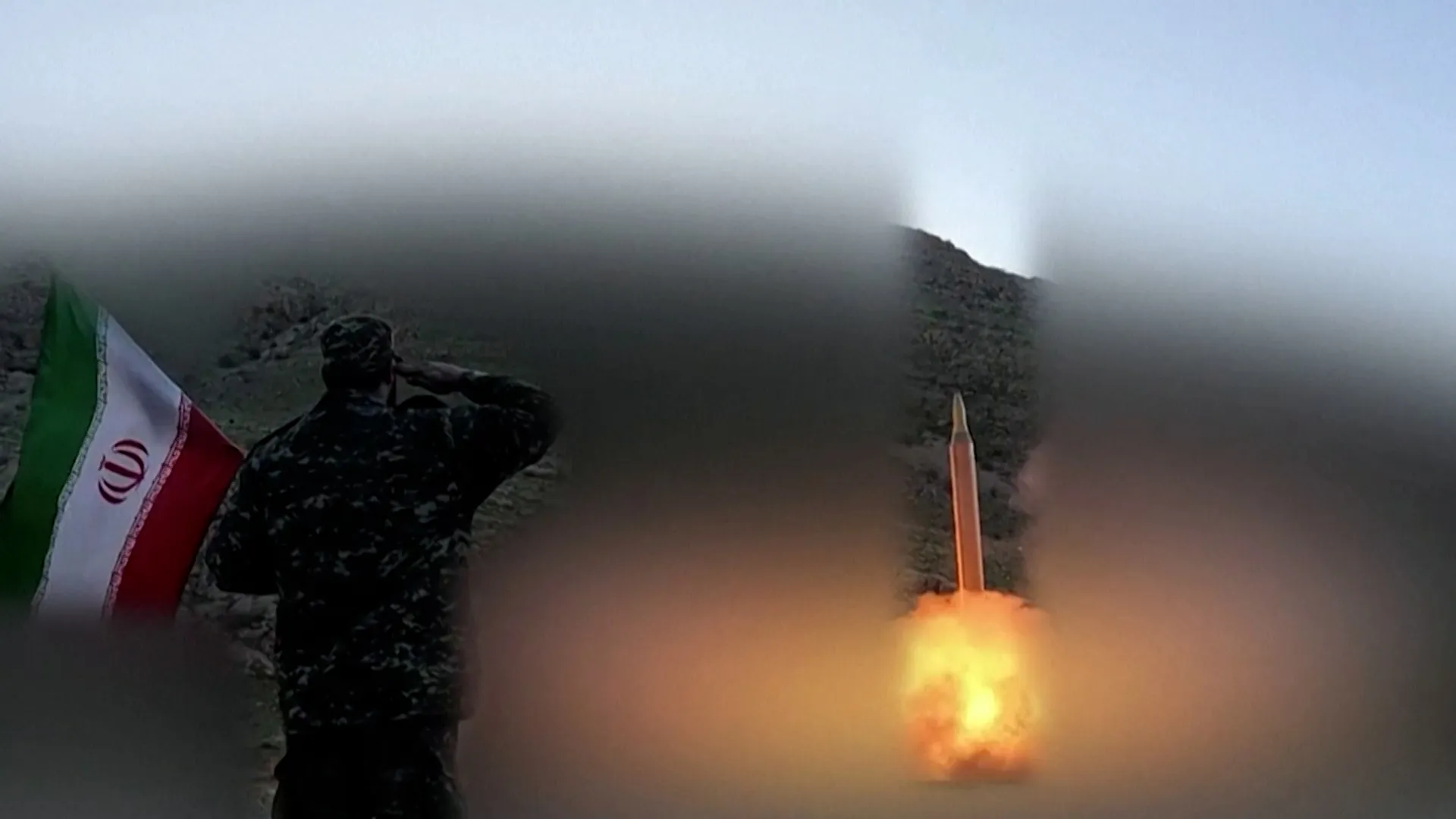
Iran’s Revolutionary Guard Corps released a video of what they say were missiles launched by their naval forces in retaliation of US strikes. US-Iran tensions have been escalating in the Strait of Hormuz leading to its closure and exchange of strikes between US and Iran.
The IRGC has promised a “crushing response” to any further US attacks on its territory. It follows a third round of US strikes on Iran in a week, which was met with retaliatory strikes from Iran on US military targets across the region.
Al Jazeera’s Tohid Asadi shares the latest details from Doha.
Tehran, Iran– The memorandum of understanding (MoU) signed last week between Iran and the United States appears to be in jeopardy after a second day of military strikes, as well as the a framework agreement that entrenches Israeli forces on Lebanese soil.
The Islamic Revolutionary Guard Corps (IRGC) on Sunday released video showing the launch of ballistic missiles overnight, with a message written on them in English and Persian saying US President Donald Trump was insisting on a “defeated war”.
Recommended Stories
list of 3 itemsend of list
The IRGC said it had fired missiles and drones towards the US Ali Al Salem airbase in Kuwait and the US Fifth Naval Fleet in Bahrain in retaliation for a second day of US strikes. It threatened more attacks if the deal is violated again by the “deceitful” US, which, along with Israel launched air attacks across Iran on February 28.
The exchanges of fire come after the US coordinated the transit of vessels out of the Strait of Hormuz in cooperation with Oman and the International Maritime Organization.
Many ships were being directed through Oman’s waters, which prompted the IRGC to hit a container ship and a tanker with explosive-laden drones in an attempt to force traffic to pass through Iranian waters instead.
Speaking to reporters in neighbouring Iraq on Sunday, Foreign Minister Abbas Araghchi said Iran will exercise sole management and oversight of the critical waterway for the next 30 days before allowing full traffic to resume.
He also emphasised the first clause of the June 17 MoU, which says military operations must immediately and permanently end on all fronts, including Lebanon, and urged Washington to exert pressure on Israel to stop attacking southern Lebanon.
The governments of Israel and Lebanon reached a US-brokered framework deal on Friday that allows Israeli forces to remain in southern Lebanon, until Tehran-backed Hezbollah is fully disarmed. That appears to contradict the MoU signed with Iran.
Hezbollah swiftly rejected the agreement, calling it “humiliating, shameful and a surrender” of Lebanon’s sovereignty.
Negar Mortazavi, a senior fellow at the Center for International Policy, said she expected the Lebanon issue to negatively impact the MoU because Hezbollah was not on board and the Lebanese government’s previous ceasefire deals with Israel have been repeatedly violated.
She also told Al Jazeera that Iran has found tremendous leverage with the Strait of Hormuz, treating it as a “golden card”, as the disruption to oil exports has heavily impacted markets and made the war unpopular among many, including in the US.
“They are using that leverage to the max and not going back to the status before the war, pretending like no war happened,” she said, adding that Iranian authorities and the IRGC have sought to centre themselves in the process of coordinating transit through the strait.
“They’re saying they want traffic to go through in coordination with them, and I think they will be able to exert that kind of power,” she said.
On Saturday, Iran’s President Masoud Pezeshkian, Speaker and chief negotiator Mohammad Bagher Ghalibaf and judiciary chief Gholam-Hossein Mohseni-Ejei released an image of their first publicised trilateral meeting since the start of the war more than four months ago.
Supreme Leader Mojtaba Khamenei has not been seen or heard from since succeeding his father, Ayatollah Ali Khamenei, who was killed in a US-Israeli attack on the first day of the war. But a new written text message attributed to him on Sunday said: “What is certain is that the criminals must be seized by the collar and made to face the punishment for their criminal acts”.
Supporters of the Islamic Republic cheered on the latest IRGC attacks against US interests as they continued demonstrating on the streets overnight into Sunday as hardline politicians and analysts called for further attacks until Iran gets better concessions.
On the state-linked talk show, Tamam Rokh, political analysts said Tehran should significantly strengthen its ties with Moscow and Beijing.
“We could do many things with help from Russia and China to damage US strategic equipment in the region like vessels, refuelling aircraft and electronic warfare,” pro-state analyst Ali Samadzadeh said on the programme on Saturday.
“There was no movement in Tehran to tie Beijing and Moscow to the war, and this major flaw exists in the form of the negotiations and the text of the MoU as well,” he said.
More than 60 hardline legislators on Sunday postponed plans to protest against the closure of parliament since the start of the war after its presiding board said it would meet to reconvene the assembly, following Ali Khamenei’s burial next month.
Many others say demands for extracting major concessions from the US and Israel do not correspond with the reality of the situation after months of war.
“In terms of military power, we couldn’t do anything about the US blockade and we didn’t think the crisis would get so serious,” pro-state commentator Vahid Ashtari told crowds at a street event in Tehran.
“I think a type of blind idealism has emerged that believes we are on top and at the peak, so we shouldn’t make a deal. But there are facts on the ground. We have some missiles and drones to carry out an asymmetric defence, but we have no fighter jets to fly to the US and hit Trump. Not only could we not avenge [Khamenei], we could not avenge Haj Qassem either,” he added, in reference to General Qassem Soleimani, who was assassinated by the US in 2020.
After two nights of attacks, Iran’s financial markets also reacted poorly, with the national currency losing gains since the signing of the MoU to trade at about 1.7 million rials against the dollar in Tehran’s open market on Sunday.
The main index of the Tehran Stock Exchange also lost more than 100,000 points to stand at just over five million points at the end of trading on Sunday, the second day of the working week in Iran.
Vahid, a 37-year-old mechanic who also deals in car parts in Tehran’s Grand Bazaar, told Al Jazeera that while the market has marginally improved since the signing of the deal with the US, it is still treading on thin ice.
He said parts for foreign cars are becoming harder to find, while prices have been rising rapidly for both domestic and foreign vehicle parts.
“I think the war will start again over the coming months and some in the bazaar think the same,” he said.
Iran’s Islamic Revolutionary Guard Corps (IRGC) has warned commercial vessels to only use routes through the Strait of Hormuz approved by Tehran, reopening a point of friction in fragile negotiations between the United States and Iran over the future of the strategic waterway.
The warning came after Oman announced a new shipping transit route through the strait on Wednesday, saying it had coordinated the route with the International Maritime Organization (IMO) as maritime traffic slowly resumes following weeks of disruption.
Recommended Stories
list of 4 itemsend of list
The dispute remains one of the unresolved issues after a memorandum of understanding (MoU) was signed by the United States and Iran last week, which largely halted hostilities in the four-month US-Israel war on Iran and which launched a 60-day negotiation process aimed at reaching a broader peace agreement.
The MoU, which includes the reopening of the strait, followed months of severe disruption to shipping after Iran effectively closed it, and the US imposed a corresponding naval blockade on Iranian ports.
Both Washington and Tehran have declared the strait open to commercial shipping, but questions remain over whether Iran will seek greater control over vessel movements, whether it will impose transit or service fees on ships using the strait following the 60-day negotiating period, and whether disagreements over the waterway could derail efforts to reach a permanent agreement altogether.
Why is the Strait of Hormuz so important?
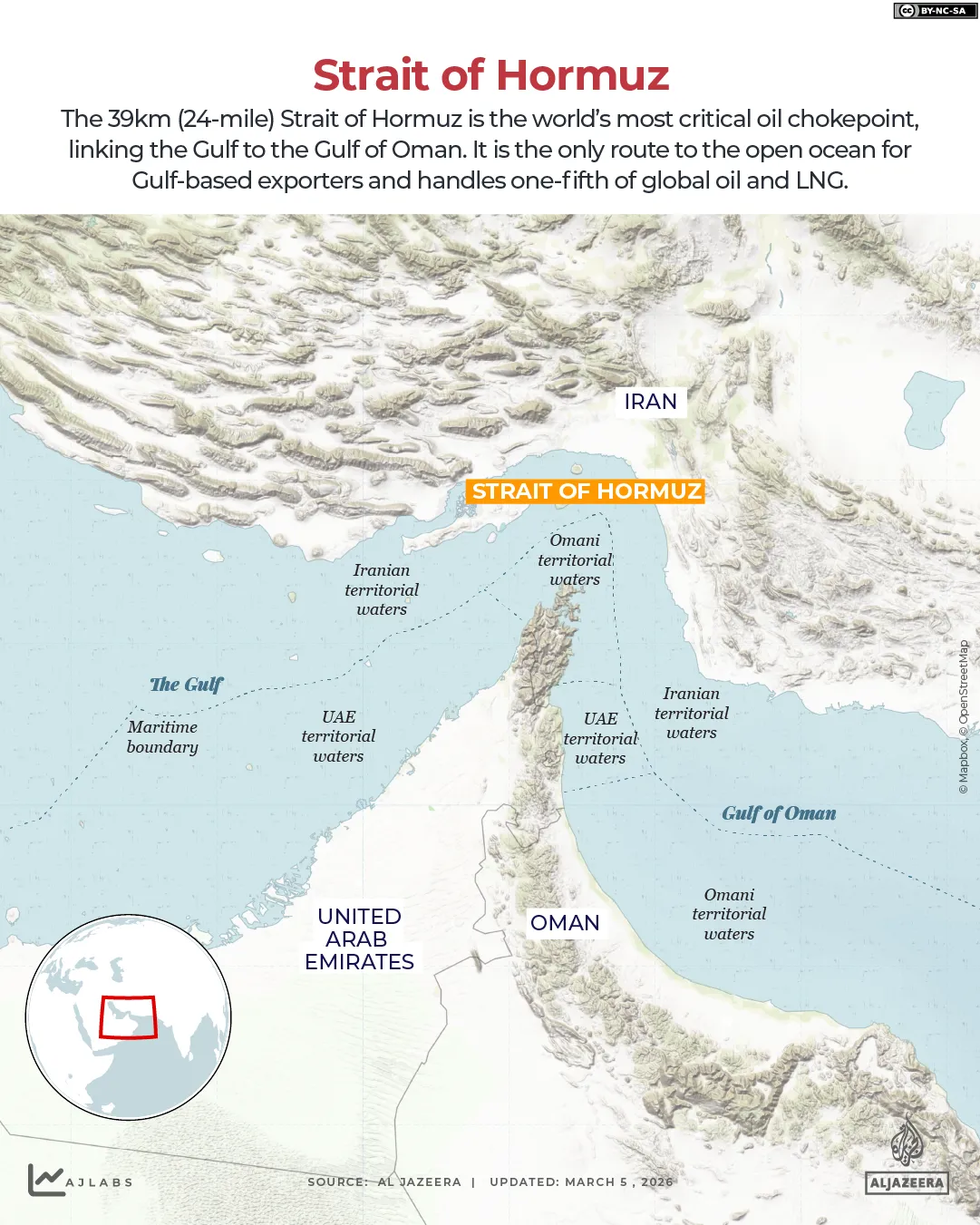
The Strait of Hormuz is one of the world’s most strategically significant waterways, with around one-fifth of global oil and liquefied natural gas (LNG) supplies normally being shipped through the narrow passage linking the Gulf to the Arabian Sea.
Bordered by Iran to the north and Oman and the United Arab Emirates (UAE) to the south, the strait is only about 50km (31 miles) wide at its entrance and exit, narrowing to about 33km (21 miles) at its tightest point. Despite its width, it is deep enough to accommodate the world’s largest oil tankers.
According to the US Energy Information Administration, about 20 million barrels of oil and petroleum products transited the strait each day in 2025, representing hundreds of billions of dollars in annual energy trade.
The route is used not only by Iran but also by Iraq, Kuwait, Qatar, Saudi Arabia and the UAE. It is also vital for global fertiliser exports, with roughly one-third of international fertiliser trade normally passing through the strait.
Because disruptions to shipping there rapidly push up global energy prices and destabilise US markets, control of the waterway has become one of Iran’s strongest sources of strategic leverage in its conflict with the US.
(Al Jazeera)
Why is Iran objecting to Oman’s new route?
The IRGC says Oman and the IMO announced the new shipping corridor without consulting Tehran. “Certain authorities have announced a new shipping route through the Strait of Hormuz without prior notification to or coordination with the Islamic Republic of Iran. The proposed route is unacceptable and poses serious safety risks,” the force said.
“The only authorised transit routes through the Strait of Hormuz are those designated by the Islamic Republic of Iran,” it said, adding that ships must maintain contact with the IRGC Navy while transiting the waterway.
Iran first issued its own map of acceptable routes through the strait in April, showing that ships should pass much closer to the Iranian coast than they had previously.
(Al Jazeera)
The IRGC’s warning came after a Liberian oil tanker passed through the strait on Thursday using a route much closer to Oman’s coastline.
Al Jazeera’s Resul Serdar, reporting from Tehran, said the IRGC appeared frustrated because the Omani route partially bypasses Iran’s direct control over shipping.
“The control of the Strait of Hormuz has been a huge leverage for Iran to put pressure on its adversaries and the global economy since the beginning of the war,” Serdar said.
Oman defended the corridor route it had announced, saying it was intended to restore safe navigation while complying with international law. Foreign Minister Badr Albusaidi said Oman remained committed to ensuring freedom of navigation through the waterway and stressed that “future arrangements related to the strait do not involve imposing any transit fees”.
What does the US-Iran agreement say about the strait?
In the MoU signed last week, Iran agreed that it would “make arrangements using its best efforts for the safe passage of commercial vessels with no charge, for 60 days only, from the Persian Gulf to the Sea of Oman and vice versa”.
While the agreement states that “the traffic of commercial vessels will immediately start”, it also acknowledges that demining operations will be required before normal shipping routes can fully resume, stating that “demining by the Islamic Republic of Iran will be instated within 30 days”. It also provides for discussions between Iran, Oman and other Gulf states on future arrangements for managing the waterway.
However, the memorandum does not specify what will happen after the initial 60-day period. Ali Vaez, Iran project director at the International Crisis Group, said the temporary rerouting of vessels had always been expected because of the mine-clearing operations outlined in the agreement.
“We always knew that if there was a deal, there would be several weeks of mine-clearing operations in the international shipping lane running through the middle of the Strait of Hormuz,” he said.
“During that period, vessels would have to transit through Iranian and Omani territorial waters instead.”
However, Vaez said the latest announcement by Iran was unexpected. “The important thing now is that the Iranians do not start taking fees or other tolls,” he said, “because that is not provided for in the memorandum of understanding.”
Asked whether the IRGC’s position differed from that of Iran’s government, Vaez said: “There is no distinction between the IRGC and the state. They are effectively one and the same. The IRGC is calling the shots.”
Can Iran charge ships fees?
International law generally protects the right of transit through international straits, including Hormuz, making it difficult for coastal states to impose unilateral transit fees on vessels simply passing through international shipping lanes, even where they are within territorial waters.
Last week, Iran announced it would waive planned fees through the strait for 60 days while talks with the US continue in Switzerland, suggesting charges may be introduced once the negotiating period expires.
Iran’s chief negotiator, Mohammad Bagher Ghalibaf, has signalled that Tehran views the post-war arrangement as fundamentally different from the status quo that existed before the conflict.
“Hormuz will never return” to its prewar status, Ghalibaf said.
The suggestion that Iran could charge fees was dismissed by US Secretary of State Marco Rubio this week. Speaking at the start of a regional tour in the United Arab Emirates, he said: “It’s an international waterway. No country is allowed to charge tolls or fees on an international waterway.”
Rubio added that he believed “all the countries in this region would agree”.
Speaking in Manama, Bahrain, after meeting with the Gulf Cooperation Council (GCC) – a bloc comprising Bahrain, Kuwait, Oman, Qatar, Saudi Arabia and the UAE – on Thursday, Rubio also told reporters: “Iranians are saying one thing, but then something else is actually happening.
“It’s now obvious to us that … the Iranian system is going to produce all sorts of maximalist rhetoric. What we’re interested in is not their press conferences. What we’re interested in is whether or not ships are moving. If ships are moving as they should be moving, then that’s what we’re going to judge.
“If, on the other hand, this rhetoric is backed up by actual ships being threatened and ships are not moving, then that’s a violation of the agreement, and we’re going to have a problem with it.”
Rubio claimed there is no regional support for Iranian transit fees, saying, “There is zero support among Gulf countries for any sort of toll or fees charged for the use of international waters … that isn’t going to happen.”
His comments came after UAE presidential adviser Anwar Gargash said that new “geopolitical facts” could not be imposed on the Arab Gulf states as a result of what he described as the “treacherous aggression against them”.
Are ships returning – and which route are they taking?
Some commercial shipping through the strait has resumed, although traffic remains well below normal levels. Before the conflict, between 120 and 140 vessels typically transited the strait each day.
According to shipping analytics company Kpler, confirmed crossings rose to 70 vessels on Wednesday as demining progressed and more operators began using the Omani route.
“The US-Iran MoU framework and apparent lifting of the US blockade appear to have supported a short-term confidence boost, although IRGC warnings against use of the Omani route could create a new source of contention,” Kpler reported.
The company added that incomplete demining, continued “dark” routing by some vessels – when ships limit or switch off their tracking transponders – and unresolved questions over inspections, sanctions and future governance meant shipping had not yet returned to prewar conditions.
This comes as oil prices drop to the lowest level since before the Iran war, with Brent crude, the global benchmark, falling to a low of $72.24 a barrel on Thursday. This remains above the prewar price of $66, however.
The chart below shows how shipping through the strait before the war compares to its status in recent weeks:
Is a peace deal achievable?
The future administration of the Strait of Hormuz is only one of several issues still to be resolved before negotiators hope to reach a comprehensive agreement within 60 days, with another major sticking point being Iran’s nuclear programme.
International Atomic Energy Agency (IAEA) Director-General Rafael Grossi has said the agreement explicitly provides for international monitoring of Iran’s nuclear activities.
However, Kazem Gharibabadi, Iran’s deputy foreign minister for legal and international affairs, has said inspectors’ access to nuclear sites damaged during the conflict will only be considered as part of a final agreement.
Questions also remain over the fate of Iran’s enriched uranium stockpile, the sequencing of sanctions relief and the release of frozen Iranian assets, while regional tensions continue to pose additional risks.
Israeli forces remain deployed in parts of southern Lebanon occupied during the conflict, according to a Lebanese military source, while Israeli strikes have continued, despite the MoU explicitly calling for “a permanent end to the war on all fronts, including Lebanon”.
Vaez said visible progress would be essential if negotiations are to survive, noting, “Both sides have to see progress, whether that’s greater access for UN nuclear inspectors, sanctions relief, or resolving the issue of Iran’s uranium stockpile.”
He cautioned against viewing the interim agreement as a series of smaller deals. “Nothing is agreed until everything is agreed,” Vaez said.
“They [the Iranians] are determined to reach a comprehensive agreement within 60 days. That’s a very ambitious timetable, but there has to be visible momentum or the process risks falling apart.”
However, Vaez said both Washington and Tehran have strong economic incentives to bring about a lasting peace. “The situation in the Strait had become one of mutually assured economic destruction,” he said.
“The United States was facing rising energy and oil prices ahead of the midterm elections … At the same time, Iran was already in a deep economic hole before this conflict began. The war only made that worse.
“It became a lose-lose dynamic, and both sides needed a way out.”