Ireland

Arab News | Thousands protest Trump visit to Ireland

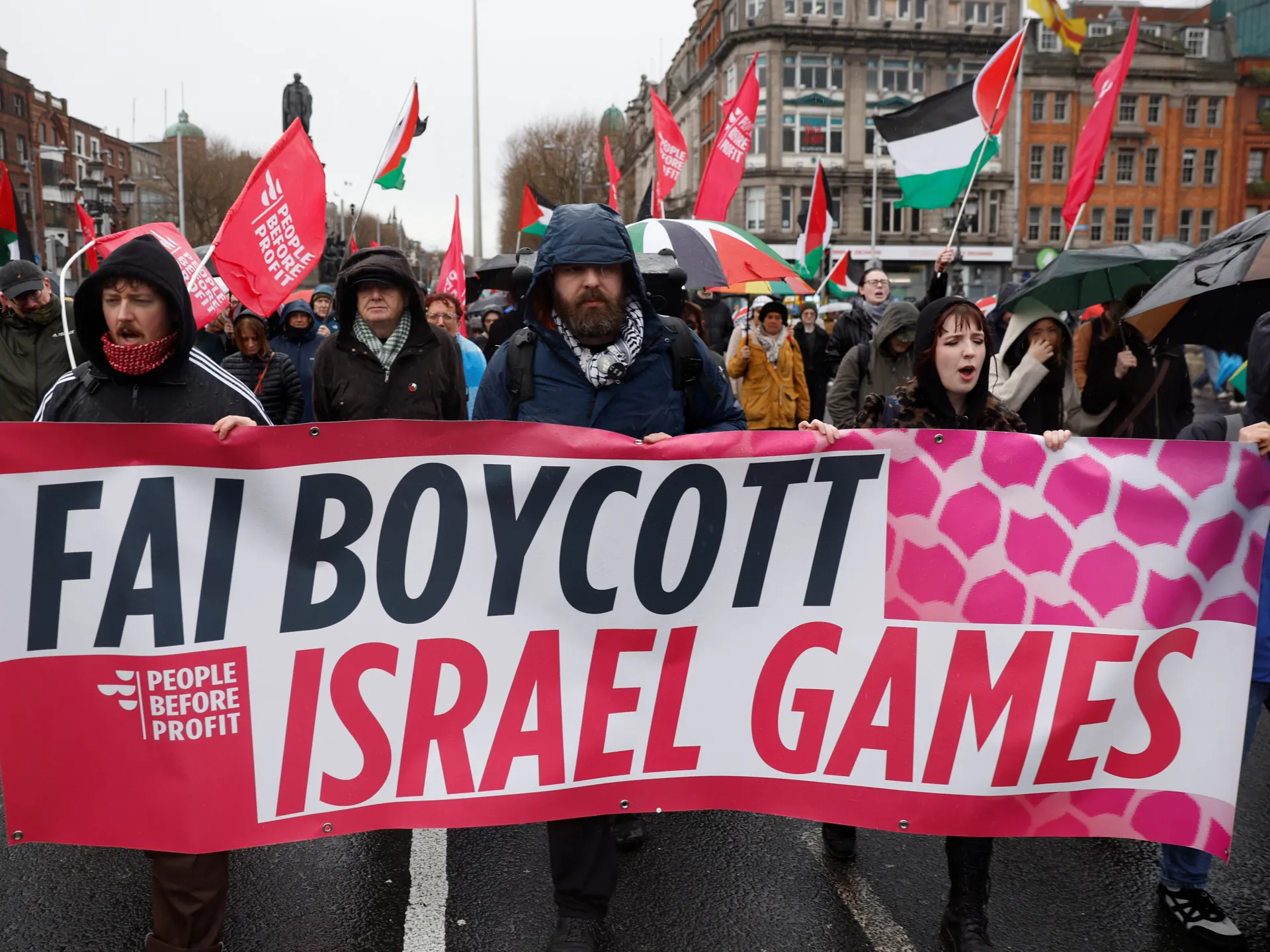
DUBLIN: Thousands of demonstrators marched through Dublin on Saturday to protest against US President Donald Trump’s visit to Ireland, with campaigners condemning his policies on foreign affairs, climate, immigration and social issues, according to The Irish Times.

The Dublin protest drew a broad mix of political parties, campaign groups, trade unions and unaffiliated demonstrators, The Irish Times reported. Organizers said about 25,000 people attended, although the newspaper said the actual number was likely lower.

Marchers walked from the Garden of Remembrance to the Dáil, carrying Palestinian flags and placards criticizing Trump over issues including Gaza, racism, misogyny, climate policy and US military activity.

One protester quoted by The Irish Times said the crowd was intended to send a message of opposition, adding: “With Trump, the only people on the streets are here to oppose him.”

Another protester, Holly Eustance, told the newspaper that Trump’s policies threatened vulnerable species and the planet, saying war and climate change caused widespread destruction while political and economic systems favored billionaires over people.

The march was largely peaceful, though The Irish Times reported that a masked breakaway group, Anti-Imperialist Action, burned a US flag near Molesworth Street, set off firecrackers and chanted against the presence of US troops at Shannon Airport.

Speakers outside the Dáil criticized the Irish government’s handling of Trump’s visit. Labour TD Ciarán Ahern accused officials of “sycophancy,” while Senator Alice Mary Higgins described the trip as a “grotesque pantomime,” according to The Irish Times.

Trump earlier appeared to dismiss questions about the protests, suggesting they were probably “friendly,” but demonstrators quoted in the Irish newspaper said their message was that he was not welcome in Ireland.


Source link

Trump: US president’s comments on a united Ireland may have targeted an audience across the Atlantic

Giving an answer to a question that is asked at a free-flowing press conference is one thing, but Donald Trump repeated his sentiments a short time later when he was delivering a speech to an invited audience at the US Ambassador’s residence.

In fact it was almost the first thing he mentioned, hinting that maybe he realised he had kicked over a can of worms at his earlier appearance.

The rest of that speech was curious. It was billed as a 20-minute address to Irish and Irish American business leaders, but was about twice that and strayed largely into domestic US matters.

President Trump has a speaking style that he describes himself as “the weave”.

He can bounce from topic to topic during any speaking engagement, veering off the script and then returning to the matter at hand.

Today he lauded his own achievements, as he sees them, such as clamping down on illegal immigration, doing deals and boosting defence production.

He repeated his criticisms once again of what he views as the UK’s lack of support for his military operation in Iran.

Source link

Trump says a unified Ireland would be ‘fantastic’ during Irish visit | Donald Trump News

British Prime Minister Andy Burnham maintains that a poll is ‘off the table’ as there isn’t enough popular support for Northern Ireland to leave the UK.

United States President Donald Trump has said that a unified Ireland would be “fantastic”, in remarks made during a visit to Dublin that were not welcomed by government ministers in London.

Trump’s comments on Saturday came weeks after British Prime Minister Andy Burnham said a referendum on Northern Ireland leaving the United Kingdom was “off the table”.

Recommended Stories

list of 3 itemsend of list

“Well, I don’t want to cause any problems, but I will tell you, I’d love to see it unified,” Trump told reporters, while sitting next to Ireland’s Prime Minister, Micheal Martin.

“It’s going to happen eventually … I think it would be a fantastic thing,” he said.

“Now the UK will have something to say about it … but I think it would be a great thing,” he added.

Martin declined to respond to reporters’ questions to comment on the US president’s remarks.

Following Trump’s comments, a spokesperson for Burnham said his position on Irish unification remained unchanged.

Responding to questions from members of parliament on Wednesday about a potential poll in Northern Ireland, Burnham said: “I am not aware that there is majority public support for another referendum, and until that changes, there will not be one”.

US President Donald Trump is welcomed by Ireland's President Catherine Connolly at Aras an Uachtarain (the president's official residence) in Dublin on September 12, 2026.
Donald Trump is welcomed by Ireland’s President Catherine Connolly at her official residence in Dublin, September 12, 2026 [Kin Cheung/AP]

Under the terms of the 1998 Good Friday Agreement (also known as the Belfast Agreement), a referendum on leaving the UK can be held only at the discretion of the British government.

The accord ended three decades of violence known as The Troubles. The sectarian conflict involved mostly Catholic nationalist paramilitaries seeking a united Ireland, mostly Protestant unionist paramilitaries wanting to remain part of the UK, and British troops.

Gavin Robinson, leader of the DUP, Northern Ireland’s main unionist party, said that Northern Ireland’s future was a matter for its people to decide, not Trump.

“President Trump knows better than most that elections matter. Northern Ireland’s constitutional future will be decided by the people of Northern Ireland, not by commentary in London, Dublin or Washington.”

While polls show a comfortable majority in Northern Ireland favour remaining in the UK, the gap has narrowed slightly since Britain’s departure from the European Union pushed unity higher up the political agenda.

Trump also met Irish President Catherine Connolly, who was elected head of state last year. When Trump last visited Ireland as president in 2019, Connolly, an outspoken politician with left-wing foreign policy views, protested at Shannon Airport in western Ireland.

During Trump’s current visit, some supporters had urged her to speak out against US military actions around the world and defend Ireland’s neutrality.

People take part in a protest against the visit of US President Donald Trump in the Irish capital Dublin on September 12, 2026.
People take part in a protest against the visit of US President Donald Trump in the Irish capital Dublin on September 12, 2026 [Adrian Dennis/AFP]

Anti-Trump protests

Anti-war and anti-Trump protests were held in Dublin and some were planned for later in western Ireland, near Trump’s golf course in Doonbeg.

Reporting from the capital, Al Jazeera’s Milena Veselinovic said Dubliners had a “laundry list” of reasons for protesting against Trump’s visit.

“They feel that the Irish government should not be, in their words, rolling out the red carpet for someone like Trump, who they say is a cause of instability in the world and has been enabling Israel’s actions in Gaza … and destabilised the whole of the Middle East.”

Irish people are also protesting against the high cost of hosting Trump, including security, which they say could pay for other things, such as healthcare and social issues, added Veselinovic.

Source link

Trump is heading to Ireland for the Irish Open at his Doonbeg golf course

President Trump is taking a break this weekend from the pressures of the Iran war and American voter anger over the conflict’s economic fallout by indulging in one of his favorite pastimes: golf.

After observing the somber 25th anniversary on Friday of the 9/11 attacks that killed more than 3,000 people in New York, Washington and Pennsylvania, Trump plans to fly to Ireland for a weekend at his eponymous golf resort in Doonbeg on the country’s Atlantic coast. Trump International Golf Links is hosting the Irish Open, which kicked off Thursday.

The president is an avid golfer who hits the links at clubs he owns in Florida, New Jersey and Virginia just about every weekend. Prime Minister Micheál Martin invited Trump to watch the Irish Open during a St. Patrick’s Day trip to Washington in March, and Ireland’s political leaders will most likely see the visit as a chance to maintain warm relations despite differences over trade and foreign policy.

Daniel Mulhall, a former Irish ambassador to the United States, said Irish and U.S. officials will see Trump’s trip “as a happy opportunity for him to have a little bit of R&R in a place that he really loves, which is his golf course in Doonbeg.”

“The relationship with America is on an even keel, which is great because not every country in the world can say that,” he said.

There will be a bit of politics, then golf

Trump plans to sit down on Saturday to talk about trade and international issues with Martin and will also have a brief meeting with President Catherine Connolly, a progressive campaigner who was elected Ireland’s ceremonial head of state last year. He’ll give remarks to business leaders at the U.S. ambassador’s residence, the White House said. Then he’ll travel to Doonbeg to attend the tournament, and possibly present the winner’s trophy on Sunday.

The U.S. and Ireland share ties of history — 30 million Americans claim Irish heritage, and more than 1 million Americans visit Ireland every year — and strong economic bonds. The Irish Treasury takes in billions in corporate tax from U.S. technology and drug companies operating in Ireland, and American firms employ more than 200,000 people in the country.

Ireland is a member of the European Union, a frequent target of Trump’s ire, but so far the country’s lucrative pharmaceutical sector has avoided steep levies.

The Middle East is a potential source of friction. Ireland has recognized a Palestinian state and banned goods from Israeli settlements in the occupied West Bank, both positions eschewed by the Trump administration.

Martin, who leads a center-right coalition government, struck up a cordial relationship with Trump during his St. Patrick’s Day visits, though Trump said in the Oval Office in March 2025 that “of course” Ireland was among countries taking advantage of the United States.

Not everyone in Ireland is welcoming Trump’s visit. More than 150 Irish lawyers signed a letter objecting to the visit, alleging that through support for conflicts in Gaza and Iran Trump is “executing and enabling war policies which are illegal, causing death and destruction on a massive scale.”

A collection of left-leaning opposition parties, anti-military groups, pro-Palestinian organizations, environmentalists and others plans to demonstrate in Dublin on Saturday.

Trump has forged a role as sports fan-in-chief

Trump’s attendance at the Irish Open continues his trend of appearing at prominent sporting events — and having a hand in organizing some of them in ways that benefit his family business. His clubs in Doral, Fla., and Bedminster, N.J., have each hosted professional golf tournaments this year.

In July, Trump marked the 250th anniversary of U.S. independence from Britain by staging a UFC fight night on the South Lawn of the White House and sanctioning the first IndyCar race ever held on the streets of Washington.

Since beginning a second term in office in January 2025, he’s attended the Super Bowl, the Daytona 500, the FIFA Club World Cup final and the U.S. Open men’s tennis final. He recently announced that he will be at the Presidents Cup golf tournament in late September near Chicago in the traditional role as honorary chairman of the matches.

Last summer, he visited his golf courses in Scotland, meeting then-Prime Minister Keir Starmer and European Commission President Ursula von der Leyen during the trip.

The president’s visit has brought a huge security operation to the rural area 175 miles west of Dublin, complicated by the presence of some 20,000 golf fans attending the Open.

Local councilor Rita McInerney, who owns a shop in Doonbeg, said Trump’s purchase of the golf course in 2014 has been a mixed bag for the town.

She said Doonbeg has been “vilified” by some in Ireland because of its Trump connection, but that the resort is a major employer and a responsible member of the local business community.

The area draws many American tourists, some of whom come because “they love the golf more than they hate Trump,” she said.

“And then there’s a group of people that will come because they follow Trump or they like Trump or they support him in the U.S.,” she said. “And then there’s other people that will avoid the place because he owns it.”

Superville and Lawless write for the Associated Press.

Source link

‘Majority do not welcome him’: Trump heads to Ireland amid fury over Gaza | Donald Trump News

Donald Trump is set to arrive in Ireland on Saturday, but most Irish people aren’t happy about it.

A recent poll by the Sunday Independent and Ireland Thinks reported that 69 percent do not support the US president’s visit.

Recommended Stories

list of 4 itemsend of list

“Thousands of us will march on Saturday because we refuse to normalise a man who has facilitated genocide,” Sean Radcliffe, an economics undergraduate student at Trinity College Dublin, told Al Jazeera.

Taoiseach Micheal Martin “should say it clearly, firmly, and publicly: the United States is facilitating genocide,” added Radcliffe, who is a leader of the student body’s Boycott, Divestment, Sanctions campaign.

Sean Corcoran, an environmental artist based on the Copper Coast in Waterford, spent five hours with three others carving “No Kings” – a nod to anti-Trump protests under the same name in the US, along with “Gaza, Iran, Ice,” into the sand of Dublin Bay Beach.

“As an Irish artist and citizen, I believe it is important for me to use my voice to share my opinion about the Trump administration,” he told Al Jazeera. “Despite the diplomatic and security welcome that Mr Trump will receive when he lands in Ireland, the majority of Irish do not welcome him to Ireland.”

Many in Ireland are using Trump’s visit as a way to show their anger over US policies [Courtesy: Uplift]

Trump is expected to meet with several figures in Ireland’s leadership, including Martin and antiwar President Catherine Connolly, who has previously said the US is, along with France and England, a nation Ireland “certainly cannot trust”.

Protests are planned throughout Ireland, including in Dublin’s Garden of Remembrance. Many are themed against Trump’s role in supporting Israel’s actions in Palestine.

Ireland, one of the West’s most vocal critics of Israel, was the first European Union country to ban imports from illegal Israeli settlements.

Roughly 4,000 security personnel will be enlisted to protect the US leader from protests and other risks during his visit, including roughly 1,000 US Secret Service agents and “anti-drone weaponry”.

Following his visits with Ireland’s political elites and the US ambassador to Ireland, resulting in the temporary shutdown of Phoenix Park, one of Europe’s largest parks, he is expected to visit the Irish Open golf tournament in Doonbeg, where Trump owns a resort.

Connolly, whose role is largely ceremonial, has said that she is “not afraid to stand against the consensus”. She secured a landslide victory in October 2025.

During her campaign, Connolly said she would meet the US president in her official capacity, but added that “I doubt that [genocide] would be the discussion, I doubt that [Gaza] would be on the agenda”.

“People expect a slightly more activist president who might speak out,” Johan Dornschneider-Elkink, professor of Computational Political Science at University College Dublin, told Al Jazeera. “The high level of consensus in the Irish population means that the president can also feel a bit comfortable pushing it a bit.”

Still, the limitations of Connolly’s role, and the economic obligations of the taoiseach are expected to overshadow the issue of Palestine during high-level conversations.

‘Ireland is very much aligned in spirit’

“I think [the protest] shows that Ireland is very much aligned in spirit and policy-wise with the Palestinian people; they very much identify with Palestine,” Stephanie Dornschneider-Elkink, associate professor of Political Science at University College Dublin, told Al Jazeera.

“But there’s also only so much space to be critical. Ireland depends on the US, and there’s an economic relationship at stake.”

Johan added that the visit is more an opportunity for Irish people who want to make known their stance on both Palestine and the Trump administration.

“There’s an understanding that Trump is one president among many, and there will be another president. There’s a longer history of the Irish-US relationship which nobody wants to see damaged.”

Leader of the Opposition Mary Lou McDonald of Sinn Fein, told journalists this week that she hoped Connolly would raise issues like “ongoing facilitation of a genocide in Gaza,” adding that the party will take part in Saturday’s protests.

The party’s spokesperson on foreign affairs, trade, and defence, Donnchadh O Laoghaire TD, shared on his Instagram that he would join the protest in the Garden of Remembrance, asking others to join him “to stand up against genocide and against war”.

U.S. President Donald Trump and Irish Taoiseach (Prime Minister) Micheal Martin attend a St. Patrick's Day reception in the East Room at the White House in Washington, D.C., U.S. March 17, 2026. REUTERS/Kylie Cooper
US President Donald Trump and Irish Taoiseach (Prime Minister) Micheal Martin attend a St Patrick’s Day reception in the East Room at the White House in Washington, DC, on March 17, 2026 [Kylie Cooper/Reuters]

The demonstration is organised by the Irish Neutrality League, in coalition with the Irish Anti-War Movement and social justice movement Tonn na Cle, and has received endorsements from the Social Democrats, Labour, People Before Profit-Solidarity, and the Green Party, in addition to Sinn Fein.

Student groups in Ireland have been among the loudest voices of pro-Palestine organising in the country, with Trinity College Dublin becoming the first university in the world to officially sever ties with Israel.

Radcliffe said there is no generational divide “of any significance” over the Israel-Palestine conflict in Ireland.

“Some of the best [pro-Palestine] activists I know in Ireland are pensioners,” he said.

Source link

Six Nations: No plans for Ireland Six Nations game in US – IRFU

Italy, who play their home Six Nations fixtures at Rome’s 70,000-seater Stadio Olimpico, also distanced themselves from the possibility of taking a game across the Atlantic.

“The United States has all the potential to be a major market for the growth of our sport: in this respect, Italy was ahead of its time by playing a test match against Ireland in Chicago back in 2018,” said a spokesman for the Italian Rugby Federation (FIR).

“An event like the one between South Africa and the All Blacks – one of the greatest rivalries on the international calendar – can serve as an exciting preview of the upcoming Men’s and Women’s Rugby World Cups in 2031 and 2033.

“At present, however, there are no discussions between FIR and other stakeholders on the possibility of a Six Nations test taking place in the US.”

In an interview with the Daily Telegraph, external and The Times, external, Gilpin said: “This isn’t a live discussion of an Italy v Ireland game, but why we use that as an example is because you’ve got two fantastic fanbases in the US of Irish and Italian fans.

“If you could take a Six Nations game to the right place, to a Boston or to a New York, where there’s a lot of those fanbases, you can definitely drive the economics.

“Now, you’re going to have Irish fans and Italian fans in those respective home countries saying: ‘Hang on a minute, you know, we want to see our country play?’

“The counter-argument to that [is] it’s still Irish and Italian fans getting the chance to watch their team, so they’re just not the ones who live in Ireland and Italy on this occasion. But that’s a balancing piece we’ve got to work through.”

Ireland have previously enjoyed two well-attended games in the US against New Zealand.

They memorably beat the All Blacks for the first time when the teams met in front of a capacity 60,000-strong crowd at Chicago’s Soldier Field in 2016, with a 2025 rematch which they lost also proving a similar commercial success.

Source link

Foreign Office issues important travel update for all Brits travelling to Ireland

The Foreign, Commonwealth and Development Office (FCDO) has updated its travel advice for British passport holders entering Ireland and the ID that is required

The Foreign Office has issued an important travel update for Brits planning to visit Ireland.

On Friday, 4 September, the Foreign, Commonwealth and Development Office (FCDO) updated its information on the ID requirements for British passport holders when travelling from the UK to Ireland. On the Foreign Office’s entry requirements page for Ireland, it advised Brits that while they don’t need a passport to enter Ireland, it might be best to carry one.

Outlining the requirement for passports and ID, the FCDO said: “British nationals are not legally required to show a passport to enter Ireland, but it may be useful to carry in case you need to prove your identity. British and Irish citizens can continue to travel freely between the UK and Ireland under the Common Travel Area.

“Some airlines and ferry operators have introduced, or will be introducing, a passport-only identification requirement. Check your carrier’s requirements before departure and, where necessary, travel with a valid passport. Check the Ireland Citizens Information Board for guidance on acceptable ID. Irish immigration officers are entitled to ask for proof of British nationality in the course of their work.”

The FCDO also confirmed that British passport holders do not need a visa to enter Ireland. They stated: “You can visit and remain indefinitely in Ireland under the Common Travel Area rules. British nationals do not need a visa or residency permit to live, work or study in Ireland. Although Ireland is in the EU, it is not part of the Schengen area, and Schengen rules do not apply.

“As Ireland is not in the Schengen area it is therefore not affected by the new Entry/Exit System (EES) that will be introduced in Schengen countries from 12 October 2025. You will not need to register for EES when entering Ireland. Read more information on the EU Entry/Exit System and to understand which countries are in the Schengen area.”

It comes after it was confirmed that anyone travelling by ferry between the UK and Ireland will be required to show a passport before boarding. As it stands, those catching a ferry to and from the Irish ports of Dublin and Rosslare can use photo IDs rather than passports, but from September 28, passports will be required.

In the update, Irish Ferries confirmed: “From 28 September 2026, all passengers travelling on Irish Ferries services between the Republic of Ireland and Britain must present a valid passport or Irish passport card before boarding. The new passport requirement applies to Irish Ferries’ Dublin–Holyhead and Rosslare–Pembroke routes, in both directions.

“This requirement applies to all passengers, including Irish and UK citizens. From 28 September 2026, driving licences, national identity cards and other forms of photographic identification will no longer be accepted for travel on these routes.

“Irish Ferries is introducing this requirement to comply with UK Border Force requirements on the accuracy and integrity of passenger data before boarding.”

Do you have a travel story to share? Email webtravel@reachplc.com

Source link

Simon Calder says ‘it’s completely pointless’ amid major UK and Ireland change this month

There is a huge change to how people can travel between the UK and Ireland

Travel expert Simon Calder has branded the new changes to travel between the UK and Ireland as “completely pointless”. Anyone travelling between the UK and Ireland by ferry will be required to show a passport before boarding.

The new rules come into force later this month and mark a major change in the ease of travel. Currently, those sailing to and from the Irish ports of Dublin and Rosslare can use photo IDs rather than passports. This can even include a bus pass.

Yet, from September 28, passports will be required. Simon shared his thoughts on the change during his Telegraph Travel Expert podcast.

He said: “We want more security, but if you’ve got a huge, long international frontier between the UK and Ireland which is completely open, and has to remain so without any checks because of the Good Friday Agreement, then putting these rules in place across the Irish Sea is completely pointless.”

While many people do have passports, Simon explained that the change can be a problem for many passengers.

He said: “There is a significant contingent of people, perhaps older travellers, who simply think ‘why do I need a passport, the only international journey I make is going back to Dublin to see family or going on the odd holiday to Kerry’.

“At the other end of the age spectrum, many people want to take their brand new child across the Irish Sea. Bring the baby, newborn across, and they are able to do that without a passport.

“It is going to be very significant in almost making life very difficult for the sorts of people who have got used to seamless travel.”

If people are not aware of the rules or do not have a passport with them from September 28, Simon said: “They won’t be getting on the ship I fear.”

The travel expert recommended other options for travellers to be able to cross between the UK and Ireland without a passport.

He said British Airways do not plan to require passports, and that you can sail from Scotland or Wales to Northern Ireland and cross by land without a passport.

New passport rules

Irish Ferries said: “From 28 September 2026, all passengers travelling on Irish Ferries services between the Republic of Ireland and Britain must present a valid passport or Irish passport card before boarding. The new passport requirement applies to Irish Ferries’ Dublin–Holyhead and Rosslare–Pembroke routes, in both directions.

“This requirement applies to all passengers, including Irish and UK citizens. From 28 September 2026, driving licences, national identity cards and other forms of photographic identification will no longer be accepted for travel on these routes.

“Irish Ferries is introducing this requirement to comply with UK Border Force requirements on the accuracy and integrity of passenger data before boarding.”

Stena Line added: “From Monday 28 September 2026, passengers travelling between Holyhead and Dublin or Fishguard and Rosslare will now need to show their passport on departure.

“There is no change to the ID requirements for business or leisure passengers travelling with Stena Line from Belfast, Liverpool, Cairnryan or Heysham.”

Source link