Iranians

Iranians mark first Ashura since Khamenei’s killing in the US-Iran war | Religion

NewsFeed

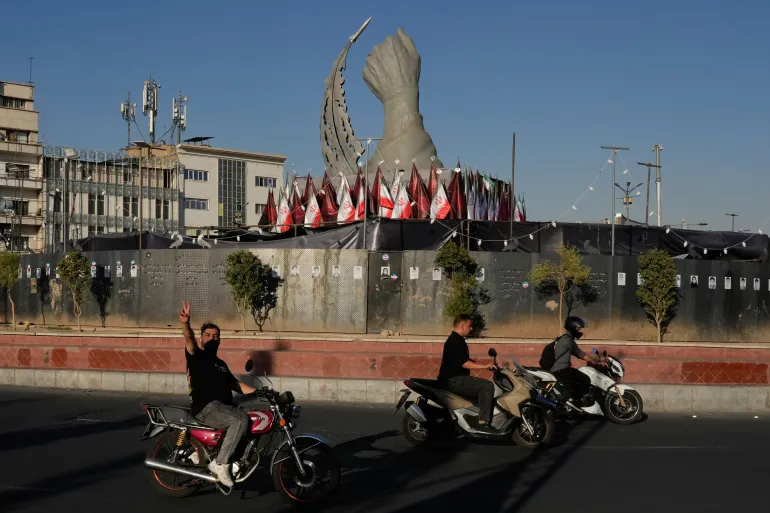
Thousands gathered in Tehran on the eve of Ashura, the first since the killing of Iranian supreme leader Ali Khamenei. Mourners carried flags, banners and images of Khamenei as Iran prepared to commemorate one of the most significant events in the Shia calendar.

Source link

Iranians gather in Tehran to support team in critical draw against Belgium | US-Israel war on Iran

NewsFeed

Iranian fans in Tehran watched their team secure a 0-0 draw against Belgium at the World Cup in Los Angeles, keeping hope alive for an unprecedented chance at the second round. Iran competes under strict US travel restrictions, which forced them to fly back to Mexico within hours of the draw, rather than remaining overnight for recovery.

Source link

Rial rebounds and stocks soar, but Iranians still grapple with high prices | US-Israel war on Iran News

The value of Iran’s currency has risen by more than 15 percent against the US dollar, and its stock market has shattered records in the wake of the memorandum of understanding agreed between the United States and Iran on Sunday.

However, Iranians suffering for years from extremely high inflation and a plunging rial have found little economic relief as the prices of basic goods, such as food, remain high despite the diplomatic breakthrough.

Recommended Stories

list of 4 itemsend of list

The Iranian economy has suffered due to decades of US sanctions. The economic crisis was exacerbated after the US and Israel launched a war against Iran on February 28. As subsequent US naval blockade on Iranian ports further added to the misery of Iranians.

In Ferdowsi Street, the beating heart of Tehran’s foreign exchange market, the scene on Thursday was a stark departure from the panic of recent months. Exchange office boards flashed rapidly changing numbers as foreign currencies, led by the dollar, took a sharp dive.

“We closed our doors just hours before the official announcement of the US-Iran understanding at a rate of 1.8 million rials to the dollar,” Amir, a 35-year-old exchange office worker who asked to remain anonymous, told Al Jazeera. “Now it has fallen to 1.54 million rials, and we expect further declines.”

Amir noted a significant increase in sales volumes although buyers remained scarce as many anticipated the rial would strengthen further, potentially dropping to 1.4 million to the dollar or lower.

The recent gains mark a sharp turnaround. After the outbreak of the war, the exchange rate jumped to a historic peak of 1.9 million rials (190,000 tomans) to the dollar in March before settling at about 1.685 million just before recent attacks carried out despite a ceasefire.

A disconnect in the grocery aisles

Despite the rial’s recovery, a walk through Tehran’s grocery stores reveals a starkly different reality. For Iranians grappling with the economic fallout of crippling sanctions and the US naval blockade, the diplomatic thaw has yet to lower the cost of living.

Shoppers browse for fresh produce at a market in Tehran. Consumers report that despite the rial's recovery, prices for basic food items and everyday goods remain stubbornly high.
Shoppers browse for fresh produce at a market in Tehran. Consumers report that despite the rial’s recovery, prices for basic food items and other necessities remain stubbornly high [Rasol Alhaei/Al Jazeera]

Reza, a 42-year-old Tehran resident, told Al Jazeera that prices for daily staples like milk, cheese, cooking oil and flour remain unchanged. “They say the dollar dropped, but my shopping basket costs the same as last week,” he said. “This means the agreement hasn’t reached our pockets yet.”

From behind the cash register, 55-year-old shop owner Ramin echoed his customer’s frustration. He explained that while the government continues to distribute subsidised goods like bread, the fluctuations of the free-market dollar do not immediately impact basic food prices.

The value of the dollar on the free market varies from the official exchange rate.

Pointing to a shelf of imported goods, another shopkeeper named Karim noted that items like shampoo, toothpaste and laundry detergent are still locked at inflated prices.

“Distributors say they bought these goods two months ago at the old dollar rates,” Karim explained. “Prices will remain high until the old stock runs out and new goods enter at the lower exchange rates.” He estimated it would take at least two weeks for the market to adjust, meaning Iranians will continue to face compounding inflation in the interim.

Euphoria on the trading floor

While Main Street struggles, Tehran’s stock market is experiencing an unprecedented boom amid expectations of improved economic conditions. The trading floor has been awash in green since the initial leaks of the Washington-Tehran agreement emerged.

On Monday, the main index jumped by a record-breaking 161,000 points in a single session, marking the highest-ever influx of cash from individual investors.

By Tuesday, the market continued its staggering ascent, climbing another 112,000 points to cross the psychological barrier of 5 million, ultimately settling at a historic high of 5.1 million.

A screen displays a sea of green on the Tehran Stock Exchange. The market shattered historical records, crossing the five-million-point mark following the announcement of the US-Iran deal.
A screen displays a sea of green on the Tehran Stock Exchange. The market shattered records, crossing the 5 million mark after the announcement of the US-Iran deal [Rasol Alhaei/Al Jazeera]

Saeed, a 40-year-old investor, called it a “historic day”. He noted that investors are rushing to buy shares in the energy and petrochemical sectors, betting heavily on the resumption of exports and the reopening of global markets.

However, Saeed remained cautiously optimistic. “The stock market is often driven by rumours,” he warned. “I don’t want to repeat the experience of the 2015 nuclear deal when the market soared and then collapsed after the US withdrawal.”

He was referring to US President Donald Trump’s 2018 withdrawal from the agreement, under which Iran agreed to restrictions on its nuclear programme in exchange for sanctions relief.

Stagnation in real estate and electronics

The wait-and-see approach in effect has paralysed other sectors of the economy. In central Tehran’s electronics hubs, 38-year-old shop owner Reza reported that while the prices of imported appliances have dropped in tandem with the dollar, sales have stalled because customers are holding out for steeper discounts.

A similar freeze has gripped the housing market. Nasrin, a 36-year-old real estate agent in northern Tehran, observed that a recent price surge that accompanied the initial truce has now given way to stagnation. Many property owners are clinging to inflated prices, seemingly unaware that the market dynamics have shifted, bringing property transactions to a virtual standstill.

‘Not a magic wand’

For macroeconomic experts, the mixed market signals are entirely expected. Hossein Selahvarzi, the former head of the Iran Chamber of Commerce, Industries, Mines and Agriculture, cautioned that the new agreement is “not a magic wand” capable of instantly fixing years of structural issues in the economy.

While the war severely damaged Iran’s infrastructure, Selahvarzi emphasised that the roots of the country’s economic malaise were firmly planted well before the bombing began.

“War is the enemy of investment, production, trade and public welfare,” Selahvarzi told Al Jazeera. He warned against the analytical mistake of believing that a peace memorandum alone would revive the economy.

“Ending the military confrontation does not necessarily mean the beginning of economic prosperity,” he said, stressing that restoring stability to the business environment remains the country’s most urgent priority.

“What we have before us is a limited and fragile opportunity to correct course and rebuild the economy, and this opportunity could be lost quickly if not managed correctly.”

Source link

Iranians Remain Skeptical of Better Future Despite US Iran War Truce

Iran’s government has portrayed the interim agreement with the United States as a victory that ended months of conflict and prevented further escalation. The deal halted a war that saw U.S. and Israeli airstrikes, disruptions to trade, and severe economic damage across Iran.

However, interviews with ordinary Iranians reveal a starkly different picture. Many citizens say years of sanctions, combined with the recent conflict, have left them struggling with rising prices, declining living standards, and deep uncertainty about the future. While the fighting may have stopped for now, many remain unconvinced that the agreement will bring meaningful economic relief or lasting stability.

Economic Hardship Continues to Dominate Daily Life

For many Iranians, the ceasefire has not changed the reality of daily economic struggles.

Business owners, students, and workers interviewed across the country described a population focused on survival rather than recovery. Many reported cutting household spending, reducing social activities, and adjusting to higher living costs. Small businesses continue to face weak consumer demand, while young people increasingly worry about their economic prospects.

The war added another layer of pressure to an economy already weakened by years of international sanctions, inflation, and limited foreign investment. As a result, many citizens see little immediate prospect of improvement even if the ceasefire holds.

Divided Views on the Outcome of the Conflict

The agreement has exposed a clear divide between the government’s narrative and public sentiment.

Supporters of the Islamic Republic view the deal as proof that Iran resisted external pressure and preserved its political system. Some hardliners argue that the country emerged stronger and demonstrated resilience despite military and economic pressure.

Many ordinary citizens, however, are less focused on geopolitical outcomes and more concerned about living standards. For them, the key measure of success is whether the agreement leads to lower prices, economic opportunities, and greater stability. So far, few appear convinced that such changes are imminent.

Concerns Grow Over Political Freedoms

Beyond economic concerns, many Iranians fear that the post war environment could lead to tighter political controls.

Some citizens believe the government may use the conflict and national security concerns to justify stronger oversight and restrictions. These fears are particularly pronounced in regions populated by ethnic minorities, where previous protests have often been met with heavy security responses.

There is also uncertainty about whether public frustration over economic conditions could trigger future demonstrations. While many people remain cautious after previous crackdowns, underlying grievances over jobs, inflation, and political freedoms remain unresolved.

The ceasefire may have reduced the immediate threat of war, but it has done little to address the deeper challenges facing Iran. Public opinion appears increasingly shaped by economic realities rather than political declarations of victory.

The government may benefit in the short term from ending the conflict and avoiding further military escalation. However, lasting stability will depend on whether authorities can deliver tangible economic improvements and restore public confidence.

The biggest challenge for Tehran is that expectations remain extremely low. Many Iranians do not see the ceasefire as a turning point but rather as a temporary pause in a broader cycle of economic hardship and political uncertainty. If future negotiations fail to produce sanctions relief, investment, and economic recovery, public frustration could continue to grow despite the end of active conflict.

Stakeholders

  • Iranian government and political leadership
  • Iranian citizens and businesses
  • United States
  • Israel
  • Ethnic minority communities in Iran
  • International investors and energy markets
  • Regional governments monitoring stability in the Middle East

What’s Next

Attention will now shift to negotiations aimed at turning the interim agreement into a permanent settlement. Iranian leaders will seek economic benefits and sanctions relief, while Washington is expected to push for further commitments on security and nuclear issues.

Domestically, the government faces the challenge of managing economic expectations and maintaining stability. Whether the ceasefire translates into meaningful improvements for ordinary Iranians may ultimately determine how the agreement is judged inside the country.

With information from Reuters.

Source link

Football upstages politics as Iranians rally behind their team at World Cup | World Cup 2026 News

Los Angeles – “I’m sure when we score a goal today, everyone will be cheering.”

That was the prediction of Iranian fan Parsa Tafreshi, who had travelled from New York to Los Angeles to see Iran take on New Zealand on Monday.

Recommended Stories

list of 3 itemsend of list

His words would prove largely true.

The game ended in a thrilling 2-2 draw, and each time Iran – known as Team Melli – scored, the stadium erupted in deafening celebrations.

There were two opposing sets of Iranian flags in Los Angeles, home to a large Iranian American community that is largely staunchly opposed to the governing system in Tehran.

Some fans waved the Islamic Republic flag, adorned with the name of God. Others opted for the pre-1979-revolution flag featuring the lion and sun, used by the Iranian opposition.

But when Team Melli were building up an attack, their supporters sang in unison.

Chants of “Iran, Iran” rang throughout the stadium, and the fans held their breath collectively each time Iran’s attackers came near New Zealand’s goal.

Concerns of unrest around the game did not materialise. Iranian fans vastly outnumbered their New Zealand counterparts at the stadium, and the game ended without any major incident.

Anti-team protest

A small group of demonstrators had gathered outside the venue, waving Israeli flags and chanting in support of opposition figure Reza Pahlavi.

They also called on United States President Donald Trump to resume the war with Iran, although Washington and Tehran have already reached a ceasefire deal.

“President Trump, finish the job,” they chanted on a loud megaphone.

Protesters also shouted slogans against the Palestinian group Hamas and Lebanon’s Hezbollah.

One of the demonstrators held a banner featuring the faces of Team Melli players with red crosses on them.

“IRGC Team,” it said, referring to Iran’s Islamic Revolutionary Guard Corps, with red ink meant to resemble blood dripping from the letters.

Protester Kourosh Kiumarsi told Al Jazeera that the Iranian squad is the “regime team”.

Asked about the Israeli flags at the demonstration, he said: “Israel and the USA attacked the regime and helped the people of Iran. They are not at war with Iran. They are at war with the Islamic Republic regime.”

Despite the intensity of the slogans at the protest, it was small and contained.

Protesters outside the Los Angeles Stadium [Ali Harb/Al Jazeera]
Protesters outside Los Angeles Stadium, June 15, 2026 [Ali Harb/Al Jazeera]

“I love that all the hype was just outside of the stadium,” said Sudi Farokhnia, who wore a green, white and red wig and a shirt featuring the lion and sun flag.

“Once you walked into the stadium, all you could hear was Iran, Iran, Iran. The energy was amazing. The people were amazing,” she told Al Jazeera after the match.

But that does not mean the entire affair was apolitical.

It would be difficult to argue that the pre-revolution flag is not a political statement.

FIFA bans political symbols at international matches, but thousands of Iranian fans on Monday were able to come in with lion-and-sun flags, shirts and hats.

Many also wore political slogans like “Make Iran Great Again” and “free Iran”.

FIFA did not respond to Al Jazeera’s request for comment on the issue.

Minab message

There were also other political expressions at the match.

Arash, an Iranian fan who asked to be identified by his first name only, wore a shirt that said “Mibab 168” on the back.

The US-Israel war on Iran killed hundreds of civilians, including 168 children at a girl’s school in the southern city of Minab, during the first day of the conflict.

“This is not a political shirt. This is not just to send a political message,” Arash told Al Jazeera.

“It’s a simple, simple statement: Schools are sanctuaries, whether it’s school shootings, bombings. School is a place of virtue. It’s a place of learning. It’s a place that – no matter who you are, what you believe in, what country – school should be off limits.”

Man with white shirt that says minab 168
An Iranian fan in Los Angeles wears a shirt that says, ‘Minab 168’ [Ali Harb/Al Jazeera]

Inside the stadium, a group of Iranian fans also revealed a “MINAB 168” message during the game.

There were also Palestinian and Israeli flags visible in the stands.

The match kicked off with a political message: Many fans jeered the Iranian national anthem, which opposition activists see as representative of the government.

Iran’s participation in the tournament was in peril earlier this year because of the war. Team Melli were forced to stay in Mexico as their base camp, while all their group-stage matches were in the US, because the Trump administration refused to host them.

Once the ball was kicked, however, that all faded into the background.

It was 11 versus 11. And the football delivered excitement, joy and disappointment.

Iran dropped two valuable points against a lower-ranked team, but came twice from behind and hit the woodwork once.

And each of the two times the net bulged, the goals brought happiness to a nation with two flags at home and abroad that has gone through war and immense hardship.

There was a number of protesters outside.

But when Iran scored, almost all Iranians cheered.

Source link

Millions of jobs lost as Iranians battle ‘Operation Economic Fury’ | US-Israel war on Iran

NewsFeed

A fragile ceasefire may have paused the US-Israeli war on Iran, but the economic cost is crippling the daily lives of Iranians. The US is blockading Iranian ports, while the price of goods skyrockets and businesses struggle to keep employees.

Source link

2026 World Snooker Championship: Hossein Vafaei ‘fighting to make Iranians proud’

Vafaei beat Barry Hawkins in the first round at the Crucible last year before losing 13-10 to Mark Williams.

An injury wrecked the start of this season but an intensive physio programme got him back playing, although he then had a poor run of results following his return.

“With my injury, I took two or three months [out] and after that I lost my form,” he added. “It was a shoulder problem, it was hurting my fingers and all the nerves on my left side.

“It was tough to get back my form and to find something and the struggles started from there.

“I’m under lots of pressure. I’m not having a good season. A lot of people have been like ‘where is he? what’s he doing?’. They’re thinking I’ve stopped playing snooker.

“I’ve had a tough year mentally, personally, and everything.”

But there has been some encouragement on the table as before his success at qualifying, he beat Williams and Zhang Anda to reach the quarter-finals of last month’s World Open where he was beaten by Trump.

However, he said news from back home meant he was often not focused on snooker.

“You get a bad text in the day and you can’t focus on your job. How can I focus?” said Vafaei.

“No-one knows how tough it is but hopefully it will be over soon, then the safety comes back to my country.”

Source link