New Delhi, India — Dressed in a blue Navy uniform and sleek sunglasses, Indian Prime Minister Narendra Modi, in late October, addressed a gathering of the country’s sea warriors.
He listed out the strategic significance of the Indian Ocean — the massive volumes of trade and oil that pass through it. “The Indian Navy is the guardian of the Indian Ocean,” he then said, to loud, proud chants of “Long Live Mother India” from his audience.
Less than five months later, India has been shown up as a “guardian”, unable to protect its own guest.
On Wednesday, the Iranian warship, IRIS Dena, was torpedoed by a US submarine just 44 nautical miles off (81km) southern Sri Lanka, as it was returning home from naval drills hosted by India. During the “Milan” biennial multilateral naval exercise, Indian President Droupadi Murmu had posed with sailors from the Dena.
Yet it took the Indian Navy more than a day after the Iranian warship was struck to respond formally to the attack, which US officials made clear was a sign of how the Donald Trump administration was willing and ready to expand its war against Iran.
“An American submarine sank an Iranian warship that thought it was safe in international waters,” US Defense Secretary Pete Hegseth said at the Pentagon on Wednesday. “Instead, it was sunk by a torpedo. Quiet death.”
Tehran is furious over the attack on its warship hundreds of miles away from home. And Iran made sure to note that the IRIS Dena warship was “a guest of India’s navy”, returning after completing the exercise it joined upon New Delhi’s invitation.
“The US has perpetrated an atrocity at sea, 2,000 miles [3,218km] away from Iran’s shores,” Iran’s foreign minister Abbas Araghchi said, referring to the sinking of the frigate. “Mark my words: The US will come to bitterly regret [the] precedent it has set.”
Now, the IRIS Dena is at the bottom of the Indian Ocean, and more than 80 Iranian sailors, who marched during joint parades and posed for selfies with Indian naval officers during their two-week visit, are dead.
What has also fallen, said retired Indian naval officers and analysts, is India’s self-image as a net security provider in the Indian Ocean. Instead, they said, the US attack on the Dena has exposed the limits of India’s power and influence in its own maritime back yard.
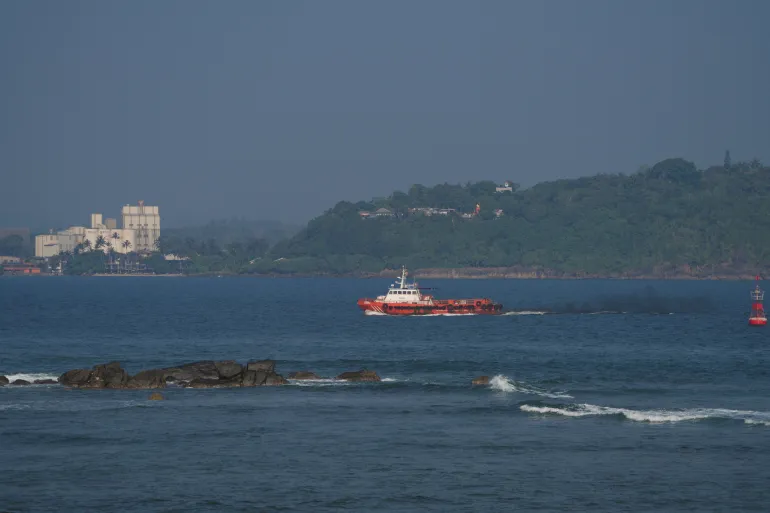
A vessel sails off the Galle coast after a submarine attack on the Iranian military ship, Iris Dena, off Sri Lanka, in Galle, Sri Lanka, March 4, 2026 [Thilina Kaluthotage/Reuters]
‘War reaches India’s backyard’
After participating in the naval exercises, IRIS Dena left Visakhapatnam on India’s eastern coast on February 26. It was hit in international waters, just south of Sri Lanka’s territorial waters, in the early hours of March 4, local time.
In response, Sri Lankan Navy rescuers recovered more than 80 bodies and picked up 32 survivors, reportedly including the commander and some senior officers from the warship. More than 100 men are still missing.
In a tweet welcoming the Dena to the naval drills, the Indian Navy’s Eastern Command had posted: “Her arrival … [reflects] long-standing cultural links between the two nations [Iran and India]”.
Vice Admiral Shekhar Sinha, the former vice chief of India’s naval staff, told Al Jazeera that he attended the Iranian parade at the function.
“I met and really liked them, especially their march for sailors travelling thousands of miles,” Sinha said. “It is always sad to see a ship sinking. But in a war, emotions don’t work. There’s nothing ethical in a war.”
Sinha said that the Indian Ocean — central to the strategic and energy security of the nation with the world’s largest population — was thought to be a fairly safe zone earlier. “But that is not the case, as we are learning now,” he told Al Jazeera.
“The unfolding battle [between the US and Israel on the one hand, and Iran on the other] has reached India’s back yard. New Delhi has to be concerned,” Sinha, who served in the Indian Navy for four decades, added. “The liberty we enjoyed in the Indian Ocean has apparently shrunk.”
Security personnel stand guard as an ambulance enters inside the Galle National Hospital, following a submarine attack on the Iranian military ship, IRIS Dena, off the coast of Sri Lanka, in Galle, Sri Lanka, March 5, 2026 [Thilina Kaluthotage/Reuters]
India’s Catch-22 situation
Only on Thursday evening did the Indian Navy issue any formal statement on the attack — more than 24 hours after the Dena was hit by a torpedo.
The Navy said that it received distress signals from the Iranian ship and had decided on deploying resources to help with rescuing sailors. But by then, it said, the Sri Lankan Navy had already stepped to lead the rescue effort.
Neither New Delhi nor the Navy has criticised — even mildly — the decision by the US to sink the Iranian warship.
Military analysts and former Indian naval officers say India is caught in a classic catch-22: Was India aware of the incoming US attack in the Indian Ocean on an Iranian warship, or was it blindsided by a nuclear-submarine in its backyard?
Admiral Arun Prakash, the former chief of India’s naval staff, told Al Jazeera that if New Delhi was blindsided, “it reflects on the US-India relationship directly.”
“If it is a surprise, then that’s a great concern since we have a so-called strategic partnership with the USA.”
And if India knew about the attacks, it would be seen by many as strategically siding with the US and Israel over their war on Iran.
C Uday Bhaskar, a retired Indian Navy officer and currently the director of the Society for Policy Studies, an independent think tank based in New Delhi, said that the US sinking an Iranian warship in the Indian Ocean muddies the Indian perception of itself as a “net security provider” in the region.
Bhaskar said the incident is a “strategic embarrassment” for India and weakens New Delhi’s credibility in the Indian Ocean, while its moral standing “takes a beating” because of the Indian government’s near-silence.
An injured Iranian sailor is moved on a stretcher at Galle National Hospital, where the sailors are receiving treatment, following a submarine attack on the Iranian military ship, IRIS Dena, off the coast of Sri Lanka, in Galle, Sri Lanka, March 5, 2026 [Thilina Kaluthotage/Reuters]
‘India on aggressor’s side’
In the post-colonial world order, India was a leader of the non-alignment movement, the Cold War-era neutrality posture adopted by several developing nations.
India now no longer calls its approach non-alignment, instead referring to it as “strategic autonomy”. But, in reality, it has inched closer to the United States and its allies, most importantly, Israel.
Merely two days before the US and Israel bombed Iran, Modi was in Israel, addressing the Knesset and warmly hugging Prime Minister Benjamin Netanyahu, who called his Indian counterpart a brother.
But Iran, under the late Supreme Leader Khamenei, was a friend of India as well, with New Delhi making strategic, business, and humanitarian investments in the country.
However, Modi has not said a word in condolence after Khamenei’s assassination. On Thursday, Indian Foreign Secretary Vikram Misri visited the Iranian embassy in New Delhi to sign a memorial book. Indian governments normally deploy ministers — not bureaucrats or diplomats — for such sombre occasions.
It is against that backdrop that India’s response to the attack on the Dena has come under scrutiny.
Because the frigate was hit when it was in international waters, India had “no formal responsibility”, said Srinath Raghavan, an Indian military historian and strategic analyst.
“But the US Navy’s actions underline both the spreading geography of this war and the sharp limits of India’s ability to manage, let alone control, its fallout,” Raghavan told Al Jazeera.
Diplomatically, India has “objectively positioned itself on the side of the aggressors in this war,” he said, by “acts of commission — visit to Israel on the eve of war — and of omission, with not even [an] official condolence, let alone condemnation, of the assassination of the Iranian head of state.” Modi visited Israel on February 25-26.
Mallikarjun Kharge, the president of India’s opposition Congress party, said the Modi government had recklessly abdicated “India’s strategic and national interests”. And the government’s silence “demeans India’s core national interests and destroys our foreign policy, carefully and painstakingly built and followed by successive governments over the years.”
In addition, Raghavan highlighted that Modi has only criticised Iran’s retaliation, which threatens to drag the Gulf region to the brink of war.
“It is difficult not to conclude that India has drastically downgraded its interests in the relationship with Iran,” he said.
“All of this detracts from India’s credibility as a player in the region and will have short and long-term consequences for the equities in West Asia [as the Middle East is referred to in India],” Raghavan told Al Jazeera.
Weekly insights and analysis on the latest developments in military technology, strategy, and foreign policy.
Iran’s ability to launch missiles and drones at U.S., Israeli, and other allied targets in the Middle East has been severely degraded, two top American military leaders said Wednesday morning. Partly as a result, War Secretary Pete Hegseth and Air Force Gen. Dan Caine, Chairman of the Joint Chiefs of Staff, also downplayed concerns about the magazine depth of U.S. offensive and defensive munitions.
You can catch up with our latest coverage of ongoing operations against Iran here. All of the other latest updates can be found lower on the page.
“Iran’s theater ballistic missile shots fired are down 86% from the first day of fighting, with a 23% decrease just in the last 24 hours, and their one-way attack drone shots are down 73% from the opening days,” Caine told reporters, including from The War Zone, at a Wednesday morning press conference. “This progress has allowed CENTCOM to establish localized air superiority across the southern flank of the Iranian coast and penetrate their defenses with overwhelming precision and firepower. We will now begin to expand inland, striking progressively deeper into Iranian territory and creating additional freedom of maneuver for U.S forces.”
Caine did not break down the numbers of Iranian missiles and drones fired. However, on Tuesday, the head of CENTCOM provided some statistics.
“The Iranian regime has launched over 500 ballistic missiles and over 2,000 drones,” Adm. Brad Cooper said in a video message.
As we have previously mentioned, one of the big concerns about Epic Fury is whether Iranian missile and drone barrages would outlast the ability of the U.S. and allies to defend against them. Despite four days of intensive attacks, Tehran still possesses thousands of missiles and drones, though a significant number of these weapons and their launchers — specifically the longer range ballistic missile types —have been destroyed or prevented from being accessed by crews.
In a closed-door Congressional hearing on Tuesday, Hegseth and Caine “told lawmakers…that Iran’s Shahed attack drones represent a major challenge and US air defenses will not be able to intercept them all, according to a source in the briefing,” CNN reported.
Trump admin officials acknowledged during a closed-door briefing on Capitol Hill Tuesday that Iran’s Shahed attack drones represent a major challenge and US air defenses will not be able to intercept them all. The drones, Defense Secretary Pete Hegseth and Chairman of the Joint…
However, both military leaders also “made an attempt to downplay concerns about the drones and noted that Gulf state partners had been stockpiling interceptors,” CNN reported.
During Wednesday’s press conference, both Caine and Hegseth stated that the U.S. has the weapons it needs.
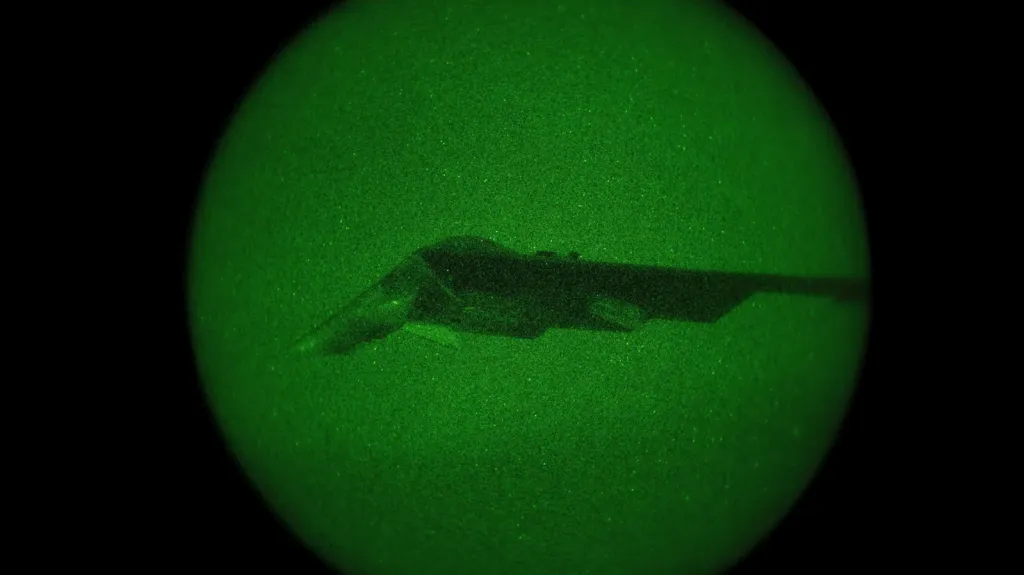
A night vision picture of a B-2 bomber supporting Operation Epic Fury. CENTCOM
“We used more exquisite standoff munitions at the start, but no longer need to,” the secretary proclaimed. “Our stockpiles of those, as well as Patriots [air defense interceptors], remain extremely strong. The enemy can no longer shoot the volume of missiles they once did. Not even close.”
Another big factor in the reduction in Iranian missile launches could be how CENTCOM has concentrated striking command and control (C2) nodes, degrading Tehran’s ability to communicate and direct fires.
Iranian (C2) “structures in a bad way,” Caine posited. “Admiral Cooper has been continuing to pressure the [Islamic Revolutionary Guard Corps] IRGC C2 and other military elements, and will continue to do so.”
A graphic the Pentagon released today offering details about the first 100 hours of Operation Epic Fury against Iran. US Military
As a result of how the operation has unfolded, “CENTCOM is now shifting in day four already from large deliberate strike packages- using standoff munitions at range outside an enemy’s ability to shoot at us – now into stand-in precision strikes overhead Iran.”
Caine said the U.S. is now using “joint direct attack munitions [JDAMs], which are GPS-aided free-fall weapons and other things like [AGM-114] Hellfires, etc. This will allow the joint force to deliver significantly increased precision effects on the target.”
A USAF MQ-9 Reaper fires a AGM-114 Hellfire at a Iranian ballistic missile TEL, which had just revealed its position by firing. pic.twitter.com/gWP4sdxrzh
TWZ has frequently described how important it is for the U.S. to move as quickly as possible from standoff to direct attacks on Iranian targets, which will significantly increase the number of strikes that can occur and widen the range of effects that can be realized via the employment of more varied weaponry. This is especially true for going after fortified targets with bunker buster munitions.
The U.S. Air Force continues to execute a high volume of airstrikes into Iran. The two most powerful air forces in the world (🇺🇸+🇮🇱) are dominating the skies over the world’s largest state sponsor of terror. pic.twitter.com/0nfwY3zdCL
Hegseth further explained that “we moved the vast majority of American troops – over 90% of Americans that were on our bases – off the X out of the range of Iranian fire. Our defensive shield is equally formidable. The most sophisticated air and missile defense network ever fielded. Thousands of Iranian missiles and drones have been intercepted and vaporized, tens of thousands of American allied lives protected. We have pushed every counter-UAS [uncrewed aerial systems] system possible forward, sparing no expense or capability.”
“I know there have been a lot of questions about munitions,” Caine acknowledged. “We have sufficient precision munitions for the task at hand, both on the offense and defense, but I want to tell you teammates, as a matter of practice, I don’t want to be talking about quantities, and I know there’s been a great debate about that, and I appreciate the interest, but just know that we consider that an operational security matter.”
Regardless of the public stance taken by Hegseth and Caine, the Trump administration “plans to meet with executives from the biggest U.S. defense contractors at the White House on Friday to discuss accelerating weapons production, as the Pentagon works to replenish supplies after strikes on Iran and several other recent military efforts,” Reuters reported, citing “five people familiar with the plan.”
(Reuters) – The Trump administration plans to meet with executives from the biggest U.S. defense contractors at the White House on Friday to discuss accelerating weapons production, as the Pentagon works to replenish supplies after strikes on Iran and several other recent…
Still, Trump has gone out of his way to present a problem he has mentioned as being concerning many times before, as a non issue:
“The United States Munitions Stockpiles have, at the medium and upper medium grade, never been higher or better,” Trump said Tuesday on his Truth Social platform. “As was stated to me today, we have a virtually unlimited supply of these weapons. Wars can be fought “forever,” and very successfully, using just these supplies (which are better than other countries finest arms!). At the highest end, we have a good supply, but are not where we want to be. Much additional high grade weaponry is stored for us in outlying countries…”
Following reports from various media outlets that stockpiles of U.S. munitions, including air defense interceptors for Patriot and THAAD systems, were running low, President Trump posted to TruthSocial that the U.S. has a “virtually unlimited supply” and that “wars can be fought… pic.twitter.com/7m6xEjVnfM
So, as it sits today, there is still a race against who will run out of munitions first when it comes to Iran’s long-range strike capabilities, but it seems as if the tide is turning in favor of the U.S., Israel, and the Arab Gulf states based on the information we are seeing. With direct attacks now ramping up on Iranian targets deeper and farther east in Iran, the momentum will more likely than not continue in that direction. This does not address the stockpile’s concerning state in regard to a potential conflict with China or even Russia. It is in a far worse state than it was at the start of this war, and these weapons take years and huge sums of money to build.
The two military leaders also discussed several other topics, including:
“Yesterday, the leader of the unit who attempted to assassinate President Trump has been hunted down and killed,” said Hegseth. “Iran tried to kill President Trump, and President Trump got the last laugh.”
“Over the next 24 to 48 hours, CENTCOM will continue to strike infrastructure and naval capability and will continue to assess our progress against the military objectives,” said Caine.
“Our partners are answering the call to defend themselves right alongside us,” Caine noted. “Jordan, Bahrain, Saudi Arabia, the UAE, Qatar and Kuwait, are all defending their people with their own combat capability, with precision and restraint.”
“We’ve got a lot of autonomous systems, or systems that are that – drones and others incorporated with smart AI aspects to them, but a lot of which I can’t talk about here,” Hegseth stated.
Hegseth addressed Iranian claims that the U.S. struck a girl’s school in southern Iran, killing more than 175 people. “All I can say is that we’re investigating that,” he avowed. “We. of course, never target civilian targets, but we’re taking a look at investigating.”
“I am not going to comment on U.S. boots on the ground,” Caine said. “I think that’s a question for policymakers, and I don’t make policy. I execute policy.”
The rest of our ongoing coverage of the conflict continues below, with the latest updates at the top.
UPDATE: 4:12 PM EST –
U.S. Central Command has issued another set of denials regarding claimed U.S. losses in the ongoing conflict, including that U.S. naval vessels and aircraft have been destroyed by enemy fire.
More fake news from the Iranian regime: 🚫The regime claims U.S. forces are withdrawing. 🚫They say they sank a U.S. destroyer. 🚫IRGC claims to have taken down U.S. fighter aircraft. 🚫The regime says they killed 100 U.S. Marines. ALL LIES.
In another new data point about the apparent slowing pace of Iranian missile launches, the IDF’s Home Front Command says it is easing restrictions on public gatherings and movements imposed at the start of the conflict. Another reassessment is now set to occur on Saturday, which could lead to further easements.
As the rate of Iran’s ballistic missile fire on Israel slows, the IDF Home Front Command says it is easing restrictions that were imposed on the Israeli public at the start of the conflict.
Following a fresh assessment, the Home Front Command says that from tomorrow at noon, the… pic.twitter.com/xYGj9EbZhx
— Emanuel (Mannie) Fabian (@manniefabian) March 4, 2026
Iranian-backed militants in Iraq have threatened to attack the interests of France, Germany, the United Kingdom, and other NATO nations if they “interfere in Iraq or the region,” according to Reuters. Pro-Iranian militants also reportedly carried out a drone attack on a majority Christian neighborhood in Erbil, the capital of Iraq’s northern Kurdish autonomous region.
IRAQ’S ISLAMIC RESISTANCE SAYS ANY ENTITY THAT AIMS TO INTERFERE IN IRAQ OR THE REGION, INCLUDING NATO, FRANCE, GERMANY AND BRITIAN, WOULD HAVE ITS INTERESTS AS ‘LEGITIMATE TARGETS’ FOR THE GROUP
White House press secretary Karoline Leavitt addressed Operation Epic Fury on Tuesday.
“Well, they’re not part of the plan for this operation at this time, but I certainly will never take away military options on behalf of the president of the United States or the commander in chief, and he wisely does not do the same for himself,” she said in response to a question about whether the U.S. military could commit ground troops to the operation. “I know there’s many leaders in the past who liked to take options off of the table without having a full understanding of how things could develop. So again, it’s not part of the current plan, but I’m not going to remove an option for the president to act that is on the table.”
“I don’t want to commit to a timeline, but certainly it’s something that is being calculated actively by both the Department of War and the Department of Energy. They’re working very closely. Both secretaries are in all of the briefings on this subject with the president, and this is again something they’re monitoring,” she also said when asked when U.S. Navy ships might begin escorting commercial vessels through the Strait of Hormuz. “And if and when necessary, the United States Navy will provide assistance to escort oil tankers through the Strait.”
“Obviously, as the president has said numerous times, do we want to see Iran being led by a rogue terrorist regime? No, of course, not,” she said on the topic of regime change. “So any day the United States of America is taking out a terrorist is a good day for our country and a good day for our people.”
When it comes to what role the United States could have after the conflict ends, “I think it’s something the president is actively considering and discussing with his advisors and his national security team,” she added. “But again, right now, the focus minute-by-minute, hour-by-hour, day-by-day, is on ensuring the quick and effective success of Operation Epic Fury.”
Q: Has the president considered how he views a US role in Iran post-conflict?
“I don’t have any updates for you on congressional asks from the president. As you know, under this president, we have significantly increased our defense budget, which is a good thing for the United States, for our national security and for protecting our homeland,” when asked about concerns about stocks of anti-air interceptors. “With respect to munitions, ammunition, weapons stockpiles, the United States of America has more than enough capability to not only successfully execute operation Epic Fury, but to go much further. And we have weapons stockpiles in places that many people in this world don’t even know about.”
Leavitt: “With respect to munitions, the United States has more than enough capability to not only successfully execute Operation Epic Fury but to go much further. We have weapons stockpiles in places that many people in this world don’t even know about. Unfortunately we had a… pic.twitter.com/qNHmQLp1Gc
“I will also add, President Trump has rightfully been calling on defense contractors in this country to rapidly and aggressively produce American-made weapons because they are the best in the world,” she added.
The Israeli Air Force has released pictures showing F-16I jets heading out for strikes on Iran carrying stand-in munitions.
The IDF continues to target Iranian ballistic missile capabilities in the central and western parts of the country.
An “extensive” wave of Israeli airstrikes in central and western Iran earlier today destroyed dozens of Iranian ballistic missile launchers and air defense systems, the military says.
According to the IDF, some of the missile launchers were armed and they were struck while… pic.twitter.com/GeBw8bNYda
— Emanuel (Mannie) Fabian (@manniefabian) March 4, 2026
The IDF has pushed back on the suggestion that attacks from Iran and Iranian-backed Hezbollah militants in Lebanon today were directly coordinated.
“It is true, there was fire at the same time, more or less, you can say simultaneously, from Iran and Lebanon,” IDF Spokesman Brig. Gen. Effie Defrin said at a press conference, according to The Times of Israel. “I don’t possess any intelligence information that says this was coordinated.”
IDF Spokesman Brig. Gen. Effie Defrin says the military has no intelligence indicating that today’s concurrent fire from Iran and by Hezbollah in Lebanon was a coordinated effort.
“It is true, there was fire at the same time, more or less, you can say simultaneously, from Iran…
— Emanuel (Mannie) Fabian (@manniefabian) March 4, 2026
New satellite imagery from Planet Labs shows damage resulting from strikes on an Iranian missile base in Kermanshah.
Planet imagery shows airstrike related damage at the Kermanshah missile base (North), Iran, most of the buildings associated with the site have been destroyed, strikes also extend to the underground tunnel entrances pic.twitter.com/9XfPW1rkbu
Axios has reported that the White House denied reports of back-channel communications with the regime in Iran in response to queries from Israeli authorities.
🇮🇱🇺🇸🇮🇷Netanyahu sought clarifications from the White House earlier this week after intelligence suggested Trump administration officials might be communicating with Iran. The White House told him no such talks had taken place. My story on @axioshttps://t.co/RRvVnXrPEF
“We need to act with clarity, with purpose, and with a cool head. The protection of U.K. nationals is our number one priority,” U.K. Prime Minister Keir Starmer said today. “American planes operating out of British bases, that is the special relationship in action… hanging on to President Trump’s latest words is not.”
Has the PM’s “dithering” response to the week’s events made the UK-US “relationship stronger or weaker?” Tory MP Gareth Bacon asks
Spanish authorities have denied White House claims that they agreed to support current U.S. operations in the Middle East following economic threats from President Donald Trump. Yesterday, Trump had threatened to cut off all trade with Spain after authorities in Madrid blocked the use of bases in the country to support strikes on Iran.
“I categorically deny it. I heard about these statements on my way here, and I’ve had time to look into them and listen to them a little,” Spanish Foreign Minister Jose Manuel Albares said. https://t.co/TS7xwBCyOr
French President Emmanuel Macron has issued a statement after speaking with the leaders of Israel and Lebanon. Macron called on Hezbollah to cease attacks on Israel and for Israel to preserve Lebanon’s territorial integrity.
Israeli Air Force Commander Maj. Gen. Tomer Bar has written that his service’s “special units are currently carrying out extraordinary missions that could ignite the imagination” in a letter, according to Ynet News. No further details about the letter’s origins or how it was obtained are provided. This comes amid other unconfirmed reports of unusual military activity in the Najaf Desert in Iraq. Israeli special operations forces have conducted spectacular raids in the past, including one targeting an Iranian-linked underground missile production facility in Syria in 2024. TWZ noted at the time that this sent a signal to Iran that its critical underground facilities were not untouchable.
MORE: Israeli Air Force commander Maj. Gen. Tomer Bar said today that IAF special forces are currently carrying out “extraordinary missions that could ignite the imagination.”
Israeli Air Force operates elite special units such as Shaldag (Unit 5101) and Unit 669, which conduct… https://t.co/S0Yvx4kZYe
The Israel Defense Forces (IDF) say they have now dropped 5,000 munitions on targets in Iran since the start of the current conflict, and that operations “continue to deepen air superiority throughout Iran, with an emphasis on the Tehran area.” The IDF also continues to release footage from those strikes.
The Israeli Air Force has dropped over 5,000 bombs during strikes in Iran since the start of the conflict, the military says.
The military says that IAF fighter jets “continue to deepen air superiority throughout Iran, with an emphasis on the Tehran area.”
— Emanuel (Mannie) Fabian (@manniefabian) March 4, 2026
An armed Iranian ballistic missile launcher in the Kermanshah area was destroyed by an Israeli Air Force F-35 fighter jet today, the military says. pic.twitter.com/W9BihQbtPI
— Emanuel (Mannie) Fabian (@manniefabian) March 4, 2026
The IDF has also released the video clip below showing a strike on what looks to be one of Iran’s Russian-made Mi-17 Hip helicopters. However, there are questions about whether it may have been a decoy.
Looks like the Israeli Air Force struck a decoy of an Iranian Mil Mi-17 helicopter painted on the ground. pic.twitter.com/mtEznE308A
— Status-6 (War & Military News) (@Archer83Able) March 4, 2026
The IDF has also provided details about targets struck during another round of strikes on Iran’s capital, Tehran.
🎯STRUCK: A large Iranian terror regime military compound in eastern Tehran.
Struck command centers in the compound include:
* The IRGC headquarters * The Intelligence Directorate headquarters * The ‘Basij’ headquarters * The ‘Quds Force’ headquarters * The Internal Security… pic.twitter.com/XBvXqks29R
The Israeli Air Force says it carried out “large-scale” airstrikes in Tehran targeting a massive Iranian military compound, which housed headquarters and personnel from across Iran’s security apparatus.
— Emanuel (Mannie) Fabian (@manniefabian) March 4, 2026
Israeli forces are also continuing to conduct ground operations in southern Lebanon, ostensibly targeting Iranian-backed Hezbollah militants.
The IDF publishes footage of its new deployment in southern Lebanon, after Hezbollah began attacking Israel.
Troops have pushed deeper into southern Lebanon in recent days, with the IDF saying it assumed “forward defensive positions to establish an additional defensive layer to… pic.twitter.com/cnsKfLXgfB
— Emanuel (Mannie) Fabian (@manniefabian) March 4, 2026
The IDF says Lebanese civilians in all of southern Lebanon should evacuate to north of the Litani River, amid the ongoing fighting against Hezbollah. pic.twitter.com/d9eTOzSo92
— Emanuel (Mannie) Fabian (@manniefabian) March 4, 2026
U.S. Central Command also continues to release footage from strikes on targets in Iran.
While the Iranian regime indiscriminately targets civilians with missiles and drones, U.S. forces continue to aggressively hunt and destroy Iranian missile launchers with precision. pic.twitter.com/1RIhMcg0Jm
CENTCOM has also now explicitly confirmed the use of Precision Strike Missile (PrSM) short-range ballistic missiles in strikes on Iran. This detail had already emerged, as TWZ previously reported.
In a historic first, long-range Precision Strike Missiles (PrSMs) were used in combat during Operation Epic Fury, providing an unrivaled deep strike capability.
“I just could not be prouder of our men and women in uniform leveraging innovation to create dilemmas for the enemy.”… pic.twitter.com/bydvIv5Tn5
Israeli authorities are still planning around one to two more weeks of operations against Iran, at least, according to the Times of Israel.
The Israeli military is planning for at least one or two more weeks of operations in Iran, during which it aims to hit thousands more Iranian regime targets, The Times of Israel has learned.
Israel’s goal is a systematic degradation of the Iranian regime and its military sites.…
— Emanuel (Mannie) Fabian (@manniefabian) March 4, 2026
Imagery continues to emerge, said to show strikes on targets in Iran’s capital, Tehran.
Massive clouds of smoke rising over several neighborhoods of the capital of Iran, Tehran, following continued American/Israeli strikes on Wednesday. pic.twitter.com/ksuZvvFiZh
— Status-6 (War & Military News) (@Archer83Able) March 4, 2026
US/Israeli airstrike this morning in Tehran, targeting an Iranian site in the government and military-heavy District 4. pic.twitter.com/uWKAM0aj9n
The video below is said to show the crew of a commercial vessel somewhere in the Middle East watching as U.S. Tomahawk land attack cruise missiles pass overhead toward targets in Iran.
The Telegraph newspaper in the United Kingdom has reported that U.S. Air Force B-2 bombers could soon be flying strikes on Iran from RAF Fairford in that country, as well as Diego Garcia in the Indian Ocean. There were reports in the lead-up to the current conflict, that British authorities had denied use of those same bases to support any future operations against Iran.
BREAKING: American B-2 stealth bombers are expected to land at British military bases “in a matter of days” to join attacks on Iran. Bases at Diego Garcia and at RAF Fairford, in Gloucestershire, are being prepared for their arrival, Western officials said today.
“Based on analysis of [the] latest available satellite imagery, IAEA [International Atomic Energy Agency] sees no damage to facilities containing nuclear material in Iran and therefore no radiological release risk at this time,” according to a new statement from the Agency today. “Near [the] Isfahan nuclear site, damage is visible at two buildings. No additional impact detected at Natanz after previously reported damage at entrances, and no impact at other nuclear sites, including [the] Bushehr NPP [nuclear power plant].”
Based on analysis of latest available satellite imagery, IAEA sees no damage to facilities containing nuclear material in Iran and therefore no radiological release risk at this time. Near Isfahan nuclear site, damage is visible at two buildings. No additional impact detected at… pic.twitter.com/boUtjRTpAk
— IAEA – International Atomic Energy Agency ⚛️ (@iaeaorg) March 4, 2026
CNN has reported again on the possibility of armed Iranian Kurdish groups launching a ground incursion in support of the current U.S.-Israeli operation, citing an unnamed source. That outlet has also reported that the U.S. Central Intelligence Agency has been working to arm those groups.
Asked about this today, Hegseth told reporters that “none of our objectives are premised on the support of the arming of any particular force. So what other entities may be doing, we’re aware of, but our objectives aren’t centered on that.” https://t.co/76MI2irOKE
Saudi Arabian authorities say they intercepted two Iranian cruise missiles in the vicinity of Al Kharj, a city situated near Prince Sultan Air Base. That base has been a major hub for U.S. air operations in the current conflict.
BREAKING: Saudi Ministry of Defense says two cruise missiles were intercepted and destroyed in Al-Kharj, a town near Prince Sultan Airbase
The New York Times says satellite imagery that it has reviewed shows damage to several radars, as well as communications systems and other facilities, at multiple military bases in the region as a result of Iranian retaliatory attacks.
A tent surrounded by satellite dishes was destroyed at Al Udeid Air Base in Qatar. Some of the dishes were most likely damaged as well. Al Udeid is the regional headquarters for the US Central Command, and was similarly struck by Iran last June. pic.twitter.com/TyuqZWHUL3
Ali Al Salem Air Base in Kuwait sustained damage to at least eight buildings or structures adjacent to satellite communications infrastructure. pic.twitter.com/oToNYRLTQg
An AN/TPY-2 radar system appears to have been stationed next to a building at a military installation outside of Al Ruwais, UAE since June of last year. Sat imagery from Sunday shows a building adjacent to it had been damaged (unclear if radar was hit) pic.twitter.com/Bp80VxDdU1
While this analysis is not comprehensive (as evidenced by what appears to be yet another radar system damaged during the strikes visible in newly released sat imagery!), it does suggest Iran has been aiming to disrupt US communication and coordination https://t.co/cb2ToNwP9p
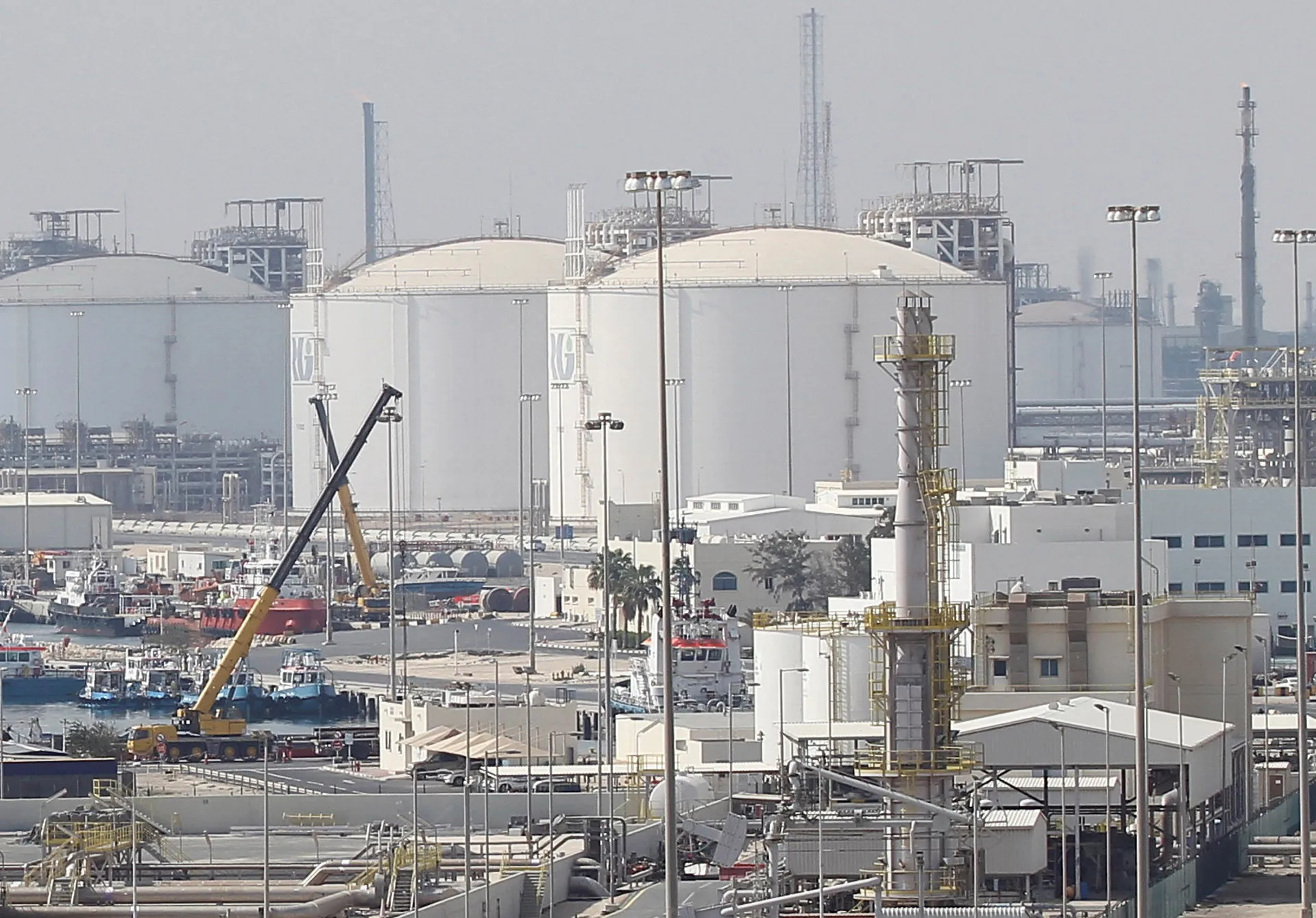
Qatar has reportedly fully halted gas liquefaction in the country, according to Reuters. It could take up to a month for production to return to normal levels once the decision is made to do so, as well.
NEW: Qatar will fully shut gas liquefaction, two sources say. Initial estimates suggest it would take about two weeks to restart operations and at least another two weeks to return to full capacity – Reuters
The United Kingdom Marine Trade Operations (UKMTO) organization, which is managed by the Royal Navy, says it has received reports of another ship coming under attack in the Strait of Hormuz.
Dutch authorities are reportedly considering a request from France to deploy military assets to help safeguard commercial shipping, according to The New York Times. There are also reports that a Dutch warship could take up station in the Eastern Mediterranean to bolster defenses against Iranian threats.
The Netherlands is weighing a request from French President Emmanuel Macron to use its military to help secure international shipping routes, according to the New York Times.
The Netherlands is preparing to send HNLMS Evertsen (F805) with France’s CSG to the Eastern Mediterranean as part of a defensive deployment against Iranian attacks.
Notably, Evertsen will be able to provide ballistic missile tracking and engagement data. pic.twitter.com/0wWxZuOcSN
“EUNAFOR [European Naval Forces] ASPIDES assets in the area of operation monitors the situation, remain on high alert and stand ready to contribute within means and capabilities to protect lives at sea, contributing to freedom of navigation and enhancing Maritime Security through one of the most vital and vulnerable sea trade corridors,” a spokesperson for the European Union-led Operation Aspides has told TWZ. “ASPIDES conducts daily assessments of potential risks, making necessary operational adjustments where required.”
In the event of a resumption of Houthi attacks – which remains a possibility – we are present and ready to implement our mandate,” they added, referring to Iranian-backed militants in Yemen. “There [is] no such tasking (escort ships through or near the Strait of Hormuz) for ASPIDES.”
“We expect significantly higher costs i.e. for bunker, insurance, container storage at different ports due to closed or unreachable ports” and “delays have to be expected especially in the Middle East, but also in other trades,” German shipping company Hapag-Lloyd has also told TWZ. “All ports within [the] Persian Gulf can not be served. This is why we need to find alternates [sic] in the region. Many other ports [are] not being served as well. We have a booking stop for all import/export cargo in the region.”
Danish shipping company Maersk is also “suspending most cargo bookings in and out of the United Arab Emirates, Oman, Iraq, Kuwait, Qatar, Bahrain and Saudi Arabia until further notice,” according to Reuters.
COPENHAGEN, March 4 (Reuters) – Maersk said on Wednesday it is temporarily suspending most cargo bookings in and out of the United Arab Emirates, Oman, Iraq, Kuwait, Qatar, Bahrain and Saudi Arabia until further notice.
All of this follows comments yesterday from U.S. President Donald Trump about the possibility of U.S. Navy ships escorting commercial vessels through the Strait of Hormuz, which you can read more about here.
The American Jewish Committee has compiled data from open sources regarding total Iranian ballistic missile launches at countries in the region. Though the full tallies may be incomplete, the indication is that the United Arab Emirates has been most heavily targeted so far.
Nearly 50% of the missiles and UAVs fired by the Iranian regime have been aimed at the UAE.
Tehran’s actions threaten U.S. partners across the region and put broader Middle East stability at risk. pic.twitter.com/s581ZmMAjl
— American Jewish Committee (@AJCGlobal) March 3, 2026
Turkish Authorities say that “NATO air and missile defense elements” intercepted a “ballistic munition” that had been tracked passing over Iraq and Syria in the direction of the Eastern Mediterranean. Debris subsequently fell inside Turkish territory.
There are reports that the weapon was aimed at Cyprus, but went off course. Turkish Foreign Minister Hakan Fidan subsequently spoke by phone with his Iranian counterpart, Foreign Minister Abbas Araghchi, and warned against “any steps that could lead to the spread of the conflict.”
A Turkish official, speaking to AFP on condition of anonymity, said the missile had been “aimed at a base in Greek Cyprus but veered off course”. https://t.co/Q7rj2j3OSB
A ballistic missile from Iran crossing Iraq and Syria was intercepted by NATO in the Eastern Mediterranean before entering Turkish airspace. No casualties reported. Türkiye summoned Iran’s ambassador and called for restraint.https://t.co/JTBeeYVDKx
Local media in Cyprus has reported that Greek F-16 fighters now operating in the country intercepted two incoming drones earlier today.
The New York Times has reported that there have been back-channel, indirect talks between U.S. and Iranian officials, including members of the respective intelligence services, about possible off-ramps to the current conflict. That report also says that American authorities are so far skeptical. Iran’s quasi-official Tasnim News Agency says the country’s Intelligence Ministry has denied that any such talks are taking place.
NEW: The Secret Channel Between Iran and the US
In public, Iran’s surviving leaders have defiantly refused to negotiate with President Trump to end the American and Israeli assault on their country. But a day after the attacks began, operatives from Iran’s Ministry of…
Iran denies that its Intelligence Ministry reached out to the CIA for talks, Iran’s semi-official Tasnim news agency reports, citing a ministry source.
“Iran’s future must not be decided outside its borders” and the international community’s support should “go to the people, not to geopolitical calculations,” Farah Pahlavi, widow of Mohammad Reza Pahlavi, the last Shah of Iran, has said in an interview with AFP in France.
She has also said that the death of Iranian Supreme Leader Ayatollah Ali Khamenei is “a moment of historic significance,” but “does not automatically mean the end of a system.”
➡️ Elle estime aussi que la mort du guide suprême Ali Khamenei constitue “un moment d’une portée historique” mais “ne signifie pas automatiquement la fin d’un système”.
“The government of the Republic of Korea, with grave concern, is closely monitoring the developments in the Middle East involving the United States, Israel, and Iran, and is actively undertaking multifaceted efforts to ensure the safety and protection of Korean nationals currently in the region, as well as to safeguard our economic security, including the stable supply of energy resources,” that country’s Ministry of Foreign Affairs has said in a statement.
The government of the Republic of Korea, with grave concern, is closely monitoring the developments in the Middle East involving the United States, Israel, and Iran, and is actively undertaking multifaceted efforts to ensure the safety and protection of Korean nationals currently… pic.twitter.com/iyhfpjvOhc
March 4 (UPI) — NATO air and missile defenses intercepted a ballistic missile launched from Iran heading toward Turkish airspace on Wednesday.
The Turkish Ministry of National Defense announced that the ballistic missile had crossed Iraqi and Syrian airspace before being neutralized by NATO air defenses posted in the Mediterranean Sea. There were no casualties or injuries.
“Our resolve and capacity to ensure the security of our country and citizens are at the highest level,” the Ministry of Defense said in a press release translated from Turkish. “While Turkey supports regional stability and peace, it is capable of ensuring the security of its territory and citizens, regardless of who or where the threat comes from.”
The ministry did not say what it believed the intended target of the missile to be.
The Iranian missile is the first fired toward NATO territory since the conflict began. It followed a warning from Tehran that European countries supporting the United States and Israel would face retaliation from Iran.
Iran has launched missiles and drones toward countries in the Middle East that have a U.S. military presence in response to the U.S. and Israeli strikes on Iran.
“NATO stands firmly with all allies, including Turkey, as Iran continues its indiscriminate attacks across the region,” Allison Hart, NATO spokeswoman, said in a statement. “Our deterrence and defense posture remains strong across all domains, including when it comes to air and missile defense.”
After being intercepted, debris from the missile fell in the Turkish province Hatay in south-central Turkey near the Syrian border.
Turkish President Recep Tayyip Erdogan said in a social media post on Tuesday that he wishes to see a diplomatic solution to the ongoing conflict.
“We do not wish to witness conflict, war, tension and massacre right next door,” Erdogan said. “Our stance on the illegal attacks targeting Iran is also in this direction.
Former South African president Nelson Mandela speaks to reporters outside of the White House in Washington on October 21, 1999. Mandela was famously released from prison in South Africa on February 11, 1990. Photo by Joel Rennich/UPI | License Photo
Weekly insights and analysis on the latest developments in military technology, strategy, and foreign policy.
Iran appears to be increasingly focusing its retaliatory attacks against energy production infrastructure in Gulf Arab States. The U.S.-Israeli operation against Iran is also continuing at a significant tempo, including a major new wave of Israeli strikes going after leadership targets in Tehran.
Readers can catch up on previous developments in the ongoing conflict in our previous rolling coverage here.
Increased targeting of Gulf Arab States’ oil and natural gas production is part of a clear Iranian strategy to put pressure on those countries to, in turn, create complications for the United States. As the economic pressure builds, the idea is that these countries will seek to end the conflict, and/or that relations with the U.S. will sour. The prospect of major, long-term disruptions in energy exports from the region has global ramifications, as well, which could bring immense external pressure to end the conflict. There is also the aspect of drawing Arab countries into the conflict, which would complicate it politically and militarily. In addition, some energy targets are not as well defended as U.S. bases in the region, for instance, and scoring hits with the now finite weapons Iran has on hand becomes easier.
Iranian attack drones struck oil storage infrastructure in Fujairah, UAE, this morning, causing a large fire.
Notably, Fujairah is the only major oil export terminal in the UAE that avoids the now-closed Strait of Hormuz. pic.twitter.com/DdAbVOyRoc
So, it’s not surprising that Iran has morphed its tactics in this manner. How this will all play out is unknown. But if the war continues on for a prolonged period, and interceptors run low while Iran’s stocks of drones and missiles don’t dry up, this entire issue could become greatly magnified.
So far, Qatar and the United Arab Emirates, as well as the United States, have pushed back on reports that interceptor stocks are dwindling and the U.S. is resisting replenishing them due to its own stockpile concerns. It isn’t clear if this is a case of strategic counter-messaging or if indeed stockpiles remain in the green, although from everything we understand about the stockpile issue overall, the former seems far more likely.
Gulf states are in a race against time: will their air-defense interceptors, with their impressive success rates so far, have to be rationed before Iranian drones and missiles run out? The calculation also depends on how fast the U.S. and Israel keep destroying Iranian launchers.…
Impacted energy-related targets are relatively wide-ranging and the scope of attacks appears to be becoming larger with time.
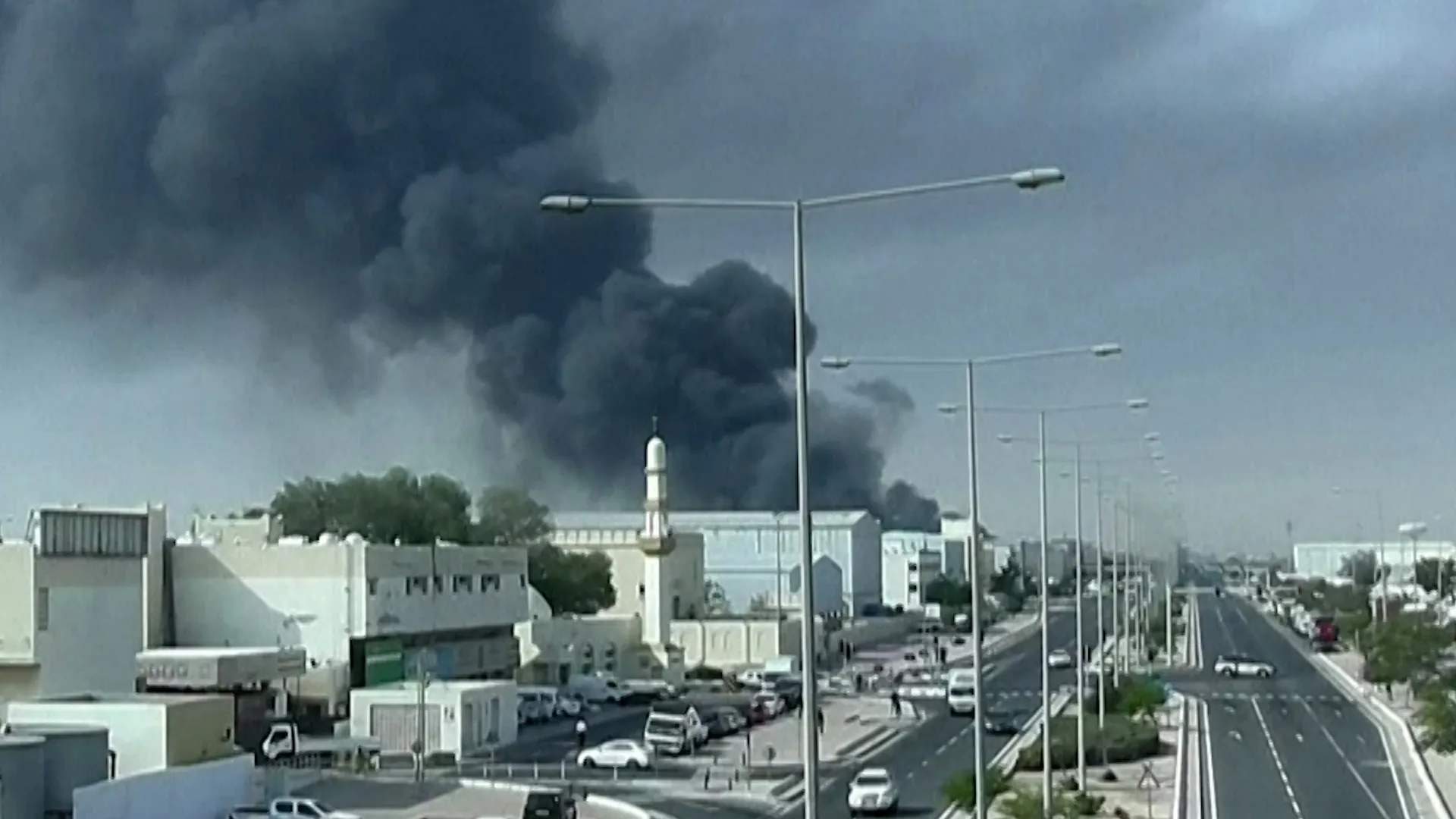
A large fire broke out today in the Oil Industry Zone in Fujairah in the United Arab Emirates (UAE), reportedly caused by falling debris from the interception of an Iranian drone. The port of Fujairah sits on the Gulf of Oman, on the other side of the highly strategic Strait of Hormuz.
UAE intercepted a drone over Fujairah today, a hub just outside the Strait of Hormuz. The IRGC is trying to cause a real energy crisis by shutting all routes. Debris caused a fire in the Oil Industry Zone, which was ultimately put out.pic.twitter.com/5GlbGuyzOm
According to state-run Oman News Agency, two Iranian drones were shot down today above the Dhofar governorate in southern Oman, while a third came down close to the port of Salalah. No casualties or damage were reported.
The Port of Duqm in Oman was also targeted by several drones, according to the country’s state news agency. One of these is said to have struck a fuel tank.
Several ships attempting to cross the Strait of Hormuz have also come under attack, as you can read about here. Yesterday, U.S. Central Command denied Iranian claims that the Strait was closed. Online ship tracking data shows a major slowdown in traffic overall, but there is still some movement through this highly strategic waterway. Imagery is also emerging showing a backlog of ships waiting to pass through.
Minimal vessel traffic seen in Strait of Hormuz amid reported closure
The latest #MarineTraffic playback shows visibly reduced transit density, alongside holding patterns, slower speeds, and vessels remaining outside the strait as operators reassess risk. pic.twitter.com/pfqk5rcbg8
Oil production at Iraq’s largest oil field, in Shafaq, has reportedly been halted, as has the flow of oil through a pipeline that links its northern Kurdish autonomous region with Turkey. There are reports that Iraqi oil exports, overall, have slowed dramatically due to the ongoing conflict.
BREAKING: Production suspended at Iraq’s largest oil field – Shafaq
IMPORTANT: Basrah crude exports are running on thin ice.@Kpler data shows ~8.7Mb of effective headroom — just ~3 days of cover if tanker constraints persist. No inbound crude tankers into the Gulf on March 2 raises the risk of ballast shortages and potential Iraqi production…
This all follows Iranian attacks yesterday that caused a halt to some operations at the Ras Tanura refinery in Saudi Arabia and a shutdown in liquid natural gas production by state-owned QatarEnergy in that country.
QatarEnergy to stop downstream production
Further to the decision by QatarEnergy to stop production of liquefied natural gas (LNG) and associated products, QatarEnergy is stopping the production of some downstream products in the State of Qatar, including urea, polymers,…
Further rolling coverage can be found below, with the newest updates at the top.
We have concluded our rolling coverage in this piece. We will be back soon to continue our reporting.
UPDATE: 7:46 PM EST –
CENTCOM commander Adm. Brad Cooper provided a video update on Epic Fury. Here are some of the highlights:
50,000 troops, 200 fighters, two aircraft carriers and bombers from the United States are participating in this operation, and more capabilities on the way.
100 hours into this operation, and we’ve already struck nearly 2,000 targets with more than 2,000 munitions.
..we’ve destroyed 17 Iranian ships, including the most operational Iranian submarine that now has a hole in that side. Today, there’s not a single Iranian ship underway in the Arabian Gulf, strait of Hormuz or Gulf of Oman.
In retaliation, the Iranian regime has launched over 500 ballistic missiles and over 2,000 drones. To be clear, Iran is indiscriminately targeting civilians as they launch these missiles and drones. You’ve seen it on TV. The evidence is crystal clear and overwhelming.
Also for the first time, U.S. Central Command’s drone task force, called Task Force Scorpion Strike, launched countless one-way attack drones achieving massive effects. I’d like to point out these drones were originally an Iranian design. We took them back to America, made them better, and fired them right back at Iran.
UPDATE: 7:03 PM EST –
“The scene here in [Tehran] was dominated by the sound of airplanes and massive explosions across the city, and the smell of smoke drifting in the air,” Al Jazeera reported. “This is very massive, and this is heavier bombardment compared to the first days of the initiation of these strikes.”
You can get a sense of what these attacks have been like in the following video.
A screencap from a video released by CENTCOM shows the loadout on a U.S. Air Force F-15E Strike Eagle. TWZ Editor-in-Chief Tyler Rogoway breaks it down.
USAF F-15E in full counter drone loadout for Epic Fury. 4 X AIM-120, 4X AIM-9, 28 FALCO APKWS laser-guided rockets + the 20mm. Jet is clean aside from that, so likely has nearby tanker support and can get to where it needs to go fast.
As Epic Fury rages on, U.S. Sen. Chris Murphy is calling for Senate debate on an authorization for the use of military force against Iran.
“This is as serious as it gets,” he told reporters after a closed-door briefing. “This is war and peace. They told us in that room that there are gonna be more Americans that are gonna die, that they’re not gonna be able to stop these drones…We have to have a debate in the US Senate on an authorization of military force.”
Chris Murphy: “This is as serious as it gets. This is war and peace. They told us in that room that there are gonna be more Americans that are gonna die, that they’re not gonna be able to stop these drones. We have to have a debate in the US Senate on an authorization of military… pic.twitter.com/VvcQTsBMmV
The Pentagon announced the names of four of the six troops killed in an Iranian drone attack on a U.S. facility in Kuwait. The four were Army Reserve soldiers.
“Capt. Cody A. Khork, 35, of Winter Haven, Fla.; Sgt. 1st Class Noah L. Tietjens, 42, of Bellevue, Neb.; Sgt. 1st Class Nicole M. Amor, 39, of White Bear Lake, Minn.; and Sgt. DeclanJ. Coady, 20, of West Des Moines, Iowa, died on March 1, 2026, in Port Shuaiba, Kuwait, during an unmanned aircraft system attack. All Soldiers were assigned to the 103rd Sustainment Command, Des Moines, Iowa. The incident is under investigation.”
Video emerged of Israeli AH-64 Apache attack helicopters using their M230 chain guns to shoot down several Iranian Shahed-136 kamikaze drones.
Footage of Israeli AH-64 Apache attack helicopters shooting down Iranian Shahed attack drones using their M230 chain guns. pic.twitter.com/kjH7AZv9Q3
B-2 Spirit stealth bombers “have been targeting command and control nodes of the Islamic Revolutionary Guard Corps, as well as weapon depots and an assembly facility for Iran’s rocket program,” CBS News reported on X.
Two U.S. officials say B-2 stealth bombers have been targeting command and control nodes of the Islamic Revolutionary Guard Corps, as well as weapon depots and an assembly facility for Iran’s rocket program.
Secretary of State Marco Rubio told reporters that attacks against Iran will intensify.
“We’re going to unleash Chang on these people in the next few hours and days,” Rubio said. “You’re going to really begin to perceive a change in the scope and intensity of these attacks as, frankly, the two most powerful air forces in the world take apart this terroristic regime.”
The term “unleash Chang” reportedly dates back to “Unleash Chiang,” an inscription on a sword former Florida Gov. Jeb Bush gave Rubio two decades ago.
The term was “the rallying cry of John Birchers in the 1950s, who urged the United States to arm Chiang Kai-shek, the Chinese Nationalist leader of Taiwan, so he could retake Red China from Mao,” Politico reported in 2015.
.@SecRubio: “We’re going to unleash Chang on these people in the next few hours and days. You’re going to really begin to perceive a change in the scope and intensity of these attacks as, frankly, the two most powerful air forces in the world take apart this terroristic regime.” https://t.co/j7DxkxPiFqpic.twitter.com/2AhXGnj1UI
— Rapid Response 47 (@RapidResponse47) March 3, 2026
UPDATE: 6:04 PM EST –
After a closed-door briefing about Epic Fury, U.S. Sen. Richard Blumenthal told reporters that “I am more fearful than ever after this briefing, that we may be putting boots on the ground, and that troops from the United States might be necessary to accomplish objectives that the administration seems to have.
UPDATE: 5:53 PM EST –
After Spain refused to let the U.S. military use its bases for missions linked to attacks on Iran, Trump threatened to impose a full U.S. trade embargo.
“Spain has been terrible,” Trump told reporters during a meeting with German Chancellor Friedrich Merz. He also told Treasury Secretary Scott Bessent to “cut off all dealings” with Spain.
“That’s all right,” Trump exclaimed. “We can use their bases. If we want, we can just fly in and use it.”
As we have reported in the past, the U.S. has used the Rota and Moron bases as transit points for fighter aircraft, electronic attack jets and aerial refueling tankers.
.@POTUS: “Some of the European nations have been helpful, and some haven’t—and I’m very surprised. Germany’s been great… Spain has been terrible. In fact, I told Scott to cut off all dealings with Spain.”
— Rapid Response 47 (@RapidResponse47) March 3, 2026
UPDATE: 5:38 PM EST –
The IDF said Tuesday it struck a secret underground nuclear complex in Tehran, describing it as a key site where Iran was developing components for a nuclear weapon. Fighter aircraft targeted the covert “Minzadehei” compound, an underground facility where Iran’s nuclear weapons group operated under the country’s Defense Ministry.
UPDATE: 5:32 PM EST –
U.S. Sen. Lindsey Graham told reporters today that new attacks against Iran are imminent and that there is a growing coalition of allies willing to take part in the fight against Iran.
🚨 BREAKING: Lindsey Graham confirms MASSIVE new attacks on Iran are IMMINENT
“The amount of firepower coming in the next day or two from us is gonna be OVERWHELMING”
“I’ve never felt better about how this ends. It’s not IF they fall, it’s WHEN they fall.” pic.twitter.com/CAkJWTqv5o
The IDF released details of its Operation Roaring Lion attack on Iran. It claims that more than 200 fighters flew more than 700 sorties. There were 47 senior leaders killed, while 600 “terror sites” were “dismantled.” The War Zone cannot independently verify these claims.
UPDATE: 5:06 PM EST –
Hundreds of Iranian university professors and tech experts have reportedly signed a statement declaring the Constitution of the Islamic Republic illegitimate. The statement also calls for the immediate transfer of power to the people, while endorsing Prince Reza Pahlavi’s democratic transition plan.
In the past few hours, hundreds of Iranian university professors and tech experts have signed a statement declaring the Constitution of the Islamic Republic illegitimate and calling for the immediate transfer of power to the people, while endorsing Prince Reza Pahlavi’s… pic.twitter.com/oihXPHvBy5
French President Emmanuel Macron has ordered the aircraft carrier Charles de Gaulle to the eastern Mediterranean amid the ongoing war.
Macron is also working to build a coalition that would help secure maritime traffic imperiled by the escalating crisis in the Middle East.
In a televised address to the nation, Macron said that action needed to be taken with the Straits of Hormuz closed and the Suez Canal and Red Sea shipping routes threatened by the widening conflict.
French President Macron:
We have defense agreements with Qatar, Kuwait, and the United Arab Emirates. We must stand by their side. I have decided to send a warship to Cyprus for protection. I have given the order to send the aircraft carrier Charles de Gaulle and its… pic.twitter.com/Tox01M1TFi
A suspected Iranian drone attack hit the CIA’s station in Saudi Arabia “in what would amount to a significant symbolic victory for the Islamic Republic,” The Washington Post reported.
“An internal State Department alert obtained by The Washington Post said the attack ‘collapsed’ part of the embassy’s roof and ‘contaminated’ the inside with smoke,” the publication stated. “The notice said the embassy sustained ‘structural damage’ and personnel ‘continue to shelter in place.’”
The extent of the damage was not immediately clear, the Post added. There was no indication that any CIA personnel were wounded.
SCOOP: A suspected Iranian drone attack hit the CIA’s station in Saudi Arabia in what would amount to a significant symbolic victory for the Islamic Republic as it lashes out at U.S. targets and personnel across the Middle East, sources tell @nakashimae and me
Officials in Dubai say the fire near the US Consulate in Dubai has been fully extinguished with no injuries recorded. The area had been hit by an Iranian drone.
بالصور: إخماد الحريق بالكامل في محيط القنصلية الأمريكية بدبي دون تسجيل أي إصابات؛ والجهات المختصة في دبي تؤكد حرصها على ضمان أمن وسلامة الجميع. pic.twitter.com/3fqjHkEHMl
— Dubai Media Office (@DXBMediaOffice) March 3, 2026
UPDATE:2:46 PM EST-
The IDF says it has now destroyed 300 Iranian missile launchers since the start of the conflict. Israeli authorities also say the country’s fighters have flown more than 1,600 sorties and dropped more than 4,000 munitions.
The IDF says Israeli airstrikes have taken out 300 Iranian missile launchers since the start of the current conflict.
“As part of the offensive effort, the air force continues to launch continuous waves of strikes against the Iranian regime’s ballistic missile arrays and [air]… pic.twitter.com/62xy3luzuE
— Emanuel (Mannie) Fabian (@manniefabian) March 3, 2026
The Israeli Air Force has dropped over 4,000 bombs in strikes on Iran since the start of the campaign which began four days ago, IDF Spokesman Brig. Gen. Effie Defrin says in a press conference.
“Today we crossed the amount of munitions that the IDF dropped during the entire…
— Emanuel (Mannie) Fabian (@manniefabian) March 3, 2026
The IDF says it has targeted an Iranian facility on the outskirts of Tehran where scientists “worked secretly to develop capabilities required for nuclear weapons.”
The Israeli Air Force struck a secretive Iranian nuclear site on the outskirts of Tehran earlier today, the military says.
In a press conference, IDF Spokesman Brig. Gen. Effie Defrin says at the partially-underground facility, a group of nuclear scientists “worked secretly to… pic.twitter.com/ollEsROFT9
— Emanuel (Mannie) Fabian (@manniefabian) March 3, 2026
The IDF is also still assessing the results of its strike targeting Iran’s Assembly of Experts in Qom. There are reports that none of the 88 clerics who make up this group were in the building when it was hit. Iranian quasi-state media claims a vote for the next Supreme Leader of the country was held remotely for security reasons.
IDF Spokesman Brig. Gen. Effie Defrin in a press conference says the results of the Israeli strike on the Iranian Assembly of Experts building in Qom are still under review.
According to reports, none of the 88 clerics were at the building at the time of the strike, rather only… https://t.co/8qweTwYKCj
— Emanuel (Mannie) Fabian (@manniefabian) March 3, 2026
NEW: Iran’s Assembly of Experts is holding final voting to choose a new Supreme Leader.
Although the Assembly’s building in Qom was reportedly hit, no session was held there.
Voting is being conducted remotely for security reasons.
The satellite imagery below shows damage to Iranian leadership targets in Tehran from Israeli strikes earlier today.
Thread: New high-resolution satellite images released by @vantortech show the aftermath of US/Israeli strikes on several major political and military sites in Tehran.
Iran presidential complex, Assembly of Experts and the Expediency Council
U.S. Central Command has also released new footage showing strikes targeting Iranian kamikaze drone capabilities.
The Iranian regime’s killer drones have been a menace in the Middle East for years. These drones are no longer a tolerable risk. pic.twitter.com/76yhDKI6OW
Imagery has emerged that is said to show a fire at a U.S. diplomatic facility in Dubai following an Iranian drone attack.
There are reports that President Donald Trump’s administration is considering using military assets to escort oil and natural gas tankers through the Strait of Hormuz. Any warships supporting these operations would also have to operate in the Strait, with all the potential risks entailed. The report says that the U.S. government could also seek to back maritime insurance, where some rates have been hiked and some policies outright cancelled as a result of the current conflict.
(Reuters) – The Trump administration is considering providing military protection to oil and gas tankers traversing the Strait of Hormuz, Politico reported on Tuesday.
BIG: The Trump administration is considering using U.S. military forces to protect oil and gas tankers traveling through the Strait of Hormuz after Iran threatened ships in the area.
Officials are discussing naval escorts for tankers and possibly having the U.S. government back… pic.twitter.com/kthwYVQYiO
Iraqi authorities say that all refineries “are operating continuously and at their full design capacity to produce various petroleum derivatives,” according to the country’s Rudaw news outlet.
President Donald Trump has said that “it would seem to me that somebody from within [Iran] maybe would be more appropriate” when asked if Reza Pahlavi, the eldest son of Mohammad Reza Pahlavi, the last Shah of Iran, is someone the U.S. might look to as part of a new Iranian government.
Reporter: Reza Pahlavi, is he an option at all in your mind?
Trump: It would seem to me that somebody from within maybe would be more appropriate. I’ve said that he looks like a very nice person, but it would seem to me that somebody that’s there, that’s currently popular if… pic.twitter.com/vRYgQXuDU7
“Yes, the State Department is actively securing military aircraft and charter flights for American citizens who wish to leave the Middle East,” Assistant Secretary of State for Global Public Affairs Dylan Johnson has written in a post on X in response to questions about what steps are being taken to help American citizens depart the Middle East. However, at the time of writing, the phone number he has given out starts with a recorded message advising callers not to rely on the U.S. government.
UPDATE:1:29 PM EST-
The Israel Defense Forces have confirmed strikes in Isfahan and elsewhere in Iran. In Isfahan, the targets are said to have been related to the Iranian ballistic missile arsenal rather than the nuclear facility there.
⭕️ OPERATIONAL UPDATE: Targets belonging to the Iranian terror regime in Tehran and Isfahan were struck.
📍Throughout Iran, industrial sites used by the Iranian regime to produce weapons, particularly ballistic missiles, were targeted.
Israel has now also issued an explicit threat to strike Iranian officials in Lebanon if they do not leave within 24 hours. The IDF said earlier that it killed Daoud Alizadeh, the Islamic Revolutionary Guard Corps’ (IRGC) Quds Force’s acting commander in charge of operations in Lebanon, in strikes on targets in Tehran. The IDF has also continued to target Iranian-backed Hezbollah militants in Lebanon.
The Israeli military issues an unusual threat against Iranian regime officials in Lebanon, warning that they will be targeted if they do not leave the country within 24 hours.
“The IDF warns representatives of the Iranian terror regime who are still in Lebanon to leave…
— Emanuel (Mannie) Fabian (@manniefabian) March 3, 2026
Alizadeh had taken responsibility for the IRGC Quds Force’s Lebanon Corps from Mohammad Reza Zahedi, who was killed in an Israeli strike on Damascus in April 2024, making him “the highest-ranking Iranian commander responsible for Lebanon,” according to the military.
— Emanuel (Mannie) Fabian (@manniefabian) March 3, 2026
The IDF issues new evacuation warnings ahead of airstrikes on Hezbollah sites in coastal Lebanese city of Tyre. pic.twitter.com/xf03b1qUox
— Emanuel (Mannie) Fabian (@manniefabian) March 3, 2026
The IDF issues an evacuation warning for a building in Sidon, ahead of an airstrike against Hezbollah infrastructure. pic.twitter.com/sFgggvkYGv
— Emanuel (Mannie) Fabian (@manniefabian) March 3, 2026
A British F-35B Joint Strike Fighter has shot down an Iranian drone while flying over Jordan. This is the first time one of the United Kingdom’s F-35Bs has shot down an aerial target in combat, at least that we know of. The U.K. Ministry of Defense now also says it is sending Wildcat helicopters to Cyprus, primarily to support counter-drone operations. The Wildcat has a demonstrated ability to knock down drones using the Martlet missile.
The UK’s F-35 fleet has scored its first kill, shooting down an Iranian attack drone over Jordan.
British fighters are now conducting combat air patrols over Jordan, Qatar, and the Eastern Mediterranean. pic.twitter.com/EDxQbONjTZ
The UAE Ministry of Defense showcased debris and remnants of Iranian missiles and drones recently intercepted during attacks on the country.
The display included Shahed 136 and Shahed 107 drones, as well as Qaim short-range ballistic missiles (SRBMs) and Paveh long-range cruise… pic.twitter.com/5CzZ5Fq13P
The UAE says now that it has successfully intercepted 172 ballistic missiles, 8 cruise missiles and 812 kamikaze drones launched by Iran, in total. One ballistic missile and 57 drones have “impacted within state territory.” Another 13 ballistic missiles have come down in the sea around the country.
Axios has reported that the UAE is now considering taking “active defense measures against Iran” in the face of continued attacks.
“The UAE is considering taking active defensive measures against Iran,” a source familiar w/Emirati policy discussions said. “The UAE view is that no country in the world would fail to evaluate its defensive posture under such circumstances.” @BarakRavidhttps://t.co/x91PFdYBqX
“To the very large numbers of people who have been in touch from all 4 corners of the globe: Oman appreciates the support you have shown for our efforts to stop the war,” Oman’s Foreign Minister Badr Albusaidi, who had been helping mediate U.S.-Iran talks before the conflict erupted, has written in a post on X. “Strengthened by your solidarity, Oman reaffirms its call for an immediate ceasefire and a return to responsible regional diplomacy. There are off ramps available. Let’s use them.”
OMAN FOREIGN MINISTER: THERE ARE OFF RAMPS AVAILABLE, LET’S USE THEM
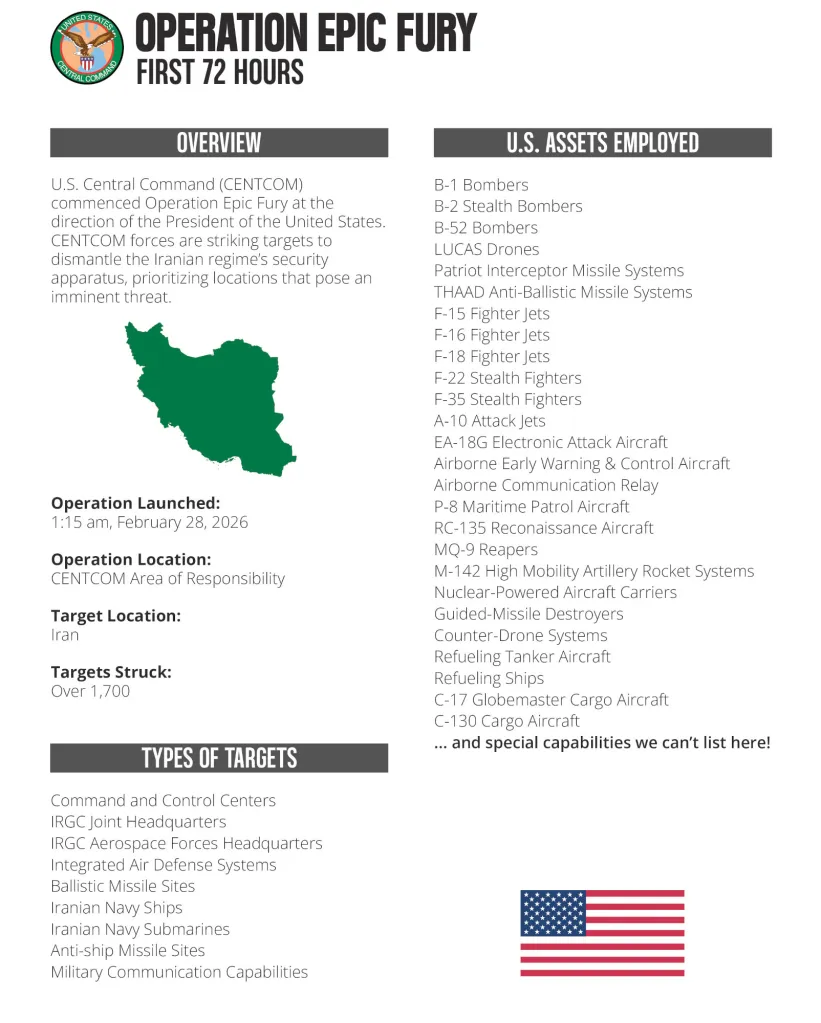
U.S. Air Force B-52 bombers have joined the air campaign against Iran, according to a new fact sheet from U.S. Central Command seen below. American forces have now struck more than 1,700 targets in total.
CENTCOM
U.S. President Donald Trump has said Iran “is running out of [missile] launchers” and “running out of areas to shoot them, because they’re being decimated,” according to Politico‘s Sophia Cai.
Trump also told Cai that it is “not too late” to work in some fashion with a new Iranian government. He pushed back again on concerns about low stocks of anti-air interceptors, as well.
🚨NEW: Trump tells me in an interview that Iran “is running out of launchers” and that U.S. defense companies are “under emergency orders” to build weapons.
Q: Is it too late for you to want to work with someone in the new government?
During a press conference alongside German Chancellor Friedrich Merz at the White House today, Trump pushed back on reports that the Israeli government had pressured him into attacking Iran. He also reiterated previous comments that “most of the people we had in mind” as potential partners in a new Iranian government “are dead.”
“We will see what happens, but first we have to finish off the military,” he added.
Reporter: Did Israel and Netanyahu force your hand to attack Iran?
Trump: No. I might’ve forced their hand. It was my opinion that these lunatics were going to attack first. pic.twitter.com/VMuyPEknlp
President Trump has also said that he has ordered an end to “all dealings” with Spain. Spanish authorities have blocked access to military bases in the country to U.S. forces supporting Operation Epic Fury.
President Donald Trump has also now said that the reason why various U.S. embassies in the region were not evacuated ahead of the start of U.S.-Israeli strikes this past weekend was that the situation moved too fast to allow for it. The U.S. State Department has now issued evacuation orders for embassies in several Middle Eastern countries.
Reporter: Thousands of Americans are stranded. Why wasn’t there an evacuation plan?
Trump: Well, because it happened all very quickly. We thought — and I thought maybe more so than most. I could ask Marco — but I thought we were going to have a situation where we were going to… pic.twitter.com/wlRmjBgWSc
Imagery has emerged showing what looks to show the aftermath of strikes on facilities belonging to the naval army of Iran’s Islamic Revolutionary Guard Corps in the port of Jask. U.S. authorities have said the destruction of Iran’s naval capabilities is a top objective of Operation Epic Fury.
“We don’t see a structured program to manufacture nuclear weapons,” International Atomic Energy Agency (IAEA) Director General Rafael Grossi has reiterated today. “Countries have either other information or political considerations, which are not for me to validate, as I said, or invalidate.”
IAEA Chief Grossi on Iran:
We don’t see a structured program to manufacture nuclear weapons.
Countries have either other information or political considerations, which are not for me to validate or invalidate. pic.twitter.com/zKaRe1zEp1
The IAEA has also now confirmed new damage to Iran’s Natanz Fuel Enrichment Plant (FEP) based on satellite imagery, which has also been circulating online. “No radiological consequence expected and no additional impact detected at FEP itself, which was severely damaged in the June conflict,” the IAEA added in a statement.
Based on the latest available satellite imagery, IAEA can now confirm some recent damage to entrance buildings of Iran’s underground Natanz Fuel Enrichment Plant (FEP). No radiological consequence expected and no additional impact detected at FEP itself, which was severely… pic.twitter.com/7CS7BRZo1s
— IAEA – International Atomic Energy Agency ⚛️ (@iaeaorg) March 3, 2026
We have prepared an overview slide summarizing the visible damage at the Natanz uranium enrichment site from the recent attack, pulling together multiple images showing before and after satellite images of the two personnel entrances and the sole vehicle entrance with comparable… pic.twitter.com/mMGvOyHgkQ
Alexey Likhachev, head of Russia’s state-run nuclear company Rosatom, has said he has lost all contact with his counterparts in Iran and that operations at the country’s Bushehr nuclear power plant had been halted. Russian personnel assist with operations at Bushehr.
⚡️Russia lost ‘all contact’ with the leadership of Iran’s nuclear industry, Rosatom chief Likhachev confirms
Operations at Iran’s Bushehr nuclear plant have been halted
639 Russian staff remain on site, with hourly check-ins as the only line still open pic.twitter.com/VKQPackUip
U.S. Central Command and the Israel Defense Forces have shared more video clips showing strikes on Iranian missile launchers.
The Iranian regime is using mobile launchers to indiscriminately fire missiles in an attempt to inflict maximum harm across the region. U.S. forces are hunting these threats down and without apology or hesitation, we are taking them out. pic.twitter.com/gv1SfKCrk4
✈️🎯60+ strike flights: The IAF completed additional waves of strikes in western Iran targeting the Iranian regime’s missile launchers, defense systems, and live-fire arrays. pic.twitter.com/I1rRLBJlUR
The Ministry of Defense in the United Arab Emirates has released footage, which looks to have been shot via targeting pods on aircraft, of intercepts of incoming Iranian missiles and drones.
The video below is said to show munitions impacting a target in the Iranian city of Urmia as part of ongoing U.S.-Israeli strikes.
Imagery is emerging showing new strikes on Mehrabad International Airport in Tehran.
Reported strikes within the last few minutes against military infrastructure located at Mehrabad International Airport in Tehran. pic.twitter.com/m7QjmIoyBA
— Status-6 (War & Military News) (@Archer83Able) March 3, 2026
The national flag of Iran flies in the wind as debris lies scattered in the aftermath of an Israeli and U.S. strike on a police station, amid the U.S.-Israeli conflict with Iran, in Tehran, Iran, March 3, 2026. Majid Asgaripour/WANA (West Asia News Agency) via REUTERS pic.twitter.com/sULKiGc6Vg
The video below shows a commercial airliner taking off from Beirut International Airport in Lebanon amid Israeli strikes.
A commercial plane takes off from the Beirut International Airport in Lebanon as smoke from Israeli airstrikes can be seen rising over the city on Tuesday. pic.twitter.com/tgaRHJzxMb
— Status-6 (War & Military News) (@Archer83Able) March 3, 2026
Qatari authorities are pushing back on reports that they have conducted strikes on targets in Iran.
Breaking news:
Western sources — Qatar carried out an attack in Iran in the past 24 hours.
An Iranian drone strike overnight on the U.S. Embassy in Riyadh, Saudi Arabia, reportedly caused part of the roof to collapse. Saudi authorities had initially said the resulting damage to the building was minimal. The Saudi government has also condemned that attack.
The damage inflicted in the attack is more significant than initial assessment conveyed by Saudi’s ministry of defense yesterday https://t.co/9blsrO8TF2
#Statement | The Kingdom of Saudi Arabia expresses its rejection and condemnation in the strongest terms of the flagrant Iranian attack that targeted the U.S. Embassy building in Riyadh. pic.twitter.com/pzSSEUEiyO
Despite pushback elsewhere, Polish Defence Minister Wladyslaw Kosiniak-Kamysz has warned that demand for air defense capabilities in the ongoing conflict in the Middle East could upend deliveries of U.S.-made systems globally, including to Ukraine. The Chosun Ilbo newspaper in South Korea has also published a story raising questions about whether U.S. air defense assets in that country could be redeployed to the Middle East, but it does not say such movements are imminent.
WARSAW, March 3 (Reuters) – A prolonged conflict in the Middle East could disrupt deliveries of U.S.-made air defence systems and other arms supplies to European countries including Ukraine, Polish Defence Minister Wladyslaw Kosiniak-Kamysz said on Monday.
Iranian authorities say the current death toll from U.S.-Israeli strikes is now 787, but how many of those individuals are members of the country’s military or security forces is unclear. Lebanese authorities also say that 40 people have been killed and 246 more wounded in Israeli strikes on that country over the past two days.
Iran death toll from US-Israel strikes rises to 787, state media reports.
DUBAI, March 3 (Reuters) – At least 40 people have been killed and 246 wounded in Israeli attacks on Lebanon on Monday and Tuesday, a spokesperson for Lebanon’s health ministry said.
U.S. and Israeli strikes on Iran continue. The Israel Defense Forces say a wave of 100 jets dropped 250 munitions on leadership targets in Tehran earlier this morning. A building in the city of Qom, where Iran’s Assembly of Experts was reportedly meeting as part of the process of choosing a new Supreme Leader, was also struck.
Overnight, the Israeli Air Force struck Iran’s “leadership complex” in Tehran, the military says.
The IDF says around 100 fighter jets dropped over 250 bombs on the complex.
The buildings targeted at the complex included Iran’s presidential bureau, the headquarters of Iran’s… pic.twitter.com/CQYMx0gww0
— Emanuel (Mannie) Fabian (@manniefabian) March 3, 2026
The Israeli Air Force has attacked the “Assembly of Experts” meeting in Qom, Iran as they were gathering to choose the new Supreme Leader. The council is comprised of 88 religious leaders from around Iran who choose the Ayatollah. pic.twitter.com/kZ68nJE9tb
The Israelis just struck the meeting of the Iranian Supreme Council where officials were gathering to choose a new Supreme Leader, a senior Israeli official told Fox News.
“Israel struck while they were counting the votes for the appointment of the supreme leader.”
Iranian President Masoud Pezeshkian has issued a statement regarding the delegation of authorities to regional officials to enable “quick decision making” amid ongoing strikes targeting the country’s leadership.
Message from the President of Iran delegating powers to the country’s Governors for “quick decision making.” https://t.co/gvyDIhvBdH
French fighters are now flying over the United Arab Emirates to help bolster that country’s defenses. France is also reportedly sending anti-air and anti-drone capabilities to help protect Cyprus in the Eastern Mediterranean.
France will send anti-missile and anti-drone systems to Cyprus, as the U.S.-Israel-Iran war heightens tensions in the Middle East, two senior Cypriot government officials have told POLITICO.https://t.co/OCVkZDVS02
U.K. Prime Minister Sir Keir Starmer has also announced the deployment of the Type 45 destroyer HMS Dragon to bolster the defense of Cyprus.
Iranian media reports say the country’s Islamic Revolutionary Guard Corps has targeted dissident groups in northern Iraq. Axios has also reported that President Donald Trump spoke with Iraqi Kurdish leaders this past week about “what might come next.” There have been reports raising the possibility of armed Iranian Kurdish groups in Iraq launching a ground incursion even before the current conflict began.
IRAN’S REVOLUTIONARY GUARDS SAYS IT TARGETED DISSIDENT GROUPS PLANNING TO ATTACK IRAN FROM IRAQI KURDISTAN REGION – IRANIAN MEDIA
Zoom in: Trump spoke to leaders from the two main Kurdish factions in Iraq – Masoud Barzani and Bafel Talabani – a day after the war started, two of the sources said. A source with knowledge of the calls said they were “sensitive” and declined to give details on their content https://t.co/1UN9dPkm5l
U.S. President Donald Trump has now said that it is “too late” to negotiate with Iran’s new leadership, according to Fox News. U.S. Special Envoy Steve Witkoff, who took part in negotiations in the lead-up to the current conflict, claims that Iranian officials say they “have enough enriched uranium for 11 nuclear bombs.”
Witkoff says the Iranian negotiators walked into the room and said, “We have enough enriched uranium for 11 nuclear bombs.”
US Navy ‘will begin escorting’ oil tankers through the Strait of Hormuz, a strategic waterway, if necessary, US President Trump says.
Published On 3 Mar 20263 Mar 2026
Share
President Donald Trump has announced that the United States government will offer insurance to ships in the Gulf after Iran largely succeeded in shutting down the Strait of Hormuz, sending oil prices soaring.
The US president added that the US military will accompany ships through Hormuz if necessary.
Recommended Stories
list of 3 itemsend of list
“Effective IMMEDIATELY, I have ordered the United States Development Finance Corporation (DFC) to provide, at a very reasonable price, political risk insurance and guarantees for the Financial Security of ALL Maritime Trade, especially Energy, traveling through the Gulf,” Trump wrote in a social media post on Tuesday.
DFC is the US government’s development finance agency. Its mission is to “advance US foreign policy and strengthen national security by mobilising private capital” across the world.
Trump added that the discounted risk insurance will be available for all shipping lanes.
“If necessary, the United States Navy will begin escorting tankers through the Strait of Hormuz, as soon as possible,” he wrote.
“No matter what, the United States will ensure the FREE FLOW of ENERGY to the WORLD.”
The Strait of Hormuz is a vital trade artery that connects the Gulf to the Indian Ocean. Around 20 percent of the world’s oil flows through it.
The price of oil has shot up by more than 15 percent since the US and Israel launched strikes on Tehran that started a war with Iran three days ago.
Costs are expected to rise even higher as oil supplies decrease as a result of Iran’s closure of the strait, as well as attacks on energy instalments in the Gulf.
Some insurance companies were reported to have cut back coverage amid the Iranian attacks.
Although the US is largely self-sufficient with its oil production, an uptick in prices globally could hike the cost for Americans at the gas or petrol pump, and could boost inflation.
The average price of one gallon of gas (3.8 liter) in the US jumped more than 11 cents overnight to $3.11 on Tuesday, according to the AAA Gas Prices website.
Earlier on Tuesday, Trump stressed that the attack on Iran “had to happen” despite its human cost and the strain it is putting on the energy market.
“We have a little high oil prices for a little while, but as soon as this ends, those prices are going to drop – I believe – lower than even before,” he told reporters.
Opinion polls show that the attack on Iran is unpopular among the US public. Increasing economic costs from the war could further diminish support for the war, months ahead of the US midterm elecitons.
You can catch up with our latest coverage of Operation Epic Fury, the joint U.S.-Israel attack on Iran in our rolling coverage here.
The ship, the MKD VYOM, was initially thought to have been struck by a projectile on March 1, in a deadly attack about 50 nautical miles north of Muscat, Oman. However, the United Kingdom Marine Trade Operations (UKMTO) organization, which is managed by the Royal Navy in the United Kingdom, gave an updated assessment of the incident Monday morning.
“UKMTO has received confirmation that the vessel was attacked by an Uncrewed Surface Vehicle (USV), and that the crew has been evacuated to shore,” the organization stated. “Authorities are investigating. Vessels are advised to transit with caution and report any suspicious activity to UKMTO.”
“The vessel suffered an explosion and subsequent fire after being struck by a suspected projectile while off the coast of Muscat, Oman on 1 March,” MKD VYOM‘s owner, V.Ships Asia said in a statement. “It is with great sadness that we confirm one crew member, who was in the engine room at the time of the incident, has died.”
أعلن المركز العُماني للأمن البحري تعرّض ناقلة النفط MKD VYOM لهجوم بواسطة زورق محمّل بالمتفجرات أثناء إبحارها على بُعد 52 ميلا بحرياً من سواحل محافظة مسقط. pic.twitter.com/XUABktn3kt
While this is the first time Iran has used a USV to strike ships in the region, it should come as no surprise that it would deploy these weapons. Iran has steadily developed USVs and undersea vehicles capable of launching kamikaze attacks and added them to its arsenal. Iran, together with its Houthi allies in Yemen, has long been a pioneer in this space. As we have previously reported, the Houthis frequently used USVs in their campaign against Red Sea shipping.
The first image of the Houthi drone boat that struck the bulk cargo carrier M/V Tutor in June 2024.
The MKD VYOM was one of at least four ships struck by Iran since the Islamic Revolutionary Guard Corps announced it was shutting down the Strait of Hormuz some 150 nautical miles to the northwest. That warning came after the U.S. and Israel started bombing Iranian targets on Feb. 28. We have previously examined in great detail what Iran could do to shut the Strait, a major chokepoint through which about 20% of the world’s crude oil passes.
“For your information, from now on…no ship of any type is…allowed to pass from the Strait of Hormuz.. From now on, the Strait of Hormuz is banned for all ships, the Strait of Hormuz is banned for all ships,” the Islamic Revolutionary Guard Corps (IRGC) said, via a radio transmission obtained by The War Zone.
The IRGC updated that warning on Monday, saying it was shutting the Strait and any ships attempting to pass through would be set on fire.
“The strait (of Hormuz) is closed. If anyone tries to pass, the heroes of the Revolutionary Guards and the regular navy will set those ships ablaze,” Ebrahim Jabari, a senior adviser to the Guards commander-in-chief, said in remarks carried by state media.
BREAKING: Islamic Revolutionary Guards commander says that the Strait of Hormuz has been closed and that Iran will set fire to any ship trying to pass, according to Iranian media – Reuters pic.twitter.com/ra0B2x5oWq
In addition to three other tankers hit in the Gulf of Oman, the U.S.flagged oil tanker STENA IMPERATIVE suffered at least two direct hits from a suspected Iranian projectile while in the Port of Bahrain on Monday, a maritime security official confirmed to The War Zone.
It is unclear at the moment if the ship was struck by a missile or a drone, the official added.
⭕️⚡️IRGC hit the US Navy-operated Oil tanker “Stena Imperative” docked in Bahrain.
Shortly before 5:30 a.m. Eastern, UKMTO stated that it “received a report of an incident in the Port of Bahrain. The Company Security Officer reported that the vessel had been struck by two unknown projectiles causing a fire. The fire has been extinguished and the vessel remains in port. All members of the ship’s crew are safe and have evacuated the vessel. Authorities are investigating.”
“Vessels are to remain cautious and report any suspicious activity to UKMTO,” the organization added.
It is believed that the STENA IMPERATIVE is the only U.S.-flagged vessel to be struck by Iran so far.
It has been reported that the tanker is part of the U.S. Maritime Administration’s Tanker Security Program, which “exists to enhance U.S. supply chain resiliency for liquid fuel products.” The Tanker Security Program came into effect in 2021 and empowered the Department of Transportation to create an ad-hoc 10-ship expanded U.S.-flagged tanker fleet for use in a crisis.
Weeks before the war broke out, the STENA IMPERATIVE was approached by Iranian gunboats, which threatened to board the vessel, in the Strait of Hormuz, before continuing on its way under military escort, according to CBS News.
U.S. Central Command issued a statement at the time confirming the incident, saying, “Two IRGC boats and an Iranian Mohajer drone approached M/V Stena Imperative at high speeds and threatened to board and seize the tanker.”
CENTCOM spokesman Capt. Tim Hawkins told CBS that the Arleigh Burke class guided-missile destroyer USS McFaul immediately responded to the scene and escorted the ship with defensive air support from the U.S. Air Force. “The situation de-escalated as a result, and the U.S.-flagged tanker is proceeding safely,” he said.
US Oil Tanker Approached By Iranian Gunboats In Strait Of Hormuz As Peace Talks Begins Soon
Since the launch of Epic Fury, shipping traffic through this vital body of water has plummeted by almost 85%, and a large number of ships have turned off their transponders to avoid being tracked.
New: Ship traffic through the Strait of Hormuz has fallen almost 85%, @Kpler‘s @DimAmpatzidis tells Hunterbrook.
“Since 00:00 UTC today, only six vessels have crossed the Strait with AIS signals active.” One of those vessels has since been bombed by Iran. pic.twitter.com/offUWTYGic
While Iran attacks tankers, the U.S. is striking Iranian Navy vessels. U.S. President Donald Trump has said “annihilating” Iran’s naval forces is a core objective of Epic Fury and that 10 Iranian ships have been “knocked out” so far.
Below is a satellite image showing damage to Iran’s main naval base in Bandar Abbas, including what looks to be the IRINS Makran sea base-type ship, following strikes as part of the ongoing U.S.-Israeli campaign. You can read more about that in our story here.
Weekly insights and analysis on the latest developments in military technology, strategy, and foreign policy.
U.S. President Donald Trump says that Iran’s Supreme Leader Ayatollah Ali Khamenei has been killed. Khamenei was among a number of senior Iranian officials targeted in the initial wave of U.S.-Israeli strikes earlier today.
Readers can first get caught up on the ongoing conflict in our previous rolling coverage here.
“Khamenei, one of the most evil people in History, is dead. This is not only Justice for the people of Iran, but for all Great Americans, and those people from many Countries throughout the World, that have been killed or mutilated by Khamenei and his gang of bloodthirsty THUGS,” Trump wrote in a post on his Truth Social social media network. “He was unable to avoid our Intelligence and Highly Sophisticated Tracking Systems and, working closely with Israel, there was not a thing he, or the other leaders that have been killed along with him, could do.”
“This is the single greatest chance for the Iranian people to take back their Country. We are hearing that many of their IRGC, Military, and other Security and Police Forces, no longer want to fight, and are looking for Immunity from us,” Trump added. “As I said last night, ‘Now they can have Immunity, later they only get Death!’ Hopefully, the IRGC and Police will peacefully merge with the Iranian Patriots, and work together as a unit to bring back the Country to the Greatness it deserves.”
Israeli Prime Minister Benjamin Netanyahu had said earlier today that, “this morning, in a powerful surprise strike, the compound of the tyrant Ali Khamenei was destroyed in the heart of Tehran… and there are many signs that this tyrant is no longer alive.”
Trump’s comment that Khamenei was “unable to avoid our Intelligence and Highly Sophisticated Tracking Systems” is notable.
“Getting asked a lot why this kicked off mid day and not at night. I don’t know for certain, but everything points to moving up a timeline based on time sensitive intelligence,” our own Tyler Rogoway highlighted earlier in a post on X. “Limitations to doing this for a large bi-national operation, but yeah, that’s where I would place my bet.”
Use your imagination on what would be worth doing that…
Exactly how this will impact the course of the conflict and especially the future of Iran is unclear, but as it sits now there is likely a gaping power vacuum in Iran.
“This is the very lifeblood of the Qatari economy.” Qatar has announced it is halting liquid natural gas (LNG) production because of Iranian attacks on key facilities. Al Jazeera’s Zein Basravi explains the impact in Doha.
March 1 (UPI) — Three members of the U.S. military were killed and five were seriously wounded in the Iranian response to U.S. and Israeli strikes the day before.
President Donald Trump said in a video statement Sunday that the nation grieves “for the true American patriots who have made the ultimate sacrifice for our nation,” while repeating the warning he made Saturday in announcing the strikes that more U.S. troops may die.
“Sadly, there will likely be more before it ends,” he said. “Likely be more.”
The service members killed were part of an Army sustainment unit based in Kuwait, which is one of several American bases in the Middle East that Iran has targeted amid its response to Operation Epic Fury, which started early Saturday morning, NBC News and The New York Times reported.
“America will avenge their deaths and deliver the most punishing blow to the terrorists who have waged war against, basically, civilization,” Trump said.
U.S. Central Command announced in a post on X on Sunday morning that the troops had been killed in action and wounded as the military continued to hit targets, while also receiving counterattacks from Iran.
Several other troops also “sustained minor shrapnel injuries and concussions — and are in the process of being returned to duty,” CENTCOM said in the post. “Major combat operations continue and our response effort is ongoing.”
“The situation is fluid,” the post noted, adding that the names of the deceased troops would be withheld until 24 hours after their next of kin have been notified.
Iran has also targeted other countries nearby, including Cyprus, the United Arab Emirates and Qatar.
The Iranian regime’s reckless use and proliferation of ballistic missiles have been a dangerous threat for decades. Now, at the President’s direction, U.S. forces are eliminating the threat. pic.twitter.com/zTsqjwVCMO— U.S. Central Command (@CENTCOM) March 1, 2026
CENTCOM on Saturday refuted Iranian claims that at least 50 U.S. service members had been killed, as well as other claims that a U.S. Navy ship had been struck by missiles and that severe damage was seen at “multiple U.S. bases.”
Through the first day-and-a-half of Operation Epic Fury, the United States and Israel have said that they hit dozens of military and government sites throughout Iran.
CENTCOM has specifically announced the sinking of Iranian naval vessels, sending B-2 stealth bombers to hit Iran’s ballistic missile facilities and various communication, air defense and command and control centers.
Trump early Saturday announced that Iranian spiritual leader, Ayatollah Ali Khamenei, was dead — along with other high-ranking leaders of Iran — in U.S. and Israeli airstrikes.
U.S. intelligence and military assets had been tracking Khamenei for months and opted for a rare daylight strike on the meeting because of the opportunity to hit multiple targets, including Defense Minister Gen. Aziz Nasirzadeh, Revolutionary Guard Corps head Gen. Mohammad Pakpour and Khamenei’s defense adviser, Ali Shamkhani.
Senate Majority Leader John Thune, R-S.D., speaks during a press conference after the weekly Republican Senate caucus luncheon at the U.S. Capitol on Wednesday. Photo by Bonnie Cash/UPI | License Photo
Footage captured the moment an Iranian drone struck the US military’s Camp Buehring in northwestern Kuwait, impacting with an explosion and cloud of smoke.
Video from Abu Dhabi captured the moment a second Iranian drone struck the Al Salam Naval Base. A fire was already burning from an earlier hit and what appears to be a cruise ship could be seen docked in the background.
An Iranian missile attack on the Israeli town of Beit Shemesh, 30 kilometers west of Jerusalem, has killed at least nine people and wounded dozens more. The strikes reportedly targeted an army headquarters and a weapons manufacturing complex.
Loud explosions have been heard in Doha, the capital of Qatar, as defence systems shot down incoming Iranian missiles. Falling debris ignited large fire that sent plumes of black smoke rising above the city. Iran has hit multiple Gulf states as it responds to US-Israeli attacks.
Iranian Ambassador to the United Nations, Amir-Saeid Iravani denounced US-Israeli military strikes across the country, decrying the deaths and injuries of hundreds of civilians as a war crime.