Iranian media report the deaths in central Iran as Tehran launches new missile salvoes at Israeli targets.
Published On 14 Mar 202614 Mar 2026
Share
A missile strike on an industrial area of the central Iranian city of Isfahan has killed at least 15 people, with workers having been inside a factory at the time of the attack, Iranian media reports.
The strike hit a factory producing heating and cooling equipment on Saturday, a working day in Iran, according to the semi-official Fars news agency, which attributed the attack to US and Israeli forces.
Recommended Stories
list of 3 itemsend of list
It came on the 15th day of a conflict that Iran’s Ministry of Health says has now killed at least 1,444 people and wounded more than 18,500 since the US-Israeli attacks began on February 28.
Cities across Iran have been repeatedly targeted following the onset of hostilities.
On March 8, shelling damaged Russia’s consulate in Isfahan, injuring staff, with Moscow calling the strike a “blatant violation” of international conventions.
Iran’s Ministry of Culture said on Saturday that 56 museums and historic sites had been damaged, including Naqsh-e Jahan Square, a 17th-century centrepiece of Isfahan, and the UNESCO-listed Golestan Palace in Tehran.
UNESCO said it was “deeply concerned,” noting that four of Iran’s 29 World Heritage Sites had been affected.
Separately on Saturday, Iran’s army confirmed that Brigadier General Abdullah Jalali-Nasab had been killed in an Israeli attack, saying he was “martyred while defending the country”.
Earlier, US forces also struck Kharg Island, which handles roughly 90 percent of Iran’s crude exports, though a regional official said operations were continuing normally, and there were no casualties.
US President Donald Trump had previously threatened to target the island’s oil infrastructure if Tehran continued to disrupt the Strait of Hormuz.
Any prospect of negotiations appears remote. The Trump administration has rebuffed regional efforts to broker a ceasefire, with a senior White House official telling the Reuters news agency the president is focused on pressing ahead.
“He’s not interested in that right now, and we’re going to continue with the mission unabated,” the official said.
Iran has equally ruled out talks while the attacks continue, Reuters reported, citing an anonymous Iranian official.
Iranian Minister of Foreign Affairs Abbas Araghchi struck a defiant tone on Saturday, saying the US security framework in the region had “proven to be full of holes” and calling on neighbours to “expel foreign aggressors”.
Israeli Minister of Defence Israel Katz said the war was entering a “decisive phase”, which would “continue as long as necessary”.
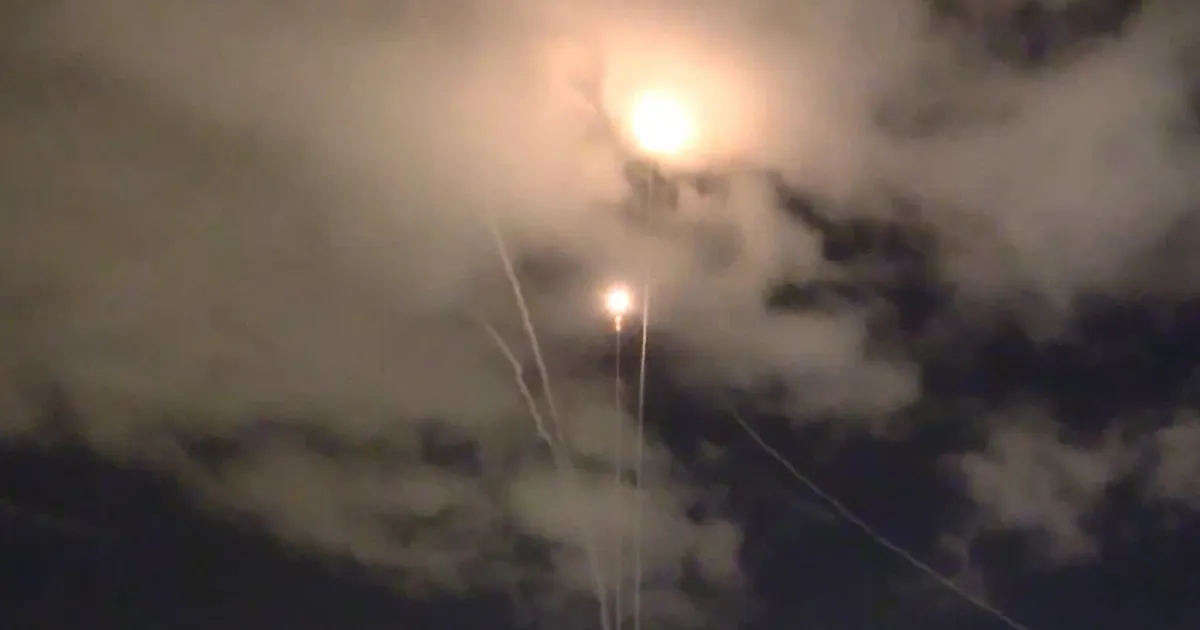
Iran launched new missile salvoes at Israel on Saturday, with explosions heard over Jerusalem, according to reporters from the AFP news agency.
Six waves of missiles, some carrying cluster bomb warheads, struck wide areas of the country, the Israeli army said. In Eilat, a cluster munition impact injured three people, including a 12-year-old boy, according to The Times of Israel.
Over the first 10 days of Operation Epic Fury, American forces destroyed 50 Iranian naval vessels “using a combination of artillery, fighters, bombers, and sea-launched missiles,” Chairman of the Joint Chiefs of Staff U.S. Air Force Gen. Dan “Razin” Caine said at a press conference at the Pentagon this morning. U.S. officials have consistently stressed that the neutralization of Iran’s naval capabilities is a core objective of the ongoing campaign against Iran.
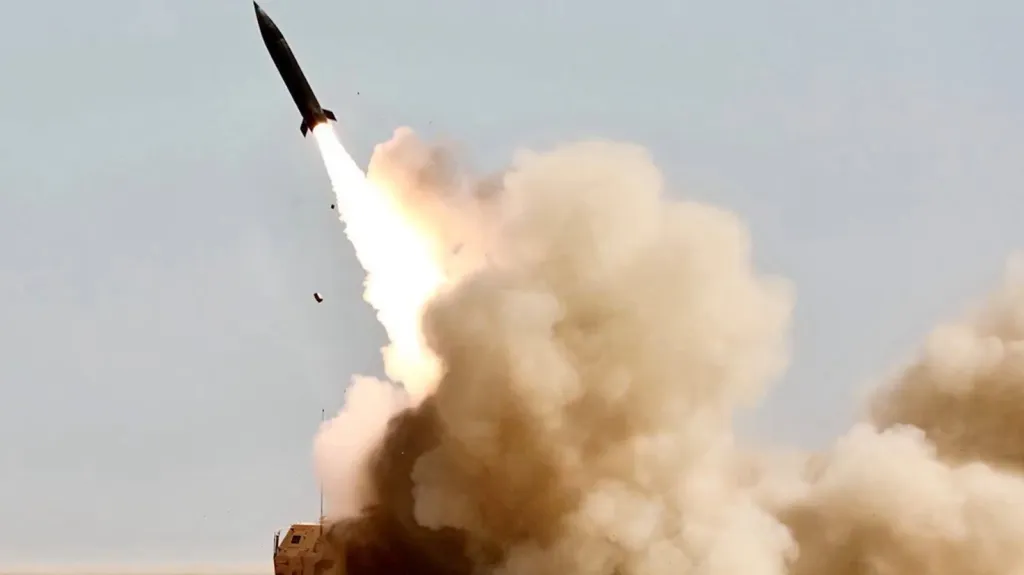
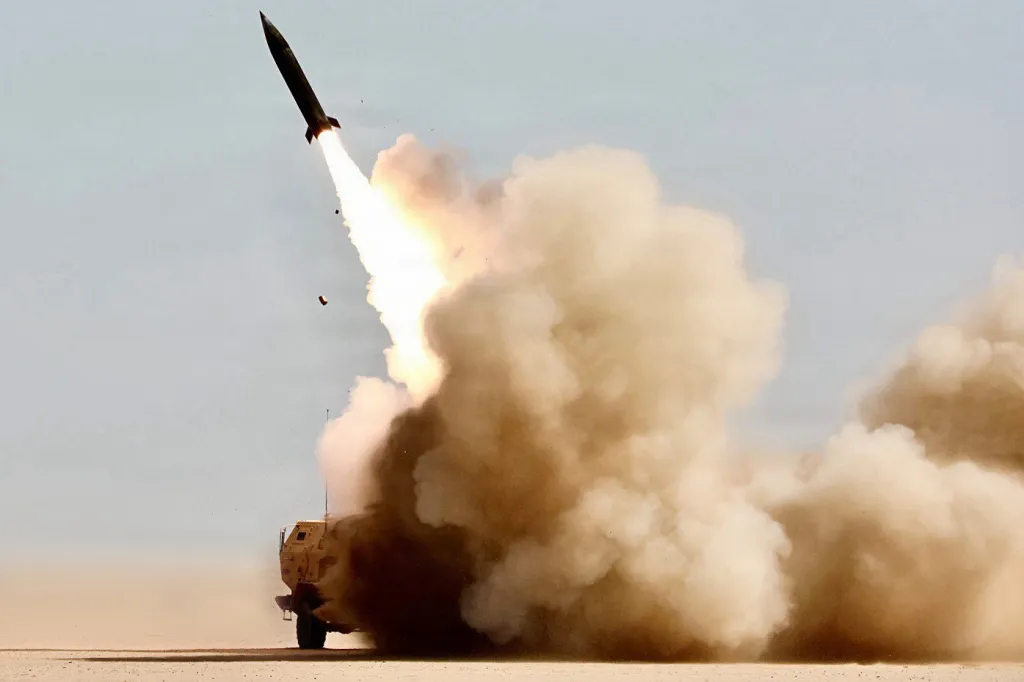
A PrSM missile seen being fired from an M142 HIMARS in support of Operation Epic Fury. CENTCOM
TWZ subsequently reached out for further clarification about what Caine was referring to here when he said “artillery” and for any additional information about the use of those assets against the Iranian Navy. A U.S. official told TWZ that HIMARS were used against Iranian Navy ships, but would not comment on what type of munitions they had fired or which ships were attacked that way.
However, U.S. Central Command (CENTCOM) has released several videos and pictures showing HIMARS operating in support of Operation Epic Fury. As noted, that imagery has only shown them firing ATACMS and PrSM ballistic missiles. CENTCOM has also now explicitly touted the first-ever combat use of PrSM in the current conflict. U.S. officials have yet to confirm where specifically ATACMS or PrSM missiles are being fired from.
In a historic first, long-range Precision Strike Missiles (PrSMs) were used in combat during Operation Epic Fury, providing an unrivaled deep strike capability.
“I just could not be prouder of our men and women in uniform leveraging innovation to create dilemmas for the enemy.”… pic.twitter.com/bydvIv5Tn5
U.S. Army High Mobility Artillery Rocket Systems (HIMARS) provide unrivaled deep-strike capability in combat against the Iranian regime. pic.twitter.com/Onsp1FUrz4
Imagery also began circulating on social media yesterday that is said to show an empty ATACMS ammunition ‘pod’ in Kuwait discovered by locals in the midst of ongoing operations against Iran. Wheeled HIMARS launchers, as well as tracked M270 Multiple Launch Rocket Systems (MLRS), fire ATACMS, PrSM, and 227mm guided artillery from pods with standardized dimensions. ATACMS are loaded one to a pod, while pods for PrSM contain two missiles.
Empty ATACMS missile container found in the deserts of Kuwait, suggesting the U.S. may be launching HIMARS strikes on Iran from Kuwaiti territory.
ATACMS is a U.S. short-range tactical ballistic missile launched from HIMARS, capable of striking targets up to ~300 km. pic.twitter.com/aVJvdAv1w6
A video also emerged online this past weekend showing two HIMARS being employed from a beach in Bahrain. When the footage was captured is unknown. What munitions they see are also unclear.
Geolocation of a U.S. M142 HIMARS launcher seen in the footage confirms it was operating in Bahrain at 26°17′18.48″N, 50°36′40.07″E, from where it was launching strikes against targets in Iran. pic.twitter.com/NjkExpwYkD
No evidence has emerged so far that HIMARS are being used to fire 227mm guided artillery rockets, which come six to a pod, in support of Operation Epic Fury. Even new extended-range variants of these rockets can only fly out to around 93 miles (150 kilometers) away, severely limiting the areas in and around Iran they could reach from available launch points in the region, to begin with. For example, the shortest distance between Bahrain and Iranian soil across the Persian Gulf is around 120 miles. The longest ranged variants of ATACMS can hit targets out to around 186 miles (300 kilometers), with PrSM’s maximum range at least 310 miles (500 kilometers).
It should also be noted that there is no known operational variant of ATACMS capable of engaging moving targets, meaning that it would have to be used against stationary ships. This is very possible, as we’ve seen multiple examples of Iranian ships struck in port or while appearing to be at anchor offshore already.
U.S. forces aren’t holding back on the mission to sink the entire Iranian Navy. Today, an Iranian drone carrier, roughly the size of a WWII aircraft carrier, was struck and is now on fire. pic.twitter.com/WyA4fniZck
There have been indications that the U.S. Army has already begun to field PrSMs that can hit ships on the move, though it is unclear if this represents the full planned Increment 2 capability. In 2024, the service announced it had successfully hit a moving vessel with an unspecified version of PrSM in a test exercise in the Pacific. In a report released in 2025, the Pentagon’s Office of the Director of Test and Evaluation (DOT&E) disclosed that the Army had actually “shot two PrSM EOC [early operational capability] missiles at a maritime target in June 2024.” At that time, the service was only known to have reached early operational capability with the baseline version of PrSM, also known as Increment 1.
The US Army previously released this low-resolution picture of a PrSM being launched during the test in the Pacific in 2024. US Army
It is possible that the Army has begun to field Increment 2 PrSMs, at least on a limited level, as well. The Army announced that it had begun initial flight testing of the new seeker system in 2023. Whether or not Increment 1 missiles can be readily converted into Increment 2 versions is also unknown. Like ATACMS, PrSMs without a moving target capability could still be fired at ships that are stationary, as well.
Regardless, Operation Epic Fury looks to be the first known instance of the U.S. military using ballistic missiles to target ships, at anchor and/or on the move, in real combat.
In general, ballistic missiles are especially well-suited to long-range standoff strikes against time-sensitive and well-defended high-value targets based on the speed at which they fly. They also reach especially high velocity as they come down in the terminal phase of flight. This all, in turn, creates additional challenges for enemy defenders attempting to intercept them compared to other kinds of missiles, including some subsonic air-breathing cruise missiles, and compresses the overall time available to react in any way. That speed also gives ballistic missiles an inherent ability to burrow more deeply into hardened targets. This could be particularly valuable when engaging larger and better-armored warships.
If nothing else, HIMARS has now been used in real combat to target enemy naval vessels, very likely with ballistic missiles. In doing so, experience is gained that could be very relevant beyond the current conflict with Iran.
Weekly insights and analysis on the latest developments in military technology, strategy, and foreign policy.
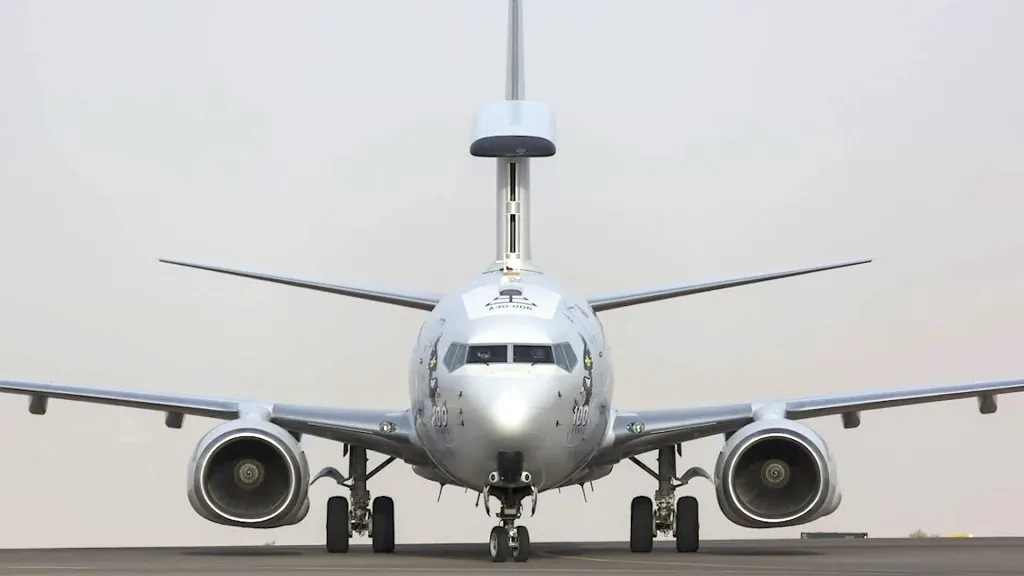
An Australian E-7A Wedgetail airborne early warning and control plane is headed for the Persian Gulf. This comes as Gulf Arab states continue to be subjected to Iran’s attacks in retaliation for ongoing U.S. and Israeli strikes. The E-7A is arguably the best airborne look-down sensor platform in the world at present, and will provide a particularly important boost in capability for spotting low-flying Iranian kamikaze drones and cruise missiles.
Australian Prime Minister Anthony Albanese announced the impending deployment of the E-7A to the Middle East at a press conference yesterday. The Royal Australian Air Force (RAAF) currently operates a fleet of six Wedgetails.
One of the RAAF’s six E-7s. RAAF
“Twelve countries across the region, from Cyprus through to the Gulf are continuing to be targeted. The United Arab Emirates alone has been forced to shoot down over 1,500 rockets and drones,” Albanese said. “This growing wave of dangerous and destabilising attacks from Iran puts civilian lives at risk, of course including Australian lives, of which there are more than 20,000 people based in the UAE.”
“In responding to requests, following a conversation that I had with the President [of the UAE,] Mohammed bin Zayed [Al Nahyan; also Crown Prince of Abu Dhabi], and other requests, Australia will deploy an E-7A Wedgetail, to the Gulf to help protect and defend Australians and other civilians,” Albanese continued. “The Wedgetail will provide long-range reconnaissance capability, which will help to protect and secure the airspace above the Gulf. The Wedgetail and supporting Australian Defence Force personnel will be deployed for an initial four weeks in support of the collective self-defense of Gulf nations.”
The E-7A is based on the Boeing 737-700 Next Generation airliner airframe. Its most prominent feature is the Northrop Grumman Multi-role Electronically Scanned Array (MESA) sensor installed on top of the fuselage, which offers 360-degree coverage and can scan for aerial and maritime threats. It also has an extensive suite of communications and data-sharing capabilities, backed by modern processing power, allowing for the rapid exchange of information with other friendly assets in the air and in other domains. You can read more about the aircraft here.
Northrop Grumman MESA Radar – Boeing E-7 AEWC
“As the Prime Minister has said at the request of the UAE, we will be deploying an E-7 Wedgetail to the Gulf. This is one of the leading capabilities in the world in terms of airborne long-range reconnaissance and command. And we are one of the leading nations in the use of the E-7,” Richard Marles, Deputy Prime Minister of Australia and the country’s Minister for Defense, also said at the press conference yesterday. “There will be in the order of 85 personnel who will go with this airframe and that’s the normal crew. The airframe will be leaving Australia today and the expectation is that it will be in the region in the middle of the week and operational by the end of the week.”
Albanese and Marles also said the Australian government planned to send a tranche of AIM-120 Advanced Medium Range Air-to-Air Missiles (AMRAAM) to the UAE. In addition to ground-based air defense, Emirati fighters have been working to intercept incoming Iranian threats.
As noted, the biggest boost in capability the RAAF’s E-7A will bring to the Gulf is its look-down sensor capability. From the aircraft’s high perch, the MESA sensor has an excellent field of view to spot low and slow-flying targets, even if they are relatively small. Wedgetail would also be able to see threats as far out into the Persian Gulf, or even possibly beyond.
So much garbage being passed around here in long jargon filled threads that sound like AI about E-7 Wedgetail and the potential RAAF deployment to the Middle East. Here is all you need to know:
it’s arguably the best low flying drone and CM detection sensor on earth.
Having another eye in the sky to provide additional alerts about incoming threats and more overall situational awareness will be a boon for defenders in the air and on the ground, in general. The E-7A can also be refueled in flight, meaning it can stay on station longer.
The UAE, which is the clear focus of the Australian deployment, does have a fleet of 5 Saab GlobalEye airborne early warning and control aircraft, but the extent to which they are operating now is unknown. While a modern and capable design, GlobalEye does not provide the same level of coverage and capability as the E-7A, and is also based on the smaller Bombardier Global 6000 business jet, which cannot refuel in flight.
GlobalEye on operational mission
There is more airborne warning and control coverage elsewhere in the Gulf, including six U.S. Air Force E-3 Sentry Airborne Warning and Control System (AWACS) aircraft forward-deployed to Saudi Arabia just ahead of the current conflict with Iran. Saudi Arabia has its own E-3s and GlobalEye jets. How effective the aging Cold War-era E-3, in particular, is at this point at spotting and tracking low-flying kamikaze drones is unclear. In general, the E-7’s active electronically-scanned array MESA sensor offers clear advantages over the Sentry’s older radar, especially when it comes to smaller, slower, and lower-flying targets.
For years now, the U.S. E-3 fleet, overall, has struggled with readiness issues, which you can read more about here. As an aside, the strain on the E-3 fleet, now magnified by the current conflict, together with Australia’s deployment of an E-7 to the region, makes the Pentagon’s attempt last year to cancel the U.S. Air Force’s Wedgetail program seem even more bizarrely short-sighted.
A US Air Force E-3 Sentry seen at Prince Sultan Air Base in Saudi Arabia in 2022. USAF
In speaking yesterday, Australia’s Marles drew a comparison between sending the E-7A to the Middle East now and the past deployment of a Wedgetail to Poland to provide coverage along that country’s border with Ukraine. However, that mission was ostensibly focused on watching for threats to cross-border transfers of aid to the government in Kyiv.
The need for E-7A in the Gulf now is substantially more pressing.
Since the current conflict began, the UAE has been providing particularly granular data about incoming Iranian missile and drone attacks, as well as interception rates, offering a good sense of the current threat ecosystem in the Gulf. As of the last official tally from the UAE’s Ministry of Defense, the country’s forces have intercepted 1,385 kamikaze drones, 241 ballistic missiles, and eight cruise missiles since February 28.
Overall, Iranian retaliatory attacks have notably slowed in recent days across the region, but they have not stopped. Based on its own data, the UAE saw a notably high number of Iranian drones get past its defenses yesterday. This comes amid persistent media reports of concerns among several Gulf Arab states, as well as the U.S. military, about the dwindling stockpile of anti-air interceptors and what has turned into a war of attrition with Iran. Publicly, American and regional authorities have pushed back on this reporting. At the same time, Australia’s plan to rush AIM-120s to the UAE is certainly evidence of demand for additional munitions.
Reasonable to ask what the raw numbers for ballistic missile and drone attempts vs. hits are, which are plotted in these figures. Again, all figures are from UAE MOD. pic.twitter.com/dhj86h6DbD
There is also a question of where the Australian E-7A will be based and what threats there might be as a result to the aircraft, aircrew, and the rest of the 85-person contingent. Albanese and Marles do not appear to have explicitly said where the jet will be flying from to provide coverage over the UAE and other parts of the Gulf region.
With Iran showing no intention of halting its drone and missile attacks across the Gulf, Australia’s E-7A Wedgetail, wherever it might be stationed, looks set to bring immensely valuable added look-down surveillance coverage to the region.
Weekly insights and analysis on the latest developments in military technology, strategy, and foreign policy.
A submarine is among the Iranian naval vessels that U.S. forces have struck with Army Tactical Missile System (ATACMS) short-range ballistic missiles. ATACMS cannot hit moving targets, so the submarine would have had to have been stationary in port when struck. TWZ was first to report earlier this week that M142 High Mobility Artillery Rocket System (HIMARS) launchers firing ATACMS, as well as Precision Strike Missile (PrSM) short-range ballistic missiles, had been aiding in the destruction of Iran’s Navy as part of Operation Epic Fury. The conflict has also marked the first combat use of PrSM, which brings a major boost in range over ATACMS.
Chairman of the Joint Chiefs of Staff U.S. Air Force Gen. Dan “Razin” Caine put a particular spotlight on the contributions of field artillery units in current operations against Iran at a press conference at the Pentagon this morning.
A M142 HIMARS launcher fires a PrSM short-range ballistic missile in support of Operation Epic Fury. CENTCOM
“Today, I’m going to talk about our incredible artillery force, comprised of American soldiers and Marines who’ve been sinking ships, [and] destroying depots,” Caine said. “Our Army and Marine artillerymen are hitting sites that Iran relies on to project power beyond their borders and protect our deployed [forces].”
“In just the first 13 days of this operation, our artillery forces have made history. They fired the first Precision Strike Missiles ever used in combat, reaching deep into enemy territory,” the Chairman continued. He also said that soldiers from the Army’s 3rd Battalion, 27th Field Artillery, part of the 18th Field Artillery Brigade based at Fort Bragg, North Carolina, were the ones to fire the first PrSMs against targets in Iran.
In a historic first, long-range Precision Strike Missiles (PrSMs) were used in combat during Operation Epic Fury, providing an unrivaled deep strike capability.
“I just could not be prouder of our men and women in uniform leveraging innovation to create dilemmas for the enemy.”… pic.twitter.com/bydvIv5Tn5
“They used Army ATACMS to sink multiple ships, including a submarine,” Caine added. “And they’ve done all of this with the precision and determination that comes from relentless training and trust in each other and in their weapon systems.”
“We’ve rendered the Iranian Navy combat ineffective,” but “continue to attack naval vessels,” Caine also said, speaking generally.
Caine did not name the Iranian submarine that was destroyed using ATACMS, nor did he say what class it was. TWZ has reached out for more information. There is no known operational version of ATACMS capable of hitting moving targets, so, as already noted, the missile would also have had to have been employed against a submarine in port or one that was otherwise stationary.
A review of satellite imagery in Planet Labs’ archive does show one of Iran’s three Russian-made Kilo class diesel-electric submarines sunk at Bandar Abbas as of March 4. The submarine had looked to be untouched in an earlier Planet Labs image taken on March 2 in the aftermath of a wave of strikes, as TWZ previously reported. Bandar Abbas is the Iranian Navy’s main base and occupies a particularly strategic position along the Strait of Hormuz.
In a video address on March 5, U.S. Navy Adm. Brad Cooper, head of U.S. Central Command (CENTCOM), had also said that “the most operational Iranian submarine … now has a hole in its side.” What submarine Cooper was referring to here remains unclear, but it may have been the Kilo class submarine struck at Bandar Abbas. At that time, his comments were also taken by many to be a reference to the IRIS Fateh, a domestically-produced diesel-electric coastal attack submarine that entered Iranian service in 2019. The fate of that boat remains unconfirmed.
The IRIS Fateh seen ahead of its launch in 2019. IRNA
On March 10, CENTCOM released the video seen below, showing strikes on various Iranian vessels at sea and in port, including what looks to be a Ghadir class diesel-electric midget submarine. That boat was struck by an AGM-114 Hellfire missile, a U.S. official told TWZ. How many Ghadir class submarines were in Iran’s inventory before the current conflict is not clear, but prior estimates had generally put the size of that fleet at between 16 and 20 hulls.
U.S. forces are degrading the Iranian regime’s ability to project power at sea and harass international shipping. For years, Iranian forces have threatened freedom of navigation in waters essential to American, regional and global security and prosperity. pic.twitter.com/gIBN02mowh
Regardless, it makes good sense that the U.S. military would focus on neutralizing Iran’s submarine force, and doing so in port if possible, as part of the larger objective of neutering the country’s naval capabilities. Finding, fixing, and engaging submerged submarines, even older and louder designs, can take significant time and effort, as you can read about in more detail in this past TWZ feature. Iranian submarines could have been used to discreetly lay mines, as well as to attempt attacks on friendly warships or commercial vessels. As it stands now, maritime traffic in and out of the Persian Gulf through the Strait of Hormuz has still ground to a virtual halt over concerns about mines and other remaining Iranian threats, which is already having global ramifications.
Chairman Caine’s comments today also reinforce the role that ATACMS and PrSM have been playing in the current conflict, in general. TWZ previously noted that this is a preview of what one would expect to see from U.S. forces in other future conflicts, especially when it comes to using ballistic missiles in the anti-ship role as part of a high-end fight with China in the Pacific. PrSM, which only began entering service in the past two years or so, offers significantly greater reach than ATACMS, allowing it to hold a much broader swath of territory at risk from any launch position.
Just yesterday, Lockheed Martin also announced the first test launch of a full-up Increment 2 PrSM, an anti-ship optimized version in development now. In that test, a HIMARS launcher fired the Increment 2 missile, which flew out to a range of around 217 and a half miles (350 kilometers), according to a company press release. The Increment 2 PrSM features an additional multi-mode seeker specifically designed to allow it to engage moving targets at sea. Lockheed Martin also released the rendering below as part of its announcement yesterday, which looks to show apertures for the seeker system around the nose.
Lockheed Martin released this rendering along with its announcement about the successful PrSM Increment 2 test launch. Lockheed Martin
Questions do remain about the anti-ship and/or moving target capabilities that might be found on baseline Increment 1 PrSMs. A pair of “early operational capability” PrSMs – a term generally understood to refer to Increment 1 missiles – were fired at what was described as a moving maritime target during a test in the Pacific back in 2024.
In the meantime, the older ATACMS, which PrSM is set to eventually replace, has now scored a hit against an enemy submarine, albeit one not on the move.
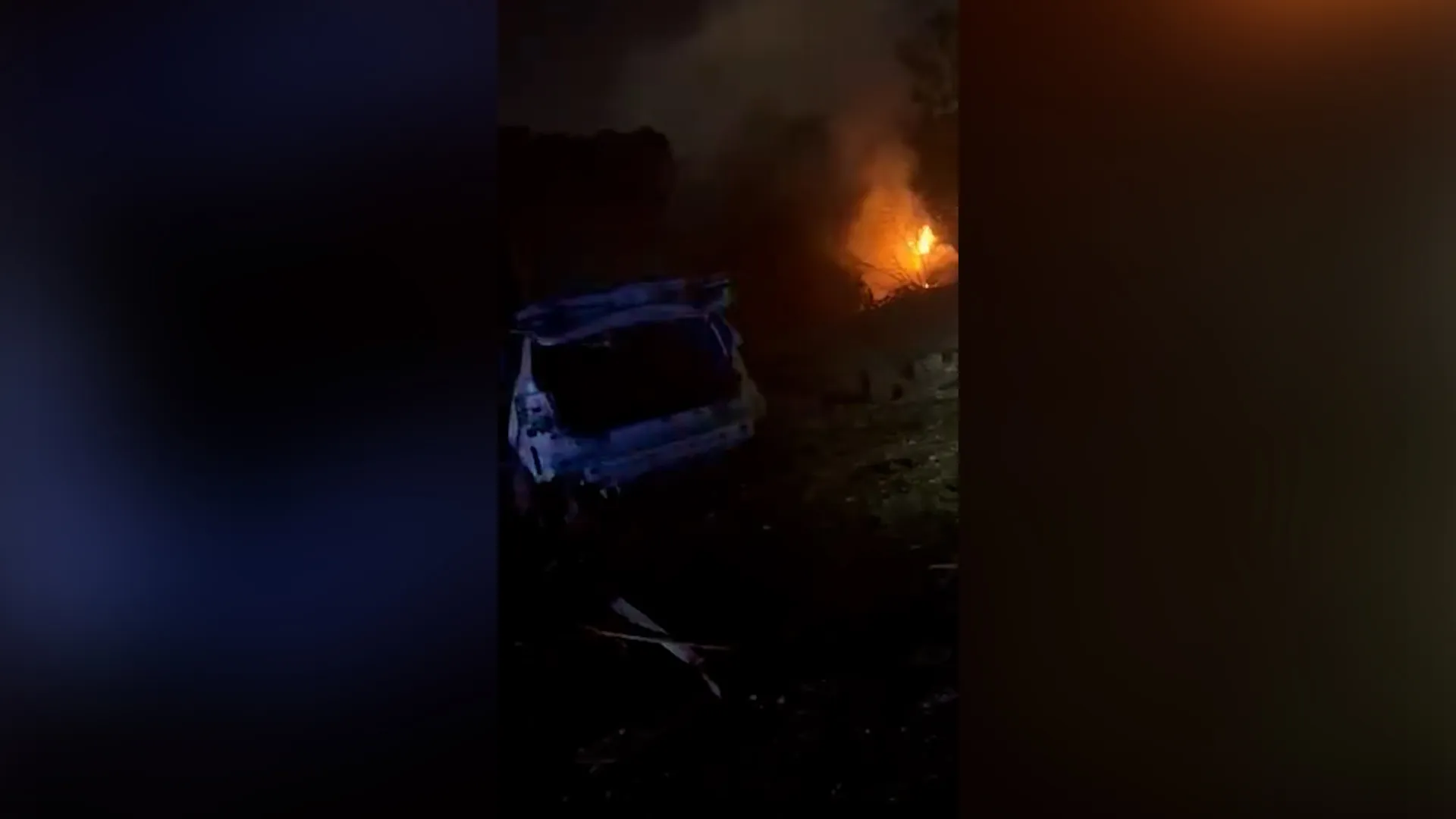
ideo from northern Israel captured the moment an Iranian missile impacted in a residential area early Friday morning. The aftermath shows a fire and scattered debris next to damaged vehicles and buildings.
Israeli Prime Minister Benjamin Netanyahu said several Iranian nuclear scientists were killed in Israeli strikes. He also said a “new path of freedom” for Iran was approaching and told Iranians the country’s future ultimately depends on them.
WASHINGTON — Iran’s new supreme leader, Mojtaba Khamenei, vowed retaliation Thursday against the United States and Israel and signaled that Tehran will continue to choke off the world’s most critical oil route, as the war strained global energy markets and raised new security concerns in the United States.
In his first public remarks since U.S.–Israeli strikes killed his father, former Supreme Leader Ayatollah Ali Khamenei, Mojtaba Khamenei swore revenge. The new leader, notably, did not appear in person for the televised statement. Instead, his written words were read aloud on Iranian state media.
“We will never retreat and vow to avenge the blood of our martyrs,” he said. “Our revenge will be never ending, not only for the late supreme leader, but also for the blood of all of our martyrs. … Those who killed our children will pay the price.”
The new leader expressed condolences to families who lost children in a strike on a girls school in Minab that killed more than 165 people, many of them children. He also warned that the war could expand, declaring that the continuation of the conflict “depends on the interests of the parties.”
The Associated Press, citing two sources, reported that outdated intelligence likely led to the United States carrying out the deadly missile strike on the elementary school. U.S. Central Command relied on target coordinates for the strike using outdated data provided by the Defense Intelligence Agency, according to a person familiar with the preliminary finding.
Khamenei indicated that Tehran would maintain its blockade in the Strait of Hormuz, a key choke point through which 20% of the world’s oil supply is shipped. He also said he believes in friendship with his country’s neighbors, but that attacks on U.S. military installations in the region will continue. He described maintaining pressure on the passage as a necessary part of Iran’s war strategy.
His remarks came as attacks continued to disrupt shipping and energy infrastructure across the Persian Gulf. The war sent oil up 10% Thursday as hostilities in Iran drag on.
Reports from the region said Iranian forces have intensified strikes on vessels attempting to pass through the Strait of Hormuz, leaving hundreds of ships stranded at its entrances and rattling global oil markets.
Two oil tankers were struck by explosives in Iraqi waters near the port of Basra. The Islamic Revolutionary Guard Corps claimed responsibility for the attacks, which killed at least one crew member and set both vessels ablaze, according to the Associated Press. A third unnamed vessel was reported to have been struck by an “unknown projectile” near Dubai and Jebel Ali, causing a small fire, the United Kingdom Maritime Trade Operations reported.
The latest incidents come after drone strikes targeted fuel storage facilities across the Gulf, including at energy sites in Bahrain and at the port of Salalah in Oman, an important hub for tankers seeking to bypass the Strait.
“They will pay the price. We will destroy their facilities,” Khamenei said. “It is necessary to continue our defensive activity, including continuing to close the Strait of Hormuz.”
Weekly insights and analysis on the latest developments in military technology, strategy, and foreign policy.
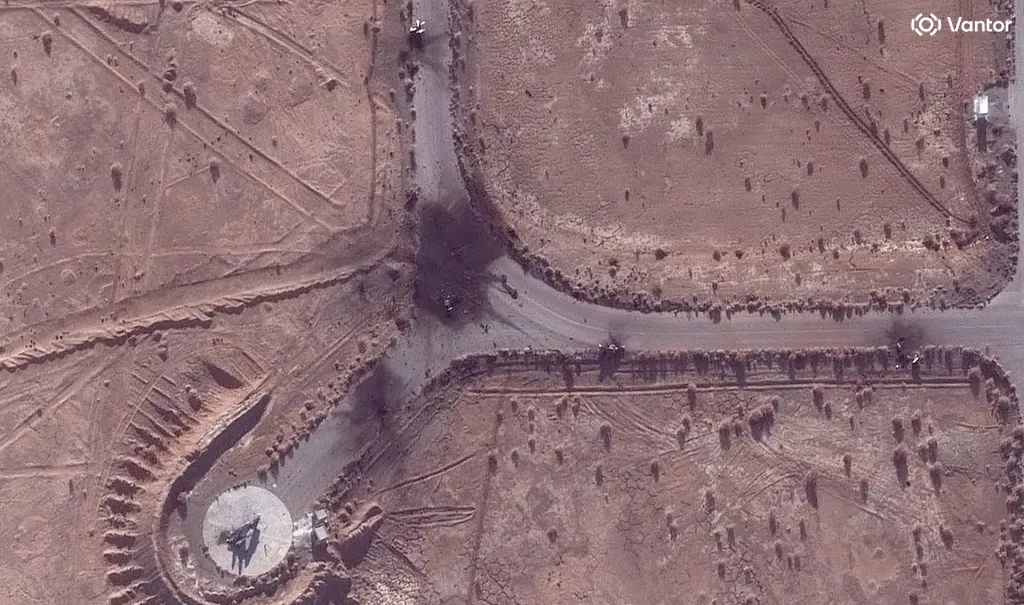
Satellite imagery from Vantor shows at least two, and more likely three, swing-wing F-14 Tomcat fighters, as well as at least 10 other aircraft destroyed on the ground following strikes on an Iranian airbase in Isfahan. Iran’s Tomcats, the only ones left in service anywhere after the U.S. Navy retired the type back in 2006, have been a hot topic of interest for decades now. The fleet’s fate may now be sealed for good as U.S. and Israeli strikes continue to pummel Iran’s Air Force, along with the rest of the country’s military and security forces.
Vantor has provided an image of Iran’s 8th Tactical Air Base in Isfahan taken on March 9, following strikes, as well as one from February 22 for comparison. The Israel Defense Forces (IDF) said explicitly on March 8 that it had targeted F-14s at Isfahan, the home base for Iran’s Tomcat fleet, but no imagery of those strikes looks to have been released. IDF videos of Iranian F-14s being struck that have been circulating online recently all look to be old.
The Vantor image from February 22 shows five F-14s. One is seen on what looks to be an alert pad, with another on a taxiway nearby. Two more are seen sitting outside a pair of aircraft hangars, while another is seen next to a separate set of hangars. The March 9 image shows the Tomcat on the pad and the lone example by the shelters to have been hit. There is also a huge scorch mark where the F-14 had been previously seen on the taxiway, pointing to its total destruction, though it is hard to tell for certain from the remaining wreckage. The other two jets appear to have been moved in the intervening weeks, and their status is unclear.
The post-strike image also shows at least 10 other aircraft destroyed along various taxiways. Vantor has assessed these to be members of the Iranian Air Force’s fleet of Chinese-made F-7 fighters. F-7 is the nomenclature for export variants of the Chengdu J-7, itself derived from the Soviet MiG-21 Fishbed.
Vantor also shared imagery of a row of four hardened aircraft shelters at Isfahan, three of which have a single hole in the top following the strikes. A structure next to the shelters, which had already been damaged prior to the current conflict, has now been flattened, as well.
Whether or not any of the F-14s that were struck at Isfahan were operational at the time is unknown. Estimates of how many Iranian Tomcats are even still airworthy have ranged widely in recent years, from just a handful to maybe as many as 25. As noted earlier, the 8th Tactical Air Base is the main station for Iran’s F-14s, though examples have also been positioned to provide quick reaction alert (QRA) coverage for Tehran in the past.
A total of 79 F-14As were delivered to Iran before the fall of the Shah in 1979. Iran’s air arm and the U.S. Navy are the only ones to have ever operated the Tomcat, and Iran has been the only one still flying them since 2006. While the current regime in Tehran has been able to keep a small portion of its original F-14 fleet flyable, sustaining the jets has been an immense challenge requiring the cannibalization of airframes.
A stock picture of one of Iran’s remaining F-14s taken in 2013. Iranian quasi-state media
The capabilities of the remaining jets can only have steadily degraded, as TWZ has written in the past:
“In particular, the F-14’s once-state-of-the-art AN/AWG-9 fire control radar has suffered from low serviceability, with the Tomcat fleet effectively being divided between those with fully functioning radars and those with more diminished capabilities. The current status of any surviving AIM-54 Phoenix and AIM-7 Sparrow air-to-air missiles is also a matter of debate, and Iranian programs to introduce alternative weaponry for the F-14 have had only very mixed results, as you can read more about here.“
The total number of F-14s in Iran, flyable or not, had already been reduced to some degree during the 12 Day War with Israel last year. Strike footage the IDF released during that conflict showed at least five Tomcats being struck. Satellite imagery had confirmed that at least two of those jets had been sitting idle for some time beforehand, as well.
The Israeli Air Force has conducted additional precision strikes targeting IRIAF F-14s, continuing its focused effort to systematically degrade Iran’s remaining air combat capabilities. pic.twitter.com/vT6JJ4D1x7
The overall intensity of the current U.S.-Israeli air campaign against Iran has been far greater than what was seen during the 12 Day War last year. The Iranian Air Force does not appear to have mustered any kind of major response, even in the first few days of what the U.S. military has dubbed Operation Epic Fury and that the Israelis are calling Operation Roaring Lion. Qatari F-15 fighters shot down two Iranian swing-wing Su-24 Fencer combat jets attempting to carry out a strike mission on Al Udeid Air Base on March 2. An Israeli F-35I Adir also shot down a Yak-130 armed jet trainer over Iran on March 4.
Other airbases across Iran beyond Isfahan have also been targeted in U.S. and Israeli strikes. Satellite imagery has previously confirmed the loss of one Il-76 cargo plane, two C-130 airlifters, and two swing-wing Su-22 Fitter combat jets in Shiraz.
U.S. Central Command has also previously released video footage in the past showing strikes targeting Su-22s at Shiraz, as well as some of Iran’s remaining U.S.-made F-5s at Qasem Soleimani International Airport (formerly Ahvaz International Airport) in Khuzestan.
Geolocation of destruction of F-27s and F-5s: 31.33563, 48.76275 Ahvaz International Airport, Khuzestan Province, Iran
Google Earth imagery taken 11/19/2025 for reference (F-5s not present). Aircraft were in current placement on 2/28/26. Runway was seen cratered by 3/05/26. https://t.co/XRMx7NZxWHpic.twitter.com/iZGnxPp4mO
Overall, Iran’s already dilapidated air arm looks to be even more severely degraded now, and seems likely doomed, at least in its present guise. U.S. officials have said that neutralizing the Iranian government’s ability to project military power beyond its borders is a core objective of the current campaign.
When it comes to the F-14s, regardless of whether any of them were still operational to any real degree when the current conflict erupted, the story of the country’s Tomcats looks to be increasingly approaching a definitive end.
Iranian explosive-laden boats appear to have attacked two fuel tankers in Iraqi waters, setting them ablaze and killing one crew member, after projectiles struck three vessels in Gulf waters, according to reports.
The ships targeted in late-night attacks on Wednesday in the Gulf near Iraq were the Marshall Islands-flagged Safesea Vishnu and the Zefyros, which had loaded fuel cargoes in Iraq, two Iraqi port officials told the Reuters news agency.
Recommended Stories
list of 4 itemsend of list
“We recovered the body of a foreign crew member from the water,” one port security official said, as Iraqi rescue teams continued searching for other missing seafarers. It was not immediately clear which ship that person was linked to.
One Iraqi port security source said Zefyros is flagged in Malta and provided Reuters with a list of crew names.
Al Jazeera’s correspondent in Baghdad, Iraq, Mahmoud Abdelwahed, said the tankers were loaded with crude oil from the Umm Qasr port in southern Iraq in the Basra province, and were attacked soon after their voyage got under way.
“Iraqi officials say this is a flagrant violation of Iraq’s sovereignty given the fact this act, they say, of sabotage has happened in Iraq’s territorial waters,” Abdelwahed said.
Reuters said that reports of the use of explosive-laden unmanned surface vessels, which Ukraine has used with great effect in its war with Russia, come as Iran has blocked oil shipments from transiting the key Strait of Hormuz, through which one-fifth of the world’s oil transits but has been blocked amid the United States-Israeli war on Iran.
Reuters, citing two unnamed sources, also reported on Wednesday that Iran has deployed about a dozen mines in the strait, while US President Donald Trump said US forces had struck 28 Iranian mine-laying vessels, amid warnings by Trump of severe repercussions should Iran lay mines in the key waterway for global shipping.
Strait of Hormuz sealed
Iran’s Islamic Revolutionary Guard Corps (IRGC) have warned that any ship passing through the Strait of Hormuz will be targeted.
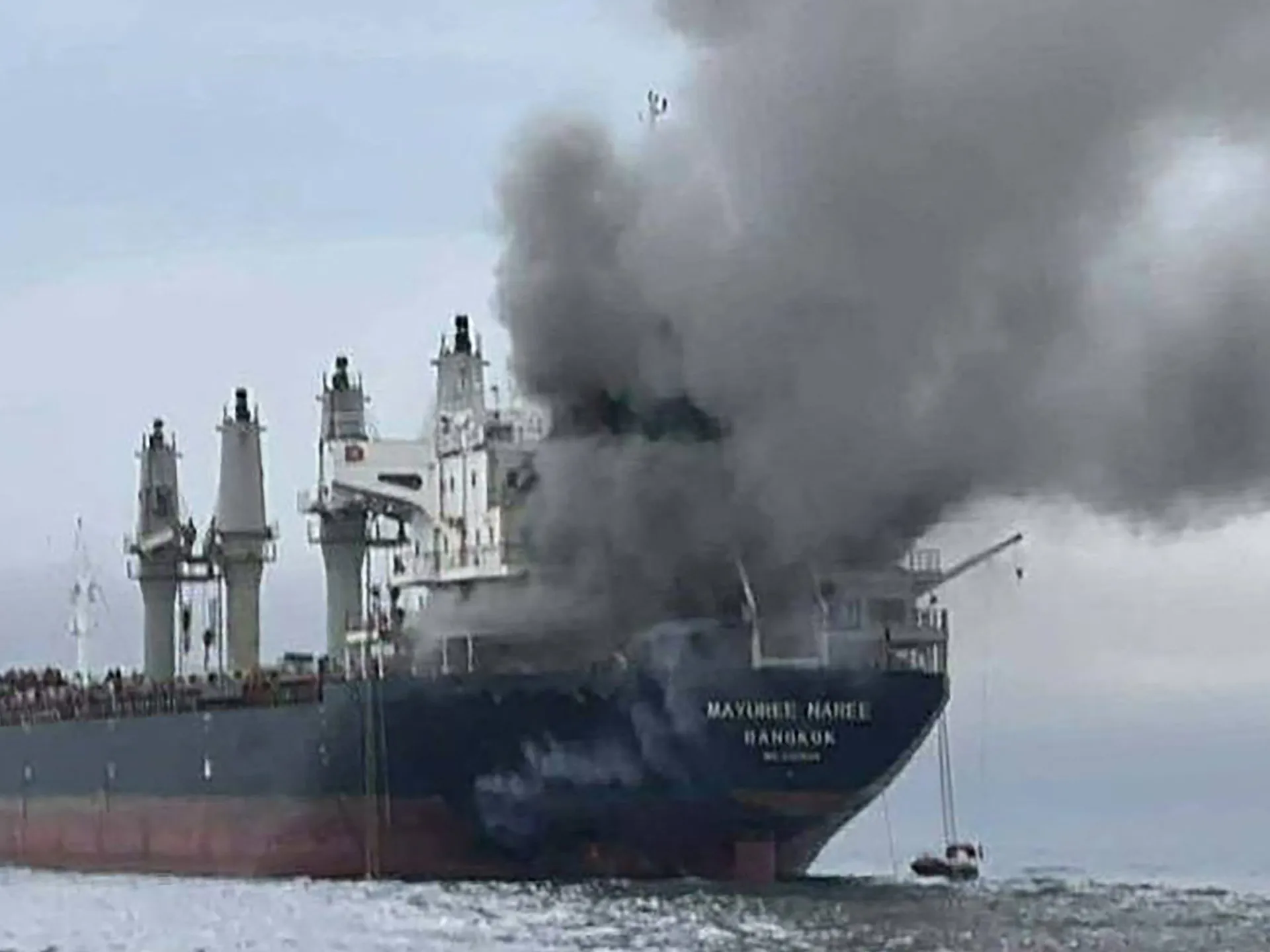
The Thai-flagged Mayuree Naree dry bulk vessel was struck by “two projectiles of unknown origin” while sailing through the strait earlier on Wednesday, causing a fire and damaging the engine room, the ship’s Thai-listed operator Precious Shipping said in a statement.
“Three crew members are reported missing and believed to be trapped in the engine room,” Precious Shipping said.
“The company is working with the relevant authorities to rescue these three missing crew members,” it said, adding that the remaining 20 crew members had been safely evacuated and were ashore in Oman.
Images shared by Thai news outlet Khaosod English showed what were reported to be crew members of the ship after their rescue by Oman’s navy.
The IRGC said in a statement carried by the semi-official Tasnim news agency that the ship was “fired upon by Iranian fighters”, suggesting the first direct engagement by the IRGC, who have previously fired missiles or drones.
The Japan-flagged container ship ONE Majesty also sustained minor damage on Wednesday from an unknown projectile 25 nautical miles (about 46 kilometres) northwest of Ras al-Khaimah in the United Arab Emirates, two maritime security firms said. Its Japanese owner Mitsui OSK Lines and a spokesperson for Ocean Network Express, its charterer, said the vessel was struck while at anchor in the Gulf, and an inspection of the hull revealed minor damage above the waterline.
All crew are safe, they said, adding that the vessel remains fully operational and seaworthy. The owner said the cause of the incident remained unclear and was under investigation.
A third vessel, a bulk carrier, was also hit by an unknown projectile approximately 50 nautical miles (about 93km) northwest of Dubai, maritime security firms said.
The projectile had damaged the hull of the Marshall Islands-flagged Star Gwyneth, maritime risk management company Vanguard said, adding that the vessel’s crew were safe. Owner Star Bulk Carriers said the ship was hit in the hold area while it was anchored. There were no crew injuries and no listing.
The US Navy has refused near-daily requests from the shipping industry for military escorts through the Strait of Hormuz since the start of the war on Iran, saying the risk of attacks is too high for now, sources familiar with the matter told Reuters.
The Bahraini interior ministry released footage of a massive blaze at a fuel storage facility following an Iranian attack. Bahrain hosts the US Navy’s Fifth Fleet and has been consistently targeted amid the US-Israeli initiated war.
Weekly insights and analysis on the latest developments in military technology, strategy, and foreign policy.
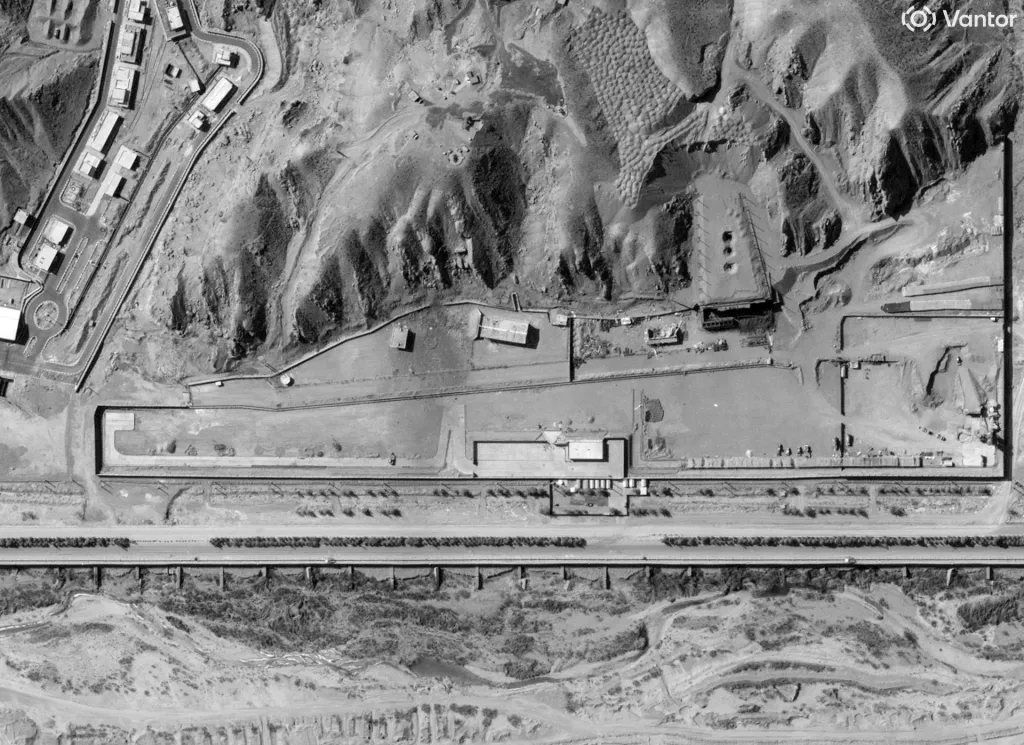
Satellite imagery from Vantor shows that a site long linked to Iran’s nuclear program has been struck. A trio of very large impact points also raises the possibility that the hardened facility was hit by 30,000-pound GBU-57/B Massive Ordnance Penetrator (MOP) bunker buster bombs. MOPs were first used operationally in U.S. strikes on Iranian nuclear facilities last year, dubbed Operation Midnight Hammer. The Taleghan 2 site was newly encased in a concrete shell and then covered with soil in the months leading up to the current conflict, which may have created a need to use munitions more capable of burrowing down into it to have a better chance of ensuring its destruction.
Vantor’s post-strike images of Taleghan 2, seen at the top of this story and below, were taken earlier today. As noted, three very large and precise impact points are visible on top of the facility.
Vantor also shared previous images of Taleghan 2 taken on March 6, 2026, and November 14, 2025. Other parts of Parchin were notably struck on March 6, but Taleghan 2 was left untouched at that time.
High resolution imagery provided to the Institute by image @VantorTech shows significant damage to the solid rocket propellant motor production facilities at Parchin. These production plants have been destroyed multiple times, first during Israeli airstrikes in October 2024, and… pic.twitter.com/FfNk6SczGh
Taleghan 2 had already been covered in a new layer of concrete by mid-January of this year. Soil had also been added on top weeks before joint U.S.-Israeli operations began on February 28. Iran was also observed taking steps to further harden and/or seal up a host of other key facilities across the country in the lead-up to the current conflict, but not to this degree. TWZ highlighted similar activity at Iranian nuclear sites ahead of the Operation Midnight Hammer strikes last year.
Over the last two to three weeks, Iran has been busy burying the new Taleghan 2 facility at the Parchin military complex with soil. Once the concrete sarcophagus around the facility was hardened, Iran did not hesitate to move soil over large parts of the new facility. More soil… pic.twitter.com/LWSrCnDdfy
We do not know what munitions were used to strike Taleghan 2, but the impact points are at least broadly consistent with what was seen at Iran’s Fordow and Natanz nuclear sites after Operation Midnight Hammer. During that operation, B-2 bombers dropped 12 GBU-57/Bs on Fordow and another two MOPs on Natanz.
When reached by TWZ, U.S. Central Command (CENTCOM) declined to comment on whether GBU-57/Bs had been dropped on Taleghan 2 or any other site in Iran in the course of the current campaign. The only aircraft currently certified to carry MOPs operationally is the B-2 bomber, with each one being able to carry two of the massive bombs at a time. B-2s have been striking Iran since the first night of the conflict.
A B-2 bomber seen taking part in strikes on Iran. CENTCOM
From what can be seen via satellite imagery, Taleghan 2 does appear to be as deeply buried as either Fordow or the underground facility at Natanz. At the same time, it was very thoroughly and deliberately hardened against attack just in the past few months, which could have driven a decision to target it with GBU-57/Bs. That work was also done relatively quickly with a clear eye toward shielding the site from strikes.
A B-2 bomber drops GBU-57/B MOP during a test. USAF
Other aspects of the target may have factored in, as well. In the strikes on Fordow last year, B-2s dropped six MOPs each down two air shafts to achieve the desired penetration. Those air vents offered a weak channel through which the bombs could penetrate far deeper to get to the targeted chamber deep within the mountain. Though it may be shallower, there do not appear to be any similar inlets readily visible at Taleghan 2. Using 30,000-pound bombs would also have helped guarantee more total destruction of this high-priority facility. The determination that MOPs were required might also explain why it was not struck previously.
The video below is a montage of imagery from past GBU-57/B tests that the U.S. military released last year after Operation Midnight Hammer.
GBU-57 MOP test
It is possible that other munitions may have been used to strike Taleghan 2. Smaller bunker busters could be dropped in succession on the same aim point in order to create openings and then create significant effects inside. CENTCOM has previously confirmed B-2 strikes on deeply buried targets in Iran using salvos of 2,000-pound-class bunker buster bombs.
Last night, U.S. B-2 stealth bombers, armed with 2,000 lb. bombs, struck Iran’s hardened ballistic missile facilities. No nation should ever doubt America’s resolve. pic.twitter.com/6JpG73lHYW
Striking Taleghan 2 otherwise fits with the U.S. military’s stated core objective of neutralizing Iran’s nuclear program. The site is tied to long-standing allegations of nuclear weapons-related work at Parchin, which Iranian officials have consistently denied. Taleghan 2 is specifically believed to have been a production facility for specialized conventional explosives required for nuclear weapons.
Five players who defected from the Iranian women’s soccer team after the team’s final match in the Asian Women’s Cup in Australia were granted asylum Tuesday.
Police assisted the women in leaving their hotel and placed them in a safe house. There, they met with Australian home affairs minister Tony Burke and their humanitarian visas were processed.
At least seven players left the hotel, according to Raha Pourbakhsh, a journalist for Iran International TV. Families of at least three of the five players granted asylum had been threatened, Pourbakhsh told CNN. At least two other players who left the hotel haven’t been located.
According to an X post by Reza Pahlavi, son of the deposed Shah of Iran, the players who “successfully sought refuge in Australia” are Fatemeh Pasandideh, Zahra Ghanbari, Zahra Sarbali, Atefeh Ramazanzadeh, and Mona Hamoudi.
Pahlavi warned in a separate post that the women would face “dire consequences” if they return to Iran.
“I don’t want to begin to imagine how difficult that decision is for each of the individual women, but certainly last night it was joy, it was relief,” Burke said.
Burke said the asylum offer was extended to all 26 players and the coaching staff, but the team left Australia for Iran on Tuesday, Ten Network News reported. It was unclear whether anyone besides the seven players who had left the team hotel had defected.
The team remained silent during the Iranian national anthem before their first Asian Cup match a week ago, which was interpreted as a protest against the regime. They saluted and quietly mouthed words to the anthem before a match against Australia after pushback from the Iranian government and accusations of treason.
Australia assisted the women, who apparently fear persecution at home. Following the United States-Israeli strikes on Iran and retaliation in the Middle East, Iranian state television labeled the soccer team “wartime traitors” and alluded to repercussions upon their return to the country.
Protesters converged near the bus transporting the team after its final match Sunday night, shouting “save our girls” and carrying the Iranian Lion flag used before the 1979 Islamic Revolution. Today, the flag is a symbol of resistance against the current regime.
Iran is now under the rule of Mojtaba Khamenei, a new hardline supreme leader. Khamenei is the son of Ayatollah Ali Khamenei, the 86-year-old leader who was killed on the first day of U.S. and Israeli attacks.
President Trump, in a statement Monday on Truth Social, said the United States would grant the Iranian players asylum if Australia did not. Trump posted a second time, saying he had spoken to Australian Prime Minister Anthony Albanese and that five players had “already been taken care of” and that “the rest are on their way.”
However, Iranian first Vice President Mohammad Reza Aref objected to the involvement of Trump and Australia, saying: “Iran welcomes its children with open arms and the government guarantees their security. No one has the right to interfere in the family affairs of the Iranian nation and play the role of a nanny who is kinder than a mother.”
Australian Foreign Minister Penny Wong told ABC that her country sides with the men and women of Iran.
“For Australians to see [Iranian players] in Australia and the Matildas swapping jerseys with them was, I think, a very evocative moment,” Wong said. “We know this regime has brutally oppressed many Iranian women and we stand in solidarity with the men and women of Iran, particularly Iranian women and girls.”
A suspected Iranian attack on a high-rise residential building in Bahrain’s capital of Manama has killed a 29-year-old Bahraini woman and injured several others.
Tedros Adhanom Ghebreyesus says children, the elderly at particular risk after damage to Iranian petroleum facilities.
Published On 9 Mar 20269 Mar 2026
Share
The head of the World Health Organization has warned that recent Israeli attacks on oil facilities in Iran could have negative effects on public health, with Iranian children and the elderly among the most vulnerable.
Tedros Adhanom Ghebreyesus said in a statement on Monday that damage to Iranian petroleum facilities “risks contaminating food, water and air”.
Recommended Stories
list of 3 itemsend of list
Those hazards “can have severe health impacts especially on children, older people, and people with pre existing medical conditions”, Tedros warned in a post on X. “Rain laden with oil has been reported falling in parts of the country.”
The Iranian authorities said oil facilities in the capital, Tehran, and the nearby province of Alborz were targeted on Saturday in the United States-Israeli war against the country, the Fars news agency reported.
Israel said it struck “a number of fuel storage facilities in Tehran” that were used “to operate military infrastructure”.
The strikes sent massive flames and clouds of thick, black smoke into the sky above Tehran, with Al Jazeera’s Tohid Asadi reporting that black raindrops fell early on Sunday morning.
The attacks on Iran’s energy infrastructure came as the US and Israeli governments had vowed to continue to bombard the country despite mounting international concern over the widening conflict.
Iran has retaliated to the US-Israeli strikes by launching missiles and drones at targets across the Middle East, including energy infrastructure in nearby Arab Gulf states.
Human rights groups have condemned both Iran and the US and Israel for targeting civilian infrastructure.
Agnes Callamard, the head of Amnesty International, said on Monday that “Israel should have taken all feasible precautions to avoid or minimize the risks to civilians when targeting oil refineries” in Iran.
“The incidental harm to civilians, including the release of toxic substance, appears to indicate that too little precautions were taken and that the incidental harm to civilians is disproportionate,” she wrote on X.
“The scenes of catastrophe described by Iranians after Tehran’s oil depots were bombed are yet another demonstration that ultimately, whatever they may say, the US and Israel’s attacks on Iran are harming first and foremost civilians, including children.”
Thick clouds of smoke rise over Tehran after the attacks on Iranian oil infrastructure, on March 8, 2026 [Majid Asgaripour/WANA via Reuters]
Ministry of National Defence says no casualties or damage after missile shot down over southern city of Gaziantep.
Published On 9 Mar 20269 Mar 2026
Share
The Turkish Ministry of National Defence says NATO air defences have intercepted a ballistic missile launched from Iran towards Turkiye as concerns grow that the United States-Israel war against Iran will escalate.
The missile was intercepted on Monday over the Sahinbey district of Gaziantep in southern Turkiye, the ministry said in a statement. No casualties or damage were reported.
Recommended Stories
list of 3 itemsend of list
“Ankara emphasized its capability and determination to protect national airspace and border security, while warning that further escalation in the region must be avoided,” the statement said.
The ministry also urged all sides, especially Tehran, “to refrain from actions that could endanger civilians or undermine regional stability”.
Monday’s incident was the second time an Iranian ballistic missile was fired towards Turkiye since the US and Israel launched a war against Iran on February 28, according to local authorities.
The US-Israeli attacks have prompted a wave of Iranian missile and drone strikes across the wider region, including on targets in Arab Gulf countries.
Iran did not immediately comment on the Turkish ministry’s statement.
NATO spokesperson Allison Hart confirmed that the military alliance had intercepted “a missile heading to Turkiye”. “NATO stands firm in its readiness to defend all Allies against any threat,” Hart said in a post on X.
Iran denied firing a ballistic missile towards Turkiye on Wednesday after Turkish authorities said NATO air defences shot down a projectile over the Eastern Mediterranean.
NATO condemned that launch, expressing its “full solidarity” with Turkiye.
“This is a tangible demonstration of the Alliance’s ability to defend our populations against all threats, including those posed by ballistic missiles,” NATO said of the interception.
Article 5 of the alliance’s North Atlantic Treaty says an attack on one NATO country will be considered an attack on all. It also commits each NATO member state to taking action deemed necessary “to restore and maintain” security.
In an interview with the Reuters news agency last week after the first ballistic missile heading towards Turkiye was shot down, NATO chief Mark Rutte said there was no talk of invoking Article 5.
Iranian authorities have said they are firing at US military bases and other US- and Israel-linked targets across the region in self-defence, but civilian infrastructure has also been attacked.
“Iran’s targets are not just US bases; they are, in fact, primarily large-scale infrastructure and civilian targets as well,” said Rob Geist Pinfold, a lecturer in defence studies at King’s College London.
“This is not a mistake. This is by design,” Pinfold told Al Jazeera, explaining that Tehran is seeking to “unleash as much chaos as possible to destabilise the region and global markets” in an effort to force Washington to abandon the war.
“We’ve seen that Iran is targeting every single [Gulf Cooperation Council] state. It’s prepared to burn its bridges with all of them to pursue this very uncertain and high-risk strategy,” he said.
“It really shows you how Iran feels like it’s facing an existential threat. For them, this is a real do-or-die moment.”
Flames engulfed Kuwait’s Public Institution for Social Security high-rise headquarters after it was hit by a suspected drone amid a wave of Iranian aerial strikes on the country.
Weekly insights and analysis on the latest developments in military technology, strategy, and foreign policy.
As expected, Iran has repeatedly targeted prized missile defense radars across the Middle East in retaliation for the joint U.S.-Israeli air campaign that is ongoing. Iran’s attacks on high-value radars that enable the region’s missile defense capabilities appear to have succeeded on multiple occasions. The irony that lower-end long-range kamikaze drones are perhaps the biggest threat to extremely advanced radars capable of providing telemetry for intercepting targets traveling at hypersonic speeds, sometimes in space, is glaring. The losses of the radars and/or damage to their facilities should finally serve as a stark wake-up call regarding the vulnerability of these critical but largely static assets.
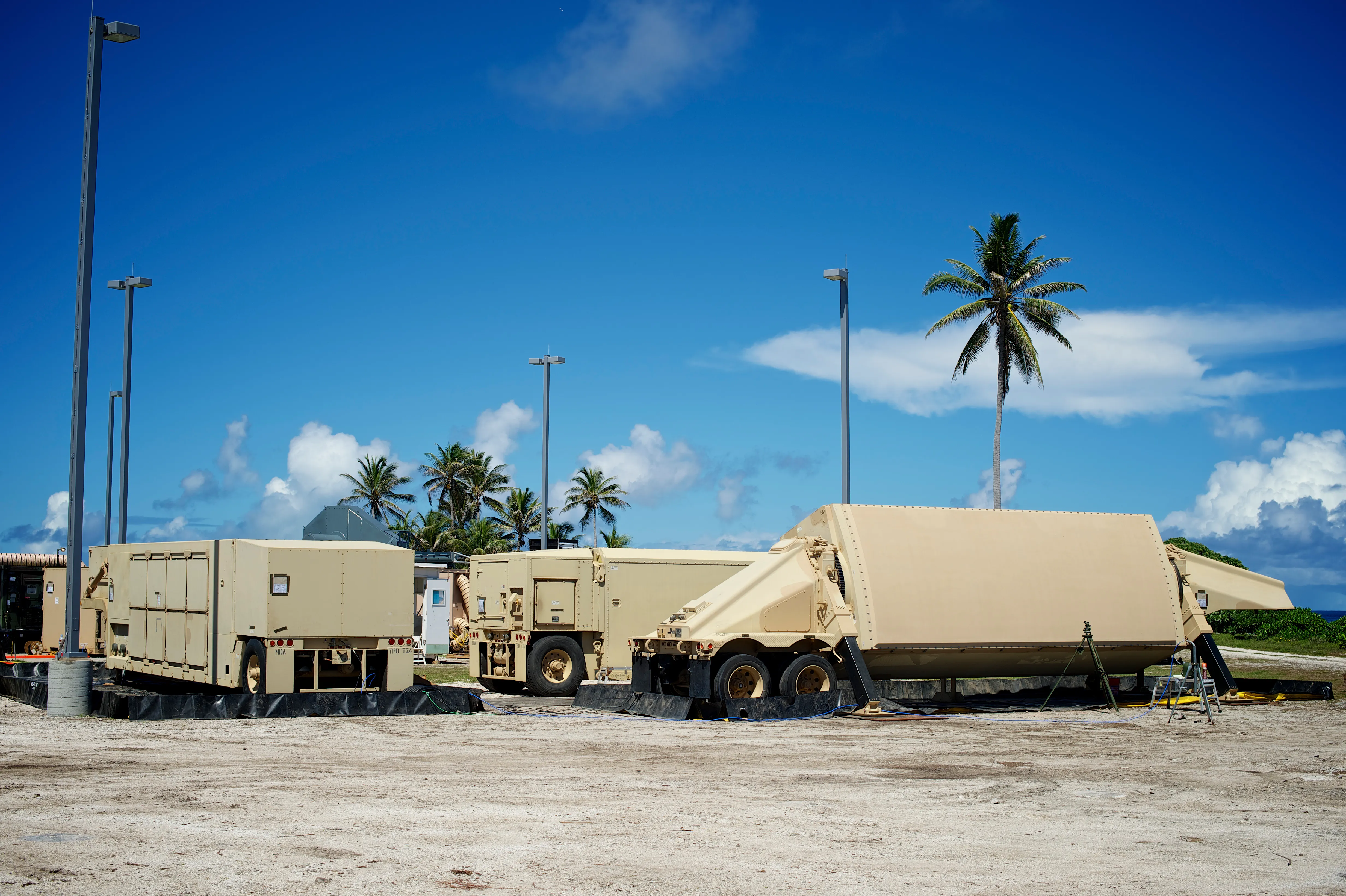
Based on the information at hand, it appears that Iran has been able to destroy one U.S. AN/TPY-2 radar in Jordan and damage the massive American-made AN/FPS-132 phased array radar in Qatar, prompting immediate concerns about available radar coverage to help respond to further barrages. There are strong indications that a number of other similar systems have been destroyed or damaged, as well.
An Army Navy / Transportable Radar Surveillance (AN/TPY-2) positioned in the Kwajalein Atoll during the FTI-01 flight test. The AN/TPY-2 radar tracked the ballistic missile targets and provided data to missile defense systems to engage and intercept. (DoW) Missile Defense Agency
For some general context to start, Iran and/or its regional proxies have hit targets in a total of 12 countries since the start of the current conflict. Iranian retaliatory attacks utilizing ballistic and cruise missiles, as well as long-range kamikaze drones, have significantly declined in recent days, but are still being carried out. Countries in the region are so far claiming very high interception rates of incoming threats, but some missiles and drones are clearly making it to their targets.
Iran has attacked a wide array of different targets, military and non-military, but there has been a clear concerted effort to go after air and missile defense radars in the region as part of the retaliatory campaign. This is to be expected given that the loss of key radars, even temporarily, risks degrading further efforts to intercept Iranian missiles and drones, hence these weapons can succeed at a higher rate. Taking out missile defense radars at very high-value sites can leave those areas far more vulnerable to follow-on attacks, as well. Striking these radars also reduces their user’s general situational awareness in the region, and can even have strategic implications beyond the region, too.
It’s also worth noting that these radars are extremely expensive and take years to replace.
Iran’s attacks on radars so far
This past week, CNN obtained imagery from Planet Labs showing an AN/TPY-2 radar damaged, or even possibly destroyed, following an Iranian attack on Muwaffaq Salti Air Base in Jordan. Muwaffaq Salti has long been a major regional hub for U.S. operations, and is being very actively utilized in the current conflict. It has the greatest concentration of U.S. tactical aircraft in the region, and thus is an extremely important target, where even one ballistic missile landing on an apron could destroy multiple prized fighter aircraft and take the lives of U.S. service members.
NEW: The radar for a THAAD system was struck and apparently destroyed in Jordan while two other THAAD radar systems may have been hit in the UAE, satellite images show – w/ @ThomasBordeaux7https://t.co/qiuWVQgyda
— Gianluca Mezzofiore (@GianlucaMezzo) March 5, 2026
The Wall Street Journal reported yesterday that the U.S. military was rushing to replace the AN/TPY-2 at Muwaffaq Salti, lending credence to the assessment that damage from the Iranian attack was at least substantial. There is a picture, seen below, circulating on social media that is said to show the AN/TPY-2 at Muwaffaq Salti having been clearly knocked out, but it remains unverified and, in an age of increasingly impressive AI fakes, should be treated as such.
Photos have now confirmed the destruction of a AN/TPY-2 Forward Based X-band Transportable Radar operated by the U.S. Army, following an Iranian drone attack earlier this week targeting Muwaffaq Salti Air Base in Jordan. The AN/TPY-2 is the primary ground-based air surveillance… pic.twitter.com/54QyQCxNVW
The active electronically-scanned array AN/TPY-2 is primarily associated with the U.S. Terminal High Altitude Area Defense (THAAD) anti-ballistic missile system, but it also has a demonstrated ability to feed data to Patriot surface-to-air missile systems. THAAD is a key upper-tier defensive system deployed to the Middle East that is capable of swatting down Iran’s most capable missiles from the end of their midcourse stage of flight and through their terminal stage. AN/TPY-2 radars can also be deployed as standalone sensors in a larger integrated air defense network. The radar is trailer-mounted and technically road mobile, but is not designed to be used on the move or very rapidly relocated from one place to another.
A stock picture of an AN/TPY-2 radar. US Army
CNN has reported that additional Planet Labs imagery indicates that AN/TPY-2 and their infrastructure were also at least targeted and possibly damaged in Iranian attacks on THAAD batteries belonging to the United Arab Emirates (UAE), one at Al Ruwais and another at Al Sader, and another one in Saudi Arabia near Prince Sultan Air Base. The New York Times also obtained satellite imagery showing that the site at Al Ruwais had at least come under attack. The full extent of the damage at any of these sites remains unclear.
A compound was damaged on Al Dhafra Air Base, UAE. Sat dishes were visible at the site as recently as mid-June of last year. It is unclear if they were still there when strikes occurred, but Iran struck the same area again on Monday. pic.twitter.com/nRyb7c6Kj5
A satellite image taken on March 1 shows smoke rising from a radar site near the Prince Sultan Air Base in Saudi Arabia, where dozens of American planes are stationed.
At the site, a tent previously used to shelter a radar system for a nearby THAAD battery was badly charred and… pic.twitter.com/rSbEdtOvwf
— Gianluca Mezzofiore (@GianlucaMezzo) March 6, 2026
Satellite imagery from Planet Labs, obtained by the Middlebury Institute of International Studies at Monterey, has also confirmed that the very large, fully static AN/FPS-132 radar in Qatar was damaged in an Iranian attack on the first day of the conflict. At least one of the radar’s three arrays was hit, and there are also signs of a possible fire.
Confirmed the AN/FPS-132 phased array radar in Qatar was damaged by Iran, thanks to an incredible image from our friends @planet
Debris from the damaged face has fallen on the roof of the main building and there is water runoff from the firefighting effort pic.twitter.com/AxzteEug7P
There are multiple versions of the giant AN/FPS-132, all of which are fixed-site solid-state phased array radar systems primarily to provide early warning of incoming ballistic missile strikes. As noted, the one in Qatar has three faces, offering 360-degree coverage, but there are also variants with only two faces. The AN/FPS-132 is part of a larger group of broadly related strategic early warning types that are also in U.S. military service at multiple sites in the United States, as well as in Greenland. The Royal Air Force (RAF) in the United Kingdom operates another one of these radars at its RAF Fylingdales base.
A stock picture of a version of the AN/FPS-132 radar. USAF
Since the first day of the current conflict, claims have been circulating that Iran was able to at least damage a U.S. AN/TPS-59 active electronically-scanned array ballistic missile defense radar in Manama, Bahrain. This appears to be based on the video below, showing a kamikaze drone hitting a large spherical radome at Naval Support Activity (NSA) Bahrain, a U.S. Navy facility in the country that is home to the headquarters of the U.S. Fifth Fleet.
Footage of an Iranian attack drone slamming into the headquarters of the US Navy’s 5th Fleet at Naval Support Activity (NSA) Bahrain moments ago. pic.twitter.com/wHbje3eiiy
However, Planet Labs imagery that The New York Times subsequently obtained has been assessed to instead show damage to what are understood to be large satellite communications terminals at NSA Bahrain. Like larger radars, these terminals also often sit inside spherical radomes. There are clear signs that communications arrays like this have been a major target of Iranian retaliation strikes on bases across the Middle East, as well.
A tent surrounded by satellite dishes was destroyed at Al Udeid Air Base in Qatar. Some of the dishes were most likely damaged as well. Al Udeid is the regional headquarters for the US Central Command, and was similarly struck by Iran last June. pic.twitter.com/TyuqZWHUL3
Yesterday, Iran’s PressTV claimed that the Iranian Navy had launched a kamikaze drone attack targeting “strategic carbon-based radar installations at the Sdot Micha facility.” While TWZ cannot independently confirm whether such an attack was launched, let alone was successful, it does highlight continued Iranian targeting of key missile defense radars. Sdot Micha Air Base in Israel hosts Arrow-series anti-ballistic missile defense systems. Elta’s Green Pine, which is analogous in some very broad respects to AN/TPY-2, is the main radar associated with these anti-missile systems.
Costly losses of key capabilities
Concerns have been raised about the immediate impacts from the loss of the AN/TPY-2 and damage to the AN/FPS-132, given that Iranian retaliatory attacks have significantly slowed, but not stopped. There are claims now, said to have originated from a report from Channel 14 in Israel, that malfunctioning and/or damaged U.S. radars have caused delays in early warning alerts about incoming Iranian missiles. TWZ has been unable to find an original source for these assertions, and they remain very much unconfirmed at this time. Regardless, it is hard not to see how losses of these systems could cause at least some degradation in total coverage, even if other land based and sea-based systems (Aegis BMD) can help with filling in some coverage.
The United States, Israel, and Gulf Arab states do have other air and missile defense radars positioned in the Middle East, or that could otherwise help fill any resulting gaps. At the same time, there are only a small number of systems that are at all equivalent to the AN/TPY-2, let alone the AN/FPS-132. Only 16 AN/TPY-2s are understood to have been produced to date, in total, for all customers. The current cost of one of those radars is generally pegged at around $250 to $300 million. When the U.S. government approved the sale of the AN/FPS-132 radar, as well as various ancillary items and services, to Qatar in 2013, that entire package had an estimated value of $1.1 billion, or just over $2.1 billion today when adjusted for inflation. Any of these systems takes years to procure.
🇺🇸 PSA: Fast Facts on AN/TPY-2 (radar system used by THAAD)
16 produced to date, 13 US Army, 2 UAE, 1 KSA, 6 more pending for KSA, none on order for US Army.
8 deployed as part of US THAAD batteries, 5 Forward Based Mode (deployed/operated by US Army in Japan [2], Israel,… pic.twitter.com/bD7gHpA3ib
Furthermore, the U.S. military and its allies have spent years (and billions of dollars) building a regional missile defense shield, with AN/TPY-2s and the AN/FPS-132 in Qatar being core components thereof. Though Iran and its expanding ballistic missile arsenal have been the driving factors behind those efforts, the U.S. government also sees these assets as being a key element of its global missile defense architecture. As noted, the Qatari AN/FPS-132 provides 360-degree coverage that is not limited to scanning for threats emanating from Iran. Houthi militants in Yemen to the south, long backed by Iran, have amassed a substantial arsenal of ballistic missiles, as well as cruise missiles and long-range kamikaze drones, and have used it to attack Gulf Arab states in the past. As an aside, the UAE was the first to employ THAAD in combat back in 2022, using the system to knock down an incoming Houthi ballistic missile.
Though more than a decade old now, this 2015 graphic from the U.S. Missile Defense Agency still gives a good sense of how AN/TPY-2s, as well as AN/FPS-132s and related designs, form a global ballistic missile defense sensor ecosystem. US Missile Defense Agency
More serious ramifications
Strategic air and missile architectures, in general, exist in a world now where the threats they face are not limited to very-long-range standoff capabilities possessed only by peer or near-peer adversaries.
It used to be, generally, that you had to fire a ballistic missile or high-end cruise missile in an attempt to strike one of these systems. Now, long-range one-way-attack drones, as well as increasingly capable cruise and ballistic missiles, continue to proliferate steadily, including to smaller nation-state armed forces and even non-state actors. An attack could even come from a small drone with a C4 charge launched from a fishing trawler 10 miles away from one of these critical radar installations. The threat of these kinds of near-field attacks has largely been overlooked for years, even as the low-end drone threat has exploded and ‘democratized’ precision-guided weaponry, as they did not fit the established aerial threat matrix and the countermeasures used to repel those threats.
Though we have not seen it yet in the course of the current conflict with Iran, the threat of more localized attacks by smaller weaponized drones, in particular, is very real and only set to grow. This was definitely shown by Ukraine’s Operation Spiderweb’s unprecedented covert attacks on multiple airbases across Russia last year. Israel also employed near-field drone and missile attacks to destroy Iranian air defenses in the opening phases of the 12 Day War last June. These operations were massively successful and knocked out Iran’s most critical air defenses, allowing for long-range munitions to strike their targets unimpeded. TWZ had been calling attention to this issue for years beforehand, including back in 2019 after drones were reportedly spotted over the U.S. Army THAAD site, with its AN/TPY-2 radar, on Guam.
СБУ показала унікальні кадри спецоперації «Павутина», у результаті якої уражено 41 військовий літак стратегічної авіації рф
CBS News also reported this past week that quadcopter-type drones may have been surveilling the Shuaiba port in Kuwait before all-out hostilities erupted. Six U.S. service members were killed, and more were wounded, in an Iranian retaliatory attack on a U.S. logistics operations center at Shuaiba on March 1.
Iranian intelligence utilized various means to track service members after they left the base.
➡️ In anticipation of the offensive and expected retaliation to include strikes on Camp Arifjan, the Tactical Ops Center (TOC) was moved to the same facility at the port used during… https://t.co/R8VcPGIESm
Large, high-value, static and semi-static radars are fragile, to begin with. Domes and other structures can be built around them to help protect them from the elements, but they still need to allow for signals to be sent out and received. This inherently limits options for more physical hardening. Since these radars are typically fixed in place permanently or semi-permanently, their locations are also easier to determine and then target using a set of basic map coordinates. This is highlighted by how quickly news outlets have been able to locate these sites and then assess damage to them from commercially available satellite imagery.
The fragility of large radars also means that what might seem to be minor damage to the casual observer could actually be enough for a mission kill that takes the system offline, or at least degrades its functionality greatly, for a protracted period of time. Depending on the radar, it might not take a very large munition at all to cause a sufficient degree of damage. Just a small drone packing a grenade-sized explosive can punch a hole in one of these fragile arrays, putting it out of action for a very long period of time.
“With that said, America’s preeminent adversaries in the entire region would make taking out the THAAD battery on Guam a top priority during a conflict or even as part of a limited demonstration of force. Why barrage it with ballistic missiles or attempt a cruise missile launch from a forward-deployed submarine or even a clandestine commando raid when you can just fly a drone loaded with explosives into it? And no, you don’t need some high-end drone system to do this as real-world events have highlighted many times over. Drug cartels are now whacking their enemies with off-the-shelf drone-borne improvised explosive devices and even U.S. allies are actually manufacturing hobby-like drones just for this purpose. Somewhat more sophisticated types can be launched from longer distances and can even home in on radar or other RF emissions sources, like THAAD’s powerful AN/TPY-2 Radar and data-links, autonomously, beyond just striking a certain point on a map.”
“Simply put, ‘shooting the archer,’ in this case an advanced anti-ballistic missile system that protects America’s most strategic base in the entire region, via a relatively cheap drone is both an absurdly obvious and terrifyingly ironic tactic—the U.S. can shoot down ballistic missiles, but the critical systems used to do so remain extremely vulnerable to the lowliest of airborne threats—cheap drones.”
A THAAD launcher on Guam. US Army
The scale and scope of Iran’s retaliatory attacks so far, while clearly threatening, pale in comparison to what one would expect to see in a major high-end fight between the United States and China in the Pacific. The overall ramifications would also be more severe.
Beyond the more immediate impacts of losing this kind of strategic radar coverage, there are far larger implications. In some cases, these radars are designed to provide critical early warning and verification of incoming nuclear strikes, or other large-scale attacks by a major adversary, targeting a nation’s home soil. They are critical parts of the nuclear deterrent. As such, losing these sensors can have major downstream impacts on strategic decision-making cycles based on concerns about what suddenly is not being seen. Fewer radars also means fewer ways to double-check that a track is not a false positive in a scenario where the total available decision-making time could be seriously truncated, to begin with. These are concerns TWZ explicitly highlighted after Ukraine’s attack on the Armavir Radar Station in Russia in 2024.
It should be clear at this point that threats to strategic radar systems that Iran’s attacks in the past week have thrust into the public eye are not new. Similarly, this highlights how the United States, and others globally, remain behind the curve when it comes to establishing deeper, layered defenses to better protect these prized assets. This was already evidenced by Ukraine’s attack on the Armavir Radar Station in Russia in 2024.
US Army Green Berets, one armed with a Stinger shoulder-fired heat-seeking surface-to-air missile, or man-portable air defense system (MANPADS), seen in front of the AN/FPS-108Cobra Dane strategic early warning and tracking radar in Alaska during an exercise in 2021. NORTHCOM/NORAD
A view of the Pave Paws radar at Leshan, Taiwan. via fas.org
Even a layered defense posture might not be enough, especially in the face of a large volume and/or complex attack involving multiple types of missiles and/or drones. Those threats could also be coming from very different vectors at once, and fired from very disparate launch points on land, at sea, or in the air. Achieving overmatch against fixed defenses is also a glaring vulnerability. An enemy can calculate how many munitions, and what mix of munitions, are required to overwhelm known defenses at a key location. This is especially true for largely static defensive arrangements. Once critical terrestrial sensors are taken out, attacking other targets that were under the defensive umbrella they helped enable can become far easier.
New eyes in space
Perhaps the biggest takeaway here is that the combat actions by Iran this week provide heft to the arguments for migrating missile tracking capabilities outside of the atmosphere. While advanced and resilient missile tracking layers in space may not replace all their terrestrial counterparts, they would provide much-needed redundancy and augmentation of their capabilities.
The U.S. Air Force and U.S. Space Force are also very eager to move most, if not all, of the airborne target warning sensor layer into orbit, and to do the same when it comes to persistent tracking of targets on the ground and at sea. Relevant space-based capabilities are still years away from becoming a reality, at least at the required scale.
Shifting the focus to sensors in orbit is not without its own risks, either. U.S. officials regularly highlight ever-growing threats to assets in space, and are now openly talking about the need for satellites to be able to fight back, as you can read more about here. As part of its work on new space-based sensor infrastructure, the U.S. military has been investing heavily in new distributed constellations with large numbers of smaller satellites to increase resiliency to attacks.
Regardless, the Pentagon is very bullish in moving missile tracking into orbit, and doing so with more resilient constellations than with a handful of traditional satellites. Work is deeply underway in proving out this technology, which would enable the entire missile defense architecture globally. President Trump’s Golden Dome initiative will need this capability in order to accomplish its lofty goals. But accelerating the development and deployment of this kind of capability is very costly and we may see a major boost in funding for it after this war ends.
Overall, more details about the scope and scale of damage to radars and other assets from Iranian retaliatory attacks are likely to continue to emerge. What we’ve already seen points to a need for a further reassessment of the vulnerabilities of critical strategic air and missile defense radars and what is needed to adequately defend them, including moving them outside of the Earth’s atmosphere.
Air raid sirens blared across occupied East Jerusalem on Saturday after missiles were reportedly fired by Iran, with explosions heard and interception trails visible in the sky.
Witness videos captured Iranian projectiles soaring over Tel Aviv as sirens blared and Israeli interceptors launched. Residents could be heard shouting as one of the missiles appeared to break apart into dozens of smaller projectiles.
At least 10 people have died, and more than 100 have been injured, after Iran launched barrages of missile and drone attacks against every member of the GCC in retaliation for US-Israeli strikes on Tehran.
Until February 28, few in the Gulf Cooperation Council (GCC) could have imagined missiles flying overhead, let alone crashing into the glass facades of five-star hotels. For decades, cities such as Dubai, Abu Dhabi, and Doha had been marketed as luxurious, safe havens—business and financial hubs seemingly shielded from the harshness of the desert and regional geopolitical turbulence, thanks to vast petrodollar wealth.
Recent attacks have punctured that sense of invulnerability.
The economic implications remain uncertain, but the US-Iran war marks a clear turning point. With much of the region still on high alert, business activity has begun to slow down and investors are reassessing risk. In January, the World Bank projected 4.4% growth for GCC countries this year. On March 2, however, JPMorgan cut its non-oil growth forecast by 0.3 percentage points.
“Businesses shift quickly into contingency mode: staff safety, operational coverage, supply, and cash-flow discipline,” says Abdulaziz Al-Anjeri, Founder & CEO, Reconnaissance Research in Kuwait. “You also see immediate attention to the ‘price of risk’—airspace and logistics friction quickly translate into higher war-risk premiums, insurance costs, and delayed decisions. The strongest response is quiet competence—keeping the lights on without drama”
Even in the most remote areas of the GCC feel the effects of the crisis. In Khasab, the last Oman town on the coast of the Strait of Hormuz and a popular tourist destination for outdoor activities, Ali Al Shuaili runs a diving center.
“Everything is normal, but the sea is closed so we can’t go fishing or diving and, of course, all tourist bookings have been cancelled,” he tells Global Finance via WhatsApp. “Life-wise, it looks normal, but everybody is worried about the business. We pray for everything to settle down quickly.”
For now, banks in the region are absorbing the shock, supported by strong liquidity and capital buffers.
“We are not seeing any direct impact on banking operations in the UAE or the wider GCC,” says Bader Al Sarraf, Research Analyst at Standard Chartered’s UAE office. “Financial institutions across the region continue to operate normally, supported by strong infrastructure, resilient financial systems, and established operational resilience frameworks that enable banks to continue facilitating transactions and supporting business activity even during periods of heightened uncertainty.”
Banks and major institutions focus first on continuity— keeping core functions stable: payments, customer access, liquidity management, and clear reassurance, adds An-Anjeri. “In moments like this, finance is not only about balance sheets; it’s also about maintaining confidence, because uncertainty can do damage even without physical disruption.”
Across the region, the prevailing approach among institutions, corporates, and investors is to monitor developments rather than take immediate action, according to Al-Sarraf.
“Given that the situation remains fluid and still in its early stages, many are in a ‘digest and risk assessment’ phase before making strategic decisions,” he says. “This reflects a period of careful observation as developments continue to unfold and as businesses and investors evaluate the potential implications across sectors and economic activity.”
One immediate concern is digital infrastructure. The Gulf has spent years positioning itself as a regional hub for data centers, but the conflict has exposed its vulnerability. Amazon Web Services reported that drones attacked three of its facilities in the UAE and Bahrain, disrupting cloud and IT services across the region. In the UAE, several bank customers briefly lost access to their online accounts. Such incidents could prompt US tech giants, including Amazon, Microsoft, Google, and Oracle, all of which have invested heavily in Gulf data infrastructure, to reassess their exposure.
Weaknesses Exposed
The war has highlighted structural weaknesses in the region’s economic model. Despite years of diversification efforts, most GCC economies still rely heavily on hydrocarbon revenues.
QatarEnergy, the world’s largest liquified natural gas (LNG) producer, halted production afte drones hit two of its facilities. Oil exports are also affected. Saudi Arabia partially shut the Ras Tanura refinery, one of the largest in the Middle East, with a capacity of 550,000 barrels a day.
Now, all eyes are on the Strait of Hormuz, a strategic chokepoint through which roughly a fifth of the world’s hydrocarbon supply transits. For GCC economies, the disruption translates into billions of dollars in daily revenue at risk.
“If the war drags on, you can get a mixed picture: energy revenues may benefit from risk pricing, while the broader economy pays through confidence, logistics, insurance, and financing costs,” says Reconnaissance Research’s An-Anjeri. “Non-oil sectors tend to feel prolonged uncertainty first because they’re confidence-sensitive—services, travel, retail, private investment. GCC states have buffers, but buffers don’t replace stability.”
Another major concern is food security: The region relies overwhelmingly on imports to feed its population, with roughly 70% of food shipments arriving through the Strait of Hormuz. The system has faced stress tests before—during the Covid-19 pandemic, for instance, and in 2017 when several GCC countries, including Saudi Arabia and the UAE, imposed an embargo on Qatar. At the time, Doha imported around 90% of its food. Since then, the country has invested heavily in domestic production and is now self-sufficient in milk, but it still depends on imports for much of the rest.
Water security may be an even more critical vulnerability. Nearly 90% of drinking water in GCC countries comes from desalination plants. Any disruption, whether from direct damage or oil spills affecting coastal facilities, could quickly trigger a humanitarian crisis within days.
For now, most governments and businesses are in a wait-and-see mode. But as the conflict widens, including in Lebanon and, to a lesser extent, towards Cyprus and Turkey… longer-term scenarios are beginning to enter boardroom discussions.
“In the short run, if the war ends quickly, I don’t think there will be any significant impact on the banks, but if the conflict extends over weeks and if the flow of oil and gas through the Strait of Hormuz continues to be even temporarily interrupted, eventually this will definitely affect GCC economies, government revenues, and trade flows,” notes Beirut-based Ali Awdeh, head of research at the Union of Arab banks.
For Al-Anjeri, the situation evolves, a number of lessons are already emerging: “For institutions, the takeaway is to treat stress-testing as real: cyber scenarios, telecom dependencies, liquidity access, supply-chain choke points, and customer-communication playbooks that are ready before the crisis—not written during it,” he says. “Hardware matters, but crisis governance matters too: credible communication, continuity discipline, and de-escalation channels so one incident doesn’t trigger a chain reaction.”
March 6 (UPI) — Counter-terrorism police in London arrested four Iranian men early Friday on suspicion of conducting surveillance for Iranian intelligence of individuals and locations linked to the Jewish community in the capital.
The suspects, one Iranian and three dual British-Iranian nationals aged between 22 and 55, were detained shortly after 1 a.m. local time in raids on addresses in north London and Watford, just north of the city, under the National Security Act, Metropolitan Police said in a news release.
Searches of at least three addresses in the north London borough of Barnet were still underway, said the Met.
Six other suspects, all males aged between 20 and 49, were arrested at one of the locations raided in London on suspicion of assisting an offender and assaulting police.
“Today’s arrests are part of a long-running investigation and part of our ongoing work to disrupt malign activity where we suspect it,” said Commander Helen Flanagan, Head of Counter Terrorism Policing for London.
“We understand the public may be concerned, in particular the Jewish community, and as always, I would ask them to remain vigilant and if they see or hear anything that concerns them, then to contact us,” she added.
The arrests come as the latest development in a long history of covert activity by the Iranian regime on British soil, mostly targeting dissidents, exiled Iranian news organizations providing independent coverage to people inside Iran and the Iranian diaspora, and groups opposing the regime.
“Iran is the biggest state sponsor of terrorism globally and sadly, that is in effect in our own society as well,” British Deputy Prime Minister David Lammy told ITV television on Friday morning.
“Our intelligence services and counter-terrorism police have thwarted lots of action over the last few years,” he added.
On Saturday, in his announcement that Britain was joining the U.S-Israeli offensive against Iran in a “defensive” role, Prime Minister Keir Starmer condemned Iranian aggression against Britain’s Middle East allies, saying the United Kingdom had long been a target.
“Even in the United Kingdom, the Iranian regime poses a direct threat to dissidents and to the Jewish community. Over the last year alone, they have backed more than 20 potentially lethal attacks on U.K. soil.”
In May, three Iranian men were charged over allegedly conducting surveillance and reconnaissance of U.K.-based journalists working for the Iran International news outlet to enable “serious violence” to be committed against them.
Mostafa Sepahvand, 39, Farhad Javadi Manesh, 44, and Shapoor Qalehali Khani Noori, 55, of London, are accused of “engaging in conduct likely to assist a foreign intelligence service” under the National Security Act.
A plea hearing is scheduled for Sept. 26 and a provisional trial date set for Oct. 5.
Iran International, a Persian-language satellite TV channel and multilingual digital news operation established in 2017, puts out highly critical coverage of the Iranian government which has banned it as a terrorist organization.
British media and U.S. academics have previously reported links between Iran International and backers at the most senior level in Saudi Arabia, which Iran International denies.
Founder of the Women’s Tennis Association and tennis great Billie Jean King (C) smiles with representatives after speaking during an annual Women’s History Month event in celebration of the 50th anniversary of Title IX in Statuary Hall at the U.S .Capitol in Washington on March 9, 2022. Women’s History Month is celebrated every March. Photo by Bonnie Cash/UPI | License Photo