iran war

Trump’s counterterrorism chief quits over Iran war

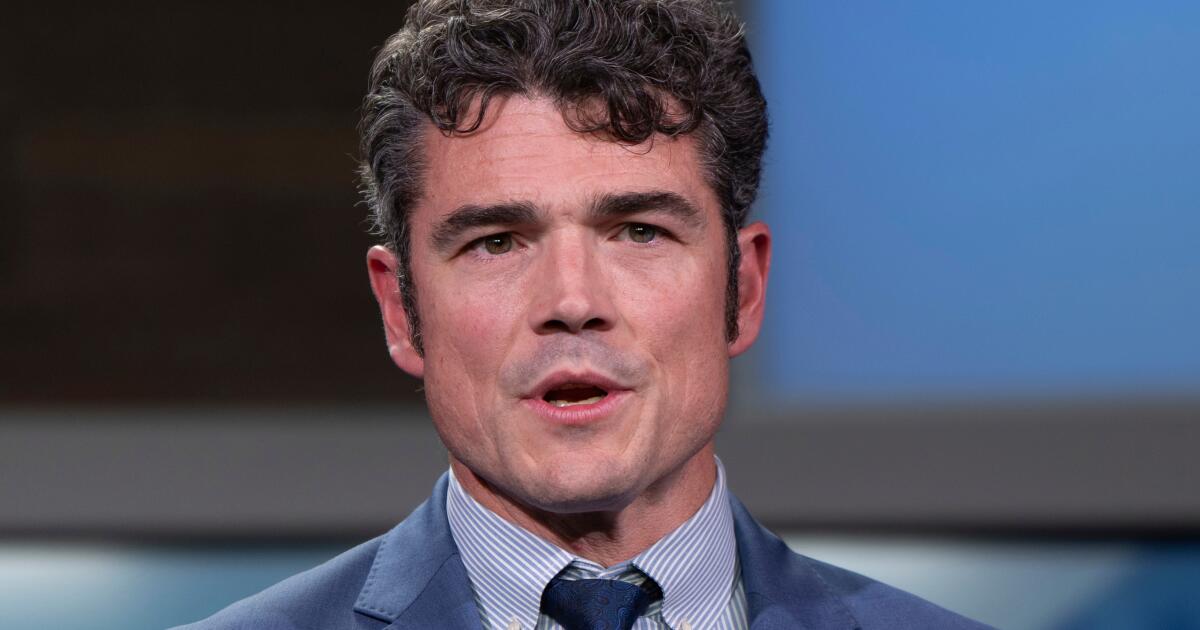
Joe Kent, the director of the National Counterterrorism Center, abruptly resigned Tuesday, becoming the most senior national security official to break publicly with the Trump administration over its military campaign against Iran.

In a statement posted on social media, Kent said he “cannot in good conscience” continue serving in the administration, contending that Iran had “posed no imminent threat to our nation” and that the United States had been drawn into the conflict through “pressure from Israel and its powerful American lobby.”

“I cannot support sending the next generation off to fight and die in a war that serves no benefit to the American people nor justifies the cost of American lives,” Kent wrote in a letter addressed to President Trump. “I pray that you will reflect upon what we are doing in Iran, and who we are doing it for.”

Trump, speaking in the Oval Office, dismissed Kent’s concerns, telling reporters that he had long believed the counterterrorism director — whom he nominated to the post in February 2025 — was “very weak on security.” The president insisted that Iran has been a threat to the U.S. “for a long time,” and said that it was a “good thing” Kent is leaving.

The resignation came at an uncertain moment for the administration. The war, which has repeatedly been sold to Americans as “short term” and contained, is now in its third week, with fraying alliances, renewed missile and drone fire on gulf Arab nations from Iran, new Israeli strikes on Iran and Lebanon, mounting casualties and no clear exit strategy.

“If we left right now it would take 10 years for them to rebuild,” Trump told reporters. “We’re not ready to leave yet, but we’ll be leaving in the near future. We’ll be leaving pretty much in the very near future.”

The uncertainty was compounded Tuesday by Israel’s killing of Ali Larijani, the head of Iran’s Supreme National Security Council, as well as Gholamreza Soleimani, the head of the Basij, Iran’s militia force.

Trump made reference to the Iranian officials killed without naming them, saying one was “their actual top” and the other was responsible for the killing of 32,000 Iranian protesters in recent weeks.

“It’s an evil group,” he said.

Effect of Larijani’s killing

Iranian officials confirmed the deaths of Larijani and Soleimani via state media Tuesday. In addition to killing the Basij leader, Israel reported striking more than 10 Basij posts, part of an effort to destroy the Islamic Republic’s ability to contain internal unrest and protests.

Benjamin Radd, a political scientist and senior fellow at the UCLA Burkle Center for International Relations, said Larijani’s killing would greatly diminish the Iranian diplomatic and institutional experience, as he was perceived to be “the last of the competent bunch” in power.

Those remaining in power are “generally not the sharpest people, they’re not the people who understand the subtleties of diplomacy, of what negotiating with the U.S. is like,” which clears a path for “a country run by a military junta” comprising Islamic Revolutionary Guard Corps leaders, Radd said.

“We’re really going to be moving more toward a military-style dictatorship — behind a clerical robe, if you will,” he said.

The battlefield developments have done little to reassure Washington’s closest allies, most of which have declined to join the fight despite Trump’s recent pleas to allied nations to send warships to help reopen the Strait of Hormuz, a crucial oil route that has been threatened by Iran’s war efforts.

In a social media post Tuesday, Trump said the United States had been informed by most of its allies in the North Atlantic Treaty Organization that they “don’t want to get involved” in the expanding Middle East war — and he claimed the American military no longer needs or wants their help.

“In fact, speaking as President of the United States of America, by far the Most Powerful Country Anywhere in the World, WE DO NOT NEED THE HELP OF ANYONE!” Trump wrote.

Trump cannot unilaterally remove the U.S. from NATO. In 2023, Sens. Tim Kaine (D-Va.) and Marco Rubio (R-Fla.) — who is now Trump’s secretary of State — successfully pushed a measure barring any president from removing the U.S. from the treaty organization without approval from the Senate or an act of Congress.

“The Senate should maintain oversight on whether or not our nation withdraws from NATO. We must ensure we are protecting our national interests and protecting the security of our democratic allies,” Rubio said at the time.

Some experts viewed Trump’s latest remarks about not needing NATO allies as a result of him having misplayed his hand at the start of the conflict with Iran, which has attempted to widen the war by targeting Gulf Cooperation Council nations in the region.

When Trump started demanding that many other nations join the U.S. in the war effort, or at least in safeguarding the Strait of Hormuz, it was “an attempt on Trump’s side to widen the war the other way,” Radd said, based in part on the fact that other nations, including China and in Europe, are much more reliant on oil from the region than the U.S.

However, it was a “clumsy” move by Trump given his alienation of NATO allies in the past, including during a major speech in Davos, Switzerland, in January, in which the president was “basically shaming and criticizing NATO and European states,” Radd said.

Calling on allies to “step up” after ridiculing them was “ham-handed,” Radd said.

Intelligence official’s departure

In Washington, Kent’s resignation exposed new divisions over the administration’s handling of the war.

On Capitol Hill, House Speaker Mike Johnson (R-La.) told reporters that he did not know where Kent was “getting his information” to conclude that Iran posed no imminent threat to the U.S. He said Trump administration officials in classified briefings have asserted that “they had exquisite intelligence and they understood that this was a serious moment for us.”

“The president felt that he had to strike first to prevent mass casualties,” Johnson said.

Several Democrats called on Kent to appear before Congress and tell the American people more about why the administration dragged the U.S. into war in Iran.

“If even officials like Joe Kent do not believe Iran posed an imminent threat, why are we sending more Americans to die in this war?” Rep. Ro Khanna (D-Fremont) wrote on X.

White House Press Secretary Karoline Leavitt said Kent’s letter contained “many false claims,” including that Iran posed no imminent threat to the U.S.

“This is the same false claim that Democrats and some in the liberal media have been repeating over and over,” Leavitt wrote on X. “As President Trump has clearly and explicitly stated, he had strong and compelling evidence that Iran was going to attack the United States first.”

She said that evidence, which has never been detailed publicly, “was compiled from many sources and factors,” and that Trump “would never make the decision to deploy military assets against a foreign adversary in a vacuum.”

Leavitt then repeated past justifications for the attack, including that Iran sponsors terrorism abroad and that it was building out its missile capabilities as “a shield” for protection as it continued to develop nuclear capabilities.

The press secretary previously said that Trump had a “feeling” that Iran was going to attack the U.S. or its assets. The president has alleged, without evidence, that Iran was within weeks of having a nuclear weapon.

Leavitt said the added assertion by Kent that Trump decided to attack Iran “based on the influence of others, even foreign countries, is both insulting and laughable.”

Kent, a former political candidate with connections to right-wing extremists, was confirmed in July as head of the National Counterterrorism Center, which analyzes and detects terrorist threats. Before joining the Trump administration, Kent ran two unsuccessful campaigns for Congress in Washington state. He also served in the military, serving 11 deployments as a Green Beret, followed by work at the CIA.

Democrats strongly opposed Kent’s confirmation in the Senate, in part because they were concerned about his ties to far-right figures and promotion of conspiracy theories. During his 2022 congressional campaign, Kent paid Graham Jorgensen, a member of the far-right military group the Proud Boys, for consulting work. He also worked closely with Joey Gibson, the founder of the Christian nationalist group Patriot Prayer, and attracted support from a variety of far-right figures.

During his Senate confirmation hearing, Kent refused to distance himself from a conspiracy theory that federal agents instigated the Jan. 6, 2021, attack at the U.S. Capitol, as well as false claims that Trump, a Republican, won the 2020 election over Democrat Joe Biden.

Democrats grilled Kent on his participation in a group chat on Signal where Trump’s national security team discussed sensitive military plans.

Republicans, meanwhile, were drawn to Kent’s experience in the military and intelligence.

Sen. Tom Cotton (R-Ark.), the GOP chair of the Intelligence Committee, said in a floor speech that Kent had “dedicated his career to fighting terrorism and keeping Americans safe.” On Tuesday, Cotton said that he disagreed with Kent’s “misguided assessment” on Iran.

“Iran’s vast missile arsenal and support for terrorism posed a grave and growing threat to America. Indeed, the ayatollahs have maimed and killed thousands of Americans,” Cotton said. “President Trump recognized this threat and made the right call to eliminate it.”

Other conservatives — including former Rep. Marjorie Taylor Greene and commentator Candace Owens — called Kent an “American hero.”

Ilan Goldenberg, a former Biden administration official who dealt with the Middle East, wrote on X that while he disagrees with the Iran war, Kent claiming that Israel pressured Trump into the conflict is “ugly stuff that plays on the worst antisemitic tropes.”

“Donald Trump is the President of the United States and he is the one ultimately responsible for sending American troops into harms way,” he said.
Source link

Trump is searching for an endgame to the Iran war

After two weeks of war with Iran, the Trump administration is being forced to temper its expectations of a swift end to the conflict, with U.S. intelligence and defense officials expressing doubt it can achieve the overthrow of Iran’s government and the destruction of its nuclear program through military means.

It was an outcome forewarned by analysts at the State Department, the CIA and the Pentagon, who together alerted the administration to the pitfalls full-scale war with Iran would bring before President Trump decided to proceed, two U.S. officials told The Times, granted anonymity to speak candidly.

Certain military goals of Operation Epic Fury laid out at the start of the war are still seen as achievable at the Pentagon, with U.S. and Israeli strikes making steady progress degrading Iran’s ballistic missile infrastructure, its drone program and its navy.

But a prewar U.S. intelligence assessment, that an air assault was unlikely to topple the Islamic Republic, still holds, with the intelligence community now casting doubt the assault had any more political effect than to radicalize a government already devoted to the destruction of Israel and harming the United States.

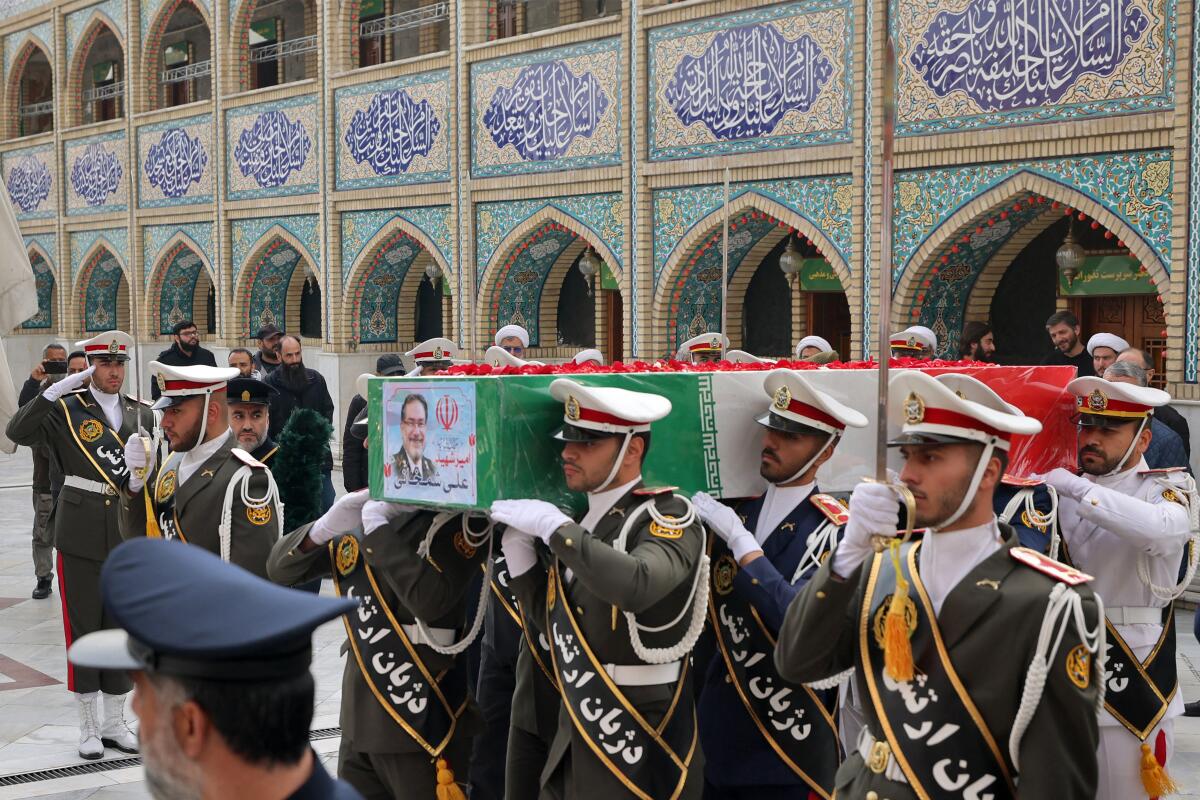
The casket of Ali Shamkhani, Iran's slain influential security adviser, proceeds during a military procession at his funeral

A military procession in Tehran carries the casket of Ali Shamkhani, political advisor to Iran’s last Supreme Leader Ayatollah Ali Khamenei, who was also killed in U.S.-Israeli attacks.

(Atta Kenare / AFP/Getty Images)

Concern has only grown that Iran’s new government will make the fateful strategic decision to build a bomb after the war, unless Trump decides to escalate the conflict with a perilous ground invasion. And the White House now contends with a new mission imperative, created by its decision to launch the war itself, of reopening the Strait of Hormuz to vital shipping traffic that carries 20% of the world’s daily oil and liquid natural gas supply.

The foreign policy strategy Trump publicly laid out as his playbook for the conflict — to come down hard on the government, decapitating its leadership, and hope the remnants would seek mercy — has not worked, with Tehran looking for new ways to expand the war and maximize pain for the U.S. administration.

Trump has minimized the conflict as an “excursion” that would end “very soon,” while also calling it a war, vowing to take the time he needs to “finish the job.” He says it will conclude whenever he decides to end it.

It remains possible that a declaration from Trump that the fighting is over results in a ceasefire, as it did in June of last year, when Trump demanded an end to 12 days of war between Iran and Israel. But the Iranians have a vote, too — and senior leadership in the Islamic Republic have made plain they plan to continue fighting this time whether Trump likes it or not.

On Friday, the Pentagon announced that an additional expeditionary unit of 2,500 Marines was being deployed to the region to support the effort.

“Starting wars is an easy matter,” Ali Larijani, secretary of Iran’s Supreme National Security Council, wrote on social media. “Ending them does not happen with a few tweets.

“We will not leave you until you admit your mistake and pay its price,” he added.

It is a sore lesson for a president whose decade in public life has been distinguished by an exceptional ability to warp reality to his liking.

“The White House has created a dilemma for America: If it declares victory and ends the war, it leaves in place a weakened Iranian government with the means and renewed motivation to pursue nuclear weapons,” said Reid Pauly, a professor of nuclear security and policy at Brown University.

“If it presses on with the war,” Pauly added, “it risks the kind of mission creep that may eventually find American boots on the ground.”

In a news release last week, the White House said that, “from the opening hours of this historic campaign, the objectives were clear: obliterate Iran’s ballistic missile arsenal and production capacity, annihilate its navy, sever its support for terrorist proxies, and ensure the world’s leading state sponsor of terrorism will never acquire a nuclear weapon.”

Yet, at the start of the operation, Trump issued a promise to the people of Iran that, at the end of the U.S.-Israeli campaign, Iran’s military and paramilitary infrastructure would be so badly hobbled that a rare, generational opportunity would emerge for them to take their government back.

“To the great proud people of Iran, I say tonight that the hour of your freedom is at hand,” Trump said. “Stay sheltered. Don’t leave your home. It’s very dangerous outside. Bombs will be dropping everywhere. When we are finished, take over your government. It will be yours to take. This will be probably your only chance for generations.”

Trump said in the days that followed he would need to have a say over the next ruler, after assassinating the country’s longtime supreme leader, Ayatollah Ali Khamenei. But the Iranian system of clerics and militants defied the president, selecting in Khamenei’s son a man viewed as even more hostile to the West than his father was.

Israeli leadership, too, set out regime change as a goal of the war. Yet even their officials now say that a substantial leadership change in Tehran is an unlikely result.

Trump would go on to insist on the “unconditional surrender” from the Iranian government, a demand that he later said would be satisfied by the incapacitation of Iran’s military.

Repeating his conviction that the war will end soon, Trump told Fox News’ Brian Kilmeade in an interview Friday that he would order an end to the fighting “when I feel it. When I feel it in my bones.”

“The problem with the administration’s approach is that it has constantly shifted its goals. Some are achievable, such as degrading Iran’s conventional force. Others are not, such as picking the next leader of Iran,” said Ray Takeyh, a scholar on Iran at the Council on Foreign Relations.

“The mixed messages have led to confusion at home,” Takeyh added, “and lack of planning for oil shortages and getting the Americans out of the region shows that process and personnel can actually matter.”

Mark Dubowitz, CEO of the Foundation for Defense of Democracies, said the joint U.S.-Israeli campaign was always designed to unfold in three phases: degrading Iran’s ability to wage war, reducing Iran’s ability to repress democratic forces inside the country, and finally, encouraging the Iranian people to rise up.

“The president controls the strategy, but no president fully controls the endgame because the regime gets a vote,” Dubowitz said. “The endgame is not a scripted political transition directed from Washington. It is a regime under simultaneous military, economic, and internal pressure — to strip of its war-making and repression capabilities — and whether that produces succession, fracture, or collapse will ultimately be decided in Tehran.”

Whether the conflict will achieve the destruction of Iran’s nuclear program is an equally grave question in Washington, where officials are debating over a list of stark options on how to physically destroy, bury or retrieve the fissile material that Tehran could use to build a nuclear weapon — a threat seen as only more grave under the stewardship of an angry and vengeful government.

“The war was publicly justified, to the extent it was justified at all, in terms of destroying Iran’s nuclear program. Very few strikes have been directed against nuclear-related targets, however — almost certainly because those that survived last June’s attacks are invulnerable to air attack,” said James Acton, co‑director of the nuclear policy program at the Carnegie Endowment for International Peace.

“Unless the U.S. and Israel attempt high-risk special forces operations or a ground incursion,” he added, “Iran will end the war with its surviving nuclear infrastructure largely intact and greater incentives to build the bomb.”

Pauly agreed it is unrealistic to expect the United States and Israel can destroy Iran’s nuclear program through air power alone. The U.N. International Atomic Energy Agency believes Iran has roughly 440 kilograms — about 970 pounds — of 60% highly enriched uranium, possibly spread across multiple facilities.

“Securing this material will require either U.S. ground troops or, after some coercive bargain is reached, international inspectors,” Pauly said.

In an exchange with reporters last week at the Pentagon, Defense Secretary Pete Hegseth had few details to offer on what U.S. options were to remove or eliminate an accessible uranium stockpile, enriched to near weapons grade, that had been buried in a U.S. operation last year intended on obliterating the nuclear threat.

Diplomacy, he suggested, might be required to secure the material.

“I will say we have a range of options, up to and including Iran deciding that they will give those up,” he told reporters, “which of course we would welcome.”

Source link

Could oil prices really reach $200 a barrel as claimed by Iran?

The global energy landscape is facing its most volatile period in decades following the US-Israeli strikes against Iran on 28 February that triggered a wider and potentially prolonged conflict in the Middle East.


ADVERTISEMENT


ADVERTISEMENT

What began as a targeted military operation has rapidly escalated into a direct confrontation with global economic implications.

Based on claims by Iranian state media and regional reports, the Islamic Revolutionary Guard Corps (IRGC) has ostensibly adopted a strategy of “energy blackmail” to leverage the international community into pressuring the US and Israel to cease its attacks.

The $200 per oil barrel threat was first articulated shortly after the conflict began.

On Sunday 1 March, a senior IRGC spokesperson warned that if “cowardly anti-human actions” continued, the world should prepare for a massive price surge, even as high as $200 per oil barrel.

This rhetoric has since become a central pillar of Tehran’s messaging.

As recently as this Wednesday, Ebrahim Zolfaqari, the spokesperson for Iran’s Khatam al-Anbiya military command headquarters, told state media: “Get ready for the oil barrel to be at $200, because the oil price depends on the regional security which you have destabilised.”

Iran’s tactical disruption

The IRGC’s current strategy relies on “internationalising” the cost of the conflict.

By disrupting the flow of nearly 20% of the world’s oil and liquefied natural gas (LNG) through the Strait of Hormuz, Iran aims to drag the global economy into the fray.

This is why the IRGC has targeted vessels from neutral nations, including ships sailing under Thai, Japanese and Marshall Islands flags, among others.

According to energy analysts, this disruption is designed to create domestic political pressure within Western nations, to in turn force the US and Israel to pull back on military action in exchange for energy stability.

By striking countries that have not attacked them directly, Tehran is signaling that no maritime trade is safe as long as the strikes on its soil continue.

The main vector of this strategy is precisely the disruption of energy markets, an element Iran can influence directly through its geographical advantage.

A history of oil price shocks

While $200 per barrel sounds astronomical, oil has approached similar levels in the past when adjusted for inflation.

The highest nominal price ever recorded was around $147 in 2008, driven by peak oil fears and rampant speculation just before the global financial crisis. When adjusted for 2026 inflation, that 2008 peak represents roughly $211 per barrel.

Previous major shocks, such as the 1973-74 Arab Oil Embargo and the 1979 Iranian Revolution, saw prices quadruple and double respectively from pre-crisis levels.

In 1980, prices hit a nominal peak of about $39.50, which would be approximately $160 in today’s terms.

However, the current crisis involves a total physical blockade of one of the world’s most critical maritime chokepoint, increasing the risk of a price “moonshot”.

Market response and reserves

At the time of writing, Brent crude is trading just above $100 per barrel, a sharp increase from the $60 range seen in mid-February before the Iran war began.

The International Energy Agency has attempted to stabilise the market by orchestrating the largest-ever coordinated release of strategic reserves, but the continuation of Iranian strikes agaisnt oil infrastructure and tankers has largely neutralised the effort.

With insurance providers cancelling war-risk coverage and shipping companies redirecting fleets, the market remains in a state of high anxiety.

If the blockade on the Strait of Hormuz persists, the $200 figure may shift from a political threat to an increasingly likely scenario.

In a recent report, Oxford Economics identified $140 per barrel as the threshold at which the global economy tips into mild recession, reducing world GDP by 0.7% by year-end and pushing the UK, the Eurozone and Japan into contraction.

Source link

Iran strikes neutralise record IEA reserves release as oil tops $100

Brent futures rose sharply on Thursday, spiking above $100 before easing slightly but remaining higher than levels seen earlier in the week as markets stay incredibly volatile.


ADVERTISEMENT


ADVERTISEMENT

This comes despite an unprecedented decision by the 32-member International Energy Agency (IEA) on Wednesday to release a record 400 million barrels to calm markets, more than double the volume released after Russia’s 2022 invasion of Ukraine.

Following the IEA decision, Iran stepped up its offensive campaign and launched strikes on Omani oil storage facilities at the Salalah port and multiple ships in and near the Strait of Hormuz, sending prices higher again.

Record coordinated release of reserves

The US alone is contributing 172 million barrels. Germany, France and Italy also confirmed they would tap their stocks, while Japan said it would begin releases next Monday.

IEA executive director Fatih Birol described the current Iran-related crisis as an “oil market challenge unprecedented in scale”, adding that the collective response reflected “strong solidarity” in defence of global energy security.

Exports of crude and refined products from the region have dropped to 10-15% of pre-war levels, with the Strait of Hormuz, which normally carries one-fifth of the world’s oil, effectively closed to the large majority of tankers.

Iran’s attacks blunt expected price relief

The new Iranian strikes came at lightning speed, directly after the IEA announcement.

Drones targeted fuel storage tanks and silos at Oman’s Salalah port, igniting fires that Omani authorities were still working to contain late on Wednesday.

British maritime security firm Ambrey confirmed damage to the facilities, while Danish shipping giant Maersk temporarily halted port operations.

Omani officials stressed there had been “no disruption to the continuity of oil supplies or petroleum derivatives” inside the country itself, while Iranian state media reported that President Pezeshkian had assured Oman’s sultan the incident would be investigated.

At the same time, six vessels were struck in the Gulf and Strait of Hormuz.

Among the reports, there was confirmation of a projectile hitting a container ship near the UAE and strikes on two tankers in Iraqi waters.

UK Maritime Trade Operations, and other monitoring groups, attributed the incidents to Iranian forces or proxies.

These developments, occurring the very day of the reserves release, appear to have smothered the anticipated calming effect on prices.

As of Thursday, the number of ships struck in the region since the beginning of the conflict rose to at least sixteen.

Record release may signal deeper market concerns

Some analysts note that the sheer volume of the release could itself be interpreted negatively. Previous coordinated actions never exceeded 183 million barrels.

The scale of the release suggests importing nations already view the disruption as the most severe and long-lasting in decades.

Even worse, a record release may not be enough.

Speaking to Euronews, Warren Patterson, Head of Commodities Strategy at ING, was blunt in his assessment.

“A record 400 million barrel release from emergency reserves is helpful, but it’s not going to go very far to offset the roughly 15 million daily supply currently disrupted.”

Patterson also added that “the only solution that will bring oil prices down on a sustained basis is getting oil flowing through the Strait of Hormuz again.”

Oxford Economics echoes this concern, warning that “the economic effect of higher energy costs rises as the oil price increases,” in a report that seemingly indicates the crisis is far from over and we have yet to feel the compounding effect of the initial shock.

Russian sanctions relief remains off the table

With the reserve release failing to calm prices, attention has turned to Russian oil as a potential source of additional supply.

The US Treasury last week granted Indian refiners a 30-day waiver to purchase Russian crude from vessels already stranded at sea, though the measure expires on 4 April and deliberately excludes new shipments.

Following the G7 emergency discussions on Wednesday, French President Emmanuel Macron stated that the group had agreed “the situation does not justify lifting any sanctions” on Russia, emphasising the need to increase global production instead.

The contrast between Washington’s narrow waiver and the G7’s firm collective position leaves little prospect of sanctions relief acting as a meaningful pressure valve, a view shared by analysts.

“Any sanction relief for Russia would see some marginal supply increases, but again not enough, with Russia’s oil output having held up well in recent years despite sanctions,” Warren Patterson of ING told Euronews.

$140-$150 oil barrel possible if conflict is prolonged

Should tensions persist, analysts warn prices could climb substantially higher.

Oxford Economics identifies $140 per barrel as the threshold at which the global economy tips into mild recession, reducing world GDP by 0.7% by year-end and pushing the UK, the Eurozone and Japan into contraction.

The managing director of the IMF, Kristalina Georgieva, also stated that every 10% increase in oil prices, provided they persist for most of the year, will push up global inflation by 0.4% and reduce worldwide economic output by as much as 0.2%.

“The risk is stark,” Patterson warned. “It’s only a matter of time before we see oil prices hitting fresh record highs if the conflict is not swiftly and decisively resolved.”

The IEA’s intervention has provided a temporary buffer, but with little visible impact on prices.

Source link

Conan O’Brien says addressing politics at Oscars is a ‘dance’

The big question surrounding last year’s Academy Awards was whether the show would address the L.A. wildfires, which had rattled the city mere months prior.

This year, the elephant in the room is the ongoing Iran war, which like last year’s wildfires, puts a celebration like the Oscars in sharp relief. But for Conan O’Brien, balancing gravity and levity is part of his job description as host.

“My job is to always try and hit this very, very thin line between entertaining people and also acknowledging some of the realities,” O’Brien said during a Wednesday news conference with the Oscars creative team.

“It’s a dance that goes on up until the show begins,” the former talk show host said, adding that he and his team of writers are still revising material ahead of the show to ensure their content is as relevant as possible.

“Between us,” he said, referencing Oscars telecast executive producers Katy Mullan and Raj Kapoor, “we will find the right tone.”

O’Brien also during the news conference recalled Johnny Carson’s turn hosting the Oscars during the Iran hostage crisis, when 52 Americans, including diplomats and other personnel, were held hostage at the U.S. embassy in Tehran from 1979 to 1981. The comedian remembered the television host parodying ABC’s “Nightline” with his joke, “It’s day 444 of the Oscars.”

“It was such a funny, topical joke that touched on something everyone was thinking about, and at the same time, got a big laugh and was unifying,” O’Brien said. “That was meaningful to me.”

Kapoor said during the news conference that the production team is putting systems in place to alleviate attendees’ safety concerns amid the tense global situation and reported threats to California.

“Every year, we monitor what’s going on in the world,” the showrunner said, adding that the ceremony has the support of the FBI and LAPD. “This show has to run like clockwork.”

He added, “Everybody that is coming to this show, that is witnessing this show, that is even a fan of the show when they’re standing outside the barricades — we want everybody to feel safe and protected and welcome.”

As for the telecast’s creative direction, the team cited “human touch” as a unifying theme — a not-so-subtle slight to AI.

“We’re celebrating human touch, human connection and what I like to call actual intelligence, as opposed to artificial,” said music director Michael Bearden. “We want to get back to the communal … and so the music will reflect that.”

That spirit of celebration will be especially tangible in the “KPop Demon Hunters” performance, Kapoor said. That performance will be complemented by a “Sinners” moment featuring Miles Caton and Raphael Saadiq as well as guests Misty Copeland, Eric Gales, Buddy Guy, Brittany Howard, Christone “Kingfish” Ingram, Jayme Lawson, Li Jun Li, Bobby Rush, Shaboozey and Alice Smith.

“We have this lovely story celebrating Korean culture with authentic Korean drummers and singers and even choreography,” the producer said. “So again, we’ve expanded our reach, and we’re telling these global stories, celebrating international films that have had a global impact and doing things in a really different way.”

Mullan and Kapoor closed the news conference by teasing a pair of reunions featuring cast members from “Bridesmaids” and the Marvel Cinematic Universe. “Bridesmaids” alum Rose Byrne is nominated for a lead actress Oscar for her role in “If I Had Legs I’d Kick You,” which marked O’Brien’s dramatic acting debut. (If Byrne wins, he said, “half that Oscar’s mine.”)

“We’re gonna have superstars, superheroes, and there is also going to be an extraterrestrial on the stage, so you can figure that one out,” Mullan said.

The 2026 Oscars will air live Sunday on ABC, with streaming available on Hulu, YouTube TV, AT&T TV and FuboTV.

Source link

US Justice Department digs into Iran’s sanctions evasion via Binance

Published on

A probe has been initiated by the US Justice Department into Iran’s use of Binance, the world’s largest crypto platform, to circumvent US sanctions and provide financial backing to terrorist organisations with ties to the IRGC, according to The Wall Street Journal.


ADVERTISEMENT


ADVERTISEMENT

The US DOJ’s examination stems from company documents and accounts provided by individuals familiar with the matter.

Authorities have contacted people with direct knowledge of the Iranian-linked transactions to request interviews and collect evidence, as per the WSJ report.

A monitor appointed by the US Treasury Department has reportedly asked Binance for details on the Iranian transactions, including information about a business partner responsible for a large share of the flows.

At this stage, it remains uncertain whether the investigation targets Binance for any potential misconduct or if it is confined to activity by customers on the platform.

A spokesperson for the company told the WSJ that Binance “categorically did not directly transact with any sanctioned entities”.

This development brings the company back to the centre of US regulatory attention, just months after its founder received a presidential pardon, highlighting persistent challenges in enforcing sanctions within the rapidly evolving crypto and fintech sectors.

Binance founder Changpeng Zhao, widely known as CZ, was pardoned by President Trump back in October.

The investigation reopens scrutiny of the exchange, which pleaded guilty in 2023 to breaching US sanctions and banking laws. That case resulted in a record $4.3bn (€3.7bn) penalty and a requirement for ongoing US oversight.

Under the terms of the 2023 agreement, Binance must actively screen clients for terrorism financing and sanctions breaches, as well as report suspicious activity promptly to authorities.

US congressional inquiry adds pressure

The developments have also drawn attention from Capitol Hill.

US Senator Richard Blumenthal, a senior Democrat on the Senate Homeland Security Committee, opened a formal inquiry last month into Binance’s handling of the Iranian transactions.

Citing the scale of the unreported flows, approaching nearly $2bn (€1.7bn) to sanctioned entities, and the suspension of internal investigators, Blumenthal questioned whether the exchange had met its obligations under US sanctions and banking laws.

He requested detailed records from Binance, which responded by describing media coverage as inaccurate and highlighting its “best-in-class compliance programme”.

The senator later described that reply as evasive and insufficient to address his concerns.

The timing of the US DOJ’s probe coincides with heightened efforts to disrupt financing networks linked to Iran’s IRGC.

Ahead of joint military actions with Israel against Iran, Washington stepped up measures to cut off revenue streams, particularly those involving crypto assets used to repatriate proceeds from oil sales to China.

In January, the US Treasury Department sanctioned two smaller crypto exchanges for moving large sums to digital wallets connected to the IRGC.

Source link