iran war

Conservatives gather for CPAC with the right openly divided over the Iran war

Conservatives are holding one of their largest annual gatherings at a perilous political moment for President Trump and with open division on the right over the war he launched in Iran.

While Trump maintains broad support among conservatives, the war in Iran is more than a wrinkle for activists drawn to his “America First” campaign pledge against getting involved in foreign conflicts. A new AP-NORC poll shows about 59% of Americans think the military action in Iran is excessive. The debate will be a subtext — and likely flare publicly — as thousands of activists, influencers and Republican lawmakers gather at the Conservative Political Action Conference that begins Wednesday outside Dallas.

The event also comes a day after a Democrat flipped the Florida state legislative seat that’s home to Trump’s Mar-a-Lago estate.

The gathering will be a contrast to the celebratory meeting one year ago when Trump, newly returned to office, vowed to “forge a new and lasting political majority” and Elon Musk wielded a chain saw to symbolize how the Republican administration was slashing the government workforce and red tape.

This year, neither Trump nor Vice President JD Vance has been publicly announced as speaking to the gathering. But among those who are slated to speak are big names in the MAGA movement who have voiced conflicting views on the Iran war.

“This is obviously going to be a hot topic,” said John Gizzi, a CPAC veteran and columnist for the conservative media outlet Newsmax, who noted the possibility of greater U.S. involvement over an uncertain length of time.

Among the featured speakers scheduled at the four-day event is longtime Trump ally Steve Bannon. Bannon said during his “War Room” podcast this month that should the war become “a hard slog,” it could cost the GOP conservative voters ahead of the midterms.

“We are going to bleed support,” Bannon said.

Texas Sen. Ted Cruz, who supports the war, also is on the agenda at the Gaylord Texan Resort and Convention Center.

“I think President Trump was exactly right to act to protect Americans,” Cruz said last week in a CBS News interview.

Former Florida Rep. Matt Gaetz’s scheduled speaking slot is a reminder of the disagreement among some conservatives about the U.S. military alliance with Israel against Iran.

Gaetz, host of a show on the conservative One America News Network, has said the U.S. has been too cozy with Israel as popular conservative personalities such as Tucker Carlson have challenged conservatives’ longtime bond with the country, prompting criticism from GOP groups, including pro-Israel Republicans, of antisemitism.

Others scheduled to speak include Trump border czar Tom Homan and former Republican National Committee Chairman Michael Whatley, who is running for the U.S. Senate in North Carolina.

Trump’s standing is strong among his base

A year after Trump presided over the group’s jubilant conference upon his return to office, he is in a much different place.

At war while worries about jobs and household costs linger, his approval is down. His signature domestic policy, aimed at tightening voting rules ahead of November’s midterm elections, has stalled in a Congress his party controls, while the House Republican majority is in jeopardy and the party’s hold on the Senate is less certain than a year ago.

Despite the dividing lines, Trump enjoys enduring approval from his party’s right flank. Eighty-six percent of conservatives said they approved of the president’s job performance in a February AP-NORC poll.

And while Trump’s supporters remain devoted, some within the most conservative circles say division over Iran could signal trouble for Republicans in November.

Texas Rep. Steve Toth, who plans to attend CPAC, suggested that Trump’s support remains robust among conservatives but that Republican messaging on the war could be stronger.

“From MAGA people, for the most part, I don’t hear frustration with the president,” said Toth, who beat incumbent Republican Rep. Dan Crenshaw in Texas’ March 3 primary. “I don’t know that we’re doing a great job at communicating the full ramifications.”

Texas’ GOP Senate primary is a lingering issue

Another stark reminder of the contrast with last year is Texas’ unresolved Senate primary, a particular political headache for Trump.

Texas Attorney Gen. Ken Paxton, who is challenging four-term GOP Sen. John Cornyn, not only is attending the event but also has one of the event’s premier speaking roles, the Ronald Reagan Dinner on Friday evening. Cornyn is not attending the Texas conference.

Trump said three weeks ago he would soon endorse one of them after Paxton finished narrowly behind Cornyn in the March 3 primary, though neither received a majority to avoid a May 26 runoff.

Trump implored whoever didn’t get the endorsement to drop out, writing in a social media post that the bitter contest “cannot, for the good of the Party, and our Country, itself, be allowed to go on any longer.”

The deadline for candidates to remove their names from the May 26 runoff ballot passed last week, as Paxton and Cornyn were launching stepped-up attack ads targeting one another.

Beaumont and Catalini write for the Associated Press. Catalini reported from Morrisville, Pa. AP writer Amelia Thomson DeVeaux in Washington contributed to this report.
Source link

Hiltzik: Doing the math on Trump’s war budget

Governing, the political sages tell us, is all about making choices, particularly when leadership faces finite resources and the choices are between war and peace; this is the “guns or butter” balancing raised by Lyndon Johnson’s pursuit of the Vietnam War and, appropriately, by President Trump’s Iran war.

Thus far, according to budget experts and the Trump administration itself, the war has cost Americans about $25 billion, with the White House reportedly preparing to seek $200 billion more in military funding. That points to the obvious question of what the U.S. could buy if it stopped spending on the Iran adventure.

Here’s the short answer: Medicaid coverage, free school lunches, and housing, child care and community college assistance for tens of millions of Americans. Those estimates come from Bobby Kogan, senior director for federal budget policy at the liberal Center for American Progress.

$11.3 billion would have fully funded the training of 100,000 new nurses to solve our staffing crisis. Instead, it was spent in just six days on an illegal war with no endgame.

— Rep. Diana DeGette (D-Colo.)

Kogan is not alone in doing the math. Similar estimates have been published by the Century Foundation and Mother Jones.

Democrats in Congress have offered their own juxtapositions: “$11.3 billion would have fully funded the training of 100,000 new nurses to solve our staffing crisis,” Rep. Diana DeGette (D-Colo.) observed on social media. “Instead, it was spent in just six days on an illegal war with no endgame.” (She wrote when that was the government’s estimate on spending in only the first week of the Iran war.)

Get the latest from Michael Hiltzik

Commentary on economics and more from a Pulitzer Prize winner.

Details will follow. But first, a reminder that the “peace dividend” — that is, the surge of available resources for socially beneficial spending after the cessation of hostilities — has always been an elusive concept.

In part that’s because it invariably gets tied up in conflicts over precisely what peacetime programs political leaders wish to fund, and that often involves tougher decisions than whether to mount a bombing campaign against a perceived adversary.

“What happened to the peace dividend?” economist Augusto Lopez-Claros asked last year, referring to the supposed surfeit of funds that was to flow after the end of the Cold War. His answer was that there were always alternatives, many of them militaristic in nature, in the wings to suck up the funds that had been spent in the past.

The issue has especially acute significance today, not merely because of the Iran war. The Trump administration and Republicans in Congress have been campaigning to cut federal spending, almost entirely on social programs such as Medicaid and on Social Security and Medicare benefits, ostensibly because they contribute heavily to our “unaffordable” federal budget deficits.

Never mind that the largest single contributor to the deficit is the massive tax cut enacted by Republicans in 2017, during the first Trump term, which were made permanent by the GOP’s budget bill last year.

Placing military spending in the context of alternatives is typically shunned by Republicans and conservatives. The Wall Street Journal editorial board derided the exercise as “dorm room politics,” referring specifically to an estimate by Rep. Ro Khanna (D-Fremont) that the $200 billion reportedly sought by the White House “would pay for free college for every American,” and more.

That doesn’t mean the exercise isn’t worthwhile, however. Kogan acknowledges that it wouldn’t be up to the Pentagon to redirect its budget to the social programs that could be funded with its funding request, but his point in making the comparisons is “to get a sense of scale.”

So let’s dive in, starting with Kogan’s work. He matched the cost of several social services against the $25 billion estimated to be spent on the war through the end of this week and the $200-billion new request. He also broke down some of the spending by ordnance. The price of one Tomahawk missile, invoiced about $3.5 million each, could cover Medicaid for a year for 275 people, for example; the U.S. has fired an estimated 300 of them in the Iran war so far, for more than $1 billion.

Kogan calculated that more than 3.1 million people could be covered by Medicaid for $25 billion, and 24.8 million could be covered for $200 billion. He based this estimate on the Congressional Budget Office’s finding that the federal share of Medicaid came last year to $668 billion to cover about 82 million adult and child enrollees, or about $8,048 per person annually.

Then there’s free school lunches, which the government has pegged at up to $4.69 per day for about 30 million children receiving meals in school. If they all received free lunch, that would come to a little over $25 billion, based on a 180-day school year. (Only about two-thirds of those children receive free meals, with the rest receiving cut-price meals or paying full price.)

Child care isn’t typically a governmental responsibility (though it should be); Kogan uses an estimate from the nonprofit organization Child Care Aware that care cost Americans about $13,128 on average in 2024; inflating that to a 2026 figure yields an average of $14,048, meaning that 1.78 million households could be covered for about $25 billion, and about 14.2 million for $200 billion.

Tuition for a two-year path to an associate degree in community college, that portal to higher education for millions of Americans, will cost an average of $8,700 this year by Kogan’s reckoning, based on the College Board’s estimate of $8,300 for 2025. That means that about 2.87 million Americans could have their tuition fully covered for about $25 billion, and nearly 23 million students could be covered for $200 billion.

The progressive Century Foundation contributed estimates of how much in social program spending could be accommodated for $200 billion. Its roster includes the cancellation of all medical debt for the 100 million Americans shouldering about $194 billion in medical debt. The enhanced Affordable Care Act premium subsidies that expired this year could be continued for almost six years for about $200 billion, extrapolating from the 10-year, $350-billion estimate produced by the CBO. “Ensuring health coverage for all Americans,” the foundation noted, “could save an estimated 68,000 lives per year.”

The foundation also notes that $200 billion could ameliorate the draconian cuts in Medicaid imposed by the preposterously named One Big Beautiful Bill that the GOP enacted as a budget measure in July. The work requirement in that bill is estimated to reduce Medicaid spending by $326 billion over 10 years, according to the CBO, mostly by throwing enrollees out of the program. The work rules, which as I’ve reported do nothing to enhance employment, could be deferred for six years, preventing the loss of coverage for about 5.2 million Americans.

Mother Jones reported soberly that $200 billion would cover the wages of 2.8 million public school teachers, based on an average salary of $72,030, as reported by the National Education Assn.

The publication took a rather more fanciful approach for some calculations. It reported that $200 billion would pay for 2,666 sequels to the “Melania” documentary, based on the $75-million reported cost of its production and marketing by Amazon, its sponsor. And 500 more White House ballrooms, based on the latest projection of $400 million for just one.

Obviously all these calculations are somewhat chimerical. No one really believes that if Congress rejects the $200-billion ask, that money would be redeployed for any of these social programs, at least while the GOP remains in control of the government purse strings. The basic arithmetic itself is subject to cavils resulting from the murkiness of some of the cost calculations and projections.

But they’re not far wide off the mark in terms of orders of magnitude. Millions of dollars in social spending could be covered by billions of dollars in military spending, and much more productive investments could be made in the years and decades to come.

The lost “peace dividend” encompasses not just domestic needs, but also “the potentially catastrophic risks that we are taking on in the future because we are misallocating resources now,” Lopez-Claros observed — “spending massively on defense while leaving unattended climate change mitigation, pandemic preparedness, the shamefully high levels of malnourishment in the world, among others. We may well come to regret this and by then, unfortunately, it might be too late.”

Even before the first bombs fell on Iran, after all, the U.S. was shortchanging all those imperatives. “Just last July, Trump signed into law the biggest cuts to the social safety net in all U.S. history,” Kogan says, including “the biggest cuts to Medicaid ever, and the biggest cuts to SNAP, ever.” (The GOP budget bill cut SNAP, the food stamp program, by $186 billion, leaving “nearly 3 million young adults ages 18 to 24 who receive SNAP vulnerable to losing that assistance,” the Urban Institute estimated after the bill was signed.

At their heart, these calculations are not really about dollars and cents. The financial figures just help us keep score of the choices that define us as a nation.

Source link

Gold and silver plunge and then recover after Trump’s Iran talks statement

Gold’s reputation over the past year as the go-to refuge in a crisis is taking a battering as war rages and threatens to expand in the Middle East and financial markets buckle.


ADVERTISEMENT


ADVERTISEMENT

Spot gold plunged to a 2026 low near $4,100 in early trading on Monday before recovering sharply to above $4,400 after US President Donald Trump announced he was postponing military strikes against Iranian power plants for five days following “very good and productive conversations” with Tehran — a swing of around $300 in the space of hours.

The metal has still shed more than 20% since hitting a record high of $5,594.82 an ounce on 29 January.

Silver has lost nearly half its value since hitting an all-time high of $121.67 in January, in one of the more violent collapses in the precious metal’s modern history.

Spot silver was down 8.9% at $61.76 — a year-to-date low and almost half of its $117 level on 28 February, when the Iran war began.

The counterintuitive sell-off has rattled investors who piled into precious metals expecting them to hold firm.

The dollar dropped against the euro after Trump’s comments and traded around $1.1572 to the euro on Monday afternoon, while the pound was up at a rate of $1.3341. The yen traded at around ¥159.47 per dollar.

Oil shocks continue to reverberate

The main culprit is the oil shock. As crude surges past $100 a barrel, bond yields are climbing and the US dollar is strengthening, making precious metals far less attractive to investors bracing for higher interest rates.

The dollar has emerged as one of the clearest safe-haven winners, strengthening over 2% so far this month.

For a non-yielding asset like gold, that is a double blow.

The prospect of higher interest rates as a result of the war is also boosting government bonds among investors, at the expense of precious metals.

Yet seasoned observers urge caution before declaring the gold story over.

Russ Mould, investment director at AJ Bell, points out that gold is in the middle of only its third major bull run since 1971 and that the previous two also caused stomach-churning fluctuations.

“Neither interest rates staying higher for longer nor a stronger dollar may help the investment case for precious metals, but both the 1971-1980 and 2001-2010 bull runs saw several retreats which did not ultimately nullify or prevent major gains,” Mould said.

“So it may be too early to give up on gold just yet,” he continued.

During the first bull run, triggered by Richard Nixon’s decision to decouple the dollar from the gold standard in 1971, gold surged from $35 to a peak of $835 an ounce by January 1980, but not before enduring three mini bear markets and five corrections of 10% or more along the way.

The second run, which began in 2001 amid the wreckage of the dotcom bust and gathered pace through the 2008 financial crisis, was equally volatile, featuring two bear markets and another five double-digit corrections before gold peaked near $1,900 in 2011.

This third advance has been no smoother.

“A swoon of more than 20% caught some bulls off guard in 2022, as the world emerged from lockdowns, and 10%-plus corrections in each of 2016, 2018, 2020, 2021 and 2023 [gold peaks] warned that volatility was never far away,” Mould noted.

The question of dividends

The paradox at the heart of the current sell-off is that the very crisis that might once have sent investors flooding into gold is now working against it.

Rising oil prices fuel inflation fears, inflation fears fuel expectations of higher interest rates and higher rates make gold — which pays no dividend and costs money to hold — less appealing.

“Gold’s status as a haven may now be tarnished in the eyes of some,” Mould said, “as the precious metal is falling in price even as war roils the Middle East and financial markets alike.”

But not everyone is convinced the metal’s moment has passed.

The inflation and stagflation of the 1970s, partly triggered by the oil shocks of 1973 and 1979, ultimately made gold the standout portfolio pick of that decade.

A prolonged conflict that stretches government finances — pushing welfare costs up and tax revenues down, on top of surging defence spending — could yet revive that dynamic.

If central banks respond to recession with fresh rate cuts and quantitative easing, the case for gold as a store of value comes roaring back.

“The war in Iran and its effect on oil and gas prices is stoking fears of inflation and how that could force central banks to raise interest rates,” he concluded.

Source link

Markets tumble as oil prices climb over $100 on Middle East conflict fears

Asian stock markets saw major declines on Monday as gold futures dropped 8% and crude oil prices continued to climb amid heightened uncertainty in the Middle East.


ADVERTISEMENT


ADVERTISEMENT

As the effective closure of the Strait of Hormuz continues to choke global supply, benchmark US crude rose above $100 a barrel on Monday morning in Europe.

Brent crude, the international standard, went up to more than $113 a barrel. The price of Brent crude has zigzagged lately from about $70 per barrel before the war began to as high as $119.50.

European stock indexes opened with losses, with the FTSE in London losing 1.5%, the CAC-40 in Paris being down by 1.6%, and the DAX in Frankfurt dropping by 2% at the opening.

Earlier on Monday, the International Energy Agency warned that the global economy faces a “major, major threat” because of the Iran war and that at least 40 energy assets across nine countries were damaged.

Meanwhile, the de-escalation of the conflict is nowhere near in sight.

Trump warned over the weekend that the US would “obliterate” Iran’s power plants if it does not fully open the Strait of Hormuz within 48 hours, prompting Tehran to say it would respond to any such strike with attacks on US and Israeli energy and infrastructure assets in the region.

“Trump’s ultimatum and Iran’s retaliatory warnings point to a widening conflict that keeps energy disruption and market volatility elevated, with no clear off-ramp in sight,” said Ng Jing Wen, analyst at Mizuho Bank in Singapore.

In Europe, the benchmark natural gas futures were trading above €60 per MWh at the market open.

This follows last week’s gains as escalating threats to Middle Eastern energy facilities heightened fears of deeper supply disruptions.

In Asia, stock markets were also significantly impacted by the uncertainty around the Middle East crisis, with Japan’s benchmark Nikkei 225 dropping 3.5%. In Taiwan, the Taiex shed 2.5%, South Korea’s Kospi dropped 6.5%, Hong Kong’s Hang Seng slipped 3.8% and the Shanghai Composite declined 3.6%.

Higher oil prices, which also shook stock markets on Friday, dashed hopes for a possible upcoming cut in interest rates by the Federal Reserve, analysts said. Before the war, traders were betting that the Fed would cut rates at least twice this year. Central banks in Europe, Japan and the United Kingdom also recently held their interest rates steady.

The S&P 500 fell 1.5% Friday to close its fourth straight losing week, its longest such streak in a year.

The Dow Jones Industrial Average dropped 443 points, or 1%, and the Nasdaq Composite tumbled 2%.

On Wall Street, roughly three out of every four stocks in the S&P 500 fell on Friday.

Stocks of smaller companies, which can feel the pinch of higher interest rates more than their bigger rivals, led the way lower. The Russell 2000 index of smaller stocks fell a market-leading 2.3%.

In the bond market, the yield on the 10-year Treasury finished last week with a jump to 4.38% Friday from 4.25% late Thursday and from just 3.97% before the war started.

The two-year Treasury yield, which more closely tracks expectations for what the Fed might do, rose to 3.88% from 3.79%.

In currency trading, the US dollar rose to 159.53 Japanese yen from 159.22 yen. The euro cost $1.1526, down from $1.1571.

Source link

Bigger tax refunds touted by Trump will probably be spent on gas

The U.S. economy was supposed to start the year with a bang, fueled by a jump in tax refunds from President Trump’s tax cut legislation. But soaring gas prices are on track to eat up those refunds, leaving most Americans with little extra to spend.

“Next spring is projected to be the largest tax refund season of all time,” Trump boasted in a prime-time speech in December intended to address voter concerns about the economy and stubbornly high prices, though exaggerating the anticipated refunds.

But that was before the Iran war, which the U.S. and Israel began on Feb. 28. Oil and gas prices have skyrocketed since then, with the nationwide average price of gas reaching $3.94 Sunday, up more than a dollar from a month earlier.

Gas prices are likely to remain elevated for some time, even if the war ends soon, because shipping and production have been disrupted and will take time to recover. Economists now expect slower growth this spring and for the year, as dollars that are spent on gas are less likely to be used for restaurants, new clothes or entertainment.

Lower- and middle-income households are likely to be hit particularly hard, because they receive smaller refunds and spend a greater proportion of their earnings on gas.

“The energy shock is to going to hit those who have the least cushion,” said Alex Jacquez, chief of policy at the left-leaning Groundwork Collaborative and a former economist in the Biden White House. “And it doesn’t look like those tax refunds are going to be here to save them.”

Neale Mahoney, director of the Stanford Institute for Economic Policy Research, calculates that gas prices could peak in May at $4.36 a gallon, based on oil price forecasts by Goldman Sachs, followed by slow declines for the rest of the year. The notion that gas prices decline much more slowly than they rise is so ingrained among economists that they refer to it as the “rocket and feathers” phenomenon — rising like a rocket before falling like a feather.

In that scenario, the average household would pay $740 more in gas this year, nearly equal to the $748 increase in refunds that the Tax Foundation has estimated the average household will receive.

Through March 6, refunds have risen by much less than that, according to Internal Revenue Service data: They have averaged $3,676, up $352 from $3,324 in 2025. Still, average refunds could rise as more complex returns are filed.

Other estimates show similar impacts. Economists at Oxford Economics, a consulting firm, estimate that if gas prices average $3.70 a gallon all year, it will cost consumers about $70 billion — more than the $60 billion in increased tax refunds.

The gas price spike comes with many consumers already in a precarious position, particularly compared with 2022, when gas prices also soared because of Russia’s invasion of Ukraine. At that time, many households still had fattened bank accounts from COVID-19 pandemic-era stimulus payments and companies were hiring rapidly and sharply lifting pay to attract workers.

Now, hiring is nearly at a standstill and Americans’ saving rate has steadily fallen in the last few years as many households borrow more to sustain their spending.

“When you start looking across the perspective from a consumer side, you’re seeing people who have maxed out their credit cards, are using ‘buy now, pay later’ to purchase their groceries,” said Julie Margetta Morgan, president of the Century Foundation think tank. “They’re making it work for now, but that can fall apart quite quickly.”

The consequences are likely to worsen the “K-shaped” phenomenon in the U.S. economy, analysts said, in which higher-income households have fared better than lower-income households. The bottom 10% of earners spend nearly 4% of their incomes on gasoline, Pantheon Macroeconomics estimates, while the top 10% spend just 1.5%. The Trump tax breaks also benefited the wealthiest taxpayers most.

For now, most analysts still expect the U.S. economy to expand this year, even if more slowly, given the gas price shock. Higher gas prices will probably worsen inflation in the short run, and over time weaker spending will also slow growth.

American consumers and businesses have repeatedly shaken off shocks since the pandemic emergency — soaring inflation, rising interest rates, Trump’s tariffs — and continued to spend, defying concerns that the economy would tip into recession. Many economists note that the proportion of their incomes that Americans spend on gas and other energy has fallen significantly compared with a decade ago.

Data from the Bank of America Institute released Friday showed that spending on gas on the bank’s credit and debit cards shot 14.4% higher in the week ended March 14 compared with a year ago. Before the war, such spending was running 5% below the previous year, a benefit to consumers.

Spending on discretionary items — restaurants, electronics and travel — is still growing, the institute said, evidence of consumer resilience. But there is little sign it is accelerating, as many economists had hoped.

“The longer these gasoline prices persist, the more that will gradually sap consumer discretionary spending,” said David Tinsley, senior economist at the institute.

Other analysts expect growth will slow because of the war. Bernard Yaros and Michael Pearce, economists at Oxford Economics, forecast that the U.S. economy will grow just 1.9% this year, down from an earlier estimate of 2.5%.

“We had anticipated a lift in spending from a bumper tax refund season,” they wrote, “but the rise in gasoline prices, if sustained, would more than offset that boost.”

Rugaber writes for the Associated Press.

Source link

Congress looks for Trump’s exit plan as the Iran war drags on

President Trump took the United States to war without a vote of support from Congress, but lawmakers are increasingly questioning when, how and at what cost the war with Iran will come to an end.

Three weeks into the conflict, the toll is becoming apparent. At least 13 U.S. military personnel have died and more than 230 have been wounded. A $200-billion request from the Pentagon for war funds is pending from the White House. Allies are under attack, oil prices are skyrocketing, and thousands more U.S. troops are deploying to the Middle East with no endgame in sight.

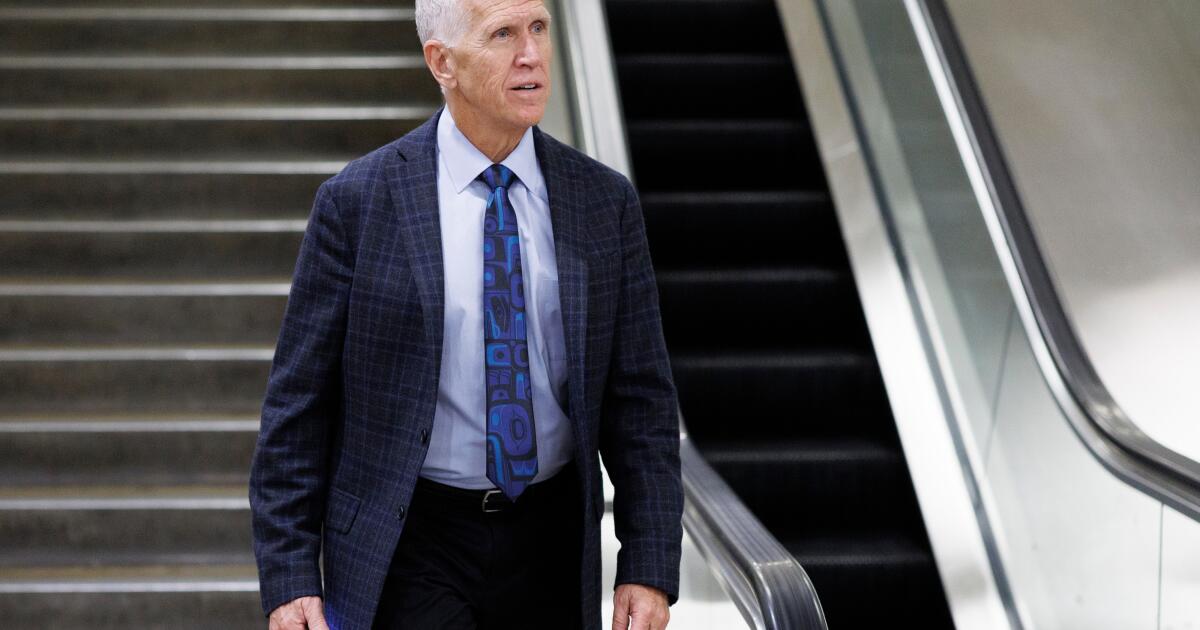
“The real question is: What ultimately are we trying to accomplish?” Sen. Thom Tillis (R-N.C.) told the Associated Press.

“I generally support anything that takes out the mullahs,” he said. “But at the end of the day, there has to be a kind of strategic articulation of the strategy, what our objectives are.”

Trump said late Friday that he was considering “winding down” the military operations even as he outlined new objectives and goals and despite the continued buildup of forces in the region.

Congress stands still

The president’s decision to launch the U.S.-Israeli war on Iran is testing the resolve of Congress, which is controlled by his party. Republicans have largely stood by the commander in chief, but will soon be faced with more consequential wartime choices.

Under the War Powers Act, the president can conduct military operations for 60 days without approval from Congress. So far, Republicans have easily voted down several resolutions from Democrats designed to halt the war.

But the administration will need to show a more comprehensive strategy ahead or risk blowback from Congress, lawmakers said, especially as they are being asked to approve billions in new spending.

Trump’s casual comment that the war will end “when I … feel it in my bones” has drawn alarm.

“When he feels it in his bones? That’s crazy,” said Virginia Sen. Mark R. Warner, the top Democrat on the Senate Intelligence Committee.

House speaker says mission is ‘all but done’

The president’s party appears unlikely to directly challenge him, even as the conflict drags on. House Speaker Mike Johnson (R-La.) has said the military operation will be over quickly.

“I do think the original mission is virtually accomplished now,” Johnson told the AP and others at the Capitol this week.

“We were trying to take out the ballistic missiles, and their means of production, and neuter the navy, and those objectives have been met,” he said.

Johnson acknowledged that Iran’s ability to threaten ships in the Strait of Hormuz is “dragging it out a little bit,” especially as U.S. allies have largely rebuffed the president’s request for help.

“As soon as we bring some calm to the situation, I think it’s all but done,” Johnson said.

But the administration’s stated goals — of ending Iran’s ability to obtain a nuclear weapon and degrading its ballistic missile supplies, among others — have perplexed lawmakers as shifting and elusive.

″Regime change? Not likely. Get rid of the enriched uranium? Not without boots on the ground,” Warner said.

“If I’m advising the president, I would have said: Before you take on a war of choice, make the case clear to the American people what our goals are,” he said.

The power of the purse

The Pentagon has told the White House that it is seeking an additional $200 billion for the war effort, an extraordinary amount that is unlikely to win support. Senate Democratic leader Chuck Schumer of New York called the amount “preposterous.”

The Defense Department’s approved appropriations from Congress this year are more than $800 billion, and Trump’s tax breaks bill gave the Pentagon an additional $150 billion over the next several years for various upgrades and projects.

Sen. Mazie Hirono (D-Hawaii) said the country has other priorities.

“How about not taking away funding for Medicaid, which will impact millions of people? How about making sure SNAP is funded?” she said, referring to the healthcare and food assistance programs that were cut as part of last year’s Republican tax reductions.

“These are things that we should be doing for the American people,” she said.

Many lawmakers have recalled the decision by President George W. Bush in the aftermath of the Sept. 11, 2001, attacks to come to Congress to seek an authorization for the use of military force — a vote to support his proposed military actions in Afghanistan and later Iraq.

Tillis said Trump has latitude under the War Powers Act to conduct the military campaign, but that will soon shift.

“When you get into the 45-day mark, you’ve got to start articulating one of two things — an authorization for the use of military force to sustain it beyond that or a very clear path on exit,” he said.

“Those are really the options the administration needs to be thinking about.”

Mascaro writes for the Associated Press.

Source link

Trump’s mixed messages on Iran: ‘Winding down’ but adding troops

President Trump frequently contradicts himself, sometimes in the same speech, social media post or even sentence. On Friday, he sent a torrent of mixed signals about the Iran war that raise more questions about the direction of the conflict and his administration’s strategy.

Within a few hours, Trump said he was considering winding down the war, his administration confirmed it was sending more troops to the Middle East and, in an effort to lessen the economic influence on global energy markets, the United States lifted sanctions on some Iranian oil for the first time in decades — relieving some of the pressure that Washington traditionally has used as leverage.

The confusing combination of actions deepens a sense among Trump’s critics that there is no clear, long-term strategy for the war the U.S. and Israel launched against Iran. Now in its fourth week, the war remains on an unpredictable path and a credible endgame is unclear as the global economy is being roiled.

‘Winding down’ the war

After another rough day in the financial markets, Trump said Friday afternoon on his social media network: “We are getting very close to meeting our objectives as we consider winding down our great Military efforts in the Middle East.”

Trump contended that the U.S. has adequately degraded Iranian naval, missile and industrial capacity and prevented Tehran from acquiring a nuclear weapon.

The president then suggested the U.S. could pull out of the conflict without stabilizing the Strait of Hormuz, the channel through which about one-fifth of the world’s oil supply travels. The strait has been ravaged by Iranian missile, drone and mine attacks during the war.

“The Hormuz Strait will have to be guarded and policed, as necessary, by other Nations who use it — The United States does not!” Trump wrote. But, in another contradiction, he said the U.S. would help if asked, “but it shouldn’t be necessary once Iran’s threat is eradicated.”

While oil that traverses the strait is usually bound for Asia and other places rather than North America, the chaos still affects the United States. Oil is bought and sold globally, so a shortage in oil for Asian countries leads to bidding up prices on oil sold to companies in America too.

That fact, coupled with an Israeli strike on Iran’s gas fields and an Iranian retaliation that crippled a major terminal to ship liquefied natural gas from Qatar, helped tank U.S. equity markets Friday, with the S&P dropping 1.5%. There also was a sharp increase in U.S. fuel prices.

More troops to the war zone

Even as Trump said the U.S. was close to winding down the war, his administration announced it was sending three more warships to the Middle East with about 2,500 additional Marines. It was the second time in a week that the administration said it was deploying more forces to the war zone. The military says some 50,000 are supporting the war effort.

Trump has often said he has ruled out sending in ground troops, but not always, and his administration has hinted at a possible deployment of special forces or similar units.

The Marines being sent to the region are an expeditionary unit designed for quick amphibious landings, but their deployment does not mean a ground invasion is certain. Analysts have suggested the presence of U.S. forces on the ground may be needed to ultimately secure the strait.

The surge in troops came just a day after news emerged that the Pentagon was seeking an additional $200 billion from Congress to fund the war. That extraordinarily high figure does not suggest that the war was winding down.

Lifting some sanctions on Iran

The administration said it would lift sanctions on the sale of Iranian oil, provided it was already at sea as of Friday. The move was an attempt to help lower skyrocketing energy prices by allowing freer sale of oil that Iran has let pass through the strait. It also extends a financial lifeline to the Iranian government that Trump is targeting.

His administration has tried other methods to lower oil prices. It has tapped the U.S. strategic petroleum reserve and lifted sanctions on some Russian oil. Yet Brent crude remained at $112 per barrel Friday, and analysts say oil prices are likely to remain high for months regardless of the next steps in the war.

The Iranian oil eventually would have reached another country, but now the United States and its allies can bid on it as well, Treasury Secretary Scott Bessent wrote on X.

“At present, sanctioned Iranian oil is being hoarded by China on the cheap,” Bessent wrote. “By temporarily unlocking this existing supply for the world, the United States will quickly bring approximately 140 million barrels of oil to global markets, expanding the amount of worldwide energy and helping to relieve the temporary pressures on supply caused by Iran.”

While 140 million barrels may seem like a lot, that is only a couple of days’ worth of oil on the global market.

Patrick De Haan, the head of petroleum analysis at GasBuddy, a U.S. fuel-tracking service, said he does not expect the temporary suspension to have a major influence on gas prices. The de facto closure of the strait has a much greater effect, he said. “Prices will likely still continue to rise so long as the Strait remains silent,” De Haan said.

And the contradictions in the position were obvious in Bessent’s post announcing the move, which labeled Iran “the head of the snake for global terrorism.” He said the administration would take steps to prevent Tehran from cashing in on the sales, but it was unclear how that would be done.

Even among some Republicans, the contradictions triggered rare public skepticism.

“Bombing Iran with one hand and buying Iran oil with the other,” South Carolina Rep. Nancy Mace posted on X on Saturday.

Riccardi writes for the Associated Press. AP business writer Dee-Ann Durbin in Ann Arbor, Mich., contributed to this report.

Source link

Joe Kent’s resignation over Iran war reignites antisemitism fears and debate over Israeli influence

It was no surprise when Joe Kent showed up on Tucker Carlson’s podcast a day after quitting his counterterrorism job in President Trump’s administration. Here was a top official who resigned to protest the war with Iran turning to right-wing media’s leading critic of the conflict.

“The Israelis drove the decision to take this action,” Kent said in Wednesday’s interview.

But before long, the conversation moved in a different direction as Kent nodded to conspiracy theories that pro-Israel forces were behind the assassination of conservative activist Charlie Kirk.

“I’m saying there are unanswered questions,” Kent said.

The conversation encapsulated two schisms within the Republican Party and the right-wing media system, both of which have reached high into the national security establishment of the Trump administration.

There’s a foreign policy debate over the wisdom of Trump’s war with Iran and the future of the United States’ longstanding alliance with Israel.

But there also are fears that the focus on Israel is the leading edge of an antisemitic fringe that has gained ground by portraying Jews as shadowy manipulators, echoing some of history’s most hateful tropes.

Tucker Carlson is playing a central role

At the center of both issues is Carlson, a former Fox News host who remains influential among conservatives. He was previously denounced for hosting Nick Fuentes, a white nationalist and antisemite, on his podcast last year. During the interview, Fuentes complained about “organized Jewry in America.”

On Wednesday, Carlson was sharply critical about Israel, saying “its lobbying in the United States pressured the president.”

Matt Brooks, president of the Republican Jewish Coalition, described Kent’s appearance on Carlson’s podcast as “part of an ongoing problem.”

He noted that his group opposed Kent’s nomination as director of the National Counterterrorism Center because of ties to right-wing extremism. Trump ignored those concerns even though, as he said after Kent’s resignation, “I always thought he was weak on security” and “I didn’t know him well.”

Kent’s resignation letter trafficked in antisemitic conspiracy theories while raising concerns about the war with Iran.

He blamed “high-ranking Israeli officials and influential members of the American media” for encouraging conflict. Indeed, Israeli leaders including Prime Minister Benjamin Netanyahu encouraged Trump to join forces in an attack on Iran.

But Kent also went further, saying it’s “the same tactic the Israelis used to draw us into the disastrous Iraq war.” He also said his wife, a Navy cryptologist who was killed by a suicide bomber in Syria, died “in a war manufactured by Israel.”

Sen. Mitch McConnell, a Kentucky Republican, described the letter as “virulent antisemitism.” Rep. Josh Gottheimer, a New Jersey Democrat, said “scapegoating Israel isn’t just a tired antisemitic trope — it’s anti-American.”

Kent has previously rejected all forms of “racism and bigotry.”

Trump has said nothing about Kent’s remarks on Israel. He previously disputed the idea that Israel pushed him toward war, saying, “I might have forced their hand.”

Unified Republican support for Israel has fractured

Questions about Israeli influence are not unique to right-wing circles. Progressives have also faced accusations of antisemitism for their response to the war in Gaza, which began with an attack by Hamas on Oct. 7, 2023.

But it’s been a widening fault line within the Republican Party, which has been a bedrock of support for Israel over the years. Conservatives are still reckoning with the fallout from Carlson’s interview with Fuentes.

For example, board members and other staff members resigned from the Heritage Foundation after the think tank’s president defended Carlson.

Trump tried to sidestep the issue, declining to criticize Fuentes and praising Carlson for having “said good things about me over the years.” The president previously dined with Fuentes at his Mar-a-Lago estate in Palm Beach, Fla., between his two terms, and Carlson has continued to visit the White House.

Mort Klein, president of the conservative Jewish group the Zionist Organization of America, said Wednesday that he supports Trump but “I’d like him to do more” about antisemitism.

“I want him to be stronger on those issues,” Klein said.

Carlson has said that he is not antisemitic. But he has said that anti-Jewish hate is less pervasive in society than bias against white people and that some Christian politicians who were fervent supporters of Israel were guilty of heresy.

The Iran war is poised to continue fracturing right-wing media.

Ben Shapiro, co-founder of The Daily Wire, called Carlson’s Fuentes interview “an act of moral imbecility” and accused the host of misleading his audience with falsehoods and conspiracy theories.

He’s also feuded with Candace Owens, who has promoted antisemitic conspiracy theories. Dennis Prager, a conservative commentator, wrote in an open letter to Owens that “I cannot think of anyone in public life engendering as much suspicion of Jews, Zionism and Israel as you.”

Megyn Kelly, like Carlson a former Fox News Channel anchor now helming her own independent media empire, said the war was sold to the American people by “Israel firsters, like Mark Levin.” Levin, a radio and Fox personality, has been among Trump’s most fervent supporters of the war.

Levin, for his part, called Kelly an “emotionally unhinged, lewd and petulant wreck.”

It promises to continue.

Levin posted on social media an invitation to Kent to appear on his show in the coming days.

“Sure,” Kent replied. “Let’s go.”

Beaumont and Bauder write for the Associated Press.

Source link

U.S. eases Venezuela oil sanctions as Trump seeks to boost world oil supply during Iran war

U.S. companies will be allowed to do business with Venezuela’s state-owned oil and gas company after the Treasury Department eased sanctions, with some limitations, on Wednesday as the Trump administration looks for ways to boost world oil supplies during the Iran war.

The Treasury issued a broad authorization allowing Petróleos de Venezuela S.A, or PDVSA, to directly sell Venezuelan oil to U.S. companies and on global markets, a massive shift after Washington for years had largely blocked dealings with Venezuela’s government and its oil sector.

Separately, the White House said President Trump would waive, for 60 days, Jones Act requirements for goods shipped between U.S. ports to be moved on U.S.-flagged vessels. The 1920s law, designed to protect the American shipbuilding sector, is often blamed for making gas more expensive.

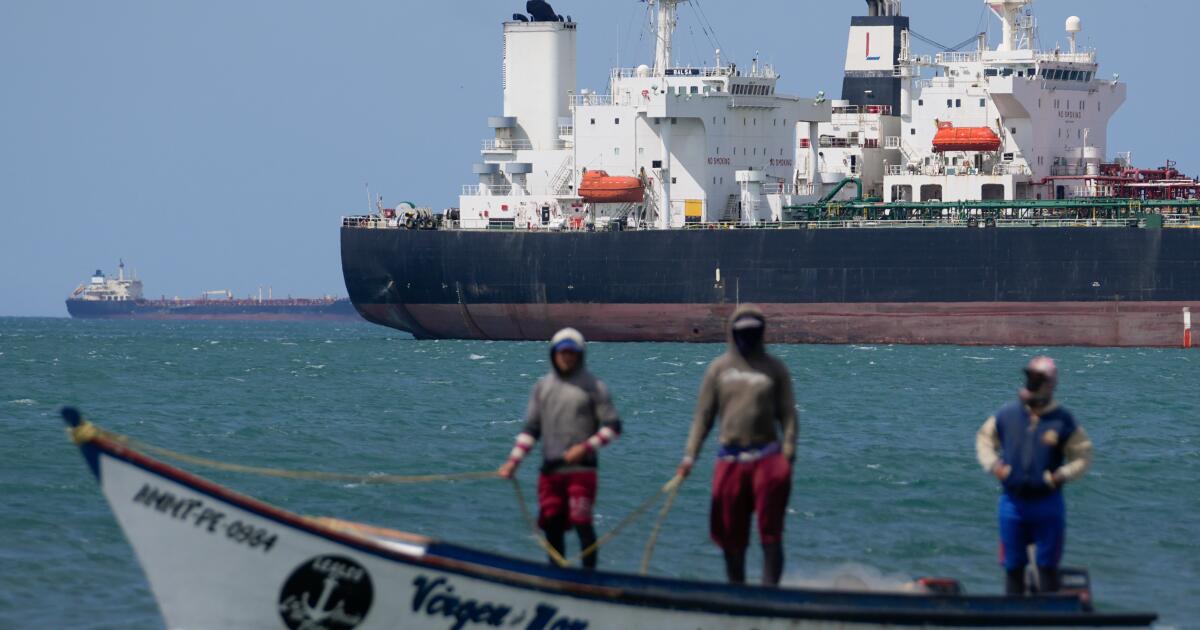
The moves highlight the increased pressure that the Republican administration is under to ease soaring oil prices as the United States, along with Israel, wages a war with Iran without a foreseeable end date. Global oil prices have since spiked as Iran halted traffic through the narrow Strait of Hormuz, where one-fifth of the world’s oil typically passes through from the Persian Gulf to customers worldwide.

The Treasury’s license is designed to incentivize new investment in Venezuela’s energy sector and is intended to benefit both the U.S and Venezuela, while increasing the global oil supply, a Treasury official told the Associated Press. The official was not authorized to discuss the matter publicly and spoke on condition of anonymity.

Since the ouster and arrest of Nicolás Maduro as Venezuela’s president during a U.S. military operation in January, Trump has said the U.S. would effectively “run” Venezuela and sell its oil.

The U.S. license provides targeted relief from sanctions, but does not lift the penalties altogether. The license allows companies that existed before Jan. 29, 2025, to buy Venezuelan oil and engage in transactions that would normally be banned under American sanctions, reopening trade for a major oil producer to global markets.

There are some limits.

Payments cannot go directly to sanctioned Venezuelan entities such as PDVSA, but must be sent instead to a special U.S.-controlled account. In other words, the U.S. will allow the oil trade but will control the cash flow.

Additionally, deals involving Russia, Iran, North Korea, Cuba and some Chinese entities will not be allowed. Transactions involving Venezuelan debt or bonds will not be allowed.

The license is expected to give a massive boost to Venezuela’s oil-dependent economy and help encourage companies that have been apprehensive to invest. The decision is part of the Trump administration’s phased-in plan to turn around Venezuela. But critics of the acting Venezuelan government argue that the move rewards Venezuela’s leadership — all loyal to Maduro and the ruling party — while repression, corruption and human rights abuses continue.

Many public sector workers survive on roughly $160 per month, while the average private sector employee earned about $237 last year, when the annual inflation rate soared to 475%, according to Venezuela’s central bank, and sent the cost of food beyond what many can afford.

Venezuela sits atop the world’s largest oil reserves and used them to power what was once Latin America’s strongest economy. But corruption, mismanagement and U.S. economic sanctions saw production steadily decline from the 3.5 million barrels per day pumped in 1999, when Maduro’s mentor, Hugo Chávez, took power, to less than 400,000 barrels per day in 2020.

A year earlier, the Treasury Department under the first Trump administration locked Venezuela out of world oil markets when it sanctioned PDVSA as part of a policy punishing Maduro’s government for corrupt, anti-democratic and criminal activities. That forced the government to sell its remaining oil output at a discount — about 40% below market prices — to buyers such as China and in other Asian markets. Venezuela even started accepting payments in Russian rubles, bartered goods or cryptocurrency.

The new license does not allow payments in gold or cryptocurrency, including the petro, which was a crypto token issued by the Venezuelan government in 2018.

Meantime, White House press secretary Karoline Leavitt said the Jones Act waiver would help “mitigate the short-term disruptions to the oil market” during the Iran war and would “allow vital resources like oil, natural gas, fertilizer, and coal to flow freely to U.S. ports.”

Hussein and Cano write for the Associated Press. Cano reported from Caracas, Venezuela. AP writer Seung Min Kim contributed to this report.

Source link

Oil surges to $110 a barrel after Israel strikes Iran’s energy facilities

Published on Updated

Brent crude oil prices reached $110 a barrel on Wednesday afternoon, after Iranian state media reported that part of the South Pars gas field, the largest plant in Iran, and the Asaluyeh oil facility were struck by Israel.


ADVERTISEMENT


ADVERTISEMENT

Moreover, the US oil benchmark WTI also rose and is trading at $98 a barrel at the time of writing.

In response to the latest Israeli attacks, the IRGC announced that some Gulf energy sites are once again “legitimate targets”.

The prospect of escalation and prolongation of the conflict in the Middle East, resulting in further destruction of energy infrastructure, and consequently disruption to global markets, has sent oil prices higher once again.

The climb occurs despite other positive news that would normally have a dampening effect on energy markets.

Saudi Arabia confirmed on Wednesday that its biggest oil refinery, Ras Tanura, restarted operations on 13 March.

Additionally, the Trump administration officially announced a 60-day waiver of the Jones Act, a century-old maritime law that restricts the movement of cargo between US ports to vessels that are American-built, American-owned, American-flagged and crewed.

However, in the face of increased tensions and more attacks on oil infrastructure, these potentially mitigating developments have not had any effect in taming prices.

Trump administration confirms Jones Act waiver

The White House Press Secretary, Karoline Leavitt, confirmed the Trump administration’s decision to issue a 60-day waiver of the Jones Act.

The measure lifts the restriction on the movement of cargo between US ports, allowing foreign tankers temporarily and cheaply to transport vital resources such as oil, gas and fertilisers along the US coastline.

In a post on X on Wednesday, Leavitt explained that the decision is “just another step to mitigate the short-term disruptions to the oil market as the US military continues meeting the objectives of Operation Epic Fury.”

The last Jones Act waiver was issued in October 2022 for a tanker supplying Puerto Rico after Hurricane Fiona.

Before that, the Biden administration temporarily eased the law in 2021 for refiner Valero Energy, after a cyberattack crippled a major East Coast fuel pipeline.

Trump renews pressure on allies to secure the Strait of Hormuz

In a separate development, US President Donald Trump has renewed pressure on allies to join a naval escort mission in order to secure the Strait of Hormuz and normalise the circulation of vessels in the region.

In a post on Truth Social, President Trump argued that allied countries need to use the Strait of Hormuz while the US does not, and warned that they could be left managing it on their own in the aftermath of the war.

Since President Trump’s original request, no firm commitments have emerged, but on Monday, the Wall Street Journal reported that the White House plans to announce as early as this week that multiple countries have agreed to join the escort mission.

The report also stated that officials are still deliberating whether such an operation would start before or after the war ends.

After meeting in Brussels, EU foreign ministers discussed extending the bloc’s Aspides naval mission to the Strait of Hormuz, but ultimately declined to participate.

Source link

Trump’s counterterrorism chief quits over Iran war

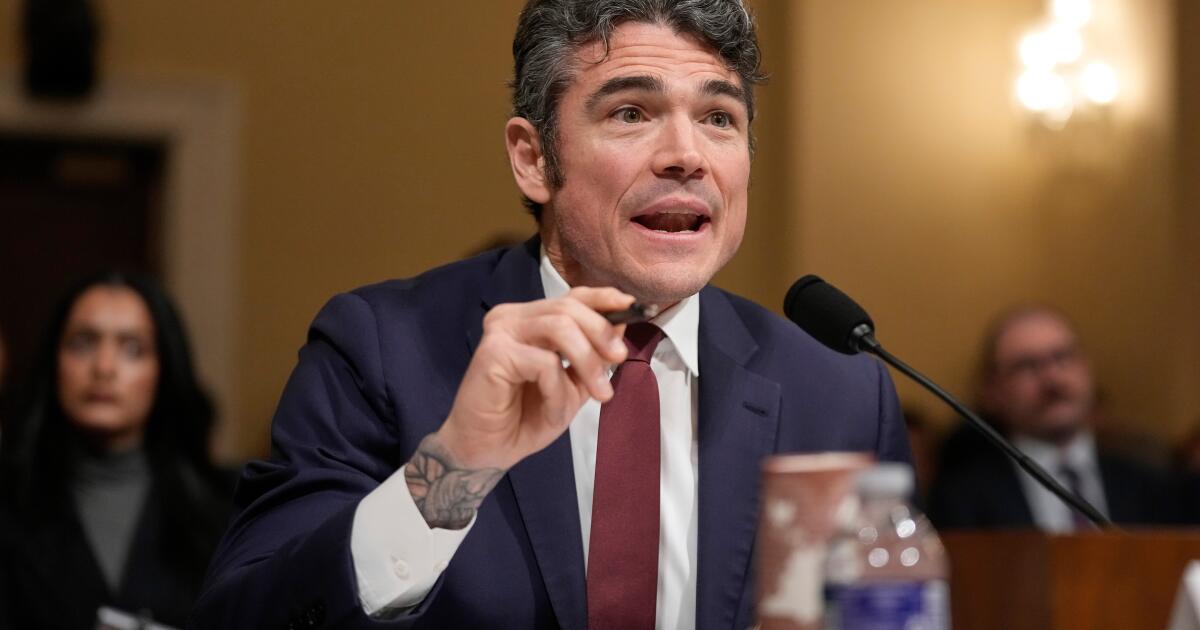
Joe Kent, the director of the National Counterterrorism Center, abruptly resigned Tuesday, becoming the most senior national security official to break publicly with the Trump administration over its military campaign against Iran.

In a statement posted on social media, Kent said he “cannot in good conscience” continue serving in the administration, contending that Iran had “posed no imminent threat to our nation” and that the United States had been drawn into the conflict through “pressure from Israel and its powerful American lobby.”

“I cannot support sending the next generation off to fight and die in a war that serves no benefit to the American people nor justifies the cost of American lives,” Kent wrote in a letter addressed to President Trump. “I pray that you will reflect upon what we are doing in Iran, and who we are doing it for.”

Trump, speaking in the Oval Office, dismissed Kent’s concerns, telling reporters that he had long believed the counterterrorism director — whom he nominated to the post in February 2025 — was “very weak on security.” The president insisted that Iran has been a threat to the U.S. “for a long time,” and said that it was a “good thing” Kent is leaving.

The resignation came at an uncertain moment for the administration. The war, which has repeatedly been sold to Americans as “short term” and contained, is now in its third week, with fraying alliances, renewed missile and drone fire on gulf Arab nations from Iran, new Israeli strikes on Iran and Lebanon, mounting casualties and no clear exit strategy.

“If we left right now it would take 10 years for them to rebuild,” Trump told reporters. “We’re not ready to leave yet, but we’ll be leaving in the near future. We’ll be leaving pretty much in the very near future.”

The uncertainty was compounded Tuesday by Israel’s killing of Ali Larijani, the head of Iran’s Supreme National Security Council, as well as Gholamreza Soleimani, the head of the Basij, Iran’s militia force.

Trump made reference to the Iranian officials killed without naming them, saying one was “their actual top” and the other was responsible for the killing of 32,000 Iranian protesters in recent weeks.

“It’s an evil group,” he said.

Effect of Larijani’s killing

Iranian officials confirmed the deaths of Larijani and Soleimani via state media Tuesday. In addition to killing the Basij leader, Israel reported striking more than 10 Basij posts, part of an effort to destroy the Islamic Republic’s ability to contain internal unrest and protests.

Benjamin Radd, a political scientist and senior fellow at the UCLA Burkle Center for International Relations, said Larijani’s killing would greatly diminish the Iranian diplomatic and institutional experience, as he was perceived to be “the last of the competent bunch” in power.

Those remaining in power are “generally not the sharpest people, they’re not the people who understand the subtleties of diplomacy, of what negotiating with the U.S. is like,” which clears a path for “a country run by a military junta” comprising Islamic Revolutionary Guard Corps leaders, Radd said.

“We’re really going to be moving more toward a military-style dictatorship — behind a clerical robe, if you will,” he said.

The battlefield developments have done little to reassure Washington’s closest allies, most of which have declined to join the fight despite Trump’s recent pleas to allied nations to send warships to help reopen the Strait of Hormuz, a crucial oil route that has been threatened by Iran’s war efforts.

In a social media post Tuesday, Trump said the United States had been informed by most of its allies in the North Atlantic Treaty Organization that they “don’t want to get involved” in the expanding Middle East war — and he claimed the American military no longer needs or wants their help.

“In fact, speaking as President of the United States of America, by far the Most Powerful Country Anywhere in the World, WE DO NOT NEED THE HELP OF ANYONE!” Trump wrote.

Trump cannot unilaterally remove the U.S. from NATO. In 2023, Sens. Tim Kaine (D-Va.) and Marco Rubio (R-Fla.) — who is now Trump’s secretary of State — successfully pushed a measure barring any president from removing the U.S. from the treaty organization without approval from the Senate or an act of Congress.

“The Senate should maintain oversight on whether or not our nation withdraws from NATO. We must ensure we are protecting our national interests and protecting the security of our democratic allies,” Rubio said at the time.

Some experts viewed Trump’s latest remarks about not needing NATO allies as a result of him having misplayed his hand at the start of the conflict with Iran, which has attempted to widen the war by targeting Gulf Cooperation Council nations in the region.

When Trump started demanding that many other nations join the U.S. in the war effort, or at least in safeguarding the Strait of Hormuz, it was “an attempt on Trump’s side to widen the war the other way,” Radd said, based in part on the fact that other nations, including China and in Europe, are much more reliant on oil from the region than the U.S.

However, it was a “clumsy” move by Trump given his alienation of NATO allies in the past, including during a major speech in Davos, Switzerland, in January, in which the president was “basically shaming and criticizing NATO and European states,” Radd said.

Calling on allies to “step up” after ridiculing them was “ham-handed,” Radd said.

Intelligence official’s departure

In Washington, Kent’s resignation exposed new divisions over the administration’s handling of the war.

On Capitol Hill, House Speaker Mike Johnson (R-La.) told reporters that he did not know where Kent was “getting his information” to conclude that Iran posed no imminent threat to the U.S. He said Trump administration officials in classified briefings have asserted that “they had exquisite intelligence and they understood that this was a serious moment for us.”

“The president felt that he had to strike first to prevent mass casualties,” Johnson said.

Several Democrats called on Kent to appear before Congress and tell the American people more about why the administration dragged the U.S. into war in Iran.

“If even officials like Joe Kent do not believe Iran posed an imminent threat, why are we sending more Americans to die in this war?” Rep. Ro Khanna (D-Fremont) wrote on X.

White House Press Secretary Karoline Leavitt said Kent’s letter contained “many false claims,” including that Iran posed no imminent threat to the U.S.

“This is the same false claim that Democrats and some in the liberal media have been repeating over and over,” Leavitt wrote on X. “As President Trump has clearly and explicitly stated, he had strong and compelling evidence that Iran was going to attack the United States first.”

She said that evidence, which has never been detailed publicly, “was compiled from many sources and factors,” and that Trump “would never make the decision to deploy military assets against a foreign adversary in a vacuum.”

Leavitt then repeated past justifications for the attack, including that Iran sponsors terrorism abroad and that it was building out its missile capabilities as “a shield” for protection as it continued to develop nuclear capabilities.

The press secretary previously said that Trump had a “feeling” that Iran was going to attack the U.S. or its assets. The president has alleged, without evidence, that Iran was within weeks of having a nuclear weapon.

Leavitt said the added assertion by Kent that Trump decided to attack Iran “based on the influence of others, even foreign countries, is both insulting and laughable.”

Kent, a former political candidate with connections to right-wing extremists, was confirmed in July as head of the National Counterterrorism Center, which analyzes and detects terrorist threats. Before joining the Trump administration, Kent ran two unsuccessful campaigns for Congress in Washington state. He also served in the military, serving 11 deployments as a Green Beret, followed by work at the CIA.

Democrats strongly opposed Kent’s confirmation in the Senate, in part because they were concerned about his ties to far-right figures and promotion of conspiracy theories. During his 2022 congressional campaign, Kent paid Graham Jorgensen, a member of the far-right military group the Proud Boys, for consulting work. He also worked closely with Joey Gibson, the founder of the Christian nationalist group Patriot Prayer, and attracted support from a variety of far-right figures.

During his Senate confirmation hearing, Kent refused to distance himself from a conspiracy theory that federal agents instigated the Jan. 6, 2021, attack at the U.S. Capitol, as well as false claims that Trump, a Republican, won the 2020 election over Democrat Joe Biden.

Democrats grilled Kent on his participation in a group chat on Signal where Trump’s national security team discussed sensitive military plans.

Republicans, meanwhile, were drawn to Kent’s experience in the military and intelligence.

Sen. Tom Cotton (R-Ark.), the GOP chair of the Intelligence Committee, said in a floor speech that Kent had “dedicated his career to fighting terrorism and keeping Americans safe.” On Tuesday, Cotton said that he disagreed with Kent’s “misguided assessment” on Iran.

“Iran’s vast missile arsenal and support for terrorism posed a grave and growing threat to America. Indeed, the ayatollahs have maimed and killed thousands of Americans,” Cotton said. “President Trump recognized this threat and made the right call to eliminate it.”

Other conservatives — including former Rep. Marjorie Taylor Greene and commentator Candace Owens — called Kent an “American hero.”

Ilan Goldenberg, a former Biden administration official who dealt with the Middle East, wrote on X that while he disagrees with the Iran war, Kent claiming that Israel pressured Trump into the conflict is “ugly stuff that plays on the worst antisemitic tropes.”

“Donald Trump is the President of the United States and he is the one ultimately responsible for sending American troops into harms way,” he said.

Source link

Trump is searching for an endgame to the Iran war

After two weeks of war with Iran, the Trump administration is being forced to temper its expectations of a swift end to the conflict, with U.S. intelligence and defense officials expressing doubt it can achieve the overthrow of Iran’s government and the destruction of its nuclear program through military means.

It was an outcome forewarned by analysts at the State Department, the CIA and the Pentagon, who together alerted the administration to the pitfalls full-scale war with Iran would bring before President Trump decided to proceed, two U.S. officials told The Times, granted anonymity to speak candidly.

Certain military goals of Operation Epic Fury laid out at the start of the war are still seen as achievable at the Pentagon, with U.S. and Israeli strikes making steady progress degrading Iran’s ballistic missile infrastructure, its drone program and its navy.

But a prewar U.S. intelligence assessment, that an air assault was unlikely to topple the Islamic Republic, still holds, with the intelligence community now casting doubt the assault had any more political effect than to radicalize a government already devoted to the destruction of Israel and harming the United States.

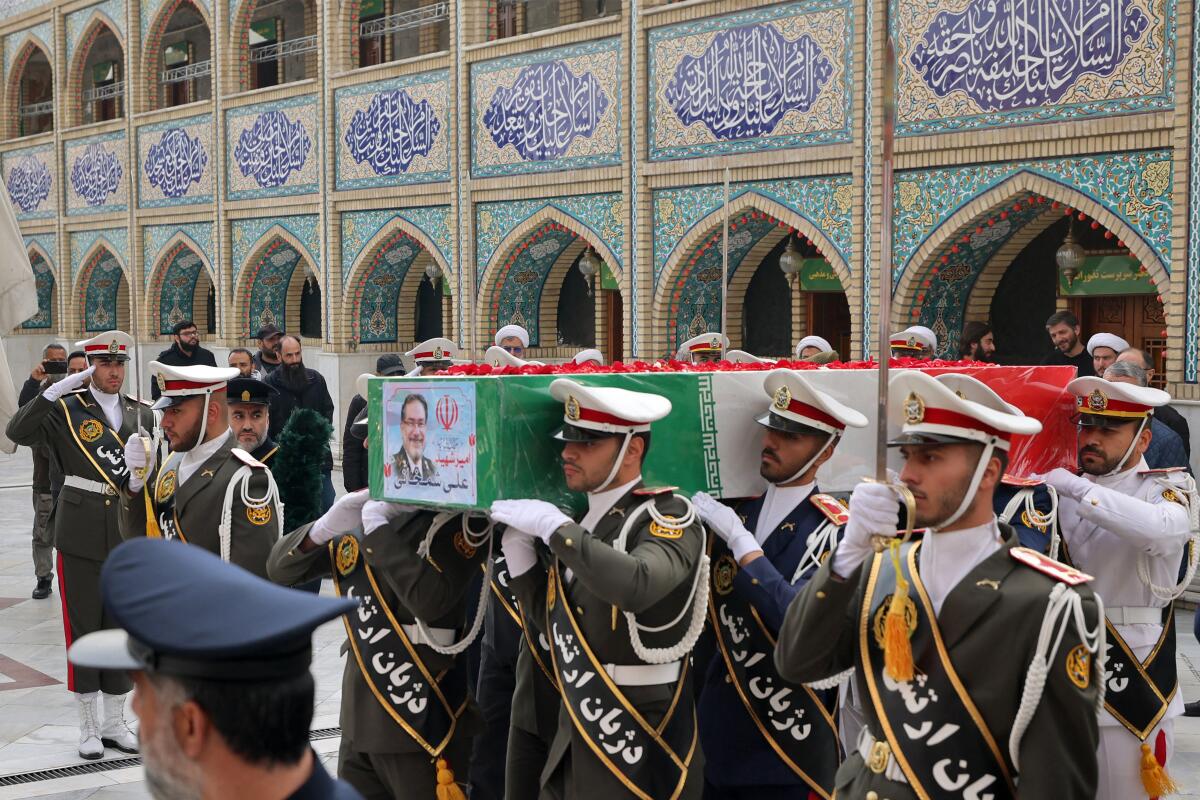
The casket of Ali Shamkhani, Iran's slain influential security adviser, proceeds during a military procession at his funeral

A military procession in Tehran carries the casket of Ali Shamkhani, political advisor to Iran’s last Supreme Leader Ayatollah Ali Khamenei, who was also killed in U.S.-Israeli attacks.

(Atta Kenare / AFP/Getty Images)

Concern has only grown that Iran’s new government will make the fateful strategic decision to build a bomb after the war, unless Trump decides to escalate the conflict with a perilous ground invasion. And the White House now contends with a new mission imperative, created by its decision to launch the war itself, of reopening the Strait of Hormuz to vital shipping traffic that carries 20% of the world’s daily oil and liquid natural gas supply.

The foreign policy strategy Trump publicly laid out as his playbook for the conflict — to come down hard on the government, decapitating its leadership, and hope the remnants would seek mercy — has not worked, with Tehran looking for new ways to expand the war and maximize pain for the U.S. administration.

Trump has minimized the conflict as an “excursion” that would end “very soon,” while also calling it a war, vowing to take the time he needs to “finish the job.” He says it will conclude whenever he decides to end it.

It remains possible that a declaration from Trump that the fighting is over results in a ceasefire, as it did in June of last year, when Trump demanded an end to 12 days of war between Iran and Israel. But the Iranians have a vote, too — and senior leadership in the Islamic Republic have made plain they plan to continue fighting this time whether Trump likes it or not.

On Friday, the Pentagon announced that an additional expeditionary unit of 2,500 Marines was being deployed to the region to support the effort.

“Starting wars is an easy matter,” Ali Larijani, secretary of Iran’s Supreme National Security Council, wrote on social media. “Ending them does not happen with a few tweets.

“We will not leave you until you admit your mistake and pay its price,” he added.

It is a sore lesson for a president whose decade in public life has been distinguished by an exceptional ability to warp reality to his liking.

“The White House has created a dilemma for America: If it declares victory and ends the war, it leaves in place a weakened Iranian government with the means and renewed motivation to pursue nuclear weapons,” said Reid Pauly, a professor of nuclear security and policy at Brown University.

“If it presses on with the war,” Pauly added, “it risks the kind of mission creep that may eventually find American boots on the ground.”

In a news release last week, the White House said that, “from the opening hours of this historic campaign, the objectives were clear: obliterate Iran’s ballistic missile arsenal and production capacity, annihilate its navy, sever its support for terrorist proxies, and ensure the world’s leading state sponsor of terrorism will never acquire a nuclear weapon.”

Yet, at the start of the operation, Trump issued a promise to the people of Iran that, at the end of the U.S.-Israeli campaign, Iran’s military and paramilitary infrastructure would be so badly hobbled that a rare, generational opportunity would emerge for them to take their government back.

“To the great proud people of Iran, I say tonight that the hour of your freedom is at hand,” Trump said. “Stay sheltered. Don’t leave your home. It’s very dangerous outside. Bombs will be dropping everywhere. When we are finished, take over your government. It will be yours to take. This will be probably your only chance for generations.”

Trump said in the days that followed he would need to have a say over the next ruler, after assassinating the country’s longtime supreme leader, Ayatollah Ali Khamenei. But the Iranian system of clerics and militants defied the president, selecting in Khamenei’s son a man viewed as even more hostile to the West than his father was.

Israeli leadership, too, set out regime change as a goal of the war. Yet even their officials now say that a substantial leadership change in Tehran is an unlikely result.

Trump would go on to insist on the “unconditional surrender” from the Iranian government, a demand that he later said would be satisfied by the incapacitation of Iran’s military.

Repeating his conviction that the war will end soon, Trump told Fox News’ Brian Kilmeade in an interview Friday that he would order an end to the fighting “when I feel it. When I feel it in my bones.”

“The problem with the administration’s approach is that it has constantly shifted its goals. Some are achievable, such as degrading Iran’s conventional force. Others are not, such as picking the next leader of Iran,” said Ray Takeyh, a scholar on Iran at the Council on Foreign Relations.

“The mixed messages have led to confusion at home,” Takeyh added, “and lack of planning for oil shortages and getting the Americans out of the region shows that process and personnel can actually matter.”

Mark Dubowitz, CEO of the Foundation for Defense of Democracies, said the joint U.S.-Israeli campaign was always designed to unfold in three phases: degrading Iran’s ability to wage war, reducing Iran’s ability to repress democratic forces inside the country, and finally, encouraging the Iranian people to rise up.

“The president controls the strategy, but no president fully controls the endgame because the regime gets a vote,” Dubowitz said. “The endgame is not a scripted political transition directed from Washington. It is a regime under simultaneous military, economic, and internal pressure — to strip of its war-making and repression capabilities — and whether that produces succession, fracture, or collapse will ultimately be decided in Tehran.”

Whether the conflict will achieve the destruction of Iran’s nuclear program is an equally grave question in Washington, where officials are debating over a list of stark options on how to physically destroy, bury or retrieve the fissile material that Tehran could use to build a nuclear weapon — a threat seen as only more grave under the stewardship of an angry and vengeful government.

“The war was publicly justified, to the extent it was justified at all, in terms of destroying Iran’s nuclear program. Very few strikes have been directed against nuclear-related targets, however — almost certainly because those that survived last June’s attacks are invulnerable to air attack,” said James Acton, co‑director of the nuclear policy program at the Carnegie Endowment for International Peace.

“Unless the U.S. and Israel attempt high-risk special forces operations or a ground incursion,” he added, “Iran will end the war with its surviving nuclear infrastructure largely intact and greater incentives to build the bomb.”

Pauly agreed it is unrealistic to expect the United States and Israel can destroy Iran’s nuclear program through air power alone. The U.N. International Atomic Energy Agency believes Iran has roughly 440 kilograms — about 970 pounds — of 60% highly enriched uranium, possibly spread across multiple facilities.

“Securing this material will require either U.S. ground troops or, after some coercive bargain is reached, international inspectors,” Pauly said.

In an exchange with reporters last week at the Pentagon, Defense Secretary Pete Hegseth had few details to offer on what U.S. options were to remove or eliminate an accessible uranium stockpile, enriched to near weapons grade, that had been buried in a U.S. operation last year intended on obliterating the nuclear threat.

Diplomacy, he suggested, might be required to secure the material.

“I will say we have a range of options, up to and including Iran deciding that they will give those up,” he told reporters, “which of course we would welcome.”

Source link

Could oil prices really reach $200 a barrel as claimed by Iran?

The global energy landscape is facing its most volatile period in decades following the US-Israeli strikes against Iran on 28 February that triggered a wider and potentially prolonged conflict in the Middle East.


ADVERTISEMENT


ADVERTISEMENT

What began as a targeted military operation has rapidly escalated into a direct confrontation with global economic implications.

Based on claims by Iranian state media and regional reports, the Islamic Revolutionary Guard Corps (IRGC) has ostensibly adopted a strategy of “energy blackmail” to leverage the international community into pressuring the US and Israel to cease its attacks.

The $200 per oil barrel threat was first articulated shortly after the conflict began.

On Sunday 1 March, a senior IRGC spokesperson warned that if “cowardly anti-human actions” continued, the world should prepare for a massive price surge, even as high as $200 per oil barrel.

This rhetoric has since become a central pillar of Tehran’s messaging.

As recently as this Wednesday, Ebrahim Zolfaqari, the spokesperson for Iran’s Khatam al-Anbiya military command headquarters, told state media: “Get ready for the oil barrel to be at $200, because the oil price depends on the regional security which you have destabilised.”

Iran’s tactical disruption

The IRGC’s current strategy relies on “internationalising” the cost of the conflict.

By disrupting the flow of nearly 20% of the world’s oil and liquefied natural gas (LNG) through the Strait of Hormuz, Iran aims to drag the global economy into the fray.

This is why the IRGC has targeted vessels from neutral nations, including ships sailing under Thai, Japanese and Marshall Islands flags, among others.

According to energy analysts, this disruption is designed to create domestic political pressure within Western nations, to in turn force the US and Israel to pull back on military action in exchange for energy stability.

By striking countries that have not attacked them directly, Tehran is signaling that no maritime trade is safe as long as the strikes on its soil continue.

The main vector of this strategy is precisely the disruption of energy markets, an element Iran can influence directly through its geographical advantage.

A history of oil price shocks

While $200 per barrel sounds astronomical, oil has approached similar levels in the past when adjusted for inflation.

The highest nominal price ever recorded was around $147 in 2008, driven by peak oil fears and rampant speculation just before the global financial crisis. When adjusted for 2026 inflation, that 2008 peak represents roughly $211 per barrel.

Previous major shocks, such as the 1973-74 Arab Oil Embargo and the 1979 Iranian Revolution, saw prices quadruple and double respectively from pre-crisis levels.

In 1980, prices hit a nominal peak of about $39.50, which would be approximately $160 in today’s terms.

However, the current crisis involves a total physical blockade of one of the world’s most critical maritime chokepoint, increasing the risk of a price “moonshot”.

Market response and reserves

At the time of writing, Brent crude is trading just above $100 per barrel, a sharp increase from the $60 range seen in mid-February before the Iran war began.

The International Energy Agency has attempted to stabilise the market by orchestrating the largest-ever coordinated release of strategic reserves, but the continuation of Iranian strikes agaisnt oil infrastructure and tankers has largely neutralised the effort.

With insurance providers cancelling war-risk coverage and shipping companies redirecting fleets, the market remains in a state of high anxiety.

If the blockade on the Strait of Hormuz persists, the $200 figure may shift from a political threat to an increasingly likely scenario.

In a recent report, Oxford Economics identified $140 per barrel as the threshold at which the global economy tips into mild recession, reducing world GDP by 0.7% by year-end and pushing the UK, the Eurozone and Japan into contraction.

Source link

Iran strikes neutralise record IEA reserves release as oil tops $100

Brent futures rose sharply on Thursday, spiking above $100 before easing slightly but remaining higher than levels seen earlier in the week as markets stay incredibly volatile.


ADVERTISEMENT


ADVERTISEMENT

This comes despite an unprecedented decision by the 32-member International Energy Agency (IEA) on Wednesday to release a record 400 million barrels to calm markets, more than double the volume released after Russia’s 2022 invasion of Ukraine.

Following the IEA decision, Iran stepped up its offensive campaign and launched strikes on Omani oil storage facilities at the Salalah port and multiple ships in and near the Strait of Hormuz, sending prices higher again.

Record coordinated release of reserves

The US alone is contributing 172 million barrels. Germany, France and Italy also confirmed they would tap their stocks, while Japan said it would begin releases next Monday.

IEA executive director Fatih Birol described the current Iran-related crisis as an “oil market challenge unprecedented in scale”, adding that the collective response reflected “strong solidarity” in defence of global energy security.

Exports of crude and refined products from the region have dropped to 10-15% of pre-war levels, with the Strait of Hormuz, which normally carries one-fifth of the world’s oil, effectively closed to the large majority of tankers.

Iran’s attacks blunt expected price relief

The new Iranian strikes came at lightning speed, directly after the IEA announcement.

Drones targeted fuel storage tanks and silos at Oman’s Salalah port, igniting fires that Omani authorities were still working to contain late on Wednesday.

British maritime security firm Ambrey confirmed damage to the facilities, while Danish shipping giant Maersk temporarily halted port operations.

Omani officials stressed there had been “no disruption to the continuity of oil supplies or petroleum derivatives” inside the country itself, while Iranian state media reported that President Pezeshkian had assured Oman’s sultan the incident would be investigated.

At the same time, six vessels were struck in the Gulf and Strait of Hormuz.

Among the reports, there was confirmation of a projectile hitting a container ship near the UAE and strikes on two tankers in Iraqi waters.

UK Maritime Trade Operations, and other monitoring groups, attributed the incidents to Iranian forces or proxies.

These developments, occurring the very day of the reserves release, appear to have smothered the anticipated calming effect on prices.

As of Thursday, the number of ships struck in the region since the beginning of the conflict rose to at least sixteen.

Record release may signal deeper market concerns

Some analysts note that the sheer volume of the release could itself be interpreted negatively. Previous coordinated actions never exceeded 183 million barrels.

The scale of the release suggests importing nations already view the disruption as the most severe and long-lasting in decades.

Even worse, a record release may not be enough.

Speaking to Euronews, Warren Patterson, Head of Commodities Strategy at ING, was blunt in his assessment.

“A record 400 million barrel release from emergency reserves is helpful, but it’s not going to go very far to offset the roughly 15 million daily supply currently disrupted.”

Patterson also added that “the only solution that will bring oil prices down on a sustained basis is getting oil flowing through the Strait of Hormuz again.”

Oxford Economics echoes this concern, warning that “the economic effect of higher energy costs rises as the oil price increases,” in a report that seemingly indicates the crisis is far from over and we have yet to feel the compounding effect of the initial shock.

Russian sanctions relief remains off the table

With the reserve release failing to calm prices, attention has turned to Russian oil as a potential source of additional supply.

The US Treasury last week granted Indian refiners a 30-day waiver to purchase Russian crude from vessels already stranded at sea, though the measure expires on 4 April and deliberately excludes new shipments.

Following the G7 emergency discussions on Wednesday, French President Emmanuel Macron stated that the group had agreed “the situation does not justify lifting any sanctions” on Russia, emphasising the need to increase global production instead.

The contrast between Washington’s narrow waiver and the G7’s firm collective position leaves little prospect of sanctions relief acting as a meaningful pressure valve, a view shared by analysts.

“Any sanction relief for Russia would see some marginal supply increases, but again not enough, with Russia’s oil output having held up well in recent years despite sanctions,” Warren Patterson of ING told Euronews.

$140-$150 oil barrel possible if conflict is prolonged

Should tensions persist, analysts warn prices could climb substantially higher.

Oxford Economics identifies $140 per barrel as the threshold at which the global economy tips into mild recession, reducing world GDP by 0.7% by year-end and pushing the UK, the Eurozone and Japan into contraction.

The managing director of the IMF, Kristalina Georgieva, also stated that every 10% increase in oil prices, provided they persist for most of the year, will push up global inflation by 0.4% and reduce worldwide economic output by as much as 0.2%.

“The risk is stark,” Patterson warned. “It’s only a matter of time before we see oil prices hitting fresh record highs if the conflict is not swiftly and decisively resolved.”

The IEA’s intervention has provided a temporary buffer, but with little visible impact on prices.

Source link

Conan O’Brien says addressing politics at Oscars is a ‘dance’

The big question surrounding last year’s Academy Awards was whether the show would address the L.A. wildfires, which had rattled the city mere months prior.

This year, the elephant in the room is the ongoing Iran war, which like last year’s wildfires, puts a celebration like the Oscars in sharp relief. But for Conan O’Brien, balancing gravity and levity is part of his job description as host.

“My job is to always try and hit this very, very thin line between entertaining people and also acknowledging some of the realities,” O’Brien said during a Wednesday news conference with the Oscars creative team.

“It’s a dance that goes on up until the show begins,” the former talk show host said, adding that he and his team of writers are still revising material ahead of the show to ensure their content is as relevant as possible.

“Between us,” he said, referencing Oscars telecast executive producers Katy Mullan and Raj Kapoor, “we will find the right tone.”

O’Brien also during the news conference recalled Johnny Carson’s turn hosting the Oscars during the Iran hostage crisis, when 52 Americans, including diplomats and other personnel, were held hostage at the U.S. embassy in Tehran from 1979 to 1981. The comedian remembered the television host parodying ABC’s “Nightline” with his joke, “It’s day 444 of the Oscars.”

“It was such a funny, topical joke that touched on something everyone was thinking about, and at the same time, got a big laugh and was unifying,” O’Brien said. “That was meaningful to me.”

Kapoor said during the news conference that the production team is putting systems in place to alleviate attendees’ safety concerns amid the tense global situation and reported threats to California.

“Every year, we monitor what’s going on in the world,” the showrunner said, adding that the ceremony has the support of the FBI and LAPD. “This show has to run like clockwork.”

He added, “Everybody that is coming to this show, that is witnessing this show, that is even a fan of the show when they’re standing outside the barricades — we want everybody to feel safe and protected and welcome.”

As for the telecast’s creative direction, the team cited “human touch” as a unifying theme — a not-so-subtle slight to AI.

“We’re celebrating human touch, human connection and what I like to call actual intelligence, as opposed to artificial,” said music director Michael Bearden. “We want to get back to the communal … and so the music will reflect that.”

That spirit of celebration will be especially tangible in the “KPop Demon Hunters” performance, Kapoor said. That performance will be complemented by a “Sinners” moment featuring Miles Caton and Raphael Saadiq as well as guests Misty Copeland, Eric Gales, Buddy Guy, Brittany Howard, Christone “Kingfish” Ingram, Jayme Lawson, Li Jun Li, Bobby Rush, Shaboozey and Alice Smith.

“We have this lovely story celebrating Korean culture with authentic Korean drummers and singers and even choreography,” the producer said. “So again, we’ve expanded our reach, and we’re telling these global stories, celebrating international films that have had a global impact and doing things in a really different way.”

Mullan and Kapoor closed the news conference by teasing a pair of reunions featuring cast members from “Bridesmaids” and the Marvel Cinematic Universe. “Bridesmaids” alum Rose Byrne is nominated for a lead actress Oscar for her role in “If I Had Legs I’d Kick You,” which marked O’Brien’s dramatic acting debut. (If Byrne wins, he said, “half that Oscar’s mine.”)

“We’re gonna have superstars, superheroes, and there is also going to be an extraterrestrial on the stage, so you can figure that one out,” Mullan said.

The 2026 Oscars will air live Sunday on ABC, with streaming available on Hulu, YouTube TV, AT&T TV and FuboTV.

Source link

US Justice Department digs into Iran’s sanctions evasion via Binance

Published on

A probe has been initiated by the US Justice Department into Iran’s use of Binance, the world’s largest crypto platform, to circumvent US sanctions and provide financial backing to terrorist organisations with ties to the IRGC, according to The Wall Street Journal.


ADVERTISEMENT


ADVERTISEMENT

The US DOJ’s examination stems from company documents and accounts provided by individuals familiar with the matter.

Authorities have contacted people with direct knowledge of the Iranian-linked transactions to request interviews and collect evidence, as per the WSJ report.

A monitor appointed by the US Treasury Department has reportedly asked Binance for details on the Iranian transactions, including information about a business partner responsible for a large share of the flows.

At this stage, it remains uncertain whether the investigation targets Binance for any potential misconduct or if it is confined to activity by customers on the platform.

A spokesperson for the company told the WSJ that Binance “categorically did not directly transact with any sanctioned entities”.

This development brings the company back to the centre of US regulatory attention, just months after its founder received a presidential pardon, highlighting persistent challenges in enforcing sanctions within the rapidly evolving crypto and fintech sectors.

Binance founder Changpeng Zhao, widely known as CZ, was pardoned by President Trump back in October.

The investigation reopens scrutiny of the exchange, which pleaded guilty in 2023 to breaching US sanctions and banking laws. That case resulted in a record $4.3bn (€3.7bn) penalty and a requirement for ongoing US oversight.

Under the terms of the 2023 agreement, Binance must actively screen clients for terrorism financing and sanctions breaches, as well as report suspicious activity promptly to authorities.

US congressional inquiry adds pressure

The developments have also drawn attention from Capitol Hill.

US Senator Richard Blumenthal, a senior Democrat on the Senate Homeland Security Committee, opened a formal inquiry last month into Binance’s handling of the Iranian transactions.

Citing the scale of the unreported flows, approaching nearly $2bn (€1.7bn) to sanctioned entities, and the suspension of internal investigators, Blumenthal questioned whether the exchange had met its obligations under US sanctions and banking laws.

He requested detailed records from Binance, which responded by describing media coverage as inaccurate and highlighting its “best-in-class compliance programme”.

The senator later described that reply as evasive and insufficient to address his concerns.

The timing of the US DOJ’s probe coincides with heightened efforts to disrupt financing networks linked to Iran’s IRGC.

Ahead of joint military actions with Israel against Iran, Washington stepped up measures to cut off revenue streams, particularly those involving crypto assets used to repatriate proceeds from oil sales to China.

In January, the US Treasury Department sanctioned two smaller crypto exchanges for moving large sums to digital wallets connected to the IRGC.

Source link