introduce

Lee says to swiftly introduce fuel price cap as Mideast crisis intensifies

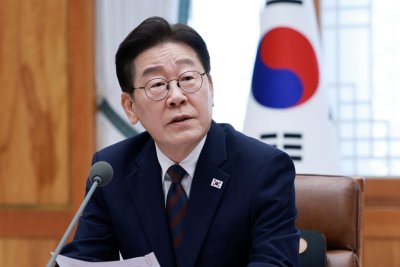
South Korean President Lee Jae Myung speaks during an emergency economy response meeting on Middle East tensions held at Cheong Wa Dae in Seoul on Monday. Photo by Yonhap

President Lee Jae Myung on Monday called for authorities to swiftly introduce a cap on local fuel prices, and preemptive responses to cope with surging gas prices and volatility in foreign exchange markets as the U.S.-led war with Iran has intensified in the Middle East.

Lee made the remarks during an interministerial meeting to assess the latest developments following U.S.-Israeli strikes on Iran and Tehran’s retaliatory attacks across the Middle East, which have prompted the price of Brent oil to surge through US$100 per barrel.

“As the crisis in the Middle East deepens, uncertainty in the domestic and global economic environment is expanding significantly, posing a considerable burden on the Korean economy relying heavily on global trade and energy imports from the Middle East,” Lee said.

Lee also called for preemptive responses Monday with worst-case scenarios in mind to address the economic fallout from heightened tensions in the Middle East, urging financial stability measures and the exploration of alternative energy routes.

“As it is difficult to predict how the situation will unfold, the government must prepare preemptive response measures with a sense of urgency, keeping even the worst-case scenario in mind,” he added.

Lee urged the government and the Bank of Korea to prepare additional preemptive measures to respond to rising volatility in financial and foreign exchange markets, instructing authorities to expand the 100 trillion-won ($66.8 billion) market stabilization program if necessary.

“We should identify hidden risks and meticulously prepare response measures.”

Lee also called for measures to address uncertainty surrounding energy supplies amid concerns over disruptions to shipping through the Strait of Hormuz, a major global shipping route.

“We will coordinate with strategic partner countries to promptly explore alternative routes that do not have to pass through the Strait of Hormuz,” he said.

In addition, he urged the government to crack down on collusion between refiners and gas stations, price fixing, and hoarding, calling for strict punishment of violators and the implementation of a price cap system on gasoline and diesel.

Copyright (c) Yonhap News Agency prohibits its content from being redistributed or reprinted without consent, and forbids the content from being learned and used by artificial intelligence systems.
Source link

California legislators introduce bill package to address wildfires

Two months after the anniversary of the devastating Southern California firestorms, several legislators at the state Capitol unveiled a package of bills aimed at preventing wildfires and lessening their harms.

“California has reached a tipping point,” Assemblymember Steve Bennett (D-Ventura) said during a news conference Wednesday. “In the last nine years, we’ve had the eight largest fires in the history of California — we shouldn’t have this problem.”

Two of the most destructive wildfires ever in California erupted on the same day last January. The fires devastated Pacific Palisades and Altadena — destroying homes and businesses, displacing residents and killing 31 people. The Palisades and Eaton fires caused an estimated economic loss of $250 billion.

Among the dozen bills announced Wednesday were:

  • Assembly Bill 1934, carried by Bennett, would require the state fire marshal’s Wildfire Mitigation Advisory Committee to develop a home hardening certification program. (Home hardening involves using ignition-resistant materials to make houses less vulnerable to embers or flames.)
  • Senate Bill 1079, from Sen. Henry Stern (D-Los Angeles), would create a Fire Innovation Unit within the California Department of Forestry and Fire Protection. The unit would serve as a hub for wildfire technology research and deployment.
  • Assembly Bill 1699, by Assemblymember Chris Rogers (D-Santa Rosa), would indefinitely extend the Prescribed Fire Liability Program and expand program eligibility.
  • Assembly Bill 1891, by Assemblymember Damon Connolly (D-San Rafael), would create the Beneficial Fire Capacity Program to expand training and support for community-led beneficial fire programs, including those developed by universities, volunteer fire districts and California Native American tribes.
  • Senate Bill 894, from Sen. Benjamin Allen (D-Santa Monica), would state the intent of the Legislature to create the California Wildfire Resilience Program, which would increase access to home hardening modifications.

Allen, who represents the Palisades, said neighborhoods are being turned upside down by wildfires.

“Modern fires are now spreading from wild lands into urban communities,” he said. “The reality that so many people in my district have been living through over this past year has been immensely challenging. Tens of thousands of families remain displaced from their homes.”

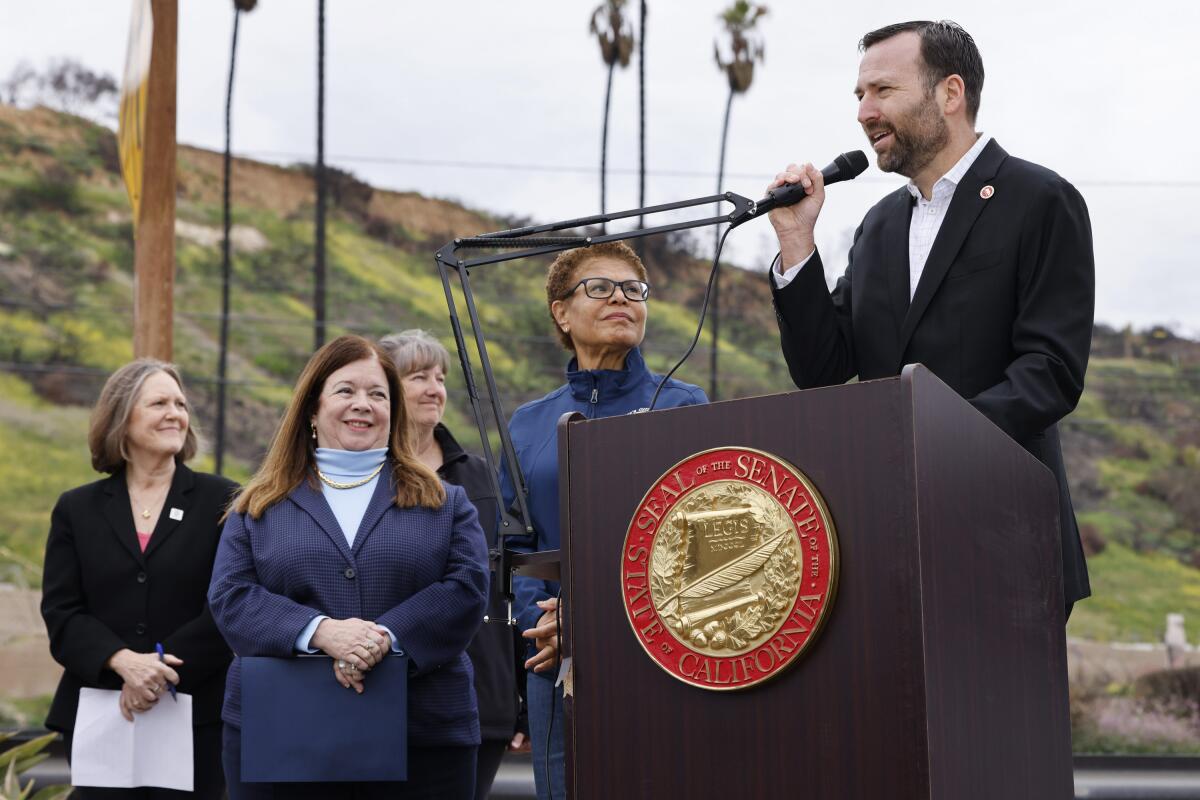
A man speaks behind a lectern as people watch him.

State Sen. Benjamin Allen (D-Santa Monica) hosts a discussion with local leaders and residents to mark 100 days since the start of the L.A. County wildfires at Will Rogers State Beach on April 17, 2025, in Los Angeles.

(Carlin Stiehl/Los Angeles Times)

Many fire survivors have expressed anger over government action that they believe enabled the disaster and hindered recovery efforts. When asked whether the Legislature had plans to dissect the response, Allen said he would support a robust investigation.

“I think the public is expecting that the state is really looking into this,” he said. “But I know there’s always 10 million different priorities around here — one of my jobs as somebody who represents these folks is to make sure it continues to be on the radar screen.”

Bennett said Californians had a right to expect oversight and transparency but should not “expect perfection” during emergencies.

“I think we are best in California if we develop a culture where everybody says, ‘You do the best you can,’” he said. “I think we would be better off.”

Survivors in Altadena and Pacific Palisades recently marked the anniversary of the disaster with solemn memorial services.

“This year has been the hardest year of our lives,” Joy Chen, executive director of the Eaton Fire Survivors Network, said during a service in Altadena. “Unimaginable grief. The 31 people who died that day, and the hundreds who have died prematurely since. Homes lost. Jobs lost. Incomes lost. A sense of safety and identity stripped away.”

Source link