intimidation

Omar says she won’t ‘be silenced’ by search of her home and blasts Trump’s ‘intimidation’ campaign

Federal agents on Monday searched the home of Democratic U.S. Rep. Ilhan Omar, a startling escalation in a criminal investigation that brings renewed scrutiny to the frequent target of Trump administration derision in the final weeks of her reelection bid.

Omar said she will “not be silenced” and called the search of her home the “latest escalation” in President Trump’s ‘‘intimidation” campaign.

The search of the Minnesota congresswoman’s home so close to next month’s midterm contests that will determine control of the House and the Senate was swiftly condemned by top Democrats in Congress and raised questions about the timing given longstanding Justice Department protocol to avoid overt investigative steps involving political candidates in the direct run-up to an election.

The Justice Department confirmed in a statement that Homeland Security Investigations agents executed a judicially authorized search warrant in the Washington, D.C., area in connection with an ongoing federal criminal investigation but provided no other details.

The nature and scope of the investigation were unclear, though officials in Trump’s administration have repeatedly hinted at the existence of an inquiry targeting Omar, a Somali-born Democrat whose status as an immigrant to the U.S. and left-wing views have repeatedly drawn criticism from Republicans and senior Trump officials.

Homeland Security Secretary Markwayne Mullin said last month that there was an “ongoing investigation” related in part to whether Omar lied on her immigration forms and that “something’s going to happen.”

Though the Republican focus on Omar’s background dates back years, the search of her home took place three weeks before the November midterms, in which Omar is on the ballot for reelection. The Justice Department has historically sought to avoid public investigative actions involving a candidate within 60 days of a primary or general election.

“For years, Donald Trump and far-right extremists have relentlessly targeted Congresswoman Omar with vile personal attacks and baseless accusations,” top House Democratic leaders said in a statement. “Now, less than 30 days until the midterm election, his violent mass deportation machine has descended upon the home of a duly elected Member of Congress and her family.”

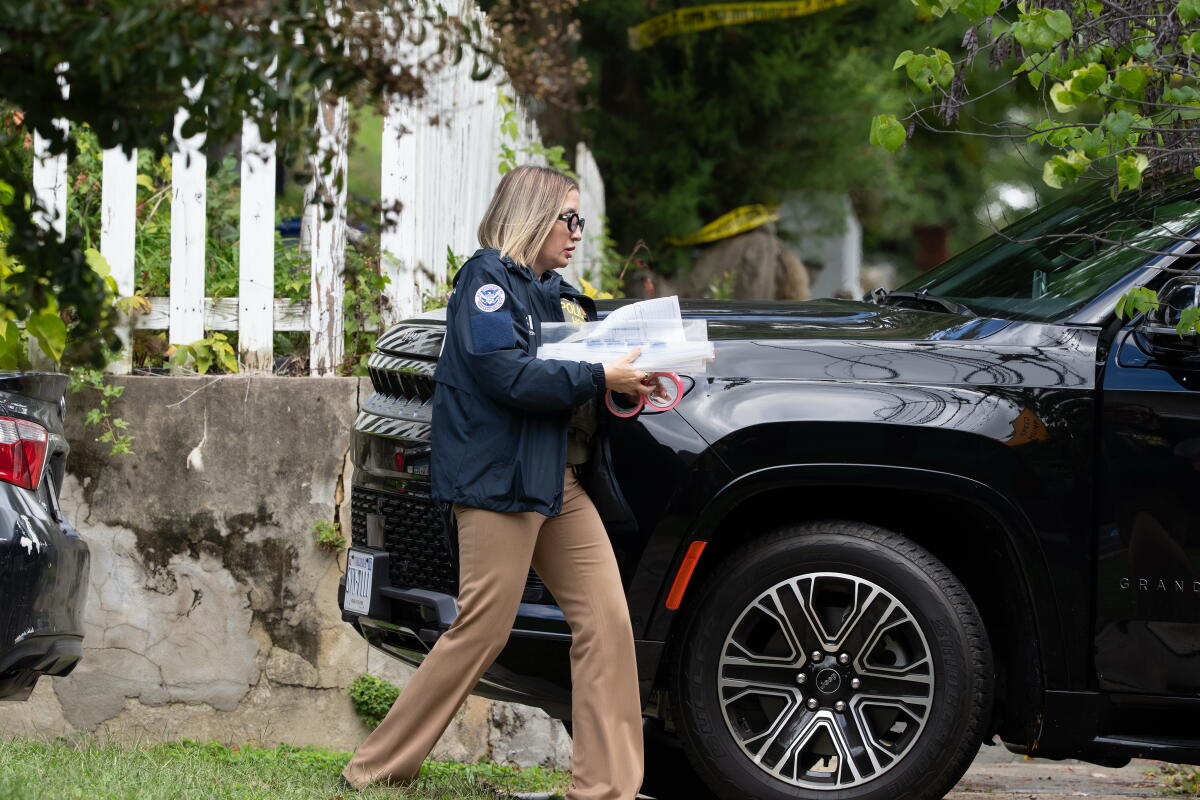
A Homeland Security officer walks out of the Washington residence of Rep. Ilhan Omar, D-Minn., during a search, Monday.

A Homeland Security officer walks out of the Washington residence of Rep. Ilhan Omar, D-Minn., during a search, Monday.

(J. Scott Applewhite / Associated Press)

Trump has frequently targeted Omar

Trump as recently as this past weekend brought up Omar at a rally in Tennessee, where he attacked her upbringing and suggested that Vice President JD Vance “and our people” were investigating her.

Vance has in the past accused Omar of committing immigration fraud — an allegation she has denied — and has said he and a top White House official were trying to figure out how to investigate her.

On Monday morning, the street
in Washington where Omar lives was blocked off as HSI agents remained near the home.

“This enforcement action is part of an ongoing federal criminal investigation,” the department said.

A spokesperson for the Department of Homeland Security, of which Homeland Security Investigations is part, referred questions about the search to the Justice Department.

Omar has long been a target for Republicans

Omar, who was first elected to the House in 2018, represents Minnesota’s 5th District, including Minneapolis. She is part of “The Squad,” progressive lawmakers who are a vibrant political force on the left wing of Congress but have also endured repeated attacks from Trump, dating to his first term. She was one of the first two Muslim American women in the House and the first African refugee to be elected to Congress.

When Republicans swept control of the House in 2023, they voted to oust Omar from the Foreign Affairs Committee, citing her anti-Israel remarks.

In January, Trump lashed out at Omar during a rally in Iowa hours before an assailant sprayed the congresswoman during a town hall meeting in Minneapolis with a substance that turned out to be vinegar. The attacker was sentenced to 14 months in prison.

Republicans have raised questions about Omar’s past since before she was elected, including asserting that she had married her brother and committed immigration fraud. Omar has broadly denied the allegations as “disgusting lies.”

“It certainly seems like something fishy is there, but everybody’s entitled to equal justice under the laws,” Vance told reporters in May. “So we’re going to investigate it. We’re going to take a look at it. If we think there’s a crime, we’re going to prosecute that crime.”

In a separate interview with conservative podcaster Benny Johnson, Vance said without offering evidence that “we actually think that Ilhan Omar definitely committed immigration fraud against the United States of America.”

He said that he and deputy White House chief of staff Stephen Miller had been discussing it.

“That’s the thing that we’re trying to figure out,” he said. “What are the legal remedies now that we know that she’s committed immigration fraud? … How do you build the case necessary to get some, some, some justice for the American people?”

Omar’s office has defended her against past allegations

Omar’s office in March dismissed Vance’s claims as fabricated and defamatory.

“This is rich coming from someone who literally said they were willing to ‘create stories’ to redirect the media,” Omar’s chief of staff, Connor McNutt, said in a statement.

“This is a ridiculous lie and desperate attempt to distract from the pedophile protection party’s unpopular war of choice, increasing gas prices, and rapidly dropping polling numbers,” McNutt said.

Tucker and Richer write for the Associated Press. AP writers Lisa Mascaro, Michelle L. Price and River Zhang in Washington, Kathy McCormack in Concord, N.H., Mike Catalini in Morrisville, Pa., and Meg Kinnard in Columbia, S.C., contributed to this report.

Source link

Fewer than half of Americans expect midterm elections to be ‘free and fair,’ poll finds

Fewer than half of Americans believe the upcoming midterm elections will be “free and fair,” amid a broader decline in confidence in vote counts, according to a new nationwide poll.

While 49% of respondents said they expected the elections to be free and fair, 23% said they did not expect them to be, and 28% said they didn’t know what to expect.

Americans are more confident that ballots, once cast, will be counted accurately, though their trust in that varies depending on their political affiliation — with 63% of Democrats, 58% of Republicans and 49% of independent voters saying they are either “somewhat” or “very” confident in an accurate count, the Center for Transparent and Trusted Elections at UC San Diego poll found.

That is a sharp decline from after the 2024 election, when 77% of Democrats, 82% of Republicans and 73% of independents expressed such confidence, the same pollsters found then.

Lauren Prather, one of the center’s co-directors, said the latest findings reflect a decline in trust but also nuance in how respondents understand what it means to have a “free and fair” election — with an accurate count of cast ballots being a major factor, but not the only one.

Of those respondents who said they don’t know if the election will be free and fair, about a third — 31% — also said that they were “somewhat confident” that the vote would be counted accurately, Prather said.

The poll also asked an open-ended question, inviting respondents to share what a “free and fair” election means to them, she said, and trust in the count was a “central part of people’s definition” and a “dominant theme.” However, they also identified other things, she said — with about a quarter of respondents also pointing to “voter access and voter eligibility, as well as freedom from interference and intimidation and having a real choice of candidates,” Prather said.

“In other words, trust in the count is the anchor of how Americans understand what it means to be free and fair but it sits within a broader set of concerns about the integrity of the whole process,” she said.

The polling reflects an American electorate that has grown increasingly concerned about U.S. elections amid unprecedented claims of widespread voter fraud from President Trump and his administration, and increasing warnings from Democrats and independent election experts that those claims — which Trump has made without evidence and which experts deny — are part of a broader effort to interfere with the election and intimidate voters.

Thad Kousser, the center’s other co-director, said the findings are in line with a broader era of distrust in civic institutions in the U.S., but also a result of the fact that “people are following different signals from their leaders” as to the trustworthiness of U.S. elections — with vastly different messaging coming from leaders on the left and the right.

Poll respondents shared some concerns about the fairness of the November midterms, he said, but also split by wide margins on other concerns based on their political affiliation.

Voters across party lines shared concerns about gerrymandering, the poll found — with 48% of both Democrats and independents and 36% of Republicans saying they distrust that congressional district lines are drawn in a way that fairly reflects what voters want.

“Nobody has loved the redistricting wars that have been a big story throughout this year,” Kousser said.

After Trump urged Texas and other Republican-led states to launch unprecedented mid-decade efforts to redraw their congressional lines to bolster their party’s chances of retaining control of the legislature through the remainder of Trump’s term, Democrats fought back — including in California, where voters passed Proposition 50 to allow state Democrats to redraw congressional lines in their party’s favor.

On potential foreign interference, 32% of Democrats, 42% of independents and 48% of Republicans said they didn’t trust that U.S. elections are well-protected.

More than three-quarters of Americans — including 79% of Democrats, 76% of Republicans and 75% of independents — said they were “concerned that misleading audio or video ‘deepfakes’ created using AI will impact” the midterms.

But on other issues — including those most discussed by the political establishment — the political divide was much starker, the poll found.

For example, while 53% of Republicans said they distrust that ballots are counted accurately, just 19% of Democrats said so. While 52% of Republicans said they distrust that noncitizens are prevented from voting, just 12% of Democrats said so.

Meanwhile, Democrats and independents were more concerned than Republicans about eligible voters being able to cast their ballots without facing obstacles or intimidation, the poll found.

Many poll respondents said they expected to face intimidation from U.S. Immigration and Customs Enforcement agents at or near polling locations — with such fears being particularly pronounced among voters of color, who were about four times as likely as white respondents to say they expected such intimidation, the poll found.

While 49% of Black respondents, 45% of “Hispanic” respondents and 40% of Asian American and Pacific Islander respondents said they expected to face intimidation, just 11% of white respondents said so, the poll found.

Overall, 35% of respondents said an ICE presence would make them less confident of an accurate vote count, compared with 23% who said it would make them more confident. Those responses also varied greatly by race — and partisan leaning.

White respondents were nearly split, with 29% saying it would make them less confident and 28% saying it would make them more confident. Respondents of other races were vastly more likely to say an ICE presence would make them less confident — with 38% of Black respondents saying they would be less confident and 10% saying they would be more confident; 43% of “Hispanic” respondents saying less and 18% saying more; and 57% of AAPI respondents saying less and just 6% saying more.

Nearly 60% of Democrats said an ICE presence would lower their confidence, and less than 8% said it would increase their confidence. Among Republicans, meanwhile, about 46% said it would increase their confidence, and less than 9% said it would decrease it.

Kousser said the polling gives the sense that a “free and fair” election “means something more to people than simply tallying up correctly the votes of those who were able to cast a ballot.”

“You might doubt that the election was free and fair if you are concerned that congressional districts are gerrymanders, or that some voters stayed away from the polls because of worries about intimidation, or that some people cast a ballot who were not, in fact, eligible,” he said. “These concerns, which can come from all different parts of the ideological spectrum, could lead people to be concerned that [a] ‘correctly counted’ election was not, in fact, fully free and fair.”

Kousser and Prather said what effect diminished trust in elections will have on the midterms and how Americans view the results remains unclear, but will depend in part on how close the election is and what messaging leaders — particularly Trump — share about the results once they come in. Prather said she did not expect it to diminish turnout.

The national survey of 5,016 American adults was conducted Sept. 1-9, with a margin of error of plus or minus 1.4%.

Source link