Tigray was cutoff from the world during the 2020-2022 civil war, which killed around 600,000 people.
Published On 25 Sep 202625 Sep 2026
Fears of a communications blackout in northern Ethiopia have increased as fighting flares between the federal military and forces from the Tigray region and their allies.
Telecom and internet networks were reported to have stopped working on Friday as the conflict threatened to develop across the country into a full-scale war.
Recommended Stories
list of 4 itemsend of list
The interruptions have provoked fears of a repeat of the communications blackout and supplies blockade during the 2020-2022 civil war in northern Ethiopia, when Tigray was largely cut off from the outside world.
Web monitor NetBlocks said it had detected an “internet disruption in northern Ethiopia corresponding to reports of a telecoms blackout in Tigray”.
The Reuters news agency reported that Tigray’s ruling party, the Tigray People’s Liberation Front, had ordered private operator Safaricom and state-owned Ethio telecom to cut off access to phone and internet networks in the region.
Full-scale war
A source said the restrictions may be part of a tactic to neutralise the advantage of government forces using battlefield drones.
Lower-level clashes between federal and Tigrayan forces have been ongoing for some time. However, fighting intensified this week across Tigray and later spread to the neighbouring Afar and Amhara regions, after seven armed groups announced they have formed an alliance.
The Ethiopian Peoples’ Forces Alliance for Survival has committed itself to removing the government of Prime Minister Abiy Ahmed.
The Tigray Army said the federal government had launched a “full-scale offensive” involving infantry, mechanised units and drones, and said its forces had begun what they called a defensive war to counter aggression by Abiy’s government.
The alliance forces have seized three airports and launched attacks against federal troops in Afar and Amhara.
The federal government has accused Eritrea of financially backing the TPLF and its allies, which leaders in the capital Asmara deny.
Abdisalam Balema, a member of the Tigray People’s Liberation Front’s (TPLF) central committee, told Al Jazeera that the situation has become a “full war”.
The outbreak of violence is the most serious escalation since the civil war in 2020-2022. During that conflict, which killed an estimated 600,000 people, the telecoms blackout and supplies blockade imposed on Tigray caused famine-like conditions for hundreds of thousands of people.
People in Tigray are reported to have rushed to stock up on basic supplies and withdraw cash.
The renewed fighting comes at an awkward moment for the United States, which only this month lifted sanctions on Ethiopia and Eritrea related to atrocities committed during the last civil war, saying the “national emergency… has expired”.
The conflict could also draw in neighbouring Eritrea, which fears landlocked Ethiopia is planning to invade it to gain access to the Red Sea.
What happened to the future we were promised? The vision that grew out of the 1990s techno-utopianism, when the internet was still a place of freedom and experimentation. Where are the infinite possibilities the early years of the millennium afforded, when social media meant AOL Instant Messenger and GeoCities, when our cellphones were not yet smart, and when personal tech evoked whimsy and excitement rather than anxiety and dread?
On a recent night in L.A., that digital optimism still existed. Here, at a clothing store on La Brea Avenue in the Fairfax District, something that felt lost was rediscovered. People were huddling around to play 1999’s “Crazy Taxi” on a Sega Dreamcast, or 2005’s “Tekken 5” on a PlayStation 2. They were surfing a perfectly re-created Y2K-era internet, and navigating an early version of Apple’s Photo Booth to snap selfies with a first-generation iSight webcam.
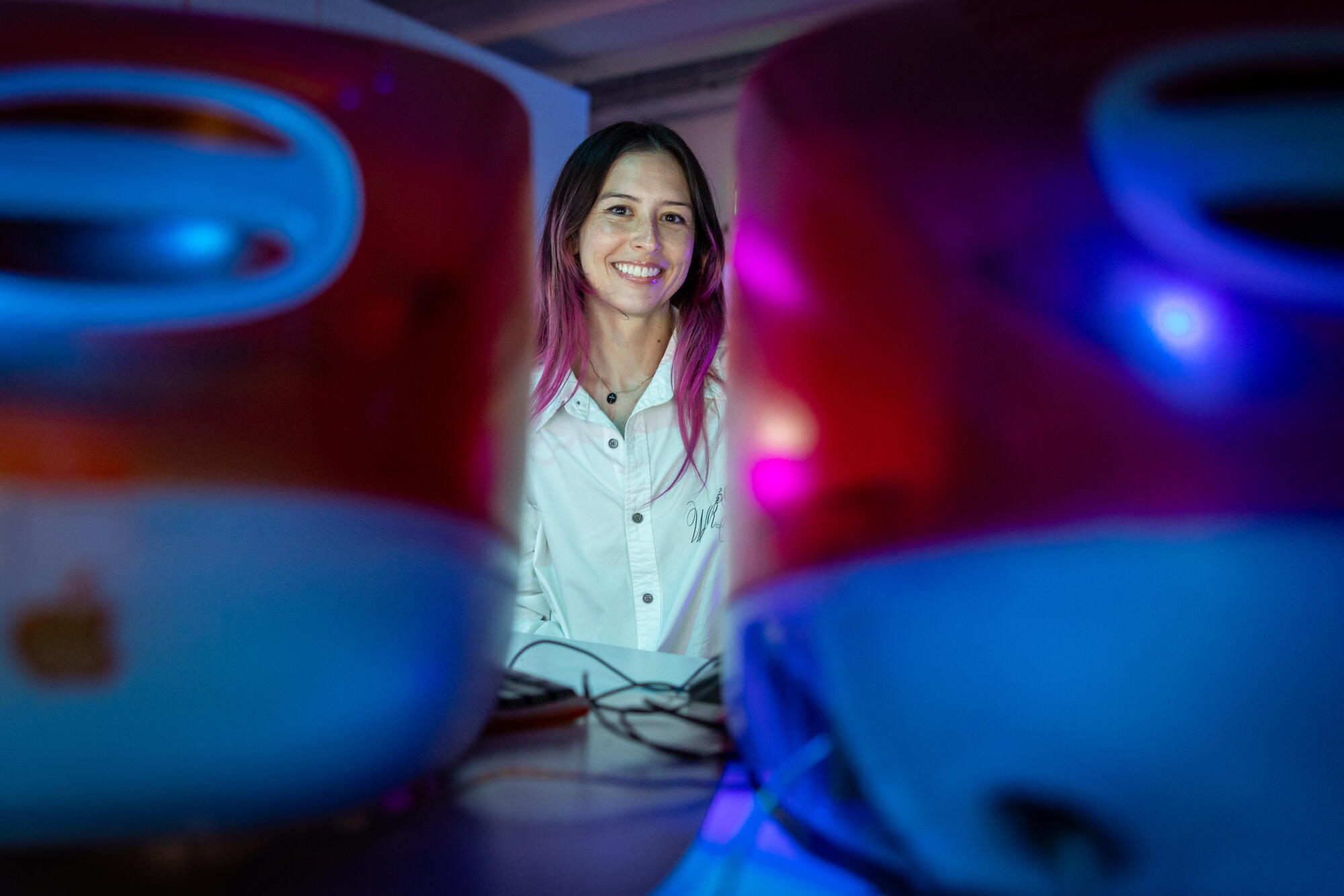
Paizley Lee created Dead Internet Theory to bring guests back to an era when tech evoked excitement rather than dread.
(Jason Armond / Los Angeles Times)
Yes, almost everyone was staring at screens, but almost no one was looking at their phone. Instead, the room felt alive and buzzing with energy. Technology was creating human connection rather than isolation.
Welcome to Dead Internet Theory, an event hosted by game designer Paizley Lee that’s both a celebration of vintage tech and a place to build community. The name is a tongue-in-cheek reference to the theory that the internet today is mostly bots, AI slop and corporate algorithms, while the human element is quickly disappearing from the web.
Lee started the event earlier this year after seeing how her friends reveled in hacking old hardware but had nowhere to show off their reimagined contraptions. She said Dead Internet Theory is a space to highlight “artists who don’t see the light of day,” a cyberpunk show-and-tell of sorts. “There’s a world of knowledge that comes from that person that can share and collaborate with another artist, and that’s really the future that we were promised, right then and there,” Lee said. “It’s the ‘Hey, look at what I made, look at what I’m interested in, and let’s share that.’ ”
Benjamin Palmer shows his project called Pan and Scan.
(Jason Armond / Los Angeles Times)
One of those artists sharing his work was Dan Ruth. Atop a low credenza, he displayed a black, leather suitcase that housed inside of it an old laptop attached to an external zip drive. On the laptop’s screen was a menu of various banned books — the Unabomber’s manifesto and “The Anarchist Cookbook” among them. Ruth had recently bought the trademark rights to the digital storage systems iOmega, Zip and Jaz. “They were what we all used in the ‘90s to transfer larger files,” he explained of the era before online storage and transfer infrastructure like Google Drive.
With his setup at the event, participants could choose whatever banned book they wanted and write it to a physical Zip disk (about the size of a saltine cracker) to keep forever. If Ruth’s installation is a bit provocative, his message is less controversial. At a time when servers are being shut down, physical media is being digitized out of existence, and the subscription model is supplanting personal ownership, Ruth believes this is a way to have data autonomy.
Guests play retro video games.
(Jason Armond / Los Angeles Times)
Lee’s own contribution to the evening is the full rainbow of Apple’s iMac G3 computers — those bubbly, teardrop-shaped desktops that debuted in 1998 to the famous “iCandy” ads displaying their colorful shells, and TV commercials scored to the Rolling Stones’ “She’s Like a Rainbow.” Over several months and multiple trips, Lee drove across the country collecting the G3s in their core five colors. And it wasn’t easy. She recalled sleeping in her car in the parking lot of a Cracker Barrel for a few nights because she had spent all her money on acquiring the computers.
It was the people Lee met in the months of gathering the G3s, however, that made it worth it: a single dad who collected vintage iMacs to bond with his son, an elementary school teacher who held onto the old computers because the school was going to destroy them.
“I met these really witchy, cool, queer programmers from MIT in Medford, Massachusetts, who invited me back for MIT Swap Fest, where I found Indigo,” said Lee, referring to another G3 color not part of the core five. “I met a guy who used to work in broadcast, and his wife just died of cancer. His mom moved in, and she has been trying to support him in getting rid of old things and not holding on to them too much.” Human moments made possible almost by the accident of holding onto a computer longer than most.
Lee’s pursuit of old tech hardware has always been, at its root, a means to meeting new people, hearing their stories and creating a relationship with them. “I care about people a lot,” she said. “I think every single person that touches any of my projects knows that I really care about people feeling good.”
Paizley Lee spent months collecting the full rainbow of iMac G3s.
(Jason Armond / Los Angeles Times)
With a mouse, Jaimie Wan clicks into the past.
(Jason Armond / Los Angeles Times)
When Lee finally acquired all five original colors (blueberry, strawberry, lime, tangerine and grape), plus all the additional colors (ruby, indigo, snow, graphite, sage and three limited edition colors), she began booting up the G3s computers to make sure they still worked. In the process, she discovered the forgotten digital detritus left on their hard drives: old resumes, photo albums, Word documents.
“It’s somebody’s life,” she said. “It feels weird to do anything with it, but it also feels weird to alter it.” In the end, she kept the old files and built a replica of the early ‘00s internet to live beside them on the computers. At Dead Internet Theory events, participants are given free reign to the G3s and slowly find clues Lee has left on their desktops that lead into a mystery game she created.
Back at the event, people flocked to the bank of iMac G3 computers. They clicked around, laughing, their eyes lighted up. “It’s really a trip seeing the old MacBooks,” said Shannon Stack after navigating one of the relics. “I remember having those in my elementary school classroom. Now, these are archival pieces. It’s freaky!”
Lee herself hovered around the computer bank, watching people interact with them and discovering the random documents left behind or playing one of Apple’s preset games. She asked a couple who had been tinkering around for over half-an-hour if they wanted a hint to her mystery. “No!” they respond excitedly.
While Dead Internet Theory has only been held in Los Angeles, Lee’s dream is to take it on the road. “I’ve got kids in Seattle, in Nashville, in Dallas that are emailing me and going, please bring it here,” she explained. The only thing stopping her was money, but that changed recently. A few weeks after the event on La Brea, she was approached by a sponsor. Now she’s making a tour happen, first with a pop-up event in New York City on Wednesday.
The event has become a place to gather and build community.
(Jason Armond / Los Angeles Times)
Recently, as Lee began driving across the country to set up, she stopped at a bed and breakfast near Red Lodge, Mont. When she learned the innkeeper had an old blueberry iMac G3 in her basement, she asked to take a look.
“I spent an hour getting her back on,” Lee said of rebooting the machine to give the innkeeper access. “And the face she made when it came back to life — literally priceless.”
The woman browsed through old photos of her daughters, their old school projects and other files forgotten over time. Afterward, the innkeeper gave Lee the computer, telling her it deserves a second life.
PM Anthony Albanese asks Apple CEO Tim Cook to back Canberra’s online safety laws to ‘keep Australians safe’.
Published On 20 Sep 202620 Sep 2026
The Australian government is seeking support from global tech giants as it works to strengthen the country’s online safety laws and artificial intelligence (AI) regulations.
Prime Minister Anthony Albanese, who met Apple CEO Tim Cook at the tech company’s headquarters in Cupertino, California, on Saturday, said that “Australia can’t do it alone” when it came to protecting children from the dangers of the internet.
Recommended Stories
list of 3 itemsend of list
“We spoke about what we’re doing to protect children from online harm and the work ahead,” Albanese wrote on social media.
“We’re putting stronger rules in place to keep Australians safe online,” he said. “And now, big tech companies like Apple are stepping up too.”
Albanese, who is also in the United States for the United Nations General Assembly, used his trip to call for stronger AI regulation after dire safety warnings from industry leaders.
Australia will introduce new standards for AI by the end of the year, he said.
In a video posted to his X account, Albanese said his Labor government is “making sure technology works for Australians”, and not the other way around.
In a post on X, Cook also said he shared with Albanese new “strong and intuitive controls to help keep kids safe online”.
New Australian legislation unveiled this month would place a “duty of care” requirement on the firms behind popular platforms, such as Facebook, TikTok and Instagram, and allow users to turn off their algorithms.
The draft laws will be introduced to parliament later this year after consultation with social media companies, industry bodies and civil society groups.
The opposition Liberal-National Coalition opposes the bill “in its current form”, according to a statement published on September 10, saying that it “contains inadequate safeguards for free speech and journalism, and leaves too much power in the hands of the Communications Minister”.
Australia implemented legislation barring children under 16 from social media platforms last year as part of a world-first crackdown designed to protect children from online bullying and “predatory algorithms”.
However, data last month found that Australians under 16 continued using social media apps such as Instagram and TikTok despite the ban.