International Air Transport Association

EasyJet urges passengers to ‘switch off’ item on board or risk lifetime ban

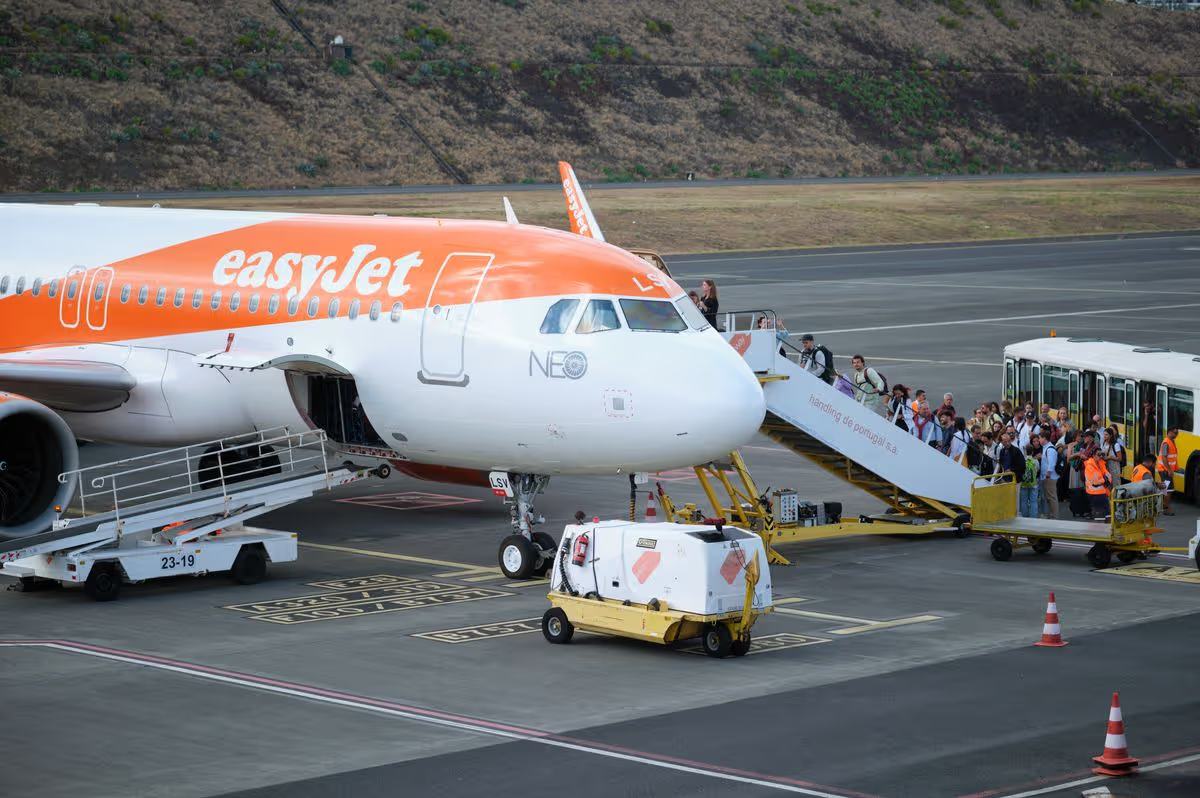
easyJet passengers are being warned they could face serious consequences if they don’t completely switch off certain electronic devices

Holidaymakers travelling with easyJet this summer are being warned that they could unknowingly fall foul of strict cabin rules unless they fully switch off a commonly used electronic device before stepping on board. The trouble is that many passengers only discover the rule once they’ve already reached the airport or are on the verge of boarding, where last-minute slip-ups could spell serious problems.

According to EasyJet, the warning relates to e-cigarettes and vaping devices, which must be carried in hand luggage only and are strictly forbidden from being stowed in hold baggage under any circumstances. The airline’s official policy states: “All electronic cigarettes and vaping devices must be carried in the cabin, re-charging is strictly prohibited and the device must be completely switched off.”

It also advises passengers to keep their devices on their person where they can be kept an eye on throughout the flight, reducing the risk of accidental activation. These rules are in place due to concerns over lithium-ion batteries, which are used to power vaping devices and are well known for posing a fire risk if they become damaged or overheat.

The UK Civil Aviation Authority categorises lithium batteries as a significant safety risk in aviation due to their potential for ‘thermal runaway’, producing intense heat and flames that are notoriously difficult to extinguish in confined spaces. The International Air Transport Association has highlighted a worldwide rise in lithium battery-related incidents, which has gone hand in hand with the increasing prevalence of portable electronic devices, prompting airlines across the globe to tighten their rules considerably.

EasyJet also warns that passengers must take precautions to prevent their vaping devices from being switched on accidentally during flights, including ensuring they are fully powered down before boarding. The airline stipulates that travellers may carry no more than two spare batteries in their hand luggage, and that these must be properly protected to prevent them from coming into contact with metal objects.

Under UK aviation rules, vaping devices must be kept in hand luggage at all times. Official government guidance states that e-cigarettes are strictly prohibited from hold baggage.

Industry experts point out that confusion often arises because rules can vary between airlines and destinations, which can leave passengers unknowingly packing the wrong items before they even reach airport security. Aviation safety specialists also warn that using or charging vaping devices while on board flights is strictly prohibited by all major airlines, with penalties ranging from confiscation to fines or even travel bans in severe cases.

As summer travel demand picks up, holidaymakers are being urged to check airline regulations before they set off to avoid delays, confiscations, or being refused entry at the boarding gate.

Source link

Airlines could switch to US jet fuel to ‘ease some pressure’ amid shortage fears

The International Air Transport Association (Iata) has urged its European members to consider switching to US-made jet fuel amid rising concerns over possible shortages caused by the Iran oil crisis

European airlines should contemplate switching to US-manufactured jet fuel amid mounting worries over shortages triggered by the Iran oil crisis, a trade body has warned. The International Air Transport Association (IATA), which represents carriers, said its European members could “ease some pressure” by altering the type of fuel they use.

Commercial aviation mainly depends on two fuel grades: Jet A-1, which is utilised across most of the world, and Jet A, which is chiefly used in North America. They are comparable, with the principal distinction being that Jet A-1 has a lower maximum freezing point, offering greater versatility on long-haul and polar routes.

Jet A is predominantly manufactured outside the Gulf, from where fuel supplies are restricted by Iran’s limitations on tankers passing through the Strait of Hormuz. IATA’s director of flight and technical operations, Stuart Fox, stated in a blog that using Jet A “could give airlines facing a possible shortfall in fuel supply more options”.

He proposed this could “help the industry make better use of the fuel we have” and “keep schedules intact”. He continued: “Fuel supply could come under pressure if the war in the Middle East continues.

“Using Jet A, which is produced at scale outside the Gulf, could be a practical way to help ease some pressure on existing supply chains.

“This would have to be done through a controlled transition from one approved fuel grade to another. In normal times, that flexibility might not be noticeable. But in today’s circumstances it’s critical to keeping the whole system moving.”

Mr Fox noted that airlines looking to switch from Jet A-1 to Jet A would need to implement crucial safety precautions, including accounting for the higher freezing point and ensuring crew members are fully briefed on which fuel is on board.

On Friday, British Airways’ parent company International Airlines Group cautioned that its profits would take a hit, anticipating spending approximately two billion euro (£1.72 billion) more than budgeted on fuel this year. Chief executive Luis Gallego stated that he does not believe the group will experience “any interruption for the summer” with regard to fuel supply.

Source link

Budget airline sends out ‘cancellation’ emails to passengers on May and June flights

The low-cost airline is cancelling flights in May and June due to soaring aviation fuel prices linked to the ongoing conflict in the Middle East

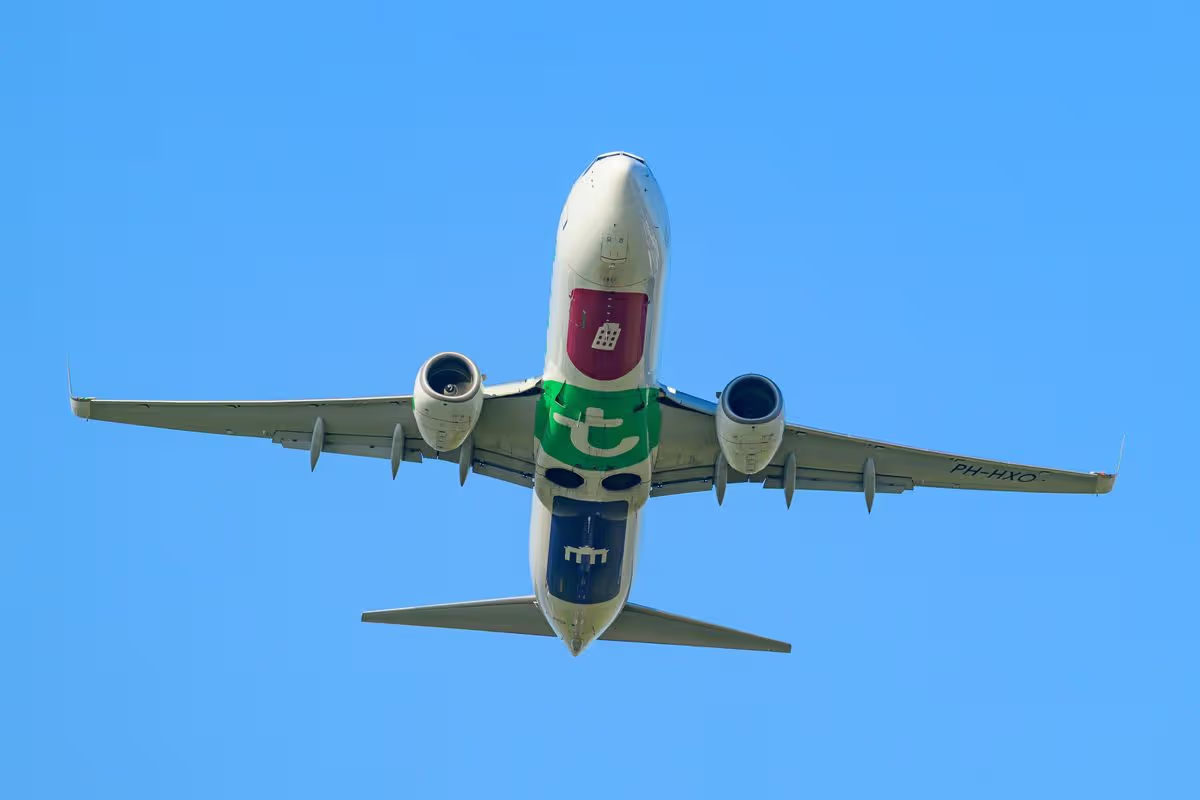
An airline that operates routes to and from the UK is axing flights in May and June because of surging fuel costs. Transavia, the budget airline owned by the Air France-KLM group, is scrapping scheduled services for May and June to cut expenses as aviation fuel prices soar due to the Middle East conflict.

The Air France-KLM group’s low-cost arm will change its timetable for May and June to streamline costs amid rocketing fuel prices linked to the Middle East war, a spokesperson confirmed to AFP. The airline operates from London Stansted to Rotterdam several times a week, and is used by tourists who fly to Schiphol airport in the Netherlands before going on to other European destinations with Transavia.

“Due to the current geopolitical situation in the Middle East and its impact on aviation fuel prices, Transavia France is adapting its flight schedule and is forced to cancel several flights scheduled for May and June 2026,” the carrier, which runs medium-distance routes, stated.

The cancellations represent “less than 2% of the flight schedule for the May-June period,” a spokesperson informed AFP. Transavia said “customers affected by a cancellation are notified individually by SMS and email.” Details of which routes are affected have not been disclosed so far.

They can then “benefit, according to their choice, from a free rescheduling, a voucher, or a full refund of their ticket.” Additionally, “for the majority of cancelled flights, a rescheduling solution within 24 hours is offered,” the airline states.

Europe normally gets half of its fuel from Gulf nations. However, since the start of the war between the United States and Iran in late February, the Strait of Hormuz has been shut down by Tehran.

In Brussels, European Commissioner Dan Jorgensen warned that the EU was “approaching very rapidly” a potential supply crisis, raising concerns about a summer characterised by “higher airfares and cancellations.” Airlines including Transavia have already begun raising ticket prices, with increases averaging approximately 10 euros per return journey, according to the carrier’s spokesperson speaking to AFP.

Chief Secretary to the Prime Minister Darren Jones warned on Sunday that the ongoing conflict is likely to push up costs for energy, food and flight tickets in the coming months, with potential disruptions to energy supplies affecting production rather than causing empty supermarket shelves.

“You’re going to see prices go up a bit as a consequence of what Donald Trump has done in the Middle East,” he told the BBC’s Sunday With Laura Kuenssberg programme. “That’s probably going to come online not just in the next few weeks, but the next few months. There’s going to be a long tail from this.”

When pressed on how long elevated prices could last, he indicated it would be roughly eight months after the Strait of Hormuz is reopened and tensions in the region begin to ease. “I think our best guess is eight-plus months from the point of resolution that you’ll see economic impacts coming through the system,” the minister said.

Last week, German airline Lufthansa said it would cut 20,000 European short-haul flights over the summer. It blamed the price of jet fuel.

An industry expert told travel journalist Simon Calder on his podcast last week that he expected more flights to be cut by airlines. Ted Wake, managing director of Kirker Holidays, said: “I think Lufthansa has got a very comprehensive schedule. Twenty thousand flights isn’t a drop in the ocean but it’s a relatively small number if you look at the overall picture.

“I think other airlines within the UK market will be doing something similar.”

Source link

Ryanair explains why thousands of flights have been cancelled

Ryanair is calling on passengers to act

Thousands of Ryanair flights have been cancelled, with the budget carrier continuing its campaign to “keep EU skies open”.

Ryanair has set up a a petition, aimed at the European Commission, to reduce the impact of French Air Traffic Control (ATC) strikes on EU flights. The campaign has now garnered support from more than two million people, with thousands of flights scrapped – and more disrupted – in 2025 alone. In October of last year, Ryanair CEO Michael O’Leary said: “It is inexcusable that Europe’s worst performing ATCs in France, Spain, Germany and the UK continue to inflict avoidable delays and cancellations on millions of EU citizens every month.

“Despite warnings, Europe’s ATC performance is not improving, as national providers fail to properly staff and manage their operations. EU ATC needs reform and its passengers who are paying the price.

“ATC delays have already disrupted 33m citizens so far this year, with France, Spain, Germany and the UK consistently failing to staff and manage their services properly.”

The International Air Transport Association (IATA) reported last month that Air Traffic Flow Management (ATFM) delays in Europe have “grown sharply” in recent years, with this “far outpacing traffic growth”. ATFM delays, it said, “have cost airlines and passengers an estimated EUR 17.5 billion since 2015 (in 2025 prices), of which over 70% is linked to capacity shortages and staffing issues”.

The Council of the European Union said last year that “the air traffic control system is increasingly struggling to manage this growing demand”, noting that while “close coordination has been underway for many months between the European Commission and EUROCONTROL as well as ongoing planning between the EUROCONTROL Network Manager, airlines, airports, air navigation service providers and the military … resolving the issue also requires political will at the national level as each country is responsible for providing adequate air traffic services and making the necessary investments to support these services.”

Source link