interior department

Suspect arrested in World War II Memorial vandalism in Washington

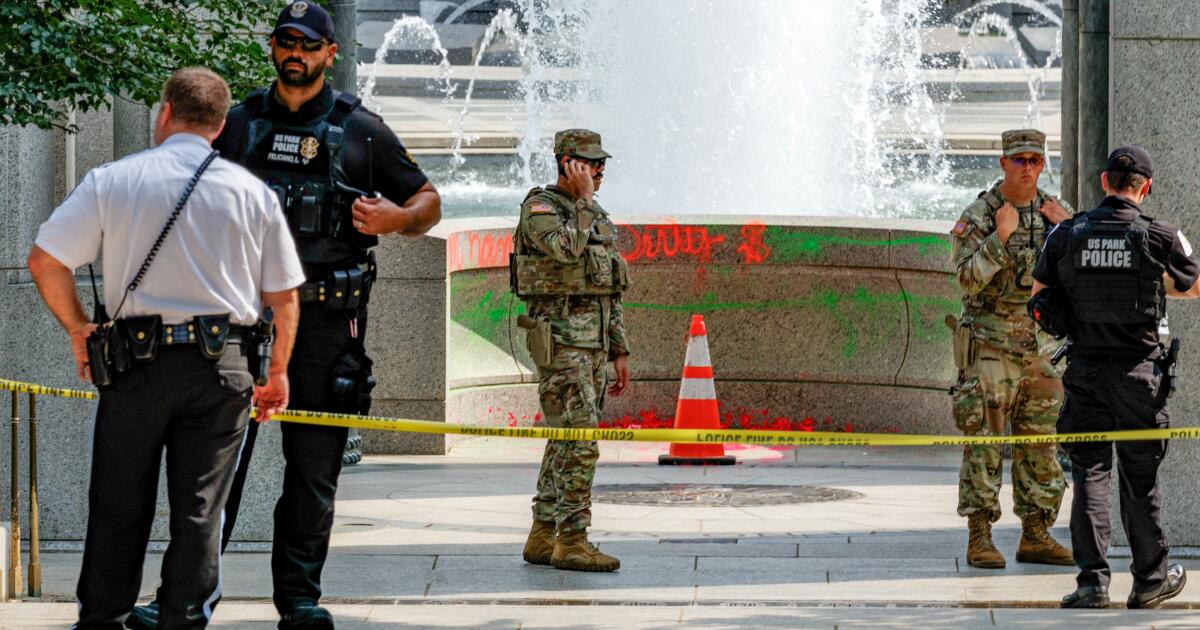
A person has been arrested in connection with vandalism at the World War II Memorial on the National Mall in Washington, D.C., U.S. Atty. for the District of Columbia Jeanine Pirro announced Friday.

Pirro announced on X that her office was filing two felony charges against Melissa L. Farris. Pirro said the felony charges are “Depredation Against Property of the United States and Destruction of Veterans’ Memorials.” The offenses carry penalties of up to 10 years in prison.

On Thursday, the words “Clean hands dirty $” were found painted on the monument and bubbles filled a fountain.

“Vandalizing our World War II Memorial is a despicable attack on a sacred monument honoring the Americans who fought and died for our freedom. Those Americans include my father and grandfather,” Pirro wrote.

A woman identified on her Facebook page as Melissa Lovewell posted a video Thursday in which she is seen taking cans of spray paint from her bag and then painting the monument.

“I will wait here to be arrested for spraying our veterans’ fountain,” she says. “It was me, I’m doing it, it’s on camera.”

In a video posted Friday, the woman, who in a separate post said she had been in Washington for three weeks, said she was turning herself in.

The arrest warrant filed in the case indicated that witnesses took pictures of the vandalism occurring, which were circulated among U.S. Park Police officers.

One officer recognized the suspect as someone they arrested Aug. 10 “for unlawfully camping on federal property” just blocks away. She livestreamed that arrest, the warrant said.

The suspect was identified by her Kentucky driver’s license as Melissa L. Farris, of Elizabethtown, Ky.

Farris was expected to be arraigned Friday. The public defender’s office said she was not yet listed in the system and had not been assigned an attorney.

The incident sparked harsh rebukes from Pirro and President Trump and comes after the president blamed damage to the nearby Lincoln Memorial Reflecting Pool on vandals, without providing evidence. That case prompted charges against multiple people, which were dropped when Pirro said evidence showed the damage came from botched repairs after Trump’s renovation at the site.

“Our beautiful World War II Memorial was just hit by Spray Painting Vandals,” Trump said on Friday on his Truth Social site. “First the Reflecting Pool, now this.”

The Interior Department said that the U.S. Park Police were on the scene following the Thursday vandalism and an investigation was ongoing. “The public should know we will find the person responsible for this disgusting act,” the department said.

The Friends of the National World War II Memorial, a nonprofit organization that helps maintain the site, said: “There are many places in our country for expression, debate, and disagreement. A national memorial honoring those who served and those who never returned home should never be used as a canvas for vandalism.”

The Veterans of Foreign Wars called the vandalism “an act of profound disrespect, a slap in the face to the veterans who served and sacrificed and to the families who carried that burden at home.”

A former Olympian was charged in late July with deliberately damaging the Reflecting Pool, but the Justice Department later moved to dismiss that case, saying evidence prosecutors had received refuted the idea that vandals were to blame.

Trump sharply criticized Pirro’s assessment that damage to the Reflecting Pool was the result of shoddy construction and not the work of vandals, as he claimed.

The case dismissal was an embarrassing setback for a Justice Department that had previously echoed Trump’s claims and billed the prosecution as accountability for damage at a Washington landmark, a pet project of Trump. Pirro’s decision to drop the case was also a rare moment during Trump’s second term of an aide or political appointee openly defying him.

Fields writes for the Associated Press.
Source link

Federal panel reviews park fencing plan and White House visitor screening center

The Trump administration is proposing to improve security around the White House by putting up a fence around nearby Lafayette Park to help limit public access when law enforcement authorities determine doing so is necessary.

The proposal is scheduled for consideration on Thursday by the U.S. Commission of Fine Arts, according to a meeting agenda and the plans posted on the agency’s website. The agency has oversight over the design of construction on federal land in Washington.

The commissioners are also set to take another look at the design for an underground facility to screen the thousands of tourists and others who visit or work at the White House. All seven commissioners were appointed by the Republican president.

The proposals are being considered at a time when security for the president has become a top concern. President Trump has been the target of multiple assassination attempts, including two during the 2024 campaign and a third this past April as he attended a dinner in Washington with White House journalists.

Those concerns were heightened the following month after U.S. Secret Service officers fatally shot a man who opened fire near a White House security checkpoint.

The administration says the projects will be an improvement over temporary structures that have long been used to aid perimeter security, like barriers fashioned out of bicycle racks, and for screening the many guests who access the White House and its grounds.

A look at both projects:

Lafayette Park last had a permanent fence in the late 1800s

Trump was accompanied by Interior Secretary Doug Burgum on a recent tour of the park to see updates being made at his direction. The president has worked with the Interior Department and one of its agencies, the National Park Service, to restart dormant park fountains.

“We’re really doing a job at Lafayette Park, which is really the entrance to the White House, and that’s going to be completed very shortly and it’ll be incredible,” Trump said in June.

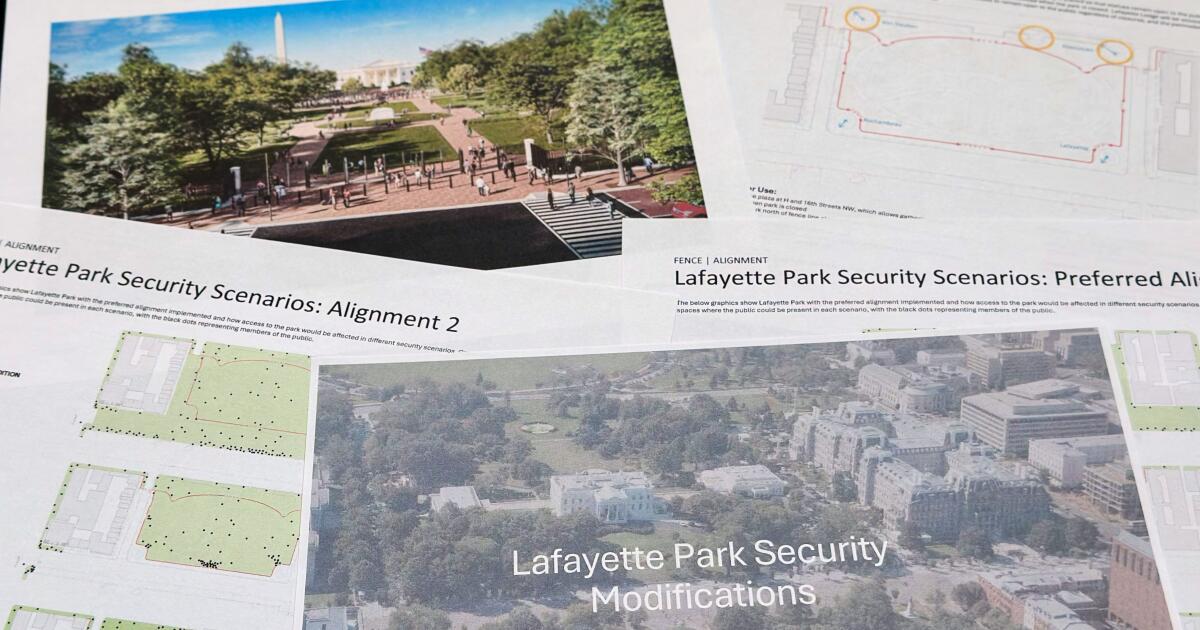
The administration’s 79-page proposal for the 8-acre (3-hectare) park calls for fencing it all the way around with gates at the north and south entrances to control public access. Options call for either including or excluding four monuments located at each of the park’s four corners.

The proposal, which is backed by the Secret Service and the Executive Office of the President, in coordination with the Interior Department and National Park Service, notes that leaving out the monuments would expose them to vandalism.

The report says the goal of the plan is to “enhance long-term safety,” preserve the Lafayette Park’s identity as a significant National Park Service landscape and “maintain public access to this nationally symbolic space.” Throngs flock to the park to protest or celebrate major events.

Lafayette Park has not had a permanent fence around it since the 19th century. The Secret Service anticipates the fence would start going up sometime next year.

The administration wants similar fencing along Pennsylvania Avenue on the north side of the White House complex, from the Treasury Department building at 15th Street to the Eisenhower Executive Office Building at 17th Street. The report said that will be treated as a separate proposal and submitted to the commission at a later date.

White House visitor screening facility could replace currently used tents

The commission is set to review a revised design for the facility, which would be built beneath Sherman Park, federal land southeast of the White House, to support screening for public tour participants, guests attending large events, White House staff and contractors.

The original design called for locating the facility’s entrance at the southern end of the park, but meetings and consultations led to a revised proposal that shifted the entrance to the western edge of the park to avoid conflicts with infrastructure and minimize the impact on the surrounding views, according to the report submitted for the commission’s review on Thursday.

The administration said the permanent facility will eliminate the need for a series of temporary screening tents currently used for events, improve security on the White House complex and enhance the experience for visitors.

The Secret Service, Interior Department, National Park Service and Executive Office of the President want to start construction in August on the 33,000-square-foot (3,066-square-meter) underground facility. They have set a July 2028 date for it to be operating.

White House visitors would face an initial ID check before they enter the facility through a pavilion located above ground, then head down to a lower level and a second checkpoint. After they are cleared, visitors will ride escalators that will take them up to the White House grounds.

Superville writes for the Associated Press.

Source link