interfere

Will Trump interfere in the midterms? Democrats and their allies are preparing

Big-city mayors are giving poll workers panic buttons in case election skeptics question their work. County and state officials are gaming out responses to immigration raids near voting centers.

Lawyers for Democratic states and civic groups are pre-writing legal challenges to ballot seizures. And Democratic aides in Washington are preparing members of Congress to push back in the court of public opinion against any baseless claims of voter fraud in competitive districts.

Across California and the nation, civic organizations, voting rights advocates and Democratic leaders are preparing for a raft of potential actions by the Trump administration to interfere in, subvert or deny November’s midterm vote.

President Trump, an election denier for years, has without evidence described the U.S. election system as badly corrupted by fraud and dangerously vulnerable to both domestic and foreign interference.

He has said he would do “anything necessary” to have “honest elections,” and has tried since returning to office to unilaterally rewrite the rules for voting nationwide and wrest control of elections from the states through executive orders and other administrative measures.

Now, he has declined to rule out additional and unprecedented steps to force his will on the November election, including through emergency declarations and military deployments, and in February suggested Republicans should simply take over voting in blue states.

Election experts say there is no evidence of widespread voter fraud in American elections, despite Trump’s allies searching for years.

A worker looks through ballots at a Los Angeles County Ballot Processing Center

A worker looks through ballots at a Los Angeles County Ballot Processing Center on Monday, June 8, 2026 in City of Industry, CA. Counting continues on ballots cast for the state’s primary election held June 2.

(Eric Thayer/Los Angeles Times)

Much of the work to resist any Trump interference or power grab is being done quietly to avoid revealing too much of the strategy to the Trump administration or stoking unnecessary fear among voters.

It is designed to match what Trump’s opponents see as his three-part “interference playbook” — to “deceive” voters before the election, “disrupt” the vote itself and “deny” any unfavorable results after, said Justin Vail of Protect Democracy, a prominent litigant against the administration.

“The threats are real,” Vail said, “but the preparation is larger and more coordinated than ever before.”

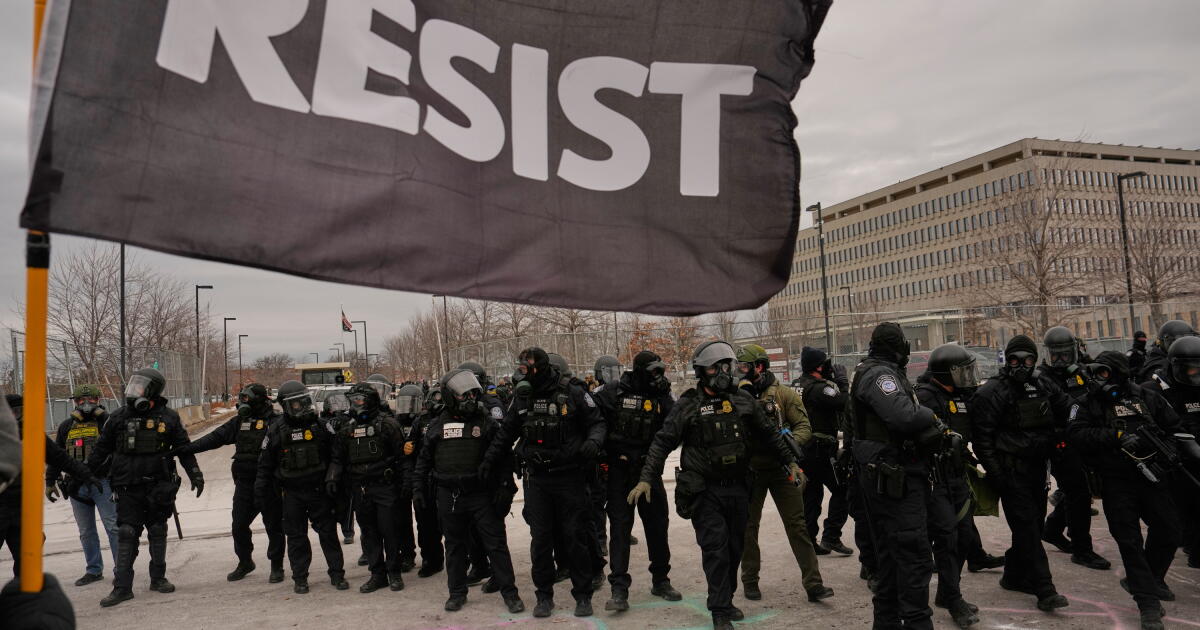
The scenarios being planned for include the president deploying troops or immigration agents to polling sites to intimidate voters, fomenting unrest as a pretext to declare a national emergency, claiming fraud in the ballot counts of key congressional races or commanding the U.S. Postal Service to intervene in mail ballot delivery.

All told, the efforts amount to an unprecedented exercise to ensure the nation’s elections are safe from its own federal government.

They also reflect a deterioration in trust between states and counties overseeing elections, voting rights and pro-democracy advocates and a federal administration that has denigrated their work and tried to take control of voting away from states.

As public frustration with the economy mounts and Trump’s approval rating sinks, Democrats have become hopeful their party will retake power in Congress. Trump, meanwhile, has suggested that alleged election integrity problems will be the culprit if Republicans lose.

In California, 61% of voters recently identified federal inference in November as a “major concern,” according to a UC Berkeley Institute of Governmental Studies poll co-sponsored by The Times.

“We are taking this threat really seriously,” said Sen. Adam Schiff (D-Calif.), who helped form a Senate task force to prepare. “Politically, I’m very optimistic about the midterms. But I’m also deeply concerned with the president’s willingness to interfere with them — and the fact that, unlike even in 2020, where there were at least some people around him to try to constrain what he was doing, all those people are gone.”

President Donald Trump is seen on a screen as his supporters cheer during a rally on the National Mall

President Donald Trump is seen on a screen as his supporters cheer during a rally on the National Mall on January 6, 2021 in Washington, DC. Trump supporters gathered in the nation’s capital today to protest the ratification of President-elect Joe Biden’s Electoral College victory over President Trump in the 2020 election.

(Samuel Corum / Getty Images)

Much of the work is legal preparation among Democratic state attorneys general and lawyers with leading civic organizations. Nothing is being ruled out after Trump’s supporters, at his goading, violently attacked the U.S. Capitol on Jan. 6, 2021, following his 2020 election loss to Joe Biden.

Other preparation is political, as members of Congress, mayors and other elected officials position themselves to use their bully pulpits and legislative powers to punch back. And grassroots campaigns are also unfolding, as community leaders recruit voters to defend their local elections, including online.

“This is an all-hands-on-deck task,” said Skye Perryman, president of the nonpartisan legal organization Democracy Forward. “We’re anticipating scenarios we haven’t seen before in the United States.”

Trump, who has never accepted his 2020 loss to Biden despite scores of reviews and audits confirming the result, has consistently sought to undermine Americans’ trust in elections, telling the nation in a prime-time speech last month that the voting system was “broken” and claiming that the SAVE America Act, a strict Republican-proposed voter ID and citizenship measure, is necessary to fix it.

The White House said it wouldn’t respond to hypothetical questions about the midterm election, but said anyone who breaks voting laws will be held accountable. Lauren Bis, a White House spokesperson, blamed “extreme liberal Democrats” for undermining U.S. confidence in elections by blocking the SAVE America Act, which Trump has failed to push through Congress.

Bis claimed voters support such changes, and said “President Trump is absolutely right: We fix this now, or we lose our country.”

Causes for concern

The fears of interference are driven by Trump’s long record of election denial; his recent insistence that the midterms are vulnerable to both domestic fraud and foreign interference; his success installing loyalists and fellow election deniers in powerful positions throughout his government; and his current administration’s many attempts to usurp control over state voting processes, including through executive orders, lawsuits and legislation.

Trump and his allies have sued to compel blue states to turn over voter rolls; seized ballots in Georgia; tried to limit mail voting via new U.S. Postal Service rules; pushed stricter citizenship and voter ID requirements via executive order and in Congress; diminished independent agencies tasking with helping states secure elections; kicked off a nationwide gerrymandering effort to boost Republican chances in the House; and threatened to imprison Democratic leaders who stand in their way.

Sen. Majority Leader John Thune and others at the U.S. Capitol

Sen. Majority Leader John Thune (R-SD) (C) departs after a meeting with U.S. President Donald Trump and Republican senators at the U.S. Capitol on June 24, 2026 in Washington, DC. President Trump is visiting Capitol Hill to attend a closed-door luncheon with the Republican Senate Steering Committee to push his SAVE America Act, which would impose strict voter ID and proof-of-citizenship requirements in federal elections.

(Kevin Dietsch / Getty Images)

Some analysts saw Trump’s speech last month as laying the groundwork for greater intervention in November, and he raised further alarm this month by entertaining a suggestion from conservative radio host and election conspiracy theorist Wayne Allyn Root that the president has “the right to declare a national security emergency” to unilaterally enforce new voting restrictions.

“Stranger things have happened,” Trump responded.

The White House has previously downplayed the likelihood of immigration agents being deployed to polling locations, but Trump has refused to rule it out. Legal experts say such a move would probably be swiftly blocked by courts, as would any unlawful deployment of military troops to polls.

Some voting experts said Trump’s efforts shouldn’t be blown out of proportion, particularly given federal courts’ dim view of them to date.

David Becker, executive director of the nonpartisan Center for Election Innovation & Research, noted Trump’s executive orders on elections were blocked, the Justice Department is 0 for 23 in cases demanding state voter rolls, and the primaries have run smoothly with high turnout — showing the president is “having very little effect.”

Kim Alexander, president of the California Voter Foundation, said it is “important that people be aware that there are threats, but to not let those threats be debilitating” or prevent them from voting.

Civic experts are urging regular voters to help debunk misinformation about voting within their communities. Democracy Forward has asked people to take one civic-minded action per day leading up to the election, while Indivisible, a progressive grassroots organization, is training volunteers nationwide to mount public push-back to any interference.

Coordination in Congress

A Senate aide who spoke with The Times on condition of anonymity said members of the Senate task force meet regularly to plan for as many potential forms of interference as possible — and that there is “no bottom” to what they’re considering.

Task force members are studying nuanced local election laws to understand how Congress members should respond to any federal interference in their home states, and working on “coordinated messaging” that all members can use in response to immigration raids or other broad interference, the aide said.

National Guard troops stand in the shade at The Park at LeDroit

National Guard troops stand in the shade at The Park at LeDroit in Northwest on August 12, 2026 in Washington, DC. U.S. President Donald Trump is claiming credit for Washington’s dramatic crime decline a year after Trump sent thousands of National Guard troops to the nation’s Capitol, but the evidence shows crime was already falling before his federal intervention and the extent to which his policies accelerated that decline remains disputed.

(Andrew Harnik / Getty Images)

They are also reading “line by line” through recent legal decisions limiting National Guard deployments and other federal actions to identify any “loopholes” the administration might exploit.

They are paying particular attention to districts with competitive congressional races and where past problems have arisen. In California, they’ve studied the recent seizure of ballots by Riverside County Sheriff Chad Bianco and the criticism of slow ballot counting statewide, the aide said.

Schiff said the scenario he is “most concerned” about is one in which the president or his allies “seed” unrest in big cities to “give the president a pretext, Reichstag fire-like, to call out the military or invoke the Insurrection Act or call out ICE or Border Patrol.”

The Reichstag fire erupted in the German parliament four weeks after Adolf Hitler was sworn in as chancellor in 1933, and was used to justify a sweeping crackdown on political opponents and the suspension of civil liberties — ushering in Nazi rule.

Schiff said lawsuits will be a necessary but “very imperfect remedy” in such a scenario, and Democrats will need to develop a more robust response combining “litigation with mobilization” and legislative oversight.

Sen. Alex Padilla (D-Calif.), the ranking Democrat on the Senate Committee on Rules and Administration, which has election oversight, is helping to create an election observer program for hotly contested races, and has warned his colleagues that he will call a vote on any election-related emergency Trump declares, so that they must co-sign or resist it.

Separately in the House, staffers have been building their own “road map” for how to deal with a laundry list of “terrible things that bad-faith actors who seek to subvert the election could do,” with a principal focus on any ways they might disrupt the Jan. 3 swearing in of new Congress members, said a House aide involved in the preparations there, who spoke with The Times on the condition of anonymity.

The U.S. Capitol, on July 20, 2026 in Washington, DC

The U.S. Capitol, on July 20, 2026 in Washington, DC.

(Tom Brenner / Getty Images)

House staffers are also looking at how court imposed limits on Trump’s emergency powers might be “exploited, weaponized [or] ignored” by the administration, including the Justice Department.

A Justice Department spokesperson said the department is “working diligently” to fulfill the demands of Trump’s election-related executive order purporting to “strengthen the integrity of our elections,” which courts have blocked, and has “statutory authority to enforce our nation’s election laws, including through requesting state voter rolls,” which courts have also blocked.

Assistant Atty. Gen. Harmeet Dhillon, who heads the department’s civil rights division and has threatened local elections officials with legal consequences if they don’t comply with her voter roll demands, said her division “has a statutory mandate to enforce our federal voting rights laws, and ensuring the voting public’s confidence in the integrity of our elections is a top priority of this administration.”

State and local preparations

California Atty. Gen. Rob Bonta said attorneys from his office and similar Democratic ones across the country are “hard at work planning, preparing, strategizing, researching, getting ready for all the different ways the Trump administration can break the law.”

California Attorney General Rob Bonta, right, holds a press conference

California Attorney General Rob Bonta, right, holds a press conference at the Ronald Reagan State Building in downtown Los Angeles on Thursday, May 14, 2026.

(Christina House/Los Angeles Times)

That includes any attempts to seize ballots, deploy federal law enforcement or the military, or command the U.S. Postal Service to interfere with mail ballots, he said. “The right to vote is the right from which all other rights flow. It’s fundamental. We need to protect it.”

Dean Logan, registrar-recorder and county clerk for Los Angeles County, said he has a responsibility to ensure that “election operations remain secure and uninterrupted” no matter the threat, and is taking steps to do so, though he declined to address potential acts by Trump. Long Beach Mayor Rex Richardson said big cities are also preparing, including to prevent harassment of voters or election workers.

“Cities are where we host vote centers. It’s where the volunteers come from, where people go with their questions,” Richardson said. “We have to pay attention to national rhetoric. We have to be aware of anxiety that might — tensions that may — arise.”

Source link

The US is now using the ‘terrorist’ label to interfere in Brazil’s election | The Far Right

In designating Brazil’s two largest criminal organisations, Primeiro Comando da Capital (PCC) and Comando Vermelho (CV), as “terrorist” groups, the United States has asserted its own definition of Brazil’s security threats, with consequences that reach far beyond law enforcement. The move is being presented by both the US and the Brazilian far right as a “necessary response” to the “growing transnational reach of organised crime”, but, in reality, it says far more about politics than security.

The designation reflects a dangerous convergence between Washington’s longstanding interventionist instincts in Latin America, echoing memories from the US-sponsored dictatorship that lasted from 1964 until 1985, and the interests of Brazil’s far right.

PCC and CV are indeed responsible for violence on a massive scale. They are among the most powerful criminal networks in Latin America and pose a genuine threat to public security in Brazil and beyond. But violence, however extreme, does not in itself make an organisation “terrorist”. Although the term is contested, terrorism is generally understood to involve violence pursued for political or ideological ends.

PCC and CV may corrupt institutions, influence politicians, control territory or confront the state when it serves their interests, but their primary purpose is criminal power and profit, not political transformation. Politics is a means of protecting and expanding their operations, not the reason those organisations exist.

The more broadly governments apply the terrorism label, the more it risks obscuring the nature of the security threat itself, while giving states greater scope to use such designations for political ends. That makes the question of why Washington chose to act now particularly important.

Neither PCC nor CV is a newly discovered threat. The PCC has existed since the early 1990s; the CV is even older, and both organisations and the harm they cause have been known to Brasilia and Washington alike for decades.

So why did the US decide in 2026 that these long-established organised crime networks should now be designated “terrorist” groups?

The answer appears to lie less in any new assessment of the threat than in Brazil’s domestic politics.

The timing of the designation is difficult to separate from the Bolsonaro family’s efforts to enlist Washington in its political fight with President Luiz Inacio Lula da Silva’s government. Former President Jair Bolsonaro is serving a 27-year-and-three-month sentence for his role in an attempted coup following his 2022 election defeat, while his sons have increasingly taken that fight to the US.

Flavio Bolsonaro, one of the former president’s sons, has spent months portraying Lula as soft on organised crime and pressing US officials to take a harder line against his government, including by directly pushing the Trump administration to designate PCC and CV as “terrorist” organisations. His brother Eduardo Bolsonaro, who now lives in the US, went further during the proceedings against their father, lobbying for sanctions against Brazilian Supreme Court justices and tariffs on Brazil. On June 16, Brazil’s Supreme Court sentenced Eduardo to four years and two months in prison for coercion over that campaign.

Flavio’s lobbying also has an immediate electoral significance. He has emerged as Lula’s main challenger in October’s election. An August 11 CNT/MDA poll put Lula on 42.4 percent in the first round and Flavio on 28.7 percent.

In that electoral context, the terrorism designation serves an important political function, reinforcing a narrative promoted by the Brazilian far right that Lula is aligned with criminal organisations or unwilling to confront them. The objective is not necessarily to prove such claims, but to create a climate of suspicion that can be weaponised domestically and used to justify greater US involvement in Brazil.

During far-right demonstrations, it is common to see supporters of the Bolsonaro family displaying US flags and openly asking for military and foreign intervention to “save” Brazil from the left. The US flags and calls for intervention are therefore not merely theatrical; they reflect a political movement that increasingly looks to Washington as an ally in its domestic struggle.

The strategy is familiar. Across the world, right-wing movements have increasingly blurred distinctions between crime, migration, political opposition and terrorism. Security rhetoric has become a tool for delegitimising opponents and justifying extraordinary measures.

Mexico offers a notable example. Calls from US politicians to classify Mexican cartels as terrorist organisations have often been accompanied by proposals for unilateral military action inside Mexican territory. And after Nicolas Maduro was kidnapped by US forces from his secure residence in Caracas, any Latin American leader has reason to take Trump’s threats of unilateral action seriously.

The issue, then, is not simply how Washington defines a security threat, but what powers and forms of intervention that definition can be used to justify. That question now extends directly to Brazil. Washington insists that the designation of groups such as the PCC and CV as terrorist organisations merely provides additional legal tools, but those tools carry consequences well beyond criminal prosecution. They give US authorities greater powers to freeze assets, impose sanctions and prosecute individuals accused of supporting these groups.

They also create new compliance obligations for companies operating in Brazil and expose financial networks to increased scrutiny. Banks may have no knowing connection with PCC or CV and still face pressure to show that their systems have not been used, directly or indirectly, to move funds linked to them. Tracing such links through clients, third parties, front companies and complex payment chains can be extraordinarily difficult.

The financial implications also intersect with a separate US dispute over PIX, Brazil’s central bank-run instant payment system, which has become a major alternative to card networks such as Visa and Mastercard. Washington has scrutinised PIX as part of a broader trade dispute, while Flavio Bolsonaro has proposed limiting its future links with non-Western payment systems.

The PCC and CV designation could add another layer of scrutiny if funds linked to either group are found to have moved through PIX.

Brazilian security officials have also warned that the designation could complicate long-established channels of police cooperation with the US. Joint investigations into PCC and CV rely heavily on routine intelligence-sharing and coordination between law enforcement agencies, but treating the groups as “terrorist” organisations could shift some investigations into more restricted intelligence and national-security channels, making that cooperation harder rather than strengthening it.

Beyond these immediate consequences, the designation creates a precedent for deeper US involvement in Brazilian security policy, and the whole of Latin America has seen this movie before.

Throughout the Cold War, Washington routinely justified interventions by framing domestic political conflicts as components of a larger ideological struggle against communism. Governments, social movements and political actors were classified according to their usefulness within broader US strategic objectives.

Today, anticommunism has largely been replaced by counterterrorism as a justification for intervention, even though Trump and the far right have also revived the fear of communism, applying it to almost anything to their left. The vocabulary has changed, but the logic remains strikingly similar.

By defining threats unilaterally and exporting those definitions abroad, Washington creates new avenues for political influence within sovereign countries that have experienced US intervention before.

Brazil has a serious organised crime problem that requires robust law enforcement, international cooperation and institutional reform. But combating criminal organisations effectively requires understanding what they are, not what political actors would like them to be.

PCC and CV are dangerous precisely because they are sophisticated criminal enterprises. Recasting them as “terrorist” organisations may generate political advantages, but it risks obscuring the nature of the threat itself.

Washington is turning a complex domestic security problem into a geopolitical and ideological battleground.

And in Latin America, history suggests that when Washington starts redefining domestic problems through the lens of its own political interests, sovereignty is often the first casualty.

The views expressed in this article are the author’s own and do not necessarily reflect Al Jazeera’s editorial stance.

Source link