interest

Trump increased investments in drugmakers that benefited from Medicare exemptions, Democrats say

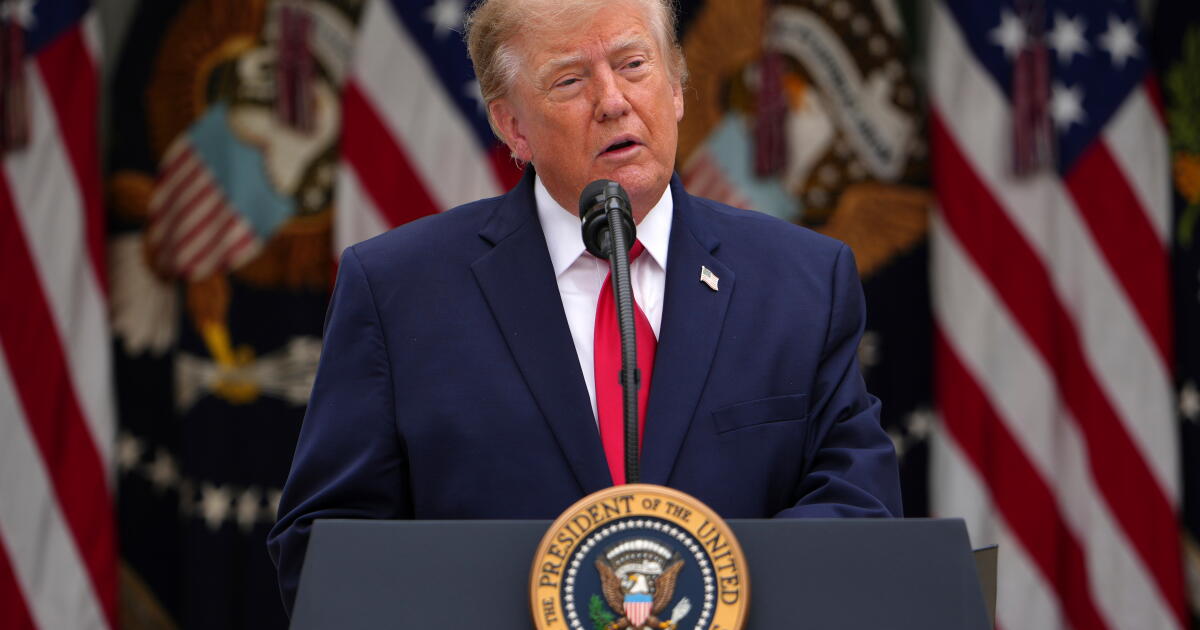
Investments in pharmaceutical companies made on behalf of President Trump increased significantly after he returned to the White House last year, with his portfolio adding millions of dollars in stock in firms that benefited from a Republican-backed law that shields certain medications from Medicare price negotiations, according to a report from congressional Democrats.

The report, released Friday by the Joint Economic Committee’s minority arm, found that Trump’s pharmaceutical stock holdings grew from a maximum reported value of $1.7 million in 2024 to as much as $56.2 million at the end of 2025. The report said that included up to $39.1 million worth of stock held in companies that benefited from exemptions to Medicare’s drug price negotiation program, which came through a provision in the Republicans’ 2025 tax and spending law.

Additional analysis of Trump’s financial disclosures provided by committee Democrats showed that his investment portfolio bought as much as $2.55 million in shares of pharmaceutical companies benefiting from the exemptions on three dates before he signed the legislation in July 2025. That included up to $950,000 in purchases on July 1, 2025, the day the Senate passed the bill. His portfolio also bought as much as $1 million in AbbVie stock in August 2025, after the bill became law.

The Republican president’s wealth has grown since he took office last year through a web of business interests, many of which have benefited from the policy moves of his administration. The White House has repeatedly denied any ethics issues and accused Democrats of “attempts to fabricate conflicts of interest.”

The report also noted that the exemptions policy could leave some Medicare beneficiaries paying thousands of dollars more for certain cancer treatments and other medications than they would have if Medicare had been allowed to negotiate lower prices.

The findings come as Trump has made lowering prescription drug costs a central part of his healthcare policy, striking deals with pharmaceutical companies that his administration says will make medications more affordable for Americans, although drug pricing is based on a complicated set of factors.

Recent polling from the Associated Press-NORC Center for Public Affairs Research shows that most Americans think Trump is profiting off the presidency in unethical or illegal ways and is focused more on his wealth than on helping people like them.

Democratic Sen. Maggie Hassan, who leads the Joint Economic Committee’s minority arm, called the report’s findings “outrageous and yet typical from this president, who makes the American people foot the bill again and again for his own gains.”

Davis Ingle, a White House spokesperson, said Trump’s stock and bond portfolio is independently managed by third-party financial institutions. He denied any conflict of interest.

“Neither President Trump nor any member of his family has any ability to direct, influence, or provide input regarding how the portfolio is invested or when investments are bought or sold,” Ingle said in a statement.

A law from President Biden’s Democratic administration allowed Medicare for the first time to negotiate prices for some of the costliest prescription drugs. Republicans’ 2025 tax and spending bill expanded an existing exemption for medications developed to treat rare diseases or conditions, delaying when certain costly drugs could become eligible for negotiations or excluding them entirely, according to healthcare research nonprofit KFF.

Also known as the orphan drug exclusion, the carve out allows drug companies to continue charging lucrative prices that might otherwise have been reduced through Medicare negotiations.

Supporters of the change argued that a broader exemption would encourage drug companies to develop treatments for rare diseases. Critics say it allows makers of blockbuster medications to avoid negotiations that could lower costs for Medicare and its recipients.

The report estimated that Medicare beneficiaries receiving the cancer drugs Keytruda, manufactured by Merck, and Opdivo, by Bristol Myers Squibb, could pay roughly $5,000 more annually than they would if Medicare negotiated prices for the medications. Trump’s portfolio includes stock in both firms.

The report also said that Trump’s portfolio continued to buy and sell pharma company stocks throughout the first eight months of 2026, adding as much as $3.5 million in stock wealth in the sector.

All recent U.S. presidents have dumped their stocks before assuming office, put their money in broadly diversified funds or set up a “blind” trust so they couldn’t even know what they owned.

Trump has put his broader business interests in a trust managed by his sons. But the arrangement rejects the conflict of interest protections that his recent predecessors in office had instituted.

Hussein writes for the Associated Press. AP writer Bernard Condon in New York contributed to this report.

Source link

U.S. Bancorp expects Q4 2026 net interest income growth of 6%-7% while outlining 8%-9% full-year net revenue growth (NYSE:USB)

Earnings Call Insights: U.S. Bancorp (USB) Q3 2026

Management View

  • President, CEO & Chairman Gunjan Kedia said, “We delivered another strong quarter, highlighted by record net revenue of approximately $8 billion and diluted earnings per share of $1.34, up approximately 10% from a year ago.” She added, “Disciplined productivity drove 240

Seeking Alpha’s Disclaimer: This article was automatically generated by an AI tool based on content available on the Seeking Alpha website, and has not been curated or reviewed by humans. Due to inherent limitations in using AI-based tools, the accuracy, completeness, or timeliness of such articles cannot be guaranteed. This article is intended for informational purposes only. Seeking Alpha does not take account of your objectives or your financial situation and does not offer any personalized investment advice. Seeking Alpha is not a licensed securities dealer, broker or US investment adviser or investment bank.

Source link

Australia raises interest rates to 15-year high | Business and Economy News

Reserve Bank of Australia lifts benchmark rate to 4.6 percent amid stubborn inflation.

Australia’s central bank has raised interest rates to a 15-year high, spelling higher mortgage payments for millions of Australian households.

The Reserve Bank of Australia (RBA) on Tuesday lifted the benchmark rate by 0.25 percent to 4.6 percent, its highest since 2011.

Recommended Stories

list of 4 itemsend of list

The RBA said inflation remained elevated and that previously flagged “upside risks” had materialised, including higher energy prices due to the United States-Israel war on Iran and rising tech costs.

“There continue to be heightened uncertainties about the outlook for domestic economic activity and inflation,” the bank’s monetary board said in a statement.

“The Middle East conflict remains unresolved, and there are scenarios where inflation is higher and activity lower than forecast,” it said.

“Global oil supply disruptions are maintaining upward pressure on global and domestic energy prices and inflation. A period of prolonged uncertainty may also cause growth to be lower overseas and in Australia.”

Australia’s annual rate of inflation stood at 3.5 percent in July, well above the central bank’s 2–3 percent target.

Central banks typically raise their benchmark interest rate when policymakers believe prices are rising too fast.

Higher interest rates raise the cost of borrowing, including mortgages, cooling consumer demand and bringing down inflation.

The latest hike is set to heap further strain on Australian households already grappling with three previous increases this year.

In a research report earlier this month, Roy Morgan said nearly one-third of Australian mortgage holders, or nearly 1.8 million people, were at risk of “mortgage stress” – where households spend 25-45 percent of after-tax income on payments – as of July.

Australia’s Treasurer Jim Chalmers, who is not responsible for setting interest rates, acknowledged that the hike would mean greater hardship for many Australians.

“We know a lot of Australians are under pressure and this will make things harder,” Chalmers said in a post on X.

“Inflation and interest rates are going up around the world but we know that doesn’t take the sting out of today’s decision.”

Chalmers said the government would take responsibility for “our part of the fight against inflation”.

“That means continuing to manage the budget responsibly, rolling out tax cuts and cost of living help, and addressing the longer term challenges in our economy in an uncertain global environment,” he said.

Source link

JJ Gabriel: Barcelona sporting director denies interest in Manchester United teenager

Barcelona’s sporting director Deco said the club has no interest in pursuing Manchester United teenager JJ Gabriel.

Gabriel, 15, travelled to the Spanish city after informing United that he wanted to leave Old Trafford earlier this month.

Real Madrid, Bayern Munich and Paris St-Germain are among the clubs reportedly keen on securing his signature.

“There’s nothing to say about this boy,” Deco said at a news conference.

“It’s normal we always have players linked with us. There’s a huge market for that, even when they are young.

“We are not interested in any player in his situation. I’m not sure what’s happening, and if he’s still a Manchester United player. We are not involved in that.

“First of all, we need to understand how the situation is before we try to do something. To speak about young, teenage players, it is not our business.”

Gabriel has not trained at United since scoring a hat-trick on his Uefa Youth League debut on 10 September.

Tournament rules prevent him from playing for a side other than United in this season’s competition.

But if he obtains a European Union passport through either his father – a former Republic of Ireland international – or mother, who has Greek-Cypriot heritage, he could join a club in the EU when he turns 16 on 6 October.

Last week, United manager Michael Carrick urged for people to be “careful and sensible” about the amount of exposure and scrutiny given to the youngster.

Source link

ECB calls for tougher EU crypto rules and wider ban on stablecoin interest

A day after unveiling Pontes, its system for settling tokenised assets in central bank money, the ECB has set out how it wants Europe’s crypto rulebook rewritten.


ADVERTISEMENT


ADVERTISEMENT

The response, published on Tuesday by the European System of Central Banks, which groups the ECB with the EU’s national central banks, argues for tougher rules on stablecoins, staking and crypto firms.

It feeds into the European Commission’s review of the Markets in Crypto-Assets Regulation, known as MiCA, the EU’s rulebook for cryptocurrencies and the firms that trade them.

MiCA has applied since December 2024, and the last transitional deadline for existing operators expired on 1 July, including Binance, the world’s largest exchange, to stop serving European customers.

The Commission’s consultation will close on 30 September, a month later than planned.

The central banks’ recommendations are not binding, and the Commission will weigh them alongside other responses before deciding whether to reopen the law.

EU diplomats have told Euronews they expect a revision in 2027, which would need the approval of the European Parliament and member states.

No interest and no loopholes

Stablecoins are cryptocurrencies designed to hold a steady value, usually by tracking the US dollar.

MiCA already bars both issuers and crypto exchanges from paying interest on them, and the central banks want it kept that way.

“The payment of stablecoin remuneration should continue to be prohibited,” the ECB response says.

Their targets are the workarounds. Some exchanges, the response notes, offer crypto lending, borrowing and staking, “thereby replicating the economic effect of interest payments through ancillary or unregulated services.”

The central banks want the ban extended to those activities and to indirect rewards, such as certain loyalty-programme benefits, calling it “a clear legislative priority”.

Washington has gone the other way.

The 2025 GENIUS Act banned US stablecoin issuers from paying interest but left exchanges free to offer rewards, and whether to close that gap became one of the most contested fights over the CLARITY Act, the landmark crypto bill that fell ten votes short in the US Senate on 15 September.

A brake on US dollar stablecoins

The central banks want stronger tools against tokens pegged to foreign currencies.

It would be useful, they say, if authorities could impose “a prohibition to issue new tokens, as well as an obligation to redeem existing tokens” on issuers where central banks judge that the tokens pose a threat, including to financial stability.

More broadly, they see limited benefit in stablecoins for everyday payments at home, given instant bank transfers and the planned digital euro. They warn that MiCA provides no legal basis for issuing the same stablecoin both inside and outside the EU.

In a bank run, European reserves could end up paying holders elsewhere, while “EU authorities cannot determine with certainty how many tokens are held within the Union.”

Eurozone central banks also do not currently let stablecoin issuers hold customer funds with them.

A token fully backed by central bank money, the response warns, “would effectively result in a ‘synthetic’ central bank digital currency” that is essentially a private imitation of the digital euro and could, in theory, drain deposits from commercial banks, especially under stress.

Staking and decentralised finance

On staking, where users lock up crypto in exchange for rewards, the response is blunt: “Staking, lending and borrowing of crypto-assets should be regulated at Union level.”

Where a firm takes customers’ crypto and promises to return it, potentially with a premium, the central banks argue that the arrangement can be “comparable to the taking of repayable funds”, in the language of banking.

The same applies to decentralised finance, or DeFi, where lending and trading run on automated software rather than through a company.

MiCA exempts fully decentralised services but never defines the term, and the central banks cite studies showing that full decentralisation is rarely, if ever, achieved, leaving it unclear who is in control.

Who licenses crypto exchanges?

The central banks also back a Commission proposal to move licensing and supervision of crypto firms from national regulators to ESMA, the EU’s markets watchdog.

Currently, one national licence covers the whole bloc, which was the route Binance originally pursued in Greece.

The Wall Street Journal reported last week, citing people familiar with the discussions, that ECB President Christine Lagarde urged Greek Prime Minister Kyriakos Mitsotakis not to approve Binance’s application because of the exchange’s past compliance problems and fears that its scale could deepen the use of US dollar stablecoins in Europe.

A senior Greek regulator, according to the newspaper, told the exchange that Lagarde wanted the decision delayed until ESMA took over, the same shift the central banks endorse in Tuesday’s response. Binance withdrew the application on 24 June.

Neither the ECB nor the Greek regulator has confirmed the account. The ECB, which has no formal role in licensing crypto firms, declined to comment, while Binance said it would “not comment on speculation”.

Source link