interest

Trump vs. Powell: Interest rates, investigation and a replacement

April 22 (UPI) — Federal Reserve Chairman Jerome Powell‘s term is nearing its end and President Donald Trump is pushing for his replacement but an investigation into Powell may hold up the appointment of a new chair.

The Justice Department opened an investigation into Powell over the renovation of the Marriner S. Eccles Federal Reserve Board Building in Washington, D.C., which Trump claims has exceeded $3 billion. The renovation was not the beginning of Trump’s feud with Powell but it has added to his effort to oust the chairman before the end of his term.

Powell’s term as chairman of the Federal Reserve will end in May but he will remain on the Board of Governors until January 2028.

Typically when a Fed chair’s term ends, they resign. However, Powell said he plans to stay put until a replacement is appointed.

At least one lawmaker, Sen. Thom Tillis, R-N.C., said he would not vote on a new chairman until the investigation into Powell is over.

The Justice Department alleges that Powell made false or misleading statements to Congress about the cost of the renovation project at the Federal Reserve headquarters during his testimony to the House Committee on Financial Services in June.

Powell’s testimony was part of his semiannual report to Congress on monetary policy.

Following the hearing, Rep. Anna Paulina Luna, R-Fla., submitted a request to then-Attorney General Pam Bondi for Powell to be investigated for perjury and making false statements. Luna said that Powell denied there would be “luxury features” included in the renovations, including a “VIP dining room, premium marble, water features and a roof terrace garden.”

Luna added that Powell “falsely claimed that the Eccles building ‘never had’ a serious renovation.” She notes that the building underwent renovations in 1999 and 2003.

“These are not minor misstatements,” Luna said. “Chairman Powell knowingly misled both Congress and executive branch officials about the true nature of a taxpayer-funded project. Lying under oath is a serious offense — especially from someone tasked with overseeing our monetary system and public trust.”

No charges have been formally filed against Powell. The challenge the Justice Department faces in convicting Powell of perjury or false statements is in proving that he willfully, knowingly made statements he knew to be false at the time.

Powell, who was Trump’s nominee for chairman in 2017, has said that the investigation into him and the Federal Reserve renovation is “pretext” to punish him for not following Trump’s direction to lower interest rates.

“No one, certainly not the chair of the Federal Reserve, is above the law, but this unprecedented action should be seen in the broader context of the administration’s threats and ongoing pressure,” Powell said in a video message in January. “This is about whether the Feed will be able to continue to set interest rates based on evidence and economic conditions — or whether instead monetary policy will be directed by political pressure or intimidation.”

Last month, federal prosecutor George A. Massucco-LaTaif told Chief U.S. District Judge James E. Boasberg that the Justice Department does not know of any evidence that a crime has been committed in the Federal Reserve renovation project.

“We do not know at this time,” Massucco-LaTaif said. “However, there are 1.2 billion reasons for us to look into it.”

The fissure between Powell and Trump began and has continued over the Federal Reserve’s decision to maintain elevated interest rates in response to inflation. Trump has repeatedly called on the Federal Reserve to lower interest rates, saying the United States should “have the lowest interest rate in the world.”

All along the Federal Reserve continues to hold an elevated interest rate, currently between 3.5% and 3.75%, in an effort to tame inflation. Its target rate of inflation is 2% on an annual basis.

Economic markers from the U.S. Bureau of Labor statistics show the rate of inflation remains at about 3%.

Trump has nominated Kevin Warsh to succeed Powell. Warsh served on the Fed’s board for five years after being appointed by President George W. Bush in 2006.

“I have known Kevin for a long period of time, and have no doubt that he will go down as one of the great Fed chairmen, maybe the best,” Trump posted on social media in January. “On top of everything else, he is ‘central casting,’ and he will never let you down.”

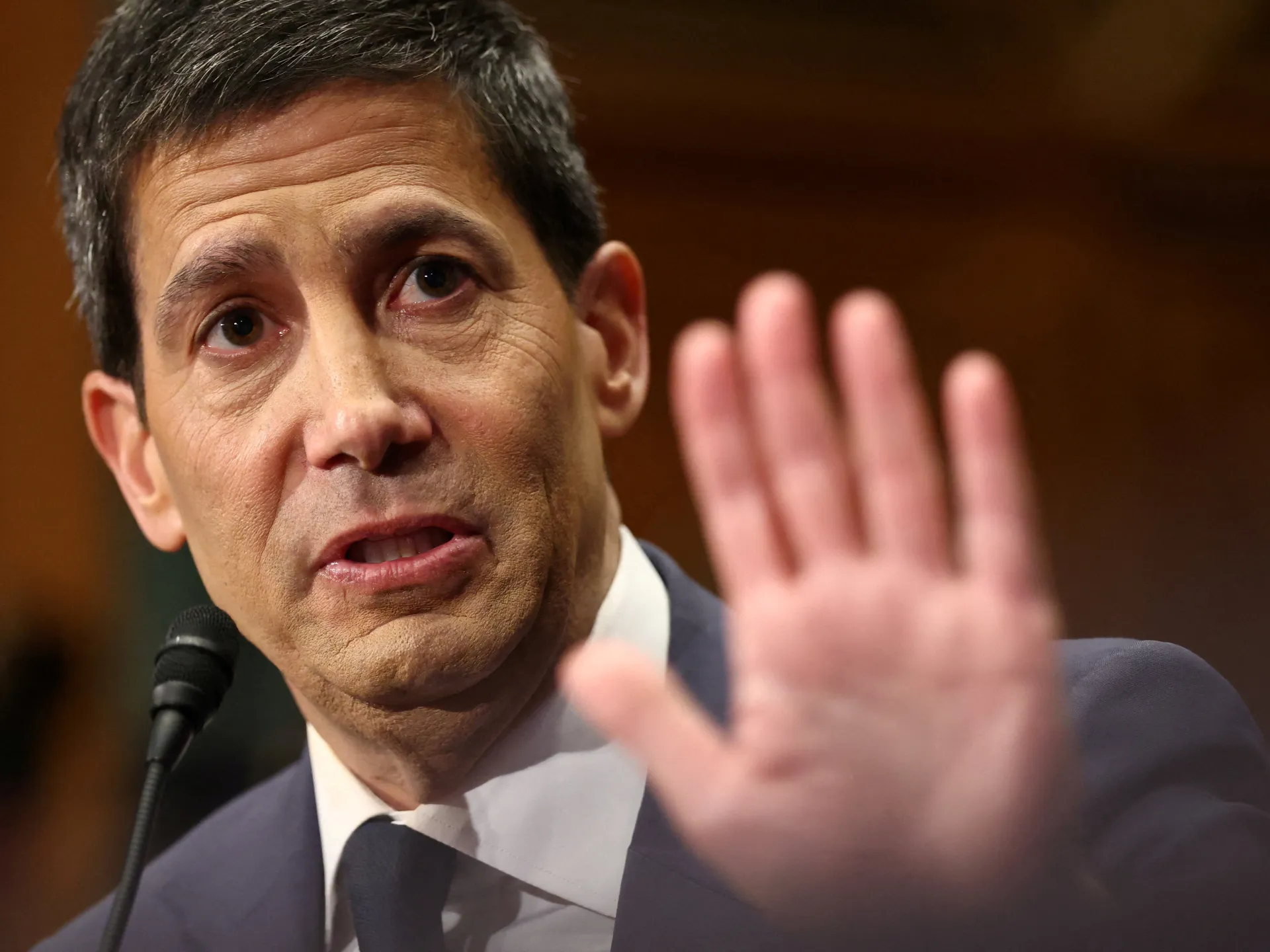
Warsh faced his first hearing on the path toward confirmation on Tuesday when he testified before the Senate Banking Committee. Questions by senators centered on the Federal Reserve’s independence, something Trump’s influence has called into question.

If appointed, Warsh would be the wealthiest person to lead the Federal Reserve.

Presidents have butted heads with the Federal Reserve throughout its history, as monetary policy can reflect on how the U.S. population views the president’s performance. A president has never tried to fire the chairman of the Federal Reserve.

The Federal Reserve is a non-partisan, independent agency made up of a board of governors posted in Washington, D.C., and 12 regional banks located across the United States.

Independence is key to the Federal Reserve’s function, keeping it from choosing policy based on the political goals of those occupying the White House and other branches of government.

Trump has not attempted to fire Powell yet but he did attempt to fire Fed board Gov. Lisa Cook. The attempt was unsuccessful as the U.S. Supreme Court intervened in October and ruled that she can remain at her post on an interim basis, at least for 2026.

The president does have some authority over choosing or designating a new Federal Reserve chair, Peter Shane, a constitutional law scholar in residence at NYU Law School, told UPI. However, a president must demonstrate a good reason for doing so.

There are two mechanisms in place that are meant to protect the independence of the Federal Reserve and its chair from political influence.

First, there is Supreme Court precedent. In 1935, the high court made a ruling in the landmark case Humphrey’s Executor vs. the United States. In this case, the court ruled that President Franklin D. Roosevelt could not fire the commissioner of the Federal Trade Commission, another independent agency, without cause.

The ruling affirmed that the authority to remove the head of any independent agency falls to Congress.

Second, there is the Federal Reserve Act. President Woodrow Wilson signed the Federal Reserve Act of 1913 to decentralize the control over monetary policy in the United States. This established the Federal Reserve and set its independence as a foundational feature of its existence.

The Federal Reserve Act makes the Federal Reserve independent in setting monetary policy without the influence of the president or Congress.

Congress has the ability to change the Federal Reserve Act. It did so in 1977 with the Federal Reserve Reform Act.

This amendment, signed into law by President Jimmy Carter, codified the objectives of the agency and established a requirement for the board of governors to report to Congress in hearings twice a year. It also added the requirement of Senate confirmation hearings for the chairman and vice chairman of the board of governors.

Last year, Rep. Thomas Massie, R-Ky., introduced the Federal Reserve Board Abolition Act, calling for the board of governors of the Federal Reserve and all Federal Reserve banks to be abolished.

“Americans have suffered under crippling inflation and the Federal Reserve is to blame,” Massie said in a statement.

Since being introduced in March 2025 the bill has not progressed beyond being referred to the House Committee on Financial Services.

FBI Director Kash Patel speaks during a press conference at Department of Justice Headquarters on Tuesday. The Trump Administration announced charges against the Southern Poverty Law Center, which the government alleges funneled over $3 million toward white supremacist and extremists groups. Photo by Bonnie Cash/UPI | License Photo

Source link

Regions projects 2026 net interest income growth of 2.5%-4% with net interest margin exiting in the low 3.70%s (NYSE:RF)

Earnings Call Insights: Regions Financial Corporation (RF) Q1 2026

Management View

  • “This morning, we reported strong first quarter earnings of $539 million or $0.62 per share,” said (President, CEO & Chairman John Turner), adding, “We grew loans and deposits on both an average and ending basis, and our credit metrics continue

Seeking Alpha’s Disclaimer: This article was automatically generated by an AI tool based on content available on the Seeking Alpha website, and has not been curated or reviewed by humans. Due to inherent limitations in using AI-based tools, the accuracy, completeness, or timeliness of such articles cannot be guaranteed. This article is intended for informational purposes only. Seeking Alpha does not take account of your objectives or your financial situation and does not offer any personalized investment advice. Seeking Alpha is not a licensed securities dealer, broker or US investment adviser or investment bank.

Source link

Alcoa anticipates $135M 2026 interest expense while environmental and ARO payments rise to about $360M (NYSE:AA)

Earnings Call Insights: Alcoa Corporation (AA) Q1 2026

Management View

  • “We had a strong start to 2026, driven by execution, and we are well positioned to deliver a strong second quarter and full year 2026 performance,” said William Oplinger (President, CEO & Director), while also pointing to continuity

Seeking Alpha’s Disclaimer: This article was automatically generated by an AI tool based on content available on the Seeking Alpha website, and has not been curated or reviewed by humans. Due to inherent limitations in using AI-based tools, the accuracy, completeness, or timeliness of such articles cannot be guaranteed. This article is intended for informational purposes only. Seeking Alpha does not take account of your objectives or your financial situation and does not offer any personalized investment advice. Seeking Alpha is not a licensed securities dealer, broker or US investment adviser or investment bank.

Source link

Another woman accuses Swalwell of sexual assault; says she was drugged in Beverly Hills in 2018

Another woman came forward Tuesday to describe rape allegations against Rep. Eric Swalwell, who announced his resignation from Congress on Monday amid a torrent of sexual misconduct accusations.

Lonna Drewes said at a news conference called by her attorneys that she was drugged and raped by Swalwell (D-Dublin) in 2018 while she was working as a model in Beverly Hills.

Drewes said she met Swalwell three times as she was growing her fashion software company and toying with the idea of a political career.

On the third occasion, she said, she believed he drugged her glass of wine. She said they were supposed to go to a political event and they stopped by his hotel room to retrieve some paperwork.

She said she found herself incapacitated despite having had only one drink.

“He raped me and he choked me and while he was choking me I lost consciousness and I thought I died,” she said. “I did not consent to any sexual activity.”

Swalwell’s attorney Elias Dabaie did not immediately respond to a call or email requesting comment. Swalwell has previously denied allegations against him, while acknowledging undefined “mistakes.”

Swalwell and his team threatened legal action against several individuals over the claims, Dabaie previously confirmed to The Times.

Lonna Drewes and Eric Swalwell

Lonna Drewes, left, says she met Rep. Eric Swalwell (D-Dublin) on three occasions in Beverly Hills in 2018. She says he sexually assaulted her on the third occasion.

(Myung J Chun / Los Angeles Times)

Drewes said she didn’t undergo a rape kit test, but disclosed the assault to people close to her and described it in her calendar. She did not have contact with Swalwell again, one of her attorneys said.

Drewes said she had no interest in Swalwell romantically and was drawn to his friendship, she said, in part because he touted connections that she believed could help her grow her businesses. She was in a relationship at the time, and he had a pregnant wife, she said.

The alleged rape had a severe impact on her mental health, causing her to self-medicate, she said. She said she also went to therapy sessions at a sexual assault center.

“I did not want to live anymore,” she said. “I cried all the time for years.”

She said she’d been considering a run for Beverly Hills City Council at the time. After the incident, she said, she feared a political backlash and felt like she had no choice but to remain silent.

Lonna Drewes, walking behind her lawyer Arick Fudali

Lonna Drewes walks behind her lawyer Arick Fudali during a news briefing in Beverly Hills on Tuesday.

(Myung J. Chun / Los Angeles Times)

“My delay in taking action against Eric was driven by fear, not doubt,” she said. “I have never doubted what happened.”

The L.A. County Sheriffs Department said Tuesday that it is investigating the case.

“The investigation remains in its preliminary stages and is ongoing,” the department said. “Investigators are in the process of gathering information, reviewing available evidence and conducting follow-up inquiries as part of a comprehensive investigative process.“

A spokesperson for the L.A. County district attorney’s office said the Sex Crimes Division had been assigned to work with law enforcement partners in an unfolding investigation.

Arick Fudali, one of the attorneys representing Drewes, said he hoped his client’s account would encourage other women to come forward.

“This is not about Democrat versus Republican,” Fudali said. “This is about accountability versus silence.”

“Lonna deserves what all women deserve — autonomy over her own body,” said attorney Lisa Bloom.

Bloom is well-known for representing high-profile victims of sexual misconduct, including women in cases against actor Bill Cosby and commentator Bill O’Reilly. Bloom said they would be providing text messages, journal entries and photographs to the police. Those include a photo of Drewes and Swalwell at the opening of a restaurant called Avra that was displayed Tuesday for reporters.

Bloom said she wanted to assist with an investigation by the Manhattan district attorney, who has opened a case into allegations against Swalwell. She said three other women have reached out to her.

Swalwell, who has served in the House of Representatives since 2013, has said he plans to fight the “serious, false” allegations made against him.

“However, I must take responsibility and ownership of the mistakes I did make,” Swalwell wrote in a statement Monday.

Bloom called Swalwell’s recent statements about the accusations against him “blather and spin” and a “slap in the face” to victims.

“Stop it,” she said. “Own your behavior.”

Swalwell had been a Democratic front-runner in the hotly contested and crowded race to be California’s next governor. Then in two bombshell reports in the San Francisco Chronicle and CNN on Friday, women accused the congressman of sexual assault and misconduct.

Candidates in the California gubernatorial race reacted to the new allegations with horror.

“The level of my disgust and outrage just continues to grow,” former state Controller Betty Yee told The Times after a business forum in Sacramento. “The fact that this is still being uncovered, that it could be bigger than what we already know?”

Swalwell said he would resign from his congressional seat under intense pressure from lawmakers of both parties. The resignation came on the heels of the House Ethics Committee opening an investigation into the sexual misconduct allegations and bipartisan threats to expel him from the House if he did not resign as women continued to come forward.

One woman told CNN that after messaging with Swalwell about her interest in Democratic politics last year, she met him for drinks and tried to deflect his advances without jeopardizing potential job opportunities. She said she began to feel “really fuzzy” and intoxicated and later found herself in his hotel room with no memory of how she got there.

Another woman, a former staff member who accused Swalwell of rape, told CNN she met him for drinks in 2019, blacked out and awoke naked in his hotel bed and could tell she had had intercourse. She said that in a separate encounter years later, he forced himself on her while she was too intoxicated to consent and despite her protests.

Gov. Gavin Newsom on Tuesday called a special election for Swalwell’s Alameda County seat on June 16, two weeks after the state’s regularly scheduled primary. If no candidate receives 50% of the vote, a second special election will be held on Aug. 18.

The June 2 regular primary and Nov. 3 general election will decide who will represent the recently reconfigured district for the next term, starting in January 2027. The special election decides who will represent the district for the remaining months of Swalwell’s term.

Times staff writers James Queally, Dakota Smith and Seema Mehta contributed to this report.

Source link

Trump family deal spree could open door for future presidents to profit from office

For decades, presidents avoided even the appearance of profiting from their office.

Harry Truman refused to lend his name to any business, even in retirement. Richard Nixon so feared a brother might profit off their ties, he had his phone tapped. And George W. Bush dumped his individual stock holdings before taking office.

President Trump is taking a different approach.

The family real estate business is undergoing the fastest overseas expansion since its founding a century ago, each deal potentially shaping everything including tariffs and military aid.

Led by Eric Trump and his brother, Donald Jr., the family business has expanded into cryptocurrencies with ventures that brought in billions of dollars but raised questions about whether some big investors received favorable treatment in return.

The brothers have also joined or invested in a number of companies that aim to do business with the government their father runs. Last month, they struck a deal giving them stakes worth millions in an armed drone maker seeking contracts with the Pentagon and with gulf states under attack by Iran and dependent on the U.S. military led by their father.

The White House and the Trump Organization deny there are any ethical problems. Asked about the issue at a recent crypto conference, Donald Jr. said, “Frankly, it’s gotten old.”

The problem of conflicts of interest goes back a decade to when Trump first ran for office, but some government ethics experts and historians argue it’s more pressing than ever as conflicts pile up in his second term that they consider unprecedented, blatant and dangerous to democracy.

“I don’t think there’s any line right now between policy decisions and political calculations and the interest of the Trump family,” said Julian Zelizer, a presidential historian at Princeton University.

Deal-making spree abroad

In Trump’s first term, the Trump Organization did zero deals in foreign countries. In a little over a year into his second term it did eight, all ostensibly complying with the Trump Organization’s self-imposed rule not to do business directly with foreign governments.

But governments in authoritarian and one-party states rarely take a hands-off approach — especially when the business belongs to a sitting president.

In Qatar, a Trump golf club and villa project is being developed in part by a company owned by the Qatari government. In Vietnam, where The New York Times reported the government pushed farmers off their land to make way for a Trump resort, the country’s deputy prime minister signed off on the deal at a ceremony. And in Saudi Arabia, a planned “Trump Plaza” resort on the Red Sea is being built by a Saudi real estate developer close to the ruling family.

Whether the deals played any role in changing U.S. policies in ways these countries sought is nearly impossible to know, but the countries did get what they wanted — access to advanced U.S. technology for Qatar, tariff relief for Vietnam and fighter jets for Saudi Arabia.

And the Trump Organization got something too: tens of millions in fees.

Asked about those projects, the Trump Organization said it has done no deals with governments so far, noting that the Saudi company was private, and has said it is “collaborating” with the Qatari business and had not struck a “partnership” with it that would have broken its self-imposed rules.

The UAE, crypto and Binance

Another deal raising conflicts of interest questions first came to light in a Wall Street Journal article in January — a year after it was struck.

Days before the inauguration, the Trump family sold nearly half of its World Liberty Financial crypto business to a UAE government-linked company run by a member of the UAE royal family for $500 million.

A second UAE entity, a government fund, invested in the offshore cryptocurrency exchange Binance using $2 billion worth of a digital currency called a stablecoin issued by World Liberty. That allowed the Trump company that received the dollars to put it in safe investments such as bonds or money market funds and keep the tens of millions of dollars in interest for itself.

Shortly after, the Trump administration reversed a Biden-era restriction and granted the UAE access to advanced U.S. chips. Binance’s founder, Changpeng Zhao, later got a pardon from Trump, despite having pleaded guilty to failing to stop criminals from using his platform to move money connected to child sex abuse, drug trafficking and terrorism.

A lawyer for Zhao denied any connection between Binance’s business with the Trump family and the pardon.

“Any claim of a quid pro quo by Binance or CZ, or preferential financial treatment by Binance, is a clear misstatement of the public record,” said Teresa Goody Guillen in a email to the AP, referring to Zhao by his initials.

Asked about the pardon, the White House said federal authorities had unfairly punished Zhao in what it called “The Biden Administration’s war on crypto.”

World Liberty dismissed the notion of a conflict, saying the UAE deal had no connection to the president’s chips policy.

Crypto billions

World Liberty has also provided a separate income stream to a new Trump limited liability corporation through sales of “governance tokens” that give owners certain voting rights in its business, though not equity stakes, raising $2 billion last year. That translates into hundreds of millions of dollars for the Trumps through their World Liberty ownership stake and a separate side deal allowing them a cut of these sales.

One big token investor was Justin Sun, a cryptocurrency billionaire who as a foreign citizen would be banned under U.S. law from making political donations to U.S. politicians. Between Trump’s election and inauguration, Sun spent $75 million on the tokens.

In February last year, a federal lawsuit charging Sun with duping investors was paused before being settled last month for a $10-million fine.

Then there are the souvenir-type “meme” coins stamped with Trump’s face that went on sale days before he took the oath of office last year.

Over the next four months, the coins generated $320 million, mostly going to Trump-related entities, according to blockchain tracker Chainalysis. That is more than double the money collected in four years running his Washington hotel in Trump’s first term.

Unlike the lobbyists or campaign donors trying to influence Trump, the coin buyers can buy anonymously. One who chose to make his purchase public was Sun, who spent $200 million on the coins and got access to Trump at a gala party he held for the biggest buyers.

Another family cryptocurrency business, American Bitcoin, went public in September, giving Donald Jr. and Eric about $1 billion in paper wealth at that time. Months earlier, their father announced a new national bitcoin reserve, sending the price for the cryptocurrency soaring to a record.

The Trump businesses aren’t completely immune to crypto’s notorious volatility. The value of bitcoin and other digital tokens has since plunged and rattled investors. Both American Bitcoin stock and the value of Trump’s souvenir meme coins have collapsed 90% from their highs.

Last month, Trump announced he would hold another dinner with new top holders of his meme coins, giving the coin a boost before it fell back again.

“Whatever constraints there were in the first term appear to have completely disappeared,” says Columbia University historian Timothy Naftali. “Do you want future presidents to be open to the highest bidder?”

Trump thinks people don’t care

Asked to comment for this story, the White House said Trump acts in an “ethically-sound manner” and that any suggestion to the contrary is either “ill-informed or malicious.” It reiterated that his assets are in a trust managed by his children and stated he has “no involvement” in family business deals.

“There are no conflicts of interest,” said spokesperson Anna Kelly.

In a separate statement, the Trump Organization said it is “fully compliant with all applicable ethics and conflicts of interest laws” and added, “The implication that politics has enriched the Trump family is unfounded.”

Trump in January told the New York Times that when it comes to potential conflicts of interest, “I found out that nobody cared, and I’m allowed to,” alluding to an exemption the president gets from the federal statute banning federal officials from holding financial interests in businesses impacted by public policy they help shape.

It’s not clear he’s wrong about American attitudes, though they appear to be changing even among Republicans. In a Pew Research Center poll in January, 42% of those voters said they were confident that Trump acts ethically in office, down from 55% at the start of his second term a year ago.

Change of fortune

Forbes estimates Trump’s net worth is now $6.3 billion, soaring 60% from before he returned to office, a striking development given how much the Trump Organization struggled before.

The Trump International Hotel in D.C. never turned a profit before being sold. Two Trump hotel chains catering to middle-class travelers in his first term shut down for lack of demand. Condominium buildings stripped the Trump name off their facades after discovering that instead of attracting buyers, it was repelling them.

No new U.S. condominiums are putting the Trump name above their entrances in his second term, but his name is prized in Washington, where people have business before the federal government.

Donald Jr., Trump’s oldest son, opened a private club in the Georgetown section of Washington that is charging initiation fees as high as $500,000 for founding members.

One of the few clubs with comparable fees, the Yellowstone Club in Montana, offers access to multiple resorts, 50 ski trails and more than a dozen restaurants across a members-only area the size of Manhattan.

Donald Jr.’s club is in the basement of a building but offers something else — proximity to power.

The club’s name is “Executive Branch.”

Bibles, guitars and sneakers

Other presidents and their families have done things in pursuit of profit that stained that high office.

Hunter Biden got paid as a director of a Ukrainian gas company while his father was vice president. The Clinton Foundation got foreign donations, though after Bill Clinton had left office. And Jimmy Carter’s brother Billy cashed in on the family name by selling beer.

In Trump’s case, the president himself is hawking goods, including $59.99 “God Bless the USA” Bibles, $399 sneakers stamped “Never Surrender” and electric guitars priced up to $11,500 — shipping not included — for a model autographed by the president.

New year, new profits

In the first months of Trump’s second year back in the White House, the momentum hasn’t let up.

In January, the Trump Organization announced its third deal involving Saudi Arabia in less than a year, this time a “collaboration” with a company more directly tied to the government because it is owned by the country’s sovereign wealth fund chaired by its crown prince, Mohammed bin Salman. Asked by the AP whether the project outside Riyadh for Trump mansions, a hotel and golf course violated the company’s pledge not to strike deals with foreign governments, the Trump Organization said it doesn’t “conduct business with any government entity” but didn’t address the project specifically.

Meanwhile, as the two oldest brothers’ new drone company seeks Pentagon contracts, other government contractors in which one or both have gotten ownership stakes this past year are taking in tens of millions of dollars of new taxpayer money. That includes a rocket motor maker, an AI chip supplier and a data analytics company, according to government contracting records.

Asked about potential conflicts after the drone deal was announced, Eric said, “I am incredibly proud to invest in companies I believe in.” A spokesman for Donald Jr. said he doesn’t “interface” with the government on companies in his portfolio, adding that “the idea that he should cease living his life and making a living to provide for his five kids just because his dad is president, is quite frankly, a laughable and ridiculous standard.”

A new investment firm that the brothers joined as advisors last year has raised $345 million in an initial public offering to buy stakes in U.S. companies designed to help their father revive America’s manufacturing base. After the AP asked Trump’s chief business lawyer about language in a regulatory filing stating the firm would target companies seeking federal grants, tax credits and government contracts, he filed a new document with that language removed.

Zelizer, the Princeton historian, says he expects future presidents will show more restraint in enriching themselves, but worries about the message Trump is sending.

“He has shown politically there is no price to be paid to making money,” he said. “You know you can go there.”

Condon writes for the Associated Press.

Source link

Korea group offers up to 12% annual savings interest to boost births

Korea Federation of Community Credit Cooperatives Director Cho Bong-eop (2-L) poses with the first customer of its new savings product offering an annual interest rate of up to 12% at the organization’s office in Seoul on Friday. Photo by Korea Federation of Community Credit Cooperatives

SEOUL, April 10 (UPI) — The Korea Federation of Community Credit Cooperatives said Friday it launched a savings product that offers an annual interest rate of up to 12% in an attempt to boost childbirth.

The one-year installment savings product provides a base rate of 4%, which increases by steps to 12% depending on the number of the customer’s children. It is subject to a deposit limit, though.

For savers with a newborn in areas experiencing population decline, the country’s top apex organization said that the maximum 12% interest would be guaranteed regardless of the number of children.

“We have introduced dedicated financial products every year since 2023 in an effort to help address the low birth rate,” cooperative Director Cho Bong-eop said in a statement.

“As a community-based financial institution, we will keep fulfilling our social responsibilities by supporting vulnerable groups and revitalizing local economies, in addition to tackling the low birth rate,” he added.

South Korea has one of the world’s lowest fertility rates, which fell to 0.72 in 2023, according to Statistics Korea. The figure rebounded slightly to 0.75 in 2024 and 0.8 last year, still far below the replacement level of 2.1.

This means that for every 100 South Korean women, only 80 babies are expected to be born over their lifetimes, leading to a gradual population decline. The country’s population stands at 51.6 million.

To address the challenge, the Seoul government has funneled a huge amount of money over the past decades to little avail. In recent years, even private companies stepped in, providing bonuses and various benefits to employees who have a baby.

Last month, Statistics Korea reported nearly 27,000 births in January, the highest monthly figure in nearly seven years. However, the fertility rate still remained below 1.

Source link

Stocks with high correlation to interest rates reached all-time high in March

Businessman Looking At Prospect Of Higher Interest Rates

DNY59/E+ via Getty Images

Companies whose stock prices have historically shown high correlation to movement in interest rates recently saw an all-time high as odds of rate hikes may seem more plausible for investors than rate cuts.

Although it has lagged in the past

Source link

‘Harry Potter’ show has serious security, expected racist backlash

The “Harry Potter” team did not need a divination expert to know its cast would encounter some “unpleasant and aggressive behavior.”

HBO boss Casey Bloys told multiple outlets this week that the network had taken precautions anticipating the vitriol the “Harry Potter and the Philosopher’s Stone” actors would face. Ghanian-English actor Paapa Essiedu recently spoke out about the racist abuse and death threats he has received since the announcement that he had been cast as potions professor Severus Snape.

“With all actors on any kind of big IP shows — and this is obviously one of those where you’ve got, you know, passionate fans, people with a lot of opinions — it can get scary in places,” Bloys told Variety in an interview published Tuesday. “So for any show like that, we anticipated it and tried to have training, you know, best practices in terms of social media and how to handle it. And obviously we’ve got a serious security team.”

Essiedu, who is portraying the enigmatic but ultimately heroic Hogwarts professor first brought to life by Alan Rickman in the original “Harry Potter” films, has opened up about the racist abuse he has received from those who believe a Black man should not be playing the fictional wizard.

“I’ve been told, ‘Quit or I’ll murder you,’” he said in an interview with the Times of London. “The reality is that if I look at Instagram, I will see somebody saying, ‘I’m going to come to your house and kill you.’”

“[N]obody should have to encounter this for doing their job … And I’d be lying if I said it doesn’t affect me emotionally,” Essiedu added.

This is not the first time that fans of J.K. Rowling’s Wizarding World novels expressed outrage over the casting of a Black actor in an adaptation. There was a similar outcry in 2016 when Noma Dumezweni was cast to play Hermione Granger in the original London production of “Harry Potter and the Cursed Child.”

It’s also not a situation unique to “Harry Potter.” Racist vitriol has been hurled toward actors in other genre franchises, including fantasy shows such as “House of the Dragon” and “The Lord of the Rings: The Rings of Power,” as well as those involved in “Star Wars” and the Marvel Cinematic Universe.

Bloys also told Deadline in an interview published Wednesday that they had “anticipated there would be a lot of interest in all of [the actors], and interest can tip over into more unpleasant and aggressive behavior.”

“We talked to them about what to expect, what to expect on social media and how we handle it, but any kind of security that’s needed is an unfortunate aspect of doing IP shows,” he said. “We just try to be mindful and monitor it.”

Essiedu also told the Times of London that “the [racist] abuse fuels” him.

“[It] makes me more passionate about making this character my own, because I think of how I felt as a kid,” he said. “I would imagine myself at Hogwarts on broomsticks, and the idea that a kid like me can see themselves represented in that world? That’s motivation to not be intimidated by someone saying they’d rather I died instead of doing work I’m going to be really proud of.”

Source link

Analyst says that Iran’s interest is in an extended war | US-Israel war on Iran

Quotable

‘Iran has the ability to keep hurting the global energy markets.’
Rob Geist-Pinfold, a lecturer in International Security at King’s College London, says that the United States has an interest in ending the war on Iran, while Tehran is likely to prolong the conflict to increase pressure on global markets and force more favourable terms

Source link

California governor candidate Matt Mahan unveils government reform plan

When he entered the race for California governor, San José Mayor Matt Mahan pitched himself as a pragmatic Democrat who would prioritize improving residents’ quality of life and government efficiency.

He unveiled a key part of that promise on Tuesday with an expansive plan to reform state government, including tying pay raises for elected officials and other top leaders to improvements on key issues, and pledging not to approve any tax increase until the state proves “that we can deliver better outcomes with the dollars we already have.”

Mahan also delivered a blistering rebuke of ballooning state spending — which, as he often points out on the campaign trail, has increased nearly 75% over the last six years. In 2020, amid the COVID-19 pandemic and accompanying economic uncertainty, California lawmakers approved a no-frills state budget that came in at $202 billion. Gov. Gavin Newsom’s latest spending proposal is nearly $349 billion.

“We have fallen into this lazy, reflexive mindset of always going back to voters and telling them that the only solution to every problem is a tax increase or a new bond or a new rule coming down from Sacramento,” Mahan said in an interview. “We need to step back and take a really hard look at our existing spending and increase the level of transparency and accountability in government.”

His eight-page plan includes ways to measure and track accountability, some of which are drawn from policies in other states. They include lobbying reforms, following up on audit recommendations and overhauling the state’s digital infrastructure and its procurement process — services Mahan described as “clunky and cumbersome.”

He also proposed a “California Performance Review,” inspired by a similar effort in Texas throughout the 1990s, that would review state agencies and solicit input from employees to eliminate waste and inefficiencies.

But near the top of the list is a proposal to tie pay raises for state officials including the governor, lawmakers and thousands of gubernatorial appointees to “measurable outcomes” in areas such as reducing homelessness and unemployment.

“People in the real world don’t get raises if they don’t do a good job,” Mahan said, “and I think it should be the same for the politicians and senior administrators who are allocating budgets, leading projects, making the big decisions on behalf of the people of California.”

Though the benchmarks would be created with input from the state Legislature, Mahan floated one example: reducing unsheltered homelessness by 5% to 10% within one year, something he said he’s accomplished three years in a row in San José.

It’s a solution one might expect from a former entrepreneur and mayor of a city in the heart of Silicon Valley. Mahan made a similar proposal at the local level last year, but it was rejected by the City Council.

“Tying pay to performance is nothing short of revolutionary in government. It’s a private-sector model that is overdue,” said former state Sen. Steve Glazer (D-Orinda), a Mahan supporter who sponsored several bills aiming to increase transparency in government.

Dozens of tech company executives are backing Mahan in the race for governor and have collectively donated millions to his campaign, as well as two independent expenditure committees supporting him.

That has raised concerns from some voters, and criticism from some of Mahan’s opponents, that he would be beholden to their interests and veto future regulations on tech or artificial intelligence companies.

Mahan has sought to dispel those concerns, arguing that he believes AI and social media platforms should be regulated. Of his plan to overhaul state information technology systems and infrastructure, he said that “whenever we spend public dollars, we have to run open, transparent and competitive procurement processes that ensure best value for the taxpayers.”

Though Mahan did not specify how he would link government outcomes to pay raises, state lawmakers have largely panned his campaign and are unlikely to get on board. The change probably would also require voter approval.

Currently, annual raises for elected officials are determined by a citizen commission that was added to the California Constitution in 1990. Changing how that panel works or imposing limits on when it can approve raises would require a constitutional amendment, which requires voter sign-off.

But Mahan contended it would be one of the fastest ways to fix a system that he says works for special interests at the expense of working people.

“I’m under no illusion that this will be easy, but I think it’s a necessary realignment of incentives,” he said. “We have to make ourselves as accountable to the people as we possibly can be.”

Source link

Valerie Perrine dead: ‘Lenny’ and ‘Superman’ actor was 82

Valerie Perrine, the Las Vegas showgirl turned Oscar-nominated actor best known for playing Lenny Bruce’s wayward wife Honey Harlow in “Lenny” and Lex Luthor’s secretary Eve Teschmacher in the 1978 and 1980 “Superman” films, died Monday morning. She was 82.

Perrine’s death was confirmed by Stacey Souther, her close friend and the director of the 2019 documentary “Valerie,” which followed the star’s debilitating battle with Parkinson’s disease.

“It is with deep sadness that I share the heartbreaking news that Valerie has passed away,” Souther announced on social media. “She faced Parkinson’s disease with incredible courage and compassion, never once complaining. She was a true inspiration who lived life to the fullest — and what a magnificent life it was. The world feels less beautiful without her in it.

“I love you, Valerie. I’ll see you on the other side.”

Souther also shared a GoFundMe link and a note that Perrine’s final wish was to be laid to rest at the Hollywood Hills Forest Lawn Cemetery. “After more than 15 years of fighting Parkinson’s, her finances are exhausted.”

Perrine was born Sept. 3, 1943, in Galveston, Texas, to parents Renee and Kenneth, a dancer and a U.S. Army lieutenant colonel. A military brat growing up, Perrine moved frequently and spent time in Japan, Paris and Scottsdale, Ariz.

She attended the University of Arizona, but her academic aspirations were short-lived. She skipped town, trading her textbooks for a feather headdress and G-string in Las Vegas. Soon she was a lead dancer in the star-spangled Lido de Paris show at the Stardust Hotel. She told the New York Times in 1974 that she spent some of her $800 weekly paycheck on experimenting with drugs: acid, mescaline, peyote, cocaine — you name it, she tried it.

Eight years after her foray into Vegas showbiz, her movie career kicked off unexpectedly during a visit to Hollywood. An agent at a friend’s dinner party took a liking to her, she told the Los Angeles Times in 2013. He asked if she had any publicity photos. The only one she had was in her topless Lido costume.

The sexy picture made its way to the desk of Monique James, the head of new talent at Universal. “She called me in and asked if I had ever acted before and I said ‘no,’” Perrine said. “She arranged a screen test.”

Paul Monash, the producer of “Slaughterhouse-Five,” which was based on Kurt Vonnegut’s acclaimed novel about World War II and time travel, directed the screen test. “They told me to wear a bikini because they wanted to see what my body looked like. I didn’t have a bikini. I wore my G-string and that was it.”

“I had been working in Vegas all the time and had been on the beach in St. Tropez, so being [naked] didn’t mean anything to me,” she told The Times. “It was my attitude that sparked his interest and the way I read the line, ‘Oh, you’re a moon child.’ He hired me.”

Dustin Hoffman as Lenny Bruce and Valerie Perrine as Honey Harlow star in a scene from the 1974 movie, "Lenny."

Dustin Hoffman as Lenny Bruce, left, and Valerie Perrine as Honey Harlow in a scene from the 1974 movie, “Lenny.”

(United Archives via Getty Images)

Soon after, she portrayed the love interest of NASCAR driver Junior Johnson opposite Jeff Bridges in the 1973 sports drama “The Last American Hero.” Perrine and Bridges dated briefly while working on the film. The same year she became the first woman to bare her breasts on television in the PBS telefilm “Steambath.”

Bridges described Perrine in the 2019 documentary “Valerie” as having a “real sense of fun and play.”

“She was excited about life and excited where she was and it’s a contagious feeling,” he said. “Growing up in a military family and traveling all over the world made her a really interesting person and as an actress, she had the ability to bring all of that into her performances.”

In 1974, she tapped into her showgirl background to portray the drug-addled stripper Honey Harlow opposite Dustin Hoffman as Lenny Bruce in the biopic “Lenny.” Her performance garnered rave reviews. She nabbed the lead actress award at the Cannes Film Festival, BAFTA named her most promising newcomer and she was nominated for an Oscar.

Perrine was perhaps best known for her portrayal of Eve Teschmacher, Lex Luthor’s secretary and love interest in the 1978 “Superman” starring Christopher Reeve, Gene Hackman and Marlon Brando. She played the role again in 1980’s “Superman II.”

She also starred in the 1980 disco flick “Can’t Stop the Music” alongside the Village People and Caitlyn Jenner. The movie flopped and Perrine was so mortified by the film’s poor reception that she moved to Europe. She didn’t officially retire from acting until around 2010, and by 2015 she had gone public with her Parkinson’s disease diagnosis.

The 2019 documentary short “Valerie,” directed by Souther, dropped the veil on Perrine’s battle with the illness, with her loss of bodily autonomy captured in the film. She said “the shakes” caused her to struggle and the level of care she required made her feel like a baby.

Still intact, though, were her sharp wit and self-deprecating sense of humor. In the film a doctor explains that there are times when physicians aren’t able to pin down a diagnosis or there are multiple diagnoses.

“The doctors don’t know what’s going on with me,” Perrine says. “They can’t figure it out.”

“What do you think it is?” the doctor asks Perrine.

“Karma,” she quips.


Source link

US Fed keeps interest rates steady amid economic, geopolitical uncertainty | Banks News

The United States Federal Reserve will hold interest rates steady as the labour market cools and prices on goods and services surge following the US and Israel’s joint strikes on Iran.

The central bank will maintain its benchmark rate at 3.5–3.75 percent, consistent with the Fed’s decision last month, when it also held rates steady.

Recommended Stories

list of 4 itemsend of list

“The Committee seeks to achieve maximum employment and inflation at the rate of 2 percent over the longer run. Uncertainty about the economic outlook remains elevated. The implications of developments in the Middle East for the US economy are uncertain,” the central bank said in a statement announcing its policy decision and referring to its Federal Open Market Committee.

“The Committee is attentive to the risks to both sides of its dual mandate.”

Holding rates steady was in line with estimates. CME FedWatch, a tool that tracks monetary policy decisions, forecast that there was a 99 percent chance that rates would hold steady.

The stall comes after three rate cuts in 2025.

Global gripes

Consumers are also facing the repercussions of US President Donald Trump’s trade and military policies in their daily expenses.

“Despite meaningful progress on inflation in 2024, Trump’s tariffs have stalled progress and kept inflation persistently above the Fed’s target. Wholesale prices are running hot as service prices surge, and now, Trump’s war in Iran is rocking commodity markets around the globe,” Elizabeth Pancotti, managing director of policy and advocacy at Groundwork Collaborative, an economic think tank, said in comments provided to Al Jazeera.

Last month, the US Supreme Court ruled against the president for his use of the International Emergency Economic Powers Act (IEEPA). The high court said the president exceeded his authority and that the tariffs imposed under that order must be refunded. However, the president then imposed new tariffs not covered by IEEPA.

The White House announced a 15 percent tariff through Section 122, which allows the president to impose tariffs for 150 days. Those changes were reflected in the producer price index report released by the US Department of Labor’s Bureau of Labor Statistics on Wednesday.

Wholesale prices rose by 0.7 percent for the month, marking the biggest one-month surge in a year. Goods prices rose 1.1 percent overall after tumbling for two months. Energy prices rose by 2.3 percent, with the cost of gas or petrol rising by 1.8 percent. Those costs are expected to get higher as tensions rise in the Strait of Hormuz following joint US-Israel strikes on Iran in late February and the subsequent retaliation.

“In the near term, higher energy prices will push up overall inflation; however, it is too soon to know the scope and duration of the potential effects on the economy,” Fed Chair Jerome Powell told reporters.

In the last month, petrol prices have jumped for US consumers. The average price for a gallon of regular gasoline is $3.84, up from $2.92 this time last month.

“The Fed’s inflation worries extend beyond weathering a fleeting wave of one-off price hikes associated with tariffs and, more recently, an energy price spike,” Stephen Stanley, chief US economist at Santander US Capital Markets, told the Reuters news agency.

Labour market stalls

Holding rates steady also comes as the job market stagnates. The latest jobs report, which was released earlier this month, showed that the US economy lost 92,000 jobs, with unemployment rising to 4.4 percent.

Meanwhile, the Job Openings and Labor Turnover Survey, or JOLTS report, which came out last week, showed 6.9 million open jobs in the US, unchanged from the month prior. That shows that employer hiring has stalled and that those who have jobs are seldom leaving for new ones.

“This might be one of the toughest moments in recent memory for the Federal Reserve’s Open Market Committee,” Michael Linden, Senior Policy Fellow at the Washington Center for Equitable Growth, said in remarks provided to Al Jazeera. “Recent data has revealed that economic growth in the back half of last year was extremely weak, the labour market seems to be on the precipice of disaster, and prices keep rising faster than anyone feels comfortable with.”

Political undercurrents

Wednesday’s decision is the second-to-last one of current Fed Chair Powell, whose term is up in May. Powell, who was first appointed by Trump during his first administration, has been a target of Trump’s scorn and criticisms for not cutting interest rates fast enough.

“When is ‘Too Late’ Powell lowering INTEREST RATES?” Trump posted on his social media platform Truth Social on Wednesday morning ahead of the decision.

Previously, Trump said he would not nominate someone to lead the central bank unless the nominee agreed with his position.

“Anybody that disagrees with me will never be the Fed Chairman!” Trump said in a post on Truth Social in December.

“We at the Fed will continue to do our jobs with objectivity, integrity and deep commitment to serve the American people,” Powell told reporters.

Trump’s nominee to succeed Powell, Kevin Warsh, has his nomination in flux as Republican Senator Thom Tillis said he would not vote to advance any of Trump’s nominees to the central bank until a criminal probe into the current chairman, Powell, is closed.

Tillis sits on the Senate Banking Committee, which vets nominees for the central bank, including Warsh. He said he will not approve Trump’s Fed nominees until the probe of Powell is closed. The criminal probe of Powell centres on Fed building renovations after a judge quashed grand jury subpoenas and called the investigation a pretext to pressure the central bank to lower interest rates.

If Warsh has not been confirmed by the Senate in time for the Fed’s June 16–17 meeting, Powell would continue to lead the rate-setting Federal Open Market Committee.

“If my successor is not confirmed by the end of my term as chair, I would serve as chair pro tem until he is confirmed. That is what the law calls for,” Powell said.

“On the question of whether I will leave while the investigation is ongoing, I have no intention of leaving the board until the investigation is well and truly over with transparency and finality.”

Source link

Fed holds interest rates steady amid Iran war, poor inflation report

March 18 (UPI) — The Federal Reserve announced that it is leaving its benchmark interest rate untouched Wednesday in its first Federal Open Market Committee statement since the start of the war with Iran.

The Fed’s benchmark interest rate remains at a 3.5% and 3.75% range as the committee held on to its projection of at least one rate cut coming this year.

“Available indicators suggest that economic activity has been expanding at a solid pace,” the FOMC statement said. “Job gains have remained low and the unemployment rate has been little changed in recent months. Inflation remains somewhat elevated.”

As for the war in Iran, the statement said its impact on the U.S. economy is “uncertain.”

The Fed continues to pursue monetary policies it believes will bring the rate of inflation down to 2%. In its statement it said it is “committed to supporting maximum employment,” in pursuit of its target.

Economic reports that inform the Fed’s decision have indicated pressures from inflation remain and economic growth has slowed.

Wednesday’s announcement comes on the heels of a producer price index report earlier in the day that showed the largest increase to the index for final demand goods since August 2023.

Last week, the U.S. Bureau of Labor Statistics reported that nonfarm payrolls fell by 92,000 in February. The unemployment rate increased to 4.4%.

These reports have economists and traders cooling on the potential for interest rate cuts. Eugenio Aleman, chief economist at Raymond James, said in a statement that the wholesale inflation report on Wednesday, “likely reinforces a hold decision.”

Data from the producer price index report predates the beginning of the war with Iran.

President Donald Trump receives a bowl of shamrocks from Irish Taoiseach Micheal Martin to celebrate St. Patrick’s Day at the White House on Tuesday. Photo by Yuri Gripas/UPI | License Photo

Source link