The ‘Old Lady of Threadneedle Street’ has chosen to wait, though not unanimously.
ADVERTISEMENT
ADVERTISEMENT
The Monetary Policy Committee voted by a majority of six to three on Thursday to leave borrowing costs unchanged, with the dissenting trio pushing for a quarter-point increase to 4%.
The decision puts the Bank of England at odds with the Federal Reserve and the European Central Bank, both of which have tightened within the past week.
Despite holding, the central bank expects the situation to worsen before it improves.
Inflation “is likely to rise further over coming quarters,” the committee said, pointing to crude and refined energy prices that have climbed again since its last meeting and remain “more volatile and higher than pre-conflict.”
Watching for second-round effects
The case for holding rests on what has not yet happened.
“There has been little evidence so far of material second-round effects in price and wage-setting,” the statement read, meaning expensive energy is not yet feeding into broader wages and prices.
However, that reprieve may be temporary.
The risk of such effects “is greater the longer higher energy prices persist or are more volatile,” the committee warned, adding that risks to the inflation outlook are “tilted to the upside, and more so than at the time of the July Monetary Policy Report.”
Brent crude and UK wholesale gas prices have risen 36% and 78% respectively since July, with Brent at $106 a barrel and gas at 207 pence per therm on 14 September.
Refinery pressures have kept crack spreads, the gap between refined fuel prices and crude, well above pre-conflict levels.
Economic activity has held up slightly better than expected, while a soft labour market and the higher borrowing costs households and businesses have faced since the conflict began should bring inflation down over time.
A crowded week for central banks
The Fed raised its benchmark on Wednesday to a range of 3.75% to 4%, its first increase since 2023 and a unanimous decision, while signalling more to come.
The ECB lifted its deposit rate to 2.5% last week.
The sequence concludes on Friday with the Bank of Japan, where markets expect a hike.
That would leave the Bank of England as the only major central bank to have stood still this week, though on Thursday’s evidence not by much.
Investors in Europe took the Federal Reserve rate hike in their stride.
ADVERTISEMENT
ADVERTISEMENT
Both the Euro Stoxx 50 and the broader pan-European Stoxx 600 traded over 0.6% higher at the start of Thursday’s session.
France’s CAC 40, Germany’s DAX 30, Italy’s FTSE MIB, Spain’s IBEX 35, the Netherlands’ AEX and Switzerland’s CH20, all traded between 0.2% and 0.7% higher than their Wednesday close.
The UK’s FTSE 100 led the pack and rose more than 1%.
Carmakers and industrials led the Paris index, with Renault gaining more than 2%, Stellantis 1.6% and Schneider Electric 1.3%. Technology went the other way, with Dassault Systèmes falling 2.4%.
The calm followed a rougher session in New York, where the Dow Jones Industrial Average closed 1.2% lower on Wednesday and the S&P 500 fell 0.4%, while the Nasdaq was broadly flat.
Asian markets were mixed overnight with Tokyo’s Nikkei 225 rising 0.2%, Seoul’s Kospi gaining 0.9%, while Hong Kong’s Hang Seng lost 0.7% and the Shanghai Composite 0.4%.
Reactions were “pretty much expected since the rate hike was also in line with market expectations”, said Lorraine Tan, director of equity research for Asia at Morningstar, adding that the Iran war is likely to keep pressure on inflation.
A stronger US dollar and higher yields
The more consequential moves were in currencies and bonds.
The US dollar climbed to its highest in seven weeks against a basket of major currencies, lifted by the jump in short-dated Treasury yields that followed the decision.
The euro was trading around $1.146, down 0.5% from Wednesday’s open.
A stronger US dollar makes European exports more competitive in American markets, but it also raises the cost of anything priced in dollars, which includes oil and gas, which compounds Europe’s energy bill at a difficult moment.
In bond markets, the two-year Treasury yield, the maturity most sensitive to rate expectations, jumped to around 4.72% from 4.67% before the decision, holding near that level on Thursday.
The 10-year sat close to 5%, reflecting both the war-driven energy shock and mounting investor concern about American government debt.
Traders now fully expect another rate hike by December and put the odds of a move as soon as October at around 50%. Goldman Sachs became one of the first major Wall Street banks to forecast consecutive hikes, reversing its previous view that this month’s move would be the only one.
Attention turns next to the Bank of England, which announces its decision later on Thursday and is expected to hold rates steady, and to the Bank of Japan on Friday, where a hike is anticipated.
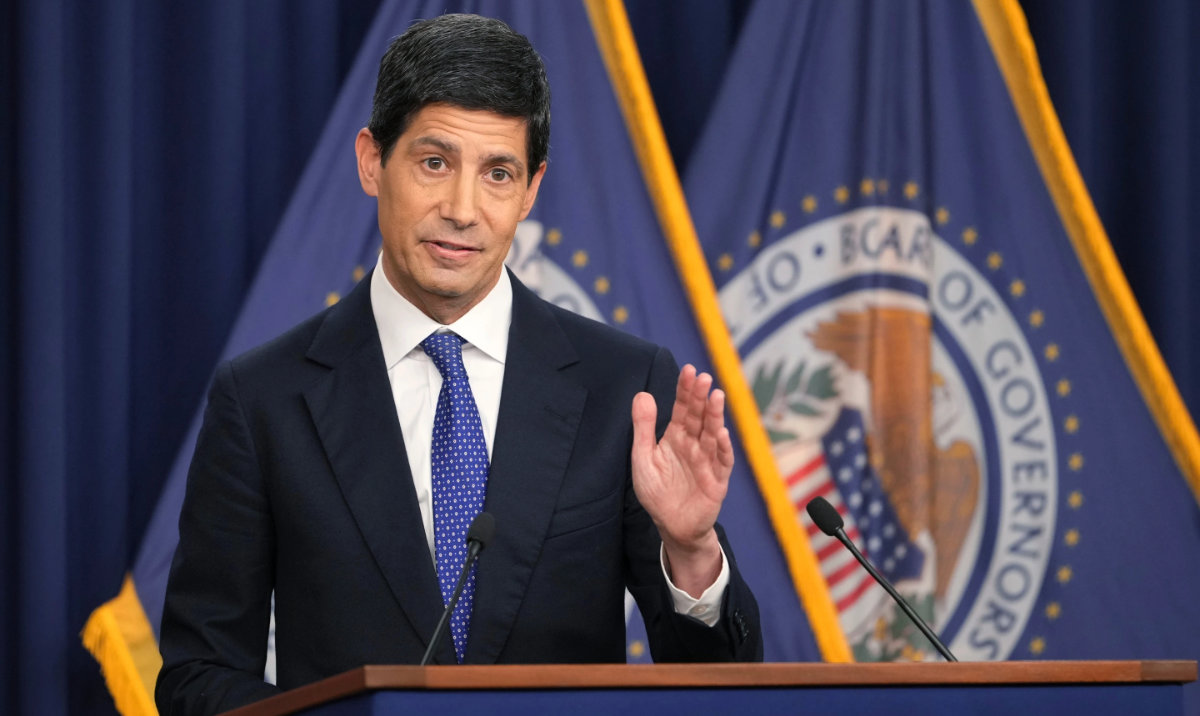
WASHINGTON, United States: The US Federal Reserve on Wednesday raised interest rates for the first time since 2023, defying President Donald Trump’s demand for cuts, as central bank chief Kevin Warsh stressed the need to combat inflation that has been “too high” for “too long.”
The Fed’s Federal Open Market Committee voted unanimously to raise rates by 25 basis points to between 3.75 and 4.00 percent, saying the rate hike would support a “timelier return” to its two-percent target for inflation.
Warsh, appointed by Trump, said the decision was a “serious” one, but needed to be taken.
“The plain fact is that inflation is too high, and has been for too long,” he told a press conference.
And Wednesday’s rate hike may not be the last — the vast majority of Fed policymakers indicated that at least one more rate hike was likely necessary before the end of the year, according to their Summary of Economic Projections.
US households and businesses have been battered by years of higher-than-target inflation, and prices have surged in the wake of Trump’s war on Iran, his signature tariff policies and the ongoing AI boom.
Trump has launched an unprecedented assault on the Fed’s independence since taking office, attempting to fire a Fed Governor and launching a criminal probe against Warsh’s predecessor in his quest for lower rates to spur economic activity.
The president’s Republican Party faces a stern test in upcoming midterm elections, with rival Democrats seeking to wrest control of both houses of Congress and economic issues front-and-center for voters.
Growing calls for hike
The Fed has held rates steady since January, choosing to wait to gauge the effects of the Iran war’s energy price shocks and to let the impact of tariffs on prices ripple through the economy.
Since July, however, a growing faction of policymakers had indicated a rate hike may be required to tame inflation, as the war grinds on and prices remained elevated.
On Friday, August’s consumer price index came in at 3.4 percent — unchanged from the month before, but still well above the Fed’s long-term two-percent target.
In its SEP, the Fed raised its forecast for its preferred gauge of inflation — the Personal Consumption Expenditures (PCE) price index — by 0.1 percentage points to 3.7 percent by year-end.
The Fed also raised its projection for GDP growth by year-end to 2.3 percent, up 0.1 percentage points.
‘Rather unfortunate’
US stock markets largely priced in Wednesday’s rate hike, but they were still down on the news — expected with any rate hike as equities become less attractive.
Yields on 10-year US Treasury bonds — which have surged in recent days as uncertainty on long-term inflation has spiked — were also up past the five-percent threshold.
Following the Fed’s announcement, White House spokesperson Kush Desai said the decision was “rather unfortunate” and that Trump had been clear that he wanted lower interest rates.
Warsh was named to his position after a contentious Senate confirmation process, where Democratic lawmakers accused him of being a “sock puppet” for Trump, which he denied.
So far, Trump has supported Warsh, claiming that the Fed chair wants lower rates and accusing the board of being “political.”
The Fed has a dual mandate to deliver maximum employment while keeping inflation to its long-term two-percent target.
It mainly achieves these goals by setting the key US interest rate — lower rates tend to spur economic activity but fuel inflation, and hiking them cools both activity and prices.
The Fed’s SEP showed that at least 12 of 18 policymakers who participated in the projection expected one more rate hike would be required before the end of the year.
Four policymakers expect two more rate hikes to be required.
Warsh has criticized the Fed’s policy of offering such projections in the past and did not participate in the previous iteration in June.
This projection also included only 18 policymakers, suggesting he had once again withheld his contribution.
Kevin Warsh has broken away from US President Donald Trump in his first Fed move, and he has done it with the entire committee behind him.
ADVERTISEMENT
ADVERTISEMENT
The Federal Open Market Committee lifted rates on Wednesday after holding them at 3.5% to 3.75% since December, ending a pause that had grown harder to justify as energy costs pushed prices higher.
Not a single member dissented in a unanimous 12-0 vote.
That matters because the pressure ran in both directions as three regional presidents had voted for a hike in July, while the White House spent months demanding cuts.
Nobody voted for either extreme.
At the time of writing, the market reaction to the decision has been fairly muted likely due to the fact that the hike was widely expected.
A statement stripped to the bone
The Fed’s communication was as striking as its decision.
The statement ran to three short paragraphs, a fraction of the length markets are used to, with no forward guidance and no hedging.
“Inflation remains elevated,” it read, adding that “today’s policy action will support a timelier return to the Committee’s 2 percent goal.”
The word “timelier” carries an implicit admission that the return had been too slow.
Then a sentence the Fed almost never writes: “The Committee will deliver price stability.” Not seeks to, not is committed to. Will.
The economic assessment was also confident throughout.
Activity is “expanding at a solid pace”, domestic spending “has been resilient”, productivity growth is “strong” and capital investment “robust”, while job gains “have kept pace with the workforce”.
Uncertainty remains elevated, the Fed said, owing partly to “geopolitical developments”, its formulation for the Iran war.
By describing an economy in good health, the committee removed the argument that higher rates would damage growth, which is precisely the case US President Donald Trump has been making.
Boxed in by the data
The decision had been building for months.
Three regional Fed presidents dissented in July in favour of an increase, the most in one direction since 2016, and several others said afterwards they were ready to move unless inflation eased which it did not.
The Fed’s preferred gauge, the personal consumption expenditures index, ran at 3.7% in both June and July, with core inflation at 3.3%. Before the Iran war sent fuel prices climbing, core stood at 3%.
Consumer prices held at 3.4% in August, but the monthly increase of 0.4% was the sharpest since May, evidence the energy shock is feeding through. Inflation has now been above the 2% target for more than five years.
Warsh had effectively committed himself at Jackson Hole in August, telling the symposium he “would be hard pressed to describe broad financial conditions as restrictive” and warning that unless underlying inflation moved to target “clearly and at sufficient speed”, the Fed had “work to do”.
Markets took him at his word as the CME’s FedWatch tool put the probability of a rate hike above 90% before today’s decision.
Defying the president who chose him
US President Donald Trump had spent months demanding the opposite, insisting the country should have the lowest interest rates in the world and choosing Warsh partly on the expectation he would deliver them.
Warsh himself said while campaigning for the job that rates could come down.
The treatment of his predecessor sharpened the stakes as Jerome Powell was publicly attacked for moving too slowly, and the US Justice Department opened a criminal investigation into testimony he gave to Congress.
Today’s decision could also have a restoring effect on the perceived independence of the Federal Reserve as an institution.
The technical details point to a Fed settling in at the new level.
The interest rate on reserve balances rises to 3.90% from Thursday, the primary credit rate to 4%, and standing repurchase operations will run at 4%. Seven regional reserve banks requested the discount rate increase.
The Fed’s new dot plot shows 12 of 18 officials expect another 0.25% hike by year-end, taking rates to 4.125%, while four see rates reaching 4.375%.
The hawkish signal extends well beyond 2026 as 14 officials see rates ending 2027 above today’s level, while the 2028 median stands at 3.9% versus 3.4% expected.
The longer-run rate also rose to 3.2%, suggesting officials increasingly believe neutral rates have moved higher while economists also expect more to follow.
The last major data point before the Fed meets has arrived, and it arrived while Americans were paying record prices at the pump.
ADVERTISEMENT
ADVERTISEMENT
The US Bureau of Labor Statistics reported on Friday afternoon that the annual rate held steady, with core inflation, which strips out food and energy, easing to 2.4% from 2.5%.
Every figure matched the consensus of economists and the monthly number is where the pressure shows.
Prices rose 0.4% in August against 0.1% in July, a fourfold acceleration and the fastest pace in three months. The annual rate stayed flat only because it is measured against the strong summer of 2025.
What it means for the Fed meeting
Markets had largely made up their minds before the figures landed.
CME’s FedWatch tool put the probability of a quarter-point increase at the 16 September meeting at 67.4%, up sharply from around 40% before Chairman Warsh’s Jackson Hole address in late August.
Following the inflation data release, those odds moved to 91.6%.
Warsh’s first keynote as chair was the turning point as he argued the American economy had strengthened rather than weakened, that the labour market was consistent with full employment, and that he “would be hard pressed to describe broad financial conditions as restrictive.”
On inflation Warsh was blunt by stating that “we must be confident that underlying inflation is moving to our objective, clearly and at sufficient speed. Otherwise, we have work to do.”
By that test, Friday’s numbers are ambiguous.
Core inflation has now fallen for a second month and sits within half a point of the 2% target, which is underlying inflation moving in the right direction. The monthly acceleration points the other way.
Warsh also refused to say what would trigger a move, rejecting forward guidance as a practice that “has overstayed its welcome”. The Fed has held its benchmark rate at 3.50% to 3.75% since December, though three regional presidents dissented in July in favour of an increase, the most in one direction since 2016.
A fuel shock with no obvious end
The pressure is coming from energy, and it is intensifying.
US crude futures topped $100 a barrel this week as fighting between American and Iranian forces escalated around the Strait of Hormuz, with Washington striking five Iranian tankers after attempted missile attacks on a US Navy warship.
Diesel is where it bites hardest.
The US national average crossed $6 a gallon on Friday for the first time in the country’s history, at least in nominal terms, according to the American Automobile Association, and leaving truckers and farmers paying around 63% more than a year ago.
In California the average is close to $8. As for petrol, it is averaging $4.22 nationwide, against $2.98 before the war began.
Ukraine’s strikes on Russian refineries prompted Moscow to ban diesel exports, removing roughly 800,000 barrels a day, while disruption around Hormuz has cost another 1.2 million.
Refineries representing about 5 million barrels a day of capacity have been shut by the two wars, and close to 8% of global diesel supply is currently disrupted.
Some retailers have already added delivery surcharges, and the effect on grocery prices tends to arrive with a lag, which means the energy shock in Friday’s numbers may not yet be the whole of it.
With high rates here to stay, CFOs rely on internal cash and working capital for stability.
In August, U.S. Treasury yields reached multi-decade highs. Treasury Secretary Scott Bessent responded by doubling the size of buyback operations for 10- to 20-year and 20- to 30-year securities to a floor of $4 billion each, effective Sept. 9 — a stopgap lasting through November 4, when the Treasury releases its next official policy statement.
Yet while Washington intervenes to stabilize government debt, finance chiefs must reckon with higher costs of capital.
“Higher rates have changed the math and, more importantly, reduced the margin for error,” Thomas DeFabrizio, CFO, Americas at Impellam Group, said in an email. “The hurdle rate should move when the cost of capital moves. Otherwise, you are pretending the financing environment has not changed.”
This reality is forcing companies to look inward, turning operational efficiency into a primary source of funding. “Every dollar released from receivables or inventory is a dollar you do not have to borrow at today’s rate,” DeFabrizio said — a meaningful gap when investment-grade credit is yielding around 5.5% and broad high-yield debt is near 7%, with lower-rated credit running considerably higher.
“That makes working capital much more than a finance housekeeping exercise,” DeFabrizio added. “It becomes a capital-allocation decision.”
Era of Cheap Capital Ends
Elevated borrowing costs directly filter down into corporate balance sheets and consumer demand, sparking broader concerns over whether public and private debt issuance has reached a tipping point. Rather than waiting for a rate relief cycle that may never materialize, finance leaders are taking direct defensive action.
Duncan Young, principal at San Francisco-based consulting firm Saorsa Growth Partners, specializes in providing fractional CFO services to companies. Businesses, he told Global Finance via email, are now prioritizing balance sheet durability over aggressive expansion.
To hedge against benchmark rate risks, companies are restructuring their short-term obligations and shifting benchmark exposure.
Duncan Young, Saorsa Growth Partners
“This is likely a function of risk-off bondholders and bank balance sheets, shifting away from Treasuries towards corporates. We’re pricing off SOFR when possible, to avoid the Treasury rate risk,” he said.
Instead of speculating on interest rate cuts, companies with near-term debt maturities are moving quickly to lock in fixed terms to insulate themselves from further upside volatility in yields.
“Our ‘current debt’ revolvers are being paid back [or] termed out to give us more resilience, heading into uncertainty. We aren’t expecting yields to ease,” Young said.
That posture is showing up across the broader CFO community.
Companies Are ‘Stretched Thin’
Middle-market companies, firms that typically generate less than $1 billion in annual revenue, have even less room to maneuver. Nick Araco, CEO of CFO Alliance, hears that many CFOs “are stretched thinner on what their current options are.”
As a result, they’re watching the Federal Reserve more closely, he added. “They don’t have the same flexibility to just refinance on their own timeline.”
“The ones sitting on debt maturing in the next 12 to 24 months are largely not betting on yields easing meaningfully,” Araco said, describing conversations across the group’s roughly 9,000 members.
This conservative stance is fundamentally altering capital allocation strategies. Rather than relying on leverage to fuel aggressive top-line targets, firms are relying on internal cash generation. They’re scaling back capital expenditures and holding cash as a strategic buffer.
“Return on cash gives us some benefit — for example, it softens the opportunity cost of us paying off debt. Terming out on a fixed rate and sitting on the cash so we can stay liquid in the next liquidity crisis is insurance worth paying,” Young added. “Given the AI outlook and the consequences of a bubble pop, we’re prioritizing resilience over growth rate, and this means less leverage and a more liquid balance sheet.”
Preparing for Double Shock
Government debt continues to test the limits of market capacity. An August 30-year Treasury auction drew below-average demand and record dealer absorption as yields hit 5.2% — the highest since 2001. Meanwhile, foreign investors’ share of U.S. debt has slid to about 30% from a 2008 peak of 49%, according to the Committee for a Responsible Federal Budget and the Bipartisan Policy Center.
That combination — elevated base yields sitting alongside historically tight credit spreads — is unsettling CFOs more than the headline numbers suggest.
“Tight spreads feel almost like a false sense of calm,” Araco said. CFOs aren’t treating today’s all-in cost of debt as the new normal, he added. They’re stress-testing what happens if spreads normalize on top of already-elevated base rates.
“It’s less about action today and more about scenario planning,” Araco said, “and making sure that their capital structure isn’t fragile if that spread compression reverses.”
Corporate leaders are taking matters into their own hands. By prioritizing liquidity, extending duration, and managing leverage, CFOs are ensuring their organizations remain resilient regardless of where government bond yields head next.
“If Treasury yields remain elevated and spreads widen at the same time, the all-in borrowing cost can change quickly. I would model that combined shock now,” DeFabrizio warns. “Once you need the capital, your negotiating position has already changed.”
Anthony Noto covers corporate finance and private credit. Contact him at anoto@gfmag.com
The European Central Bank’s governing council lifted the deposit facility rate from 2.25% to 2.5% on Thursday. It is the second hike since 11 June, when the ECB moved for the first time in three years.
The ECB sets monetary policy for the eurozone through three key interest rates, with the deposit facility rate serving as its main policy benchmark.
The main refinancing rate was lifted to 2.65% and the marginal lending facility to 2.9%.
In its statement, the central bank noted that “the conflict in the Middle East continues to generate inflation pressures, and inflation is set to remain well above target for an extended period,” while ensuring that “with today’s decision, the Governing Council remains well positioned to navigate the uncertainty caused by the conflict.”
The ECB staff projections continue to estimate that headline inflation will average 3% this year. However, it has revised up the expectations for 2027 and 2028 to 2.5% and 2.1% respectively, compared with June.
An energy problem, not a demand problem
The decision follows an August inflation reading of 3.3%, up from 2.9% in July and the highest since September 2023.
Energy costs did nearly all the work, with energy inflation jumping to 14.3% from 10.3%, as fighting around the Strait of Hormuz kept crude supply constrained. The problem persists as Brent crude crossed $100 a barrel again on Wednesday due to renewed exchanges of fire between the US and Iran.
Underneath, the picture is calmer.
Core inflation, which strips out energy, food, alcohol and tobacco, actually fell to 2.4% from 2.5% in August, while services inflation, the component most sensitive to wages, dropped to 3% from 3.3%. There is still little sign that expensive energy is spreading into the rest of the economy.
That distinction has been central to the ECB’s own thinking.
In a paper published earlier this month, its economists found that adverse energy supply factors accounted for around 90% of the rise in energy inflation between January and May of this year.
“This time the energy supply shock dominates, while demand and public policy stimulus have minor roles,” the economists wrote, contrasting it with the 2021-22 surge that prompted a far more aggressive response.
A single rate for very different economies
The eurozone inflation average conceals a wide spread.
August inflation ran at 4.5% in Spain, 2.9% in Germany and 2.7% in France, three economies facing the same energy shock with markedly different outcomes.
Growth complicates matters further.
The bloc has held up better than expected, but resilience is not overheating, and even at 2.5% the deposit rate remains within the range the ECB considers neutral. Going further would mean deciding that policy must actively restrain the economy.
Christine Lagarde had signalled this move in July, when the council held rates but instructed staff to model oil and gas scenarios ahead of September.
“The burden of proof is on data,” Lagarde said then, adding that “the full inflationary impact of the energy shock has yet to play out.”
Thursday’s decision comes alongside fresh staff projections, though their cut-off date falls roughly two weeks before the meeting, meaning neither the latest leg higher in oil nor the surge in European government bond yields to 15-year highs will be reflected.
Attention now turns to Frankfurt’s peers.
The Federal Reserve will announce on 16 September and the Bank of Japan on the 18, with both expected to consider hikes of their own.
Meanwhile, the Bank of England will decide on 17 September and is expected to hold rates as it currently maintains a much higher benchmark than the rest at 3.75%.
European CFOs must adjust as the region’s biggest pension buyer of long-dated debt cuts back.
This article appears in the September 2026 issue of Global Finance Magazine.
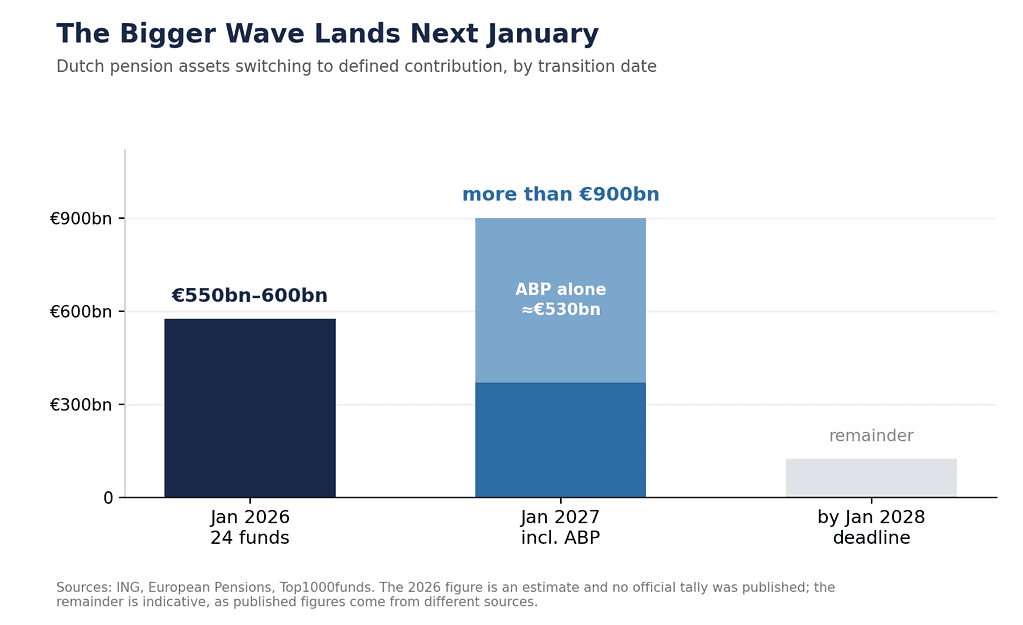
The Netherlands pension system is beginning to reduce one of Europe’s most reliable sources of demand for long-dated debt as a broad regulatory shift changes how Dutch pension funds manage their assets and liabilities. ING Groep NV estimates that nearly €600 billion ($699 billion) of assets have already been affected by the change, with more than €900 billion expected to follow early next year.
Under the old defined-benefit pension system, Dutch funds were required to hedge the interest-rate sensitivity of long-term pension liabilities by using long-dated bonds and swaps to match assets with payments extending decades into the future. Under the new defined-contribution model, which became law in 2023, that liability matching requirement has been significantly reduced, allowing funds to carry less duration and scale back their long-term hedges, resulting in less structural demand for the longest-dated debt and swaps.
For European CFOs, this could mean a higher premium for 20-, 30- and 50-year borrowing as companies and governments compete for a smaller pool of long-duration investors.
The change “should reduce structural demand for long-end duration assets and support curve steepeners over the long-term horizon,” wrote Sara Adjir, senior vice president and portfolio manager, and Jeroen van Bezooijen, account manager, at Pacific Investment Management Co., in a research note. They expect the impact will be mostly concentrated in 50-year swaps, but will also be felt in the demand for 20- and 30-year euro swaps and government bonds, including German and Dutch debt.
Deadlines
The Netherlands runs Europe’s largest pension system, with roughly €1.6 trillion in assets, and every fund must complete the switch by January 2028. Dutch pensions have long dominated the market for European long-dated debt, holding around €88 billion of interest-rate swaps maturing beyond 25 years at the end of last year, roughly a quarter of the total.
The first major wave of the transition came on Jan. 1, when 24 funds converted, among them the healthcare scheme PFZW and the metals scheme PMT, with an estimated €550 billion to €600 billion of pension assets between them. Analysis by the Netherlands central bank shows that Dutch pensions bought almost €34 billion net of swaps maturing inside 25 years while selling more than €12 billion of longer-dated ones.
The bigger test, however, comes when more than €900 billion of pension assets is scheduled to convert on Jan. 1, with the Dutch civil service scheme ABP accounting for about €530 billion of that.
The shift does not mean long-dated Dutch debt is suddenly becoming illiquid or even hard to sell: “Overall, we still see strong demand for our 30-year bond. Remember, we are AAA,” said Saskia van Dun, director of the Dutch State Treasury Agency.
Sovereign Issuers Adjust
Data indicates that sovereign borrowers are already adjusting to the change.
The share of Netherlands government bonds sold at maturities beyond 10 years fell from 42% at the start of 2025 to 31% by the third quarter, according to the Organization for Economic Co-operation and Development (OECD), which calls the constraint on long tenors structural. The OECD expects eurozone debt agencies to sell a record €1.35 trillion of medium- and long-term bonds this year into that thinner pool of demand.
For European finance chiefs, however, times are changing. For two decades, long-dated bond demand was unusually deep and predictable. As it recedes, the shifting cost of locking in 20 or 30 years of funding could become a live question.
Thomas Monteiro is a contributing writer based in Spain.
Market odds put a quarter-point hike at close to certainty, which would lift the European Central Bank’s deposit rate from 2.25% to 2.5%.
What makes this a difficult call is not whether the ECB acts, but why, and whether the reasoning survives contact with the data.
The path here has been compressed as the ECB raised rates on 11 June for the first time in three years, lifting the deposit rate from 2% to 2.25% in response to the energy shock from the Iran war, and then held rates in July while Christine Lagarde pointed hawkishly towards September.
August’s inflation figures removed any remaining doubt with eurozone inflation hitting 3.3%, up from 2.9% in July and the highest since September 2023, as energy inflation surged to 14.3% from 10.3%.
The inflation is not spreading
Look beneath the headline inflation and the picture inverts.
Core inflation, which strips out energy, food, alcohol and tobacco, actually fell to 2.4% from 2.5%. Services inflation, the component most closely tied to wages and domestic demand, dropped to 3% from 3.3%.
In other words, there is still little evidence that expensive energy is feeding through into everything else. That is what economists mean by “second-round effects”, and their absence is the strongest argument against tightening.
The ECB’s own research also supports the distinction.
In a paper published on Tuesday, ECB economists found that adverse energy supply factors, driven by geopolitical tensions, accounted for around 90% of the rise in energy inflation between January and May.
“This time the energy supply shock dominates, while demand and public policy stimulus have minor roles,” the economists wrote, adding that “these differences are key to explaining why monetary policy responses differ.”
The 2021-22 surge, by contrast, came from “a combination of large and unprecedented supply and demand-side factors,” which is why the ECB then “raised interest rates forcefully and persistently” rather than gradually.
The national spread across the EU further underlines how uneven this is.
August inflation ran at 4.5% in Spain, 2.9% in Germany and 2.7% in France, three economies facing the same energy shock with very different results, all governed by one interest rate.
Economic growth is the other complication.
The eurozone has proved more resilient than expected, which ING attributes partly to luck, partly to Asian competitors suffering more from the closure of the Strait of Hormuz and partly to fiscal stimulus. However, resilience does not mean the growth could not, or should not, accelerate.
ING characterises Thursday’s expected move as “another insurance rate hike”, or “a dovish rate hike,” noting that even at 2.5% the deposit rate sits within the range the ECB itself considers neutral.
Going further would mean deciding restrictive policy is required, which would be a different judgement entirely.
Everyone is looking to hike at the same time
The ECB is not acting alone, and that matters for the euro.
The Federal Reserve meets on 15 and 16 September, with Chair Kevin Warsh having used his first Jackson Hole address to argue that financial conditions are not restrictive and underlying inflation has not improved.
Investors had put the odds of a US hike at roughly one in three before those remarks, but now price a 60% chance the Fed hikes the target range from 3.5%-3.75% to 3.75%-4%.
The Bank of Japan follows on 17 and 18 September, with markets pricing an 80% to 90% chance of a move to 1.25%.
On the other hand, the Bank of England is expected to hold rates at 3.75% on 17 September as it currently maintains a much higher interest rate than the rest.
If the Fed were to hike while the ECB held, the dollar would strengthen against the euro and that would cut both ways for Frankfurt.
A weaker euro makes European exports more competitive, but it also makes imports dearer, and since oil and gas are priced in dollars, it would push up precisely the energy costs driving the inflation problem in the first place.
Overall, we can assume a September rate hike is a done deal for the ECB but we can also project that it won’t solve the central bank’s current dilemma of raising borrowing costs against an inflation it cannot reach, while withdrawing support an economy could still use.