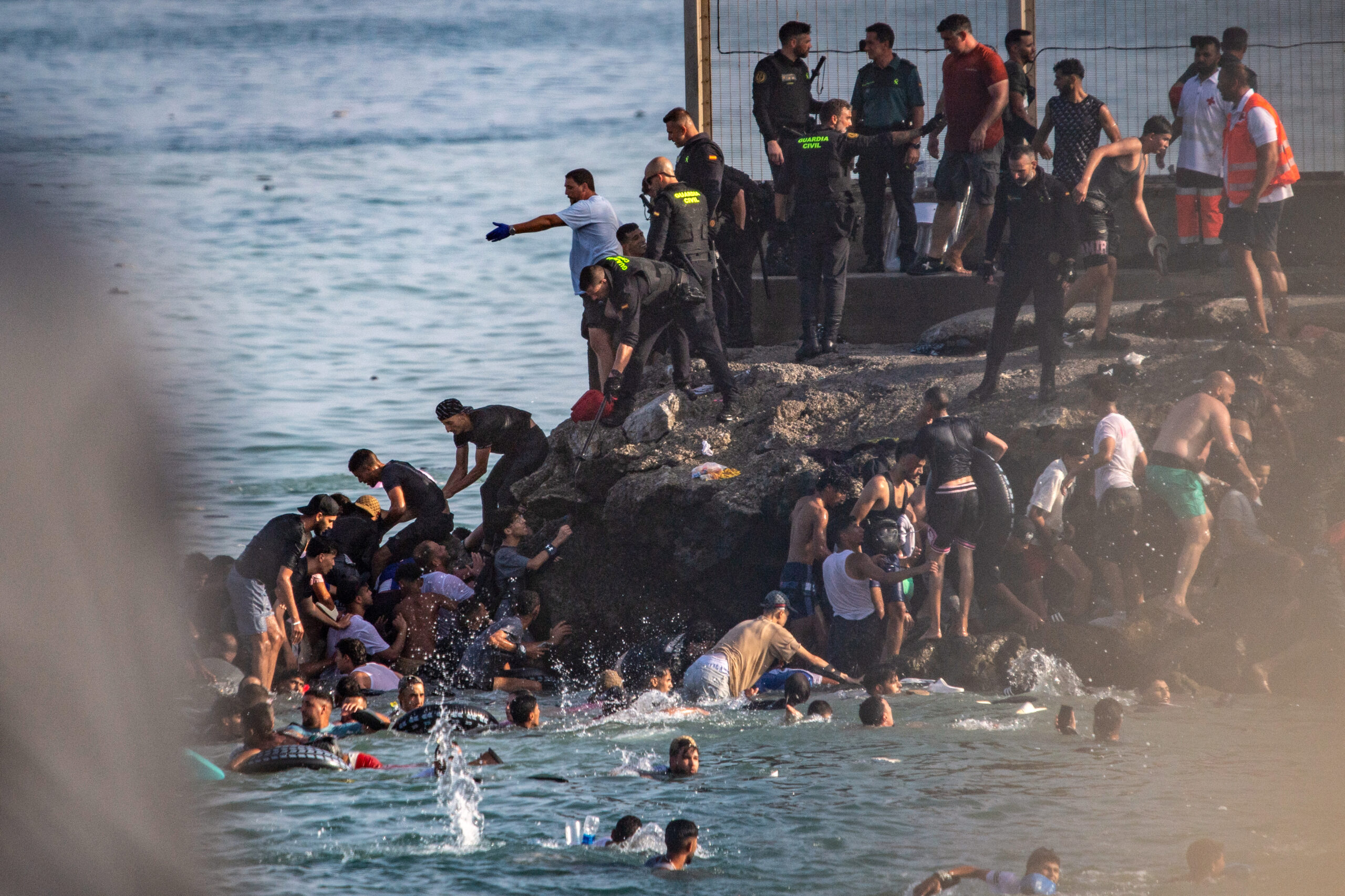
MADRID: Spanish Intelligence and security reports declassified on Wednesday had warned of possible “mass entries” by migrants into Ceuta just before thousands crossed into Spain’s North African enclave from Morocco.
Prime Minister Pedro Sanchez had told parliament when he announced he would declassify these 40 documents that there was “no information that conveyed the magnitude” of “the crisis we were going to suffer” on July 30 and 31.
“Internal communications have been detected in migrant groups in which they are trying to organise mass entries on the night of 29/07/2026,” reads a document from CENIF, a border division of the National Police, issued on the eve of the arrival of more than 70,000 migrants in the small Spanish territory.
CENIF said almost 1,000 people swam in from Morocco between July 1 and 28 — “a drastic upward trend compared to last year,” and “a consolidated and priority threat”.
An urgent memo from the National Intelligence Centre on the afternoon of July 29 warns of “several calls to carry out entries into Ceuta” in Facebook groups, one of them with over 160,000 members.
In a message on X Wednesday, Sanchez said that “with the information available at the time, no one could have foreseen the migration crisis that unfolded on the 30th and 31st. No competent body did so. Neither in Spain nor in the EU.”
He also said he had not received any document with “solid evidence that Morocco planned or carried out the incident”.
The government declassified the documents amid questions over Rabat’s role in the events and whether the Spanish government had been warned of the likelihood of mass entries.
Sanchez has insisted his government did not receive any report that would have allowed it to anticipate the scale of what was going to happen, nor anything containing “solid evidence that Morocco planned or carried out the episode.”
Doubts about Morocco’s role increased after the leak last week of a police report that pointed to the “permissiveness” of its security forces during the crisis.
A declassified document issued by military intelligence at midday on July 30 states that it is “highly likely that the Moroccan authorities are not actively encouraging the migratory wave, but have so far acted in a negligent and passive manner.”
The opposition accuses the government of failing to act despite being warned about what was going on and criticises it for exonerating Morocco, which it sees as being behind the mass entry.
“The government knew everything that was happening… They had the information. They are directly responsible for the invasion of Ceuta,” Ester Munoz, spokeswoman for the right-wing Popular Party in parliament, told reporters.
Weekly insights and analysis on the latest developments in military technology, strategy, and foreign policy.
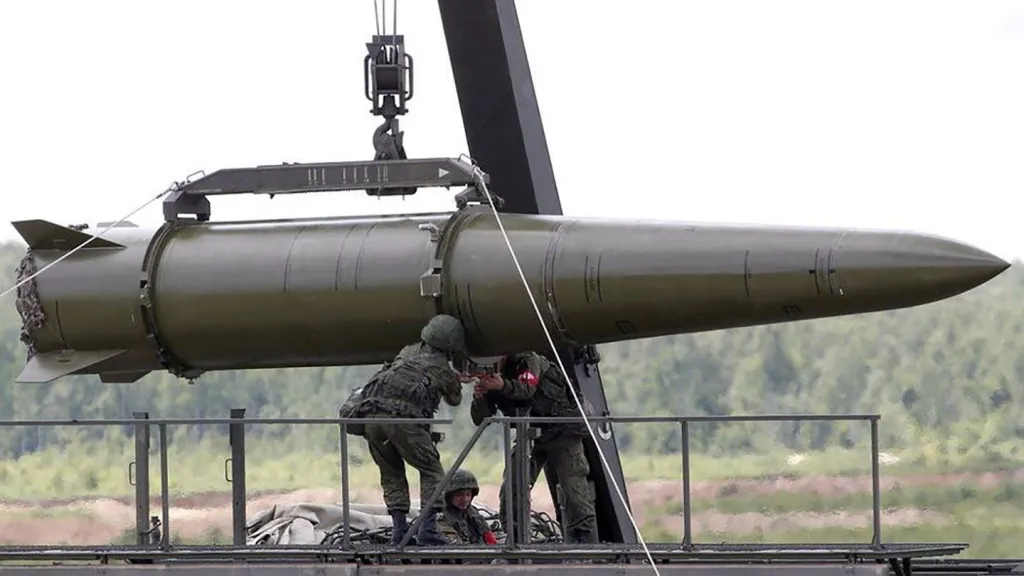
Russia used a longer-range Iskander ballistic missile for the first time in an attack on Kyiv, Ukraine’s Defense Intelligence Directorate (GUR) said on Thursday. Missiles fired from deeper inside Russia would present additional challenges to Ukraine’s new campaign to attack the systems before they launch.
“In one of the combined missile strikes on the capital this summer, the enemy first used the updated 9M723-2 ballistic missiles, also known by the code name ‘Iskander-1000,’” GUR stated. “The updated missile, due to the increased engine and, accordingly, the increased launcher, is capable of hitting targets at a distance of up to 550 km (about 341 miles).”
According to GUR, the range of the previous Iskander variant, the 9M723-1, is 390 km, or about 242 miles.
A Russian Iskander-M series ballistic missile. (Russian MoD) Russian MOD
In its statement about the new Iskander, GUR included photos of what appear to be recovered components of the weapon. However, the agency did not provide any specifics about what the components were, where they were found or when.
GUR GUR
While GUR states that the new Iskander short-range ballistic missile (SRBM) was only recently fired at Ukraine, unconfirmed reports emerged in January that this weapon may have been introduced back then. Reports also began to appear last year that Russia was poised to start mass-producing a new version of the Iskander SRBM, with a range of about 600 miles and improved accuracy. Talk of the development of this new missile emerged after the termination by the United States of the Intermediate-Range Nuclear Forces Treaty (INF) in 2019. This had previously prohibited the Soviet Union (later Russia) and the United States from fielding any ground-launched conventional or nuclear-capable missile of any type that can hit targets between 500 and 5,500 kilometers (310 and 3,420 miles) away. Russia formally abandoned the treaty a short while after the U.S pulled out.
We have reached out to GUR for details.
A Telegram channel operated by Russian paratroopers lauded the development.
“Now, rearward facilities that were previously considered relatively safe are within range,” gloated the Paratrooper’s Diary. “The missile retains its ballistic trajectory, which means it can maneuver throughout its flight path, making interception more difficult for air defense systems.”
“According to preliminary data, the increase in the fuel compartment may have allowed for adjustments to the warhead mass, but the missile is still capable of carrying both cluster and high-explosive warheads with increased power,” the paratroopers continued. “The deployment of the ‘Iskander-1000’ indicates that the Russian defense industry is not only replenishing stockpiles but also scaling up a major modernization of missile weaponry.”
Reducing the size of the warhead and increasing fuel storage is a well proven way of extended the range of certain missiles without drastically chaining its outer mold line. Other improvements, such as new motors and guidance capabilities can also help in this regard.
(Paratrooper’s Diary Telegram)
Russia produces dozens of these weapons a month, noted missile expert Fabian Hoffmann.
“Recently, Ukrainian intelligence provided an updated estimate of Russian missile production capacity, stating that Russia produces around 60 9M723 ballistic missiles per month,” he pointed out in May.
“Based on recent employment trends, this figure is not entirely implausible (at least compared to when this number was first mentioned in 2024), though it should be treated as an upper-bound estimate,” Hoffmann added. “More realistically, Russia’s combined 9M723 and Kh-47M2 production capacity in mid-2026 may be between 600 and 800 units annually, with monthly production potentially fluctuating significantly depending on the availability of internationally sourced components. This would allow Russia to sustain an average employment rate of roughly 50 to 70 monthly ballistic missile strikes against Ukraine, with greater peaks possible if part of the production is stockpiled in a given month.”
To bolster its stocks of short-range ballistic missiles, Russia is receiving more KN-23 and KN-24 missiles from North Korea, which are loosely akin to the Iskander-M. Russia has also asked Pyongyang for an additional tranche of KN-30 missiles, also known as the Hwasong-11C, according to a separate GUR report issued today.
“The new KN-30 ballistic missiles, which are three times more powerful than the KN-23/24, were requested by Moscow from Pyongyang, but so far, the transfer of these missiles from North Korea to Russia has not been recorded,” GUR added.
GUR
The KN-30 is an enlarged derivative of the original Hwasong-11 and designed to carry larger warheads. North Korea has previously said it has tested subvariants of the Da/C type with 2.5-ton and 4.5-ton conventional high-explosive warheads, and that it can also be fitted with a nuclear warhead.
Ukraine has had to absorb a lot of damage because it ran out of Patriots months ago. However, President Volodymyr Zelensky recently said an unspecified number of additional interceptors would be delivered. Evidence has also emerged that a new supply of Patriots is being used against Russian missiles, including Iskanders. Still, the concern stands because of the precarious nature of Ukraine’s interceptor supply and Russia’s ability to make new and improved missiles.
As we noted earlier in this story, Ukraine has a new campaign, recently announced by Zelensky, to go after Russia’s ballistic missiles prior to launching to offset a dearth of interceptors. However, Russia’s ability to launch missiles another 100 or so miles further away from Ukraine will make them harder to find and hit.
“When our anti-ballistic missile stocks are at a minimum, there is another tactic,” Zelensky commented. “It is more difficult, and we developed it. It is hunting their nearby positions from which ballistic missiles are launched.”
Zelensky offered no details about how the campaign would be carried out. However, “Ukraine has already targeted Russian ballistic missile infrastructure in several operations this year in Crimea and Rostov, Russia, with drones, Euromaidan Press reported.
❗️Zelensky says Ukrainian forces struck an Iskander-M missile launcher on Russian territory near Ukraine’s border. He called it another success and said operational details cannot be disclosed because of the mission’s sensitivity, but confirmed the launcher was hit. #Ukrainepic.twitter.com/Ao0ooa8JYt
It is always preferable to shoot the archer not the arrow, but doing so reliably is very challenging as the Iranians proved again in Epic Fury. Despite a concerted campaign by the U.S. and Israel to go after Iranian missile launchers, the Islamic Republic was still able to fire off numerous volleys, creating a swath of destruction across the region.
For Ukraine, this kind of effort would have to mirror its mid-range strike campaign against Russian logistics using longer-range drones. Ukrainians told us they are hitting targets up to 250 km away in the occupied territories. However, that’s been aided in no small measure by the use of Space X Starlink systems.
Carrying out a similar campaign in Russia would be challenging, because Space X owner Elon Musk is reluctant to allow their use deep inside Russia. As we previously noted, Ukraine is asking Musk for permission to “use Starlink-equipped drones against ballistic missile launchers up to 200km inside Russia,” the Financial Times reported last week.
GUR is calling for increased efforts to cut off the supply of foreign assistance Russia receives.
“To counter the aggressor’s plans, it is crucial to consolidate efforts aimed at limiting Russia’s program for the development, production, and modernization of ballistic weapons,” the directorate proffered.
The Ukrainian intelligence information about the new Iskander was part of a report on the amount of foreign components found on these missiles. The information is published on the directorate’s War & Sanctions portal, which identifies foreign assistance to Russia’s weapons programs.
“Only a quarter of the 140 components published today are manufactured by Russian enterprises,” GUR stated.
Almost half – 63 – were manufactured by American firms, GUR explained. The Iskanders also contained components from Switzerland, Belarus, Germany, Taiwan and China.
“In one of the most important components of the missile guidance system — the flight information processing unit obtained from the laser gyroscope — only 5 out of 43 components are manufactured in the Russian Federation,” GUR added.
Police allege Australian-Russian citizen joined Ukrainian military seeking to send information to Russian intelligence.
Published On 21 Aug 202621 Aug 2026
Australian police have charged a dual Russian-Australian citizen for trying to pass Ukrainian military information to people he believed were linked to Russian intelligence.
The 27-year-old man was due to appear in court in Brisbane on Friday on charges of foreign interference.
Recommended Stories
list of 3 itemsend of list
Australian Federal Police Commissioner Krissy Barrett told a news conference that the suspect travelled to Russia for training in October 2024. He then returned to Australia but “maintained contact” with individuals he believed were linked to Moscow’s intelligence services.
The police allege the man enlisted in the Ukrainian military in May 2025, where he “gained access to information relating to their military personnel, units and locations”.
Barrett said he shared the information obtained in Ukraine with “individuals he believed were acting on behalf of Russian intelligence services”, putting the safety of Ukrainian military staff at risk.
“We don’t want Australia to become a safe haven for people who are undertaking foreign interference on behalf of other countries,” the commissioner said.
The identity of the suspect, who is unemployed, has not been revealed. Police said there was no indication he had received military training in Australia. Search warrants have been executed, they added, noting the possibility of further arrests related to the case.
Australian Federal Police and the Australian Security Intelligence Organisation spy agency conducted the investigation.
“This case should put regimes perpetrating foreign interference on notice: we have zero tolerance,” ASIO Deputy Director-General Claire McGuinness said.
Russia’s embassy in Australia said it had no knowledge of the case.
“At this stage, no official requests or notifications have been received by the Embassy or the Consulate General in Sydney, either from the Australian authorities or from the individual concerned,” the embassy said in an email to the AFP news agency. “We are currently using the available channels and resources to establish the circumstances of the case.”
Russia arrests Ukrainian operatives
Meanwhile, Russian authorities have arrested nine people and charged them with working for Ukrainian intelligence, state media reported on Friday.
The TASS media agency said eight of the suspects were found to have 35 drones, equipped with explosives smuggled from the European Union, and planned to attack a strategic defence enterprise in the Moscow region.
Separately, a foreign national was detained close to the Norwegian border. The FSB security service said that the man – whose nationality it did not reveal – had been arrested for trying to launch a surveillance drone over Moscow to help Ukrainian intelligence plot an attack on the Russian capital.
The FSB said it had detained the individual as he was trying to flee to Norway on foot.