instrument

Taxidermy sound bath? It just works at the Natural History Museum

I lay on my back and stared at a bright blue painted sky, dappled with puffy clouds. As my mind drifted, the sound of a breeze, created by handheld fans, filled the room. Then came a symphony of chimes, crystal bowls, wave drums and rain sticks. To my right, a black bear cub eyed me curiously.

Soon a thunderous crescendo of gongs arose. I looked to my left, where two endangered polar bears stood on a sheet of ice, ocean looming behind them.

The noises softened and went still. With a resounding clap from participants around the room, I came back to reality.

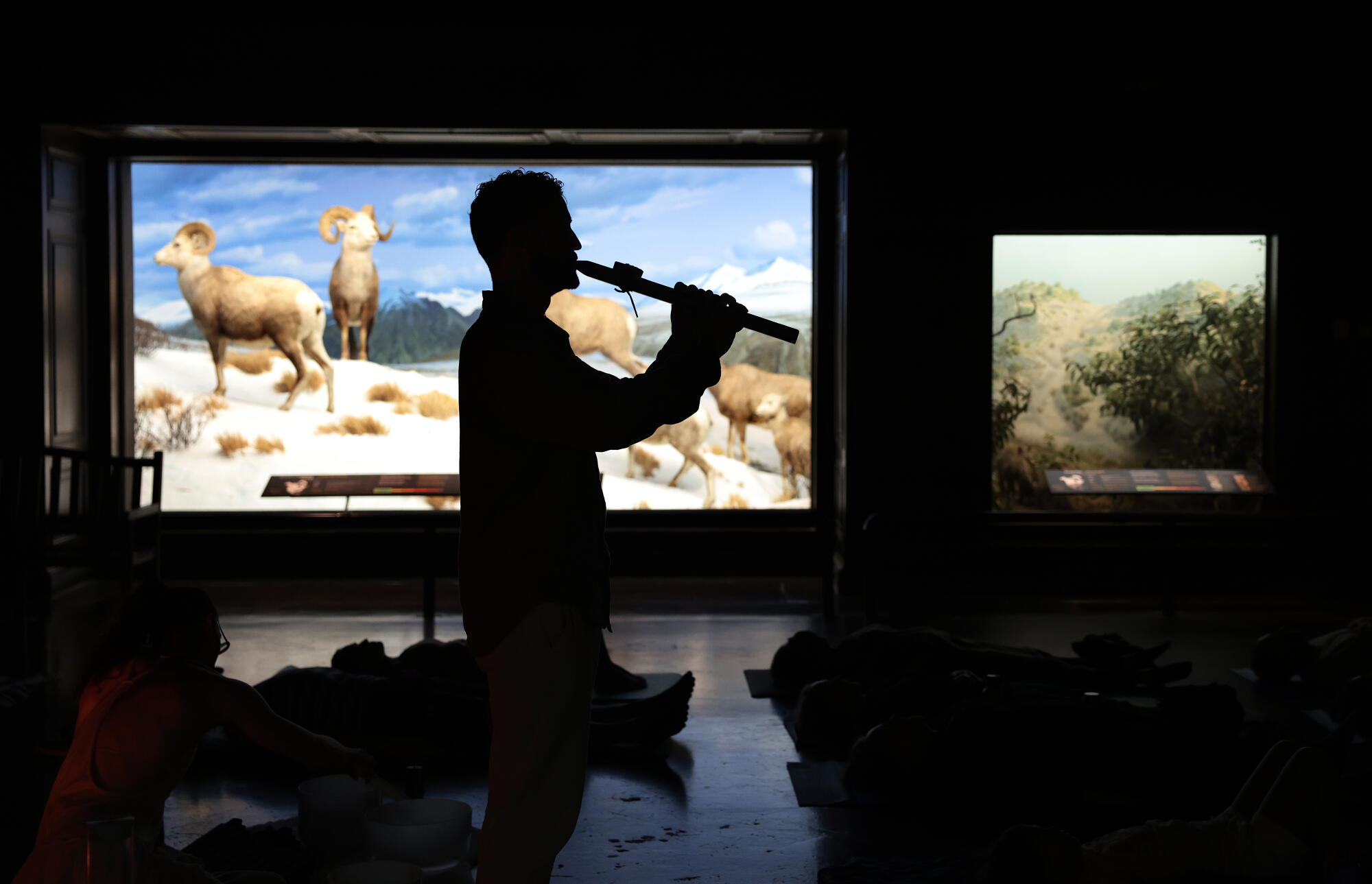
I wasn’t in a forest, nor the Arctic. And no, I had not recently taken any psychedelic substances. I was at a sound bath in the North American Mammal Hall at L.A.’s Natural History Museum, surrounded by dioramas of taxidermy, meditative instruments and sound healers from the Oso Sound Healing Studio.

Avery Whitmore leads participants in a sound bath.

Avery Whitmore leads participants in a sound bath.

Hosted earlier this month, the sound bath was the first of two events in the museum’s new Mindfulness Mornings at the Museum series, where guests can experience a meditative practice in the iconic gallery before opening hours. A nearly sold-out yoga session led by SoulPlay Yoga will take place on Sept. 13, and museum organizers hope to host more events after that, said Joel Quizon, the manager of public programs.

The Natural History Museum always looks for ways to “activate the museum space,” Quizon said. Ahead of the sound bath, Oso Sound Healing Studio founder Avery Whitmore said the unconventional space would invite a childlike energy, a deeper connection to animals and introspection.

“Just seeing these older animals, it takes you into another place,” Whitmore said. “It could invite you into a deeper meditation about where we are, where we come from. In that mind state, you might be a little bit more receptive to exploring the same questions about yourself.”

The museum introduced Mindfulness Mornings following the success of its past wellness events — including sound baths that were part of its First Fridays after-hours series. With those events, the lines went “down to the basement,” Quizon said.

People laying down on the floor during a sound bath.

The Natural History Museum is an apt venue for mindfulness events as people already see it as an “oasis [in] the city,” said Joel Quizon, the museum’s manager of public programs.

Two women lay on yoga mats

Participants Kenny Mayo of Culver City, left, and Verseilla McCloskey of Long Beach are immersed in sound.

Whitmore, who previously collaborated with the museum during First Fridays in 2025, founded Oso Sound Healing Studio in 2023. He played piano and percussion as a child and later guitar as an adult, but “put all of that away for many years,” he said.

About a decade ago, personal struggle led him to seek out spiritual practices, and that healing guided him toward being of service to others. That led him to attend massage school — not to start a career as a massage therapist, he said, but to learn how to give back to others.

The experience inspired him to learn other healing modalities, including breath work and sound meditation: the latter of which reignited his musical appreciation. “ It helped to revisit that, or reawaken it from another perspective,” Whitmore said.

When I attended the sound bath, about 100 people filled the hall and Whitmore opened the meditation by asking how many new sound bathers were here. More than half of the attendees, including me, raised their hands.

During the practice, participants can peek and see the varied habitats of North America beside them.

During the practice, participants can peek and see the varied habitats of North America beside them.

Avery Whitmore created a sound bath experience inspired by the unique museum space.

Avery Whitmore created a sound bath experience inspired by the unique museum space.

With the overhead lights dimmed and soft light spilling from the dioramas, the displays looked like windows to other worlds. I took a mat next to the American black bears and American badgers, only slightly jealous that the mats next to the large-scale walrus diorama were taken.

The meditation lasted about an hour. In addition to the variety of instruments evoking the sounds of nature, it incorporated breathwork, vocal exercises and a small amount of physical sensation: a refreshing spritz of rose water. Sets of instruments were stationed along every wall of the room, fully encompassing us in sound. Peeking at the animals around me, I couldn’t help but think of them as characters whenever new instruments joined the symphony.

“Definitely the coolest sound healing experience I’ve been to,” said Kenny Mayo, 35, after the sound bath.

“The different stations felt like an orchestra. It was put together in such a beautiful, methodical way, and all of the instruments were harmonizing perfectly.  It felt like no matter where you were, there was something close to you,” Mayo said.

Toward the end of the meditation, Whitmore asked participants to envision an animal and invited them to receive its message. Mayo said she thought of a hawk, and found meaning in connecting with the spirits of animals that “don’t exist anymore.”

“It’s a magical thing, to be able to see the history of all the animals, our ancestors,” she said. “We can still connect to the essence.”

I looked at the taxidermy black bear cub, standing energetically on its hind legs, and imagined the future ahead of it; then across the room to the adult polar bears, traversing an icy surface that, beyond the diorama, continues to melt away.

As part of the meditation, participants were invited to think about where they were, and where they've come from.

As part of the meditation, participants were invited to think about where they were, and where they’ve come from.

Source link

Emmy-winning composer Bear McCreary trades Hollywood scores for headbanging riffs

Emmy-nominated composer Bear McCreary has taken a reverse road to symphonic rock. Prog rockers have traditionally integrated symphonic elements; other rock bands have done orchestral versions of their songs. McCreary began creating television and film scores, discovered his inner metalhead, and has since bridged those worlds with his “Singularity” project. It all adds up to a different take on that time-honored formula.

The second of the two albums, “The Singularity: Ekleipsis,” is out Friday and features contributions from guitarist Steve Vai, Coheed and Cambria frontman Claudio Sanchez, Fall Out Boy frontman Patrick Stump and McCreary’s younger brother Brendan, who sings on half the tracks. The multifaceted album feels like “I am Bear, hear me roar.”

“I love that quote,” he says, laughing, during his two-hour interview with The Times. “I want to put that on the posters. I feel like ‘The Singularity’ is a temper tantrum of a record from someone who had been writing music for other people for 20 years, then all these ideas exploded out.” Two years after the release of the first “Singularity” album, “Ekleipsis” feels more focused and personal to him.

Portraits of Los Angeles composer Bear McCreary

From Anthrax dinners to sessions with Slash, Stewart Copeland and Bulgarian choirs, McCreary’s restless curiosity drives genre-bending songs that wrestle with identity, diaspora and the world listeners are trying to survive.

(Allen J. Schaben / Los Angeles Times)

The first “Singularity” double album — which featured guests like Serj Tankian, Corey Taylor, Rufus Wainwright and Joe Satriani — tied into a graphic novel about a man who repeatedly experiences loss and death at the hands of a villainous character in his every life across their multiverse. This leads to a major revelation at the end. Although McCreary says that “Ekleipsis” is not disconnected from that universe, it is not strictly tied to a narrative.

“I wasn’t setting out to write a concept album again,” McCreary admits, “but there’s something immediate in all the lyrics. Half of them are specifically talking about the world that we all find ourselves living in and trying to overcome in some way.”

McCreary’s sonic diversity continues with “Ekleipsis.” Gojira frontman Joe Duplantier collaborated with the McCreary brothers and the Mystery of the Bulgarian Voices choir on “Black Box” to create a work of dissonant majesty. The composer improvised his way through the initial stages of “Pray for a Storm,” his high-energy collaboration with famed drummer Stewart Copeland.

“Let’s all go into your studio with nothing,” McCreary recalls telling the irrepressible percussionist. “I’m not even going to bring an idea. We’ll plug in our instruments, set the mics up and play. I want to capture your ideas and your energy, then shape it into a song based on the pieces that I get.”

McCreary sees new endeavors as a learning experience. He meets his collaborators in the way they like to work. He was awed while writing with Guns N’ Roses bassist Duff McKagan and Red Hot Chili Peppers drummer Chad Smith on the anthemic “Cool Kids.”

“Those guys are true songsmiths,” the composer declares. “I think they’re unrecognized as songwriters. They wrote for Ozzy Osbourne. They’re focused on hammering down a riff until it works. We walked into a studio with a riff that Duff had written and walked out with this song that we brought Slash onto. We got that band experience [with them].”

McCreary is best known for scoring series like “Battlestar Galactica,” “The Walking Dead” and “The Lord of the Rings: The Rings of Power,” along with movies such as “Godzilla: King of the Monsters” and the “God of War” video game franchise. He gained entry into metal through a dinner with Anthrax guitarist and “Battlestar” fan Scott Ian two decades ago.

“‘I know you. You’re a guy who loves Sepultura,’” Ian told him, invoking a musical link for the composer. Intrigued, McCreary listened to Sepultura’s folk-infused Brazilian death metal and loved it. His metal journey began.

Ever since, McCreary has been itching to dive into that arena. He has an important collaborator in that quest.

“My brother’s my secret weapon when it comes to rock,” McCreary says. “His body of [rock] knowledge makes up for mine. Our emphasis is in a different place. He is a fantastic producer because he’s got a really good radar for when things are useless, when a part of a song isn’t pulling its weight. It’s a very good influence to have someone like that. He’s got a great lyrical sense and an incredible voice.”

McCreary says Brendan is often the driving force of their lyrical efforts, and “sometimes we co-write with other people. Claudio Sanchez wrote all the lyrics on ‘Sweet Misery.’ It just depends.”

The younger McCreary was the propelling wordsmith on “One Fine Day.” “It’s about our experience as being in the Armenian diaspora and exploring what that means to us,” McCreary elaborates. “All the songs are very personal, which is another thing that sets this record apart from the last record. Many of them were personal, but I also had a weird song about an automaton that fell in love.”

Portraits of Los Angeles composer Bear McCreary

Mentored at USC by Elmer Bernstein, McCreary now leaps from “God of War” themes to a Higgs boson rock musical and a roaring Singularity tour that hits L.A. on Sept. 17.

(Allen J. Schaben / Los Angeles Times)

Before he jammed with rock icons, McCreary was mentored by the late, iconic Elmer Bernstein for nearly the last decade of his life. The burgeoning young composer organized Bernstein’s music archives, sat in on recording sessions and audited his senior-level classes for three years while studying at the Thornton School of Music at USC. McCreary says that Bernstein “really set me on the path that I am now on, not because I learned how to orchestrate or how to write music from him. But he showed me the life that I could envision myself having when I was 15 or 16, that crucial time when you’re really setting the rudder for where you’re going to go in life.”

That rudder has steered him to many shores. McCreary has been co-writing the musical “Particle Fever” with Zoe Sarnak (“Galileo).” Pulitzer Prize finalist and Tony winner David Henry Hwang (“M. Butterfly)” wrote the book, and Tony nominee Leigh Silverman (“Suffs”) is its director. It is based on the documentary of the same name about the discovery of the Higgs boson — the “God particle” — at the Large Hadron Collider in CERN. It will debut at the La Jolla Playhouse in February 2027.

“It is a really kick-ass, earnest rock musical about a really ambitious discovery,” McCreary says. “My hope is that it actually has some of the swagger and fun that people found in ‘Hamilton,’ which also was a very dry subject that you learned about in eighth grade.”

The 47-year-old composer exudes an infectiously upbeat energy. He loves challenges and says he learned that charisma and charm are valuable assets to get in the door to prove one’s talents.

“I’m wired to be very positive and collaborative,” he concedes. “But I got so oppressively excited in my 20s that I started annoying people. My lesson was walk it back.”

His creative energy continues unabated. He’s even scored shorts for filmmakers he met through Twitter. (“I’m down to work.”) He has been blogging about his musical life for 20 years for a core group of followers. (“In hindsight, if Jerry Goldsmith had done that in the ‘80s, my God, my life would be different.”)

McCreary started as a high school keyboardist, then found the accordion in college, an instrument that gave him greater stage motion and which he later used to great effect in his music for the “Outlander” series. He loves to headbang while playing the hurdy-gurdy, an instrument he picked up in 2010 and later employed in the “Black Sails” show and “God of War: Ragnarok” video game. He learned guitar to play rhythm during his 2025 shows.

Those riffs will be on display at the Wacken Open Air festival on Friday and during McCreary’s eight-date September “Singularity” tour of the West Coast that hits L.A. on Sept. 17. McCreary has performed his symphonic scores in Europe and America with orchestras, but now he also loves to rock out (loud).

A big secret of the ambitious McCreary’s success harks back to lessons of simplicity that Bernstein taught him.

“The giant theme that I wrote for ‘God of War’ can be played with one finger on a piano,” McCreary reveals. “That is the thing that it boils down to, and that is what I listen for in music. Most of the time it means there’s a melody in there that sticks with you, and it doesn’t matter how well it is produced or how epic it is or how loud it is. A good song is a good song is a good song, and it really doesn’t matter how good a band performs. If the song is good, it will connect with people.”

Source link