inspections

Iran war day 117: Nuclear inspections dispute as US Senate curbs war powers | Military News

Iran and the US clash over nuclear inspections and Hormuz as negotiators push for a final deal within 60 days.

Iran and the United States have offered conflicting accounts of key issues as negotiators work towards a final agreement within a 60-day window. Differences remain over nuclear oversight and the implementation of any deal, underscoring the challenges facing both sides.

US Secretary of State Marco Rubio said Iran would not be allowed to charge tolls in the Strait of Hormuz under a final agreement, stressing that the strategic waterway must remain open to international shipping.

Meanwhile, Iran rejected US claims that it had agreed to allow nuclear inspectors back into the country after President Donald Trump said Tehran had accepted the “highest level” of monitoring. The conflicting statements highlight the gaps that negotiators are still trying to bridge.

Here is what has happened:

In Iran

  • Iran’s military shifts to ‘offensive doctrine’: General Ahmad Reza Pourdastan, head of Iran’s Army Strategic Studies and Research Center, said Tehran has moved away from a purely defensive posture and now includes preemptive operations in its military strategy. Quoted by the semi-official Fars news agency, Pourdastan said Iran could “severely surprise the enemy” if national interests required it and added that much of the country’s military capability has yet to be used.
  • Iran says no IAEA inspections planned: Tohid Asadi, reporting from the Strait of Hormuz, says the Iranian Foreign Ministry spokesperson Esmaeil Baghaei has denied reports of a meeting with International Atomic Energy Agency (IAEA) chief Rafael Grossi and said there are currently no plans for visits or inspections by the UN nuclear watchdog. Baghaei said Iran’s dealings with the IAEA would be governed by existing procedures, its safeguards obligations, parliamentary legislation and decisions by the Supreme National Security Council. Iran suspended cooperation with the IAEA after US and Israeli strikes on its nuclear facilities in June 2025, and while diplomacy continues under a 60-day framework, Tehran says it has not granted permission for inspectors to return.

War diplomacy:

  • ‘No way’ US and Iran can finalise deal in 60 days, analyst says: Charles Kupchan, a senior fellow at the Council on Foreign Relations, told Al Jazeera there is “no way” Washington and Tehran can complete a final agreement within the 60-day timeframe repeatedly cited by President Donald Trump. “I think we’re talking about at least into the next calendar year,” he said, adding that he would not be surprised if both sides simply “run out the clock” by continuing negotiations and keeping the Strait of Hormuz open without reaching a final deal before the end of Trump’s presidency.
  • Qatar says LNG production could return to normal within weeks: Prime Minister Sheikh Mohammed bin Abdulrahman bin Jassim Al Thani told the Financial Times that Qatar is preparing to restore normal liquefied natural gas (LNG) production after the interim US-Iran deal. Qatar, the world’s second-largest LNG producer, halted output in March following an Iranian drone attack on the Ras Laffan facility. Sheikh Mohammed said most production could resume within weeks, except at the damaged site, adding that QatarEnergy would only lift its force majeure declaration once it is satisfied that all safety and operational concerns have been addressed.

In the Gulf:

  • Rubio ‘trying to sell the deal’ with Iran on Gulf tour: Alan Fisher, reporting from Washington, DC, said US Secretary of State Marco Rubio is visiting the United Arab Emirates, Kuwait and Bahrain, three Gulf countries seen as having been among the most affected by the war with Iran. Rubio, who also serves as Trump’s national security adviser, is expected to reassure regional allies that US security commitments remain intact. He will also address the Gulf Cooperation Council in Bahrain, where he is “really trying to sell the deal”, amid concerns over Washington’s response to Iranian attacks.

In the US

  • US Senate approves resolution to curb Trump’s war powers on Iran: The Senate voted 50-48 to pass a measure requiring congressional approval for further US military action against Iran, marking the first time a war powers resolution on the conflict has cleared both chambers of Congress. Four Republicans – Bill Cassidy, Lisa Murkowski, Susan Collins and Rand Paul – joined nearly all Democrats in backing the measure, while Pennsylvania Democrat John Fetterman voted against it. The resolution is expected to face a veto from President Trump.

In Israel

  • US ‘very naive’ on Iran, Ben-Gvir says: Israeli National Security Minister Itamar Ben-Gvir said the US would be “very naive” if it believed Iran would abandon its nuclear programme, and hinted that Israel may act independently against Tehran. “It is Israel’s responsibility to confront this Iranian threat and act against it alone,” he told Israel’s Channel 7, adding that “no circumstances” could force Israel to act “according to the dictates of a friend, even if that friend is truly great”. His remarks come amid reported tensions between Washington and Tel Aviv over Israel’s attacks on Lebanon and ongoing US-Iran negotiations. Last week, US Vice President JD Vance publicly criticised Israeli cabinet ministers for “attacking” Washington, calling the US Israel’s “only powerful ally” left in the world.

In Lebanon

  • UN says ceasefire ‘largely holding’ in southern Lebanon: The United Nations said the ceasefire in southern Lebanon appears to be “largely holding”, although peacekeepers continue to observe Israeli military ground and air activity. UN spokesperson Stephane Dujarric said UNIFIL troops witnessed “heavy” machine-gun fire and three tank rounds fired by Israeli forces near Biyyada on Monday, while drones were also seen “apparently to monitor UNIFIL peacekeepers”. The incident came a day after peacekeepers reported the first day without exchanges of fire since fighting escalated on March 2. The UN urged all sides to “adhere fully to the ceasefire and refrain from any escalation, particularly during this delicate period of ongoing negotiations”.

Source link

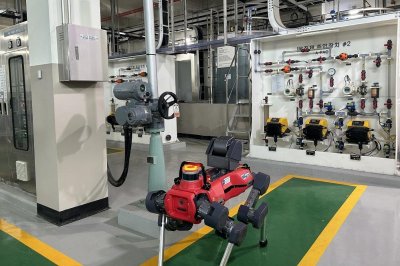
K-water to use robots for 61% of plant inspections

Korea Water Resources Corporation is moving to introduce a robot-based
inspection system for managing water supply facilities. Photo Courtesy of K-water

May 28 (Asia Today) — Korea Water Resources Corporation, also known as K-water, is accelerating the use of four-legged artificial intelligence robots to inspect large-scale water treatment plants.

The state-run water agency is adopting robots to improve facility inspections and safety management in hazardous areas and during nighttime patrols at water treatment plants.

Under K-water’s plan to introduce inspection robots at metropolitan water treatment plants, four-legged robots will be deployed this year and next year at four facilities in Seongnam, Hwaseong, Gosan and Gongju.

The agency plans to use data and results from those sites to expand the system to 40 additional water treatment plants by 2030.

K-water plans to deploy robots at 10 plants in 2027, 11 in 2028, nine in 2029 and 10 in 2030. The plan would establish a robot operating system at 44 metropolitan water treatment plants, with 44 robots in total.

A task force will soon begin work to operate the four pilot sites selected for this year.

The total budget for the project is 26 billion won, or about $17.3 million. It includes 7.8 billion won, or about $5.2 million, in state funding and 18.2 billion won, or about $12.1 million, from K-water’s own budget.

The robots will be used for equipment inspections, patrols, construction supervision and accident response. K-water is also considering the phased introduction of water quality analysis assistance robots, grass-cutting robots and unmanned guide robots.

The agency eventually plans to replace some of the robots with humanoid robots.

The use of AI and robots at water treatment plants is part of K-water’s strategy to create fully autonomous facilities. The agency aims to upgrade AI functions now used to assist workers and achieve fully autonomous water treatment plant operations within four years.

After that, K-water plans to package AI-based plant operation technology with robot-based management systems for use in overseas water management markets.

Once the robot operating system is established, K-water expects robots to handle 61% of condition inspection work among inspection and maintenance tasks. Condition inspections include checking whether equipment has visible abnormalities.

The agency estimates the system could save about 2.25 billion won, or about $1.5 million, annually.

K-water also plans to develop its own independent control system to avoid dependence on specific vendors for data accumulated during robot operations and additional operating costs.

“Bidding for the four pilot sites is expected to begin as early as next month, along with software service procurement,” a K-water official said. “Contracts are expected around August, and actual installation is expected to begin at the end of the year.”

The official said K-water will also consider gradually expanding the system beyond water treatment plants to other water supply facilities, dams and sewage systems.

— Reported by Asia Today; translated by UPI

© Asia Today. Unauthorized reproduction or redistribution prohibited.

Original Korean report: https://www.asiatoday.co.kr/kn/view.php?key=20260528010008434
Source link