With the Cinerama Dome, Sony is betting on in-person experiences
Other than “The Odyssey,” the biggest news in Los Angeles film circles last week was the return of the Cinerama Dome.
The iconic theater, which has been closed since March 2020, will be restored and reopened by Sony Pictures Entertainment and its Alamo Drafthouse theater chain. As my colleague Cerys Davies reported, renovations begin next month and will continue until early 2028.
For more than 60 years, the dome has been a landmark on Sunset Boulevard. With its 86-foot-wide curved screen, it has premiered such iconic Hollywood films as 1977’s “Close Encounters of the Third Kind,” and made a cameo of its own in 2019’s “Once Upon a Time … in Hollywood.”
Ever since the dome closed at the start of the COVID-19 pandemic, there have been questions about whether it would return. Filmmakers like “Anora” director Sean Baker and “Baby Driver” director Edgar Wright publicly called for its reopening, while a “Save Your Cinema” preservation campaign led by Benjamin Steinberg kept the geodesic icon in the public eye.
“It was definitely the capital of, like, the movie-going experience in L.A.,” Steinberg told my colleague, adding that he plans to visit the theater two to three times a week when it reopens. “I can’t wait to go back inside the Cinerama Dome and watch movies.”
The theater will be operated by Alamo Drafthouse, though Sony says it plans to keep the “Cinerama” name and exterior branding, as well as the dome’s “traditional concession experience” — meaning you won’t be able to order food and drinks to your seat. (Cinephiles recently have criticized the chain for changing its in-seat ordering system to require use of mobile phones in the theater.)
Alongside traditional theatrical showings, the dome also will include some Alamo Drafthouse specials, including repertory screenings, premieres, events and filmmaker series.
Adjacent to the dome, the 14-screen former ArcLight Cinemas will reopen as an Alamo Drafthouse, Sony said, offering dine-in food and beverages, as well as karaoke rooms and “fan celebrations.”
Sony was interested in the dome even before the Culver City-based studio acquired Alamo Drafthouse in 2024.
“It’s such a great location,” Ravi Ahuja, chief executive and chairman of Sony Pictures, told me. “It’s historic, people love it and the theater was successful before it closed. It’s one of a kind, which is the kind of experience we’re after.”
The move also highlights the opportunity Sony sees in the experiences business — an increasingly important strategy for Hollywood.
The Alamo Drafthouse acquisition was part of this, as was the studio’s recent $100-million investment and minority stake in Cosm, a virtual reality venue operator that has a location at Inglewood’s Hollywood Park.
The studio also has “Wheel of Fortune Live!,” a touring version of the popular game show, “Jeopardy! Bar League,” which was incubated at Alamo Drafthouse, and events for its streaming service Crunchyroll at anime conventions.
“It’s another leg of the franchise stool,” Ahuja said. “Fans want to engage in person with each other. It’s part of a human need when you have deep fandom around something.”
As the theatrical market waxes and wanes and the television business has become more unpredictable, it makes sense that studios like Sony increasingly look to diversify and attract fans in new ways.
After all, people have a lot of things they can do with their time and money. And after a period of slow returns since the pandemic, they’ve increasingly been coming back to in-person activities. To keep loyal fans in the fold, studios need to give them more ways to interact with the stories and entertainment they love, or they’ll move on.
Betting on the experiences business isn’t new. Walt Disney Co. makes the majority of its operating income not from its theatrical movies or streaming service, but from its theme parks and cruise line division. Last year, Universal opened Epic Universe, a major investment in its Orlando theme park resort that indicates the importance of this business for the company and owner Comcast.
But not every company wants or needs to start a theme park business. For one, it’s expensive. And for a studio like Sony, which doesn’t have a lot of kid-focused franchises, it doesn’t really make sense.
As a result, some are getting into the experiences space in more specific and limited ways, such as studio tours or branded attractions.
For Sony, that’s meant building a business around these in-person offerings that align more with its adult-leaning audiences. Lionsgate has a “John Wick Experience” in Las Vegas, while Warner Bros., among other things, recently debuted “Harry Potter: A Hogwarts Express Adventure” train event at the Southern California Railway Museum in Perris. (Universal licenses Harry Potter from Warner Bros. for inclusion in its parks.)
For most studios without a major theme park presence, this kind of location-based entertainment is still likely a relatively small part of their corporate revenue, potentially less than 1%, said Dennis Spiegel, founder and chief executive of the International Theme Park Services, Inc. consulting firm. But what these experiences do is help lengthen the life of a franchise by keeping licensing revenue flowing and keeping brands relevant between film releases, he said.
“Hollywood increasingly sees it as an essential part of maximizing the lifetime value of its intellectual property,” he wrote in an email. “In many ways, we have seen how these experiences have become as much of a marketing engine as they are a profit center.”
As for the Cinerama Dome, don’t take it as a sign that Sony is looking to build out an exhibition empire. The studio is looking for only special and selective deals like the dome, Ahuja said, and there are no plans to add more L.A. exhibition locations.
Stuff We Wrote
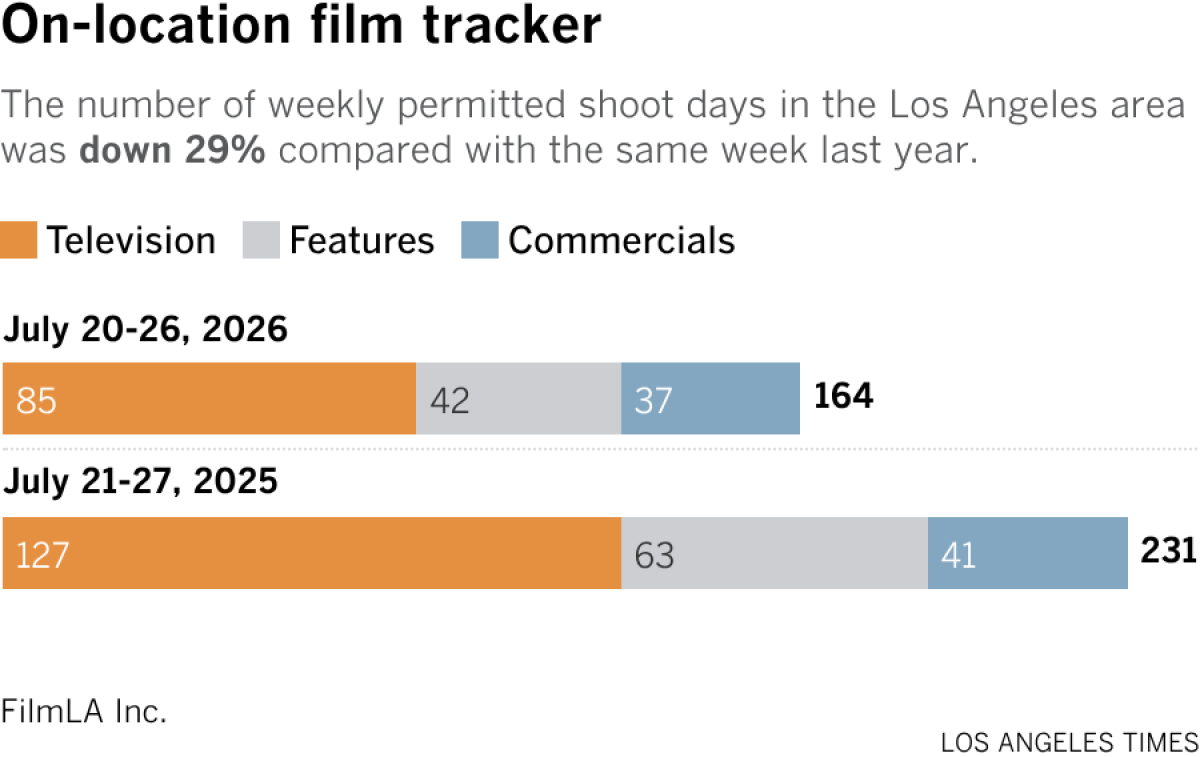
Film shoots

Number of the week

Christopher Nolan’s “The Odyssey” continued its dominance at the box office in its second outing with a three-day domestic haul of $90 million, down only 27% from its debut weekend.
Internationally, the Universal Pictures film raked in $137.6 million for a worldwide total of $652 million.
The big box office performance came as an unauthorized copy of the film leaked online over the weekend. The studio said it “immediately initiated takedown protocols” once it became aware of theillegal posting on X and “will pursue all appropriate remedies to protect our content and intellectual property rights.” The post was viewed more than 2.1 million times before a takedown notice replaced the copy of the film.
What I’m watching
I did not expect Amazon MGM Studios’ “The Sheep Detectives” to deliver a profound message on death and grieving when I sat down to watch it with a friend, but those talking ovine sleuths really got to me.