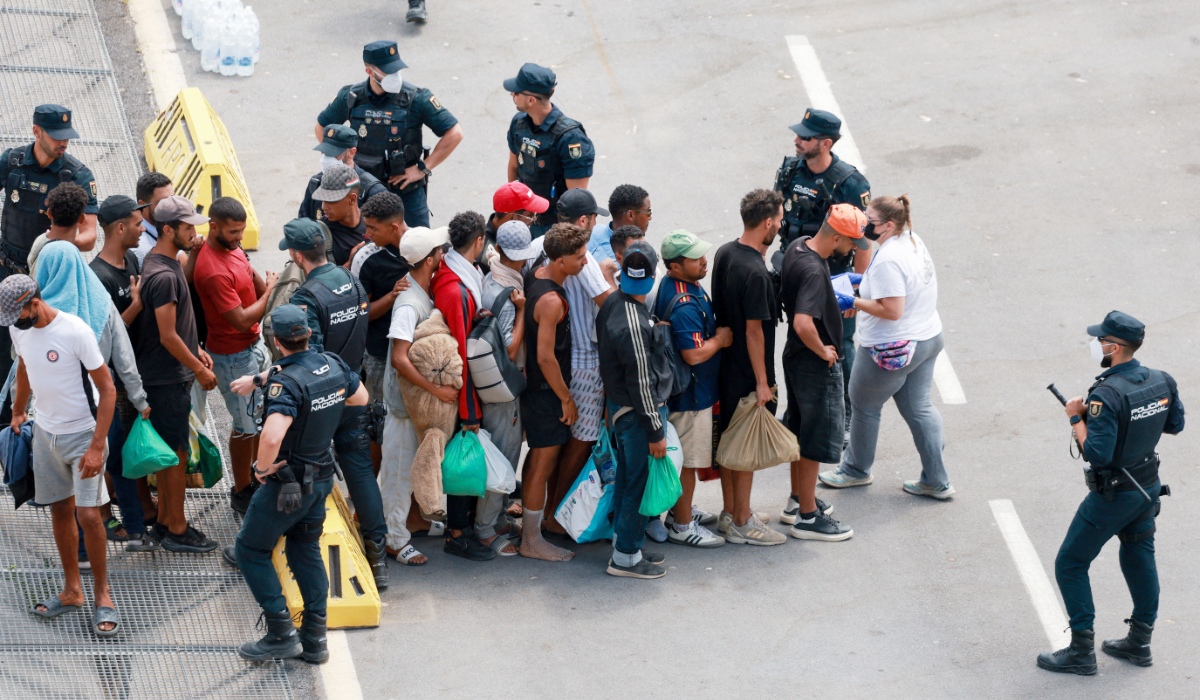
America, the Land of Immigrants, has always been ambivalent about just what that mantle should mean, but that ambivalence has taken on an edge. The middle ground has shifted, decidedly to the right.
And California, characteristically, is ahead of the trend.
Now, when liberal Sen. Barbara Boxer suggests that National Guard troops be stationed along the southern border, only immigrant-rights activists are publicly aghast. When Gov. Pete Wilson says the Constitution should be changed to deny citizenship to U.S.-born children of illegal immigrants, a Field poll shows that half of all Californians like the idea.
“This is a state of siege in California,” says an observer from Washington, immigration expert Demetrios Papademetriou of the Carnegie Endowment for International Peace.
“There is an enormous bombardment out there. There is always something new about immigration. One’s senses get bombarded every day, which is the worst possible moment for trying to make fundamental decisions regarding immigration. I am delighted that they will be made in Washington, rather than California.”
Yet California is where the Immigration and Naturalization Service estimates 52% of all illegal immigrants live, where dueling studies constantly argue the benefits and costs of the immigrant mix, and where, increasingly, many see an immigration apocalypse born of neglect.
Even the membership of the Sierra Club is in the midst of an emotional debate about whether to take a public stand on the hot button topic of the day.
“It’s not as simple as clean air, or like pollution, where less is better,” said Executive Director Carl Pope.
But millions of other Americans seem to have made up their minds. The polls say most Americans believe illegal immigration is out of control, that the country has too many immigrants, illegal or otherwise, and that this is very bad news for the economy and for our national quality of life.
Every day, Americans are clamoring that something should be done. So everyone from the President of the United States to the president of the local homeowners association is offering suggestions.
Hire more Border Patrol agents and get them equipment that works. Issue tamper-proof identity cards. End taxpayer-funded medical care and schooling for anyone in the country illegally. Seize the assets of employers who hire illegal immigrants. And get serious, finally, about welfare fraud. The list goes on.
“Under bold, centrist political leadership, California could have been avoided,” said Dan Stein, executive director of the Federation for American Immigration Reform, or FAIR, the grandfather of a growing family of groups calling for a moratorium on immigration.
“What is happening in California is the direct result of the isolated and removed nature of immigration policy decisions in Washington.”
Many call this brouhaha a backlash against immigrants, scapegoating during an economic recession and a shortsighted repudiation of the principles that made America great.
Others call it unadorned common sense.
“If you set your table for five people in your home and then 15 people show up unexpectedly, you aren’t prepared, and you’ve got problems,” said Fred Vines, a retired state policeman who lives with his wife, a teacher, on Los Angeles’ Westside.
“We’re billions in the hole,” he said. “This has never happened before. It’s got to be overpopulation. You’ve got people coming here who shouldn’t be here.
“Put up a Berlin Wall!” cried Vines, an African-American who denies that racism has anything to do with his get-tough stand. He says that any fool can see it: Immigration is bringing this country down.
*
The organizers of this night meeting of Citizens for Action Now, an 18-month-old immigration reform group in Orange County, have called for more folding chairs to accommodate an overflow crowd of about 60 mostly middle-aged, mostly white citizens or legal immigrants.
Barbara Coe, a police records clerk and co-director of the group, has made a point of emphasizing the legal immigrant component to the newcomers in the room.
It is not immigrants the group is against, she says, but illegal immigrants. She stressed that racism has no place here.
“We decided that the only way we are literally going to save our heritage is to put the focus on the illegal alien problem,” she said.
Early arrivals at the meeting talk among themselves. A middle-aged woman tells of the “marauders” who take over the streets at night. A man who lives and works in Santa Ana, the county seat that is now 70% Latino, says of the city: “It’s gone! It’s gone!”
Before everyone stands to recite the Pledge of Allegiance, sheets of blue cards are passed around. Citizens for Action Now, part of the 15-member California Coalition for Immigration Reform, asks its members to carry the cards with them and leave them in businesses such as restaurants, “where it seems fairly apparent” that illegal immigrants are employed.
“Stop the Invasion! Close our Borders NOW! Deny benefits to ILLEGAL ALIENS NOW! Defeat GATT/NAFTA NOW!” read the cards, which leave a space for the sender’s name and address.
The evening’s guest speaker, William E. Dannemeyer, the former Orange County congressman considering another U.S. Senate bid, arrives to detail his controversial, and unsuccessful, legislative efforts to stem the immigrant flow.
But during the question and answer session after his remarks, members of Citizens for Action Now intimate that Dannemeyer, who was one of the most conservative lawmakers on Capitol Hill, hadn’t been tough enough.
One woman told Dannemeyer: “I feel desperate that the battle is lost.” Another man detailed his inspection of Israel’s border defense system, praising that country’s swift actions to thwart enemy incursions.
“If we can go to the moon, are you going to tell me we don’t have the technology to do what this little country Israel can? That’s baloney!”
The room erupts in applause.
*
Immigrant rights groups say they have heard such sentiments before, only they are hardly blase.
They are afraid that the angry, frustrated public mood might translate into laws that will codify discrimination and divert attention from more onerous economic problems in favor of an easy target: the illegal immigrant without a vote. They warn of a rise in hate crimes.
“We in the immigrant rights community are on the defensive right now,” concedes Roberto Lovato, who heads the Central American Refugee Center in Los Angeles. “We are not being sought out for solutions.”
At a recent news conference in Downtown Los Angeles, Latino community leaders displayed enlarged copies of stories that appeared in the Los Angeles Times from the 1930s to the present. The idea was to trigger a public deja vu .
“Ousting of Aliens Will Be Speeded,” read a headline from 1931. “Government Maps War on Wetbacks,” said another from 1954, and in 1971: “Illegal Alien Growing Peril to U.S. Worker.”
The last offering, “Wilson Urges Stiff Penalties to Deter Illegal Immigrants,” was from the week before.
“We know well in our community that this is a historical cycle,” says Arturo Vargas, vice president of the Mexican American Legal Defense and Educational Fund.
Indeed, during the 19th Century, the state Legislature imposed special taxes on Mexican miners, and the state’s Workingmen’s Party rallied around the slogan, “The Chinese Must Go.” During the Great Depression, and again in 1954, hundreds of thousands of Mexicans were sent home.
Yet, cyclical or not, the country’s anti-immigrant mood seems unlikely to cool on its own. Based on a mix of fact, myth and fear, feelings run deep. Ambivalence–and contradictions–thread through it all.
The restaurant busboy might be admired for his willingness to work hard for little pay. But the faceless mass of illegal immigrants is threatening our way of life.
Although it is true that, as a percentage of the population, immigration levels today are a third of what they were during the peak years of 1900-20, the numbers are about the same. And those numbers–about 10 million legal and 3 million to 5 million illegal immigrants over the past decade–seem huge.
This is especially true during economic hard times, or perhaps, as immigrant rights group suggest, when people consider who the new immigrants are. Unlike the immigration boom at the turn of the century, more than 90% of the latest immigrant tide comes from the Third World.
Bottom line: The United States takes in more immigrants than the rest of the world combined. And people here are wondering out loud if America has not done enough.
Consider this reaction from homemaker and mother Ellie Kiefer, who recently moved from her Burbank home of 11 years to Simi Valley: “They are just letting them come in. If it was something very positive, starting nice businesses, or really trying or something, that might be different.
“But the crime is getting worse, there are more gangs. The killings. It’s ridiculous. That’s one of the reasons I’m so sick of it.”
Or this from a middle-aged African-American woman who works as a teaching assistant in the Los Angeles Unified School District: “We have to go back to school to speak their language. That’s not fair. And I have to pay for it out of my own pocket. If you are born here in the United States, and you speak English, you have to adjust to them. I don’t think that’s fair.”
Lucy Bermudez, a Philippine-born nurse who just left heavily immigrant Panorama City for Ventura County, says: “I waited for 15 years to become a citizen. It’s unfair of the illegal ones. They are just popping in.”
For Spanish-speaking shopkeeper Maria Elba Miranda, who emigrated illegally from El Salvador 13 years ago, the burning issue is security, and fear. “I’ve noticed a change in the type of people coming, even from my own country,” she said.
“There are just too many people here. . . . I remember when I came, I was really scared, timid, just looking for work, but now they come here looking for trouble.”
On the same Los Angeles street where Miranda lives and works, immigrants openly hawk fake green cards for $50. If you want a phony Social Security card, they can arrange that too. And to the untrained eye, all the documents look good.
“What we do is help people work, not like those guys, they’re the ones who should be deported,” says a 17-year-old nicknamed Orejas, or Ears, who arrived illegally from Mexico six months ago.
Orejas points across the street at the “bad immigrants” to distinguish himself and his friends from their ilk. Go to them, he says, if you want to buy drugs.
*
The INS estimates, conservatively, that about 3.2 million illegal immigrants now live in the United States. Most of these migrants–up to 70% of them from Mexico–arrived after the estimated 3.7 million others who have taken advantage of the amnesty provision of the 1986 Immigration Reform and Control Act.
Although that law is widely acknowledged to have ended life in the shadows for many immigrants, it has failed to stop the illegal flow. To wit: the control part of the act has become a joke:
Thousands of mandated Border Patrol jobs remain unfilled. Employer sanctions are rarely enforced. And states such as California complain bitterly that Washington does not reimburse them for services to illegal immigrants whose entry the federal government should have blocked.
Such a situation has led many to believe that no sooner do illegal immigrants cross the border than they end up on the dole. In fact, undocumented immigrants are legally ineligible for almost all public benefits other than maternity and emergency medical care under Medi-Cal or Medicaid, and some prenatal care.
But because of the thriving market in counterfeit documents, fraud appears to be widespread.
Moreover, U.S.-born children of illegal immigrants are also entitled to all citizenship benefits, such as the fast-growing Aid to Families With Dependent Children program, and like foreign-born children, free education through the 12th grade.
And beyond the costs vs. revenue debate that is the subject of academic debate, residents of areas with large immigrant populations say they feel the impact of the newcomers in more personal ways.
An African-American police officer married to a Mexican immigrant says the couple’s two children are enrolled in a Los Angeles public school that is 90% Latino, “so my kids have a hard time.”
“The teachers are spending all this time on the Spanish,” he said. “So it slows down my kids. So I’m moving mine to a private school.”
Puerto Rican Miguel Rodriguez, 35, of Carson recently recovered from a car accident and went back to reclaim his welding job.
“They told me they didn’t have anything,” he said. “They hired a couple of guys, Latinos who don’t speak any English, who will take less. They’re making $8 an hour. I was making $13. . . . It kind of pisses me off.”
And from Lanie Wong, 65, a mother of five grown children and a daughter of Chinese immigrants, there is this: “It bothers me that the illegals think they can outsmart our system. They brag. It doesn’t affect me, personally. But it’s the principle.”
*
Felix Martinez, a 43-year-old father of four, and his friend, Milton Monterosa, 41, a father of two, have arrived hours early for an appointment at a Los Angeles office of the state Economic Development Department. They have gone months without work and are hoping for a lead on a job.
Like hundreds of thousands, perhaps millions of others, Martinez, of Mexico City, and Monterosa, from San Salvador, overstayed their entry visas and slipped unnoticed into the underground economy that traditionally welcomed illegal immigrants with abundant, low-paying jobs.
Under the amnesty granted to illegal immigrants residing in the country before 1982, both men legalized their status, but the American dream escapes them still.
“My friend and I were just talking,” Martinez says. “Los Angeles has fallen down so much. Before, there used to be a lot of work. Things were good. Now the situation is desperate. There is no work. There is nothing.”
Monterosa just nods.
“On the one hand, I think it’s good that immigrants come to this country,” Martinez goes on. “But, you know, I’m in this position. I can’t condone more people coming. I tell my brothers, everybody. They say, ‘Oh, the streets are paved with gold there. There is a lot of work. I’m coming.’ I tell them: ‘There is no work. Why should you come to suffer? Don’t come.’ ”
Inside the unemployment office, Los Angeles-born Lawrence Cush, 31, is also waiting for a lead. He says he has prepared himself for a good job with a college education and experience as a PBX operator at the Ambassador Hotel.
But he has been out of work since 1985.
“I feel in competition with the immigrants,” he says. “Everyone should speak English, but they don’t. . . . I applied for a job at Continental Cable and they told me that I had all the qualifications but that I didn’t get hired because I didn’t speak Spanish.”
Cush is on welfare. He is looking for a job that pays at least $8 an hour “so that I could make $17,000-$20,000 a year, and that’s not that much. That way I could do my part to support my family.
“I’m not going to take the minimum wage,” he said.
Outside, Martinez speaks in Spanish: “I have these desperate nights where I hug my knees together in bed and pray to God for a miracle, to send me a job, any job, a gardener, a cook, whatever. I’m not talking about some fancy job in an office, a secretary.
“I’ll take anything.”