indycar

Race cars and cage fights — on National Park land?

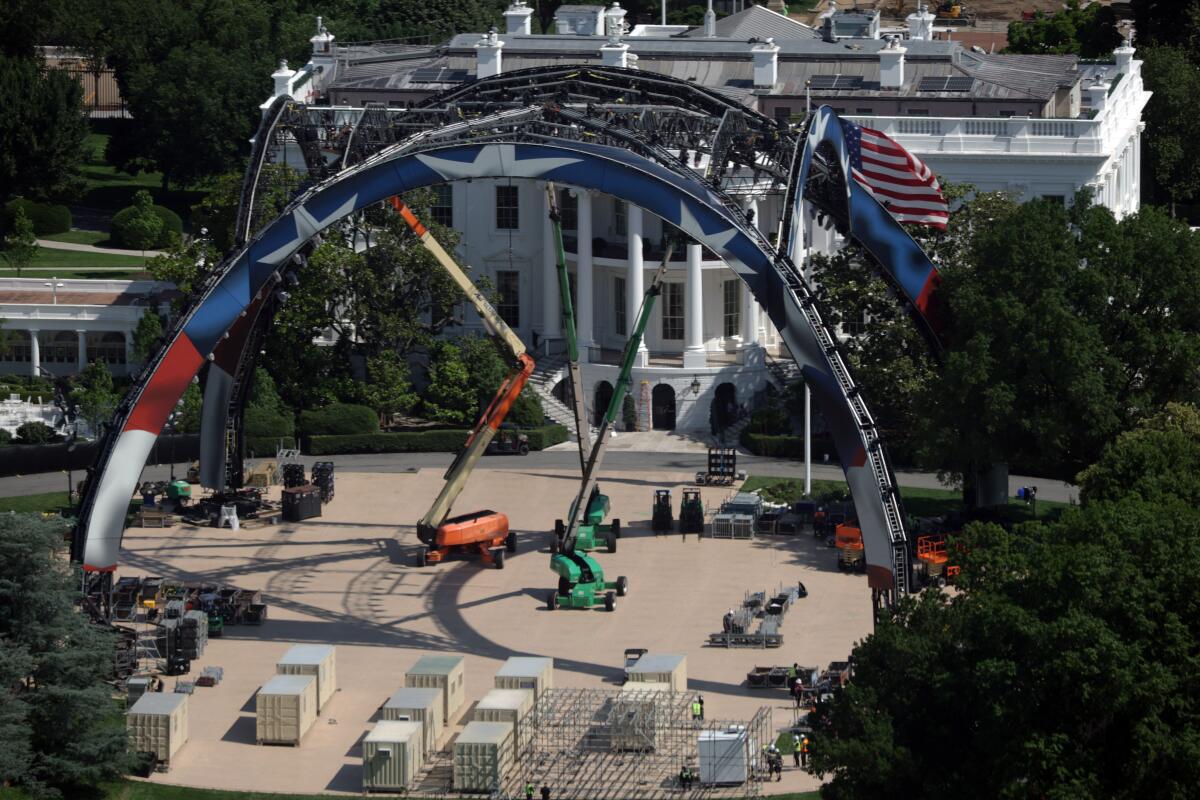
President Trump plans to celebrate the nation’s 250th anniversary — and his own 80th birthday — next month by watching bare-chested and bloody UFC fighters kick, punch and choke each other on the storied South Lawn of the White House.

Later, during the administration’s summer-long festival to commemorate the signing of the Declaration of Independence, IndyCars will race in a fossil fuel-burning extravaganza around and around the National Mall — home to the U.S. Capitol and the Washington and Lincoln monuments.

Both venues are National Park Service land and are administered by the agency.

The planned spectacles — UFC Freedom 250 and the Freedom 250 Grand Prix — stray so far from the park service’s traditional mission and ethos that advocates and career employees are crying foul.

“These events are inappropriate and disrespectful to the history and importance of the White House and the National Mall,” said Jonathan Jarvis, who began his career as a park ranger on the Mall in 1976 and was named director of the National Park Service by President Obama in 2009.

White House officials insist that IndyCar and the UFC are extremely popular with everyday Americans: the race and the fights will be exuberant celebrations of patriotism and pride, they say.

The UFC event, in particular, “will be one of the greatest and most historic sports events in history, and President Trump hosting it at the White House is a testament to his vision to celebrate America’s monumental 250th anniversary,” said White House spokesperson Davis Ingle.

An aerial view of UFC construction outside the White House.

President Trump is hosting a UFC match on the White House grounds in honor of the 250th anniversary of the United States.

(Alex Wong / Getty Images)

To organize this summer’s events, the Trump administration asked the National Park Foundation — a congressionally chartered nonprofit that works closely with the park service and collects private donations to help maintain hiking trails and fund programs to get kids outdoors — to lend a hand.

Because of the scale of the planned celebrations, the foundation created a limited liability company, “Freedom 250,” to “execute events, activities, and celebrations in or around national parks,” according to the Freedom 250 website.

Freedom 250 has its own employees, but the foundation provides funds and the park service approves the events and reviews their budgets, according to the website.

Which is why advocates are appalled.

“Essentially, this is a hijacking of one of America’s oldest and most well-respected conservation organizations,” said Aaron Weiss, director of the Center for Western Priorities, an environmental nonprofit based in Denver. “There are so many very good people at the foundation, with so many years doing real work on behalf of America’s national parks, it’s heartbreaking to watch.”

When Jarvis was director of the park service — and therefore an ex-officio board member of the foundation — the two organizations worked hand in hand to ensure that the foundation’s work complemented that of the park service. They organized the annual Easter Egg Roll on the White House South Lawn and lit the Christmas tree on the Ellipse, Jarvis said.

Workers paint the bottom of the Lincoln Memorial Reflecting Pool.

Workers continue to paint the bottom of the Lincoln Memorial Reflecting Pool on the National Mall.

(Alex Wong / Getty Images)

Occasionally, the president made special requests, which were reviewed carefully to ensure they were consistent with park service principles. Michelle Obama’s famous “Kitchen Garden” passed the test, Jarvis said with a chuckle, providing fruits and vegetables for family meals — and the occasional state dinner — for years.

It’s hard to imagine any career parks employee, or the foundation board members he served with, coming up with the current agenda, Jarvis said.

In addition to the IndyCar race and cage fights, the National Park Foundation is sponsoring “Freedom Trucks” — six red, white and blue tractor trailers traveling the country as rolling museums — and Rededicate 250, a large Christian revival meeting held on the Mall earlier this month that raised objections about the mixing of church and state.

“I think the foundation is being told what to do,” Jarvis said. “And I think it’s hard to say no to the White House these days.”

Josh deBerge, a spokesperson for the National Park Foundation, insisted that no money from Freedom 250 is being spent on the IndyCar race or the UFC fights.

But the IndyCar race is listed as a “signature” event on the Freedom 250 website, and both IndyCar and the UFC are listed as Freedom 250 sponsors.

Danielle Alvarez, a former Trump campaign senior advisor, is a spokesperson for Freedom 250. She acknowledged that the race and the cage fights are happening on national park land and under the banner of Freedom 250, but said neither is receiving funds or logistical support from her organization.

“Many groups have adopted ‘Freedom 250’ branding as part of their festivities, even though it does not mean it is backed by Freedom 250 funding,” Alvarez said in a text message. “The shared terminology is a natural expression of collective pride in 250 years of American independence.”

Neither IndyCar nor the UFC responded to requests for comment.

All of this comes as the Trump administration has taken an ax to the National Park Service, cutting its staff by 25% through buyouts and layoffs since 2025, and proposing another 25% staff reduction this year.

An employee does restoration work on a statue of a general on a horse

A worker applies hot wax during the restoration process of the Gen. Nathanael Greene statue in Stanton Park on Capitol Hill.

(Tom Williams / CQ-Roll Call / Getty Images)

Trump has also proposed slashing nearly $800 million from the park system’s roughly $3-billion operating budget — potentially diminishing the ability to keep facilities clean and control crowds. Already this year, Yosemite National Park has ditched a reservation system, leading to enormous crowds in the valley and on nearby trails.

Parks advocates fear it’s part of a broader and deliberate strategy to marginalize an agency that has long been a sanctuary for environmentalists and progressives — most of whom presumably did not vote for Trump.

In addition to the staff and budget cuts, Trump last year instructed the National Park Service to scrub any language he would deem negative, unpatriotic or smacking of “improper partisan ideology” from signs and presentations visitors encounter at parks and historic sites.

Instead, he ordered the agency to ensure that its signs remind Americans of our “extraordinary heritage, consistent progress toward becoming a more perfect Union, and unmatched record of advancing liberty, prosperity and human flourishing.”

Those marching orders left opponents and free speech advocates in disbelief, wondering how park employees were supposed to put a sunny spin on monuments acknowledging slavery, Jim Crow laws and the incarceration of Japanese Americans during World War II.

Trump opponents also question the political wisdom of picking on an agency that’s routinely ranked among the most admired branches of the large and sprawling federal government. Even Americans who pay little attention to politics will probably never forget standing in Yosemite Valley and admiring a towering waterfall.

There were more than 323 million visits to America’s national parks in 2025, dwarfing attendance — 135 million — at professional football, baseball, basketball and hockey games combined.

That has not stopped the assault by the current administration.

A black granite walkway at the White House.

Black granite was installed last month as the new walkway for the West Wing Colonnade at the White House.

(Andrew Harnik / Getty Images)

“The ideologues in power now take a very dim view of the federal government in general, and the last thing they want is a highly popular and successful federal agency,” Jarvis said. “So if they can kill it, or diminish it through neglect, they win. They don’t really care about the public’s opinion.”

Chuck Sams, the last director of the National Park Service, stepped down the day Trump was inaugurated. Since then, the agency has not had a Senate-confirmed director.

Sams agreed that the Trump administration seems to have it in for the Park Service and worried that the guardrails that used to prevent the executive branch from doing whatever it wants with park land are disappearing.

Destroying the East Wing of the White House for Trump’s proposed ballroom and paving over portions of the White House Rose Garden lawn are prime examples, Sams said.

During his tenure, any proposed change to the White House or its grounds was approached in a “very concerted and deliberate manner with a lot of educated professionals weighing in,” Sams said. “Was it slow? Absolutely, but that was because everyone understood these places belong to the people.”

Asked what he thought of the IndyCar race and the cage fights, Sams said, “We are in uncharted territory, on uncharted ground.”
Source link

Katherine Legge attempts ‘The Double,’ the Indy 500 and Coca-Cola 600

Indiana’s lack of glamour is a point of pride, rooted in Midwestern practicality and endless flat fields of corn.

Lately, though, the Hoosier state has been elevated by towering sports figures. And on Sunday, two will be the fresh faces of the Indianapolis 500, which attracts more spectators than any other single-day sporting event in the world.

Indiana Fever superstar Caitlin Clark will be the grand marshal. National championship-winning Indiana football coach Curt Cignetti will drive the honorary pace car.

But even those high achievers might be awestruck by one of the race car drivers. Or at least what that driver will attempt.

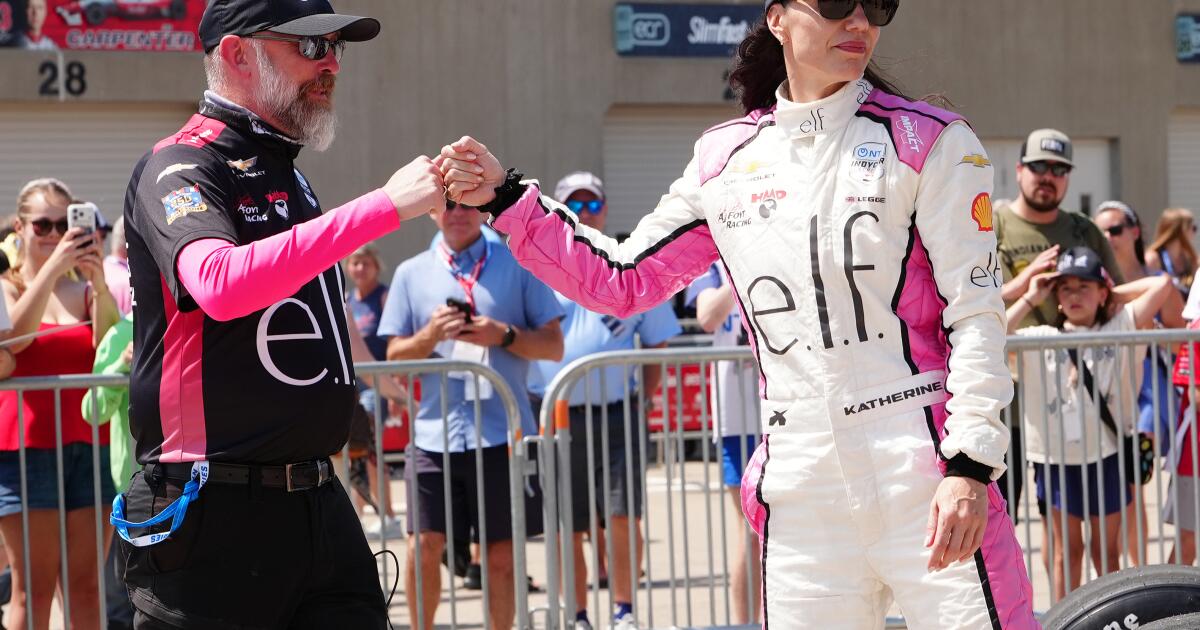
Not only will Katherine Legge be the only woman among the 33 drivers in the Indy 500, which begins at 9:45 a.m. PT on Sunday. The 45-year-old motorsports trailblazer from England will then fly to Charlotte to race in the NASCAR Cup’s Coca-Cola 600, which begins at 3:29 p.m. PT.

That’s 1,100 miles of left turns around two oval tracks.

On the same day.

As impressive as undertaking what is known simply as “The Double” are Legge’s travel plans from Indianapolis to Charlotte. Five hours and 44 minutes separate the starts of the two races. The Indy 500 takes longer than three hours to complete. The commute will take close to two hours.

Legge plans to hustle. She will hop into a helicopter moments after the Indy 500 and head to a nearby private jet that will zip her 366 miles to Concord Airport near Charlotte in an hour. Another helicopter will drop her onto the Charlotte Motor Speedway infield. A golf cart will take a beeline to her Chevrolet Camaro in time for the green flag.

At least that’s the plan.

“Being focused for a three-to-four-hour IndyCar race then a five-hour NASCAR race, it’s the same as driving from New York to Daytona Beach pretty much at, gosh, an average of 200 miles an hour,” Legge said. “You cannot lose focus for a second of any of that. I don’t think anybody can comprehend that.”

Legge is the first woman and only the sixth driver overall to attempt The Double. Although her career has included IMSA sports cars and Formula E in addition to IndyCar and NASCAR, she has never attempted anything this challenging.

John Andretti, Robby Gordon, Tony Stewart, Kyle Larson and (rest in peace) Kurt Busch are the others who have tried.

Larson is the most recent, finishing 18th in the Indy 500 and 37th in the Coca-Cola 600 a year ago. He also tried in 2024 but didn’t get to his car in time in Charlotte because of a rain delay in Indianapolis.

The documentary “Kyle Larson vs. The Double” premiered Wednesday on Prime Video. It follows the two-time NASCAR Cup Series champion through preparation, logistics and grueling reality of getting through the day.

Legge is beginning to relate.

“I was thinking about what I’m going to do with a hybrid strategy at the same time as telling people about how I’m going to do the double,” she said. “It’s this weird disconnect, right? Where you’re like, ‘That’s so cool.’ And conceptually, you know exactly what’s involved, but it doesn’t sink in.”

Busch, who tragically died at 41 on Thursday from an undetermined illness, turned in a valiant effort in 2014, finishing sixth in the Indy 500 despite having limited experience in IndyCar. Engine problems torpedoed his chances in the Coca-Cola 600, however, and he completed only 271 of 400 laps on the 1.5-mile track.

“It was a challenge I put forth for myself,” Busch said. “I enjoyed it. I soaked it in.”

Only once in five attempts did Gordon complete both races, finishing eighth in Indianapolis and 16th in Charlotte in 2002. A year earlier, Stewart turned in the most impressive double, finishing sixth at Indy and third at Charlotte.

Andretti was pioneer of The Double in 1994, finishing a respectable 10th before flying to Charlotte with a nurse and registered dietitian to ensure he stayed hydrated. Andretti was penalized for missing the drivers’ meeting, however, and sent from the No. 9 starting position to the rear of the field. He crashed and withdrew on the 91st lap.

Content with one race Sunday will be defending Indy 500 winner Álex Palou, who will start on the pole after a four-lap qualifying average of 232.248 mph. Six different drivers have won the race in consecutive years.

Legge, who will be racing in her fifth Indy 500, will start in the No. 26 position. Actor and Indianapolis native Brendan Fraser will be the honorary starter and wave the green flag. It will be the beginning of an exhausting day.

“Honestly, I’m doing it because it’s a really cool thing to do, and it’s kind of like this old-school epic badge of honor that you get for doing both races in one day,” Legge told Fox Sports. “I’m not doing it to leave a legacy.

“You can do anything that you put your mind to if you want it enough. It would be remiss of me to not take that responsibility seriously, but at the same time, that’s not why I set out to do it. I set out to do it because I love to race.”

Source link

How Alex Palou found IndyCar fame — and why he rejected F1

Alex Palou’s 2025 season was the best for an IndyCar driver in nearly 20 years.

He won a career-high eight races, including the Indianapolis 500. He won his third straight series title and his fourth championship overall. He made the podium 13 times in 17 races.

Yet if you ask Palou, he’ll tell you he’s going into Saturday’s qualifying for Sunday’s Grand Prix of Long Beach needing to prove himself all over again.

“Who cares about what we did last year?” he said. “It’s cool to have four championships, but the only important year is 2026. Everybody started with zero points on the board and we need to do it all over again.”

That’s far easier said than done, although Palou is off to a fast start in his quest for a fifth championship having won two of the first four races on the IndyCar schedule to stand second in the driver standings, two points behind defending Long Beach champion Kyle Kirkwood.

“Last year was magical,” said Palou, who has captured 10 of the last 21 checkered flags, dating to 2024. “As an athlete you always want to keep on improving, but I need to be realistic and understand that to win eight races in IndyCar in the same year, it’s pretty tough to beat.

“So although I want to achieve that, we just need to take 2026 separately and just try our best, try to win as many races as possible and then obviously fight for the [Indy] 500 and the championship.”

Winning Long Beach, one of the few prizes on the IndyCar circuit that has eluded him, would be a big step in that drive for five. But that won’t be easy since passing on the tight 1.968-mile street course, with its 11 turns, is difficult. That makes track position important, putting a premium on Saturday’s qualifying and on pit stops in Sunday’s race.

“It’s always super tough to be competitive there,” Palou said of Long Beach, where he finished second last April, giving him three straight podium finishes. “One of the only bad things about street racing [is] that it’s really tough for us to overtake with how tight the tracks are and all the bumps.

“It just makes it super challenging.”

Alex Palou competes during the Grand Prix of St. Petersburg in Florida on March 1.

Alex Palou competes during the Grand Prix of St. Petersburg in Florida on March 1.

(David Jensen / Getty Images)

Not as challenging as the race Palou, the most successful Spanish driver in IndyCar history, had to run just to get into a race car.

As a boy growing up in the tiny Catalan village of Sant Antoni de Vilamajor, Palou started kart racing about the same time he started grade school. He was 15 when he finished second in the 2012 European karting championship yet he didn’t see much of a future beyond that.

Lewis Hamilton had finished in the same spot 13 years earlier, then went on to become the most successful Formula One driver in history. But England has a long-established history with open-wheel racing and Spain did not.

“He came from nothing, showing up at a carting track and then having these big dreams and aspirations. And here he is,” said Barry Wanser, the senior manager of IndyCar operations for Chip Ganassi Racing.

“I know he’s very proud he’s the first Spaniard to win the Indianapolis 500. That’s just absolutely incredible.”

But that was never the goal.

“Honestly,” Palou said, “my goal was just to have fun. When we started, I never wanted to be a race car driver for a living. I never thought that it would be possible.”

Before Palou, Fernando Alonso, a two-time F1 champion, was Spain’s most successful open-wheel driver. After Alonso is Carlos Sainz Jr., who has won four F1 races; Pedro de la Rosa, who made more than 100 F1 starts but climbed the podium just once; and Oriol Servià, who ran 79 IndyCar races in nine years but never placed higher than fourth before retiring in 2019, one year before Palou made his debut in the series.

Aside from Alonso, those drivers were good but not great, leaving the road from Spain to success in open-wheel racing a narrow one. That’s a path Palou is now widening.

“I would say that for sure it’s helping future generations that I’m here and that I had success,” he said, “just because they can know that with a normal European background you can come to the U.S. and fight for wins and championships.”

Alex Palou celebrates after winning the Grand Prix of St. Petersburg on March 1.

Alex Palou celebrates after winning the Grand Prix of St. Petersburg on March 1.

(David Jensen / Getty Images)

Wanser said what makes Palou so good is his feel for both the car and the track and his ability to communicate with his team.

“He has a very unique ability to understand what he needs the car to do to maximize performance on the tires,” said Wanser, the race strategist for Ganassi’s No. 10 car who has sometimes been called Palou’s indispensable partner. “You’re talking about road courses, street courses, for the primary [tires] — the hards and the softs — and understanding what he needs for qualifying and also what the car needs for reducing tire deg[redation] during the race.”

For now Palou, who turned 29 earlier this month, appears content with mastering those skills in IndyCar rather that following the natural progression into an F1 ride.

He said he went “all in” to win an F1 seat following his first IndyCar title in 2021, but doubts about whether he’d be given a competitive car led him to back out. Rumors linking him to Red Bull’s F1 team surfaced after last year’s Indy 500, but Palou shot those down too, saying he was staying with Ganassi.

Wanser, obviously, is happy with that decision and hopes it will pay off Sunday in Long Beach.

“Alex is very young, right?” he said. “IndyCar is so competitive that we could never, ever think about being complacent. If we start heading down that road, we will get beat and get beat often.

“It’s nonstop trying to constantly improve, knowing every weekend we show up to the racetrack it’s going to be difficult to win.”

Source link