Venezuelan Gov’t Signs Deals with General Electric and IMPSA to Boost Electricity Supply
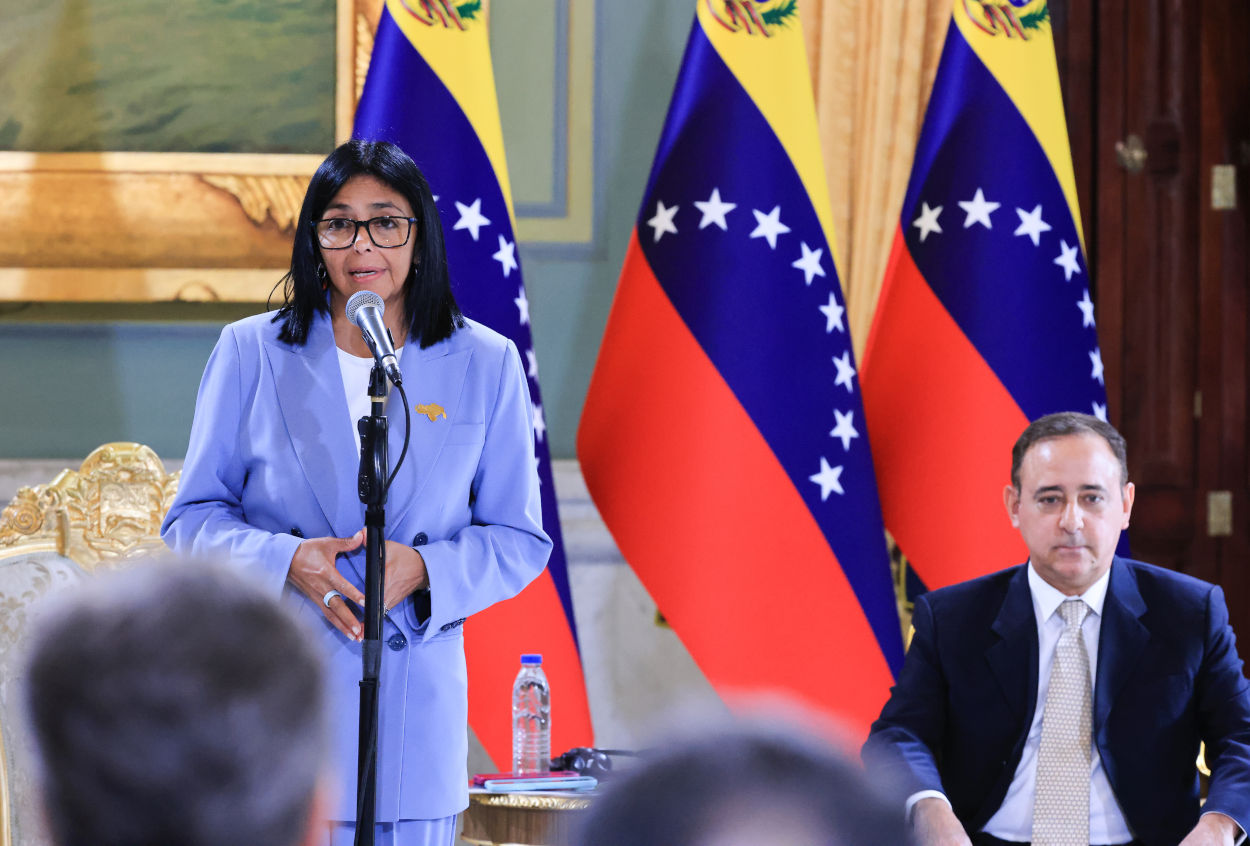
Rodríguez thanked US Chargé d’Affaires John Barrett for helping establish ties with US corporations. (Prensa Presidencial)
Mérida, June 16, 2026 (venezuelanalysis.com) – The Venezuelan government has signed two agreements with foreign companies as part of efforts to bolster the country’s National Electric System (SEN).
On Monday, Acting President Delcy Rodríguez penned a memorandum of understanding with GE Vernova, a company formed from the 2024 breakup of US conglomerate General Electric, at Miraflores Palace in Caracas.
“This memorandum is historic for Venezuela, so we can recover such an essential service for the Venezuelan people,” she stated during a televised broadcast. “I have asked the teams to convert this memorandum into a contract as soon as possible and start the works.”
According to Rodríguez, the agreement will incorporate 1,000 Megawatts (MW) into Venezuela’s electricity grid in the next 24 months, and 5,000 MW over four years. The acting president added that GE technicians have spent “six weeks” in the country assessing conditions of electric equipment.
Rodríguez did not disclose what the deal entails, nor what components of the electric grid will be turned over to GE Vernova, but stated that the plan concerns generation, transmission, and electricity substations.
The Venezuelan acting leader went on to thank US Chargé d’Affaires John Barrett, who was present at the ceremony, for promoting engagement with major US corporations like GE. Company executives Roger Martella and Eric Gray were likewise in attendance. Martella stated that GE’s objective was to quickly reactivate electricity generation.
“We want to move quickly so the system can work as best as possible in a few months. We already have an agreement on technical details,” he said.
Two days earlier, Venezuelan authorities announced a separate accord with Argentina-based firm Industrias Metalúrgicas Pescarmona (IMPSA) to rehabilitate the Manuel Piar and Antonio José de Sucre hydroelectric projects, known as the Tocoma and Macagua dams. Both are located in the Caroní river, in Bolívar state, which also supplies the Simón Bolívar Hydroelectric Plant, known as the Guri Dam.
The official release indicated that the agreement aims to inject 2,640 MW into the grid. IMPSA President Jorge Salcedo clarified on social media that the company’s initial target is to restore 672 MW of capacity from Tocoma within 19 months.
“This agreement launches a broader effort to strengthen Venezuela’s power system through a comprehensive plan that could deliver up to 2,160 MW at Tocoma and 480 MW at Macagua over the next five years,” he wrote.
The Tocoma project dates back to the 2000s. In 2008, Venezuela’s state electricity company CORPOELEC hired a construction consortium headed by Brazilian firm Odebrecht to build the dam, with IMPSA tasked with supplying machinery.
However, despite costs running over US $9.3 billion, more than triple the original $3 billion budget, the project was not culminated. Venezuelan authorities reported that construction was at 90 percent completion in 2016. A $1.2 billion debt owed by CORPOELEC saw IMPSA suspend activities with only two of the ten projected turbines partially installed.
According to Reuters, IMPSA is holding most of the contracted equipment in storage and will replace the missing or obsolete ones with new technology.
IMPSA was temporarily owned by the Argentine state before being privatized by the Milei administration in February 2025. The company was acquired by the US-based consortium Industrial Acquisition Fund (IAF). IAF’s main partner is ARC Energy, headed by close Trump ally and donor Jason Arceneaux.
Venezuela’s electrical system has suffered under years of US sanctions as well as underinvestment, lack of maintenance, and corruption. Around 40 percent of its installed 30,000 MW capacity is currently operational, with generation deficit around 3,000 MW meaning regular blackouts in most of the country.
Strengthening the electrical supply is a precondition for the country’s economic recovery, with growing oil production placing an additional burden on the grid.
The Rodríguez acting government has sought to address the issue by opening the electricity system to the private sector, with GE and IMPSA the first corporations formally engaged.
On June 4, the National Assembly preliminarily approved a reform of the Organic Law of the National Electricity System. The new legal framework breaks with the 2007 legislation under Hugo Chávez that centralized the grid under CORPOELEC and defined all stages of electricity generation and distribution as “strategic for the nation.”
The reform allows for private sector participation in generation, transmission, distribution, and commercialization ativities through concessions lasting up to 25 years. It also envisions new tariff structures based on “real costs and reasonable returns” for investors.
Edited by Ricardo Vaz in Caracas.