Immigration

Naturalized U.S. citizens thought they were safe. Trump’s immigration policies are shaking that belief

When he first came to the United States after escaping civil war in Sierra Leone and spending almost a decade in a refugee camp, Dauda Sesay had no idea he could become a citizen. But he was told that if he followed the rules and stayed out of trouble, after some years he could apply. As a U.S. citizen, he would have protection.

It’s what made him decide to apply: the premise — and the promise — that when he became a naturalized American citizen, it would create a bond between him and his new home. That he would have rights as well as responsibilities, like voting, and that as he was making a commitment to the country, the country was making one to him.

“When I raised my hand and took the oath of allegiance, I did believe that moment the promise that I belonged,” said Sesay, 48, who arrived in Louisiana more than 15 years ago and now works as an advocate for refugees and their integration into American society.

But in recent months, as President Trump reshapes immigration and the country’s relationship with immigrants, that belief has been shaken for Sesay and other naturalized citizens. There’s now fear that the push to drastically increase deportations and shift who can claim America as home, through things such as trying to end birthright citizenship, is having a ripple effect.

What they thought was the bedrock protection of naturalization now feels more like quicksand.

What happens if they leave?

Some are worried that if they leave the country, they will have difficulties when trying to return, fearful because of accounts of naturalized citizens being questioned or detained by U.S. border agents. They wonder: Do they need to lock down their phones to protect their privacy? Others are hesitant about moving around within the country, after stories like that of a U.S. citizen accused of being here illegally and detained even after his mother produced his birth certificate.

Sesay said he doesn’t travel domestically anymore without his passport, despite having a Real ID with its stringent federally mandated identity requirements.

Immigration enforcement roundups, often conducted by unidentifiable masked federal agents in places including Chicago and New York City, have at times included American citizens in their dragnets. One U.S. citizen who says he was detained by immigration agents twice has filed a federal lawsuit.

Adding to the worries, the Justice Department issued a memo this summer saying it would ramp up efforts to denaturalize immigrants who’ve committed crimes or are deemed a national security risk. At one point during the summer, Trump threatened the citizenship of Zohran Mamdani, the 34-year-old democratic socialist mayor-elect of New York City, who naturalized as a young adult.

The atmosphere makes some worried to speak about it publicly, for fear of drawing negative attention to themselves. Requests for comment through several community organizations and other connections found no takers willing to go on the record other than Sesay.

In New Mexico, state Sen. Cindy Nava says she’s familiar with the fear, having grown up undocumented before getting DACA protections — Deferred Action for Childhood Arrivals is the Obama-era program that protected from deportation people brought to the U.S. illegally as children — and gaining citizenship through her marriage. But she hadn’t expected to see so much fear among naturalized citizens.

“I had never seen those folks be afraid. … Now the folks that I know that were not afraid before, now they are uncertain of what their status holds in terms of a safety net for them,” Nava said.

What citizenship has meant, and who was included, has expanded and contracted throughout American history, said Stephen Kantrowitz, professor of history at the University of Wisconsin-Madison. He said that while the word “citizen” is in the original Constitution, it is not defined.

“When the Constitution is written, nobody knows what citizenship means,” he said. “It’s a term of art, it comes out of the French revolutionary tradition. It sort of suggests an equality of the members of a political community, and it has some implications for the right to be a member of that political community. But it is … so undefined.”

American immigration and its obstacles

The first naturalization law passed in 1790 by the new country’s Congress said citizenship was for any “free white person” of good character. Those of African descent or nativity were added as a specific category to federal immigration law after the ravages of the Civil War in the 19th century, which was also when the 14th Amendment was added to the Constitution to establish birthright citizenship.

In the last years of the 19th century and into the 20th century, laws were passed limiting immigration and, by extension, naturalization. The Immigration Act of 1924 effectively barred people from Asia because they were ineligible for naturalization, being neither white nor Black. That didn’t change until 1952, when an immigration law removed racial restrictions on who could be naturalized. The 1965 Immigration and Naturalization Act replaced the previous immigration system with one that portioned out visas equally among nations.

American history also includes times when those who had citizenship had it taken away, such as after the 1923 Supreme Court ruling in U.S. vs. Bhagat Singh Thind. That ruling said that Indians couldn’t be naturalized because they did not qualify as white, leading to several dozen denaturalizations. At other times, it was ignored, as in World War II, when Japanese Americans were forced into incarceration camps.

“Political power will sometimes simply decide that a group of people, or a person or a family, isn’t entitled to citizenship,” Kantrowitz said.

In this moment, Sesay says, it feels like betrayal.

“The United States of America — that’s what I took that oath of allegiance, that’s what I make commitment to,” Sesay said. “Now, inside my home country, and I’m seeing a shift. … Honestly, that is not the America I believe in when I put my hand over my heart.”

Hajela writes for the Associated Press.

Source link

Chicago day-care worker detained by immigration agents released after community support

A Chicago day-care center employee who was detained by immigration agents at work as children were being dropped off last week has been released, according to her attorney.

Diana Santillana Galeano was detained Nov. 5 at the Rayito de Sol Spanish Immersion Early Learning Center on the north side of Chicago. A video showed officers struggling with her as they walked out the front door. Her attorneys said in a statement Thursday that she was released from a detention center in Indiana on Wednesday night.

“We are thrilled that Ms. Santillana was released, and has been able to return home to Chicago where she belongs,” attorney Charlie Wysong said in the statement. “We will continue to pursue her immigration claims to stay in the United States. We are grateful to her community for the outpouring of support over these difficult days, and ask that her privacy be respected while she rests and recovers from this ordeal.”

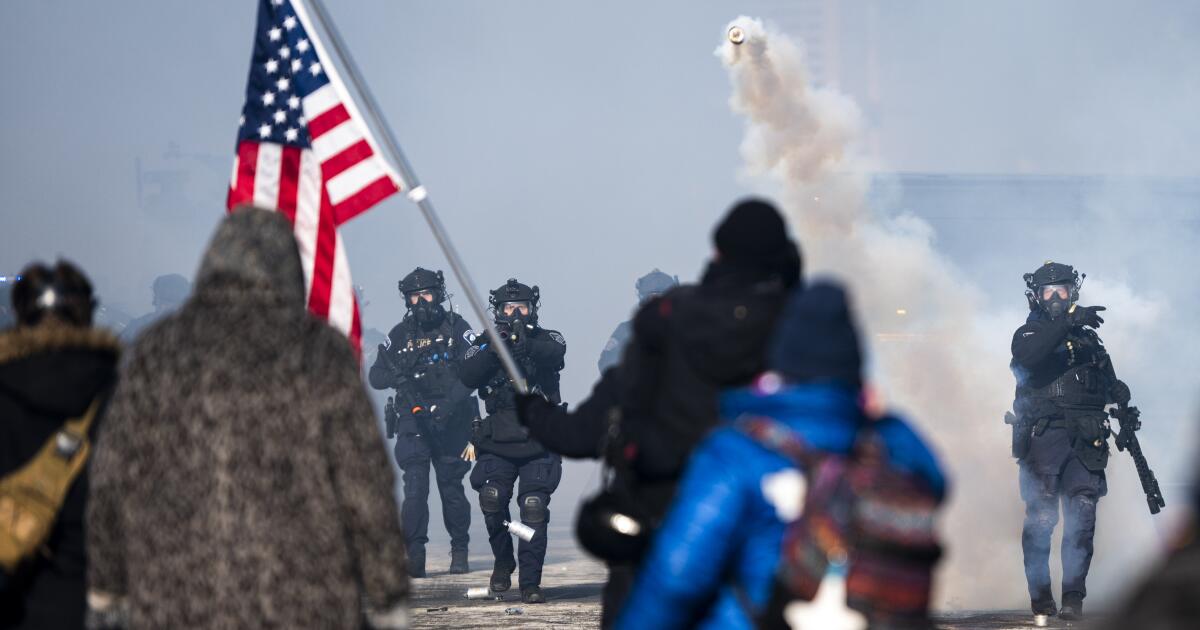
Her case reflects the Trump administration’s increasingly aggressive enforcement tactics. But her detention at a day care was unusual even under “Operation Midway Blitz,” which has resulted in more than 3,000 immigration arrests in the Chicago area since early September. Agents have rappelled from a Black Hawk helicopter in a middle-of-the-night apartment building raid, appeared with overwhelming force in recreational areas and launched tear gas amid protests.

“I am so grateful to everyone who has advocated on my behalf, and on behalf of the countless others who have experienced similar trauma over recent months in the Chicago area,” Santillana Galeano said in the same statement. “I love our community and the children I teach, and I can’t wait to see them again.”

The Department of Homeland Security said last week that the woman, who is from Colombia, entered the U.S. illegally in June 2023 but obtained authorization to work under the Biden administration. The department denied that the day care was targeted.

Source link

Trump’s next immigration crackdown will target Charlotte, North Carolina, sheriff says

The next city bracing for the Trump administration’s immigration crackdown is Charlotte, North Carolina, which could see an influx of federal agents as early as this weekend, a county sheriff said Thursday.

Mecklenburg County Sheriff Garry McFadden said in a statement that two federal officials confirmed a plan for U.S. Customs and Border Protection agents to start an enforcement operation on Saturday or early next week in North Carolina’s largest city. His office declined to identify those officials. McFadden said details about the operation haven’t been disclosed, and his office hasn’t been asked to assist.

Department of Homeland Security Assistant Secretary Tricia McLaughlin declined to comment, saying, “Every day, DHS enforces the laws of the nation across the country. We do not discuss future or potential operations.”

President Trump has defended sending the military and immigration agents into Democratic-run cities like Los Angeles, Chicago and even the nation’s capital, saying the unprecedented operations are needed to fight crime and carry out his mass deportation agenda. Charlotte is another such Democratic stronghold, and the state will have one of the most hotly contested U.S. Senate races in the country next year.

Activists, faith leaders, and local and state officials in the city had already begun preparing the immigrant community, sharing information about resources and attempting to calm fears. A call organized by the group CharlotteEAST had nearly 500 people on it Wednesday.

“The purpose of this call was to create a mutual aid network. It was an information resource sharing session,” said City Councilmember-Elect JD Mazuera Arias.

“Let’s get as many people as possible aware of the helpers and who the people are that are doing the work that individuals can plug into, either as volunteers to donate to or those who are in need of support can turn to,” said CharlotteEAST executive director Greg Asciutto.

The Charlotte-Mecklenburg Police Department also sought to clarify its role, saying it “has no authority to enforce federal immigration laws,” and is not involved in planning or carrying out these enforcement operations.

Mazuera Arias and others said they had already begun receiving reports of what appeared to be plainclothes officers in neighborhoods and on local transit.

“This is some of the chaos that we also saw in Chicago,” state Sen. Caleb Theodros, who represents Charlotte and Mecklenburg County, said Thursday.

Theodros was one of several local and state officials who issued a statement of solidarity this week.

“More than 150,000 foreign-born residents live in our city, contributing billions to our economy and enriching every neighborhood with culture, hard work, and hope,” it read, adding: “We will stand together, look out for one another, and ensure that fear never divides the city we all call home.”

Gregory Bovino, the Border Patrol chief who led Customs and Border Protection’s recent Chicago operation and was also central to the immigration crackdown in Los Angeles, had been coy about where agents would target next.

The Trump administration’s so-called “ Operation Midway Blitz ” in the Chicago area was announced in early September, over the objections of local leaders and after weeks of threats on the Democratic stronghold.

It started as a handful of arrests by U.S. Immigration and Customs Enforcement officers in the suburbs but eventually included hundreds of Customs and Border Protection agents whose tactics grew increasingly aggressive. More than 3,200 people suspected of violating immigration laws have been arrested across Chicago and its many suburbs dipping into Indiana.

The Department of Homeland Security, which oversees both immigration agencies, has offered few details on the arrests, aside from publicizing a handful of people who were living in the U.S. without legal permission and had criminal records.

The group Indivisible Charlotte and the Carolina Migrant Network will be conducting a training for volunteers on Friday.

“Training people how to recognize legitimate ICE agents, versus obviously those who don’t look legitimate,” said Tony Siracusa, spokesman for Indvisible Charlotte. “They’re not always wearing vests that say ‘ICE.’ And what your rights are.”

The groups will also discuss areas where they can conduct “pop up protests.”

“Obviously, we’re not doing anything that is going to encourage people to go get arrested by federal agents,” he said.

Siracusa said locals are “not freaking out, but very definitely concerned. Nobody asked for this help. Nobody asked for this, at least no one of any official capacity.”

Breed and Verduzco write for the Associated Press. Breed reported from Wake Forest, N.C. AP writer Sophia Tareen in Chicago contributed to this report.

Source link

U.S. bishops give ‘special’ message against Trump immigration policy

1 of 2 | American Catholic bishops pictured April 2008 singing in the Crypt Church of the Basilica of the National Shrine in Washington, D.C. On Wednesday, the U.S. Conference of Catholic Bishops issued sharp criticism to the Trump administration’s ongoing mass deportation of immigrants. File Photo by Alexis C. Glenn/UPI | License Photo

Nov. 13 (UPI) — America’s Catholic bishops sent sharp criticism of rising fear in the United States and ongoing mass deportations in a rebuke of Trump administration immigration policy.

On Wednesday, the U.S. Conference of Catholic Bishops said its some 273 active bishops were “disturbed” to see that “among our people a climate of fear and anxiety around questions of profiling and immigration enforcement.”

“We are saddened by the state of contemporary debate and the vilification of immigrants,” the group wrote in its statement.

It arrived after U.S.-born Pope Leo XIV directed bishops in the United States to be vocal and speak out against President Donald Trump‘s hardline crackdown on migration.

The U.S. religious leaders approved the rare “special message” with 5 votes against and 3 abstentions of 216 ballots cast at its meeting Wednesday in Baltimore, Md.

“We recognize that nations have a responsibility to regulate their borders and establish a just and orderly immigration system for the sake of the common good,” the plethora of all-male bishops added. “Without such processes, immigrants face the risk of trafficking and other forms of exploitation. Safe and legal pathways serve as an antidote to such risks.”

It marked the first time in 12 years the USCCB invoked its urgent way of collectively speaking as a body.

“We are concerned about the conditions in detention centers and the lack of access to pastoral care,” the bishops added. “We lament that some immigrants in the United States have arbitrarily lost their legal status.”

Trump has targeted immigration enforcement in Democratic-run cities such as the nation’s capital, Los Angeles and in Chicago with the presence of masked ICE agents leading to violent activity, arrests and sprayed tear gas.

The bishops wrote that Catholic teaching “exhorts nations to recognize the fundamental dignity of all persons, including immigrants.”

“We bishops advocate for a meaningful reform of our nation’s immigration laws and procedures,” they continued. “Human dignity and national security are not in conflict.”

The new pope has called for an end to Israel’s war in Gaza with the militant wing Hamas, expanded access to much-needed aid for hundreds of thousands of Palestinian refugees and children and a cease to Russia’s full-scale invasion of Ukraine.

On Wednesday, the Catholic leaders said national security and human dignity both “are possible if people of good will work together.

Source link

U.S. Catholic bishops select conservative culture warrior to lead them during Trump’s second term

U.S. Catholic bishops elected Oklahoma City Archbishop Paul Coakley as their new president on Tuesday, choosing a conservative culture warrior to lead during President Trump’s second term.

The vote serves as a barometer for the bishops’ priorities. In choosing Coakley, they are doubling down on their conservative bent, even as they push for more humane immigration policies from the Trump administration.

Coakley was seen as a strong contender for the top post, having already been elected in 2022 to serve as secretary, the No. 3 conference official. In three rounds of voting, he beat out centrist candidate Bishop Daniel Flores of Brownsville, Texas, who was subsequently elected vice president.

Coakley serves as advisor to the Napa Institute, an association for conservative Catholic powerbrokers. In 2018, he publicly supported an ardent critic of Pope Francis, Italian Archbishop Carlo Maria Viganò, who was later excommunicated for stances that were deemed divisive.

The U.S. Conference of Catholic Bishops has often been at odds with the Vatican and the inclusive, modernizing approach of the late Pope Francis. His U.S.-born successor, Pope Leo XIV, is continuing a similar pastoral emphasis on marginalized people, poverty and the environment.

The choice of Coakley may fuel tensions with Pope Leo, said Steven Millies, professor of public theology at the Catholic Theological Union in Chicago.

“In the long conflict between many U.S. bishops and Francis that Leo inherits, this is not a de-escalating step,” he said.

Half the 10 candidates on the ballot came from the conservative wing of the conference. The difference is more in style than substance. Most U.S. Catholic bishops are reliably conservative on social issues, but some — like Coakley — place more emphasis on opposing abortion and LGBTQ+ rights.

The candidates were nominated by their fellow bishops, and Coakley succeeds the outgoing leader, Military Services Archbishop Timothy Broglio, for a three-year term. The current vice president, Archbishop William Lori of Baltimore, was too close to the mandatory retirement age of 75 to assume the top spot.

Coakley edged out a well-known conservative on the ballot, Bishop Robert Barron of Minnesota’s Winona-Rochester diocese, whose popular Word on Fire ministry has made him a Catholic media star.

In defeating Flores, Coakley won over another strong contender, who some Catholic insiders thought could help unify U.S. bishops and work well with the Vatican. Flores has been the U.S. bishops’ leader in the Vatican’s synod process to modernize the church. As a Latino leading a diocese along the U.S.-Mexico border, he supports traditional Catholic doctrine on abortion and LGBTQ issues and is outspoken in his defense of migrants.

Flores will be eligible for the top post in three years. His election as vice president indicates that the U.S. conference “may eventually, cautiously open itself to the church’s new horizons,” said David Gibson, director of Fordham University’s Center on Religion and Culture.

The bishops are crafting a statement on immigration during the annual fall meeting. On many issues, they appear as divided and polarized as their country, but on immigration, even the most conservative Catholic leaders stand on the side of migrants.

The question is how strongly the whole body plans to speak about the Trump administration’s harsh immigration tactics.

Fear of immigration enforcement has suppressed Mass attendance at some parishes. Local clerics are fighting to administer sacraments to detained immigrants. U.S. Catholic bishops shuttered their longstanding refugee resettlement program after the Trump administration halted federal funding for resettlement aid.

“On the political front, you know for decades the U.S. bishops have been advocating for comprehensive immigration reform,” Bishop Kevin Rhoades, of Indiana’s Fort Wayne-South Bend diocese, said during a news conference.

Rhoades serves on Trump’s Religious Liberty Commission, and he leads the bishops’ committee on religious liberty. He said bishops are very concerned about detained migrants receiving pastoral care and the sacraments.

“That’s an issue of the right to worship,” he said. “One doesn’t lose that right when one is detained, whether one is documented or undocumented.”

The bishops sent a letter to Pope Leo from their meeting, saying they “will continue to stand with migrants and defend everyone’s right to worship free from intimidation.”

The letter continued, “We support secure and orderly borders and law enforcement actions in response to dangerous criminal activity, but we cannot remain silent in this challenging hour while the right to worship and the right to due process are undermined.”

Pope Leo recently called for “deep reflection” in the United States about the treatment of migrants held in detention, saying that “many people who have lived for years and years and years, never causing problems, have been deeply affected by what is going on right now.”

Stanley writes for the Associated Press.

Source link

Why does the UK want to copy Denmark’s stringent immigration policies? | Explainer News

The United Kingdom’s government is considering an amendment to immigration rules modelled on Denmark’s controversial policy amid pressure from the far-right groups, who have attacked the Labour government over the rising number of refugees and migrants crossing into the country.

Home Secretary Shabana Mahmood last month dispatched officials to study the workings of the Danish immigration and asylum system, widely considered the toughest in Europe. The officials are reportedly looking to review the British immigration rules on family reunion and limit refugees to a temporary stay.

Recommended Stories

list of 4 itemsend of list

The Labour government led by Prime Minister Keir Starmer has been under immense pressure amid growing public opposition to immigration and the surge in the popularity of the far-right Reform UK, which has centred its campaign around the issue of immigration.

So, what’s in Denmark’s immigration laws, and why is the centre-left Labour government adopting laws on asylum and border controls championed by the right wing?

uk immigration
Migrants wade into the sea to try to board smugglers’ boats in an attempt to cross the English Channel off the beach of Gravelines, northern France on September 27, 2025. Britain and France have signed a deal to prevent the arrival of refugees and migrants via boats [File: Sameer Al-Doumy/AFP]

What are Denmark’s immigration laws?

Over the last two decades in Europe, Denmark has led the way in implementing increasingly restrictive policies in its immigration and asylum system, with top leaders aiming for “zero asylum seekers” arriving in the country.

First, Denmark has made family reunions tougher, keeping the bar of conditions comparatively higher than it is in allied countries. Those who live in estates designated as “parallel societies”, where more than 50 percent of residents are from so-called “non-Western” backgrounds, are barred from being granted family reunion. This has been decried by rights groups as racist for refugees’ ethnic profiling.

In Denmark, a refugee with residency rights must meet several criteria for their partner to join them in the country. Both must be age 24 or older, the partner in Denmark must not have claimed benefits for three years, and both partners need to pass a Danish language test.

Permanent residency is possible only after eight years under very strict criteria, including full-time employment.

Christian Albrekt Larsen, a professor in the Political Science department of Aalborg University in Denmark, told Al Jazeera that successive Danish governments’ restrictive policies on “immigration and integration have turned [it] into a consensus position – meaning the ‘need’ for radical anti-immigration parties has been reduced”.

Noting that “there is not one single Danish ‘model’”, but that the evolution has been a process of adjustments since 1998, Larsen said, “In general, Denmark’s ‘effectiveness’ lies in being seen as less attractive than its close neighbours, [including] Germany, Sweden, and Norway.”

Copenhagen is more likely to give asylum to those who have been targeted by a foreign regime, while those fleeing conflicts are increasingly limited in remaining in the country temporarily.

However, Denmark decides which country is safe on its own. For example, in 2022, the Danish government did not renew permits for more than 1,200 refugees from Syria because it judged Damascus to be safe for refugees to return to.

In 2021, Denmark also passed laws allowing it to process asylum seekers outside of Europe, like negotiating with Rwanda, though putting this into practice has been controversial and challenging.

Denmark has reduced the number of successful asylum claims to a 40-year low, except in 2020, amid the coronavirus pandemic’s travel restrictions.

uk immigration
The UK Border Force vessel ‘Typhoon’, carrying migrants picked up at sea while attempting to cross the English Channel from France, prepares to dock in Dover, southeast England, on January 13, 2025 [Ben Stansall/AFP]

How do these differ from the UK’s current immigration laws?

The UK allows individuals to claim asylum if they prove they are unsafe in their home countries. Refugee status is granted if an individual is at risk of persecution under the United Nations’ 1951 Refugee Convention. Refugees are usually granted five years of leave to remain, with the option to apply for permanent settlement afterward.

Most migrants and refugees can apply for indefinite leave to remain (ILR) after five years, followed by eligibility for citizenship one year later. Requirements include English proficiency and passing the “Life in the UK” test.

The UK system currently does not impose an age limit beyond 18, but requires a minimum annual income of 29,000 British pounds ($38,161), and is subject to a rise pending a review, for sponsoring partners.

Asylum seekers are excluded from mainstream welfare and receive a meagre weekly allowance. However, once granted protection, they access the same benefits as British nationals.

The UK under the previous Conservative government passed controversial legislation to enable deportation to Rwanda, but the policy has not yet been implemented due to ongoing legal challenges.

Before September this year, the UK Home Office allowed spouses, partners, and dependents under 18 to come to the UK without fulfilling the income and English-language tests that apply to other migrants. That is currently suspended, pending the drafting of new rules.

uk immigration
People hold a banner as they gather to attend a United Kingdom Independence Party (UKIP) anti-immigration march in central London on October 25, 2025 [Jack Taylor/Reuters]

Why is the Labour government changing the UK’s immigration laws?

Facing heat from the opposition over the rising arrivals of migrants and refugees by boats, Prime Minister Starmer in May proposed a draft paper on immigration, calling it a move towards a “controlled, selective and fair” system.

As part of the proposal, the standard waiting time for migrants and refugees for permanent settlement would be doubled to 10 years, and English language requirements would be tightened.

The Labour Party, which advocated for a more open migration model, has been on the back foot over the issue of immigration.

From January through July of this year, more than 25,000 people crossed the English Channel into the UK.

The opposition has seized on this issue.

Nigel Farage, the leader of the Reform UK party, has accused Labour of being soft on immigration. Farage has pledged to scrap indefinite leave to remain – a proposal Starmer has dubbed as “racist” and “immoral”.

Successive British governments have tried unsuccessfully to reduce net migration, which is the number of people coming to the UK, minus the number leaving. Net migration climbed to a record 906,000 in June 2023. It stood at 728,000 last year.

Starmer’s administration has framed the new immigration rules as a “clean break” from a system they see as overreliant on low-paid overseas labour.

A survey released by Ipsos last month revealed that immigration continues to be seen as the biggest issue facing the country, with 51 percent of Britons mentioning it as a concern. That is more than the economy (35 percent) or healthcare (26 percent).

However, at the same time, a YouGov poll found only 26 percent of people said immigration and asylum was one of the three most important issues facing their community.

Concern about immigration is a “manufactured panic”, a report published by the Best for Britain campaign group noted.

The group’s director of policy and research, Tom Brufatto, said that “the data clearly demonstrates that media exposure and political discourse are fanning the flames of anti-immigration sentiment in the UK, causing the government to lose support both to its right and left flank simultaneously.”

British Prime Minister Keir Starmer applauds at a podium.
British Prime Minister Keir Starmer has faced criticism for shifting his stance on immigration [File: Phil Noble/Reuters]

Is there opposition to the change within the Labour Party?

The left-leaning leaders of the Labour Party have condemned the “far-right”, “racist” approach of the British government’s moves to adapt the Danish model.

Labour MPs urged Home Secretary Mahmood to dial down her plans for a Danish-style overhaul of the immigration and asylum system.

Nadia Whittome, Labour MP for Nottingham East, told the BBC Radio 4 Today programme that she thinks that “this is a dead end – morally, politically and electorally”.

“I think these are policies of the far right,” she said. “I don’t think anyone wants to see a Labour government flirting with them.”

Whittome argued that it would be a “dangerous path” to take and that some of the Danish policies, especially those around “parallel societies”, were “undeniably racist”.

Clive Lewis, the MP for Norwich South, said: “Denmark’s Social Democrats have gone down what I would call a hardcore approach to immigration.

“They’ve adopted many of the talking points of what we would call the far right,” Lewis said. “Labour does need to win back some Reform-leaning voters, but you can’t do that at the cost of losing progressive votes.”

Meanwhile, members of Parliament from the traditional “Red Wall” constituencies, where the Reform UK party has a support base, are receptive to Mahmood’s plans.

The fissures grew more apparent after Lucy Powell, who won the Labour deputy leadership contest last month, challenged Starmer to soften his stance on immigration.

“Division and hate are on the rise,” Powell said last month. “Discontent and disillusionment are widespread. We have this one big chance to show that progressive mainstream politics really can change people’s lives for the better.”

uk immigration
People hold anti-racist placards as they take part in a ‘Stop the Far Right’ demonstration on a National Day of Protest, outside of the headquarters of the Reform UK political party, in London on August 10, 2024 [Benjamin Cremel/AFP]

How do immigration laws vary across Europe?

European countries differ widely in how they manage immigration. Some are major destinations for large absolute numbers of migrants and refugees, while others have adopted restrictive legal measures or strong integration policies.

In 2023, the largest absolute numbers of immigrants entering European Union countries were recorded in Germany and Spain, over 1.2 million each, followed by Italy and France, according to the EU’s latest Migration and Asylum report.

These four countries together accounted for more than half of all non-EU immigration to the EU.

EU member states operate within EU migration and asylum rules, and Schengen zone rules where applicable, and are bound by international obligations such as the UN Refugee Convention. But individual states apply national legislation that interprets those obligations, and in recent years, public sentiment has turned against immigration amid a cost-of-living crisis.

YouGov polling conducted in Britain, Denmark, France, Germany, Italy, Spain and Sweden found that respondents believe immigration over the past decade has been too high. In Britain, 70 percent of those surveyed said that immigration rates have been too high, according to the survey released in February.

On the other hand, countries like Hungary, Poland, and Austria, in addition to Denmark, have formed immigration policies focused on building border fences and restrictive family reunification rules, alongside expedited deportations and limits on access to social benefits.

Austrian and German ministers have referenced the Danish model as a source of inspiration for their own domestic policies.

Several EU states have also tried a version of externalising asylum processes, including Italy with Albania, Denmark with Rwanda, Greece with Turkiye, Spain with Morocco, and Malta with Libya and Tunisia.

Rights groups have criticised the EU for immigration policies that focus on border control and for policies to transfer refugees to third countries.

Source link

Judge limits federal agents’ use of force in Chicago immigration crackdown

Nov. 7 (UPI) — A federal judge has issued a preliminary injunction barring federal authorities from using force against protesters, journalists and others in Chicago as the Trump administration conducts an immigration crackdown in the city.

U.S. District Judge Sara Ellis issued her ruling Thursday, in a case brought against the Trump administration in early October alleging that federal agents in Chicago have responded to protests and negative media coverage “with a pattern of extreme brutality in a concerted and ongoing effort to silence the press and civilians.”

The ruling explicitly states that the federal agents are prohibited from using crowd control weapons such as batons, rubber or plastic bullets, flash-bang grenades and tear gas against civilians unless there is “a threat of imminent harm to a law enforcement officer.”

In a bench ruling, reported on by The New York Times, Ellis said government officials, including Gregory Bovino, a top Border Patrol official leading the operation in Chicago, lied repeatedly about the tactics they employed against protesters.

The ruling comes amid growing criticism of the Trump administration’s deployment of federal immigration authorities executing Operation Midway Blitz, which began on Sept. 9, targeting undocumented immigrants with criminal records.

Videos circulating online, however, show masked agents hauling a woman, later identified as U.S. citizen Dayanne Figueroa, from her vehicle, which they crashed into, and forcibly detaining a teacher from a daycare in front of school children. Rep. Mike Quigley, D-Ill., said they detained the woman without a warrant, calling the actions of the immigration agents “domestic terrorism.”

Chicago Mayor Brandon Johnson earlier Thursday said during a press conference the daycare employee’s arrest “shocked the conscience of every single Chicagoan.”

In her bench ruling Thursday, Ellis, a President Barack Obama appointee, rejected the government’s description of Chicago as a violent- and riot-riddled city, saying, “That simply is untrue, and the government’s own evidence in this case belies that assertion.”

With pointed remarks at Bovino, she said the federal agent “admitted that he lied” about being hit in the head with a rock in October, which was his reasoning for deploying tear gas canisters.

“Video evidence ultimately disproved this,” she said, CNN reported.

Lawyers with Lovey & Lovey who brought the case before the court described it as protecting the right to protest.

Steve Art, a partner at the firm, called Ellis’ preliminary injunction in a press conference a “powerful ruling.”

“For weeks, the Trump administration has deployed Gregory Bovino and his gang of thugs to terrorize our community. They have tear gassed dozens of residential neighborhoods, they have abused the elderly, they have abused pregnant women, they have abused young children. On our streets, they have used weapons of war,” he said.

“We want to be clear every person who is associated with or who has enabled the Trump administration’s violence in Chicago should be ashamed of themselves.”

Source link

Judge hears testimony about ‘disgusting’ conditions at Chicago-area immigration site

A judge heard testimony Tuesday about overflowing toilets, crowded cells, no beds and water that “tasted like sewer” at a Chicago-area building that serves as a key detention spot for people rounded up in the Trump administration’s immigration crackdown.

Three people who were held at the building in Broadview, just outside Chicago, offered rare public accounts about the conditions there as U.S. District Judge Robert Gettleman considers ordering changes at a site that has become a flashpoint for protests and confrontations with federal agents.

“I don’t want anyone else to live what I lived through,” said Felipe Agustin Zamacona, 47, an Amazon driver and Mexican immigrant who has lived in the U.S. for decades.

Zamacona said there were 150 people in a holding cell. Desperate to lie down to sleep, he said he once took the spot of another man who got up to use the toilet.

And the water? Zamacona said he tried to drink from a sink but it “tasted like sewer.”

A lawsuit filed last week accuses the government of denying proper access to food, water and medical care, and coercing people to sign documents they don’t understand. Without that knowledge, and without private communication with lawyers, they have unknowingly relinquished their rights and faced deportation, the lawsuit alleges.

“This is not an issue of not getting a toilet or a Fiji water bottle,” attorney Alexa Van Brunt of the MacArthur Justice Center told the judge. “These are a set of dire conditions that when taken together paint a harrowing picture.”

Before testimony began, U.S. District Judge Robert Gettleman said the allegations were “disgusting.”

“To have to sleep on a floor next to an overflowing toilet — that’s obviously unconstitutional,” he said.

Attorney Jana Brady of the Justice Department acknowledged there are no beds at the Broadview building, just outside Chicago, because it was not intended to be a long-term detention site.

Authorities have “improved the operations” over the past few months, she said, adding there has been a “learning curve.”

“The conditions are not sufficiently serious,” Brady told the judge.

The building has been managed by U.S. Immigration and Customs Enforcement for decades. But amid the Chicago-area crackdown, it has been used to process people for detention or deportation.

Greg Bovino, the Border Patrol commander who has led the Chicago immigration operation, said criticism was unfounded.

“I think they’re doing a great job out there,” he told the Associated Press during an interview this week.

Testifying with the help of a translator, Pablo Moreno Gonzalez, 56, said he was arrested last week while waiting to start work. Like Zamacona, he said he was placed in a cell with 150 other people, with no beds, blankets, toothbrush or toothpaste.

“It was just really bad. … It was just too much,” Moreno Gonzalez, crying, told the judge.

A third person, Claudia Carolina Pereira Guevara, testified from Honduras, separated from two children who remain in the U.S. She said she was held at Broadview for five days in October and recalled using a garbage bag to clear a clogged toilet.

“They gave us nothing that had to do with cleaning. Absolutely nothing,” Guevara said.

For months advocates have raised concerns about conditions at Broadview, which has drawn scrutiny from members of Congress, political candidates and activist groups. Lawyers and relatives of people held there have called it a de facto detention center, saying up to 200 people have been held at a time without access to legal counsel.

The Broadview center has also drawn demonstrations, leading to the arrests of numerous protesters. The demonstrations are at the center of a separate lawsuit from a coalition of news outlets and protesters who claim federal agents violated their First Amendment rights by repeatedly using tear gas and other weapons on them.

Fernando writes for the Associated Press. AP reporters Sophia Tareen in Chicago and Ed White in Detroit contributed to this report.

Source link