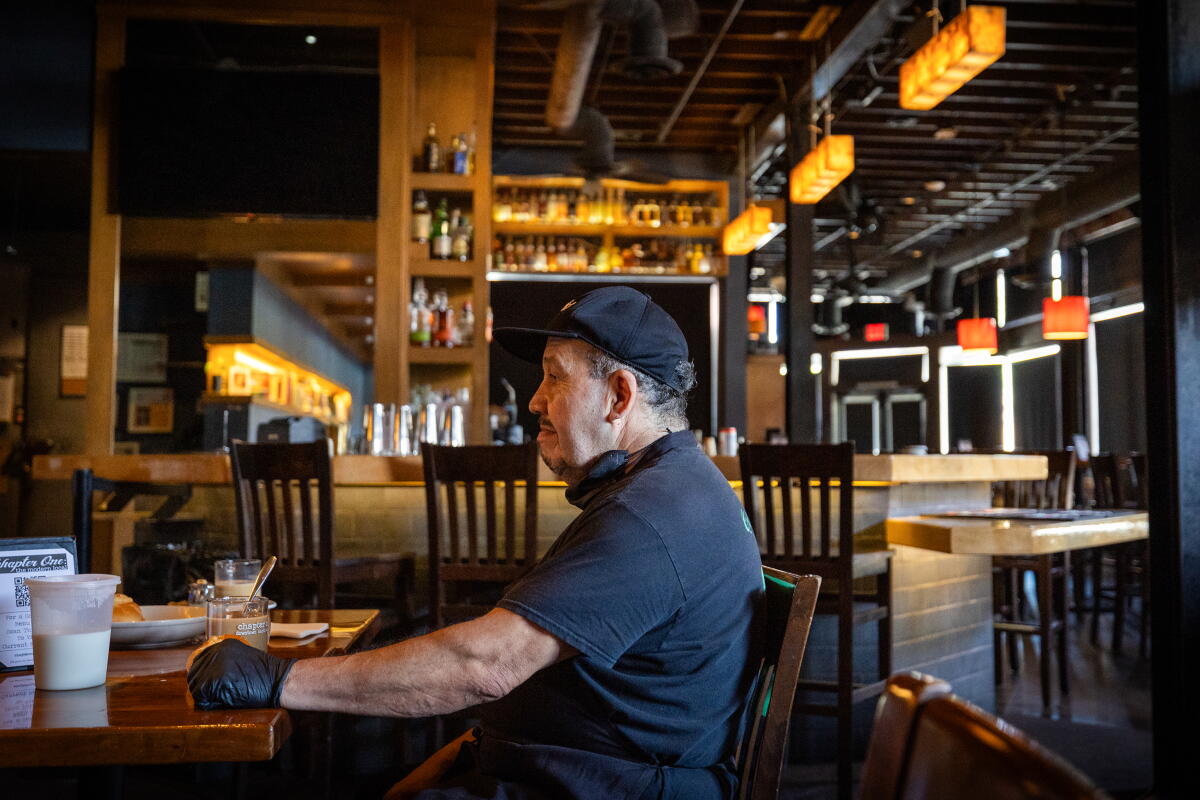
Restaurant industry wants immigration reform from the next Congress
Comprehensive immigration reform, wallowing in the machinations of Washington for decades since the amnesty of 1986, has been elusive for four decades. Will the incoming Congress grab fate by the horns and send a permanent, fair and humane immigration reform package to the desk of President Trump?
Reforming the immigration system is a top concern for restaurants, along with the need to immediately draw down tariffs. That’s what industry leaders have said in recent weeks. Makes sense, since restaurants across the country have openings for line cooks, servers, dishwashers, bussers and front-of-house staff — by the hundreds of thousands.
This is L.A. Omnivore, a newsletter about food, culture and everything else. It’s the day after Thanksgiving, but my mind is still reeling from the undeniable mandate for change and progress that U.S. voters delivered at the polls in this month’s election. Could it finally happen?
Immigration fuels, feeds us
I, like many Angelenos, can get emotional when the topic of immigration comes up. Every morning my mind is rattled by the realization that the Trump administration’s terrorizing ICE raids have morphed into background noise for people not directly affected. It’s the result of an insidious normalization process in our digital and news cultures.
But looked at from another perspective, immigration is a business issue.
Just about every major national business association, from the U.S. Chamber of Commerce on down, supports in some form welcoming immigrant labor to the country in a safe and fair manner. Why? Because it powers so many industries that are vital to the world’s largest economy. This is especially true for restaurants.
Think of every restaurant in the country — every McDonald’s, every Olive Garden, every Taco Bell. Every family restaurant, every upscale establishment, every bar with a grill. There are hundreds of thousands of such businesses in the United States, with some 15 million employees, according to data from the National Restaurant Assn.
“It’s the second largest private sector in the country, over half of Americans have worked in restaurants in their lives. So the importance of this industry to our national economy cannot be overstated,” said Sam Oches, editor in chief of the trade publication Nation’s Restaurant News.
Now, consider that more than 20% of restaurant employees are immigrants. And, at any given time, the industry has about 1 million job openings on average.
The time is now, Oches said, to finally pass reform that would allow workers to come out of the shadows and gain work permits or visas to help fill those jobs. Trump’s violent immigration crackdown has made the urgency of the issue as acute as possible, for all to see.
“Rather famously, they were raiding restaurants across the country. And now their employees are not showing up because they are scared of getting taken out of their place of work by ICE,” Oches said. “Basically this industry depends on immigrants for that workforce and the industry needs immigration reform so there can be a path for legal status” for all food workers.
Affordability issues
Sean Kennedy, chief advocacy officer for the National Restaurant Assn., said the repudiation of Trump’s policies was made clear at the ballot box across various sectors and regions of the country.
The president’s tariffs, and the elective war against Iran, also exacerbated persistent inflation pressures on everyday households and raised fuel prices across the board. And what’s the first thing that people tend to cut back on when everything else gets too expensive? Restaurants, Kennedy said.
“Affordability issues are really restaurant issues,” he said. “We are selling a product that Americans are sharing in once a week or so, hopefully more. And our profit margins are already so low.”

(Allen J. Schaben / Los Angeles Times)
John Tallichet is CEO of Specialty Restaurants Corp., which owns several restaurants and events spaces in the L.A. area, including the Proud Bird next door to LAX, Luminarias in Monterey Park and the Reef in Long Beach. He said in an interview that the pain and fear generated by the ICE raids directly impacted the food and restaurant industry, which relies heavily on human-to-human contact.
“At the end of the day we are in the hospitality business,” Tallichet said. “Anything that creates anxiety for our team members is bad for our industry, and our team members are so critical. We’re driven by employees.”
His company is proud to make note of its long-term workforce, including some employees across its restaurants that have worked for decades. Tallichet, like many other restaurant operators, wants a long-term solution to match its business model.
“To have anybody with that kind of longevity to feel unsure of what’s going on is just really unfortunate,” he said. “Having access to visas that aren’t seasonal, that are year-round, and don’t require higher education, I think is really important for the restaurant industry.”
After the Republicans’ midterm defeat, Trump told “60 Minutes” that immigration is one area where he’s willing to meet Democrats for some kind of reform. If so, such a move would directly contradict everything that comes out of the mouth of his new chief of staff, L.A.’s own Stephen Miller.
Given the Trump administration’s hard-line policies, which are out-of-step with voter sentiment, we’ll have to wait until the new Congress convenes in January to see whether this glaring contradiction is resolved. Democrats are already gearing up.
“We rely on the immigrant community from the back of the house to the front of the house, to the owner,” the National Restaurant Assn.’s Kennedy said, “to bring our industry to a better place.”
Are you hopeful for actual reform to actually come through? I asked Tallichet.
“We’re about the most hopeful people out there, as an industry, so, yes, I think we are,” he said. “There’s a lot of pain that’s happened, and through difficult times, people come together. And I believe that this is the right time, right now.”

Gurpal Singh Maan, owner of Royal Chaat, his restaurant inside a Shell gas station in Patterson, Calif.
(Ian Bates / For The Times)
Other food-ish stories you may have missed…
- More than 57 million people watched the 2025 NFL Thanksgiving games, and sure, I watched Thursday. The whole time I couldn’t shake this story from my mind: At least 75.4% of NFL players who died between 2008 and 2023 had chronic traumatic encephalopathy, according to a new study that corrected for selection bias. The disease cannot be diagnosed until after death, so the new finding drew together former players who donated their brains for study and a death index of all players who died in that period, coming to a staggering figure, reports The Times’ Steve Henson.
- The presence of delicious Indian food along the I-5 corridor in the Central Valley is well-known to road-tested Californians, as this Reddit thread demonstrates. More recently, a federal crackdown on immigrant truck drivers resulted in a boon of new roadside Indian restaurants known as dhabas along California highways, reports Nilesh Christopher of The Times.
- An NBC News report from February was trending this week and the reason why may enrage you. A Russian family with three children that was held for more than four months at the Dilley detention center in Texas alleged that last Thanksgiving, children were shown into a gym as a holiday feast was being set up. The children thought it was for them, but no, it was for employees, they were told. Really. “Even in Russia, they don’t treat children like this,” the father said.