
immigration policy

Stephen Miller rises, but California hopes it can blunt his force

President Trump’s appointment of Stephen Miller — the architect of the administration’s extreme crackdown on immigration — to White House chief of staff is sparking alarm among immigrant advocates and politicians across California.

But this week’s sweeping Democratic victories are giving immigrant communities hope that control of Congress will give them more tools to fight Miller’s policies.

Miller grew up in Santa Monica but has become a relentless critic of California, specifically its immigration policies, protections and, in many ways, identity. Southern California was the first city targeted by widespread immigration raids last year, upending the region in ways that continue to reverberate, particularly for immigrant communities.

Miller’s promotion, announced Friday, is seen by many as an indication that the president has no intention of backing away from some of his most polarizing policies during his last two years in office, despite devastating midterm losses for Republicans across the country. Many viewed the nationwide Democratic swing — in South Carolina, Texas, California’s Central Valley and across the Midwest — as a rebuke of the administration’s first two years, particularly the major immigration crackdown that went far beyond Trump’s promise to focus on the “worst of the worst,” instead arresting thousands without criminal convictions, many of whom had lived in the country for decades.

“We’re concerned that this means the president may be doubling down on his domestic agenda of ICE crackdowns and on deportations if Stephen Miller is at the helm,” said Jamal Abdi, the president of the National Iranian American Council. “He thinks that every problem starts with the immigrant community — and that getting rid of them is the solution.”

Abdi worries that Miller’s latest promotion will further anti-immigrant policies, which have long painted Iranians and other immigrant communities as threats. He is hopeful Miller will help end the military’s war in Iran but fears that may mean more focus domestically on immigrants, especially Iranians, who have been demonized amid hostilities. The diaspora is highly concentrated in Los Angeles, which is home to the largest group of people of Iranian descent outside of Iran.

“We are definitely not out of the woods, and it seems like maybe the president might do less damage abroad but will really focus energy domestically,” Abdi said.

Angelica Salas, executive director of the Coalition for Humane Immigrant Rights in Los Angeles, said seeing more power in the hands of Miller — who she said was behind the Trump administration’s strategies that included “warrantless arrest, racial profiling, excessive use of force, medical neglect in detention centers, people deported illegally” — is threatening.

“Now he’s the chief of staff, and so that means that he has access to every single Cabinet secretary to unleash his reign of terror on our people,” Salas said. During the midterm elections, she said her team was aware of an influx of Department of Homeland Security sightings and activity in the Southland.

“We saw people arrested the day after the election in a massive way and it almost feels very vengeful,” she said. “Almost [like saying], ‘You know you can’t stop us.’”

Now, she and other immigration advocates are preparing themselves for “even more abuse from this administration,” Salas said.

But Ahilan Arulanantham, faculty co-director of UCLA’s Miñana Family Center for Immigration Law and Policy, said Miller’s promotion doesn’t change anything for him.

“He’s been adopting the most extreme authoritarian and racist views and espousing it publicly … for the entire two years of this administration,” Arulanantham said. “Whether he does it as the deputy chief of staff or chief of staff … I don’t have a view of the difference.”

Despite widespread backlash to the immigration raids last year, particularly after federal agents killed two civilians in Minnesota, the administration did pull back some of its most aggressive tactics. But Miller has remained intensely focused on his goal to limit immigration dramatically and deport undocumented migrants.

Miller’s new role will come as the administration prepares to face a Democratic-led House of Representatives and Senate, which could provide the strongest check yet on the executive branch since Trump began his second term.

“Congress has tremendous opportunity to constrain what the federal government can do in the form of abusive immigration practices,” Arulanantham said. “Congress has a huge amount of leverage that it could choose to use to force the administration to change its conduct — in the way that voters have clearly demanded.”

He hopes Congress will pass laws that limit how the Department of Homeland Security enforces immigration laws, including how agents use warrants — or don’t, what they wear while on duty and what factors they can consider when stopping someone.

Members of Congress appeared to agree with that approach.

“Stephen Miller should lawyer up,” U.S. Rep. Robert Garcia (D-Long Beach), who is set to lead the House Oversight Committee once the next Congress is sworn in, wrote in a statement Friday. He and his colleagues are committed to fighting “against his hateful policies in Congress and the courts.”

“Just days after the American people rejected his corrupt and lawless presidency, Donald Trump is doubling down,” Garcia said. “Stephen Miller is the architect of the unconstitutional ICE raids that have terrorized our communities and kidnapped and killed American citizens and immigrant families.”

Sen. Alex Padilla (D-California) characterized Miller as the man most responsible for “the cruelest immigration policies this country has seen in modern times: family separations, detainment of babies and children, militarized raids, arbitrary arrest quotas, and the horror unleashed in communities across the country,” Padilla said.

“We will use every tool at our disposal — oversight, investigations, subpoenas, and our leverage over federal funding — to expose this Administration’s abuse of power and hold those responsible accountable.”

Standing up to the administration was a similar response for lawmakers in Los Angeles. City Councilmember Eunisses Hernandez, whose district was targeted by some of the most extreme immigration sweeps last year, called Miller’s appointment an act of desperation by Trump.

The councilmember said it won’t deter her office or the community from resisting harsh immigration policies and continued activity in L.A.

“We’re going to fight back,” Hernandez said. “Even when we were on the losing side, when we didn’t have the majority in the Senate or the House, many of us were still fighting against those raids, fighting for our communities, fighting to make sure people are fed and housed.”
Source link

Democrats gain ground with AAPI adults as trust in Republicans fades, AP-NORC/AAPI Data poll finds

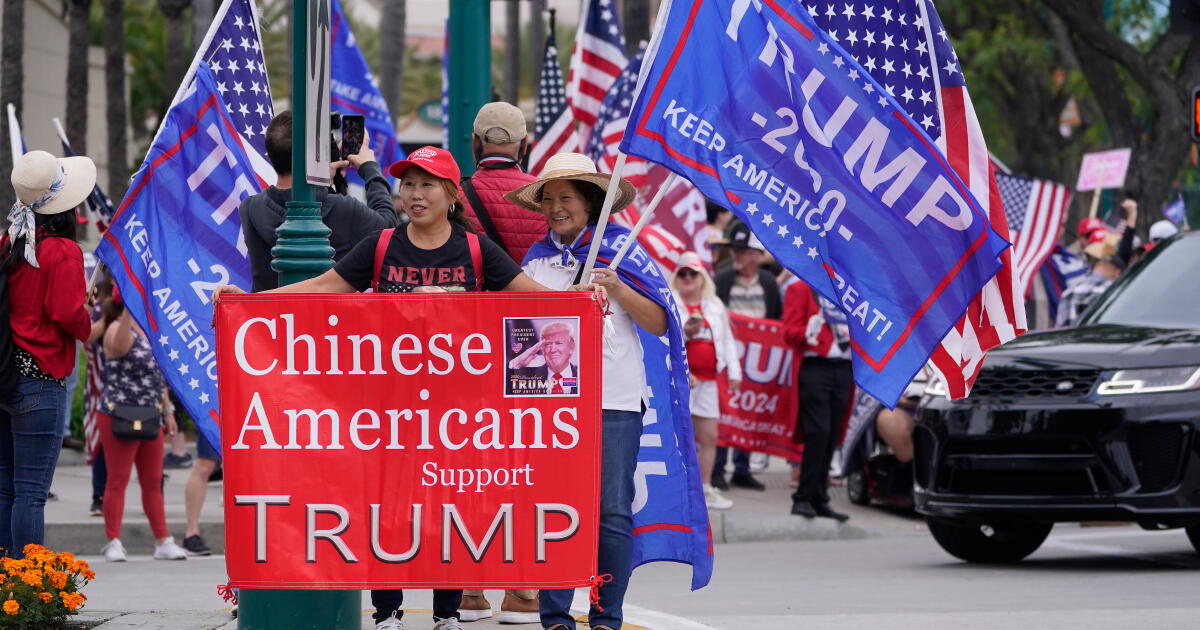
Asian Americans, Native Hawaiians and Pacific Islander adults have become more disillusioned with President Trump and Republicans as the Nov. 3 midterm elections approach, according to a new AP-NORC/AAPI Data poll, giving Democrats a substantial edge on major issues like the economy and health care.

The survey, which was conducted from Sept. 8-15 by AAPI Data and The Associated Press-NORC Center for Public Affairs Research, reveals that Trump’s standing on the economy has fallen among AAPI adults over the course of his second term.

About one-quarter of AAPI adults approve of the way Trump is handling his job as president overall. Only about 2 in 10 approve of his performance on the economy, which the vast majority of AAPI adults see as one of the most important issues for the upcoming election.

But although AAPI adults trust Democrats more than Republicans on a wide range of issues, views of the Democratic Party itself are still split.

Rebecca Larocco, a 45-year-old Korean American in Corning, Iowa, voted for Trump in 2016 and is leaning Republican in the midterm elections. She approves of his immigration policies but is unsure about Trump’s handling of the economy as the Iran war continues to compound gas prices.

“Where I’m at, it’s went up almost $1.50 (a gallon),” she said. “I didn’t expect to go into war at all, that has been definitely unexpected and I’m not sure… I’m just hoping they’ll do what they’re saying and get our economy back on track, get immigration and crime lowered.”

The economy is a top issue for AAPI adults

The economy remains top of mind for an overwhelming majority of the AAPI adult population when they consider the midterms. With the ongoing Iran war affecting gas prices and other costs staying elevated, Americans overall are deeply pessimistic about the state of the economy and see it as a high priority for the midterms. That includes AAPI adults — according to the poll, about 9 in 10 rank the economy as one of the most important issues for the upcoming election, and about 8 in 10 say this about the cost of living.

The economy, the cost of living and healthcare dwarf other issues for AAPI adults. About 7 in 10 AAPI adults say healthcare is one of the most important issues for the election, while only about half say this about foreign policy, crime, immigration, election fairness or climate change.

At the same time, Trump’s economic approval among AAPI adults has dropped about 10 percentage points over the course of the year, and there are other signs his popularity has waned with this group. In late 2024, just after the election, about 4 in 10 AAPI adults had a “somewhat” or “very” favorable view of Trump. That’s fallen to about 3 in 10 now.

“What the data show is that any gains that he made not only during the 2024 election — there was a bit of a honeymoon period that Trump enjoyed after the election before Inauguration Day — that has now largely disappeared,” said Karthick Ramakrishnan, founder and executive director of AAPI Data.

Len Takahashi, 57, of Universal City, Texas, describes himself as conservative but voted for Democrats in the last three presidential elections and for Republicans in midterm elections. For this midterm election, he is simply open to candidates who prioritize the economy.

“I would like policies that look in the best interest of the American public,” said Takahashi, who is Japanese American. “That could be bringing down spending, a balanced budget of U.S. spending, bringing down inflation, working towards a more stable economy and, lastly, just a better atmosphere between the far left and far right.”

AAPIs trust Democrats more on most issues but are not entirely sold on the party

Democrats have gained at Republicans’ expense since Trump returned to the White House when it comes to AAPI adults’ trust in handling many key issues.

In a March 2025 poll, AAPI adults were evenly divided over which political party would better handle the economy and immigration. Now, Democrats have a roughly 20-percentage-point advantage on both issues.

Meanwhile, around two-thirds of AAPI adults have a “somewhat” or “very” unfavorable view of the GOP. Only about one-quarter have a “somewhat” or “very” favorable view.

But while trust in the Democrats on specific issues has increased, AAPI adults are ambivalent about the party as a whole. About half, 48%, of AAPI adults have a “somewhat” or “very” unfavorable impression of the Democratic Party, while 44% have a “somewhat” or “very” favorable impression.

A separate AP-NORC survey of registered voters in September found, similarly, that while voters in general are deeply dissatisfied with Trump and the GOP, few think either party is capable of solving important problems.

Louise Rider, 40, is a Democrat living in Chicago. She believes Democrats are better than Republicans across all issues but says she’s unhappy with how the party has governed.

“I don’t think the Democrats are doing great, I think they need a lot of change as a party,” she said. “It’s kind of a helpless feeling, that nothing will get done with both parties unless there’s major changes.”

Some Republicans still stand behind Trump. James Finley, 74, of Lenox, Massachusetts, said Trump deserves some understanding because he cannot bring down high prices overnight. When it comes to Republicans in general, Finley is a little more critical.

“They’ve had the majority for a couple of years,” said Finley, whose ancestry includes Japanese heritage. “I think they could have done a little bit more or maybe a lot more in terms of passing certain things that I wanted to pass.”

Still, he sticks to the party line and because “all I ever hear from Democrats is to get Trump,” Finley said.

AAPIs concerned about fair midterm elections

As the election approaches, many AAPI adults are worried about problems with misinformation, legal challenges to the results, and voter suppression. About half of AAPI adults say it’s a “major problem” in U.S. elections that people who are eligible are not allowed to vote, while about two-thirds see foreign government attempts to influence results as a “major” problem.

Looking ahead to the November election, about half of AAPI adults are “extremely” or “very” concerned about fake or false information about the candidates, and about half also feel this way about legal challenges to the election results.

Finley is unsure if the voting process can be tightly monitored to prevent undocumented or unregistered people from attempting to vote.

But Takahashi, the conservative from Texas, is worried that Trump will try to manipulate the election.

He’s concerned, he said, that Trump would amplify claims of “fraud in the election system” should the midterms not go in his favor. “(He’ll) make that a point to distract the American public,” he said.

Tang, Jiang and Sanders write for the Associated Press. Tang reported from Phoenix and Jiang from New York. The poll of 1,023 U.S. adults who are Asian American, Native Hawaiian and Pacific Islander was conducted Sept. 8-15, using a sample drawn from NORC’s probability-based Amplify AAPI Panel, designed to be representative of the Asian American, Native Hawaiian and Pacific Islander population. The margin of sampling error for all respondents is ±4.7 percentage points. This poll is part of an ongoing project exploring the views of Asian Americans, Native Hawaiians and Pacific Islanders, which are usually not highlighted in other surveys because of small sample sizes and lack of linguistic representation.

Source link