immigration officer

Homeland Security Secretary Markwayne Mullin refuses to commit to following court orders

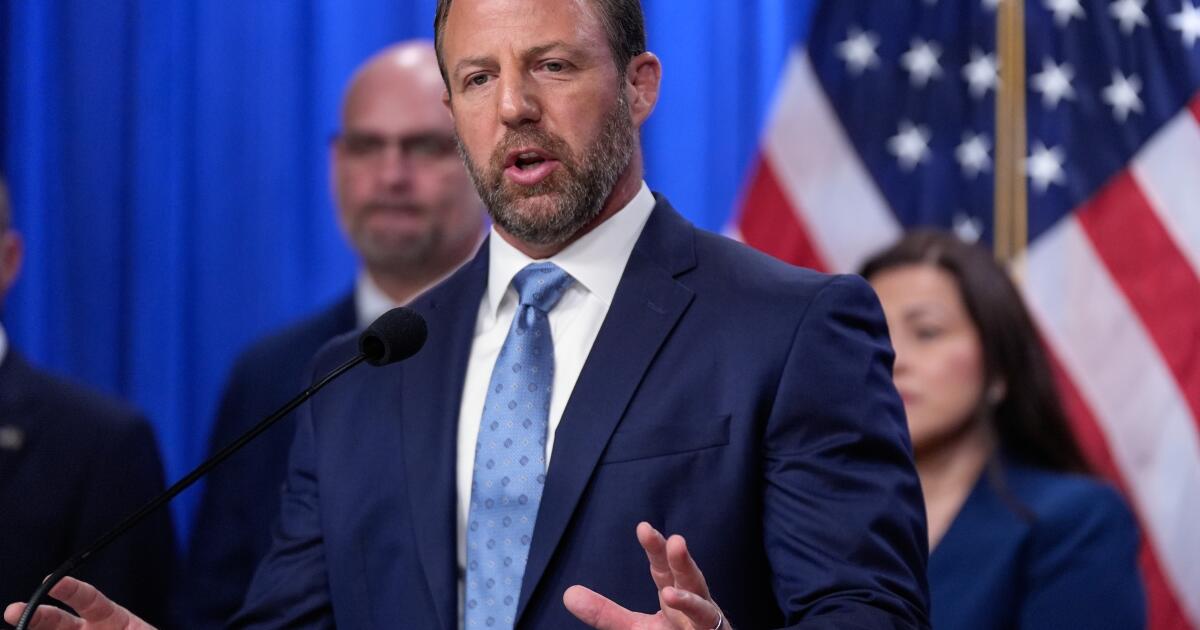
Homeland Security Secretary Markwayne Mullin, under intense grilling at a Senate hearing Tuesday, refused to commit to abiding by federal court orders.

Mullin also conceded that his predecessor as secretary, Kristi Noem, had inaccurately described two shootings involving immigration officers in Minneapolis.

His refusal to commit to complying with court orders came during a testy exchange with Sen. Chris Murphy (D-Conn.). Murphy quoted Chief U.S. District Judge Patrick Schiltz in Minnesota — a Republican appointee — who said Immigration and Customs Enforcement had violated nearly 100 court orders and had “likely violated more court orders in January 2026 than some federal agencies have violated in their entire existence.”

When Murphy asked Mullin to commit to complying with court orders in the future, Mullin replied that his agency would not break the law.

So you’ll pick and choose which court orders you’ll obey?

— Sen. Chris Murphy

“But that doesn’t sound like the same thing as committing that you will obey a court order,” Murphy said.

“If we didn’t think the courts were politicized, then I would probably be able to answer that. But we see courts over and over again that use their bench for political opinion and not just the rule of law,” Mullin said.

“So you’ll pick and choose which court orders you’ll obey?” Murphy asked,

Mullin told Murphy not to put words in his mouth.

Addressing his fellow senators, Murphy said, “If you’re a Democrat or a Republican on this committee, you should be really, really freaked out.”

Murphy later returned to the court orders question, saying that ignoring judges erodes democracy.

“I agree that there is politics involved in judicial decisions,” he said. “I do not think that gives an excuse to either Democratic or Republican administrations to ignore those court orders. I think that’s actually the end of our republic, if the administration willfully ignores a court order because they disagree with it or its motivation.”

Mullin faced the Senate Appropriations Committee amid scrutiny over the agency’s budget and immigration enforcement ahead of the World Cup. President Trump tapped Mullin to take over leadership of the embattled Department of Homeland Security after Noem was fired in March.

Mullin’s appearance came as the Senate is considering legislation that would fund immigration enforcement agencies through the end of Trump’s term. Republicans intend to use a legislative maneuver that would bypass the need for support from Democrats, who have pushed for reforms since two U.S. citizens were killed by immigration agents in Minneapolis.

During his previous appearance before senators, Mullin projected himself as diplomatic, saying he would work to bring confidence to the agency and keep it out of the news. But recently, he has set the travel industry on edge by threatening to remove Customs and Border Protection officers from airports in so-called sanctuary cities, which limit collaboration with immigration enforcement agents.

Millions of people are preparing to visit the United States for the World Cup, which starts June 11 and includes host cities such as Los Angeles, San Francisco and Seattle. Mullin said he will attend his first soccer game June 12 in Los Angeles.

Murphy, the committee’s top Democrat, made note of Mullin’s promise to keep Homeland Security out of the news. He said the agency has repeatedly broken the law, wasted billions in taxpayer dollars and lined the pockets of private prison corporations.

“Nothing has really gotten better,” he said. “In fact, you spent the first two months of your tenure threatening to suspend international arrivals in states represented by Democrats. Not only would that throw our entire air travel system into chaos, it’s completely illegal.”

Mullin took issue with Murphy’s characterization of the agency’s behavior, calling it political theater. Murphy sat with his head propped up on his hand, looking directly back at his former Senate colleague.

Mullin said threats against immigration agents are up significantly and that Murphy’s “reckless tone is getting people hurt.”

Protests erupted last month outside an immigrant detention facility in New Jersey after detainees launched a hunger and labor strike over what they called inhumane conditions such as rotten food and medical neglect. Tensions have escalated over several days as protesters clashed with law enforcement and counterprotesters.

On Monday in Dallas, Mullin said he would pull Customs officers from airports around the country to help with the security in Newark, if it became necessary.

Addressing the issue of officer training, Mullin said Tuesday that the agency will return next month to 72 days of training for new recruits, including training on crowd control. Last year, then-acting ICE Director Todd Lyons told Congress the agency had reduced the number of training days to 42.

He also said the agency is not “actively patrolling” sensitive locations, such as schools, and said that the agency has stopped relying on administrative warrants to enter a residence by force and is now seeking judicial warrants before doing so in most cases.

Asked by Sen. Patty Murray (D-Wash.) about body-worn cameras, Mullin said the agency doesn’t have the money to supply enough body cameras for every immigration officer. Homeland Security received an unprecedented windfall last year of $170 billion under Trump’s sweeping tax bill, the One Big Beautiful Bill Act.

Mullin said the agency suffered a blow to morale because of the historic 76-day shutdown of ICE and CBP after a congressional stalemate over funding.

“Some people couldn’t sustain it,” he said. “We lost a tremendous amount of workforce, about 8%.”

During an exchange with Sen. Chris Van Hollen (D-Md.), Mullin acknowledged that Noem had unfairly and inaccurately described two shootings involving immigration officers in Minneapolis.

An ICE agent was recently arrested over the nonfatal shooting of a Venezuelan man, whom Noem had called an attempted murderer.

“That’s an untrue statement, isn’t it?” Van Hollen said.

“From what we have been briefed on, yes,” Mullin replied.

Next, Van Hollen brought up Alex Pretti, who was shot and killed by CBP agents. Noem called him a domestic terrorist.

“You agree the facts don’t support that statement?” Van Hollen said.

“The investigation would say that’s probably not accurate,” Mullin replied.

Mullin was scheduled to appear before the House on Wednesday.

Source link

A sudden shift: ICE arrests drop nearly 12% after Minneapolis killings and immigration shake-up

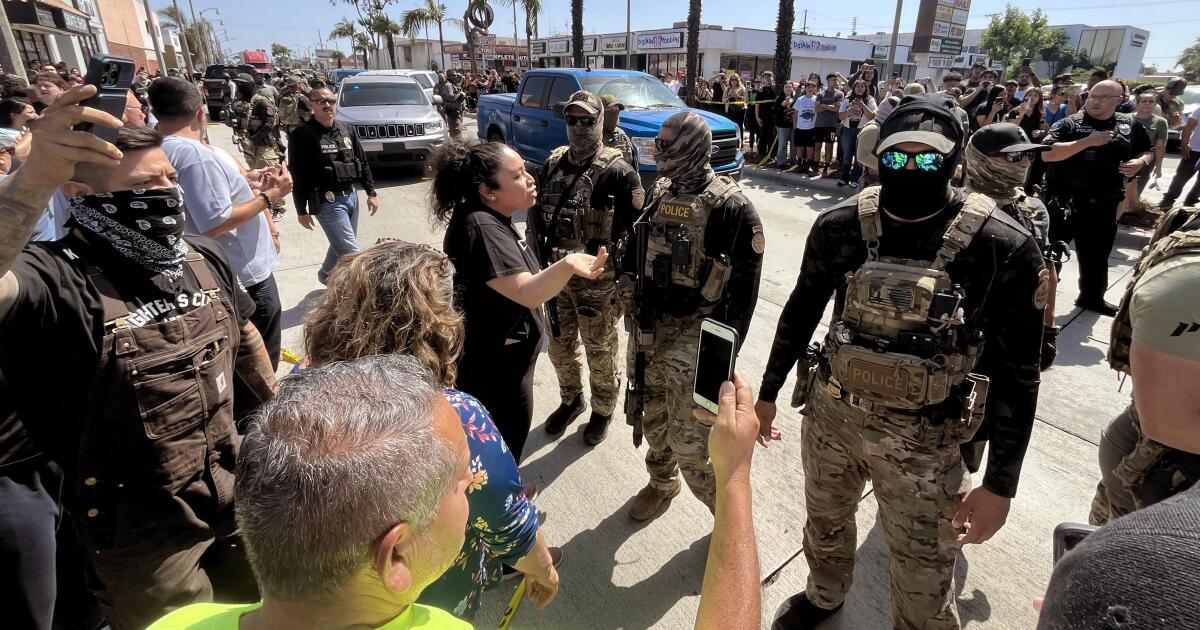
At the peak of the crackdown, carloads of masked immigration officers were a common sight in the streets of Minneapolis, while thousands of people were being arrested every week in Texas, Florida and California.

“Turn and burn,” top Border Patrol commander Gregory Bovino called the strategy, with relentless displays of force and teams of agents descending on restaurant kitchens, bus stops and Home Depot parking lots.

In December, arrests by Immigration and Customs Enforcement agents peaked at nearly 40,000 nationwide and were nearly as high the next month, according to data provided to UC Berkeley’s Deportation Data Project and analyzed by the Associated Press.

In late January, the killings in Minneapolis of two American citizens by immigration officers and growing concerns over the government’s heavy-handed tactics led to a shake-up of top immigration officials. In the weeks that followed, ICE arrests across the country dropped on average by nearly 12%.

Polling has found the public felt the immigration enforcement operation in Minnesota went too far, a factor that may have contributed to the abrupt firing of Homeland Security Secretary Kristi Noem in early March.

The numbers don’t follow the same pattern everywhere

Bovino, who swaggered through raid scenes in tactical gear and was the public face of the Trump administration crackdown, was pushed aside following the killings in Minneapolis of Renee Good and Alex Pretti. Border advisor Tom Homan was then sent to the Twin Cities to chart a new course for immigration enforcement, and he announced the drawdown of immigration agents in the state on Feb. 4.

An AP analysis of ICE arrest records show the department averaged 7,369 weekly arrests nationwide in the five weeks after Homan’s drawdown announcement, , the most recent period for which data is available, down from 8,347 per week in the previous five weeks. Those arrest numbers were still higher on average than during much of the first year of President Trump’s second term, and were dramatically higher than during the Biden administration.

The numbers were not, however, uniform across the country.

ICE arrests rose significantly in Kentucky, Indiana, North Carolina and Florida during those five weeks, in some cases hitting their highest weekly count since the start of Trump’s second term.. In Kentucky alone, weekly arrests more than doubled, reaching 86 by early March.

Those increases were offset by steep drops in a handful of large states, including Minnesota and Texas.

Many arrested were not Trump’s ‘worst of the worst’

The Trump administration insists it is targeting the most vicious criminals living illegally in the U.S., and the president has referred to them as “ the worst of the worst.”

In some cases the description is accurate, but the reality is complicated.

Many of the toughest criminals taken into ICE custody were already in prison, but many others who were arrested have no criminal history.

Nationally, some 46% of the people ICE arrested in the five weeks before Feb. 4 had no criminal charges or convictions, dropping to 41% in the five weeks that followed.

Yet that’s still above the 35% weekly average for the time since Trump returned to office. And in a number of states, even after Feb. 4, the share of noncriminals being arrested went up, not down.

Has there been a change in approach?

Across the country, thousands of federal court filings offer an imperfect window into how the Trump administration’s deportation tactics remain in high gear, even if activity has waned.

Like the 21-year-old Honduran man with no criminal record who has filed a petition for release after being arrested Feb. 22 in a suburban San Diego traffic stop. The father of three U.S. citizen children — ages 5, 3 and 10 months — had been under ICE surveillance, the petition says, before officers in tactical gear pulled him over.

Or the 33-year-old Venezuelan woman, a well-known south Texas doctor who worked in a region designated as medically underserved, who was arrested earlier this month with her 5-year-old daughter, a U.S. citizen, on her way to her husband’s asylum hearing.

She was arrested, officials said, for overstaying her visa.

Aaron Reichlin-Melnick, a senior fellow with the research and advocacy group the American Immigration Council, says he sees signs of change in lower arrest and detention numbers but warns it’s too early to know if those shifts are permanent.

“The Trump administration says: ‘We’re not slowing down,’ ‘Nothing has changed,’” in immigration enforcement, he said. “But it’s very clear that they have pulled back from some of the tactics of Operation Metro Surge,” the crackdown that swept Minneapolis.

Kessler and Sullivan write for the Associated Press. Kessler reported from Washington and Sullivan from Minneapolis. AP reporters Elliot Spagat in San Diego and Gisela Salomon in Miami contributed to this report.

Source link