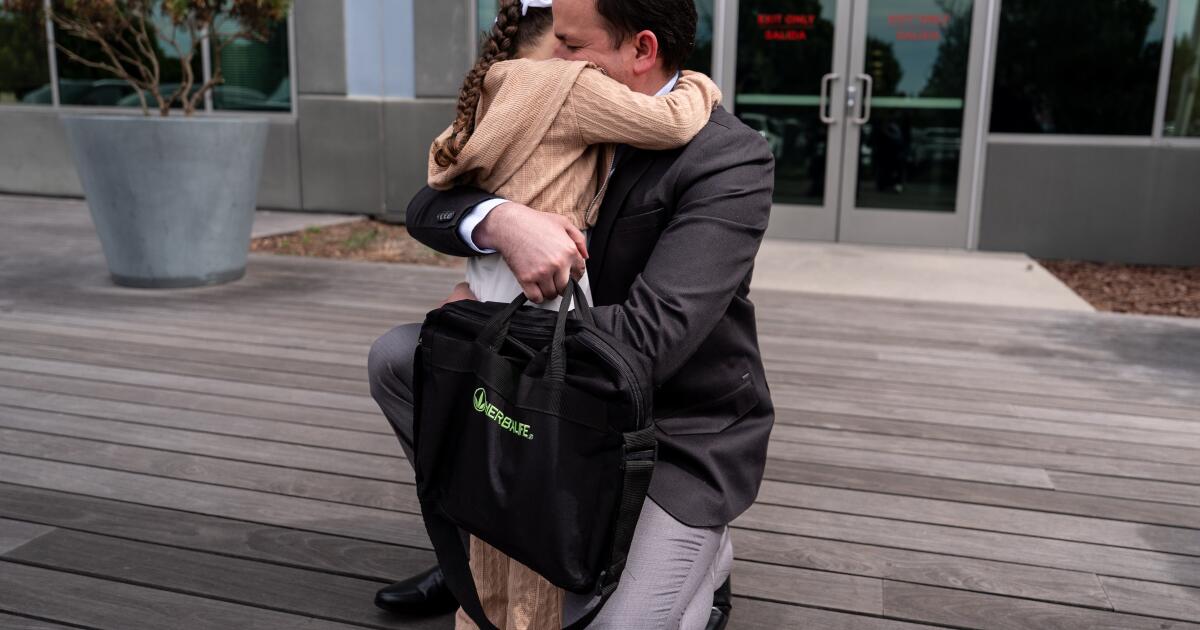
immigration enforcement operation

A sudden shift: ICE arrests drop nearly 12% after Minneapolis killings and immigration shake-up

At the peak of the crackdown, carloads of masked immigration officers were a common sight in the streets of Minneapolis, while thousands of people were being arrested every week in Texas, Florida and California.

“Turn and burn,” top Border Patrol commander Gregory Bovino called the strategy, with relentless displays of force and teams of agents descending on restaurant kitchens, bus stops and Home Depot parking lots.

In December, arrests by Immigration and Customs Enforcement agents peaked at nearly 40,000 nationwide and were nearly as high the next month, according to data provided to UC Berkeley’s Deportation Data Project and analyzed by the Associated Press.

In late January, the killings in Minneapolis of two American citizens by immigration officers and growing concerns over the government’s heavy-handed tactics led to a shake-up of top immigration officials. In the weeks that followed, ICE arrests across the country dropped on average by nearly 12%.

Polling has found the public felt the immigration enforcement operation in Minnesota went too far, a factor that may have contributed to the abrupt firing of Homeland Security Secretary Kristi Noem in early March.

The numbers don’t follow the same pattern everywhere

Bovino, who swaggered through raid scenes in tactical gear and was the public face of the Trump administration crackdown, was pushed aside following the killings in Minneapolis of Renee Good and Alex Pretti. Border advisor Tom Homan was then sent to the Twin Cities to chart a new course for immigration enforcement, and he announced the drawdown of immigration agents in the state on Feb. 4.

An AP analysis of ICE arrest records show the department averaged 7,369 weekly arrests nationwide in the five weeks after Homan’s drawdown announcement, , the most recent period for which data is available, down from 8,347 per week in the previous five weeks. Those arrest numbers were still higher on average than during much of the first year of President Trump’s second term, and were dramatically higher than during the Biden administration.

The numbers were not, however, uniform across the country.

ICE arrests rose significantly in Kentucky, Indiana, North Carolina and Florida during those five weeks, in some cases hitting their highest weekly count since the start of Trump’s second term.. In Kentucky alone, weekly arrests more than doubled, reaching 86 by early March.

Those increases were offset by steep drops in a handful of large states, including Minnesota and Texas.

Many arrested were not Trump’s ‘worst of the worst’

The Trump administration insists it is targeting the most vicious criminals living illegally in the U.S., and the president has referred to them as “ the worst of the worst.”

In some cases the description is accurate, but the reality is complicated.

Many of the toughest criminals taken into ICE custody were already in prison, but many others who were arrested have no criminal history.

Nationally, some 46% of the people ICE arrested in the five weeks before Feb. 4 had no criminal charges or convictions, dropping to 41% in the five weeks that followed.

Yet that’s still above the 35% weekly average for the time since Trump returned to office. And in a number of states, even after Feb. 4, the share of noncriminals being arrested went up, not down.

Has there been a change in approach?

Across the country, thousands of federal court filings offer an imperfect window into how the Trump administration’s deportation tactics remain in high gear, even if activity has waned.

Like the 21-year-old Honduran man with no criminal record who has filed a petition for release after being arrested Feb. 22 in a suburban San Diego traffic stop. The father of three U.S. citizen children — ages 5, 3 and 10 months — had been under ICE surveillance, the petition says, before officers in tactical gear pulled him over.

Or the 33-year-old Venezuelan woman, a well-known south Texas doctor who worked in a region designated as medically underserved, who was arrested earlier this month with her 5-year-old daughter, a U.S. citizen, on her way to her husband’s asylum hearing.

She was arrested, officials said, for overstaying her visa.

Aaron Reichlin-Melnick, a senior fellow with the research and advocacy group the American Immigration Council, says he sees signs of change in lower arrest and detention numbers but warns it’s too early to know if those shifts are permanent.

“The Trump administration says: ‘We’re not slowing down,’ ‘Nothing has changed,’” in immigration enforcement, he said. “But it’s very clear that they have pulled back from some of the tactics of Operation Metro Surge,” the crackdown that swept Minneapolis.

Kessler and Sullivan write for the Associated Press. Kessler reported from Washington and Sullivan from Minneapolis. AP reporters Elliot Spagat in San Diego and Gisela Salomon in Miami contributed to this report.

Source link

Missed paychecks and airport delays: Pressure mounts on Congress to end the funding shutdown

Pressure is mounting on Congress to end the funding shutdown that has resulted in travel disruptions, missed paychecks and even warnings of airport closures, but lawmakers have yet to resolve the underlying issue of reining in President Trump’s immigration enforcement operations.

Senators intend to vote Thursday on a Republican proposal that would fund the Transportation Security Administration and much of the Department of Homeland Security, except the enforcement and removal operations conducted by U.S. Immigration and Customs Enforcement. That plan is expected to fail.

Democrats argue it does not go far enough at putting guardrails on officers from ICE, Customs and Border Protection and other federal agencies who are engaged in the immigration sweeps, particularly after the deaths of two Americans protesting the actions in Minneapolis.

Trump, who has largely left the issue to Congress to resolve, threatened to send the National Guard to airports, in addition his deployment of ICE agents who are now checking travelers IDs — a development drawing concerns.

“They need to end this shutdown immediately or we’ll have to take drastic measures,” Trump said Thursday during a Cabinet meeting at the White House.

With Congress set to leave town by week’s end for its own spring break recess, calls are intensifying for an end to the 41-day stalemate that’s put the livelihoods of TSA officers at risk as they provide airport security without pay.

Multiple airports are experiencing greater than 40% callout rates of TSA workers and more than 480 of its nearly 50,000 transportation security officers have now quit during the shutdown. Nationwide, nearly 11% of TSA workers — more than 3,200 on a single day — missed work.

Trump stays out of the fray

The Republican president initially signed off on the plan the GOP senators brought to him late Monday. By Tuesday, he said he would not be happy with any deal.

Trump did not directly address the status of negotiations late Wednesday evening during an annual fundraising dinner for the House Republicans’ campaign committee as Speaker Mike Johnson, R-La., works to keep majority control of the chamber in the November elections.

But Trump criticized Democrats for refusing to settle their demands on immigration changes. On Thursday, he revived his campaign for senators to end the filibuster as a way to overpower opposition to GOP policies, something most Republican senators do not want to do.

The GOP’s big tax cuts bill that Trump signed into law last year funneled billions to DHS, including $75 billion for ICE operations, ensuring the money is flowing for his immigration and deportation agenda even with the funding shutdown. ICE and other immigration officers are still being paid.

The situation is partly of Trump’s making, a strategy the president put in place last fall when he cut a deal with Democrats to end a previous federal shutdown. At that time, Trump agreed to fund the federal government, except for DHS, which was then put on temporary funding that has expired.

A stopgap measure

The Republican offer added one new restraint on immigration officers, funding the use of body cameras that had previously been agreed to. It excluded other policies that Democrats have demanded, such as that federal agents wear identification, remove their face masks and refrain from conducting raids around schools, churches or other sensitive places.

Senate Democratic leader Chuck Schumer of New York said they needed to see real changes. “We’ve been talking about ICE reforms from day one,” he said.

Democrats had been in several days of talks with the White House, including with border czar Tom Homan, that appeared to be making progress toward a deal. The White House presented its own offer with several items Democrats had been demanding, including officer IDs and training.

But those negotiations broke down over the weekend.

Republicans say Democrats are putting the country at risk. They say the Trump administration has already made strides to meet Democrats’ demands and has shown a new approach to its immigration operations, swearing in Oklahoma Sen. Markwayne Mullin as the new homeland security secretary to replace Kristi Noem.

But conservative Republicans also panned the proposal, demanding full funding for immigration operations and skeptical of the promise from GOP leaders that they would address Trump’s proof-of-citizenship voting bill in a subsequent legislative package.

Senate Majority Leader John Thune, R-S.D., said late Wednesday that if Democrats put a “more realistic offer on the table, we’ll be back in business.”

Asked if Congress would consider a stopgap measure to temporarily fund the department, Thune said: “We’ll see.”

Airport lines grow as TSA workers endure hardships

Passengers are facing more four-hour waits to clear security at George Bush Intercontinental Airport in Houston.

The airport’s website said Thursday morning that travelers should expect to wait two hours, 30 minutes in the security line at one of its open terminals and four hours at the other.

Lines and wait times are expected to grow Thursday and Friday because of “significantly higher passenger traffic,” according to an update on the airport’s website.

“This is a dire situation,” the acting TSA administrator, Ha Nguyen McNeill, testified at a House hearing Wednesday.

She described the multiple hardships facing unpaid TSA workers — piling up bills and eviction notices, even plasma donations to make ends meet — and warned of potential airport closures if more employees refuse to come to work.

“At this point, we have to look at all options on the table,” she said. “And that does require us to, at some point, make very difficult choices as to which airports we might try to keep open and which ones we might have to shut down as our callout rates increase.”

She cited the growing financial strain on the TSA workforce.

“Some are sleeping in their cars, selling their blood and plasma, and taking on second jobs to make ends meet,” she said.

McNeil also said TSA officers working at the nation’s airports have experienced a more than 500% increase in the frequency of assaults since the shutdown began.

“This is unacceptable, and it will not be tolerated,” McNeill said.

Mascaro and Freking write for the Associated Press. AP writers Rebecca Santana and Ben Finley in Washington; Wyatte Grantham-Philips in New York; Rio Yamat in Las Vegas; Russ Bynum in Savannah, Ga., and Gabriela Aoun Angueira in San Diego contributed to this report.

Source link