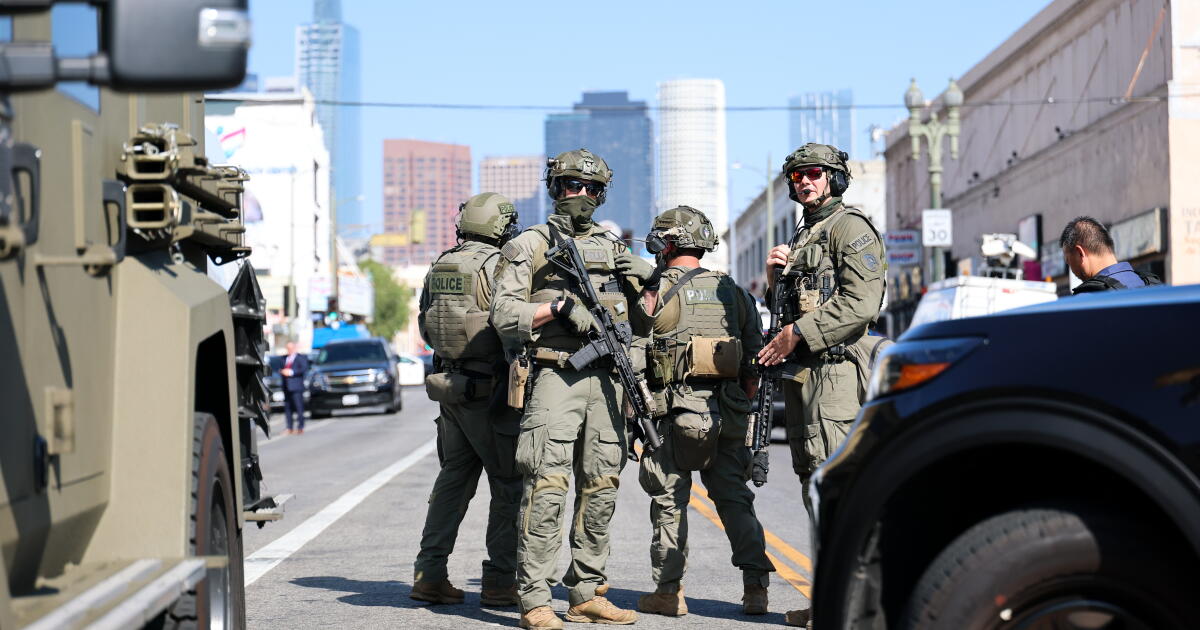
immigration agent

Most Californians still disapprove of immigration crackdown, poll says

Two-thirds of California voters disapprove of President Trump’s immigration policies and a majority believe those policies are discriminating against Latinos, according to a new poll.

Nearly half of the voters said they were concerned that they, a family member or a close friend could be detained because of Trump’s immigration policies.

The findings of the UC Berkeley Institute of Governmental Studies poll, released Wednesday, show that most Californians haven’t budged on their thoughts about the president’s approach to immigration since he returned to office. A poll last August similarly showed strong disapproval of the Trump administration’s approach to immigration enforcement.

The poll, which was conducted for the Los Angeles Times, showed the usual division along party lines when voters were asked whether they trust the U.S. Border Patrol and Immigration and Customs Enforcement, whether agents should wear masks while on duty, and whether Latinos are being discriminated against.

“This suggests that a significant number of voters see ICE infringement on the individual rights of the undocumented as also potentially leading to broader infringements on citizens’ rights,” said G. Cristina Mora, co-director of the institute and a sociology professor at UC Berkeley who studies race and immigration.

“Latino voters also seem to particularly worry about the way that racism is motivating current immigration practices,” she said, which is likely tied to the Supreme Court’s approval of immigration agents detaining people on the basis of their perceived race, ethnicity, language or occupation.

The overall disapproval among voters of Trump’s immigration policies — 64% — was down a bit from the August poll, in which 69% of respondents said they disapproved of how immigration enforcement was being carried out in California.

Republicans appear to be more approving of immigration policies now, with 86% saying they approve of Trump’s immigration policies — up from 79% approval of enforcement in California last August.

Mora said the tilt among California Republicans toward the Trump administration could be due, in part, to the framing of the question, which asked about “President Trump’s immigration policies.”

Any time Trump’s name is included, Republicans are more likely to agree with him, she said. The same effect is seen when asking about other issues, such as the economy.

Another factor could be the timing, Mora said. Last summer, federal agents conducted widespread raids in Los Angeles before moving on to target other cities, such as Chicago and Minneapolis.

Now that the administration has shifted away from some tactics that resulted in escalations of violence, Republicans are “falling in line” again with the administration, she said.

“My hunch is it was shocking,” Mora said of the immigration raids last summer. “Things have normalized because the tension is somewhere else.”

Seeking to de-escalate after two protesters were shot and killed by federal agents in Minneapolis, the president tapped his border advisor Tom Homan to take control of the immigration enforcement operation there.

Republican strategist Ford O’Connell said that’s why voters are more supportive.

“Tom Homan being in charge and publicly taking a much lighter touch and appearing reasonable to the average voter is why you’re seeing this turnaround,” he said.

But Democratic strategist Maria Cardona said that that’s wishful thinking and that ICE’s approach hasn’t substantially changed.

“It only went down five points,” she said, referring to the disapproval of Trump’s policies. “That’s not the American people being on the side of the administration — it’s that they’re not seeing American citizens murdered on their screens every day.”

One question saw strong division among Republicans: Should immigration agents be allowed to enter the homes of suspected undocumented immigrants without a judge-approved search warrant?

Among California Republicans, 45% said no, 38% said yes, and 17% said they have no opinion.

O’Connell said that’s because Republicans strongly value civil liberties, especially around property.

Republicans were more strongly in favor of a different policy, allowing ICE agents to wear masks while on duty. While 91% of Democrats opposed the policy, 68% of Republicans favored it.

In the August poll, 45% of Republicans said federal agents should be required to show clear identification when carrying out their work. That desire for identification doesn’t appear to extend to being fully identifiable by face.

O’Connell said Republicans understand the concern over agents increasingly being doxxed.

“The administration wants to find a happy medium there, whether it’s a nameplate or a badge number,” he said. “There is wiggle room.”

Nearly 7 in 10 respondents said they want state and local authorities to intervene when they witness unlawful detentions or excessive use of force by federal immigration agents.

Voters were also asked about their level of concern that they, a family member or a close friend could be detained because of Trump’s immigration policies. While 85% of Republicans said they are not too concerned or not concerned at all, 63% of Democrats said they are somewhat or very concerned.

Overall, nearly half of the respondents, 45%, said they are somewhat or very concerned. Among racial and ethnic groups, 62% of Latino voters, 46% of Black voters and 43% of Asian or Pacific Islander voters said they are somewhat or very concerned.

“The Latino community has always wanted to think the best of this country and they still do,” Cardona said. “Our positivism, our optimism, our hope in a better future is second to none. I think that’s what you’re seeing in those numbers, even as our community feels totally attacked.”

Mora said the high concern among Black residents is notable because, while most Black Californians aren’t immigrants themselves, Los Angeles has one of the largest concentrations of Blaxicans — the children of one Black parent and one Latino parent.

Beyond intermarriages, Black residents in California are also likely to have immigrant friends or neighbors, she said.

O’Connell took a different view: “I don’t think we can glean anything from it other than how one party focuses more on identity politics than the other.”

The Institute of Governmental Studies poll was completed online in English and Spanish from March 9 to 15 by 5,109 registered voters in California.

Source link

Commentary: Goodbye, Border Patrol bogeyman Gregory Bovino, and good riddance

How would you feel about getting a dream gig only to see it end in disgrace because of, well, you?

That’s what Gregory Bovino gets to think about for the rest of his life. Friday is the Border Patrol lifer’s last day on the job after 30 years — and he ain’t leaving because he wants to.

For the past year, the self-described “hillbilly” was the personification of the Trump administration’s xenophobic deportation deluge. Helicopter invasions of apartment complexes, tear gas canisters thrown into large crowds, defying court orders, glamorous photo shoots: There was no municipality too big, no tactic too crazy, no quote too incendiary for Bovino to take on while he treated immigrant neighborhoods like the shores of Normandy.

The North Carolina native’s caravan of cruelty quickly earned him a promotion from El Centro sector chief to Border Patrol commander at large, a new position crafted just for him. He embraced the role of migra bogeyman like a tween boy scarfing down a bowl of Warheads, always promising more deportations, more chaos, more more.

Not anymore.

In January, Border Patrol agents shot and killed ICU nurse Alex Pretti during a protest against them a few weeks after an Immigration and Customs Enforcement officer did the same to Renée Good, a mother of three. Bovino threw napalm on the matter by claiming Pretti wanted to “massacre law enforcement” without offering any evidence. The incidents so soured the public on immigration agents that a Public Religion Research Institute poll released this week showed only 35% of Americans surveyed approved of how Trump is handling immigration, compared to 48% a year ago.

Bovino was sent back down to El Centro and lost his social media privileges, where he had long posted cringe-inducing videos about what a swell guy he was. Even Trump turned on his migra man, telling Fox News that Bovino was “a pretty out-there kind of a guy … and in some cases that’s good. Maybe it wasn’t good [in Minneapolis].”

I should’ve warned Bovino the one time we met that failure was his fate.

The setting: the Fox 11 Los Angeles studios in July. Bovino and I were in to do separate interviews with the station’s former anchor Elex Michaelson. Bovino was in the middle of his Los Angeles invasion, which saw immigration agents lay siege to MacArthur Park, storm Home Depots and car washes and show up outside the Japanese American National Museum while politicians inside were decrying Trump.

Dressed in full Border Patrol uniform complete with a clipped-on walkie-talkie on his shoulder, the guy was billing himself as a modern-day Charles Martel defending the homeland from invading infidels. The nasal-voiced Bovino rambled to Michaelson about how “Ma and Pa America” deserved a country free from undocumented immigrants and vowed to remain in Los Angeles “until the operation is over.”

US Border Patrol march to the Edward R. Roybal Federal Building

Then-U.S. Border Patrol commander at large Gregory Bovino, center, along with Border Patrol agents as they march to the Edward R. Roybal Federal Building after a show of force outside the Japanese American National Museum where Gov. Gavin Newsom was holding a redistricting press conference on Aug. 14, 2025, in Los Angeles.

(Carlin Stiehl / Los Angeles Times)

After his interview, Bovino and three Border Patrol agents strolled into the greenroom to grab some homemade cookies while I sat on a couch. He looked me in the eye while bending down to sign Michaelson’s guest book, as if he expected me to not only recognize him but say something.

It was like staring at someone doing an impersonation that was one part Lt. Col. Kilgore from “Apocalypse Now” and two parts Henery Hawk, the short, brash Looney Tunes character that was always trying to capture the much larger Foghorn Leghorn. He really thought that his scorched-earth assault on L.A. would defeat the city and convince other communities to offer no pushback once Bovino’s self-titled “Green Machine” trolled into town.

The opposite happened.

People who had never bothered with politics — even some who voted for Trump or at least agreed with deporting immigrants with criminal convictions — rose up to resist. Everywhere became a front — social media, the streets, courtrooms — and activists across Southern California began to share notes among themselves and with communities nationwide to prepare them for la migra. Bovino flailed back at every affront instead of focusing on his mission, not realizing his recklessness was eroding public support for his cause and threatening it altogether.

Really, Bovino lost the day he has long claimed as a victory: the Battle of MacArthur Park.

That’s when he convinced the Trump administration to send a skeptical National Guard alongside his men to surround the historic L.A. green space in the ludicrously named Operation Excalibur. Armed vehicles parked on Wilshire Boulevard. A grinning Bovino strutted around with media in tow. A wannabe cavalry unit, anchored in the center by an agent on a white horse, swept through a soccer field where children were attending day camp just minutes before.

No one was arrested or detained that day. Instead, Bovino left to a chorus of cuss words and boo birds. The exercise allowed Americans to see the folly of burning millions of taxpayer dollars just so someone could star in a TikTok reel. It also broke the spell Bovino had cast over many critics — myself included — who had feared he truly was an unstoppable Punisher.

Nah, he was just a spiky-haired pendejo.

If Bovino was as smart as he thinks he is, he would’ve followed the longtime strategy of another longtime immigration enforcer. Trump border czar Tom Homan executed a yearslong roundup under the Obama administration with numbers Trump has yet to reach and with nowhere near as much public rancor. Homan, who loves the camera almost as much as Bovino, knew then and now that an issue as explosive as deportations must be approached quietly if it’s to be done successfully.

Instead, not only does he have to clean up Bovino’s mess, there’s now a real chance that the Republicans will lose the midterms because of Latinos who voted for Trump in 2024 but are now furious at his administration. That’s why even Trump is now telling Republicans to tone down their anti-immigrant rhetoric, stat.

Gracias, Bovino!

You thought you would go down in U.S. history as a domestic Patton, a borderlands Sherman. Instead, your last week coincided with the publication of a New York Times profile of you railing at enemies while downing coffee at a burger bar in El Centro.

You called Customs and Border Protection commissioner Rodney Scott “weak-kneed,” mocked Homan and said you could’ve deported 100 million people — a radically racist number considering even the Center for Immigration Studies, which has long pushed for reduced immigration of all kinds, estimated a record 15.4 million illegal immigrants were in this country at the start of Trump’s second term.

Instead, you’re heading off to the Tar Heel State to spend your days hunting… coyotes.

“Maybe I get me some dogs and we go hard,” you told the New York Times. “I’ll take it in my own hands.”

Which reminds me of another hapless cartoon character who thought himself a genius but who kept screwing things up in ceaseless pursuit of his quarry: Wile E. Coyote.

Source link

Federal distrust prompts some Democratic states to protect polling places, election records

Democratic-led states alarmed by the prospect of federal immigration officers patrolling the polls during this year’s midterm elections are taking steps to counter what they see as a potential tactic to intimidate voters.

New Mexico this week became the first state to bar armed agents from polling locations in response to President Trump’s immigration crackdown, a step being considered in at least half a dozen other Democratic-led states.

The moves highlight a deep distrust toward the Trump administration from blue states, which have been the target of his aggressive immigration tactics while threatened with military deployments and deep cuts in federal funding. Their concerns were heightened after the president suggested he wants to nationalize U.S. elections, even though the Constitution says it’s the states that run elections.

The Trump administration said it has no plans to deploy immigration agents to polling locations. Last month, the heads of Immigration and Customs Enforcement and Border Patrol told a congressional committee “No, sir” when asked if they had any plans to guard polling places. The Department of Homeland Security’s deputy assistant secretary for election integrity, Heather Honey, recently told secretaries of state it “is simply not true” that immigration agents will be at the polls this year.

But a group of eight secretaries of state wants that in writing from the nominee to succeed Kristi Noem as secretary of the Department of Homeland Security. In a letter Monday to Trump’s new pick to lead the agency, Markwayne Mullin, the group pressed for assurances “that ICE will not have a presence at polling locations during the 2026 election cycle.”

Federal law already prohibits the deployment of armed federal forces to election locations unless “necessary to repel armed enemies of the United States,” but Democratic lawmakers, election officials and governors remain concerned.

“The fear is that the Trump administration will attempt to evoke a national emergency or execute some other deployment of federal agents or military troops in order to interfere with elections and intimidate voters,” said Connecticut Democratic state Rep. Matt Blumenthal, co-author of a state bill to establish a 250-foot buffer from federal agents at local polls and other restrictions on federal intervention. “And we’re not going to let that happen.”

A potential clash between states and the federal government

Other bills seeking to ban immigration agents at the polls are pending in Democratic-led states, large and small, from California to Rhode Island.

In Virginia, lawmakers are weighing legislation that could prevent federal civil immigration officials from making arrests within 40 feet of any polling place or courthouse. But the provision on polling sites remains under negotiation, and it’s unclear whether it will be in the final bill.

The newly signed law in New Mexico prohibits orders that put any armed person in the “civil, military or naval service of the United States” at local polling locations and related parking areas, or within 50 feet of a monitored ballot box, from the start of early voting.

Under New Mexico’s new law, which takes effect in May and will be in place for the state’s June 2 primary, people who experience intimidation or obstruction at the polls from federal agents or military personnel can file a civil lawsuit seeking relief in state courts. State prosecutors and local and state election officials also can sue, and the courts can apply fines of up to $50,000 per violation.

It also prohibits changes to voting qualifications and election rules and procedures that conflict with New Mexico law, as Trump prods the U.S. Senate to approve a bill to impose strict new proof-of-citizenship requirements in elections nationwide.

Any state measures intended to counter federal election law will face legal hurdles because of the supremacy clause in the U.S. Constitution, which says federal law supersedes state law.

“It could set up a direct clash between state governments and the federal government. We don’t know exactly how that’s going to go,” said Richard Hasen, director of the Safeguarding Democracy Project at the UCLA School of Law. “Given the supremacy clause, there’s only so much states can do.”

‘We will hold free and fair elections’

New Mexico Gov. Michelle Lujan Grisham said her own distrust of the Trump administration in election oversight stems from ongoing Department of Justice efforts to get detailed state voter data without explaining why and Trump’s continuing false claims of widespread fraud in the 2020 presidential election.

“Do I believe the federal government and people in the White House? No,” said Lujan Grisham, who terms out of office at the end of 2026.

“We are sending a message to everyone: We will hold free and fair elections, and New Mexicans will be safe in every ballot location and that’s our responsibility,” the Democrat said Tuesday during a news conference. “The Constitution says the states run their elections, and that bill makes that painfully re-clear to the federal government.”

Federal seizure of ballots and election records is a growing concern

New Mexico Republicans, who are in the minority in the legislature, voted in unison against the bill.

“I would question strongly why we have to do this other than just to have to poke the president in the eye,” state GOP Sen. Bill Sharer of Farmington said during floor debate.

State Sen. Katy Duhigg, an Albuquerque Democrat who was a co-sponsor of the legislation, said it’s “better safe than sorry with democracy.” She said she wanted to “make sure that there was some sort of tool that our local law enforcement would have at their disposal if something does happen, if the federal government does in some manner try to interfere with our elections.”

Connecticut’s bill, scheduled for a hearing later this week, also takes aim at federal attempts to seize ballots or other election material. It would require that state officials receive notification of such a move.

Blumenthal said state lawmakers can’t prevent seizures such as the January search by the FBI on an election center in Fulton County, Ga., a Democratic stronghold that includes Atlanta. But he said, “there might be an opportunity for our state attorney general’s office or the secretary of the state’s office to challenge that.”

Lee and Haigh write for the Associated Press. Haigh reported from Hartford, Conn. AP writer Oliva Diaz in Richmond, Va., and David A. Lieb in Jefferson City, Mo., contributed to this report.

Source link