Ramadan is in full swing in Los Angeles, where a community of hundreds of thousands of Muslims is observing a month dedicated to fasting, prayer, reflection and service. With the unfolding war in the Middle East, the holiday holds even more significance for locals with ties to the region.
The Islamic holiday began Feb. 17 and ends March 19, during which observers fast from dawn to sunset to foster discipline, self-control and gratitude. Observers break their daily fast with an iftar, a festive meal shared with loved ones after sunset. Many also rise before dawn for a suhoor meal.
Halal, which translates to “permissible” in Arabic, pertains to the type of meat and the way it’s prepared. Pork and its byproducts are not allowed, and a Muslim must slaughter the animal while invoking the name of Allah. The animal must also be healthy and blood should be completely drained after slaughter.
This Ramadan season, several L.A. restaurants are offering late-night hours, special iftar menus and discounts for the holiday.
“The demand for iftar and halal food is skyrocketing,” said Assad Shalhoub, a member of MENA Creator Club, a community group for Middle Eastern and North African content creators that organized an iftar gathering at West Adams’ Maydan Market. “I think a lot of people are becoming more proud of their culture and their heritage, and with that comes a lot of people seeking things like this.”
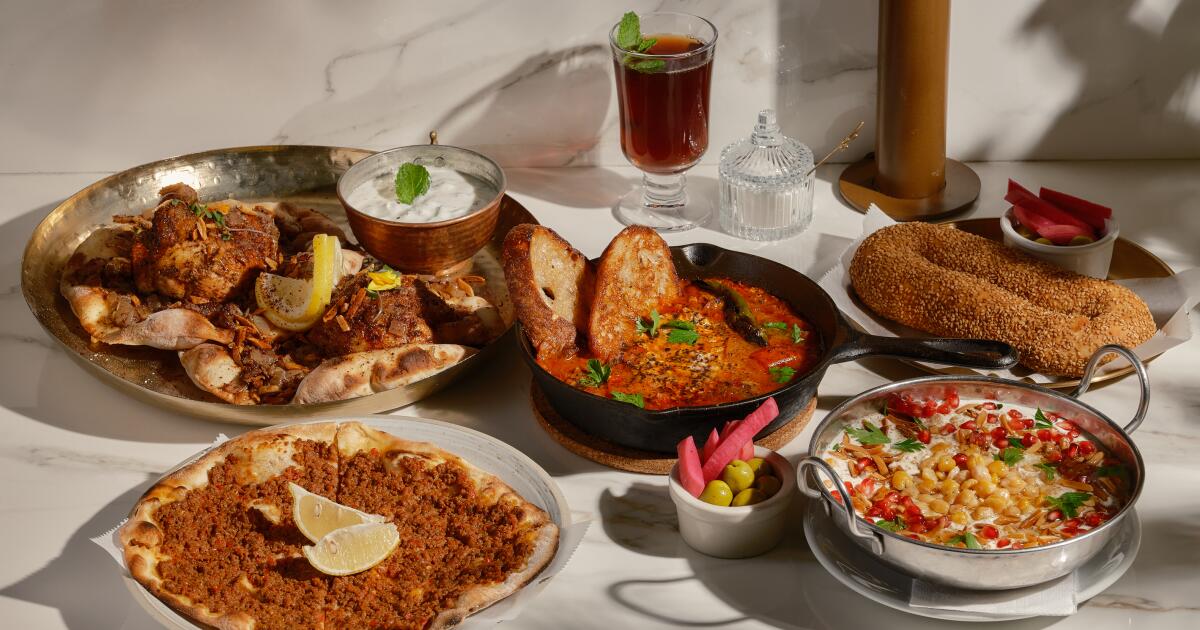
Here are eight halal restaurants to break fast and share a meal with loved ones during Ramadan.
With summer temperatures and clear skies this weekend, it’s hard to believe that just weeks ago, the city was hit with a week of heavy rainstorms. Several restaurants across the region were forced to temporarily close due to flooding, resulting in revenue loss and expensive repairs.
March brings the start of spring, which means we’re already seeing seasonal produce such as asparagus, peas and apricots appear on our favorite menus. Keep reading for more dining ideas this month, including the return of a globe-trotting cafe, a community-minded food hub in South L.A. and an Argentinian bistro with a connection to Bad Bunny’s Super Bowl performance.
After two years of a grinding war, Palestinians in the Gaza Strip are observing the holy month of Ramadan during an unabating economic catastrophe as Israel continues to impose restrictions on the entry of food and other supplies despite a “ceasefire” reached in October.
For most families, the daily struggle to secure a mere loaf of bread has replaced the traditional festive atmosphere before the war. An analysis by Al Jazeera, based on official data, reveals that skyrocketing prices for basic commodities have made a complete iftar meal to break the daily fast a distant dream for the vast majority of the population.
Skyrocketing costs
During periods when Israel tightened its siege or completely closed the crossings into Gaza, food prices spiked by more than 700 percent. While prices have retreated slightly since the “ceasefire” began in October, they remain significantly higher than pre-war levels.
According to Mohammed Barbakh, director general of policy and planning at the Ministry of Economy in Gaza, official data tracking prices from before the war began on October 7, 2023, to the first days of this Ramadan show staggering increases.
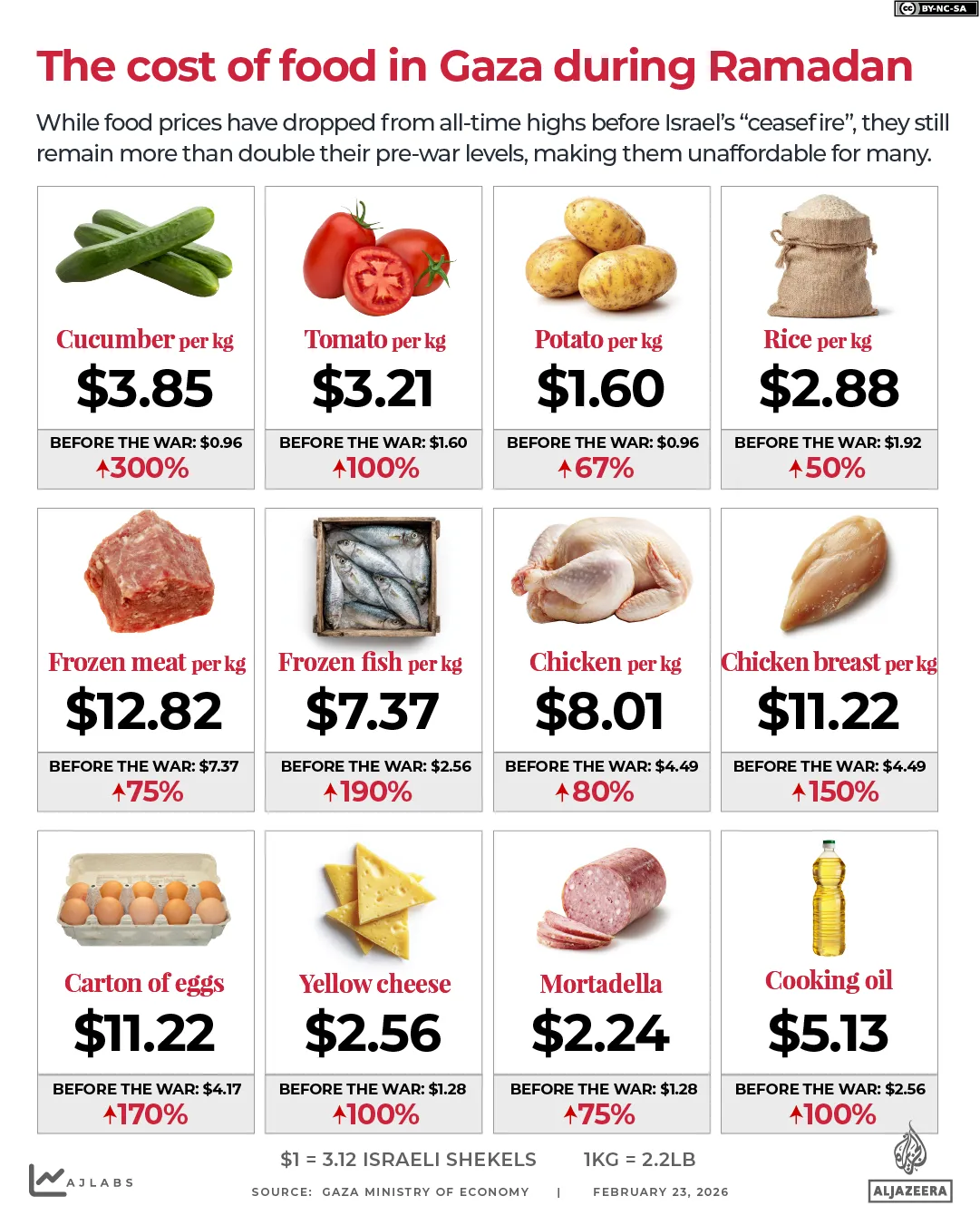
Al Jazeera’s analysis of the ministry’s price data reveals the following hikes:
Chicken: Prices rose from 14 shekels ($4.49) to 25 shekels ($8.01) per kilogramme (2.2lb), an 80 percent increase.
Frozen fish: Prices jumped from 8 shekels ($2.56) to 23 shekels ($7.37) per kilo, a 190 percent increase.
Frozen red meat: Prices rose from 23 shekels ($7.37) to 40 shekels ($12.82) per kilo, a 75 percent difference.
Eggs: A tray of 30 eggs now costs 35 shekels ($11.22) compared with 13 shekels ($4.17), a 170 percent increase.
Vegetables, a staple of the Palestinian diet, have also seen dramatic surges. Tomatoes have doubled in price while cucumbers have jumped by 300 percent, rising from 3 shekels ($0.96) per kilo to 12 shekels ($3.85). Cheese prices have increased by up to 110 percent, directly impacting the cost of suhoor, the predawn meal before the daily fasting during Ramadan begins.
(Al Jazeera)
The cost of a meal
Based on data from the Palestinian Central Bureau of Statistics, Al Jazeera estimated the cost of a basic iftar for a family of six. The meal includes two chickens, rice, salad, appetisers, a soft drink, cooking gas and oil.
The price of the meal has risen to about 150 shekels ($48), up from 79 shekels ($25.32) before the war, an increase of 90 percent.
For suhoor, a simple meal of cheese, hummus, falafel and bread now costs 31.5 shekels ($10.10), compared with 18.6 shekels ($5.96) previously.
The combined daily cost to feed a medium-sized family now stands at 181.5 shekels ($58.17), an 88 percent jump from pre-war figures.
Economic obliteration
These price hikes coincide with a collapse in purchasing power. A United Nations report released in late 2025 indicated that the annual per capita income in Gaza plummeted to $161 (503 shekels) in 2024, down from $1,250 (3,900 shekels) in 2022.
The labour market has essentially vanished. In a statement issued in October, Sami al-Amsi, head of the General Federation of Palestinian Trade Unions, said unemployment stood then at more than 95 percent as workshops, farmland and fishing fleets were destroyed.
“The worker is no longer looking for a job because there is no work at all,” al-Amsi said. “Today, the Palestinian worker is looking for a food parcel to survive.”
Blockade and monopoly
Economic researcher Ahmed Abu Qamar attributed the inflation to Israel’s restrictive entry policies and “coordination fees” imposed on trucks.
“The humanitarian protocol stipulates the entry of 600 trucks daily, yet the Israeli occupation effectively allows only between 200 and 250 trucks,” Abu Qamar told Al Jazeera, noting that the Strip actually requires 1,000 trucks daily to meet minimum demand.
He also highlighted a monopoly system under which only about 10 merchants are authorised to import goods through four Israeli companies, restricting competition and keeping prices artificially high. He called for a return to a free market system and the full opening of crossings to alleviate the burden on a population already crushed by conflict.
The dawn-to-dusk fast lasts anywhere from 11.5 to 15.5 hours, depending on where in the world you are.
Published On 15 Feb 202615 Feb 2026
Share
The Muslim holy month of Ramadan is set to begin on February 18 or 19, depending on the sighting of the crescent moon.
During the month, which lasts 29 or 30 days, Muslims observing the fast will refrain from eating and drinking from dawn to dusk, typically for a period of 12 to 15 hours, depending on their location.
Muslims believe Ramadan is the month when the first verses of the Quran were revealed to the Prophet Muhammad more than 1,400 years ago.
The fast entails abstinence from eating, drinking, smoking and sexual relations during daylight hours to achieve greater “taqwa”, or consciousness of God.
Why does Ramadan start on different dates every year?
Ramadan begins 10 to 12 days earlier each year. This is because the Islamic calendar is based on the lunar Hijri calendar, with months that are 29 or 30 days long.
For nearly 90 percent of the world’s population living in the Northern Hemisphere, the number of fasting hours will be a bit shorter this year and will continue to decrease until 2031, when Ramadan will encompass the winter solstice, the shortest day of the year.
For fasting Muslims living south of the equator, the number of fasting hours will be longer than last year.
Because the lunar year is shorter than the solar year by 11 days, Ramadan will be observed twice in the year 2030 – first beginning on January 5 and then starting on December 26.
(Al Jazeera)
Fasting hours around the world
The number of daylight hours varies across the world.
Since it is winter in the Northern Hemisphere, this Ramadan, people living there will have the shortest fasts, lasting about 12 to 13 hours on the first day, with the duration increasing throughout the month.
People in southern countries like Chile, New Zealand, and South Africa will have the longest fasts, lasting about 14 to 15 hours on the first day. However, the number of fasting hours will decrease throughout the month.
(Al Jazeera)
Fasting times around the world
The table below shows the number of fasting hours, suhoor and iftar times on the first and last days of Ramadan 2026. Use the arrows or search box to find your city.
Ramadan greetings in different languages
Muslim-majority nations have various greetings in their native languages for Ramadan.
“Ramadan Mubarak” and “Ramadan Kareem” are the most common greetings exchanged in this period, wishing the recipient a blessed or generous month, respectively.