Borno Closed Its Largest IDP Camp Outside Maiduguri. But Did Displacement Really End?
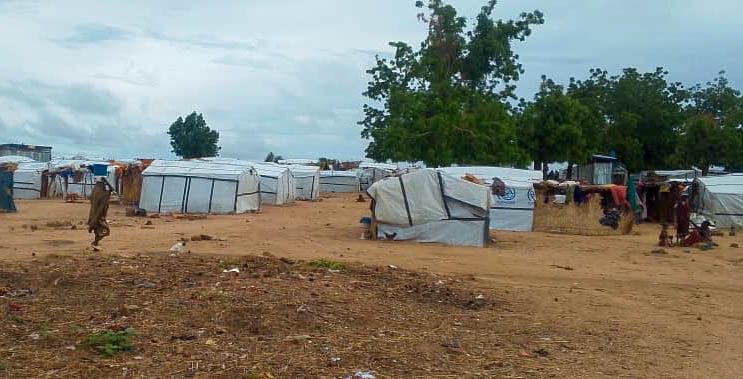
Chellu Masaram’s shelter stands on a patch of land in Goniri, a community a few kilometres from Bama town in northeastern Nigeria.
At 85, she does not have the strength to build a house. So when she and her grandchildren arrived after the closure of the Government Senior Science Secondary School (GSSS) camp in Bama, one of the largest displacement settlements in Borno State outside Maiduguri, they used the only materials they had.
“We still do not have a room,” Chellu told HumAngle. “We made a room out of the tarpaulin we brought from the camp. The room leaks when it rains.”
For more than a decade, displacement has shaped her life. She fled Sabsabwa, a town in Bama, in 2014 when Boko Haram terrorists attacked the community and killed her son. Since then, she has raised his three children alone: a year at the Bama General Hospital camp, then ten years at GSSS.
Now she is displaced again.
On June 25, Borno State announced the closure of the GSSS camp as part of its broader policy of ending camp-based displacement and resettling people to their communities of origin or nearby settlements. The announcement was made by Dauda Iliya, spokesperson to Governor Babagana Umara Zulum. The exercise was described as the relocation of about 3,000 households to settlements including Abbaram, Darajamal, Mainti, and Goniri, though the actual number of individuals moved remains unclear. Authorities also indicated that the displacement camp in Gwoza could be among the next to close.
The numbers associated with the GSSS camp have varied considerably over the years. In 2023, the camp’s own management estimated it was hosting more than 100,000 people, four times its designed capacity of 25,000. Government statements on the recent closure referenced approximately 3,000 households being relocated to surrounding communities. But that figure came with its own complications. During the closure announcement, Governor Zulum noted that a year earlier the camp had held no more than 400 households, and expressed surprise that the number had risen to 3,000 shortly before closure. “Most of them are residents living within the town,” he said, suggesting that a significant share of those counted at the end were not long-term displaced persons but local residents who had re-entered the camp, most likely to access aid distributions. If that is accurate, the 3,000 figure may overstate the number of people who were genuinely in need of resettlement support, while simultaneously obscuring how many actual long-term IDPs were moved and to where. Humanitarian and official figures detailing the exact number of individuals relocated have not been publicly released.
HumAngle wrote to the Borno State Emergency Management Agency (BOSEMA) seeking clarification on the number of households and individuals relocated, the preparedness of receiving communities, and plans for future camp closures. The agency had not responded by the time of publication.
What is emerging from Goniri and other receiving communities is a more complicated picture than the language of “camp closure” suggests. For some families, displacement may not have ended. It may simply have changed location.

From Camp Residents to Makeshift Settlers
Chellu and her grandchildren left the camp in the evening, a truck transporting their belongings. “We paid ₦7,000,” she said.
The move brought them to Goniri, one of the communities receiving former camp residents. The grandchildren she cares for are now 17, 15, and 12 years old. None attend formal school. The oldest studies at a Tsangaya school in Bama and returns there to sleep each night. The two girls remain with their grandmother.
The family survives through a combination of small trading and firewood collection. Chellu sells groundnuts when she can. The more demanding work falls to her granddaughters. “The girls go to the bush to gather firewood to sell,” she said. According to her, they spend up to three hours walking into surrounding bush areas before returning with wood that earns around ₦2,000 daily. “This is what we depend on majorly.”

The arrangement is not unusual. Across displacement settings in Borno and the wider North East, firewood collection has become one of the primary survival strategies available to women and girls. In 2020, HumAngle reported how this burden traps women in a cycle of poverty that limits access to education and economic opportunity while increasing exposure to violence.
For Chellu’s granddaughters, the hours in the bush are not a choice. They are an economic necessity shaped by the inadequacy of humanitarian support and the absence of alternative livelihoods. But in Borno, those hours carry a risk that goes beyond physical exhaustion.
Firewood collection in conflict-affected parts of the northeast has long been documented as a moment of acute danger for women and girls. A 2018 World Food Programme survey found that 85 per cent of women in four local government areas of Borno feared rape, murder, or abduction while collecting firewood. UNHCR protection monitoring reports have recorded incidents of rape during firewood collection, alongside the persistent threat of abduction by terrorists. In March 2024, more than 200 internally displaced women were abducted in Ngala, Gamboru Ngala LGA, while collecting firewood in the bush around Jillam and Wurga villages, approximately 15 kilometres from town. Older women and children under 10 were reportedly released; scores of others remained unaccounted for. In August 2023, at least 42 women were abducted by suspected Boko Haram terrorists while gathering firewood in Mafa. This often forces relatives in camps to crowdsource ransom.
In Goniri, Chellu’s granddaughters are navigating that same risk. They go anyway, because the family has to eat.

The broader consequences of this dependence extend beyond the households bearing it.
As hundreds of families like Chellu’s converge on Goniri and surrounding communities, demand for firewood is rising sharply in an environment already under significant ecological pressure. The Lake Chad Basin, of which Borno is a part, has experienced accelerating deforestation driven by displacement, conflict, and climate stress. A study examining the impact of internally displaced persons on forest cover in Jere LGA found that displaced populations destroyed approximately 12 square kilometres of forest and vegetation. Research on the Lake Chad Basin has found that competition between displaced populations and host communities for firewood is driving deforestation and natural resource degradation, reducing the resilience of both groups. Governor Babagana Zulum has acknowledged that displacement-linked deforestation in Borno is contributing to soil erosion, reduced water availability, and increased vulnerability to climate change.
“It was not like this at the camp,” Chellu said.
Food worries now dominate her thoughts. She said she recently cried because she did not know how she would provide enough. For water and medical care, she and the children walk to Bama, a journey she estimates at over an hour on foot. “As old as I am, I must trek with the children for at least an hour daily,” she said. The move has also introduced tensions with neighbours. A nearby resident has repeatedly told her family they are not welcome. “He said he does not want us beside him,” she said. She says the man has attempted to physically attack her and her granddaughters on multiple occasions, and that complaints to local leaders have produced no resolution.
“I wish the government would intervene.”
The uncertainty surrounding shelter, water, food, and social acceptance has left her wondering what exactly changed when the camp closed. For a woman who has spent 11 years moving between displacement sites, the answer is not obvious.
The shelter gap in Goniri
The Borno State government has long argued that prolonged camp life is not a sustainable solution. Camp closures form part of a broader strategy aimed at restoring communities, reducing dependency on humanitarian assistance, and facilitating recovery from years of insurgency. But interviews with former camp residents in Goniri suggest the transition has been uneven.
Abubakar Mohammed, 36, arrived in Goniri after years in displacement. He first fled Alagarno in Damboa Local Government Area when insurgent attacks devastated the community, spent three months at the Bama General Hospital camp, and then moved to the GSSS camp, where he remained for several years. Like many residents, he said the relocation came with little explanation. “We were asked to relocate two weeks ago,” he told HumAngle on July 7. “We were not given any reason.”

Before departure, he received a token card later exchanged for a document used during aid distribution. The government distributed ₦30,000 to each household that held a token, along with 25-kilogram bags of rice and maize flour. “Only those who had tokens got the money,” he said. Even so, the assistance did not resolve the housing challenge. “The government constructed some shelters before asking us to relocate,” he acknowledged. “But it is not sufficient.” He now lives in a makeshift tarpaulin shelter on land temporarily provided by community heads. “The Aja [District Head] said, ‘You may live here pending when you find your own place,’” he recalled. His wife and children share the structure with him; his mother and three sisters are staying elsewhere in Goniri with a friend. Many other households have improvised similar arrangements, renting accommodation or relying on relatives. Some remain more exposed. “Other people could not even afford to set up shelters,” he said. “They sleep in the open.”

The experience of Babagana Ali, 38, illustrates how unevenly the same process was administered.
His displacement history spans multiple locations. He first fled Warafaya in 2017 and settled in Kumshe, both in Bama; in 2022, violence displaced him again, eventually bringing him to Bama town and the GSSS camp. When officials announced the closure, residents received approximately one week’s notice. “They came on a Thursday and gave us a week’s notice,” he said. Unlike Abubakar, Babagana never received a ration card. He was working on his farm when distributions took place and as a result received none of the food items, zinc sheets, or money given to other households. Without money for a truck, he rented a pushcart for ₦1,500 and made two trips to move his belongings. Today, he shares a single tarpaulin shelter with two wives, six children, and four children belonging to his late brother. When it rains, water enters through the roof.
His experience points to a concern emerging across interviews: the closure of the camp may have reduced the visibility of displacement without resolving the housing deficit it created.
Earlier, humanitarian actors have made appeals for emergency shelter interventions in Goniri and Abbaram following the influx of relocated households. Those appeals suggest that aid agencies themselves recognised accommodation gaps after the movement began. This pattern is not new to Borno’s camp closure process. A 2022 Human Rights Watch report documenting earlier rounds of camp closures found that housing, water, healthcare, schools, and other infrastructure necessary to meet basic needs were lacking in many receiving communities, and that the closures had stripped over 200,000 displaced people of food and shelter without adequate alternatives.
Residents gave varying estimates of how many people have arrived in Goniri since the closure. Chellu believed there could be about 3,000 people in the settlement; Abubakar estimated as many as 6,000, with roughly half lacking adequate shelter. HumAngle could not independently verify these figures, but both accounts point to the same reality: Goniri’s population has grown rapidly, and the question is whether the community has the infrastructure to absorb it.
Life beyond the camp
For government officials, the success of relocation will ultimately depend on what happens after families arrive. Housing is only one part of that equation. Access to livelihoods, water, healthcare, sanitation, education, and social acceptance all determine whether a relocation becomes sustainable. In Goniri, many of those systems remain under pressure.
Water emerged repeatedly during HumAngle’s reporting. Chellu, Abubakar, and Babagana all described the same daily routine: a walk to Bama that can take up to an hour. OCHA’s 2025 Humanitarian Needs and Response Plan identifies overcrowding in camps and receiving settlements, alongside lack of access to clean water and sanitation, as conditions that have worsened as a direct result of IDP movements linked to camp closures in Borno. Healthcare follows the same route as water. Abubakar estimated transportation costs at about ₦300 per trip, a burden that falls hardest on older residents, pregnant women, and households without steady income.
Sanitation presents another strain. Babagana said the communal latrines built for an earlier displaced population are now being shared by hundreds of newly arrived households. “There are insufficient toilets,” he said. “We have to queue. It is also dirty.” He estimated that only five fenced latrines serve the settlement.

Livelihoods present a different challenge. Before the closure, many residents relied on a combination of humanitarian support and informal income. Outside the camp, they face greater pressure to generate income independently. Abubakar is a farmer by training, but insecurity has limited access to agricultural land this season. “I now do menial jobs,” he said, earning around ₦3,000 on a good day. Babagana manages similarly. “Anything that my strength can do,” he said, with income averaging around ₦2,000 daily. Neither considers it sufficient for households of their size.
For children, the transition raises additional concerns. None of Chellu’s grandchildren attends formal school. Their days revolve around religious education and income-generating activities, the girls spending long hours collecting firewood that contributes directly to household survival. They are not alone in this. UNICEF estimates that 56 per cent of displaced children across Borno, Adamawa, and Yobe states do not attend school, with roughly two million children out of school across the three states. The situation in Goniri illustrates how economic hardship reshapes childhood after displacement, turning survival into a full-time occupation.
Social integration remains unresolved. While some host community members have provided land and accommodation, not all relationships appear harmonious. Abubakar said some residents blame the displaced for ongoing insecurity. “They say we caused the ongoing insecurity,” he said. Such perceptions breed friction in communities already stretched by scarce resources and years of conflict.
A state moving toward more closures
The debate over Bama is likely to intensify as the camp in Gwoza is expected to be the next major closure.
Many residents of Borno also want to leave camps behind. After years of displacement, the idea of living in a community rather than a crowded camp carries real emotional weight.
“I expected the government to wait for peace before asking us to relocate,” he said.
That concern reflects a broader uncertainty in Bama and surrounding areas. Several communities continue to experience insecurity, farming restrictions, and periodic displacement linked to insurgent activity and military operations. Earlier in 2024, OCHA conducted area-based assessments of both the GSSS camp in Bama and the camp in Gwoza, both of which document the fragility of receiving communities and the scale of unresolved displacement needs. Sabsabwa, from which Chellu was displaced in 2014, experienced renewed disruptions in late 2022 and 2025. Warafaya, where Babagana once lived, was emptied by violence years ago. Alagarno, Abubakar’s hometown, was devastated by insurgent attacks. For many families, displacement has not been a single event but a series of movements from one place to another.
Without clear data from BOSEMA, several questions remain unanswered. How many people were actually moved from the camp? How many houses were completed before the relocation? How many households are still living under tarpaulins or in the open? What support is planned for communities such as Goniri and Abbaram as their populations grow? Those questions matter not only for Bama but for every future camp closure in Borno.

As evening approaches in Goniri, Chellu’s grandson leaves for the Tsangaya school where he sleeps, her granddaughters prepare for another trip into the bush to gather firewood, and the tarpaulin roof remains patched against the next rain.