identification

Despite Trump’s insistence, in-person voting does exist in Los Angeles

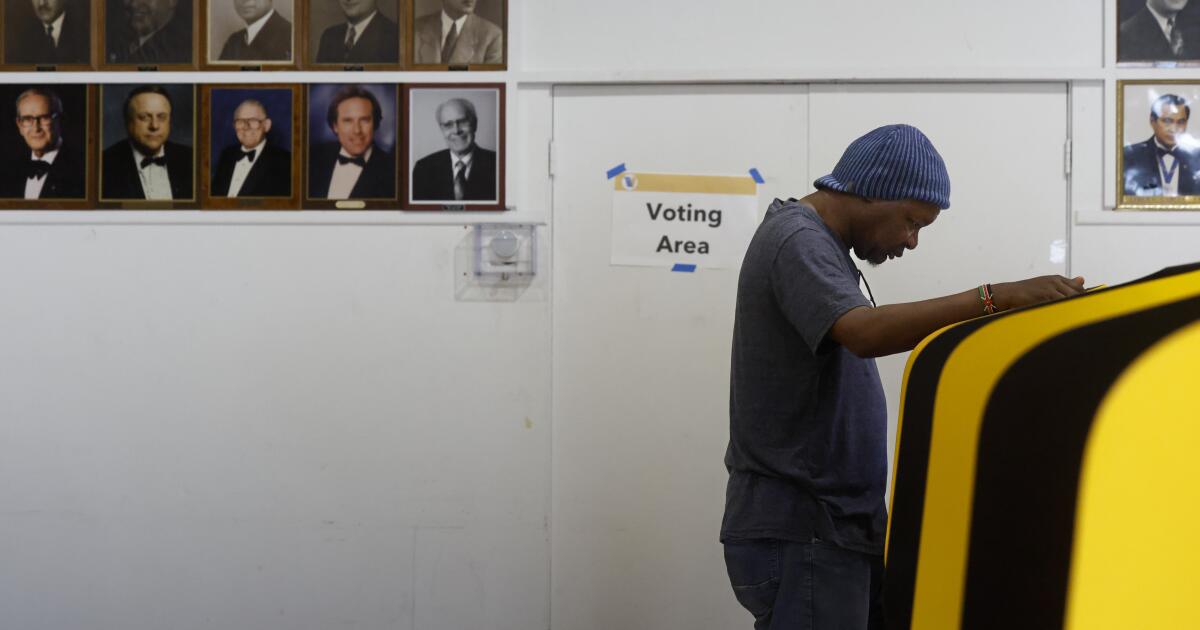
Yes, voting centers will be open across Los Angeles this week. And no, you don’t have to cast your ballot by mail.

With days left before the June 2 primary, President Trump made a round of misleading claims about the electoral process, this time falsely suggesting that the city was holding elections only by mail.

Trump’s comments came Saturday during an appearance on Fox News when he was asked by host Lara Trump — the president’s daughter-in-law — about his predictions for the upcoming primary.

“You know, they don’t have voting booths; everything’s by mail,” Trump responded. “I don’t think a Republican can win in California unless you pass the Save America Act — then they’re gonna have to show proof of citizenship, they’re going to have to get rid of mail-in voting.”

The L.A. County registrar-recorder moved to set the record straight in a tweet posted Sunday morning that read “MISINFORMATION ALERT.”

Noting that in-person voting was in fact allowed, the agency announced that it had 646 vote centers across the county — each with multiple voting booths. The centers will be open from 10 a.m. to 7 p.m. on Monday and Tuesday, the agency said in the posting, while tagging Fox News and the White House.

A map of polling locations featured on the agency’s website shows that there are dozens of voter centers available countywide. Mobile vote centers also were made available at various sites in the county. Mobile voting runs for the 10 days before election day and will not be available on June 2, according to the county registrar-recorder.

As of Friday morning, 333,000 mail-in votes had been cast in the June 2 primary for Los Angeles mayor, city attorney, city controller and eight of the 15 City Council seats. This was up from 321,000 at the same time in 2022, according to registrar-recorder.

Registered voters already should have received a ballot in the mail. Those who choose to vote in person can take their mail-in ballot to a vote center and ask to vote in person instead. Residents who haven’t yet registered to vote can still do so by requesting a conditional voter registration application at any voter center and filling out their ballot as they normally would.

Recent polling suggests that, ahead of Tuesday’s primary, incumbent Los Angeles Mayor Karen Bass has what pollsters deem a statistically insignificant lead in her bid for reelection as the city’s top executive. Bass is locked in a tight race with councilmember and former ally Nithya Raman and Spencer Pratt.

Trump has signaled his support for Pratt but hasn’t formally endorsed the former reality TV star and registered Republican. Former Trump advisor Steve Bannon said the president hadn’t done so out of the fear it would hurt Pratt’s chances in Democrat-dominant Los Angeles.

In 2020, during the outbreak of the COVID-19 pandemic, Gov. Gavin Newsom took the unprecedented step of issuing a statewide order for voting by mail for that year’s election in what he described as a necessary step to limit the virus’ spread.

A handful of rural counties had no in-person voting locations that March.

In 1979, the state eliminated the need for an excuse to receive an absentee ballot, and an option to choose permanent absentee voting was created in 2002. In the decades since, Californians have embraced the flexibility that voting away from a polling place offers. In nearly every statewide election since 2008, the majority of votes have not been cast at a traditional polling place.

Fourteen more counties — including Orange, Sacramento and Santa Clara — have adopted the state Voter’s Choice Act, an optional state law that requires them to mail every voter a ballot and to replace traditional neighborhood polling places with multipurpose vote centers. Those in-person locations offer multiple election services for up to 10 days before election day.

Los Angeles, the 15th county to adopt the new state law, was initially given special permission by the Legislature to implement it without mailing every voter a ballot.

Trump has for years repeated baseless claims that the 2020 election was stolen and that undocumented immigrants were swaying elections by voting illegally.

In light of these claims, Trump and some Republicans have pushed for new restrictions on voters. A federal proposal known as the Save America Act — which would require Americans to prove they are U.S. citizens before they register to vote and to show identification at the polls, among other things — cleared the U.S. House but stalled out in the Senate.

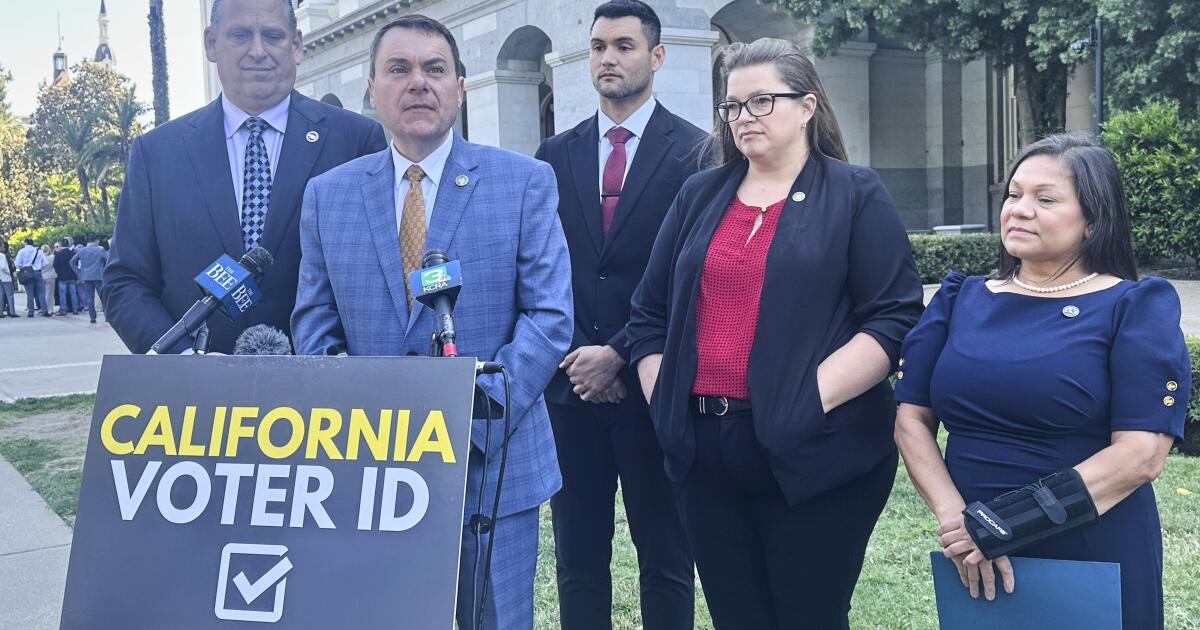
In November, California voters will weigh in on a similarly contentious ballot measure pushed by Republicans that would require all voters in future elections to show identification every time they vote in person or provide a special PIN when submitting mail-in ballots.

Under current state law, Californians are required to provide identification when registering to vote and must swear under penalty of perjury, a felony, that they are eligible to vote and are U.S. citizens. They are not required to show or provide identification when casting a ballot in person or by mail.

If passed, the California ballot measure would require voters to present government-issued identification, such as a state driver’s license, every time they vote. Voters mailing ballots would be required to write a four-digit number, essentially a PIN, on their ballot envelopes matching the one generated when they registered to vote.

Critics of California’s voter ID initiative, including many legal scholars, say the ballot measure addresses a problem that does not exist.

In May, a federal judge handed Trump a victory by declining to halt the president’s executive order creating a federal list of eligible voters and then directed the U.S. Postal Service to deliver mail ballots only to those on the list. Observers say the decision opens the door for potential sweeping changes in how American elections are run shortly before this year’s midterm elections.

The Associated Press contributed to this report.

Source link

Assemblymember Carl DeMaio’s ballot measure will be considered by voters in November

A ballot measure that would require Californians to show identification every time they vote in person, or use a special pin number when submitting mail-in ballots, has qualified for the November ballot, elections officials announced Friday.

The measure also would require election officials to verify registered voters are U.S. citizens, aligning with a Republican-led push for new restrictions on voters in the wake of President Trump’s baseless claims that the 2020 election was stolen from him, and that undocumented immigrants are swaying elections by voting illegally.

Republican Assemblymember Carl DeMaio from San Diego has been pushing the measure for several years, while Trump and Republicans also are seeking a similar initiative at the federal level.

If passed, the California ballot measure would require a voter to present government-issued identification, such as a state driver’s license, every time they vote. Voters mailing ballots would be required to write a four-digit number, essentially a pin number, on their ballots matching the one generated when they registered to vote.

The pin would come from ID such as a driver’s license, or could be generated from the county. The vast majority of Californians mail in their ballots in elections.

Under the measure, election officials also must ensure that registered voters are U.S. citizens by using information from government records, which could include information in the federal Social Security Administration database, and maintain accurate voter registration lists.

DeMaio said the measure is different than a federal proposal, known as the SAVE Act, which stalled out in the U.S. Senate this week.

DeMaio said the state ballot measure “does not do away with mail in ballots, because voters of all political backgrounds like the convenience of mail in ballots. So we want to keep that convenience.”

The ballot measure needs a simple majority to pass.

Under current law, Californians are not required to show or provide identification when casting a ballot in person or by mail. They are required to provide identification when registering to vote, and must swear under penalty of perjury, a felony, that they are eligible to vote and a U.S. citizen.

Jenny Farrell, executive director of the League of Women Voters of California, told the Times that her group is committed to fighting the measure, arguing it would make it harder for people in the state to vote.

She said that people may forget to use a pin on their mail-in ballot, leading to their vote being disqualified. Similar changes in Texas, she said, led to a rise in rejected ballots due to technical errors.

“It doesn’t really weed out illegal voting,” which doesn’t actually exist, she said, “but it does cause more ballots to be incorrectly flagged and ultimately rejected.”

ACLU of Northern and Southern California, Common Cause, Disability Rights California also oppose the measure.

DeMaio filed for the ballot initiative in 2021 and 2023, but did not move forward with the signature collection process in order to fine-tune the ballot language.

He said his ballot measure wasn’t focused primarily about making sure that undocumented people don’t vote.

“That’s one element of concern that we’ve heard from some groups, but it really is making sure that, number one, we properly maintain our voter rolls,” he said.

Source link