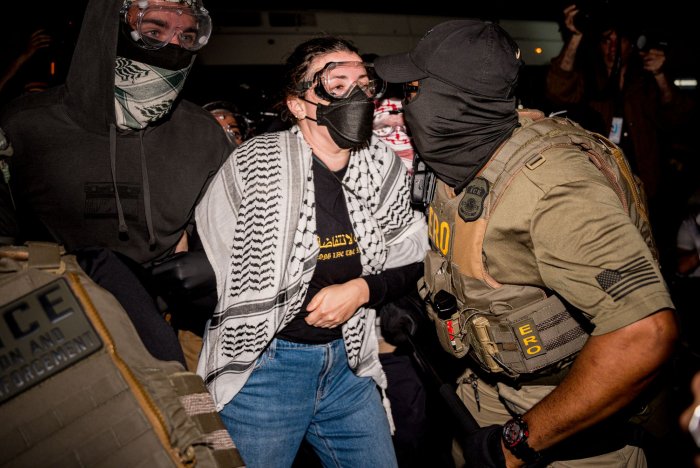
A Native American lawyer confronts ICE as he channels generational resistance into a fight for justice in the US.
Chase Iron Eyes drops everything following Renee Good’s killing by ICE to join protests on the streets of Minneapolis. Chase, a resident of the Pine Ridge reservation, is a lawyer whose life and work are shaped by generations of Native American resistance.
With 3,000 federal agents deployed to the Minneapolis-Saint Paul area as part of Operation Metro Surge, Chase sees the impact of the crackdown for himself. When ICE begins targeting Native Americans in Minnesota, he works to move street-level resistance into the courtroom.
Chase, alongside other human rights lawyers, mounts a legal challenge and pursues class-action lawsuits against ICE and the Department of Homeland Security.
Native Americans Resisting ICE is a documentary film by Joi Lee and Ed Ou.
WASHINGTON — Immigration and Customs Enforcement arrested 10,000 people over a five-day period at the end of June, marking a major push by the agency tasked with carrying out the Trump administration’s mass deportations agenda.
The arrest numbers, obtained from a person familiar with the information who spoke anonymously to discuss data that has not been publicly released, comes after the agency shifted its approach from high-profile arrest sweeps in major American cities to quieter ways to reach President Trump’s deportation goals.
The figures indicate that while the administration is no longer cracking down on individual cities, the arrests continue and are surging.
The total number of arrests during the five-day period starting Friday and ending Tuesday translates to roughly 2,000 arrests per day. It was not clear where the arrests had taken place.
The spike in arrests was first reported by The New York Times.
“Since Day One, DHS law enforcement has been delivering on President Trump’s promise to the American people to arrest and deport criminal illegal aliens including murderers, rapists, pedophiles, gang members, and terrorists,” said the Department of Homeland Security in a statement. “Our message is clear: if you come to our country illegally, we will find you, we will arrest you, and we will deport you.”
The arrests news also comes as the number of people entered into ICE detention facilities climbed in June to roughly 39,000 after hovering near 30,000 per month since February, according to information obtained by the Associated Press.
ICE doesn’t publicly release arrest data, making exact comparisons with previous periods difficult. But according to data provided to UC Berkeley’s Deportation Data Project and analyzed by The Associated Press, 2,000 arrests per day would mark a sharp increase over previous periods.
December had the most ICE arrests since the beginning of the Trump administration, and that month only averaged 1,283 arrests per day nationwide.
In January, at a time when the administration flooded the streets of Minneapolis and surrounding regions with hundreds of immigration enforcement officers, arrests averaged about 1,212 per day across the country.
But that proved to be a turning point in the Trump administration’s mass deportations agenda after two American citizens were killed by immigration officers while protesting the crackdown in Minneapolis.
Border advisor Tom Homan started drawing down the number of officers in Minnesota as the agency stepped back from the flashy surge operations that had been common during the tenure of then-Homeland Security Secretary Kristi Noem.
Operations under Noem, headed by former Border Patrol Chief Gregory Bovino, were marked by frequent clashes between immigration enforcement officers and protesters in footage that was often splashed across the Department’s social media channels.
In February, immigration arrests fell to 1,057 a day, according to information from the Deportation Data Project. The Project sued through the Freedom of Information Act to obtain the ICE arrests data, and it is only current through February.
After Noem was fired, her successor at Homeland Security, Markwayne Mullin, suggested he’d be taking a more low-profile approach to immigration enforcement and he aimed to get the department out of the headlines. But Mullin was expected to adopt Trump’s priorities on immigration.
Former NFL running back Chris Johnson has issued a challenge to his family, friends and fans — one that could quite literally send a chill down the spine of those who remember a certain viral trend from more than a decade ago.
A quick refresher: A social media sensation went viral in 2014, involving people posting videos of themselves having a bucket of ice water poured over their heads and challenging others, by name, to do the same.
The trend was often referred to as the ALS Ice Bucket Challenge because many folks used the videos to raise awareness for and funding to help fight the degenerative neurological disorder amyotrophic lateral sclerosis, commonly known as ALS or Lou Gehrig’s disease.
Johnson, a three-time Pro Bowl selection who holds the NFL record for most yards from scrimmage in a single season, on Tuesday revealed on “Good Morning America” that he has been diagnosed with ALS. Soon after, former Utah basketball player and sports content creator Hunter Mecum posted a video on Instagram in which he dumped a large bowl of ice water on himself in Johnson’s honor.
That video inspired Johnson to bring the movement back.
“Man… the love y’all have shown me these last few days really [means] more than you know. Me and my family appreciate every prayer, message and every bit of support,” Johnson wrote on Wednesday on Instagram.
“After seeing @huntermecum video, I’m asking y’all to help me with something. Let’s bring back the ALS Ice Bucket Challenge. Grab a bucket, challenge 3 people and if you can, donate to help fund ALS research.”
Johnson included a link in his bio to a fundraiser for ALS research set up in his honor. As of Thursday morning, it had raised more than $32,000.
The retired player known as CJ2K also called on three people to accept the ice bucket challenge — ex-Tennessee Titans teammate LenDale White and fellow former NFL greats Marshawn Lynch and Adam “Pacman” Jones.
So far, White and Lynch have accepted Johnson’s challenge. Lynch, the former star running back for the Seattle Seahawks and Oakland Raiders, obliged by getting hailed on by a bucket of ice.
White, who was Johnson’s “Smash and Dash” counterpart in the Titans backfield, took the traditional ice water route and nominated former NFL players Deion Sanders, Vince Young and Michael Sims-Walker, who was on hand at the time and accepted the challenge in a separate video.
Johnson also posted a video of his daughter Honey Love taking the challenge, with White handling the ice-bucket duty. She nominated her brothers and former Lakers superstar LeBron James.
James hasn’t yet responded, but he was one of the many celebrities who took part in the original challenge 12 years ago. Others included Kobe Bryant (who submerged himself in an ice tub), Shaquille O’Neal (who humorously poured one drop of water on his head) and Donald Trump (who joked he was nominated because “they want to see whether or not it’s my real hair, which it is”).
US prosecutors have alleged those involved in the Prairieland Detention Center protest were linked to antifa.
Seven more people have been sentenced to prison over a protest that culminated in a police officer being shot outside an immigration detention centre last year.
A federal court in Fort Worth handed down the latest sentences on Wednesday. Critics, however, say the case could reshape how protest is prosecuted in the United States.
Recommended Stories
list of 4 itemsend of list
The case centres on a shooting outside the Prairieland Detention Center, near Dallas, Texas, that took place during an antigovernment protest.
Six of the defendants in Wednesday’s sentencing hearing had pleaded guilty to providing material support to “terrorism” and received prison terms ranging from nearly two to 15 years.
A seventh defendant, Ines Soto, was sentenced to 50 years in prison after being convicted of “providing material support to terrorists”, as well as charges related to rioting and conspiracy to carry an explosive.
The protest in question took place on the night of July 4, 2025. Activists had gathered outside Prairieland to denounce President Donald Trump’s push for mass deportation. Some set off fireworks. Others have been accused of vandalism.
Prosecutors said that, during the demonstration, former US Marine reservist Benjamin Song shot and wounded a police officer who had just arrived at the centre. Song had reportedly shouted, “Get out the rifles,” prior to opening fire.
The Trump administration has described the protest as an act of “terrorism”, and 19 people were ultimately arrested.
Some of those detained were not present at the Prairieland protest. But the Trump administration has designated antifa — a loose-knit, left-wing antifascist movement — as a “domestic terrorist organisation”, and it accused the protest’s supporters of being part of an “antifa cell”.
Prosecutors for the US Department of Justice also argued that bringing firearms, first aid kits and body armour to the protest showed nefarious intent.
“The sentences handed down today make clear that Antifa terrorists who attack law enforcement and federal facilities will face swift and uncompromising justice,” acting Attorney General Todd Blanche said in a statement last week.
But civil liberties advocates say the case could have broad implications for protesters nationwide.
It will also likely test the boundaries of the free speech rights protected under the First Amendment of the US Constitution.
The Justice Department touted last week’s initial round of sentencing as the first time alleged antifa members were sentenced on criminal charges since Trump issued his executive order designating the group a “domestic terrorist” body.
Lawyers for the defendants, however, have largely denied links to antifa and rejected the prosecution’s characterisation of the protest.
They argued there was no planned ambush and that those carrying firearms only did so for their own protection, as is allowed under the Constitution’s Second Amendment. The fireworks, they added, were meant as a show of support for immigrants detained inside Prairieland.
On June 23, the eight defendants who chose to stand trial were handed lengthy prison terms.
Song was sentenced to 100 years in prison after being convicted of attempted murder in the shooting. The seven others received sentences ranging from 30 to 70 years. They received a combined 450 years in prison.
One defendant, Daniel Rolando Sanchez Estrada, has argued his only crime was to move a box of belongings, including zines. Prosecutors, meanwhile, have characterised his actions as “transporting a box containing numerous Antifa materials” and attempting to conceal them.
Several of the defendants, including Song and Sanchez Estrada, have filed notices of appeal.
In handing down last week’s sentences, US District Judge Reed O’Connor said what happened was not a protest but an “assault on democracy” and that “the need to deter this type of conduct is high”.
NEW YORK — President Trump said he is nominating Lance Schroyer, a former Oklahoma state trooper, as the next director of Immigration and Customs and Enforcement.
On his social media platform Saturday, Trump described Schroyer, a former Marine, as “a proven leader” with “real operational experience.”
Schroyer hails from the same state as the new Department of Homeland Security Secretary Markwayne Mullin, a former congressman. Earlier this month, Mullin brought Schroyer on stage at a National Sheriffs’ Assn. event, calling him a “good friend of mine” and noting the department had recently hired him.
Mullin quickly praised Schroyer in a statement highlighting the former trooper’s 29-year career and his work with federal and state partners on a U.S. immigration enforcement program.
“President Trump made a great pick, and I’m confident Lance’s strong leadership and firsthand experience will empower the men and women of ICE to deport criminal illegal aliens, secure the homeland, and protect the American people,” Mullin said Saturday.
If confirmed, Schroyer will lead ICE at a time when the public mood has soured on Trump’s immigration crackdown, which sent surges of federal immigration officers into many U.S. cities. Those raids sent tensions soaring and prompted clashes between protesters and federal agents, including the fatal shootings of two U.S. citizens in Minneapolis this year.
Trump returned to the White House on a promise of mass deportations, and ICE has been a central executor of that vision. The agency is undergoing massive growth from a onetime injection of $75 billion last year, which has allowed for the hiring of 12,000 officers and increased detention capacity.
Mullin, who started in his role in March, has promised to keep his department out of the headlines and has indicated a softer tone on immigration, although he aligns with the president’s priorities on mass deportations.
Claire Trickler-McNulty, a former senior ICE official, said prior confirmed ICE directors have often been attorneys, though some state and local law enforcement officials have also been nominated. She said his background in Oklahoma suggests Mullin probably influenced the pick.
“I think probably given the attention on ICE, he wants to feel like he has somebody he can trust in there,” she said in an interview.
John Torres, another senior ICE official, said Schroyer faces an uphill climb toward Senate confirmation, but his experience being at the state and local level instead of the federal level might help.
“He won’t have any of that baggage, where they’re going to turn around and say, ‘Oh, well, he worked for this administration or that,’” Torres said.
Schroyer’s nomination comes after former ICE Director Todd Lyons resigned at the end of May. David Venturella, a former executive at a private prison operator, has been serving as the acting head of the agency. Venturella is expected to stay on as the acting director until Schroyer is confirmed, according to a Homeland Security official speaking on condition of anonymity.
ICE has not had a Senate-confirmed director since the Obama administration, a result of polarizing politics around the agency and immigration policy.
Swenson writes for the Associated Press. AP writers Elliot Spagat and Rebecca Santana contributed to this report.
Lance Schroyer, who is a 29-year veteran of law enforcement and has been working as a senior advisor to Homeland Security Secretary Markwayne Mullin, was nominated on Saturday by President Donald Trump to be director of Immigration and Customs Enforcement. Photo by Department of Homeland Security
June 27 (UPI) — President Donald Trump on Saturday announced that he nominated former Oklahoma state trooper Lance Schroyer to be director of Immigration and Customs Enforcement.
Schroyer, a senior advisor at the Department of Homeland Security and retired U.S. Marine, will replace former acting ICE Director Todd Lyons, who announced in April that he would leave the agency on May 31.
Trump announced that he is nominating Schroyer for the position in a post on Truth Social, touting his 29 years in law enforcement, including in previous partnership roles with ICE.
“He is a PATRIOT with real operational experience, and proven leader with DECADES of experience locking up the worst of the worst,” Trump said in the post.
“Lance has firsthand experience getting Illegal Aliens OFF our streets and, just like ME and our Secretary of Homeland Security Markwayne Mullin, he LOVES the men and women of ICE!” Trump said.
DHS said in a press release endorsing the nomination that Schroyer’s role as senior advisor to Mullin has included overseeing coordination of immigration enforcement and serving as a liaison between involved law enforcement agencies.
Before his position at DHS, Schroyer was a major in the Oklahoma Department of Public Safety with responsibility for its Emergency Services Unit and a longtime Oklahoma state trooper.
In a statement, Mullin noted that ICE has not had a Senate confirmed director in more than a decade and, echoing Trump’s post, said the Senate needs to quickly confirm Schroyer.
“Lance will play a vital role in helping deliver on the President’s mandate from the American people to target, arrest and deport illegal aliens,” Mullin said.
“Lance is coming straight from the operational field where he ran large scale operations and worked alongside state and federal partners to remove illegal aliens from Oklahoma under the 287g program,” he said.
Lyons was appointed by Trump in March 2025 after his predecessor, Caleb Vitello, did not start removing people from the United States who allegedly were illegally in the country.
In his roughly one year in the job, Lyons oversaw more than 475,000 removals of people from the country and nearly 379,000 arrests.
Protestors and federal agents clash outside Delaney Hall Detention Center in Newark, N.J., on May 27, 2026. Photo by Angelina Katsanis/UPI | License Photo
The Dodgers’ decision to deny U.S. Customs and Border Protection agents access to Dodger Stadium wasn’t the way the team intended to first address the surge of federal immigration enforcement a year ago.
Pressed by religious, labor and community leaders to take a stand, the Dodgers had prepared a response to Immigration and Customs Enforcement and Border Patrol raids that triggered widespread protests — only to shelve the announcement as the team went public with their refusal to let federal agents onto stadium grounds. A day later, on June 20, the Dodgers unveiled their plan, centered on $1 million “toward direct financial assistance for families of immigrants impacted by recent events in the region.”
In total, the Dodgers donated $1.1 million, representatives for California Community Foundation and Labor Community Services — the two nonprofits that received the funds — told The Times.
“The Dodgers have been in L.A. for 68 years,” said Joseph Tomás McKellar, executive director of PICO California. “They’re beloved among immigrant communities in a way that no other sports team is. That gives the Dodgers cultural and financial power in the region. We applaud what they did, but they could do even more by exercising leadership.”
PICO California, the state’s largest faith-based organizing network, was behind a petition delivered to the Dodgers, the contents of which were largely addressed by the team’s $1-million commitment. But as the last of the money flowed to immigrant families in need in late August, another petition circulated that demanded Dodgers owner Mark Walter sell his “company’s stake in ICE jails and deportation flights.”
Walter’s massive investment firm, Guggenheim Partners, owned more than a million shares of GEO Group, valued at nearly $12 million. By the end of 2025, Guggenheim’s interest in GEO Group had fallen to around 10,000 shares. And by the end of March of this year, Guggenheim no longer owned any shares of the prison company that also assisted in the deportation of immigrants, according to SEC filings reviewed by The Times.
Walter also faced criticism over the partnership announced last year between Palantir Technologies and TWG Global — of which Walter is chairman and chief executive officer. Palantir provides AI and analytics software to ICE, tools the American Civil Liberties Union said “form the backbone for ICE’s mass deportation regime.”
There are no indicators as to why Guggenheim Partners divested from GEO Group. The Dodgers declined comment. Guggenheim Partners did not respond to The Times’ request for comment. GEO Group referred questions to Guggenheim Partners.
In January, Coalition for Humane Immigrant Rights, or CHIRLA, filed a federal lawsuit against federal officials over the condition of the Adelanto ICE Processing Center in San Bernardino County, a facility operated by GEO Group. In the complaint, CHIRLA alleged “detained individuals face dangerous conditions and pervasive abuses — disease and illness are rampant, mold grows on the walls, and detained individuals are denied sufficient food, clean drinking water, proper medical care, and disability accommodations.”
Donald Trump’s reelection has been a major driver of profits for GEO Group. GEO Group founder, chairman and chief executive George Zoley said in a May earnings call the company was “awarded new or expanded contracts that represent up to approximately $520 million in new incremental annual revenues, which represents the largest amount of new business we have won in the single year in our company’s history.” Former GEO Group exec David Venturella is the acting director of ICE.
“It’s really good to know [of the Guggenheim divestment],” said Rabbi Susan Goldberg, a longtime immigrants rights activist and founder of Nefesh, a Jewish spiritual community in Echo Park. “We showed up so often at its [regional] headquarters in Culver City that they moved. We don’t know where they are located in the area now.”
The California Community Foundation received $1 million, which worked with Los Angeles city officials to distribute $1,000 in direct relief to 1,000 households impacted by the immigration raids. The money was distributed through cash cards, according to the foundation. The Dodgers’ gift amounts to a quarter of the $4 million the foundation has raised for its Los Angeles Neighbors Support Fund, $3.3 million of which has been “deployed to impacted communities with new investments continuing to roll out,” according to the nonprofit.
The Dodgers also donated $100,000 to Labor Community Services, a partner of the Los Angeles County Federation of Labor, that provided more than 4,000 families with food assistance with the team’s donation.
“The Dodgers’ generous donation has enabled us to reach and assist more families throughout Los Angeles County with dignity and compassion, providing critical food assistance at a time when it is needed most,” Labor Community Services Executive Director Norma López said in a statement to The Times.
A spokesperson for Labor Community Services said no other pro sports team outside the Dodgers made a similar donation to help impacted immigrant families.
“The Dodgers have a unique responsibility and they are an example of something we want to continue to see, especially as the World Cup and the Olympics come to L.A.,” said Carlos Martin Rodriguez, director of organizing for L.A. Voice, a multifaith coalition that organized several vigils and demonstrations when the raids were at their height. “I hope this wasn’t a singular moment, but the beginning of a movement.”
U.S. Immigration and Customs Enforcement is retreating from a plan to use warehouses to hold up to 10,000 people on a single site, jettisoning a key piece of former Homeland Security Secretary Kristi Noem’s $38-billion plan to rapidly expand detention capacity this year.
The federal government, which was sued by Michigan and a Detroit suburb, informed a judge Monday that a warehouse purchased in Romulus will be sold. Plans also are unraveling in Social Circle, Ga., and the El Paso suburb of Socorro, local officials said.
The three cities are among 11 where the federal government spent a combined $1.074 billion on warehouses.
The New York Times first reported last week that federal immigration officials now plan to get rid of seven of the 11 warehouses — either giving them to other federal agencies or selling them outright.
DHS didn’t confirm the reports but said in a statement that it is “moving swiftly to utilize EXISTING detention space with our state and county partners.”
“Wildly foolhardy” is how Claire Trickler-McNulty, a former ICE official under the Obama, Trump and Biden administrations described the plans to convert the buildings into immigrant detention.
One issue was that Noem’s purchases were largely carried out of public view and angered communities that were caught by surprise. Some only learned about ICE’s ambitions after the agency bought or leased space for detainees.
After Noem was fired, her replacement, Markwayne Mullin, quickly paused the purchase of new warehouses.
Objections came from Republicans and Democrats alike
Some were opposed on moral grounds to ICE’s presence in their neighborhoods, while others questioned whether the facilities would be a drain on local resources, such as sewer and water systems.
Seven federal lawsuits were filed, and regulatory roadblocks created hassles elsewhere.
Meanwhile, questions about how much DHS paid for some warehouses triggered an internal audit. The agency shelled out double what the New Jersey warehouse was valued at in tax records and nearly five times more than the assessed value of the Social Circle warehouse.
Trickler-McNulty, the former ICE official, said ICE does have a few facilities that it owns that it inherited from its predecessor agency, the Immigration and Naturalization Service, but generally ICE has contracted out its detention needs.
“Facilities over 2,000 people just break down. It’s very hard to run a very big facility, to keep it staffed, to keep all of it moving,” she said.
Former head of plumbing business takes over for Noem
Mullin, who took over and expanded his family’s plumbing business before representing Oklahoma in the U.S House and Senate, acknowledged there had been issues at his confirmation hearing.
He noted that most municipalities don’t have the capacity in their infrastructure for waste and water.
Indeed the water issues were such a challenge that a federal lawsuit filed over the Salt Lake City warehouse, the costliest purchased at $145.4 million, said ICE officials told the mayor that they might need to truck water and sewage from the facility as an “interim solution.”
Plans begin to unravel
The New York Times story, which cited internal documents that the newspaper obtained, said the Salt Lake City warehouse is among those that federal immigration officials plans to hand off or sell. Also on the list is the Romulus warehouse, as well as one in New Jersey and two each in Georgia and Pennsylvania.
Michigan Attorney General Dana Nessel said it would have been an “abomination” if the 249,000-square-foot Romulus warehouse was transformed into immigrant detention, as was planned when it was purchased for $34.7 million,
“The ICE warehouse proposal was every bit as ill-conceived as it was cruel and unnecessary, and I am relieved that this chapter is coming to a close,” Nessel, a Democrat, said.
Social Circle, Georgia, announced last week in a statement that it has received notification from U.S. Rep. Mike Collins, a Republican, that the Department of Homeland Security is no longer pursuing an ICE detention facility there.
Meanwhile, acting ICE Director David Venturella told officials in the El Paso area during a visit there earlier this month that the agency has changed its plans for three warehouses it purchased in nearby Socorro for $122 million, said Rep. Veronica Escobar, who was present for the visit.
Escobar, a Democrat who represents El Paso, said during a news conference that ICE no longer plans to detain up to 8,500 immigrants in the facilities as originally envisioned, and instead will convert the property into an ICE campus, she said. The site will include an unspecified smaller number of detainees but also ICE offices and training space, she said.
Frustrations persist as communities seek details
However, many of the communities remained frustrated, as they struggled to get information about possible sales.
In Pennsylvania, state and local officials said Tuesday that they hadn’t received any new information from DHS about two warehouses bought earlier this year by the department. Both are being held up by the state’s denial of permits over concerns that drinking water and sewer service are inadequate to handle thousands of inhabitants.
U.S. Rep. Dan Meuser, whose district includes both warehouses, said he met Friday with DHS personnel, but that the agency hadn’t made a decision whether to use them as detention centers or sell them.
In Georgia, the city manager in Oakwood, said Tuesday he is talking to his state congressional delegation, trying to confirm rumors that a warehouse there will be sold. “I have not heard anything yet,” B.R. White said.
Work appears to continue on other warehouses
In Maryland, where a judge extended a stoppage on transforming a sprawling warehouse into a processing facility for immigrants, ICE is currently collecting public comments about the environmental impacts of the facility. And an announcement earlier this month disclosed more details on plans for the facility, including six secure recreation yards.
Patrick Dattilio, the founder of Hagerstown Rapid Response, which formed in opposition to housing ICE detainees in the warehouse, said there has been little communication outside of the lawsuit. But he remains committed to keeping it from opening.
“It’s a big warehouse,” Dattilio said. “It’s not meant for people.”
Hollingsworth, Foley and Santana write for the Associated Press. AP writers Marc Levy and Ed White contributed to this report.
MADISON, Wis. — A federal judge on Tuesday declined to overturn a Wisconsin judge’s obstruction of justice conviction for helping a man evade immigration officers who showed up at a courtroom looking to detain him.
The case against Hannah Dugan, who resigned from the Milwaukee County Circuit Court following her conviction, was an early test of how the courts would respond to President Trump’s sweeping immigration crackdown.
Trump allies branded Dugan as an activist judge, while her supporters said she was unfairly targeted.
U.S. District Judge Lynn Adelman postponed Dugan’s sentencing June 3 to consider arguments about whether he should overturn her conviction. But in his ruling Tuesday, Adelman said Dugan’s conviction would stand. He did not immediately set a sentencing date.
“The court’s decision is wrong,” Dugan’s legal defense team said in a statement.
Questions about a similar case in Virginia
Dugan’s attorney had argued that her conviction in helping Eduardo Flores-Ruiz leave the courthouse was invalid and should be overturned. He said that was necessary because a federal appeals court in April overturned a key Virginia immigration case that the judge and prosecutors had cited in Dugan’s case.
In the Virginia case, an immigrant who was in the country illegally was detained by U.S. Immigration and Customs Enforcement agents and later escaped. He was recaptured and indicted on a charge of obstructing a pending immigration proceeding.
The federal appeals court found that the ICE action did not constitute a “pending proceeding,” as is required under the federal obstruction law.
Dugan’s attorneys argue that she should not have been charged because there was no “pending proceeding” against the immigrant in her courtroom being sought by ICE agents, only a warrant filed for his arrest. The filing of a warrant does not constitute a “proceeding” under the law, Dugan’s attorneys argued.
Prosecutors countered that the facts in the Virginia case are different and don’t apply to Dugan’s. They also argued that other cases support Dugan’s conviction.
Adelman said the attempted arrest of Flores-Ruiz did count as a “pending proceeding,” in part because it was a planned and targeted operation rather than an arrest resulting from a random encounter.
“Defendant argues that ICE was acting as a law enforcement agency here,” Adelman wrote. “But this ignores the fact that, unlike, say, the FBI, ICE can issue its own warrants and adjudicate and effectuate a removal, as it did with Flores-Ruiz, without the involvement of a court. This makes a difference.”
Dugan faces 5 years in prison, but will likely get probation
Dugan, 67, faces up to five years in prison after a jury convicted her Dec. 19, 2025, but she is unlikely to be sentenced to time behind bars. Federal sentencing guidelines generally call for probation for defendants like her, who have no criminal history and are convicted of a nonviolent crime.
Dugan resigned from her position as a Milwaukee County circuit judge two weeks after her conviction amid threats of impeachment from Republican state lawmakers. She had been a judge for nine years.
The Trump administration brought the case against Dugan as the president pressed ahead with his sweeping immigration crackdown. Trump’s administration and his allies branded Dugan as an activist judge, while Dugan’s attorneys said she was being unfairly targeted and argued, unsuccessfully, that she was immune from being charged because she was a judge.
Dugan’s case marked the first time that a state judge in Wisconsin went to trial on charges of obstructing immigration agents. She was acquitted of concealing an individual to prevent arrest, which is considered a misdemeanor.
Dugan helped an immigrant wanted by ICE agents
On April 18, 2025, immigration officers went to the Milwaukee County courthouse after learning Flores-Ruiz had reentered the country illegally and was scheduled to appear before Dugan for a hearing in a state battery case.
Dugan confronted agents outside her courtroom and directed them to the chief judge’s office because she told them their administrative warrant wasn’t sufficient grounds to arrest Flores-Ruiz.
After the agents left, she led Flores-Ruiz and his attorney out a private jury door. Agents spotted Flores-Ruiz in the corridor, followed him outside and arrested him after a foot chase. A week later, FBI agents arrested Dugan in the courthouse, leading her outside in handcuffs.
June 15 (UPI) — Police in New Jersey’s Stafford Township said an Immigration and Customs Enforcement agent fired his gun at a fleeing vehicle moments after being struck.
The Stafford Township Police Department said in a statement shared to social media that ICE was attempting to apprehend a suspect around 9:30 a.m. in Manahawkin when the person fled in a vehicle.
The suspect’s vehicle, which witnesses identified to News 12 New Jersey as a white van, struck an ICE officer, who then fired his gun at the vehicle.
Witnesses said the shot shattered the back window of the van, but the vehicle did not stop.
“The suspect fled the scene in the vehicle and has not been located at this time. The agent reportedly sustained unknown injuries and it is unknown if the suspect was injured at this time,” police wrote.
The department said police were not involved in the original ICE operation Monday morning. The department secured the crime scene and managed traffic while the Federal Bureau of Investigation was called in to investigate.
Police administered first aid to the injured ICE agent and “facilitated his transport for further treatment,” the statement said.
ICE provided a statement to NBC10 Philadelphia identifying the suspect as Friedrich Castillo-Ormeno, a Peru native who was ordered to leave the country by given an immigration judge on Jan. 30.
WASHINGTON — A year after the Trump administration kicked off its aggressive immigration enforcement tour with military-style raids across greater Los Angeles, federal officials have veered toward a less flashy but broader strategy: making immigrants’ lives harder so they will leave.
The changes range in scale and scope, from disqualifying immigrants from certain jobs to indefinitely pausing the processing of visa applications. They target those lawfully present as well as the undocumented.
Since President Trump’s second term began, the administration has used executive orders and federal regulations to chip away at services or benefits, such as work permits and small business loans, that immigrants could obtain in the past.
Now, immigrants are finding that freedoms — the ones that once made the U.S. a desirable place to start over — are disappearing. Many are retreating back into the shadows as they fear previously routine tasks, such as traveling across states, filing taxes and seeking medical care.
“The priority is to force people to leave the country or not come, regardless of legal status or really any other criteria,” said David Bier, immigration studies director at the Libertarian think tank the Cato Institute. “They’re taking a sledgehammer to the system.”
Trump won the White House in part on his promise to clamp down on illegal immigration, but recent polling shows support for his agenda has waned, especially after immigration agents shot and killed two U.S. citizens in Minneapolis.
In a statement, White House spokesperson Abigail Jackson said Trump’s highest priority has always been the deportation of immigrants with criminal records. The Department of Homeland Security said Trump also prioritizes immigration that strengthens the country financially, socially and culturally.
President Trump displays the signed “Secure America Act” during a ceremony in the Oval Office on Wednesday. The act provides $70 billion for immigration enforcement and border-security agencies.
(Aaron Schwartz / CNP, Bloomberg)
The number of arrests by ICE agents has declined. On average, ICE arrested about 1,000 immigrants per day in early March, down from a peak average of just under 1,400 in mid-January, agency data show. And there are fewer detained immigrants — facilities across the country held about 60,000 detainees in April, compared to more than 70,000 in late January.
The downturns prompted some Trump loyalists to say the administration is failing to fulfill his signature promise, which is an assertion the administration rejects.
“ICE is NOT slowing down,” said Homeland Security spokesperson Lauren Bis. “Since Day One, DHS law enforcement has been delivering on President Trump’s promise to the American people to arrest and deport criminal illegal aliens.”
At a border security conference last month, Tom Homan, who leads border policy for the White House, suggested immigration agents would return to more muscular enforcement tactics.
“You ain’t seen s— yet,” he told the audience.
But along with focusing on deportations, the administration is deploying other tactics to deter illegal — and legal —immigration.
ICE agents confront protesters on June 8 as they gather outside the federal immigration center at Delaney Hall in Newark, New Jersey, where ICE is housing detained immigrants.
(Spencer Platt / Getty Images)
Curtailing visas
Last month, the Department of Homeland Security announced that “except in extraordinary circumstances,” immigrants seeking lawful permanent residency must leave the U.S. to complete the process. After a backlash, the administration defended the policy, saying it won’t prevent anyone who qualifies for a green card from getting one.
U.S. Citizenship and Immigration Services, the agency in charge of processing immigration benefits, has upped security screening since Trump took office. The agency says that’s to root out fraud, but critics say all it does is unnecessarily slow down a system that already vets applicants vigorously.
The administration indefinitely banned people from 75 countries from receiving immigrant visas, which allow people to move permanently to the U.S.
In a similar move, the government halted the processing of immigration applications for people from 39 countries and who are already in the U.S. On June 5, a federal judge struck down the policy in a scathing ruling that said the administration “justifies its actions with pretextual concerns of ‘national security’ that mask anti-immigrant sentiments.”
Children of Guatemalan origin, from left, Areimy, Mariela and Enrique, arrive at Miami International Airport on Dec. 4, 2025, as they prepare to leave the United States to reunite with their recently deported parents in Guatemala.
(Chandan Khanna / AFP via Getty Images)
The judge’s ruling may offer relief, but for many immigrants, the effects of the policy are devastating. Armin, a 42-year-old from Iran, said he has racked up more than $15,000 in debt since the pause took effect in December. Armin asked The Times not to fully identify for fear of jeopardizing his immigration case.
The nutritional scientist came to the U.S. in 2019 on a student visa and has a pending green card application under a provision that allows certain highly skilled immigrants to apply for permanent residency without needing an employer to sponsor them.
After receiving his PhD and completing a postdoctoral program, Armin was in between jobs when he received a research grant in November. But with the processing of his work authorization halted, the university that issued the grant said it couldn’t hire him as a research associate. In February, he was turned down for another job.
Armin said he is confused about why the administration won’t differentiate between legal immigrants and those who should be deported.
“I can’t believe it,” he said. “I’m doing research and my research has national interest benefits. You expect support from the government. Unfortunately they don’t differentiate. They don’t care about your resume.”
Bier said the visa policies affect half of all legal immigrants coming from abroad. He published a report in April about how Trump has cut legal immigration far more than illegal immigration, noting that the administration’s policies have led to big drops in visas for international students, high-skilled workers and refugees.
“The legal immigration system is being used as a means to carry out the mass deportation agenda,” he said.
Alessandro Negrete, who lived most of his life in the U.S. undocumented, crosses into Mexico after deciding to leave.
(Robert Gauthier / Los Angeles Times)
Encouraging self-deportation
More than 90,000 immigrants have been granted voluntary departure since the start of the Trump administration, according to federal immigration court data through April that was analyzed by TRAC, a data research organization. Voluntary departure avoids official deportation and can leave open the possibility of an immigrant returning to the U.S. legally.
Homan, who declined to be interviewed for this story, has said self-deportations were part of the administration’s immigration plan all along.
“We knew if we surged unlimited ICE resources in the interior, and we do these operations, that that will force those that are here illegally to leave on their own,” he recently told the Washington Examiner.
Halting work permits
In the past, asylum seekers and others with deportation protections have had the ability to seek permits to work legally in the U.S. But work is now an administration target.
One proposed regulation would prevent asylum seekers from working legally in the U.S. Another proposal, published Friday, would further restrict access to work permits for other immigrants.
Under a rule that took effect last month, asylum seekers pay an annual $102 fee within 30 days of receiving a notice from U.S. Citizenship and Immigration Services. If the deadline is missed, their applications will be rejected — with no opportunity to appeal — and they could be placed in deportation proceedings. Those who apply for asylum with the agency have entered the U.S. legally, such as on a visa, and are not undocumented.
Asylum seekers rest at a Tijuana migrant shelter a day after President Trump began his second term in the White House.
(Robert Gauthier/Los Angeles Times)
Conchita Cruz, co-executive director of the Asylum Seeker Advocacy Project, said many asylum applicants have not received notice that the fee is due.
Cruz said she believes the Trump administration is using these changes as an excuse to dismiss people’s asylum claims. While the president has the power to decide whether to offer or rescind humanitarian programs, such as Temporary Protected Status, the right to seek asylum is enshrined in law.
“We’re worried this is a pretext for people to fall out of the asylum system and fall out of the workforce,” she said.
The processing of work permits has already been slowed, leaving many immigrants who still qualify for employment authorization unable to work.
During a House Homeland Security Committee hearing last week, Rep. Lou Correa (D-Santa Ana) asked Homeland Security Secretary Markwayne Mullin to help him speed up the work permit renewals for two police officers who were recently fired by agencies in his district because their DACA status expired.
Mullin said he would help but that Congress ultimately must pass a permanent solution for DACA recipients.
“These are police officers on Main Street, sir,” Correa responded.
“Not all of them are,” Mullin said. “I’m not just going to wave a magic wand and fix them all.”
“You have that magic wand — that’s your job,” Correa said.
It wasn’t just Democrats complaining about slow processing. Rep. Gabe Evans (R-Colo.) similarly asked Mullin for help because many of his constituents — “farm workers, youth ministers, nurses, grocery store business managers” — who have lived and worked in the U.S. legally for decades are now having trouble renewing their visas.
Secretary of Homeland Security Markwayne Mullin, left, and President Trump, center, walk to the motorcade after exiting Air Force One at Joint Base Andrews, Maryland, on May 20.
(Kent Nishimura / AFP via Getty Images)
Calls for mass deportations
Mullin, who took the reins in March after Trump fired his predecessor, Kristi Noem, rolled back some of Noem’s policies, including telling agents to stop entering homes without judicial warrants and canceling some contracts she had initiated.
But the changes and the downturn in arrests have drawn criticism from some fervent Trump supporters.
“Trump’s legacy is tied up in this,” said Mike Howell, a former DHS attorney who founded a group called the Mass Deportation Coalition. “It’s going to be hard to tell a younger voter to get excited to show up when one of their top issues is mass deportation and, a year and a half in, it doesn’t appear it’s going full-steam ahead.”
Howell said enforcement at work sites is critical to scaling up arrests and deportations. That more such operations haven’t happened, he said, is a political decision to appease wealthy donors and special interest groups who don’t want to see their workers deported.
The architect of Trump’s immigration agenda is Stephen Miller, a top White House aid who has called for a “moratorium on immigration from third-world countries,” demanded 3,000 arrests per day and said that immigrants and their descendants “recreate the conditions, and the terrors, of their broken homelands.”
Royce Bernstein Murray, a former Homeland Security official who worked on immigration policy under the Biden administration, said the winding down of flashy enforcement surges has given the administration more time to “focus on tearing down the legal immigration system.”
“This is Stephen Miller’s sweet spot,” she said. “He was never in enforcement — he’s a policy guy. This is really an opportunity for him to make good on all he has planned for years.”
While ICE has, in recent months, returned to its more conventional targeted enforcement tactics, Homan has sought to make clear that mass deportations are still a goal.
“For the people out there saying ‘President Trump’s getting weak on mass deportation,’ you don’t know what the hell you’re talking about,” Homan said at the border expo.
On Monday, Homan told Fox News that he had just reviewed plans for an ICE operation that would surge agents to New York City.
WASHINGTON — Dozens of House Democrats are asking the new director of Immigration and Customs Enforcement to roll back a policy that they say hinders their ability to speak with detainees during oversight visits.
The new policy requires that lawmakers identify detainees by name at least two business days before a visit and provide a signed consent form from each detainee. It’s the latest point of conflict in an ongoing battle over when and how lawmakers can inspect immigration facilities.
In a letter Thursday to acting ICE Director David Venturella, Rep. Mike Levin (D-San Juan Capistrano) and 77 other members of Congress, including two dozen from California, argued that they need to conduct constant oversight of immigration facilities because of historic levels of reports regarding the mistreatment of detainees, deaths in custody and substandard facility conditions.
“This Administration has enabled a revolving door of arbitrary policies, directives, and guidance on member access to facilities or on communication with detainees designed to hinder any productive oversight,” they wrote.
The letter was written in response to the new policy, which was outlined in a memo last month.
In the letter, Levin and the other members wrote that detainees have a hard time accessing the visitation form because it is at times unavailable at a detention center’s law library. They said it limits their ability to speak broadly with detainees, particularly those from vulnerable populations, such as the elderly.
Detainees previously used a sign-up sheet to meet with members of Congress or just started talking to detainees they encountered during facility tours.
In the memo outlining ICE’s new policy, then-acting director Todd Lyons said the increased visits by members of Congress have become a burden and a time suck. Homeland Security didn’t immediately reply to a request for comment, but previously said that the policy doesn’t prevent lawmakers from speaking with detainees.
Levin said the increase in visits was necessary because the agency slashed staffing of its oversight offices. The letter notes that for next fiscal year, the president requested additional cuts to the Homeland Security Office of Inspector General.
“These actions, coupled with the constant changes to policies surrounding member access to facilities, reveal a clear attack on the levers that ensure government transparency at every level,” the members wrote.
Democratic House members sued the Trump administration last July after they were repeatedly denied access to immigrant detention facilities in California and across the country.
Homeland Security officials previously implemented a policy requiring lawmakers to give seven days’ notice before a visit, but that policy was temporarily blocked in federal court.
This week, lawyers said a Belizean man who helped organize hunger strikes at the Adelanto ICE Processing Center was moved to facilities out of state and scheduled to be deported after he spoke to three members of Congress about conditions at the detention center in San Bernardino County.
Erling Haaland swapped the football pitch for the ice rink as he and his Norway team-mates took in a Stanley Cup match.
The Norway contingent provided lively support for the Carolina Hurricanes in game five of the NHL play-off series against the Vegas Golden Knights on Thursday.
The Manchester City forward, who will make his long-awaited World Cup debut against Iraq on 16 June (23:00 BST), cut a relaxed figure at the Lenovo Centre in Raleigh, waving to the crowd when the Norway team appeared on the scoreboard screen and swinging a Hurricanes rally towel around his head.
Arriving at the game in a grey polo shirt, he was later filmed beaming in a white and red Hurricanes jersey emblazoned with the number nine – the same number he wears for both club and country.
The Hurricanes, targeting their first Stanley Cup crown for 20 years, lead the Golden Knights 3-2 in the best-of-seven series, completing a 4-2 regulation win in game five.
Norway are playing at their first World Cup since 1998 – and their first major tournament since Euro 2000 – and have already made a mark despite not starting their campaign until next Tuesday.
June 10 (UPI) — Brad Lander, former New York City comptroller, appeared in a Manhattan court Wednesday after his arrest last year at 26 Federal Plaza, the site of the city’s major immigration court.
Police arrested Lander on Sept. 18 during his attempt, with other officials, to inspect holding rooms for detained immigrants. Police also arrested about 10 other officials, The Guardian reported.
Lander said that he pleaded not guilty to misdemeanor charges so he could question Immigrations and Customs Enforcement operations under oath, WABC-TV reported.
“Someone for the past year has been unreasonably obstructing the usual use of 26 Federal Plaza as an immigration court hearing, but the guilty party is ICE, the guilty party is not us,” Lander said.
Lander was ticketed on a violation for allegedly blocking an elevator bank on the 10th floor of the building. He testified Wednesday that he was there in his role as comptroller and that there were concerns that the holding rooms — usually used for much shorter periods of time — were crowded and unsafe, The Guardian reported. When the officials were not allowed to inspect the rooms, they sat down to wait.
The Guardian said that the trial unfolded “slightlysurreally — with an emphasis on the detail of alleged elevator blocking.”
“Were you trying to block the elevator?” asked Deidre von Dornum, Lander’s attorney.
“No,” Lander said, saying that the officials were there to inspect the rooms. “Our purpose was not to block the elevators.”
He said the elevator near him “did not ding, or open, during that time.”
Prosecutor Arial Cohen said Lander ignored multiple warnings to move.
Michael Bass, another attorney for Lander, said the comptroller was “concerned for the safety of his constituents.”
“Arrest is the bludgeon of suppression, and this case is yet another example of the administration’s suppression of political dissent,” Bass said.
Lander is running for the congressional seat held by incumbent Democrat Dan Goldman.
California Atty. Gen. Rob Bonta and Santa Clara County officials announced a new lawsuit against the Trump administration that aims to block a planned immigration facility near Gilroy.
The lawsuit, filed Wednesday in U.S. district court in San Jose, alleges that the leased land is zoned elusively for agricultural use and that the federal government violated laws requiring state and county notification, as well as procedural steps required before beginning construction.
The agency told the San José Spotlight that the project is an ICE office and denied that it would be a detention center. But state and local officials believe the facility will be used for short-term detention of up to 150 people at a time.
“The administration is trying to jam through a new facility on a community that does not want it, bulldozing over laws, shrouding their plans in secrecy and ignoring calls from the community to stop,” Bonta said during a news conference in San José, adding that it marks the 71st lawsuit filed by his office against the Trump administration.
The Department of Homeland Security did not immediately respond to a request for comment.
The suit also argues that the property is in an area known to support several endangered and threatened species and that a facility there would strain the limited waste disposal and drinking water infrastructure.
Santa Clara County officials said they weren’t notified last year when the federal government, intending to build a facility for U.S. Immigration and Customs Enforcement, leased nearly 25 acres of unincorporated land just outside of Gilroy. The parcel includes three buildings, greenhouses and a large agricultural field, according to the lawsuit.
Community members alerted the county about the forthcoming facility earlier this year and have protested the plans. Construction began early last month, according to the lawsuit.
The plot of land sits 3 miles southeast of the Gilroy Premium Outlets, at 7240 Holsclaw Road, federal procurement records show. The Department of Homeland Security secured a 20-year, $26.5-million lease from a subsidiary of the Beverly Hills-based Elmwood Capital Group, a real estate investment firm.
ICE also has a processing facility in nearby Morgan Hill.
According to the lawsuit, agricultural research companies that previously occupied the property generated hazardous waste that wasn’t properly disposed of.
“The federal government’s apparent failure to address — much less mitigate — these risks endanger the construction workers building the site, detainees and employees who will be located at the site, and the environment beneath and surrounding the site,” the lawsuit said.
According to the lawsuit, the federal government’s only formal communication with the county regarding the project was a one-paragraph letter dated June 21, 2023, and forwarded by an Elmwood Capital representative. The letter said the federal government was planning “office and operations space” there and that it should be exempt from local zoning and planning review.
“Part of the problem here is that they are trying to move forward with this project with as little transparency as possible, and hoping that nobody notices, nobody catches on to the details,” said Santa Clara County Counsel Tony LoPresti. “So, part of what our lawsuit will do is it will force that transparency to occur.”
ICE holding facilities have been the subject of multiple lawsuits since the start of the Trump administration over alleged overcrowding, poor conditions and confinement that went on for days and weeks.
Bonta and LoPresti said that the building of an ICE facility in Gilroy signals a desire by the federal government to increase enforcement in the area.
Advocates and local leaders have raised similar concerns in Dublin, another Bay Area city where federal officials are working to transfer ownership of a former prison. Congressional Democrats sent a letter earlier this month opposing the possibility that it could reopen as an immigrant detention facility.
WASHINGTON — Mismanagement at a massive Immigration and Customs Enforcement facility in Texas created unsafe conditions that contributed to detainee deaths and suffering even as millions of wasted tax dollars enriched contractors, according to a federal report released Tuesday.
The Government Accountability Office report documents serious problems at Camp East Montana, a sprawling tent facility at Ft. Bliss in El Paso where three detainees have died in a little more than six months. Evidence in one of those deaths, of a 55-year-old Cuban migrant who died in January after being held down by guards, was “missing or destroyed,” the report found.
ICE rushed to open the camp in August before construction was complete and failed to conduct required oversight to ensure detainees were held in sanitary conditions and receiving adequate medical care, according to the report.
The Department of Homeland Security noted that ICE has replaced the contractor running the facility. “This new contractor will allow Camp East Montana to continue abiding by the highest detention standards with the ability to provide more medical care on-site,” said Homeland Security spokesperson Lauren Bis.
The GAO’s findings echo past reporting by the Associated Press and other news outlets about dangerous conditions at Camp East Montana, which quickly became the nation’s largest immigration detention facility.
But the government report also details previously undisclosed incidents, including a detainee escape in October due to what ICE called the contractor’s oversight failure. In January, a security guard lost a loaded firearm inside the facility that was never recovered.
The contractor failed to administer skin tests to screen detainees for tuberculosis, relying on a questionnaire instead, the report said. The inadequate screening allowed a detainee with tuberculosis to be housed with the general population, which later suffered an outbreak.
GAO is an independent, nonpartisan agency in Congress that investigates how federal funds are spent and evaluates whether programs and policies are operating effectively. The office opened its review into Camp East Montana at the request of Democrats in the House and Senate.
Sen. Dick Durbin of Illinois called the report’s findings “damning.”
“We now know even more details of how dangerous and irresponsible the Trump administration’s mass deportation campaign truly is,” said Durbin, the ranking Democrat on the Senate Judiciary Committee, adding that “those detained are experiencing conditions that shock the conscience.”
A rush to build led to an inexperienced contractor
Facing pressure to increase its detention capacity, the Trump administration routed the contract to build Camp East Montana through the Army to speed construction after ICE twice failed to successfully award one. That resulted in the selection of a small, little-known contractor, Acquisition Logistics, for the $1.3-billion deal despite it having no prior experience operating detention facilities and facing what ICE called a “significant learning curve.”
The Army — and later ICE after the camp was transferred to the agency — wasted millions of dollars paying for services it did not need because the contract did not account for fluctuations in the detainee population, the report said.
The Army blew as much as $11.5 million paying for guards, medical services, transportation and meals in the weeks before the camp held detainees. Millions more were wasted because the government was contracted to pay the cost of meals for the camp’s maximum population of 5,000, even when the number of detainees there dropped to around 1,600, the report said.
The facility did not meet ICE detention standards or the contract’s requirements in several ways when it opened, in part because it had not been inspected as required by ICE policy, the report said. The camp lacked security cameras on the perimeter and had other surveillance blind spots that raised the risk of sexual assaults or escapes.
The camp could not accommodate detainees using wheelchairs and had no showers compliant with the Americans With Disabilities Act, resulting in the disabled being held in medical care rooms.
The recreation area wasn’t available for several days, and after one yard was opened, it wasn’t enough space to provide required time for detainees. The law library, space to meet with attorneys and a visitation area did not open for weeks, resulting in detainees being deprived of legal resources and contact with family and friends, the report found.
The problems persisted as ICE began transporting more detainees there from across the country, the GAO found. While built to house up to 5,000 immigrants for short-term stays, its population has averaged about half of that from October until April, according to ICE’s most recent data.
Missing evidence and other problems
Detainees held at the facility didn’t receive comprehensive health assessments, which meant that those with chronic conditions received substandard care, the report said.
The contractor cleaned the dormitories weekly rather than daily as required, resulting in unsanitary conditions. Some guards offered detainees cookies if they would clean their own rooms. Acquisition Logistics didn’t reply to messages seeking comment.
The GAO report says investigations into the January death of Geraldo Lunas Campos were undermined after “evidence associated with the incident was missing or destroyed.” It did not elaborate. Campos died after he was restrained by guards and an outside autopsy report ruled the death a homicide due to asphyxia. The contractor at the facility did not provide use-of-force and death reports to ICE as required, according to the new report.
An investigation by ICE’s Office of Professional Responsibility into the death is on hold pending a criminal investigation by the FBI.
On Jan. 14, Nicaraguan detainee Victor Manuel Diaz, 36, died of suicide after staff put him in a medical holding room instead of suicide-resistant cell and left him unattended for intervals longer than 15 minutes, the report said. Staff could not see into the room because the contractor had failed to install vision panels that had been requested months earlier, it found.
“These are huge discrepancies in their failure to prevent suicides,” said Diaz family attorney Randall Kallinen, noting that the report strengthens a potential wrongful death claim he’s considering. “They are part of an entire laundry list of problems at Camp East Montana.”
Biesecker and Foley write for the Associated Press. Foley reported from Iowa City, Iowa.
WASHINGTON — A Treasury inspector general report raises concerns about Immigration and Customs Enforcement’s ability to safeguard taxpayer information after ICE and the Internal Revenue Service agreed in 2025 to share taxpayer data for the purpose of immigration investigations.
The recently released report provides the first official accounting of the scale of the IRS-ICE information transfer and documents security concerns surrounding an arrangement that has been the subject of multiple lawsuits and significant controversy inside both agencies.
The Treasury Inspector General for Tax Administration found that the 2025 data-sharing agreement between ICE and the Treasury Department — which allowed ICE to submit names and addresses of immigrants in the U.S. illegally to the IRS for cross-verification against tax records — resulted in inconsistent formatting in ICE’s data and the IRS’ matching criteria, which led to errors.
The deal led the then-acting commissioner of the IRS to resign.
The report says that after the agreement was signed, ICE requested address information on more than 1.2 million people, and that the IRS ultimately provided last-known addresses for about 47,000 people.
The inspector general concluded that the IRS’ automated matching process was flawed. Inconsistent formatting in ICE’s data led to questionable matches, including in cases in which incomplete or inaccurate addresses were labeled as valid, the report says.
Representatives from the Treasury Department and the IRS did not respond to a request for comment.
The plan to cross-verify tax and immigration data is part of President Trump’s agenda to secure U.S. borders and his nationwide immigration crackdown, which has resulted in deportations, workplace raids and the use of an 18th century wartime law to deport Venezuelan migrants.
However, this is not the first time it’s been revealed that tens of thousands of taxpayers’ information was revealed to ICE.
In February, a federal judge said the IRS broke the law by disclosing confidential taxpayer information to ICE, referring to the same 47,000 disclosures that the inspector general points out.
U.S. District Judge Colleen Kollar-Kotelly found that the IRS had erroneously shared the taxpayer information of thousands of people with the Department of Homeland Security as part of the 2025 agreement.
No recommendations were made in the new inspector general report, according to a letter by Nancy A. LaManna, deputy inspector general for inspections and evaluations.
“However, we plan to share some concerns we identified during our review with the DHS Office of Inspector General,” her letter says.
Vegas Golden Knights defenseman Brayden McNabb was forced to leave Game 2 of the Stanley Cup Final on Thursday after taking a puck to his face on a slap shot midway through the first period.
The 14-year veteran, who played for the Kings from 2014-2017, did not return to the game. ESPN is reporting that McNabb was taken from Lenovo Center in Raleigh, N.C., to a hospital for evaluation.
Vegas coach John Tortorella did not have an update on McNabb’s status after his team’s 4-3 overtime loss to the Carolina Huricanes, and the Golden Knights had not provided one as of early Friday morning.
McNabb was defending in front of the net with 9:08 remaining in the first period when a blistering shot by Carolina winger Nikolaj Ehlers hit him in the facial area. Slow-motion replays show the puck may have struck the protective visor on McNabb’s helmet near his eyes.
After crumpling to the ice, McNabb immediately climbed to his feet, skated off the playing area and headed down the tunnel while holding a hand over his nose and mouth.
“It’s a scary play,” Vegas forward Brett Howden said after the game. ”You never want to see that. Just hope he’s doing all right. We haven’t seen him yet but hope he’s doing OK.”
Knights defenseman Noah Hanifin said: “Any time you see that happen to a teammate, especially to a guy like Nabber who is a huge part of this team, a leader, it’s tough. It’s hard to see that happen to any guy on the ice. We’re just hoping for the best for him.”
Born in Davidson, Canada, McNabb was selected by the Buffalo Sabres in the third round of the 2009 entry draft. He played in 37 games for the Sabres and was acquired by the Kings on March 5, 2014. Los Angeles also received Jonathan Parker and a pair of draft picks in exchange for Hudson Fasching and Nic Deslauriers.
McNabb had six goals and 36 assists in three seasons with the Kings before being selected by Vegas in the 2017 expansion draft. This is his third Stanley Cup Final with the Golden Knights, who won the championship in 2023.
In Vegas’ 5-4 Game 1 victory against Carolina on Tuesday, McNabb had three assists for the first time in his career. Ben Hutton and Kaedan Korczak are possible options to take McNabb’s spot if he can’t play in Saturday’s Game 3 in Las Vegas.
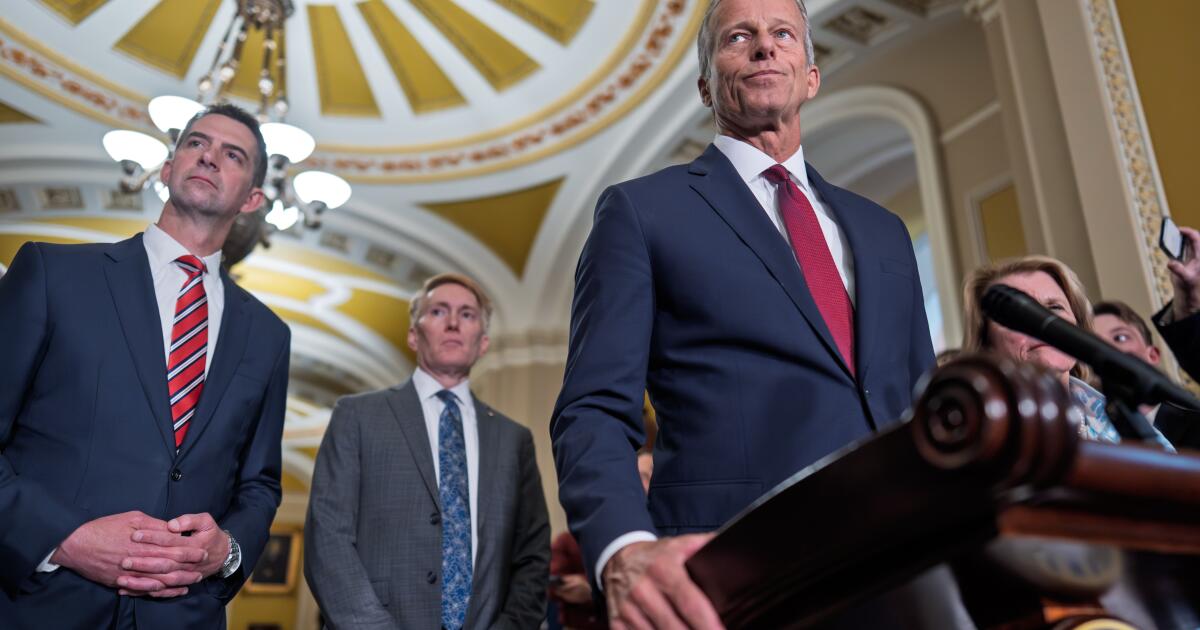
WASHINGTON — The Senate is beginning a long series of votes Thursday on legislation to fund President Trump’s immigration enforcement agencies, moving toward passage of a three-year fix as Democrats have blocked the money for months in protest.
The roughly $70 billion bill to fund U.S. Immigration and Customs Enforcement and the Border Patrol would end the blockade by Democrats who demanded policy changes after the fatal shootings of two protesters by federal agents in January. The bill would fund the agencies for three years, through the end of Trump’s term.
First, though, Republicans must beat back a potential gauntlet of amendments that Democrats plan to offer, including to try and permanently ban Trump’s $1.776 billion settlement fund for allies who he believes have been politically persecuted. Democrats have said their first amendment Thursday morning will be to eliminate the fund and send the immigration spending bill back to committee.
Senate Republicans are using a complicated procedural maneuver to get around the filibuster and pass the budget legislation with no Democratic votes. But it has taken weeks to get the bill to the Senate floor as Republicans navigated various obstacles to passage created by Trump and the White House — including a $1 billion proposal for White House security that they eventually scrapped and fierce bipartisan backlash to the settlement fund.
“The thing we’re trying to do here is to keep the focus on funding for ICE and CBP,” Senate Majority Leader John Thune said Wednesday evening, after the Senate voted to start debating the legislation. “This was narrow and targeted from the very beginning and clean, and we’re trying to maintain it that way.”
But it’s unclear if Republicans will have enough votes to fend off the Democratic amendments. Acting Attorney General Todd Blanche said this week that the fund would not move forward, and many GOP senators said Wednesday that they were satisfied with his remarks.
Yet Trump, who has been at odds with Senate Republicans in recent weeks, raised new doubts about the settlement’s future on Wednesday afternoon when he told reporters that the settlement is “very important” and said “I don’t know” whether it is dead or on hold.
“I’d have to ask the lawyers,” he said.
Democrats, Republicans plan to force votes on settlement
To pass legislation through the budget process called reconciliation, the Senate must first hold a long series of votes. Democrats are using that process to try and ban the settlement by law — and also kill the immigration spending bill.
After Trump’s comments about the fund, Schumer posted on X that “this is EXACTLY why” Democrats would be forcing votes to ban it.
Some Republicans also planned to try and put Blanche’s promise in writing. Sen. Thom Tillis, R-N.C., has said he will offer an amendment to block any attempt at resurrecting the fund.
“We’ve got a sufficient number of Republicans who have been very clear they’ve got concerns there,” said Tillis.
ICE and Border Patrol money has been long fight
Democrats say any funding bill for the Homeland Security Department should place restraints on federal immigration authorities, including better identification for federal officers and more use of judicial warrants, among other asks.
After federal agents shot Renee Good and Alex Pretti in Minneapolis, Trump agreed to a Democratic request that the Homeland Security bill be separated from a larger spending measure that became law. But bipartisan negotiations went nowhere, and the DHS funding lapsed in mid-February with no agreement on changes to the Trump administration’s immigration enforcement tactics.
Congress eventually funded the rest of the Homeland Security Department at the end of April with Democratic support. But ICE and Border Patrol remained without regular funding, and Republicans launched a new effort to pass three years of funding for those agencies with no Democratic votes.
Security money for Trump’s ballroom dropped
Work on the legislation was also delayed by Republican opposition to $1 billion in security funding for the White House, including for Trump’s new ballroom, that was added to the original bill.
Democrats and some Republicans questioned using taxpayer money for the massive project, and Republicans did not include it in the final bill when it was released on Wednesday.
Thune said he was working with his GOP conference to try and fight off any amendments and ensure he has enough votes for a simple majority to pass the bill in the 53-47 Senate.
“Keep in mind, we’ve got to keep them all together, make sure we’ve got 50 votes for it,” he said.
Republican House leaders said Wednesday they would like to clear the legislation before the end of the week, if the Senate can finish it. House Majority Leader Steve Scalise, R-La., said that House leaders were having internal conversations about the schedule.
“We just need to make sure everybody’s there,” Scalise said.
Jalonick and Cappelletti write for the Associated Press.
1 of 5 | Markwayne Mullin, secretary of the Department of Homeland Security, and Troy Edgar, deputy secretary, are shown Wednesday during a House Homeland Security Committee hearing on the fiscal year 2027 budget request for DHS in the Canon House Office Building near the U.S. Capitol in Washington, D.C. Photo by Bonnie Cash/UPI | License Photo
June 3 (UPI) — Markwayne Mullin, secretary of the Department of Homeland Security, said Wednesday that Immigration and Customs Enforcement officers will have to undergo more than 500 hours of training again, a return to the amount the department originally required.
News agencies first reported in early May that this change might be on the way. In fall 2025, ICE cut training for its officers from 584 hours to 336 hours, a move that came as part of a hiring push that brought in hundreds of new ICE agents. Senate Democrats released documents showing the cuts earlier this year, The New York Times reported.
The cuts were criticized by Democrats and some others, as critics said recruits did not receive enough training on how to handle firearms, First Amendment rights or other issues. Many people have called for ICE to be reformed or abolished, especially after ICE agents killed two U.S. citizens in January in Minneapolis. Then, in February, the Times reported, a former ICE attorney publicly criticized the changes in training at a forum in Washington, D.C.
“For the last five minutes, I watched ICE dismantle the training program,” Ryan Schwank said. “Cutting 240 hours of vital classes from a 584-hour program — classes that teach the Constitution, our legal system, firearms training, the use of force, lawful arrests, proper detention and the limits of officers’ authority.”
The agency responded at the time by saying hours had not been cut.
Mullin also said Wednesday that he’s reviewing contracts signed by Kristi Noem, the previous secretary of the department, that may have ties to her allies, The Hill reported. Rep. Bennie Thompson, D-Miss., the top Democrat on the committee, noted that Noem had signed contracts giving business to companies connected with her.
Mullin said he’d give the committee a list of any canceled contracts that hadn’t yet been signed. The department cannot nullify contacts that have been signed, but some are under review, he said.
Acting Attorney General Todd Blanche speaks during a House Appropriations Subcommittee on Commerce, Justice, Science and Related Agencies oversight hearing on the Department of Justice in the Rayburn House Office Building near the U.S. Capitol on Tuesday. Blanche announced the Justice Department is abandoning President Donald Trump’s proposed $1.8 billion “anti weaponization” fund. Photo by Bonnie Cash/UPI | License Photo
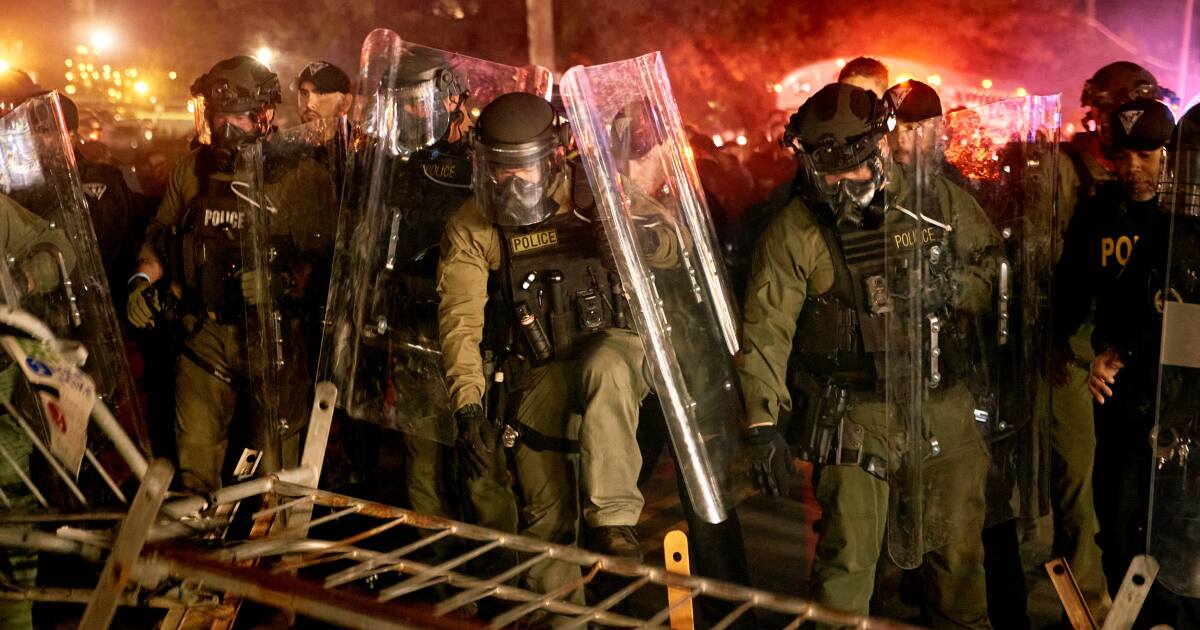
NEWARK, N.J. — The mayor of Newark imposed a curfew early Sunday around an immigration detention center in New Jersey after a series of intense clashes between protesters and police.
The curfew around Delaney Hall will be in place between 9 p.m. and 6 a.m. until further notice, Mayor Ras Baraka said in a statement.
The move came after another night of standoffs between law enforcement and demonstrators at the facility, as protesters could be seen in photographs and videos fighting over barricades as police used riot shields to push them back. A video posted on social media showed police on horseback marching into crowds, attempting to break up groups of demonstrators.
The high-profile demonstrations at Delaney Hall began this month after advocates said detainees launched a hunger strike over poor living conditions at the 1,000-bed facility, the latest focus of opposition over the federal government’s immigration crackdown.
The private company GEO Group operates the lockup under the supervision of U.S. Immigration and Customs Enforcement. The shuttered facility reopened for immigration detainees in February 2025.
New Jersey state police on Friday replaced federal immigration enforcement agents who had been facing off against protesters at the facility for days.
In a statement Sunday morning, New Jersey Gov. Mikie Sherrill said masked people attacked a barrier in a designated protest area set up by state police and were “throwing projectiles, utilizing the barriers as weapons, and lighting tires on fire in the street.”
“These actions put both peaceful protesters and law enforcement in danger,” Sherrill said, urging calm to focus on advocating for “better conditions for the detainees, for their families, and ultimately, for the closure of Delaney Hall.”
Sherrill also said that the federal government has reopened family visits at Delaney Hall starting Sunday.
Asked about visitations resuming, the U.S. Department of Homeland Security said in a statement, “To be clear: Visitation was only suspended because of violent riots. Now that we have a secure perimeter, visitation can resume.”
NEWARK, N.J. — New Jersey state police set up designated protest zones and vehicle checkpoints outside an immigration detention center in Newark on Friday, replacing federal immigration enforcement agents who have been clashing with protesters for days.
Gov. Mikie Sherrill said she sent in state police to bring order outside Delaney Hall as the demonstrations have intensified, with violence and arrests increasing as night falls.
“It has grown unsafe, and that’s completely unacceptable,” the Democratic governor said at a news conference announcing the new measures. “We need to take this opportunity to lower the temperature.”
As police erected protest barriers, U.S. Immigration and Customs Enforcement agents who had formed a line in front of protesters moved inside the building’s perimeter fence.
New Jersey State Police Lt. Col. David Sierotowicz said ICE officers agreed to stand down with state police assuming responsibility.
Demonstrators had mixed reactions. Some staged a sit-in and refused to move into one of the new protest areas police set up using metal barriers and concrete blocks.
Rachel Cohen worried that demonstrators exercising their 1st Amendment rights were being silenced.
“It is not helpful to quell protest for the sake of a false peace,” she said. “There is no peace while we are torturing our neighbors on [the] government dime inside this facility.”
U.S. Homeland Security Secretary Markwayne Mullin, on social media, called the measures a “win for law and order” and noted that Sherrill had resisted sending state police for days.
The protests began a week earlier after immigrant advocates said detainees inside launched a hunger strike over poor living conditions at the 1,000-bed facility, which opened last May.
Demonstrators have been attempting to block people and vehicles from entering and exiting, linking their arms in a human chain and using trash cans, umbrellas and other items as makeshift shields and barricades.
ICE officers wearing helmets and tactical vests have used pepper spray and batons to try to disperse the protesters and clear the roadway for vehicles.
At least six demonstrators were arrested and accused of assaulting law enforcement officers Wednesday night, and more have been arrested on other nights, according to the Department of Homeland Security.
Acting U.S. Atty. Gen. Todd Blanche shared images online Friday of bloody wounds and bruises sustained by ICE officers.
“These riots are clearly not ‘peaceful protests’ as you can see from the photos of these horrific wounds,” he said. “Assault a federal officer, you’ll be held accountable.”
Another demonstrator, Lisa O’Dwyer, said she was fine with the designated protest areas.
“I like to get my point across and stay safe at the same time,” the Westfield resident said.
Eyesha Marable, pastor at Mt. Zion AME Church in Millburn, agreed, even while acknowledging that there were “different schools of thought” among protesters.
“There are people here who are angry. Their family members are inside. Their friends are inside. People have been taken off the streets, out of their communities,” she said.
“We have to keep the peace,” Marable said. “The goal is to get our people free, to get them liberated, and we cannot do that if we’re fighting out here.”
State Atty. Gen. Jennifer Davenport said it was important to “de-escalate” the situation as “violence, either against protesters or by protesters, is unacceptable.”
Sherrill said she did not want to give ICE a pretext to expand operations in the state, noting that federal immigration officers around the country have killed and injured protesters in recent months.
“We all need to do everything we can to cool things down now,” she said.
The governor and other Democratic officials tried to visit detainees Monday but were denied entry.
Democratic members of Congress from New York City, however, were able to tour Delaney Hall the day after that. They reported dire conditions, with detainees being fed small portions of often spoiled food and their varied medical needs going ignored.
Families and supporters of detainees also say their loved ones have also been subjected to pepper spray and physical force in retaliation for their hunger strike and the protests outside.
Marcelo and Shaffrey write for the Associated Press and reported from New York and Newark, respectively.