ICE officers shot a man in New York because they believed they were in danger, official says
WASHINGTON — Federal immigration officers opened fire on a Dominican man in New York because he drove his car into officers’ vehicles and they believed their lives were in danger, a senior Immigration and Customs Enforcement official said Friday.
The 28-year-old man, whom New York City police identified as Oscar Belgal, was shot “superficially” in the neck as ICE officers attempted to arrest him, said Marcos Charles, head of ICE’s Enforcement and Removal Operations. Authorities have not released details of Belgal’s condition.
Officers used their vehicles to block the man as he attempted to drive away, but he accelerated toward them, Charles said during a news conference with U.S. Homeland Security Secretary Markwayne Mullin in Washington. The Department of Homeland Security said the news conference was about the “dangerous consequences of sanctuary city policies.”
“Our officers, using their training and believing that their life and the life of the partners and the general public were in danger, used their training and fired weapons,” Charles said.
Belgal had his 5-year-old son in the car with him when the shooting happened, officials said.
Mullin said ICE agents didn’t know the child was in the car, but that Belgal “was aware” and chose to put the boy at risk by trying to evade officers.
ICE previously tried to detain Belgal, Charles says
Belgal was associated with a robbery crew that used mopeds and weapons, and was convicted of grand larceny last year and sentenced to five years of probation, Charles said, adding that he evaded officers in September when ICE tried to arrest him for deportation.
The Legal Aid Society, which was representing Belgal in an ongoing drug case, called Friday for a “full and transparent” investigation of the shooting, the officers involved to be held accountable and an end to “ICE’s escalating presence in New York City.”

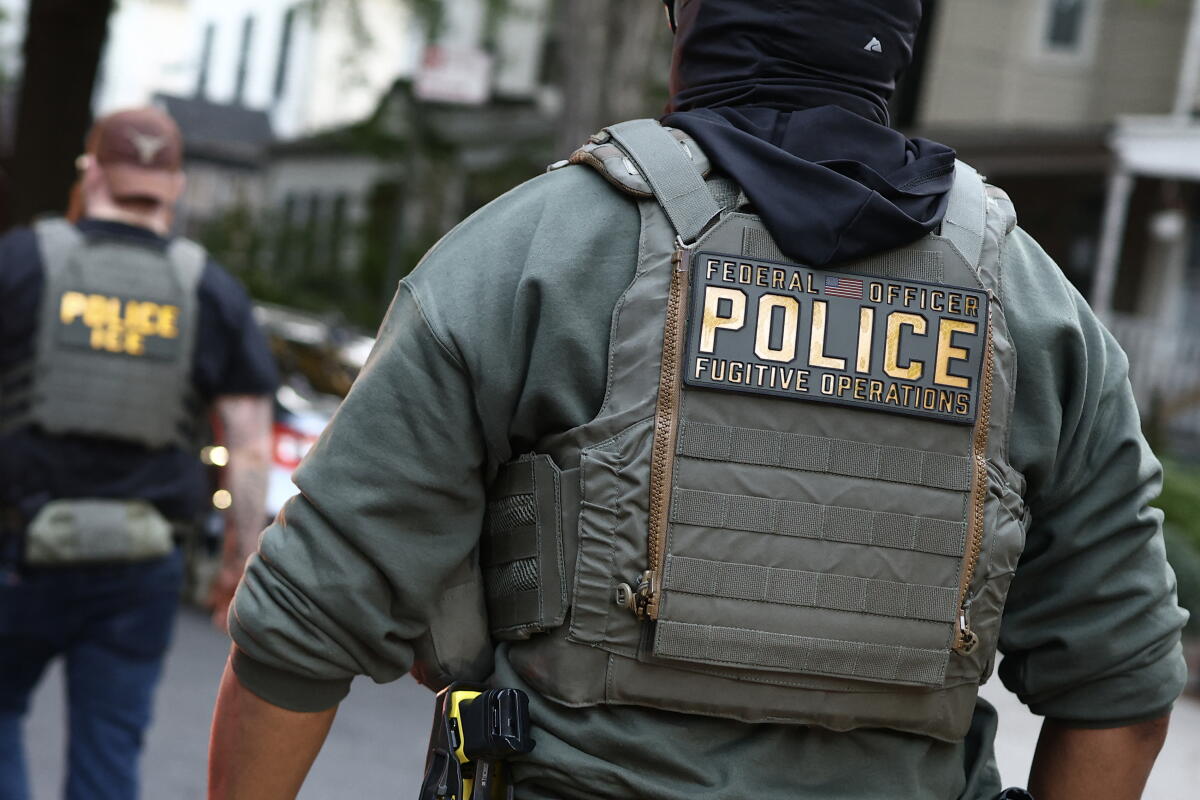
Federal agents walk near the scene where a man was shot by an ICE officer during an operation in the Bronx borough of New York on Oct. 8, according to local media and police.
(Charly Triballeau / AFP via Getty Images)
Belgal has pleaded not guilty to narcotics-sale charges in the drug case. The Legal Aid Society did not comment further.
New York City Mayor Zohran Mamdani and New York Gov. Kathy Hochul, both Democrats, said late Thursday that they had pressed Mullin and Republican President Trump to release Belgal, but to no avail. They also urged the administration to immediately release ICE officers’ body camera footage of the shooting and to halt immigration enforcement operations in the city.
Mullin said Belgal was being held in a “highly secured” detention facility outside New York City but declined to say where.
Attorneys representing Belgal filed an emergency petition Thursday night calling for his release. A hearing is scheduled for Friday afternoon.
He also confirmed ICE officers were wearing body cameras that were activated, but didn’t say when any of that footage would be released. Under agency policy, bodycam video can be released within 72 hours if “determined that it is in the best interests of the agency.”
On Friday, New York City police released footage from its officers as they arrived at the scene following the shooting. The department previously said its officers were not involved in the arrest and not at the scene when the shooting happened.
The video shows a city officer responding to a chaotic scene where Belgal — sitting on the ground with his hands behind his back and head drooping to one side — was surrounded by several officials. The video shows officers lifting Belgal and placing him in a black SUV. Police said he was taken to a hospital.
“Yo put pressure. Put pressure,” an officer can be heard saying as the SUV reverses down the block.
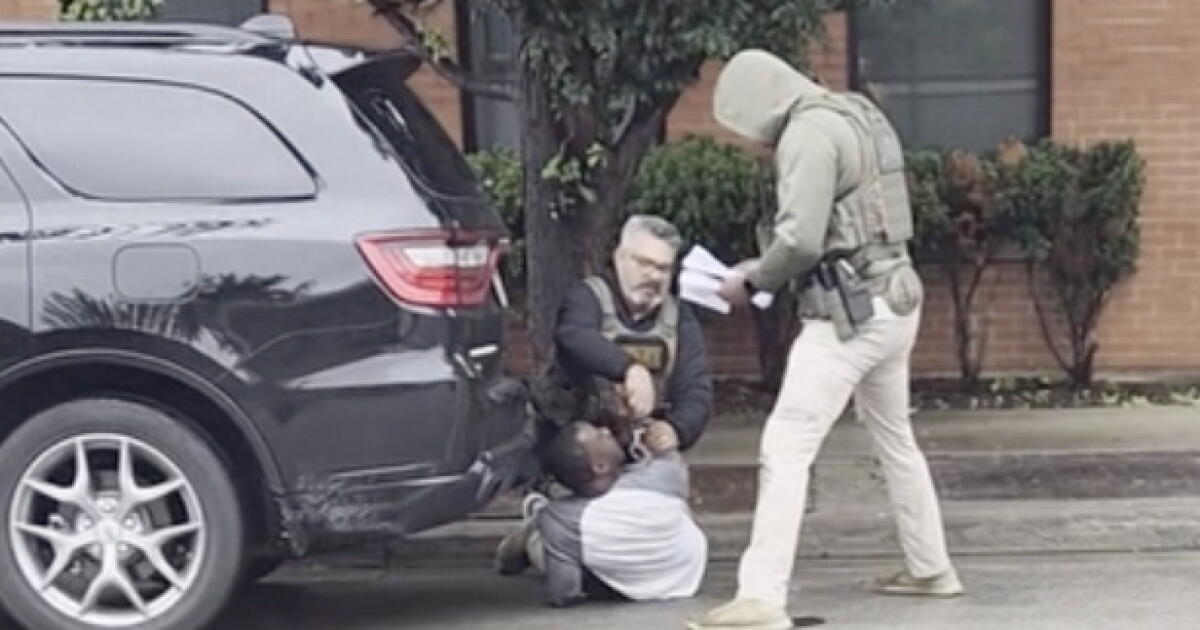
New York City Police Commissioner Jessica Tisch said Belgal was pulling into a parking space when a federal officer in plainclothes approached with his gun drawn, followed by another federal officer who also wasn’t in uniform. Belgal started to pull the car forward, and at least one of the officers fired seven rounds, hitting the man below his left ear.
Protesters and local officials decried the shooting as an example of the dangers of the Trump administration’s immigration crackdown.

New York City Mayor Zohran Mamdani arrives to speak to the media about the ICE shooting in the Bronx borough of New York on Oct. 8. Mamdani said he would ask President Trump to remove federal immigration agents from the city as tensions flared over the latest shooting involving ICE.
(Charly Triballeau / AFP via Getty Images)

Homeland Security Secretary Markwayne Mullin takes questions from reporters during a news conference at U.S. Immigration and Customs Enforcement headquarters on Friday in Washington, DC. Mullin, joined by ICE officials, addressed Thursday’s shooting of a man in New York City by a federal immigration agent as he spoke out against sanctuary city policies.
(Kevin Dietsch / Getty Images)
“There is no justification for what we have seen today,” Mamdani said late Thursday at the scene of the shooting.
Federal officers who surrounded the vehicle wore construction vests and masks, making it difficult to identify them as immigration officers, he said.
Mullin criticizes NYC’s immigration policies
Mullin devoted much of Friday’s news conference to criticizing Mamdani and New York City’s limits on cooperation with ICE. The Democrat, who took office in January, has restricted local cooperation with immigration enforcement operations and repeatedly called for the abolition of ICE.
“Sanctuary politicians, they create an environment for criminal activity to thrive, not for the American citizens to be safe,” Mullin said.
Homeland Security Secretary Markwayne Mullin takes questions from reporters during a news conference at U.S. Immigration and Customs Enforcement headquarters on Friday in Washington, DC. Mullin, joined by ICE officials, addressed Thursday’s shooting of a man in New York City by a federal immigration agent as he spoke out against sanctuary city policies.
(Kevin Dietsch / Getty Images)
ICE has asked local officials in New York to hold onto more than 14,000 people for federal officers to collect and place in immigration detention, he said.
“Silence. Absolute silence is what we have gotten back,” the secretary said. “Why would they release these individuals back onto the streets?”
“We’re enforcing our nation’s laws. We’re not picking and choosing,” Mullin continued. “Why is that controversial? We should all want law and order on our streets.”
ICE has justified other shootings with perceived threats to officers
During Trump’s second term, Homeland Security has often accused suspects of attempting to ram officers with vehicles or otherwise pose a threat and using that as justification for opening fire. But evidence from other shootings involving immigration enforcement officers has sometimes called into question that rationale.
In the Jan. 7 shooting death of Renee Good in Minneapolis, Homeland Security officials initially claimed an ICE officer opened fire in self-defense after Good attempted to run him over with her vehicle. Videos filmed from multiple angles challenged the administration’s narrative.
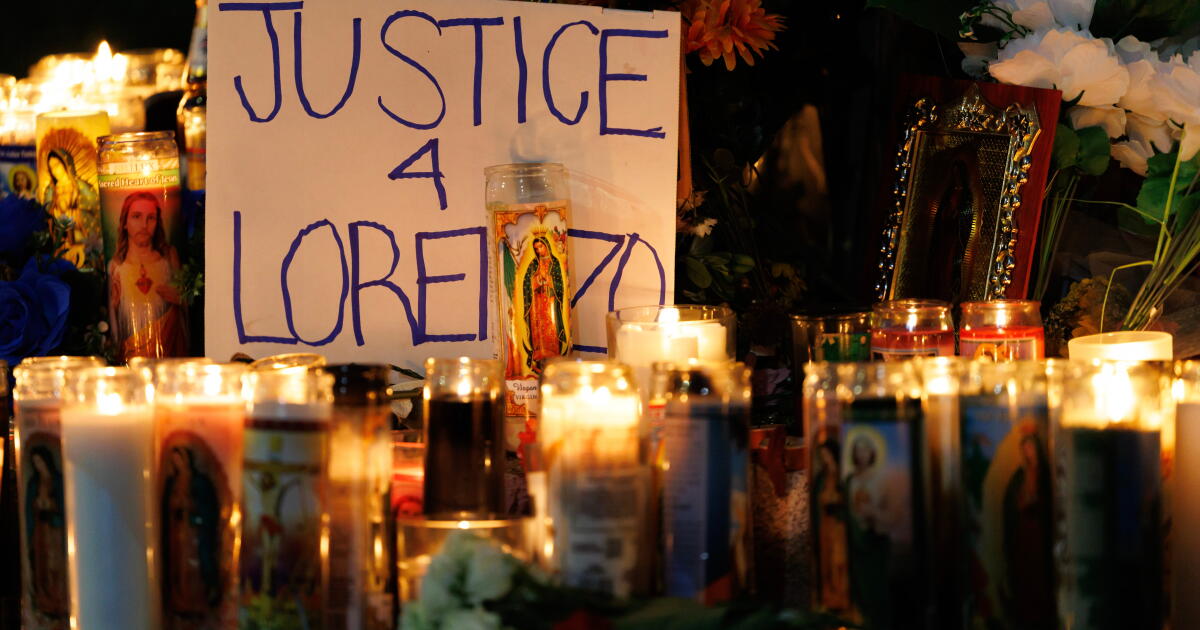
On July 10, ICE officers fatally shot Lorenzo Salgado Araujo in Houston as the Mexican national was driving his construction crew to a job site. DHS maintained Salgado Araujo rammed an ICE vehicle, but the three men inside his vehicle disputed the narrative.
Last year in a Chicago suburb, immigration officers fatally shot Silverio Villegas González after they say the Mexican national drove at them and dragged one with his car, causing “serious injuries.” But body camera videos from local police showed the agent who shot Villegas González walking around afterward and dismissing his own injuries as “nothing major.”
Santana and Marcelo write for the Associated Press. Marcelo reported from New York. AP reporters Anthony Izaguirre and Jennifer Peltz in New York City and Ryan Foley in Iowa City, Iowa, contributed to this report.