Hyundai

Hyundai Motor Group accelerates Atlas humanoid robot production push

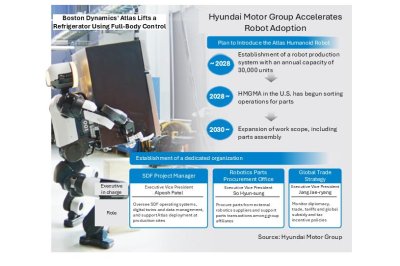
An infographic shows Hyundai Motor Group’s roadmap for deploying Atlas humanoid robots at manufacturing facilities, including plans to build annual production capacity of 30,000 units by 2028 and expand robot operations from parts sequencing to assembly work at its Georgia smart factory. Graphic by Asia Today and translated by UPI

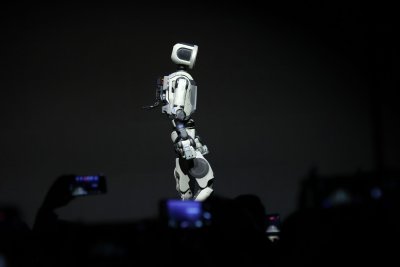
May 25 (Asia Today) — Hyundai Motor Group is accelerating plans to mass-produce humanoid robot Atlas and deploy it at manufacturing sites, creating new software-defined factory and robotics parts organizations as it pushes to build AI-driven future factories.

Industry officials say the leading candidate for Atlas mass production is the company’s Hyundai Motor Group Metaplant America, or HMGMA, in the U.S. state of Georgia.

Analysts say Hyundai’s strategy goes beyond simply introducing robots into factories and instead aims to simultaneously establish AI-based manufacturing systems and a dedicated robotics supply chain.

According to industry sources Sunday, Hyundai Motor Group recently created a new “Software Defined Factory,” or SDF, division and appointed Alpesh Patel to lead the effort.

SDF refers to a next-generation manufacturing system in which AI integrates and controls factory-wide production, quality management and logistics through unified software systems.

The goal is not only factory automation but also real-time analysis of manufacturing data and optimization of quality control and logistics operations.

Patel, formerly with consulting firm McKinsey & Company, joined Hyundai Motor Group in 2023 and previously served as chief innovation officer at the Hyundai Motor Group Innovation Center Singapore, or HMGICS, where he led development of digital manufacturing systems.

Industry observers said Hyundai’s decision to move Patel into a broader group leadership role reflects plans to expand smart manufacturing systems validated in Singapore across global production sites.

Patel is also expected to oversee digital twin operations, production data management and AI-driven factory systems while coordinating future deployment of Atlas robots in manufacturing facilities.

Analysts say humanoid robots require integrated coordination among production equipment, logistics systems and worker movement within a unified software environment to function effectively in factories.

Hyundai Motor Group is also expanding its robotics supply chain infrastructure.

The company recently established a dedicated Robotics Parts Procurement Office and appointed So Hyun-sung to lead the division.

The office will oversee sourcing and cost competitiveness for core humanoid robot components such as actuators, robotic grippers and head modules as Boston Dynamics moves toward mass production.

Boston Dynamics reportedly requested that key Atlas components be mass-produced by Hyundai Mobis.

Hyundai Motor Group plans to build a mass-production system centered on Hyundai Mobis while linking it to global procurement networks to secure supply stability and pricing competitiveness.

Industry officials have also discussed the possibility of constructing a U.S.-based actuator production facility capable of producing about 350,000 units annually.

The company has additionally reorganized teams handling global trade risks amid rapidly changing international trade conditions.

Hyundai recently established a Global Trade Strategy Office under its Global Policy Office to oversee diplomacy, trade and tariff issues, appointing Jang Jae-ryang to lead the division.

Industry analysts said the move is intended to address growing risks involving global manufacturing and supply chains.

Georgia has emerged as the leading candidate for Atlas mass production over Massachusetts, where Boston Dynamics is headquartered, according to industry sources.

Officials reportedly concluded Georgia would allow newly produced robots to be immediately deployed and tested at HMGMA production facilities.

HMGMA already operates as a smart factory combining about 1,700 workers and more than 1,000 robots.

Industry officials said the facility offers advantages for repeated testing, machine learning and operational improvement of Atlas robots in real manufacturing environments.

The site is also viewed as strategically favorable for vertically integrating component procurement, robot production and deployment logistics.

Hyundai Motor Group plans to establish annual Atlas production capacity of 30,000 units by 2028 and gradually deploy more than 25,000 of those robots across Hyundai and Kia production facilities.

Initially, Atlas robots are expected to handle parts sequencing operations at the Georgia factory before expanding into assembly work.

Hyundai also plans to extend SDF technologies to facilities including its Pune plant in India and a dedicated electric vehicle factory in Ulsan, South Korea.

An industry official said Hyundai Motor Group is pursuing more than a traditional automated factory model.

“What Hyundai is building is a future manufacturing system combining AI and humanoid robots,” the official said. “The creation of SDF organizations, robotics supply chains and production hubs is essentially preparation for the era of mass-produced robots.”

— Reported by Asia Today; translated by UPI

© Asia Today. Unauthorized reproduction or redistribution prohibited.

Original Korean report: https://www.asiatoday.co.kr/kn/view.php?key=20260526010007193
Source link

HD Hyundai expands role in Ukraine reconstruction

A
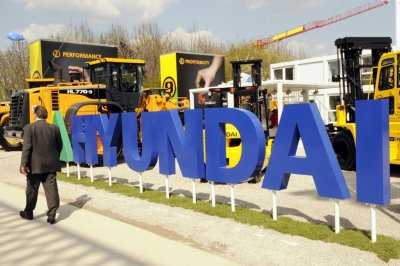
visitor walks past Hyundai heavy machinery stand at the Bauma, 29th
International Trade Fair for Construction Machinery, Building Material
Machines, Mining Machines, Construction Vehicles and Construction Equipment
trade fair in Munich. Photo by MAURITZ ANTIN / EPA

May 22 (Asia Today) — HD Construction Equipment said Friday it signed an agreement with Ukraine’s Mykolaiv regional government to expand cooperation on postwar reconstruction.

The memorandum of understanding was signed Thursday at HD Hyundai’s Global R&D Center in Pangyo, south of Seoul. Attendees included Mykolaiv Gov. Vitaliy Kim, HD Hyundai Vice Chairman Cho Young-cheul and HD Construction Equipment President Moon Jae-young.

The agreement expands cooperation that began in 2023, when HD Construction Equipment worked with the Mykolaiv regional government on construction equipment donations and training.

The two sides agreed to broaden cooperation to include equipment supply, a local training center, service and maintenance support, financing systems and energy infrastructure restoration.

HD Construction Equipment has continued reconstruction talks with Ukrainian government and local officials since the war began. In 2023, Ukraine’s first deputy infrastructure minister, Vasyl Shkurakov, visited the company’s Ulsan campus, leading to further discussions on rebuilding projects.

The company later donated five major pieces of equipment, including excavators and forklifts, to Mykolaiv. The equipment is still being used for emergency recovery and infrastructure restoration work.

HD Hyundai said it plans to pursue a groupwide reconstruction cooperation model combining its construction machinery and energy capabilities.

“We will build a cooperation system that can make a practical contribution to Ukraine’s reconstruction, going beyond simple equipment supply,” Cho said.

— Reported by Asia Today; translated by UPI

© Asia Today. Unauthorized reproduction or redistribution prohibited.

Original Korean report: https://www.asiatoday.co.kr/kn/view.php?key=20260522010006601

Source link

Hyundai tests EV power-sharing service on Jeju Island

A Hyundai Ioniq 9 uses a bidirectional charger installed at the home of a customer participating in Hyundai Motor Group’s V2G pilot service in Hangyeong, Jeju Island. /Courtesy of Hyundai Motor Group

May 15 (Asia Today) — Hyundai Motor Group said Friday it has launched a vehicle-to-grid pilot service for general customers on Jeju Island, using electric vehicles as mobile energy storage systems.

Vehicle-to-grid technology, or V2G, allows electricity to move both ways between an electric vehicle battery and the power grid. The system can store surplus power in EV batteries and send it back to the grid when demand rises.

The pilot program will involve 40 Jeju residents who own Hyundai Ioniq 9 or Kia EV9 vehicles equipped with V2G functions. Hyundai Motor Group selected customers in cooperation with the Jeju provincial government.

The company will provide bidirectional chargers free of charge and cover EV charging costs during the trial period.

Hyundai said it selected participants with different occupations and residential locations to test the service under a range of real-life conditions. The participants include early adopters interested in clean energy and new technology.

The project fits Jeju’s power structure because the island relies heavily on wind and solar energy. Surplus electricity generated during the day can be stored in EV batteries and supplied back to the grid at night when demand increases.

Hyundai Motor Group previously operated a V2G demonstration project in Jeju with mobility platform Socar in the second half of last year. The latest pilot expands the test to ordinary customers.

Industry officials say V2G commercialization could turn electric vehicles into key assets in the energy industry, supporting local energy independence and distributed power systems rather than relying only on centralized power plants.

“We expect this pilot service, directly involving Jeju residents, to contribute to local energy production and consumption in the region,” a Hyundai Motor Group official said. “It will also play a meaningful role in achieving Jeju’s 2035 carbon neutrality vision.”

— Reported by Asia Today; translated by UPI

© Asia Today. Unauthorized reproduction or redistribution prohibited.

Original Korean report: https://www.asiatoday.co.kr/kn/view.php?key=20260515010004112

Source link

Hyundai Motor hits 13.5 million vehicle sales in India after 30 years

An AI-generated image depicts Hyundai Motor’s expansion in the Indian automobile market. Photo by Asia Today and translated by UPI

May 11 (Asia Today) — Hyundai Motor Company has surpassed 13.5 million cumulative vehicle sales in India, underscoring the company’s three-decade push to localize production and develop models tailored to Indian consumers.

According to the automaker on Sunday, Hyundai Motor India Ltd., established on May 6, 1996, has sold about 13.5 million vehicles cumulatively, including 9.6 million domestic sales and 3.9 million exports.

The Indian unit has also become a strategic export hub for markets in the Middle East, Africa and Latin America, shipping models such as the Verna and Grand i10 to about 150 countries, including Saudi Arabia, South Africa and Mexico.

Hyundai entered India in the 1990s after identifying the country as a high-growth market with low vehicle ownership despite its large population. The company built its first assembly plant in Chennai, in the southern state of Tamil Nadu, and began production in 1998.

Hyundai later expanded the site with engine and transmission facilities, creating the company’s first comprehensive overseas manufacturing base.

The first model produced in India was the Santro, a localized version of the Atos compact car sold in South Korea. Hyundai modified the vehicle to better fit local conditions, including adopting a “tall-boy” design with increased cabin height that proved popular among Sikh drivers who wear turbans.

The company further expanded production capacity by opening a second Chennai plant in 2007 to support growing domestic demand and exports.

Industry analysts said Hyundai’s momentum in India accelerated after the launch of the Creta SUV in 2015. The model helped expand demand for sport utility vehicles in a market previously dominated by sedans.

Hyundai’s India Technology and Engineering Center also adapted vehicles to local consumer preferences, increasing cabin space and ground clearance to accommodate large families and rough road conditions.

To strengthen competitiveness, Hyundai launched a localization initiative in 2013 to expand sourcing from Indian suppliers. The company worked with industry groups and formed joint ventures with global suppliers, eventually achieving an average local parts sourcing rate of 82%.

“Hyundai successfully localized its operations to the point where many consumers see it as an Indian company,” an industry official said.

India’s automobile market grew from about 370,000 vehicles in 1998, when Hyundai entered the market, to approximately 4.56 million vehicles in 2025, representing annual average growth of about 10%, the official added.

— Reported by Asia Today; translated by UPI

© Asia Today. Unauthorized reproduction or redistribution prohibited.

Original Korean report: https://www.asiatoday.co.kr/kn/view.php?key=20260511010002552

Source link

Hyundai, Kia top 40,000 hybrid sales in U.S.

People view the Kia EV3 on display during the New York International Auto Show in New York, New York, USA, 02 April 2026. Photo by SARAH YENESEL / EPA

May 4 (Asia Today) — Hyundai Motor and Kia accelerated their shift toward electrified vehicles in the United States in April, even as overall sales fell slightly.

Hyundai Motor Group said Monday it sold 159,216 vehicles in the U.S. market in April, down 2.1% from a year earlier. Hyundai Motor sold 86,513 vehicles, down 1.5%, while Kia sold 72,703, down 2.8%. Genesis sales rose 0.8% to 6,356 vehicles.

The decline was attributed to a high base effect from advance purchases last year linked to tariff concerns. Major global automakers also reported weaker sales, while Hyundai Motor Group maintained its No. 2 position in the market.

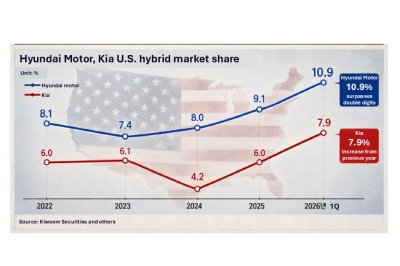
Eco-friendly vehicle sales showed clear growth despite the overall decline. Hyundai and Kia sold 48,425 eco-friendly vehicles in April, up 47.6% from a year earlier. Their share of total sales exceeded 30% for the first time, reaching 30.4%.

Hybrid sales surged 57.8% to a record 41,239 vehicles. Hyundai sold 21,713 hybrids, up 47.7%, while Kia sold 19,526, up 70%.

Electric vehicle sales also rose 7.7% to 7,186. Hyundai EV sales edged lower to 4,779, but Kia’s EV sales jumped 65% to 2,407, driving growth in the segment.

By model, the Hyundai Tucson led sales with 22,024 vehicles, followed by the Elantra with 14,778 and the Palisade with 11,324. Sonata sales rose 18.2% to 7,105, while Elantra sales climbed 12.6%, showing signs of recovery in sedan demand.

Among hybrid models, Sonata hybrid sales surged 170% to 4,520 and Elantra hybrid sales rose 55.3% to 2,399, reflecting stronger demand for electrified models.

For Kia, the Sportage remained the top seller with 15,803 vehicles, followed by the K4 with 13,214 and the Telluride with 12,577. Seltos sales rose 31.7% to 5,335, absorbing demand in the compact SUV segment.

Among Kia’s eco-friendly vehicles, the Sportage hybrid rose 65.2% to 7,446 and EV9 sales jumped 481.5% to 1,349.

Genesis maintained its position in the premium market, led by GV70 sales of 2,837, up 7.7%, and G70 sales of 991, up 23.4%.

Hyundai and Kia said their balanced portfolio of hybrids, electric vehicles and internal combustion engine models is helping them respond flexibly to changing market conditions.

— Reported by Asia Today; translated by UPI

© Asia Today. Unauthorized reproduction or redistribution prohibited.

Original Korean report: https://www.asiatoday.co.kr/kn/view.php?key=20260504010000367

Source link