Espionage, sabotage, cyberattacks, and covert operations are a ‘constant reality’, says Germany’s interior minister.
Published On 9 Aug 20269 Aug 2026
Germany is facing daily “hybrid warfare” attacks from abroad, an official has said, days after an explosive-laden drone was discovered at Leipzig/Halle Airport.
Interior Minister Alexander Dobrindt told the local newspaper Bild am Sonntag on Sunday that foreign powers wanted to subdue Germany politically and socially by stirring up fear.
Recommended Stories
list of 4 itemsend of list
“We’re not at war, but we are the daily target of hybrid warfare,” Dobrindt said.
“Espionage, sabotage, cyberattacks, or covert operations by foreign powers aimed at destabilising Germany or inflicting direct harm are a constant reality.”
He did not identify any countries behind the alleged attacks.
The minister’s comments come after a drone loaded with explosives was discovered at the Leipzig/Halle Airport in eastern Germany on Tuesday.
Some German lawmakers pointed the finger at Russia, which has been at war with Ukraine since its full-scale invasion of the country in 2022.
The Russian embassy in Berlin on Friday dismissed the Leipzig event as a “fabricated provocation”, saying it was another example of unsubstantiated accusations against Moscow.
Germany plans to boost anti-drone capacity
Germany is planning to strengthen its ability to counter drones amid concerns over the threat, Bild reported, citing government sources.
The newspaper said Dobrindt’s ministry wanted to double the federal government’s team of anti-drone experts from 150 to 300 and increase its network of related bases from four to eight.
Germany’s armed forces said on Saturday that two drones were spotted late on Thursday over a German military base site in Mechernich, in the western state of North Rhine-Westphalia.
Bulgaria’s defence ministry said there was no reason to suspect the incident was intentional. Ukraine said it was working with Bulgarian authorities to clarify the circumstances.
The drone incidents across Europe have renewed concerns that Russia’s war in Ukraine could increasingly affect neighbouring NATO states.
NATO and European Union officials have blamed Russia for previous drone sightings. Russia has rejected all the allegations.
Weekly insights and analysis on the latest developments in military technology, strategy, and foreign policy.
The U.K. Royal Navy has launched a kamikaze drone, the Nyan one-way effector, from a ship at sea, marking a significant step toward the U.K.’s ambition of a so-called ‘hybrid’ naval force. This is just one element of a much broader push toward increased reliance on uncrewed platforms, something that was underscored in the long-awaited Defense Investment Plan, unveiled earlier this week.
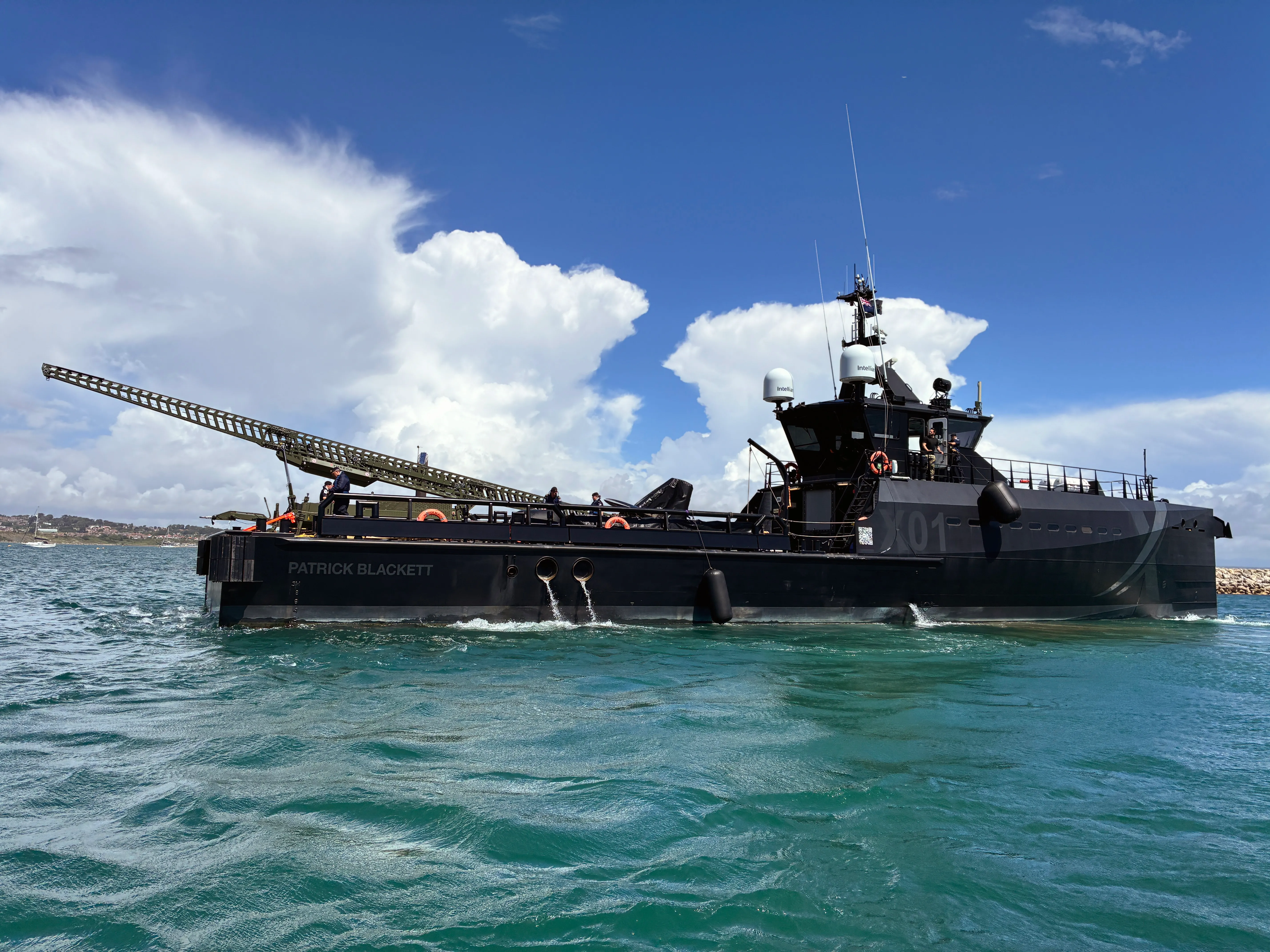
During recent trials off the south coast of England, the Nyan one-way effector drone was launched from the experimentation ship XV Patrick Blackett, a platform used by the Royal Navy as a testbed for new technologies.
The trial, known as Exercise Neptune Reach, involved personnel from the Royal Navy’s 744 Naval Air Squadron, 26 Royal Artillery of the British Army, and the Royal Air Force.
In a statement, Luke Pollard MP, Minister for Defense Readiness and Industry, said: “Britain is serious about the transition to a Hybrid Navy with new, powerful drones at the heart of the Royal Navy. By bringing together Army and Navy expertise to field strike drones from a ship at sea, we are accelerating the capabilities our forces need to stay ahead of our adversaries.”
The experimentation ship XV Patrick Blackett with the launcher for the Nyan drone installed. Crown Copyright Royal Navy
The catapult launcher for the Nyan was installed on the ship’s deck. Operators then programmed the drone to fly to a specific target, which it flew to autonomously, while the ship was underway.
Developed starting in 2022, specifically for precision strike, the Nyan was designed and built by Callen-Lenz, a subsidiary of BAE Systems. It is intended to be a low-cost strike platform, with a unit cost of less than £100,000 ($132,000), according to the manufacturer.
The drone has a wingspan of around 9.5 feet and a reported range of more than 93 miles (150 kilometers) — meaning it can hit targets at a greater distance than the Harpoon anti-ship missile. Built mainly of carbon fiber, the Nyan is powered by a small turbojet engine. The design of the drone and its construction include reference to low observability, including a stealthy exhaust nozzle, making it harder for hostile air defenses to detect and destroy.
Royal Navy and British Army personnel prepare a Nyan for launch on experimentation ship XV Patrick Blackett. Crown Copyright Royal Navy
The Nyan drone and launcher have already been tested extensively during land exercises. During Exercise Spring Storm in Estonia this year, the British Army used the system in support of NATO allies on maneuvers. Thereafter, the British Army’s Royal Artillery adopted the Nyan for operational service.
In the maritime context, the Exercise Neptune Reach trials from the Patrick Blackett were part of the wider, tri-service Project Vantage. This is focused on rapidly testing and delivering one-way effectors for the Royal Navy.
“This trial makes a significant step forward in delivering maritime one-way effectors at pace,” explained Lt. Cmdr. David Burton, Maritime One-Way Effectors Capability Sponsor with the Royal Navy. “Under Project Vantage, we are planning to integrate these capabilities into the Hybrid Navy, combining crewed platforms with uncrewed systems to expand reach, increase tempo and enhance lethality.”
A palletized Nyan drone is lowered onto its catapult launcher installed on the ship’s deck. Crown Copyright Royal Navy
The Nyan is already in quantity production, with more than 1,000 units manufactured so far, according to Matt Foster, CEO of Callen-Lenz.
The Royal Navy has said that the recent at-sea trials pave the way for further experimentation and also potential future deployment of the Nyan across the fleet.
Beyond the strike mission that the Nyan is currently equipped for, Callen-Lenz has said that the Nyan could be adapted to carry other payloads, or potentially be scaled up for increased range or endurance.
Interestingly, BAE Systems has also outlined the potential for further trials of the Nyan aboard the aircraft carrier HMS Queen Elizabeth.
In its last Strategic Defense Review, published last year, the U.K. Ministry of Defense described how plans for a hybrid naval force would also affect the two carriers and their air wings:
“The Royal Navy must continue to move towards a more powerful but cheaper and simpler fleet, developing a ‘high-low’ mix of equipment and weapons that exploits autonomy and digital integration,” the review stated. “Carrier strike is already at the cutting edge of NATO capability, but much more rapid progress is needed in its evolution into hybrid carrier air wings, whereby crewed combat aircraft (F-35B) are complemented by autonomous collaborative platforms in the air, and expendable, single-use drones. Plans for the hybrid carrier air wings should also include long-range precision missiles capable of being fired from the carrier deck.”
Already tested extensively during land exercises, the autonomous drone was taken to sea to explore how it could be operated from a ship. Crown Copyright Royal Navy
Earlier this week, the Defense Investment Plan noted that the development effort for the hybrid carrier air wing will include trials of jet-powered drones from the carrier. Previous drone trials aboard the British carriers have involved the QinetiQ Banshee Jet 80+, an adapted target drone, launched from HMS Prince of Wales in 2021. Subsequently, the General Atomics Mojave short takeoff and landing (STOL) drone was operated from the same carrier in 2023, as you can read about here. The Mojave’s impressive STOL capabilities meant that no launch and recovery systems were required for these tests.
A Mojave STOL drone landing on HMS Prince of Wales. GA-ASI
Beyond catapult-launched drones like the Nyan, the Royal Navy has a longer-term ambition for ‘cat and trap’ drone operations aboard its carriers, under an effort named Project Ark Royal.
If successful, Project Ark Royal will see the two carriers start to operate drones that can undertake a variety of missions and then increasingly heavier, complex, and higher-performance ones. In the past, General Atomics has pitched to the Royal Navy a carrier-capable fifth member of its Gambit drone family, intended to fit into a future air wing aboard the U.K. carriers.
A rendering featuring a catapult-equipped HMS Prince of Wales with a Gambit-series drone ready to launch. GA-ASI
Later on, full catapult-assisted takeoff but arrested recovery (CATOBAR) capability could even add fixed-wing crewed aircraft, as we have explored in the past.
Of course, the United Kingdom is not alone in these aspirations, with China and Turkey, most notably, also increasingly exploring using drones aboard big-deck amphibious warfare vessels and other non-conventional-takeoff-and-landing aircraft carriers.
For the time being, the Nyan represents a fairly modest strike capability. Based on its range, what is likely a relatively small warhead, and subsonic performance, it is best understood as a low-cost tactical precision weapon. It lacks the reach and payload of the kinds of long-range precision-fires capabilities that the U.K. Armed Forces are increasingly looking to develop. However, it is an affordable means of engaging targets at relatively short distances and could be particularly effective if launched in large numbers and from a variety of platforms. As we have explored in the past, quantity has its own advantages in this context, and launching swarms of these at enemy ships or shore targets would make them very hard to defend against.
At the same time, experience with the Nyan in a maritime environment will help pave the way for introducing more capable drones.
An experimental Banshee Jet 80 target drone on the flight deck of HMS Prince of Wales during an earlier test of uncrewed technology on the aircraft carrier. Crown Copyright LPhot Ben Corbett
As such, the successful at-sea launch of the Nyan drone marks an important milestone in the Royal Navy’s transition toward a hybrid naval force.
More generally, by demonstrating the ability to deploy low-cost, autonomous strike drones from a moving ship, the trial highlights the U.K.’s commitment to expanding precision strike capabilities and expanding its use on uncrewed platforms.
As the Royal Navy continues to experiment with ship-based drone operations, including air wings featuring uncrewed systems, these kinds of assets are set to play an increasingly important role, complementing traditional platforms and enhancing the fleet’s overall combat effectiveness.
How has US imperialism targeted Venezuela and Iran? How have years of hybrid warfare shaped resistance? What role does China play in the emerging multipolar world?
In Episode 46 of the VA Podcast, Venezuelanalysis editor Ricardo Vaz is joined by VA co-editor Lucas Koerner and scholar Matteo Capasso to discuss sanctions, sovereignty, deterrence, and international anti-imperialist solidarity.