hush

Federal appeals court gives President Trump a path to erasing hush money conviction

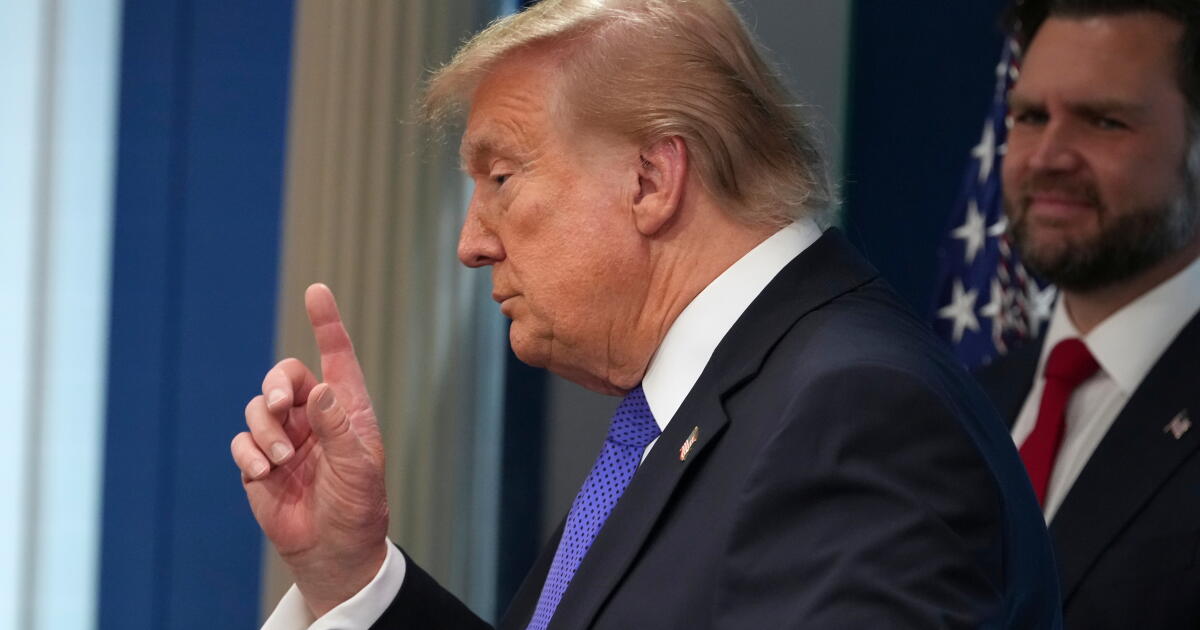
A federal appeals court on Monday gave President Trump a new pathway to erasing his hush money criminal conviction, moving the case to a federal court where he could seek to have it dismissed on immunity grounds.

A three-judge panel of the 2nd U.S. Circuit Court of Appeals reversed a lower court decision that had kept the case in state court in New York, where Trump was tried and convicted on 34 felony counts of falsifying business records to obscure a $130,000 payment to adult film performer Stormy Daniels.

The panel ordered a lower court to promptly issue a decision on whether the case should remain in federal court. If that happens, Trump could then argue that verdict should be discarded because of presidential immunity.

The decision also set in motion a halt to proceedings in Trump’s simultaneous state court appeal. Trump denies wrongdoing and was given no punishment in the case, which made him the first U.S. president convicted of a crime.

In a two-page order, the 2nd Circuit panel said it disagreed with the late U.S. District Judge Alvin Hellerstein’s earlier denial of Trump’s request to move the historic case from state court to federal court, a process known as removal.

The appellate judges ruled that Hellerstein “erred in holding that removal is categorically unavailable in a state criminal case” after a conviction and erred in denying that Trump had good cause to make two attempts at moving the case — once after his indictment and again after his trial.

The ruling came a week after 2nd Circuit Judges Raymond J. Lohier Jr., John M. Walker Jr. and José A. Cabranes spent more than an hour questioning Trump’s lawyer and a state prosecutor on the matter.

Lohier and Cabranes were appointed by Democrats. Walker was appointed by a Republican.

In a statement, a spokesperson for Trump’s legal team said the president “appreciates the 2nd Circuit’s prompt and correct ruling, as he continues to win against Democrat weaponization of our Justice System.”

The Manhattan district attorney’s office, which prosecuted the case, declined to comment.

Trump’s lawyer, Robert Giuffra Jr., had urged the judges to rule swiftly, arguing that without federal court intervention, the president “will likely have to wait years” for state appellate courts to rule before he can take the matter to the U.S. Supreme Court.

Steven Wu, chief of the appeals division at the Manhattan D.A’.s office, urged the 2nd Circuit panel to uphold Hellerstein’s ruling and leave the case in state court.

Trump had been waging a traditional appeal through New York’s state court system, which included arguments before the mid-level Appellate Division on Nov. 5. That court has yet to rule and could be prevented from doing so indefinitely under Monday’s ruling.

Trump asked the 2nd Circuit to step in after a federal judge in August ruled against the president for a third time. Hellerstein, who died last month at 92, wrote in his decision that “paying hush money to an adult film star or engaging in a cover-up of an embarrassment are not subsumed in presidential immunity.”

Trump first sought to move the case to federal court weeks after he was indicted in March 2023. He tried again after his conviction and the Supreme Court’s July 2024 ruling that presidents and ex-presidents can’t be prosecuted for official acts and prosecutors can’t use official acts as evidence that unofficial actions were illegal.

After Trump appealed Hellerstein’s second denial, the 2nd Circuit ordered the judge to reconsider, finding that he had failed to weigh “important issues relevant” to the president’s request to move the case.

That panel, which also included Lohier, said it expressed no view on how he should rule but instructed Hellerstein to closely review evidence that Trump claimed was related to official acts and whether Trump could argue those actions were taken as part of his White House duties.

Giuffra told the 2nd Circuit panel last week that prosecutors at Trump’s trial had used the type of official acts evidence that was later barred by the Supreme Court’s immunity ruling, including testimony about his Oval Office conversations, workflow and social media posts.

Giuffra also took issue with the prosecution’s description of the hush money payment as an illegal campaign contribution under the Federal Election Campaign Act, arguing that such allegations belong in federal court, not state court.

Sisak writes for the Associated Press.
Source link

Court weighs Trump’s appeal in the Stormy Daniels hush money case

New York appeals judges grilled President Trump’s lawyers and prosecutors Thursday about his bid to erase his historic hush money conviction, but the court didn’t signal how or when it would rule.

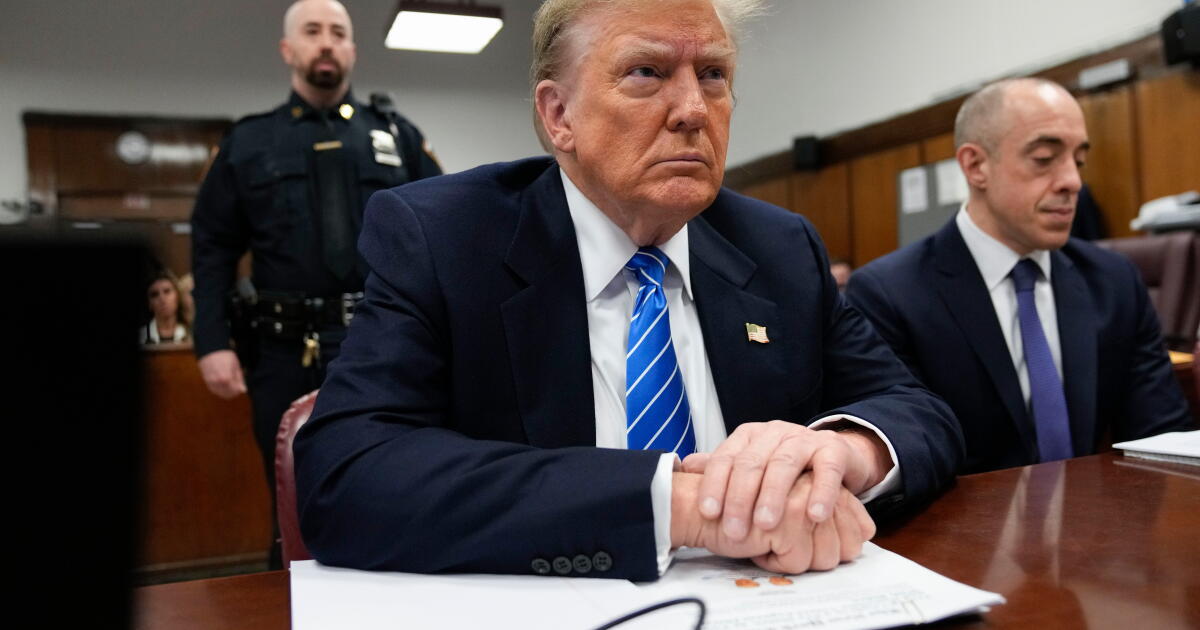
The judges delved into legal theory, presidential immunity and some evidence in Trump’s 2024 trial. Convicted of 34 felony counts of falsifying business records to obscure a $130,000 payment to adult film performer Stormy Daniels, Trump denies any wrongdoing. He has turned to state and federal courts in hopes of unwinding the verdict.

Trump, who denounced the case on social media as recently as September, didn’t attend Thursday’s court session.

Much of the back-and-forth focused on prosecutors’ theory that the hush money was meant to keep unflattering information about Trump away from the electorate before the 2016 vote, and that it amounted to an illegal campaign contribution under the Federal Election Campaign Act.

Trump lawyer Robert Giuffra Jr. told the judges that Manhattan Dist. Atty. Alvin Bragg’s office has no place tying a case to a federal election law.

“We think it’s the most obvious ground for reversal,” he said.

Prosecutors argued that they weren’t prosecuting an alleged federal campaign finance offense, but rather presenting it as a factor underlying what they claim was a Trump-orchestrated conspiracy.

“So are you relying upon FECA in order to prove your falsifying business records [charge]?” Justice Troy Webber asked.

“Only partially,” replied Bragg’s appeals chief, Steven Wu, adding that it was “important only to show that the purpose for the falsifying business records here was to conceal that conspiracy.”

Judges drill down on question about White House conversations

The appeal also concerns whether jurors should have been allowed to hear testimony about supposed White House workflow and conversations — some with then-Communications Director Hope Hicks — and even Trump social media posts during his first term. His lawyers cite presidential immunity for official acts, and they argue his official conduct included responding to the Daniels drama once it became public in 2018.

“Ms. Hicks was serving as a White House official,” talking with the president about how to respond to press inquiries that implicitly concerned his fitness for office, Giuffra told the appeals judges.

Wu countered later: “In this conversation, they were not speaking about a press response. … The president was talking to her about his private opinion.”

The appeals judges pressed both sides about the matter and the specifics of Hicks’ testimony. She told jurors that she asked Trump how he wanted to respond, but as for what he said, she testified only that he expressed relief that the Daniels story hadn’t emerged during the campaign.

Bragg’s office contends that all the White House-related evidence was fair game. The conversations were “unofficial conduct,” some of the other evidence was public record, and some was a general description of office practices, prosecutors say. They maintain that even if some of the evidence should have been excluded, its admission was a “harmless error” that doesn’t warrant overturning a conviction that rested on “a mountain” of other proof against Trump.

Justice Bahaati E. Pitt-Burke wondered aloud about that.

“If you take all of those things cumulatively, right, and there’s a problem with this evidence, there’s a problem with this evidence, at what point … does it stop being harmless error and turn into something else?” she asked.

“It would have to be a lot more than there was in this case,” Wu responded.

Trump’s lawyers also have argued the case was political

While the appeal turns on complex legal disputes, political overtones aren’t hard to find. The very first paragraph of one of the Trump team’s court filings contended that the case was the flimsy product of “immense political pressure” on a Democratic prosecutor to go after Trump — rhetoric that echoes the Republican president’s own oft-repeated claims in the court of public opinion.

The May 2024 verdict made Trump the first former — and now current — U.S. president with a criminal conviction. Though historic, it didn’t impede his return to the White House or subject him to any punishment.

The trial involved $130,000 that Daniels got from Trump’s then-fixer and lawyer, Michael Cohen, weeks before the 2016 election. The money bought, for a time, her silence about an alleged sexual encounter with the married Trump a decade earlier. He says that nothing sexual happened between them.

Trump’s company reimbursed Cohen in 2017, logging those payments as legal expenses.

Trump’s lawyers argue there’s only “weak” evidence that he even knew about Cohen’s dealings at the time. His trial attorneys also said that payments to Cohen were indeed legal expenses, and that any hush money expended on Trump’s behalf wasn’t hidden campaign spending, just an effort to avoid embarrassing his family.

The distinction matters because, under New York law, falsifying business records isn’t a felony unless it’s done with an intent to commit or conceal a separate crime.

While pursuing his state appeal, Trump also has been trying to shift the case to federal court and have it dismissed on immunity grounds. A federal judge said no — for the third time — in August. Trump’s attorneys are appealing that decision, with arguments set for Nov. 16.

Peltz and Sisak write for the Associated Press.

Source link