humor

Michael Che’s sense of humor is definitely darker than Weekend Update

It has been five years since Michael Che’s last stand-up special. Of course, he has a good excuse, being busy much of the year co-writing and performing “Weekend Update” on “Saturday Night Live,” and he also wrote and starred in two series of his acclaimed sketch comedy show, “That Damn Michael Che.”

But he feels more like himself on the stage, he said in a recent interview. “I really miss stand-up when I’m not doing it because I can really let loose on stage and say all the words I want,” he says.

In his new Netflix hour, with the pointed title, “Michael Che: Shot in Minnesota,” he wastes no time in getting into it, opening with a series of jokes saying a lot of words about Charlie Kirk’s murder: He believes that it happened because “straight white conservative Christian men are being silenced.”

He clearly loves poking at people’s sensitive spots. His favorite joke, he says onstage, is, “Men want anal sex the way women want a sensitive man. It just sounds nice… until you see them crying.”

He talks about race (“I don’t care what color you are — if you’re rich, you’re white”) and goes after President Trump and people who try to police language, but he also talks up how much fun he had at a Pride parade and about growing up poor, with his mother cleaning houses to help make ends meet. In our interview done via Zoom (without a camera on) while he was stuck in traffic on the way to 30 Rockefeller Center and then in an elevator and then in the SNL offices, he discussed it all.

This interview has been edited for length and clarity.

Did anyone in your family shape your humor and your storytelling?

My family has a different kind of humor. It’s a little meaner, if I’m being honest with you.

I’d like to see Thanksgiving at your house.

A lot of people would. It’s kind of crazy.

But the one person was my grandfather who was a pastor. He knew how to hold court and tell a story and he was a funny guy. He could be silly or absurd or dry. So maybe there’s a lot of him in what I do. But he did it week after week with different material.

Speaking of week after week, which is closer to your real self, the “Weekend Update” persona or your stand-up persona?

The stand-up is the most me; “Update” is a job and it’s a character. On stage you get to hear more nuances — on “Weekend Update” it’s a short segment, and I’m splitting time with Colin and guests. There are more needs being met than just mine. I say that respectfully, but there are things we have to touch on that I wouldn’t in my personal work and there are things other people write so it’s never all me.

I can listen, I can build, I can take you on a journey, I can make you think this is a bad joke, but it’s actually a good joke. I can make you think it’s a dirty joke, but it’s a clean joke.

I miss doing stand-up full time, but maybe that’s only because I don’t do it full time. But maybe if I did it full time, I’d miss doing it part time. Getting this hour together for the special, Lorne [Michaels, SNL’s iconic boss] was nice enough to let me go on the road even during show weeks, and he didn’t ask as much of me this past season. He was really kind, and I really appreciate it.

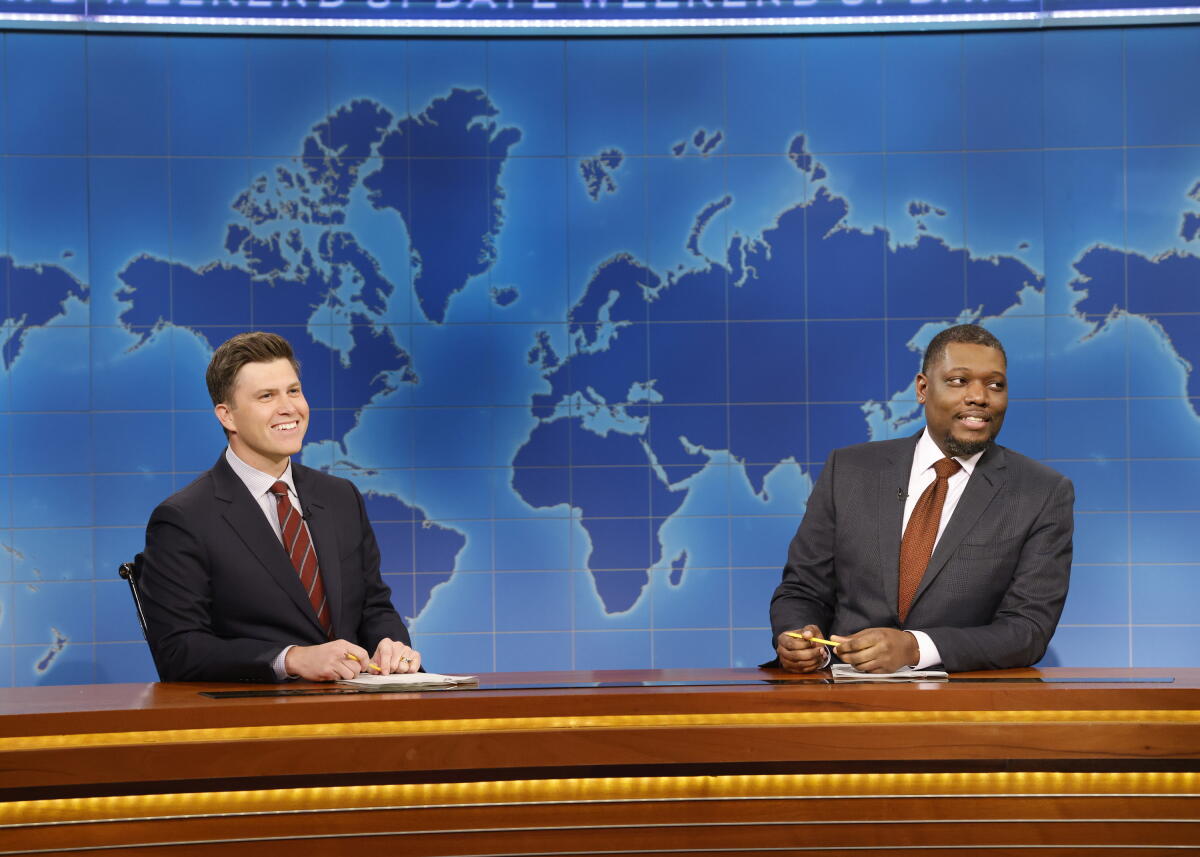
Colin Jost and Michael Che on "Saturday Night Live" sitting on the Weekend Update desk,

Colin Jost, left, and Michael Che on “Weekend Update” on “Saturday Night Live” on Saturday, March 11, 2023. Che has been doing “Weekend Update” for 12 years, as has Jost.

(Will Heath / NBC)

Your stand-up persona is definitely more thoughtful and open-minded than your “Weekend Update” one. Are you conscious of revealing yourself onstage or just thinking about what’s funny?

They tell you in the criminal world that the longer you talk to the police the more chances there are you’re going to reveal something. And I feel like it’s true for comedy, too. A lot of the stuff that I do is just thoughts that we haven’t said out loud and explored yet. I start with the thought, and if I can get a joke, a one liner out of the thought, that’s then I start to explore it onstage. I only write one line because I can’t write in a vacuum. I need to be able to listen to see what an audience gives me; otherwise, I only know how it makes me feel.

You open this special with that riff on Charlie Kirk’s murder. Your audience is not filled with Turning Point members, but people still may be hesitant to laugh. Are you starting there to challenge yourself or challenge your audience, or is it just because you think it’s funny?

I think all three of those things can be true. Those jokes are funny, but it is hard to laugh at. That’s the sort of feat I seek to pull off, to make people laugh about things that they’re not necessarily expecting to hear without being gross and gratuitous. I did those jokes on Shane Gillis’ show and his audience reacted favorably.

None of this is to make any kind of larger point other than I want you to laugh at the things that horrify you. It’s just horrifying on the surface so people think you can’t make a joke about it. People are afraid of the attempt. And I say, “Well, what about this one?” I do like that.

Then you move on to the R-word and the N-word. Are you simply pushing buttons for laughs or pushing people to think about their own biases and preconceptions about language and their political sensibilities?

I don’t want to let words dictate my next emotions. I want you to put the responsibility of self-control on yourself. People are going to say nasty things literally just to get a rise out of you, and it’s up to you to decide how you’re going to handle that. Also, I’m trying to be consistent. If I start with jokes about Charlie Kirk, but then somebody wants to call me the N-word, I can’t say, “Well, that’s crossing the line.” Right now there ain’t no more lines. We’re in a culture war and bombs are going to fly. So let’s see who’s got the stomach for it.

When you refer to a guy buying you drinks in a bar as “visibly gay,” the audience gets uncomfortably quiet in a way. How do you feel when they hush over a line like that?

With a lot of these jokes it’s like dribbling a football, you just don’t know where it’s going to land. But I like putting people on their heels and being a Black comic of my generation, they expect the joke to go one way because they’ve heard the jokes that come from others so they’re apprehensive. I expect them to be apprehensive and then talk them through it. When the joke lands differently with a punchline they’re not expecting, they’re pleasantly surprised.
Source link

Nimesh Patel’s ‘Buy the dip’ finds humor and hope in a country in crisis

Nimesh Patel’s stock in comedy has been on an upswing lately. From sold-out shows to a skyrocketing social media following and the release of his first Netflix special, “Buy the Dip,” last month, it’s been amazing the difference a year makes. The new hour filmed in Washington, D.C., delivers surgically precise, dryly delivered jokes and personal stories about America falling apart from the heart of our nation’s capital.

Despite the dire circumstances, it’s in our country’s DNA to believe in the power of the rebound. So does Patel, who’s seen one play out with his own career after taking an unexpected hit. Last fall, the comedian faced public backlash for his decision to accept — and then reject — a spot on the controversial Riyadh Comedy Festival, for which he’d been offered $125,000 to perform along with major names like Dave Chappelle, Bill Burr, Sebastian Maniscalco, Whitney Cummings and many more. The rollout of a comedy festival in Saudi Arabia, a nation whose government has been accused of human rights abuses and, according to U.S. intelligence, the brutal murder of journalist Jamal Khashoggi at its consulate in Turkey, lead to a war of words on the internet aimed at the comedians on the lineup. Hearing the scrutiny loud and clear and ultimately deciding the money wasn’t worth it, Patel decided to pull out and tell the world via Instagram that he wasn’t going, opting instead (and somewhat grudgingly) to make up for the lost bag with 40 extra shows added to his nationwide theater tour. The response to his video announcement drew even more ire from comedy fans. Looking back on it now, he admits his delivery at the time, looking tired and somewhat annoyed by his own decision, wasn’t the greatest.

“People read that as sarcasm and like woe is me,” Patel said in a recent conversation with The Times over Zoom. “I can see why they thought that I was a poor actor in the video that I posted. But everyone acts better than the person they see on the screen until it becomes their life and then they’re like, ‘Oh s—, yeah, I probably would have done the same thing.’ So, f— them!”

Despite the roasting he received, Patel stuck to his word and did the shows. Stepping on stage night after night to earn the money he had planned on making last year from one canceled gig in Saudi Arabia gave him the reps he says he needed to perfect the new hour of material. The title “Buy the Dip” is a nod to the remnants of his former career in finance — it’s stock market terminology about buying a failing asset with the hope that it will go up in value again. But it also describes the optimism from which he now makes his decisions as a parent and as someone who still believes that things can get better, even at their lowest.

“I have to be an optimist, I have to believe the world is getting better, because otherwise, what the f— did I do by having a kid?” he said.

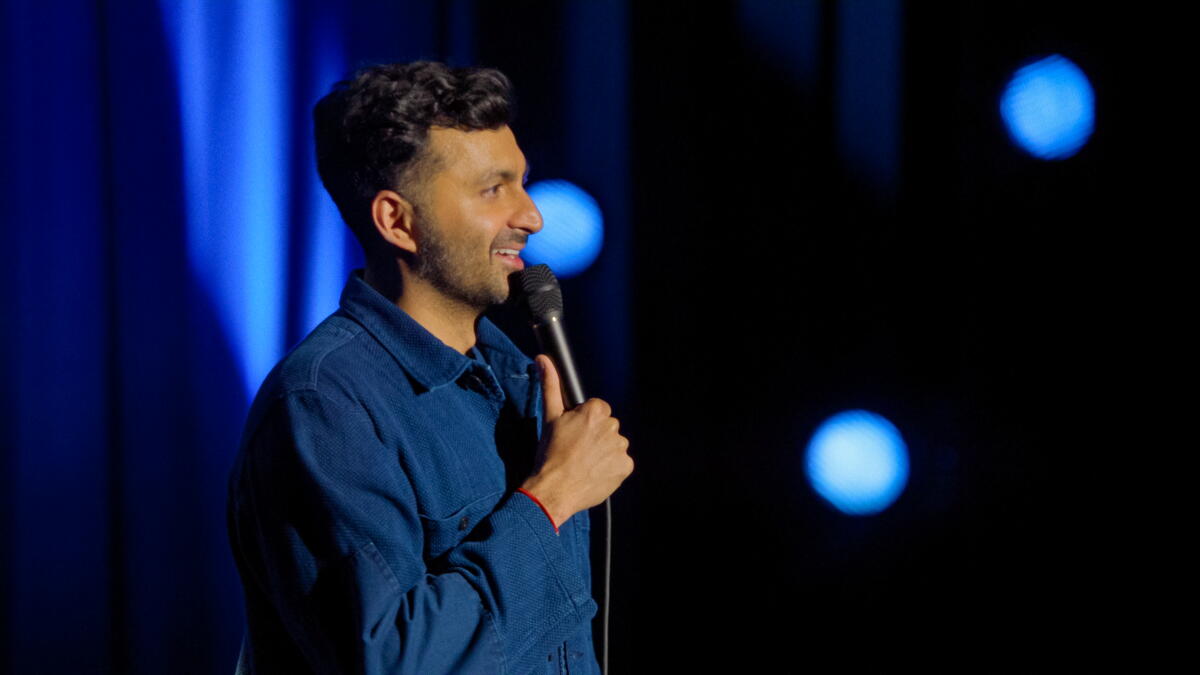
Comedian Nimesh Patel on stage during his special

In his Netflix debut special, “Buy the Dip,” comedian Nimesh Patel turns personal setbacks and a troubled America into sharply observed jokes grounded in unexpected optimism.

(Courtesy of Netflix)

His belief in positivity followed him to D.C. to record the special, the town where he says he got his first big breaks as a comedian opening for major acts like Maz Jobrani at the Warner Theatre, headlining the Bier Baron and the DC Improv and even the Kennedy Center — “or the now-defunct Trump whatever you’re supposed to call it,” he joked. When it comes to his comedy trajectory, taking the long view is essential to realizing that Patel’s path to this special started over a decade ago when Chris Rock discovered him while on stage in Brooklyn and helped him get writing gigs on “Saturday Night Live” and the 2016 Oscars ceremony, two opportunities that solidified his resolve to go into comedy full-time after he lost his job in finance.

As an Indian American comedian, he knows there is a spotlight of cultural representation on him, which he notes in the special and even makes fun of. That kind of attention isn’t on just him but also on Indian Americans in even higher-profile jobs, such as, say, the first Indian American director of the FBI, the chronically embattled Kash Patel.

“Let me be clear, it’s really difficult to both be proud of Kash and despise him at the same time,” Patel says. On the one hand, there’s the astonishing feat of going from being one of the few Indian kids in Virginia amid post-9/11 racism to becoming head of the nation’s domestic intelligence agency. On the other there’s a career riddled with gaffes and allegedly immoral conduct that makes him an easy punching bag for the writers at “SNL” with the help of his late-night TV doppelganger Aziz Ansari.

“For him to go from that to then be serving the country at this level, that is an incredible achievement, and it’s just so sad that that is who our representative is at the moment,” Patel said. “Just like when an Uber driver says to me, ‘Your last name is Patel? Like Kash?’ I’m like, ‘Yeah, just like that, but not like that at all, you know?’”

Nimesh Patel on stage performing his special

Patel revisits the backlash he faced after accepting, then withdrawing from, Saudi Arabia’s Riyadh Comedy Festival, and how dozens of extra tour dates helped shape his new material.

(Courtesy of Netflix)

While trying to distance himself from one person who shares his family name, when it comes to his actual family, Patel has plenty of jokes of being too close to them. Like many millennials, he’s squeezed tight between caring for aging parents and raising a child. At 40, he says in the special that people in his age bracket have become the “Sandwich Generation.” Though, to be fair to his toddler, keeping track of his parents is a much harder task at times.

“They won’t take help. They’re very independent, and I imagine I was the same way when I was growing up,” Patel said. “So it’s that in itself is just like the Progressive commercial that we’re all becoming our parents, but in real life and not driven by a corporate marketing team. It’s just funny to see that play out.”

Whether the obstacles he faces in life are laugh-out-loud funny or career hurdles that threaten to topple him into the abyss, the idea that he can always bounce back is the key to staying unfazed during the highs and the lows of life. And to the extent that anyone can take a lesson from Patel in the art of staying even-keeled, he hopes the special will make people feel a little less bad about the country being on the brink of destruction.

“Everyone knows that we’re not in a good spot right now,” he said. “The dip is here now. I fully believe that we can recover, I hope that we can. It’s going to be a lot of pain. I don’t know if we’re at the bottom just yet, but I’m optimistic, and I have to be. Otherwise, I don’t know what I’m doing.”

Source link