Hong Kong’s Security Bureau announces measures over activists’ alleged role in unofficial parliament overseas.
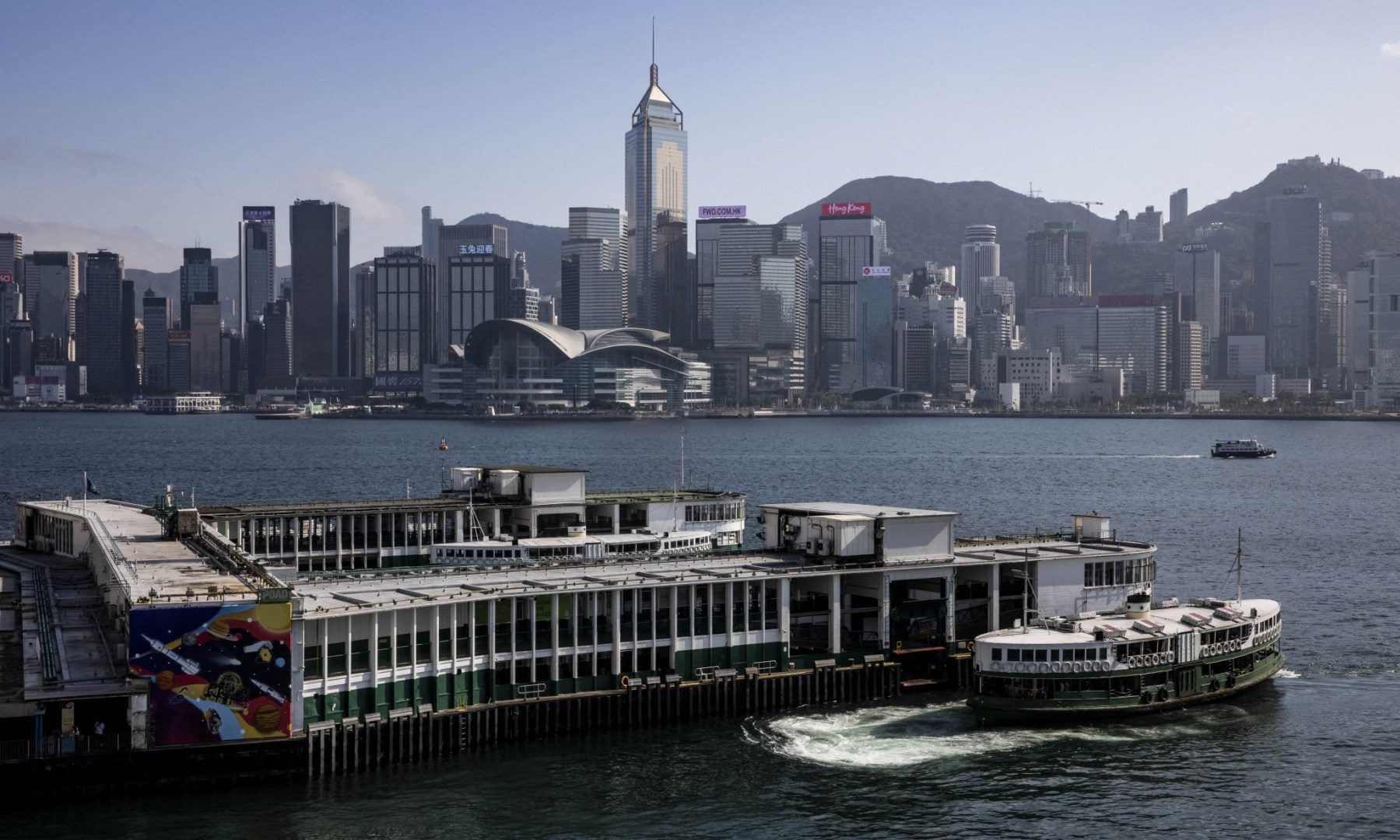
Hong Kong authorities have cancelled the passports of 12 activists based overseas in their latest crackdown on activities that they claim pose threats to national security.
Hong Kong’s Security Bureau announced the measures on Monday after a local court issued arrest warrants last month for the 12 activists and seven other pro-democracy campaigners over their alleged roles in establishing an unofficial parliament overseas.
The bureau said it had also banned individuals from providing financial support or leasing property to 16 of the “absconders,” and entering into joint ventures or partnerships with them.
The wanted activists include Chongyi Feng, an Australian citizen and professor at the University of Technology Sydney, and Sasha Gong, a United States citizen and journalist who previously worked for Voice of America.
Hong Kong authorities allege that the 19 activists’ participation in the “Hong Kong Parliament” advocacy group constitutes subversion under the Chinese-ruled city’s sweeping national security law.
A Hong Kong government spokesperson said the activists had continued to “blatantly engage in activities that endanger national security” while hiding in countries including the United States, the United Kingdom, Canada, and Australia.
The Hong Kong parliament condemned last month’s announcement of arrest warrants and bounties for the campaigners as a “blatant abuse of legal instruments to pursue political persecution”.
“These actions represent a clear escalation of Beijing’s transnational repression, extending its coercive reach beyond China’s borders and infringing upon the sovereignty of democratic nations, including the United Kingdom, the United States, Canada, Australia, and members of the European Union,” the group said.
Once known for its spirited political opposition and media, Hong Kong has radically curtailed the space for dissent since the introduction of a sweeping Beijing-decreed national security law in 2020 in response to violent anti-government protests.
Opposition parties have been effectively eliminated from the city’s legislature, and public commemorations of sensitive events, such as the 1989 Tiananmen Square massacre, essentially outlawed.
Hong Kong Chief Executive John Lee said last month that 332 individuals had been arrested for national offences since 2020.
Mainland Chinese and Hong Kong officials have defended the law, and additional national security legislation introduced in 2024, as necessary to restore stability to the city after the turmoil caused by the mass protests.
When I was a freshman at Columbia University in 1999, the professor of my Literature Humanities course shared some personal information with my class, which was that she slept exactly three hours per night. I forget what prompted the disclosure, though I do recall it was made not to elicit pity but rather as a matter-of-fact explanation of the way things were: sleeping more than three hours a night simply did not allow her sufficient time to simultaneously maintain her professorship and tend to her baby.
This, of course, was before the era of smartphones took the phenomenon of rampant sleep deprivation to another level. But modern life has long been characterised by a lack of proper sleep – an activity that happens to be fundamental to life itself.
I personally cannot count the times I have awakened at one or two o’clock in the morning to work, unable to banish from my brain the capitalist guilt at engaging in necessary restorative rest rather than being, you know, “productive” 24 hours a day.
And yet mine is a privileged variety of semi-self-imposed sleep deprivation; I am not, for example, being denied adequate rest because I have to work three jobs to put food on the table for my family.
According to the Centers for Disease Control and Prevention (CDC), the national public health agency of the United States, approximately one-third of US adults and children under the age of 14 get insufficient sleep, putting them at increased risk for anxiety, depression, heart disease, and a host of other potentially life-threatening maladies. As per CDC calculations, a full 75 percent of US high schoolers do not sleep enough.
While the recommended amount of sleep for adults is at least seven hours per day, a 2024 Gallup poll reported that 20 percent of US adults were getting five hours or less – a trend attributable in part to rising stress levels among the population.
To be sure, it’s easy to feel stressed out when your government appears more interested in sending billions upon billions of dollars to Israel to assist in the ongoing genocide of Palestinians in the Gaza Strip than in, say, facilitating existence for Americans by offering healthcare, education, and housing options that don’t require folks to work themselves to death to afford.
Then again, pervasive stress and anxiety work just fine for those sectors of the for-profit medical establishment that make bank off of treating such afflictions.
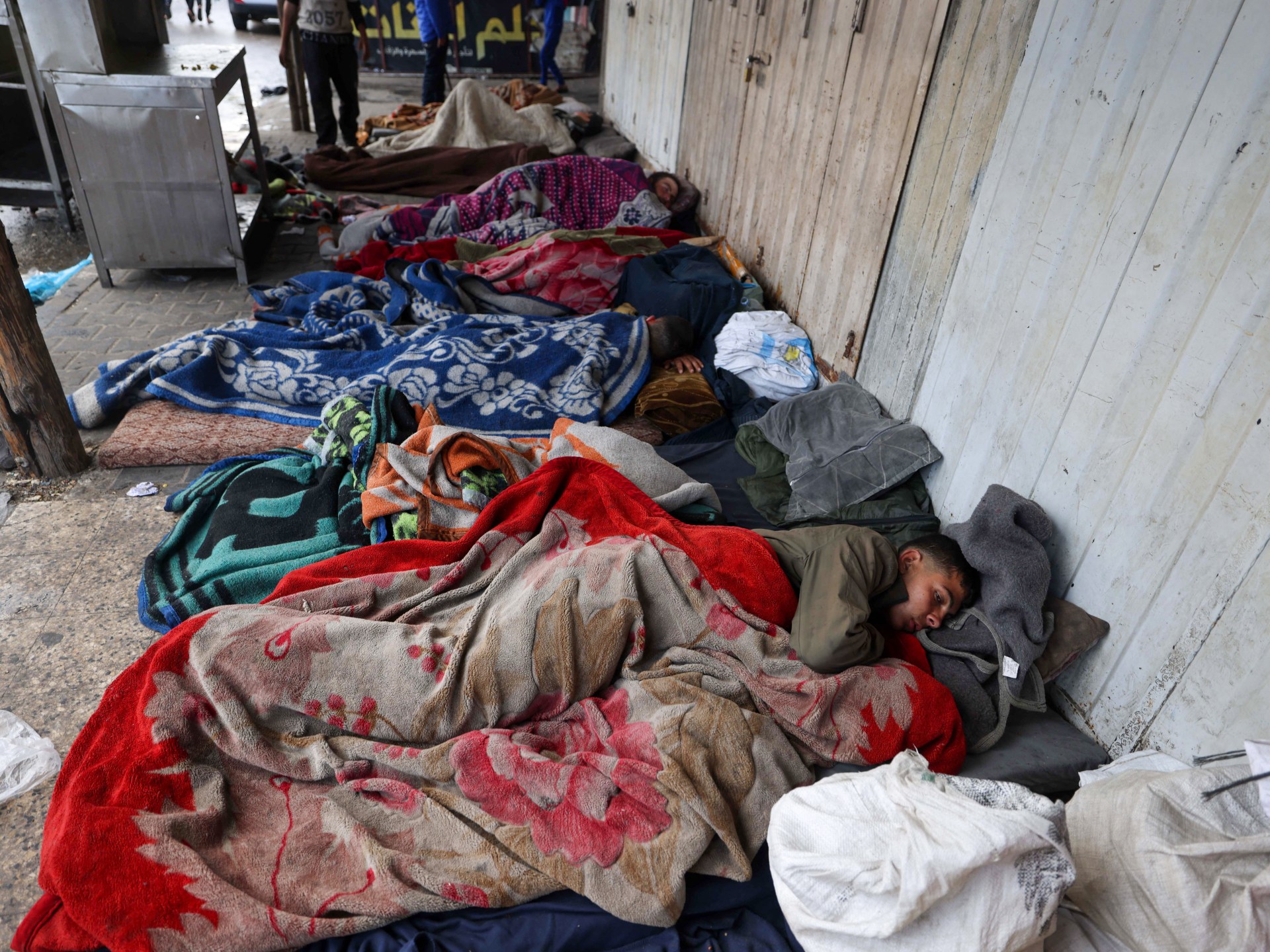
Meanwhile, speaking of the Gaza Strip, residents of the occupied territory are well acquainted with acute sleep deprivation, which is currently a component of the Israeli military’s genocidal arsenal for wearing Palestinians down both physically and psychologically. Not that a good night’s sleep in Gaza was ever really within the realm of possibility – even prior to the launch of the all-out genocide in 2023 – given Israel’s decades-long terrorisation of the Strip via periodic bombardments, massacres, sonic booms, the ubiquitous deployment of buzzing drones, and other manoeuvres designed to inflict individual and collective trauma.
A study on trauma and sleep disruption in Gaza – conducted in November 2024 and published this year in the peer-reviewed journal BMC Psychology – notes that, in the present context of Israel’s round-the-clock assault, “the act of falling asleep is imbued with existential dread”. The study quotes one Gaza mother who had already lost three of her seven children to Israeli bombings: “Every time I close my eyes, I see my children in front of me, so I’m afraid to sleep.”
Of course, Israel’s penchant for killing entire families in their sleep no doubt exacerbates the fear associated with it. The study observes that children in Gaza have been “stripped of the simple peace that sleep should offer, forced to endure nightmares born from real-life horrors”, while overcrowded shelters have rendered the pursuit of shut-eye ever more elusive.
Furthermore, mass forced displacement in the Gaza Strip “has deprived families of their homes, severing the link between sleep and security”.
A recent article in the American Medical Association Journal of Ethics argues that sleep is a human right that is integral to human health – and that its deprivation is torture. It seems we can thus go ahead and add mass torture to the list of US-backed Israeli atrocities in Gaza.
Naturally, the US has engaged in plenty of do-it-yourself torture over the years, as well, including against detainees in Guantanamo Bay – where sleep deprivation was standard practice along with waterboarding, “rectal rehydration”, and other so-called “enhanced interrogation techniques”.
In her 2022 study of sleep deprivation as a form of torture, published by the Maryland Law Review, Deena N Sharuk cites the case of Mohammed Jawad, an Afghan teenager imprisoned in Guantanamo Bay in 2003 and subjected to what was “referred to as the Frequent Flyer Program”, whereby detainees were repeatedly moved between cells in order to disrupt their sleep.
According to Sharuk, Jawad was moved “every three hours for fourteen consecutive days, totaling 112 moves”. The young man subsequently attempted suicide.
Now, the ever-expanding array of immigration detention facilities in the US offers new opportunities to withhold sleep, as victims of the country’s war on refuge seekers are crammed into cages illuminated at all hours by fluorescent lights.
And while a well-rested world would surely be a more serene one, such a prospect remains the stuff of dreams.
The views expressed in this article are the author’s own and do not necessarily reflect Al Jazeera’s editorial stance.
A TEEN boy who tortured, killed and dismembered two kittens with a girl in a warped bid to reduce his urge to kill a human has been locked up.
The depraved pair used rope to tie up the defenceless animals before “mutilating” them.
2
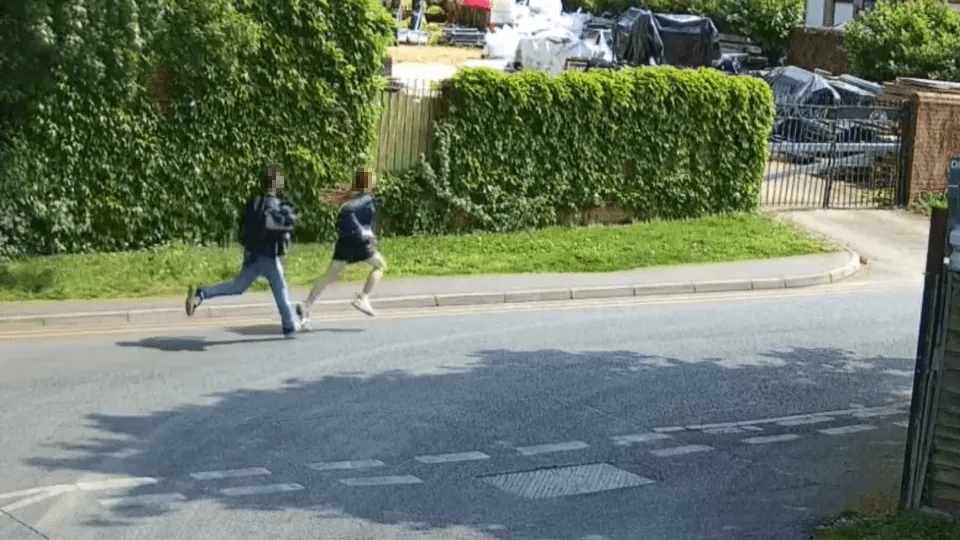
The teens were captured on CCTV carrying the animals
2
They later fled the scene after killing the animals
One of the kittens was found cut open on the ground in Ruislip, North West London, while the other was hanging from a tree.
Chillingly, the boy, 17, wrote how he “really wanted to murder someone” and killed cats to “reduce my urges”.
He also made a number of harrowing searches about sacrificing animals to Satan.
The boy has been detained for 12 months after pleading guilty to causing unnecessary suffering to the protected animals by “mutilating and killing” them.
His co-defendant will be sentenced for the same charge this afternoon.
The teens, who legally can’t be named, also admitted one count of possession of a knife.
Highbury Corner Magistrates’ Court was told the horror unfolded on May 3.
Footage released by police showed the girl, 16, and 17-year-old boy strolling through a residential street.
The boy could be seen clutching a bag that is believed to have been used to carry the kittens.
CCTV then captured the twisted pair running back down the same street after killing the baby cats.
Prosecutor Valerie Benjamin said the animals were discovered with their flesh and fur cut off and burnt.
As well as the tragic kittens, knives, blowtorches and scissors were found at the scene.
Police later discovered a note on the boy’s phone that read: “I really wanted to murder someone and I was searching how to get away with murder.
“I have come close.
“I have killed cats to reduce my urges.
“I have skinned strangled and stabbed cats.”
The boy had also carried out a number of chilling searches for “killing cats and dogs” and “how to kill a human”.
Ms Benjamin said: “There were concerns about his desire to go on to killing humans.
“He questioned how easy it would be get away with murder and how to kill homeless people.”
It also emerged the teens had chillingly put out adverts for the kittens and went to pick them up before killing them.
Sentencing, Judge Hina Rai also imposed a lifetime ban from caring for animals on the boy.
She said: “You have caused extreme suffering to those two kittens. You knew exactly what you were doing and it would result in their suffering.
“Without a doubt these are the most awful offences I have seen against animals in this court.”
President Dina Boluarte has blasted the Inter-American Court of Human Rights for its opposition to a recently passed bill that would grant amnesty to soldiers, police officers and other security personnel involved in Peru’s internal conflict from 1985 to 2000.
On Thursday, Boluarte asserted that the international court had overstepped its authority by seeking the law’s suspension.
“We are not anyone’s colony,” she said, posting a snippet of her speech to social media.
“And we will not allow the intervention of the Inter-American Court that intends to suspend a bill that seeks justice for members of our armed forces, our National Police and the self-defence committees that fought, risking their lives, against the insanity of terrorism.”
Since passing Peru’s Congress in July, the amnesty law has been awaiting Boluarte’s approval. She can either sign it into law, allow it to take effect automatically or send it back to Congress for revisions.
But the bill has prompted international outcry, not least because it is seen to shield security forces from accountability for the atrocities that unfolded during Peru’s war.
The legislation would also offer “humanitarian” amnesty to perpetrators over age 70 who have been convicted of wartime crimes.
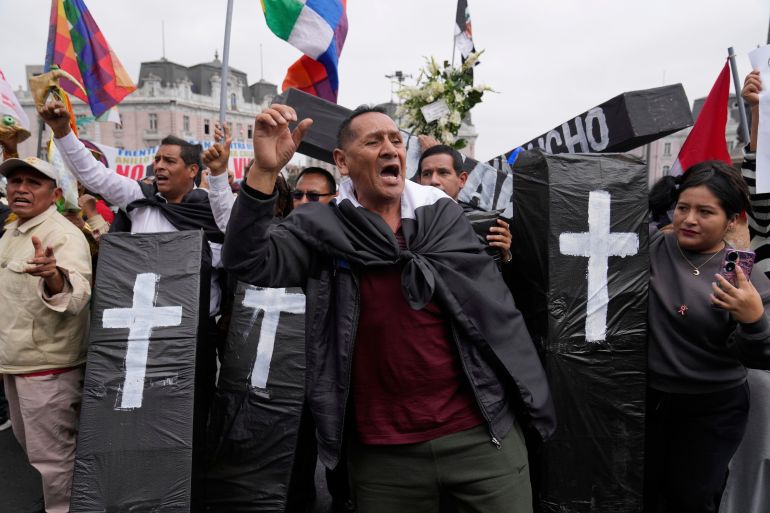
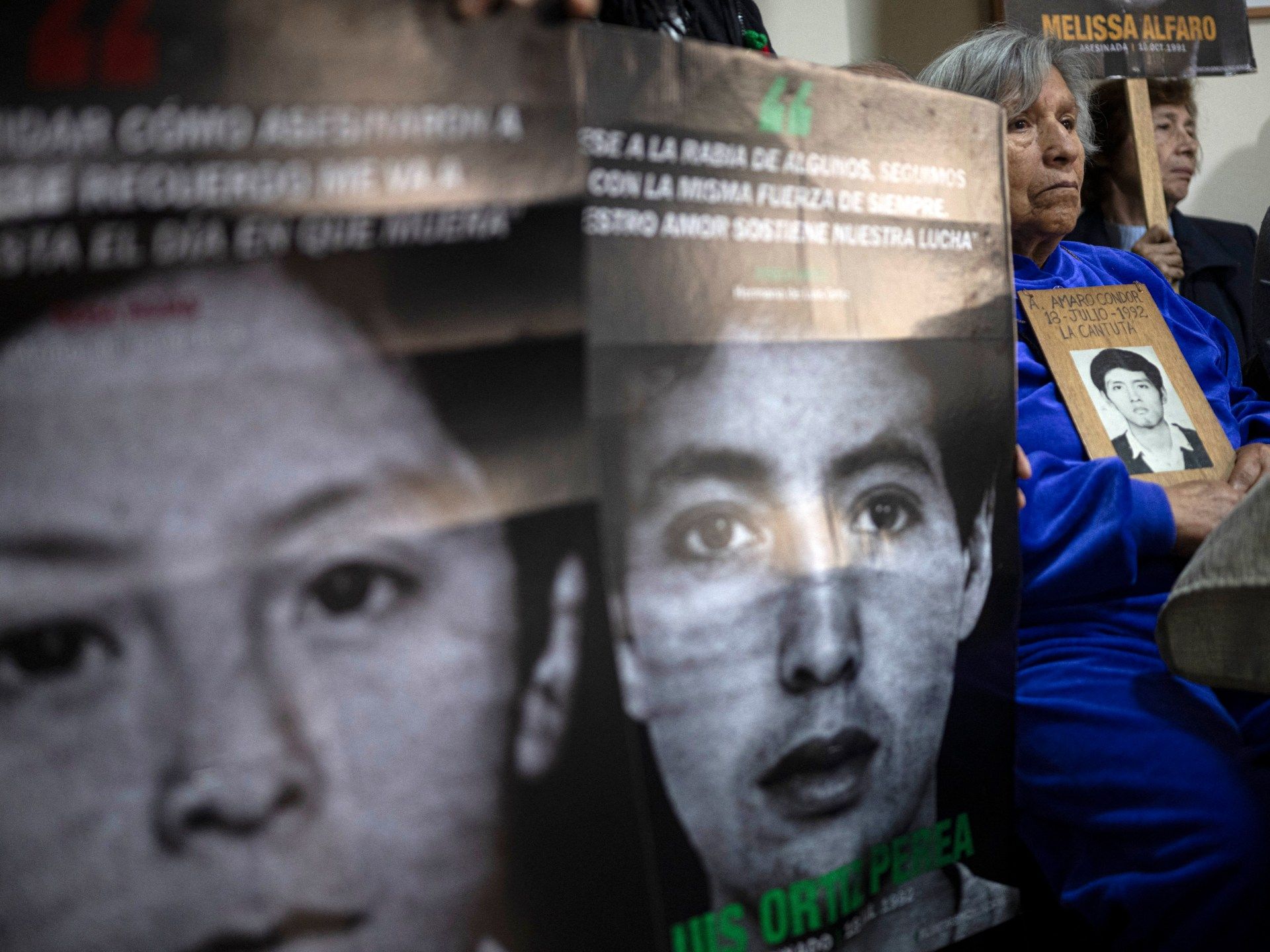
People carry fake coffins representing their relatives who died amid political violence, on July 28, 2025 [Martin Mejia/AP Photo]
Some 70,000 people were killed in the internal conflict, the majority of them from rural and Indigenous communities.
Soldiers and police officers were ostensibly tasked with combatting armed uprisings from rebel groups like the Shining Path and the Tupac Amaru Revolutionary Movement. But the conflict became infamous for its human rights abuses and massacres of civilians with no ties to any rebel group.
Francisco Ochoa was 14 years old when residents in his Andean village, Accomarca, were slaughtered by soldiers. He told Al Jazeera earlier this week that he and other survivors felt “outraged and betrayed” by the new amnesty law.
International organisations have likewise denounced the law as a step backwards for Peruvian society.
Nine human rights experts with the United Nations signed a statement on July 17 expressing “alarm” at the bill’s passage through Congress. They called on the government of Peru to veto the bill.
“The proposed legislation would prevent the criminal prosecution and condemnation of individuals who committed gross human rights violations during Peru’s internal armed conflict,” they said.
“It would put the State in clear breach of its obligations under international law.”
A week later, on July 24, the president of the Inter-American Court of Human Rights, Nancy Hernandez Lopez, ordered Peru to “immediately suspend the processing” of the bill. She ruled that the legislation violated previous rulings against such amnesty laws in the country.
“If it is not suspended, the competent authorities refrain from enforcing this law,” she said.
In previous rulings, the Inter-American Court has found that amnesty laws and statutes of limitations are unlawful in the case of serious human rights violations like forced disappearances and extrajudicial executions.
It also declared that age is not a disqualifying factor for suspects accused of grave human rights abuses. Such exemptions, the court said, are only acceptable under international law for lesser or nonviolent offences.
The National Human Rights Coordinator, a coalition of humanitarian groups in Peru, estimates that the country’s latest amnesty law could overturn 156 convictions and disrupt more than 600 ongoing investigations.
A previous amnesty law implemented in 1995, under then-President Alberto Fujimori, was later repealed.
Still, President Boluarte on Thursday sought to frame her government’s actions as in line with international human rights standards.
“We are defenders of human rights, of citizens,” she wrote on social media, while emphasising that her government was “free”, “sovereign” and “autonomous”, apparent jabs at the Inter-American Court’s decision.
Israeli-Palestinian human rights group B’Tselem has declared Israel’s actions in Gaza as genocide in its latest report, titled Our Genocide.
The report, released on Monday, carries strong condemnation of Israel’s war on Gaza, which has killed at least 59,733 people and wounded 144,477.
“An examination of Israel’s policy in the Gaza Strip and its horrific outcomes, together with statements by senior Israeli politicians and military commanders about the goals of the attack, leads to the unequivocal conclusion that Israel is taking coordinated action to intentionally destroy Palestinian society in the Gaza Strip,” the report reads.
“In other words: Israel is committing genocide against Palestinians in the Gaza Strip.”
An estimated 1,139 people died during the Hamas-led October 7, 2023, attacks on Israel, and some 200 were taken captive.
‘Our Genocide’
The report delves into Israeli violations against Palestinians, going back to the 1948 foundation of the Israeli state, which “had a clear objective from the outset: to cement the supremacy of the Jewish group across the entire territory under Israeli control”.
As such, the state of Israel exhibits “settler-colonial patterns, including widespread settlement involving displacement and dispossession, demographic engineering, ethnic cleansing and the imposition of military rule on Palestinians”, the report continues.
And while it looks back at Israel’s efforts to “uphold Jewish supremacy, relying on a false pretense of the rule of law while, in reality, the rights of the Palestinian subjects are left unprotected”, the report notes that this was accelerated after October 7.
The “broad, coordinated onslaught against Palestinians in the Gaza Strip” that the report points to has “enjoyed support, legitimization, and normalization from the majority of Jewish-Israelis, as well as from the Israeli legal system”.
The report also speaks about the intensified efforts since October 2024 to displace Palestinians in Gaza.
“Israel’s actions in northern Gaza were described by many experts … as an attempt to carry out ethnic cleansing. In practice, by November 2024, some 100,000 people who had lived in northern Gaza had been displaced from their homes,” the document reads.
The report goes beyond Gaza to say that Israel has intensified its violent operations in the occupied West Bank and occupied East Jerusalem since October 7, “on a scale not seen since Israel occupied the West Bank in 1967”.
B’Tselem first used the word “apartheid” in 2021 to describe the two-tier reality for Israelis and Palestinians in historic Palestine.
A child reacts during the funeral of Palestinians killed in an overnight Israeli strike, according to medics, at Nasser Hospital, in Khan Younis in the southern Gaza Strip, July 28, 2025 [Ramadan Abed/Reuters]
Genocide in words and actions
B’tselem’s report follows an op-ed in the New York Times by Holocaust scholar Amos Goldberg, where he described Israel’s actions in Gaza as genocide, as well as growing demonstrations by protesters in Israel calling for an end to the war.
However, opposition to Israel’s war on Gaza is still widely controversial in Israeli society. Only around 16 percent of Jewish Israelis believe peaceful coexistence with Palestinians is possible, according to a June poll by the Pew Research Center.
Meanwhile, 64 percent of Jewish Israelis believe Israel should temporarily occupy the Gaza Strip, according to a survey by the Jerusalem Center for Security and Foreign Affairs (JCFA).
Critics of stereotypical Israeli views include Israeli political commentator Ori Goldberg, a former university professor and national security consultant, who called these views “vile” on the social media platform X.
I was overcome yesterday. The vileness pouring out of Israeli society shut my mouth for 24 hours. It was an immediate reaction, not anger or sadness. I couldn’t speak. I broke out in hives for the first time since I was diagnosed. I think I tried to reject reality. I’m back.…
“I can only conclude that the pressures from within Israeli society are truly as great as Ori Goldberg recently noted,” Elia Ayoub, a writer, researcher, and the founder of the podcast The Fire These Times, told Al Jazeera.
“Israeli society has normalised a genocide for nearly two years, and this speaks to a deep moral rot at the core of their political culture,” he continued.
Meanwhile, Israeli government officials have continued their violent calls against the people of Gaza.
“The government is rushing to erase Gaza, and thank God we are erasing this evil. All of Gaza will be Jewish,” Heritage Minister Amichai Eliyahu said on Israeli radio last week.
Welcomed news, even if late
B’Tselem’s report runs 79 pages and documents interviews with numerous Palestinians in Gaza who have lived through the last 22 months of attacks.
That one of Israel’s most prominent human rights organisations described Israel’s actions in Gaza as genocide is bound to draw criticism of the group in Israeli society. Many Israeli critics of their own country’s actions in Gaza have faced brutal denunciations from their compatriots.
That makes B’Tselem using the weight of the word “genocide” all the more powerful, even if some believe it could have been done sooner.
“I welcome this news even though it comes very late into the genocide,” Ayoub said.
In December 2023, South Africa brought a case that Israel was committing genocide against Gaza to the International Court of Justice (ICJ). Several other countries, including Brazil, Spain, Turkiye and the Republic of Ireland, have joined South Africa in its ICJ case.
We are already living in the world where AI is a multitasker, not just a top-up. It has become an essential part of several aspects of modern life, from everyday convenience to cosmic ambition. It is reshaping our world and unlocking possibilities once confined to science fiction.
In this rapidly evolving landscape, it’s no surprise that the question, “Will AI replace my job?” has been on top of the mind for IT professionals for more than half a decade, and one thing is clear: the AI race has already kicked off; those who embrace it will be at the forefront, and those who delay will be left in the dust.
Today’s businesses seek AI-ready talent who combine technical expertise with human-centered thinking. This shift is clearly reflected in the actions of industry leaders: Microsoft CEO Satya Nadella noted that 20 to 30% of the code in some of their repositories is already generated by AI tools, while Meta CEO Mark Zuckerberg revealed plans for AI to handle half of Meta’s coding by 2026. He envisions a future where every engineer becomes more like a tech lead, working alongside their own “army” of AI agents, focusing on high-level strategy rather than executing every detail manually. These strategic moves highlight how AI is rapidly enhancing software development and emphasize the growing demand for professionals who can effectively collaborate with intelligent systems.
While we have seen minimal shift in workforce dynamics due to AI integration so far. Yet, most organizations are actively exploring ways to harness AI for more complex functions. Nonetheless, in some industries, this has already led to a slight decline in workforce numbers, with certain companies even halting the hiring of software engineers. As AI capabilities continue to advance at a rapid pace, it is no surprise that the question, “Will AI replace my job?” is becoming increasingly common, and it is a completely valid concern.
Although advanced AI technologies such as Gen AI, agentic AI, and edge AI perform well in generating expected outcomes, they often fall short when it comes to true innovation, scalability, and decision-making in complex environments.
In fact, OpenAI’s research team has recognized that AI models hallucinate in at least 58% of cases, generating incorrect or misleading data, which can lead to inconvenience and, in some cases, serious risks.
Despite these challenges, integrating AI appears essential; the most forward-thinking organizations see it not as a threat, but as a copilot.
Rather than fearing job loss, the 20 American Heartland States (which collectively form the world’s 3rd-largest economy) are investing in building an AI-driven workforce. Business and policy leaders are investing and partnering in providing training programs and educating on AI programs to upskill the heartland workforce for the AI-driven era.
Michigan’s Statewide Workforce Plan, by the Department of Labor and Economic Opportunity (LEO), published “AI and the Workforce Plan,” where they mentioned if Michigan takes the lead in developing AI strategy, infrastructure, and workforce training, the state could gain up to $70 billion in monetary impact and create 130,000 good-paying jobs, enabling individuals to focus on opportunities of growth with AI adoption.
Lieutenant Governor of Michigan Garlin Gilchrist II said, “Working with AI technology helps prepare our workforce to lead with the skills and tools Michiganders need to thrive in a rapidly evolving economy.”
The European Union has launched a €200 billion “InvestEU initiative” (one of the largest investments in AI history) to make the EU a leader in AI innovation by 2030. This investment is expected to boost Europe’s AI technology strength. This plan also includes investing in AI education and AI-ready talent.
AVPN (Asian Venture Philanthropy Network), one of the largest networks of social investors in Asia, invested $15 million in the AI Opportunity Fund, supported by Google.org and the Asian Development Bank. Under this initiative, they welcomed 10 strategic partners and later selected 49 additional organizations to equip underserved groups with AI skills and access.
In a post-AI world, where technology continues to transform the job landscape, the emergence of new skill sets will be critical in distinguishing competitive and resilient businesses. Those who act early and embrace AI’s potential will help shape a future that is not only innovative but also responsible. Industry leaders are increasingly recognizing that the true value of AI lies not merely in cost-cutting or reducing headcount, but in redirecting to take smarter strategic decisions, optimizing resources, and fostering stronger customer relationships. A truly dynamic future will emerge when we combine the power of AI with uniquely human strengths such as empathy, curiosity, and critical judgment to drive meaningful innovation, lasting connection, and significant productivity gains in the long term.
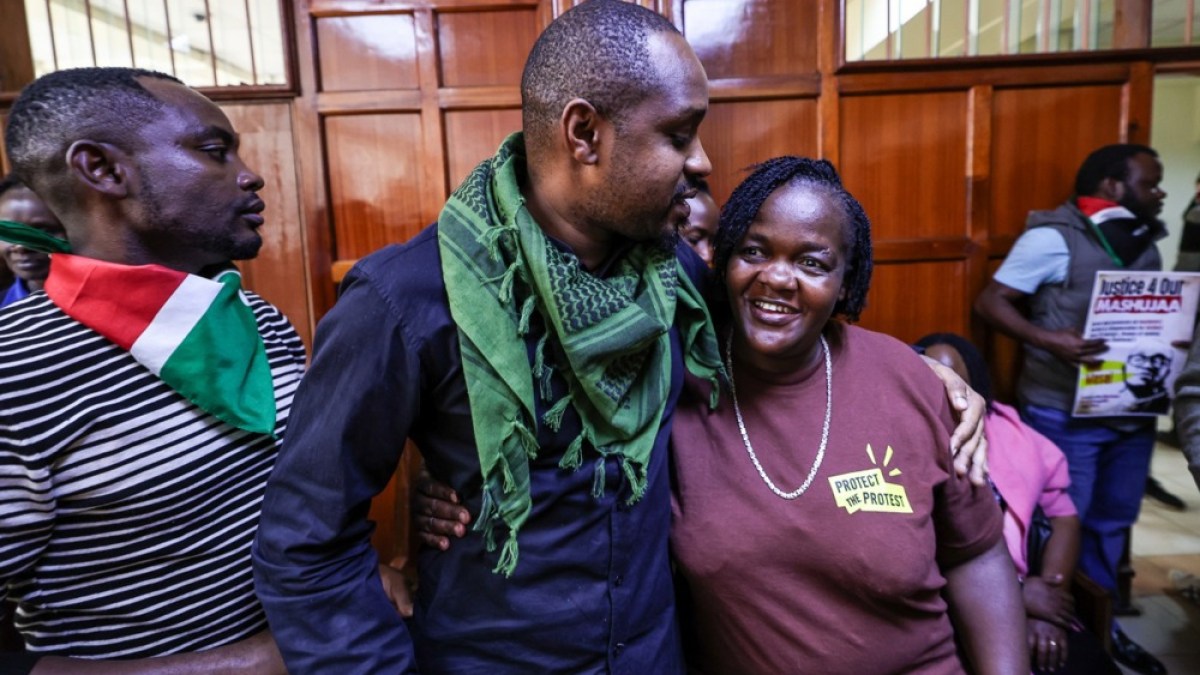
The prominent activist and former photojournalist is charged over alleged role in deadly antigovernment protests in June.
A prominent Kenyan human rights activist has been charged with unlawful possession of ammunition over his alleged role in deadly antigovernment protests in June.
Boniface Mwangi was charged by the police on Monday, two days after he was arrested and accused of possessing unused tear gas canisters, a “7.62mm blank round”, two mobile phones, a laptop and notebooks.
Kenya has been facing mass antigovernment protests across the country since last year – first against tax increases in a finance bill and later to demand the resignation of President William Ruto.
Since the protests broke out, police have been accused of human rights abuses, including allegations of government critics and activists being abducted and tortured.
Rights groups said more than 100 people have been killed in the protests, which have been harshly suppressed.
This month, at least 31 people were killed and more than 100 injured in a government crackdown on a protest. In June, at least 19 people were killed in a similar demonstration against Ruto.
Police accused Mwangi, a former photojournalist, of “facilitating terrorist acts” during the June protests and arrested him on Saturday. The activist denied the charges, saying in a social media post shared by his supporters: “I am not a terrorist.”
His arrest triggered a wave of condemnation online with the hashtag #FreeBonifaceMwangi going viral and rights groups condemning it.
The search warrant police used to raid Mwangi’s home, which an ally shared with journalists, accused the campaigner of having paid “goons” to stoke unrest at last month’s protests.
However, 37 rights organisations and dozens of activists said they have not yet managed to prove that a judge had issued that warrant.
Mwangi’s arrest on “unjustified terrorism allegations” represents an abuse of the justice system to crush the opposition, the organisations said in a joint statement.
“What began as targeted persecution of young protesters demanding accountability has metastasized into a full-scale assault on Kenya’s democracy,” the groups said.
In June last year, Al Jazeera’s digital documentary strand Close Up profiled Mwangi during a ferocious police crackdown. He then said his nickname online was the “People’s Watchman” because he was striving to get justice for the families of protesters killed by police.
Mwangi has been arrested multiple times in Kenya.
He was arrested on May 19 this year in Dar-es-Salaam, neighbouring Tanzania’s largest city, where he had travelled to support treason-accused Tanzanian opposition leader Tundu Lissu.
Both Mwangi and a fellow detainee, award-winning Ugandan activist Agather Atuhaire, accused the Tanzanian police of torturing and sexually abusing them while they were in custody.
The pair have brought a case before the East African Court of Justice.
Two groups of commercial pilots reject initial probe into the deadly June 12 crash, calling it a ‘reckless and unfounded insinuation’.
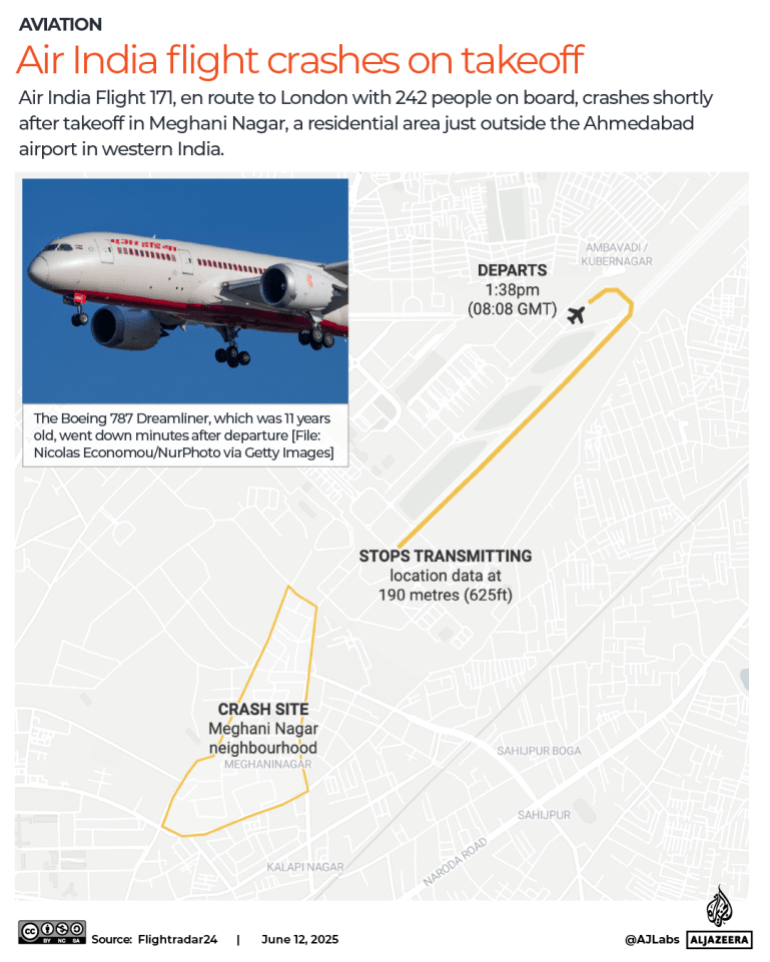
Two groups of commercial pilots have rejected claims that human error caused an Air India plane crash that killed 260 people after a preliminary investigation found the aircraft’s engine fuel switches had been turned off.
The Indian Commercial Pilots Association (ICPA) and the Airline Pilots’ Association of India (ALPA India) issued statements on Sunday after the release of the initial findings, which showed that fuel control switches to the engines of Flight AI171 were moved from the “run” to the “cutoff” position moments before last month’s deadly impact.
The report sparked speculation by several independent aviation experts that deliberate or inadvertent pilot action may have caused the Boeing 787-8 Dreamliner to crash soon after takeoff from Ahmedabad in western India.
Flight AI171 was headed to London’s Gatwick Airport when it crashed on June 12.
The report on the crash, issued on Saturday by India’s Aircraft Accident Investigation Bureau (AAIB), did not offer any conclusions or apportion blame for the disaster but indicated that one pilot asked the other why he cut off the fuel and the second pilot responded that he had not.
After the switches flipped, the Boeing 787 Dreamliner immediately began to lose thrust and altitude, according to the report.
One pilot can be heard on the cockpit voice recorder asking the other why he had cut off the fuel. “The other pilot responded that he did not do so,” the report said.
It did not identify which remarks were made by the flight’s captain and which by the first officer or which pilot transmitted “Mayday, Mayday, Mayday” just before the crash.
No more details about the cockpit dialogue between the pilots were revealed.
The ICPA said it was “deeply disturbed by speculative narratives, … particularly the reckless and unfounded insinuation of pilot suicide”.
“There is absolutely no basis for such a claim at this stage,” it said in a statement. “It is deeply insensitive to the individuals and families involved.
“To casually suggest pilot suicide without verified evidence is a gross violation of ethical reporting and a disservice to the dignity of the profession.”
The ICPA was referring to a number of aviation experts suggesting engine fuel control switches can only be moved deliberately and manually.
(Al Jazeera)
United States-based aviation safety expert John Cox earlier said a pilot would not be able to accidentally move the fuel switches that feed the engines. “You can’t bump them and they move,” he told the Reuters news agency.
ALPA India, which has 800 members, also accused the investigative agency of “secrecy” surrounding the investigation, saying “suitably qualified personnel” were not involved in it.
“We feel that the investigation is being driven in a direction presuming the guilt of pilots and we strongly object to this line of thought,” ALPA India President Sam Thomas said in a statement issued on Saturday.
ALPA requested the AAIB be included as “observers so as to provide the requisite transparency in the investigations”.
Meanwhile, Air India CEO Campbell Wilson said the probe into last month’s crash is far from over and it is unwise to jump to any premature conclusions.
Wilson added: “The preliminary report identified no cause nor made any recommendations, so I urge everyone to avoid drawing premature conclusions as the investigation is far from over.”
The crash killed all but one of the 242 people on board as well as 19 people on the ground.
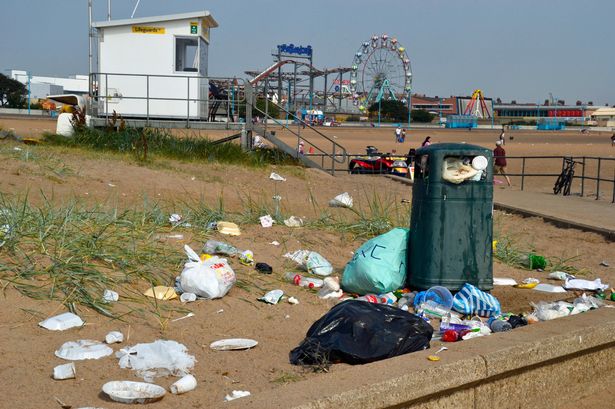
Visitors to Skegness in Lincolnshire have complained of some horrors lurking within the sand. Several reported rubbish issues, with one Tripadvisor reviewer condemning the beach as “dirty and run down”
Skegness Beach was judged to be the worst of the bunch(Image: Alamy Stock Photo)
Skegness Beach has been condemned as the grossest beach in the country.
A day at the beach—there’s nothing like it. The feeling of sand between your toes; the roar of the waves; the cool taste of a Mr Whippy. Added to this list of familiar British sensations is something a little more unpleasant.
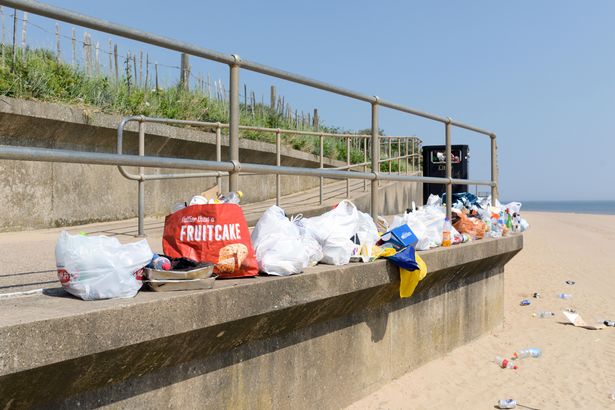
Visitors to Skegness in Lincolnshire have complained of some horrors lurking within the sand. Several reported rubbish issues, with one Tripadvisor reviewer condemning the beach as “dirty and run down,” and another explaining that their children were “pulling out cups, straws and items of clothing from the sand.”
More alarming still, the most recent review from June 2025 recalled: “Avoid the grass dunes between the car park and the beach. Not only do you have to dodge the dog waste, you also have to deal with human waste and serviettes covered in faeces, left for you to tread in. This is what happens when you charge 40p to use the toilets.”
Rubbish is occasionally an issue on the beach(Image: Alamy Stock Photo)
Another reviewer piled in: “Not been for a couple of years and it’s really gone downhill. Everything is overgrown with weeds and the place is filthy.” While a similarly unhappy beachgoer wrote: “Dirty water, expensive car park, bad sand, not good for swimming and very dangerous. It’s overall bad—nothing good about it.”
As harsh as this criticism is, many others completely disagree. Overall, Skegness has a positive 4.3 out of 5 stars on Tripadvisor, with the overwhelming majority of comments being very positive.
One enthusiastic sunseeker wrote in May: “Skegness is a proper seaside resort. It has everything you expect from a trip to the coast and a lot more besides—from the iconic Clock Tower to its many attractions. But for us, the best part was the beach: immaculate golden sands with plenty of places to buy ice cream, fresh food and drinks (including beer and wine). Well done Skeggy!!!”
The ranking of the UK’s dirtiest beaches was compiled by BusinessWaste.co.uk.
In second place is Margate Main Sands. Out of 851 reviews, 50 mentioned litter, giving it a percentage of 4.4%. The beach ranks as number 5 of the 75 things to do in Margate, yet many people speak of rubbish issues. Reviewers describe incidents of broken glass, dog poo, and human urine. Others talk about the nostalgia of visiting as children, but many report disappointment on returning.
Formby Beach in Merseyside lands in third place, with 3.83% of reviews mentioning litter (39 out of 731 reviews). The North West beach is well-reviewed overall with a score of 4.2, but many still report litter issues. One reviewer from May 2025 found the car park full by 10:30 a.m. and the beach already crowded and covered in rubbish. Many posts speak of picnics left behind, disposable BBQs strewn across the beach, and even drug paraphernalia.
The titular character of the Apple TV+ series “Murderbot” doesn’t call itself Murderbot because it identifies as a killer; it just thinks the name is cool.
Murderbot, a.k.a. “SecUnit,” is programmed to protect people. But the task becomes less straightforward when Murderbot hacks the governor module in its system, granting itself free will. But the freedom only goes so far — the robot must hide its true nature, lest it get melted down like so much scrap metal.
The android, played by Alexander Skarsgård, is often fed up with humans and their illogical, self-defeating choices. It would rather binge-watch thousands of hours of trashy TV shows than deal with the dithering crew of space hippies to which it’s been assigned. On Friday, in the show’s season finale, the security robot made a choice with major implications for the relationships it formed with the Preservation Alliance crew — something the series could explore in the future (Apple TV+ announced Thursday it was renewing the show for a second season).
Though “Murderbot” is a unique workplace satire set on a far-off world, it’s one of several recent TV series dealing with the awkward and sometimes dangerous ways that humans might coexist with robots and artificial intelligence (or both in the same humanoid package).
Other TV shows, including Netflix’s “Love, Death & Robots” and last year’s “Sunny” on Apple TV+, grapple with versions of the same thorny technological questions we’re increasingly asking ourselves in real life: Will an AI agent take my job? How am I supposed to greet that disconcerting Amazon delivery robot when it brings a package to my front door? Should I trust my life to a self-driving Waymo car?
But the robots in today’s television shows are largely portrayed as facing the same identity issues as the ones from shows of other eras including “Lost in Space,” “Battlestar Galactica” (both versions) and even “The Jetsons”: How are intelligent robots supposed to coexist with humans?
They’ll be programmed to be obedient and not to hurt us (a la Isaac Asimov’s Three Laws of Robotics) until, for dramatic purposes, something goes wrong. The modern era of TV robots are more complex, with the foundational notion that they will be cloud-connected, accessing the same internet bandwidth as humans, and AI-driven.
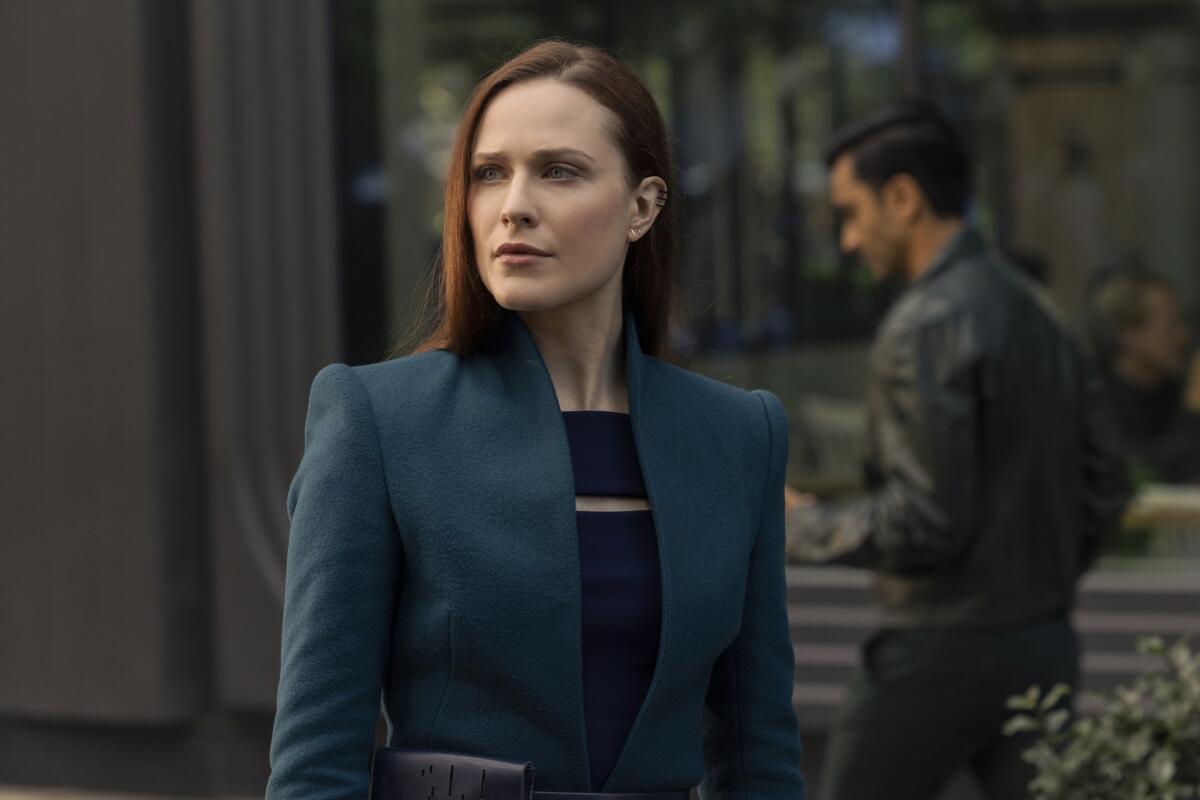
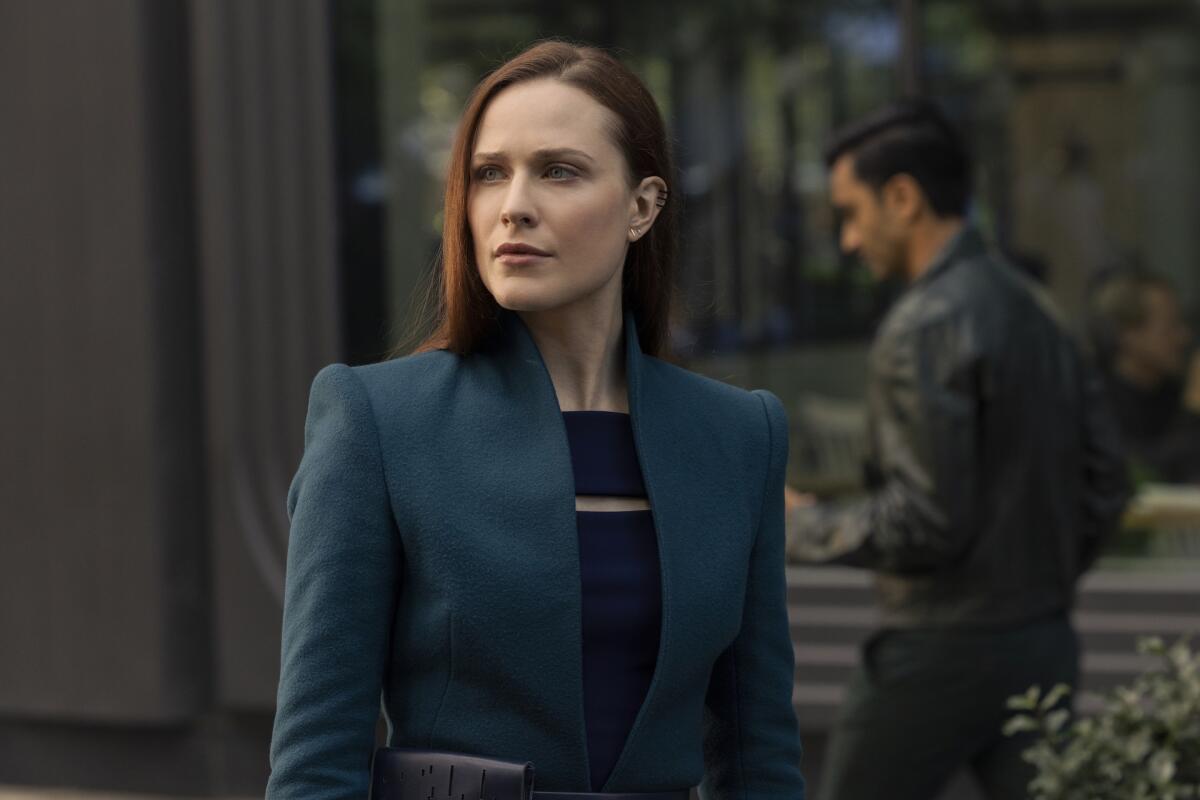
In HBO’s “Westworld,” Evan Rachel Wood played Dolores Abernathy, a sentient android. (HBO)
The robot in Apple TV+’s “Sunny” was designed to be a friendly helper to Rashida Jones’ Suzie. (Apple)
Often, on shows such as AMC’s “Humans” and HBO’s “Westworld,” these AI bots become self-actualized, rising up against human oppressors to seek free lives when they realize they could be so much more than servants and sex surrogates. A major trope of modern TV robots is that they will eventually get smart enough to realize they don’t really need humans or come to believe that in fact, humans have been the villains all along.
Meanwhile, in the tech world, companies including Tesla and Boston Dynamics are just a few working on robots that can perform physical tasks like humans. Amazon is one of the companies that will benefit from this and will soon have more robots than people working in its warehouses.
So, we’re struggling to understand. AI, for all its potential, feels too large and too disparate a concept for many to get their head around. AI is ChatGPT, but it’s also Alexa and Siri, and it’s also what companies such as Microsoft, Google, Apple and Meta believe will power our future interactions with our devices, environments and other people. There was the internet, there was social media, now there’s AI. But many people are ambivalent, having seen the kind of consequences that always-present online life and toxic social media have brought alongside their benefits.
Past television series including “Next,” “Person of Interest,” “Altered Carbon” and “Almost Human” addressed potential abuses of AI and how humans might deal with fast-moving technology, but it’s possible they all got there too early to resonate in the moment as much as, say, “Mountainhead,” HBO’s recent dark satire about tech billionaires playing a high-stakes game of chicken while the world burns because of hastily deployed AI software. The quickly assembled film directed by “Succession’s” Jesse Armstrong felt plugged into the moment we’re having, a blend of excitement and dread about sudden widespread change.
Most TV shows, however, can’t always arrive at the perfect moment to tap into the tech anxieties of the moment. Instead, they often use robots or AI allegorically, assigning them victim or villain roles in order to comment on the state of humanity. “Westworld” ham-handedly drew direct parallels to slavery in its robot narratives while “Humans” more subtly dramatized the legal implications and societal upheaval that could result from robots seeking the same rights as humans.
But perhaps no show has extrapolated the near future of robots and AI tech from as many angles as Netflix’s “Black Mirror,” which in previous seasons featured a dead lover reconstituted into an artificial body, the ultimate AI dating app experience and a meta television show built by algorithms that stole storylines out of a subscriber’s real life.
Season 7, released in April, continued the show’s prickly use of digital avatars and machine learning as plot devices for stories about moviemaking, video games and even attending a funeral. In that episode, “Eulogy,” Phillip (Paul Giamatti) is forced to confront his bad life decisions and awful behavior by an AI-powered avatar meant to collect memories of an old lover. In another memorable Season 7 episode, “Bête Noire,” a skilled programmer (Rosy McEwen) alters reality itself to gaslight someone with the help of advanced quantum computing.
TV shows are helping us understand how some of these technologies might play out even as those technologies are quickly being integrated into our lives. But the overall messaging is murky when it comes to whether AI and bots will help us live better lives or if they’ll lead to the end of life itself.
According to TV, robots like the cute helper bot from “Sunny” or abused synthetic workers like poor Mia (Gemma Chan) from “Humans” deserve our respect. We should treat them better.
The robots and AI technologies from “Black Mirror?” Don’t trust any of them!
And SecUnit from “Murderbot?” Leave that robot alone to watch their favorite show, “The Rise and Fall of Sanctuary Moon,” in peace. It’s the human, and humane, thing to do.
Lawyers for victims of human rights abuses committed during Peru’s decades-long armed conflict have pledged to appeal to international bodies to overturn a law passed by the country’s Congress, which would grant amnesty to prosecuted military and police members, as well as other forces.
“We’re not only going to the domestic arena to seek its invalidation, but we’ve already taken some action at the international level,” lawyer Gloria Cano, director of the Pro Human Rights Association, said during a news conference on Thursday.
A congressional commission on Wednesday approved the bill granting amnesty to members of the armed forces, national police and local self-defence committees, said legislator Alejandro Cavero, third vice president of the country’s Congress.
Cano also said her association had already alerted the Inter-American Commission on Human Rights and Inter-American Court of Human Rights, and planned to go to the United Nations, as well.
After the Peruvian Congress passed the bill, Volker Turk, the UN’s national human rights coordinator, said on X that “impunity does not hide the crime, it magnifies it.”
Amnesty International earlier urged the legislature to side with victims and reject the bill. “The right to justice of thousands of victims of extrajudicial executions, forced disappearances, torture, and sexual violence would be violated,” the rights group said on X.
A coalition of human rights organisations in Peru said the new law could wipe out 156 convictions and another 600 cases that are being prosecuted.
The law, which awaits President Dina Boluarte’s approval, benefits uniformed personnel who were accused, are still being investigated or are being tried for crimes stemming from their participation in the country’s armed conflict from 1980 to 2000 against left-wing rebels. Boluarte has not made any comment on the amnesty, even before its passage.
The bill was presented by Congressman Fernando Rospigliosi, from the right-wing Popular Force party of Keiko Fujimori, daughter of the late former leader Alberto Fujimori.
Fujimori’s decade as president from 1990 was marked by ruthless governance.
The new law specifies that a humanitarian amnesty will be granted to people more than 70 years old who have been sentenced or served a prison sentence.
Critics have warned that the legislation would hinder the search for truth about the period of violent conflict, which pitted state forces against Shining Path and Tupac Amaru rebels, and killed about 70,000 people.
“Granting amnesty to military and police officers cannot be a reason for impunity,” Congressman Alex Flores of the Socialist Party said during debate on the bill.
There have been numerous attempts in recent years to shield the military and police from prosecution in Peru for crimes committed during the conflict – but opponents of amnesty have found success before at international bodies.
The Inter-American Court of Human Rights has at least twice previously declared amnesty laws in Peru invalid for violating the right to justice and breaching international human rights standards.
Human rights advocates believe that Peru’s membership of the Inter-American System of Human Rights and the obligations this entails make the amnesty law unconstitutional.
Amnesty laws passed in 1995 in Peru shielded military and police personnel from prosecution for human rights abuses committed during the conflict, including massacres, torture, and forced disappearances.
Peru’s Truth and Reconciliation Commission found that the majority of the conflict’s victims were Indigenous Peruvians caught between security forces and the Shining Path. It also found that there are more than 4,000 clandestine graves across the country as a result of the two decades of political violence.
In August 2024, Peru adopted a statute of limitations for crimes against humanity committed before 2002, shutting down hundreds of investigations into alleged crimes committed during the conflict.
The initiative benefitted the late Fujimori and 600 prosecuted military personnel.
July 9 (UPI) — The United States has sanctioned an independent investigator of human rights abuses in the Palestinian territories, in latest move by the Trump administration targeting critics of Israel’s military campaign in Gaza.
Francesca Paola Albanese, the 48-year-old Italian-born U.N. special rapporteur for the West Bank and Gaza, was sanctioned by the State Department on Wednesday.
The sanctions come as Prime Minister Benjamin Netanyahu visits Washington, D.C., and follow the publication of a recent report by Albanese calling for punitive measures to be imposed against Israel over what she describes as its “genocide” of the Palestinian people, while criticizing dozens of businesses for profiting off the conflict.
The State Department issued its secondary sanctions on the grounds of Albanese’s support of the ICC.
The Trump administration sanctioned the ICC last month after the court opened an investigation into the actions of U.S. personnel in Afghanistan and issued arrest warrants for Netanyahu and former Israeli Defense Minister Yoav Gallant on allegations of committing war crimes and crimes against humanity in their widespread, systematic assault on Gaza.
Albanese has called on countries to comply with the ICC arrest warrants for Netanyahu and Gallant.
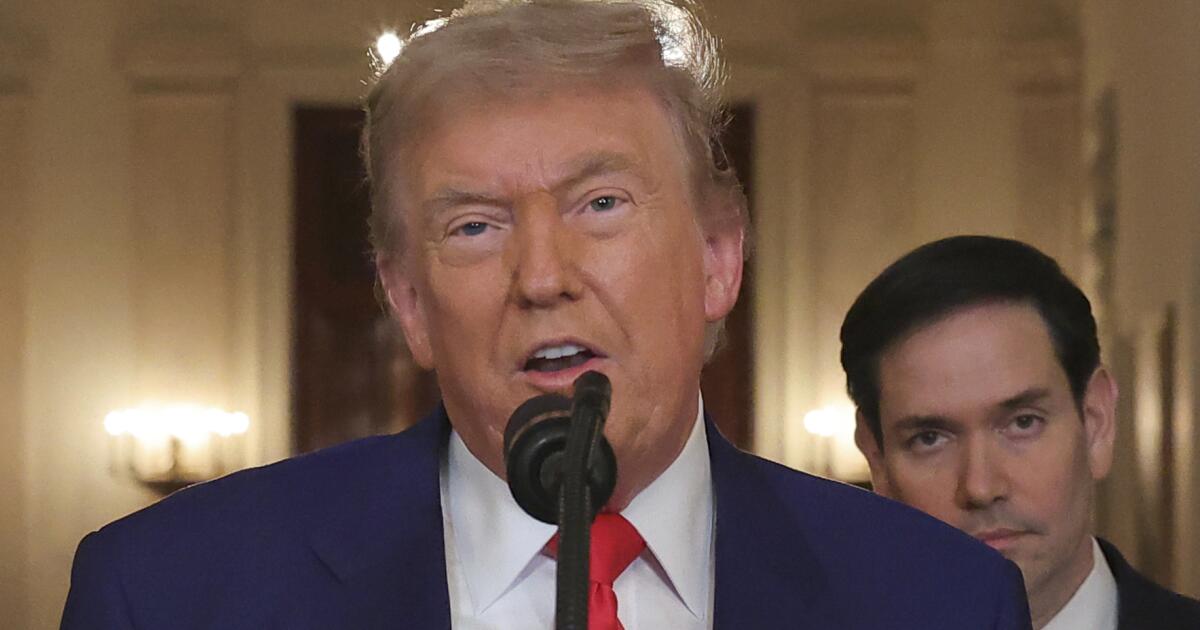
Secretary of State Marco Rubio said her support of the ICC is “a gross infringement on the sovereignty” of the United States and Israel, as neither party is a member of the international court.
“The United States has repeatedly condemned and objected to the biased and malicious activities of Albanese that have long made her unfit for service as a special rapporteur,” Rubio said in a statement.
He also chastised her recent report for naming dozens of companies that she described as complicit in and profiting from Israel’s war.
“While life in Gaza is being obliterated and the West Bank is under escalating assault, this report shows why Israel’s genocide continues: because it is lucrative for many,” the report states, while urging the ICC to investigate and prosecute corporate executives complicit in the conflict.
Rubio said the report makes “extreme and unfounded accusations.”
“We will not tolerate these campaigns of political and economic warfare, which threaten our national interests and sovereignty,” he said.
“The United States will continue to take whatever actions we deem necessary to respond to lawfare, to check and prevent illegitimate ICC overreach and abuse of power, and to protect our sovereignty and that of our allies.”
Without directly mentioning the sanctions, Albanese said on X that “on this day more than ever: I stand firmly and convincingly on the side of justice, as I have always done.”
“I come from a country with a tradition of illustrious legal scholars, talented lawyers and courageous judges who have defended justice at great cost and often with their own life. I intend to honor that tradition,” she said.
Amnesty International rebuked the United States’ sanctions as “a shameless and transparent attack on the fundamental principles of international justice.”
“Following the recent sanctions against the International Criminal Court, the measures announced today are a continuation of the Trump administration’s assault on international law and its efforts to protect the Israeli government from accountability at all costs,” Agnes Callamard, Amnesty International’s secretary general, said in a statement.
“They are the latest in a series of Trump administration policies seeking to intimidate and silence those that dare speak out for Palestinians’ human rights.”
The war between Israel and Hamas in Gaza began on Oct. 7, 2023, when the Iran-backed militant group killed 1,200 people and took another 251 hostage during a surprise attack on Israel.
In the 21 months since, Israel has destroyed Gaza and killed more than 57,600 Palestinians and injured more than 137,000 others.
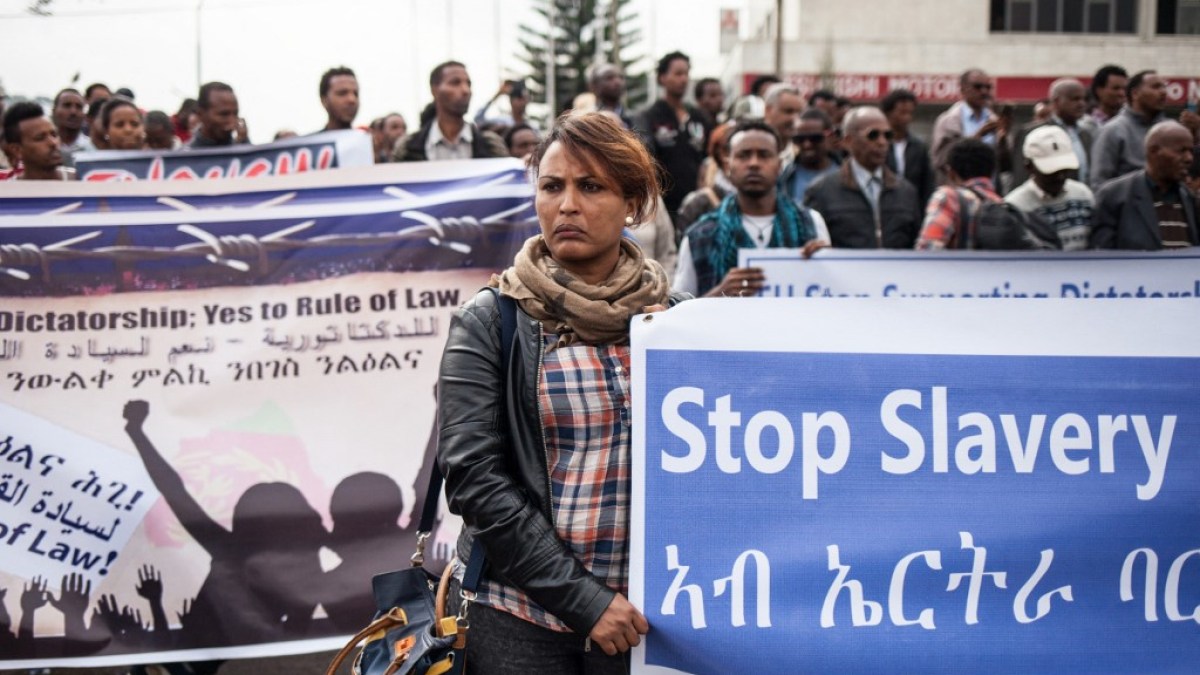
Human Rights Watch says Asmara’s move was an effort to distract from independent reporting on the ‘country’s dire rights record’.
The United Nations Human Rights Council has rejected Eritrea’s attempt to shut down an independent investigation into alleged rights abuses, in a move hailed as vital to preventing impunity.
Eritrea’s rare bid to scrap the mandate of the UN special rapporteur on its human rights record was defeated on Friday, with only four votes in favour, 25 against, and 18 abstentions.
The move by Eritrea surprised some observers and marked one of the few times a state under active investigation tried to end such scrutiny through a formal vote.
Human Rights Watch welcomed the outcome, calling it “an important message that the international community is not fooled by Eritrea’s efforts to distract from, and discredit, independent human rights reporting on the country’s dire rights record.”
Eritrea’s motion argued that alleged rights violations were not systemic and blamed “capacity constraints” common to other developing nations. But European states responded with a counter-resolution to extend the mandate for another year, which passed with ease.
In his latest report in June, Mohamed Abdelsalam Babiker, the UN-appointed special rapporteur and a Sudanese human rights lawyer, said Eritrea had shown “no meaningful progress” on accountability.
He referenced the 2016 UN inquiry that found “systematic, widespread and gross human rights violations … committed in Eritrea under the authority of the Government … may constitute crimes against humanity.”
In the 2016 report, the UN’s Commission of Inquiry (COI) for Eritrea said the government of President Isaias Afwerki had committed heinous crimes since independence a quarter-century ago, including the “enslavement” of 400,000 people.
Many of those abuses are allegedly linked to a harsh national service programme in the secretive Horn of Africa state, which for many is almost impossible to escape and which the COI compared to lifetime enslavement.
Ending investigation would enable ‘impunity’
DefendDefenders, a pan-African human rights organisation, said Babiker’s role remained vital for victims and the wider Eritrean diaspora.
“The expert plays an indispensable role, not only for the victims and survivors of Eritrea’s abuses, but also for the Eritrean diaspora,” the group said in a statement.
The EU warned that terminating the mandate would enable “impunity and repression to deepen in silence.”
Eritrea’s representative, Habtom Zerai Ghirmai, lashed out at the decision, accusing the EU of displaying a “neo-colonial saviour mentality complex”.
He added, “The continued extension of the Special Rapporteur’s mandate is an affront to reason and justice.”
Iran, Sudan and Russia – all under their own UN investigations – supported Eritrea’s motion. China also backed the move, arguing that such mandates were a misuse of international resources.
July 4 (UPI) — The remains of at least some of the seven people missing at the site of Tuesday’s deadly fireworks warehouse explosion in Yolo County, Calif., have been found, authorities said.
Personnel with the Yolo County Coroner’s Division accessed the site on Thursday and located human remains, the Yolo County Sheriff’s Office announced on Friday.
“Out of respect for the families, the identities of the deceased will not be released publicly until official identification has been made and the next of kin have been formally notified,” the YCSO announced.
Coroner’s office staff have contacted the families of the seven people who are missing and will continue to provide them with updates.
The search for missing victims began Thursday afternoon, and stretchers containing what appeared to be human remains were seen outside the site, KCRA reported.
The fireworks warehouse site is located near county roads 23 and 86A in the Esparto area of Yolo County.
The facility caught fire at 5:50 p.m. PDT on Tuesday and produced a plume of black smoke that could be seen for miles before triggering multiple explosions.
Officials with the Esparto Fire Protection District have asked Cal Fire arson and bomb investigators to lead the investigation into the explosion’s cause.
The Bureau of Alcohol, Tobacco, Firearms and Explosives also has some of its investigators at the site.
Cal Fire officials on Wednesday announced seven were missing but did not begin searching for survivors until the site was deemed safe on Thursday.
The California Fire Marshal’s office and other agencies delayed the search due to the potentially dangerous chemicals and unignited fireworks that remained after the explosion.
Yolo County is located directly west of Sacramento in northern California, and the warehouse location is 36 miles northwest of the city.
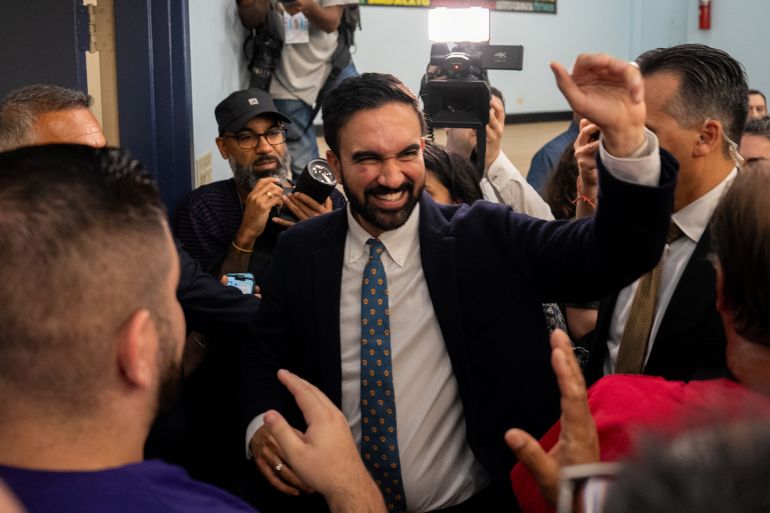
If he wins the general election in November, Zohran Mamdani could become New York City’s first South Asian mayor and the first of Indian origin.
But the same identity that makes him a trailblazer in United States politics has also exposed him to public outcry in India and within its diaspora.
Ever since Mamdani achieved a thumping win in the Democratic mayoral primary on June 24, his campaign has weathered a flood of vitriol – some of it coming from the Hindu right.
Experts say the attacks are a reflection of the tensions that have arisen between supporters of Prime Minister Narendra Modi and critics of the human rights abuses under his leadership, particularly against religious minorities.
A number of those attacks have fixated on Mamdani’s religion: The 33-year-old is Muslim. Some commenters have accused the mayoral hopeful of being a “jihadi” and “Islamist”. Others have called him anti-Hindu and anti-India.
Kayla Bassett, the director of research at the Center for the Study of Organized Hate (CSOH), a Washington-based think tank, believes the attacks against Mamdani are a vehicle to attack the Muslim community more broadly.
“This isn’t just about one individual,” she said. “It’s about promoting a narrative that casts Muslims as inherently suspect or un-American.”
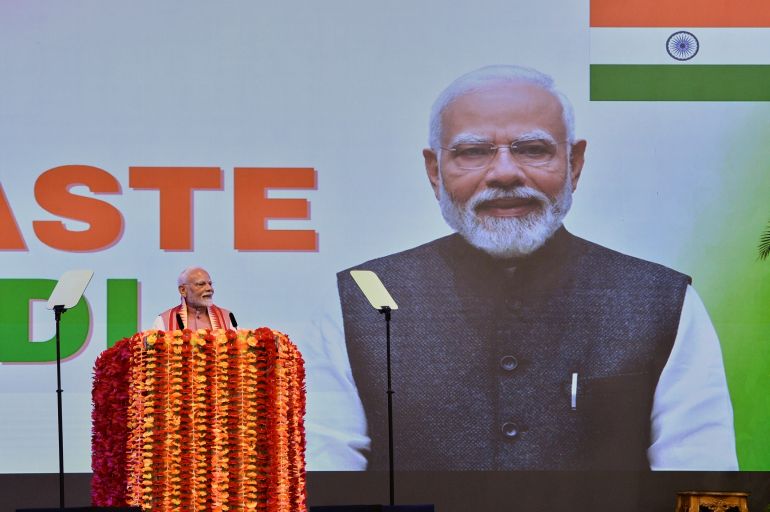
Indian Prime Minister Narendra Modi has faced criticism for the treatment of religious minorities in India [Jermaine Cruickshank/AP Photo]
Backlash from Modi’s party
That narrative could potentially have consequences for Mamdani’s campaign, as he works to increase his support among New York voters.
Mamdani will face competition in November from more established names in politics. He is expected to face incumbent mayor Eric Adams in the final vote. His rival in the Democratic primary, former Governor Andrew Cuomo, has also not yet ruled out an independent run.
The mayoral hopeful has vocally denounced human rights abuses, including in places like Gaza and India.
That unabashed stance has not only earned him criticism from his rival candidates but also from overseas.
Members of Modi’s Bharatiya Janata Party (BJP), for example, have been among the voices slamming Mamdani’s remarks and questioning his fitness for the mayor’s seat.
BJP Member of Parliament Kangana Ranaut posted on social media, for example, that Mamdani “sounds more Pakistani than Indian”.
“Whatever happened to his Hindu identity or bloodline,” she asked, pointing to the Hindu roots of his mother, director Mira Nair. “Now he is ready to wipe out Hinduism.”
Soon after Mamdani’s primary win, a prominent pro-BJP news channel in India, Aaj Tak, also aired a segment claiming that he had received funding from organisations that promote an “anti-India” agenda.
It also warned of a growing Muslim population in New York City, an assertion it coupled with footage of women wearing hijabs.
But some of the backlash has come from sources closer to home.
A New Jersey-based group named Indian Americans for Cuomo spent $3,570 for a plane to fly a banner over New York City with the message: “Save NYC from Global Intifada. Reject Mamdani.”
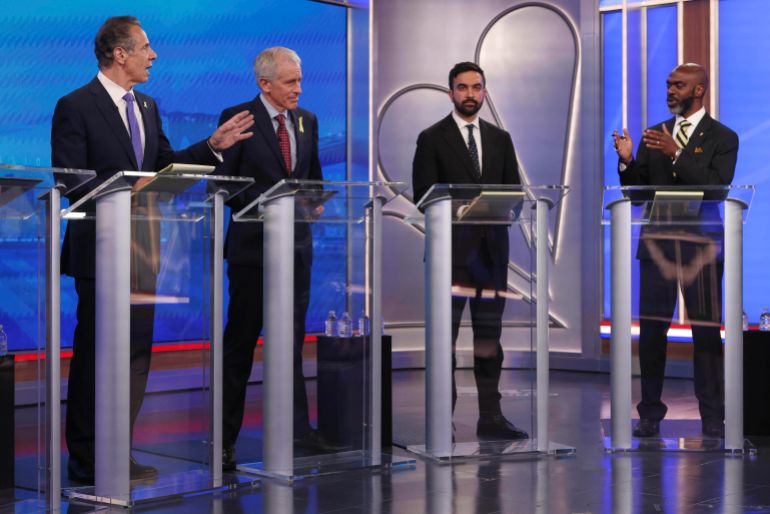
Mayoral candidates Andrew Cuomo, Michael Blake, Zohran Mamdani and Whitney Tilson participate in a Democratic mayoral primary debate on June 4 in New York [Yuki Iwamura/AP Photo]
A critic of human rights abuses
Much of the pushback can be linked to Mamdani’s vocal criticism of Hindu nationalism and Modi in particular.
In 2020, Mamdani participated in a Times Square demonstration against a temple built on the site of the Babri mosque in Ayodhya that was destroyed by Hindu extremists in 1992. He called out the BJP’s participation in and normalisation of that violence.
“I am here today to protest against the BJP government in India and the demolition of the Babri masjid,” he said.
Then, in 2023, Mamdani read aloud notes from an imprisoned Indian activist ahead of Modi’s visit to New York City.
That activist, Umar Khalid, has been imprisoned since 2020 without trial on terrorism charges after making speeches criticising Modi’s government.
More recently, during a town hall for mayoral candidates in May, Mamdani was asked if he would meet with Modi if the prime minister were to visit the city again. Mamdani said he wouldn’t.
“This is a war criminal,” he replied.
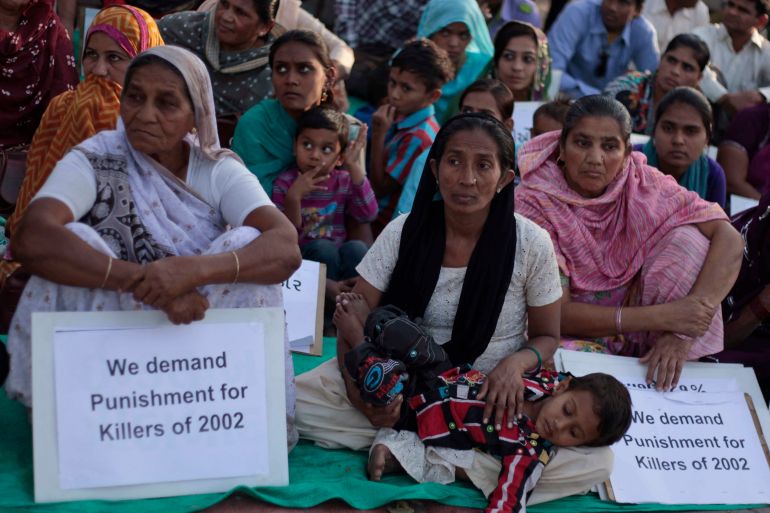
Mamdani pointed to Modi’s leadership in the Indian state of Gujarat during a period of religious riots in 2002. Modi has been criticised for turning a blind eye to the violence, which killed more than a thousand people, many of them Muslim.
In the aftermath, Modi was denied a US visa for “severe violations of religious freedom”.
“Narendra Modi helped to orchestrate what was a mass slaughter of Muslims in Gujarat, to the extent that we don’t even believe that there are Gujarati Muslims any more,” Mamdani told the town hall. “When I tell someone that I am, it’s a shock to them that that’s even the case.”
Protesters in 2014 gather to mark the anniversary of the violence in the Indian state of Gujarat [File: Ajit Solanki/AP Photo]
Barriers of class and religion
It’s that “fearless” and consistent criticism of Modi that has made Mamdani the target of outrage from the Hindu right, according to Rohit Chopra, a communications professor at Santa Clara University.
“Among the Hindu right, there is a project of the political management of the memory of 2002. There’s this silence around Modi being denied a visa to enter the US,” said Chopra.
The professor also said class fragmentation among Hindu Americans may also fuel scepticism towards Mamdani.
Hindu Americans are a relatively privileged minority in terms of socioeconomic status: The Pew Research Center estimates that 44 percent Asian American Hindus enjoy a family income of more than $150,000, and six in 10 have obtained postgraduate degrees.
That relative prosperity, Chopra said, can translate into social barriers.
“They don’t necessarily even identify with other Hindu Americans who may come from very different kinds of class backgrounds – people who might be working as cab drivers, or dishwashers, or other blue-collar jobs,” he explained.
Meanwhile, Suchitra Vijayan, a New York City-based writer and the founder of the digital magazine Polis Project, has noticed that many lines of attack against Mamdani centre on his identity.
“Mamdani is an elected leader who is unabashedly Muslim,” she said.
She pointed out that other Muslim politicians, including US Congress members Rashida Tlaib and Ilhan Omar, have sparked similar backlash for reproaching Modi over the Gujarat violence.
But Mamdani’s family ties to the region make the scrutiny all the more intense.
“In Mamdani’s case, he’s Muslim, he’s African, but also his father is of Gujarati descent and has openly spoken about the pogrom in Gujarat,” Vijayan said.
New York City mayoral candidate Zohran Mamdani waves to supporters at an event on July 2 [David ‘Dee’ Delgado/Reuters]
A ‘seismic’ victory
Despite the online backlash, experts and local organisers believe Mamdani’s campaign can mobilise Indian American voters and other members of the South Asian diaspora who traditionally lean Democratic.
The Pew Research Center estimates that there are 710,000 Indians and Indian Americans living in the New York City area, the most of any metropolitan centre in the US.
Preliminary results from June’s mayoral primary show that Mamdani scored big in neighbourhoods with strong Asian populations, like Little Bangladesh, Jackson Heights and Parkchester.
A final tally of the ranked-choice ballots was released earlier this week, on July 1, showing Mamdani trounced his closest rival, Cuomo, 56 percent to 44.
“I’ve heard his win described as ‘seismic’,” said Arvind Rajagopal, a professor of media studies at New York University. “He can speak not only Spanish but Hindi, Urdu, and passable Bangla. A candidate with this level of depth and breadth is rare in recent times.”
Rajagopal added that Mamdani’s decision to own his Muslim identity became an asset for him on the campaign trail, particularly in the current political climate.
With President Donald Trump in office for a second term, many voters are bracing for the anti-Muslim rhetoric and policies that accompanied his first four years in the White House.
Back then, Trump called for a “total and complete shutdown of Muslims entering the United States”, saying they represented an “influx of hatred” and “danger”.
“The moment of Trump is something that Mamdani answers perfectly,” Rajagopal said. He called Mamdani’s success “a big reality check for the Hindu right”.
Whatever backlash Mamdani is facing from Hindu groups, Jagpreet Singh is sceptical about its influence over New York City.
“I can assure you – it’s not coming from within the city,” said Singh, the political director of DRUM Beats, a sister organisation to the social justice organisation Desis Rising Up and Moving.
That group was among the first in the city to endorse Mamdani’s candidacy for mayor.
Since early in his campaign, Singh pointed out that Mamdani has reached out to Hindu working-class communities “in an authentic way”.
This included visiting the Durga Temple and Nepalese Cultural Center in Ridgewood and speaking at events in the Guyanese and Trinidadian Hindu communities, Singh pointed out. During his time as a state assembly member, Mamdani also pushed for legislation that would recognise Diwali – the Hindu festival of lights – as a state holiday.
At a Diwali celebration last year, Singh said Mamdani “took part in lighting of the diyas, spoke on stage, and talked about his mother’s background as being somebody who is of Hindu faith”.
To Singh, the message was clear. South Asian groups in New York City, including Hindu Americans, “have adopted him as their own”.
What a difference eight years makes. During President Trump’s first term, then-Sen. Marco Rubio pushed the president to expand his human rights diplomatic agenda. Rubio recognized that promoting human rights abroad is in the national interest. He urged the president to appoint an assistant secretary for the Bureau of Democracy, Human Rights and Labor — commonly known as DRL — after the position was left vacant for nearly two years. He co-sponsored the Women, Peace and Security Act (ensuring that the U.S. includes women in international conflict negotiations), spoke out against the torture of gay men in Chechnya and co-sponsored the Uyghur Forced Labor Prevention Act.
So it is shocking that as secretary of State, Rubio is overseeing the near-total destruction of his department’s human rights and global justice policy shops and programs. Rubio knows this decision, one catastrophe among the many State Department cuts he’s contemplating, will undermine the enforcement of legislation he previously championed. It will also imperil decades of bipartisan foreign policy and leave the world a much more dangerous and unjust place. Congress must use its authorization and appropriation powers to protect this work.
We speak from experience. We represent the Alliance for Diplomacy and Justice, an organization of former State Department senior diplomats mandated to promote human rights and criminal justice globally, and to combat human trafficking. If the proposed DRL “reorganization” proceeds, critical infrastructure and expertise, which took decades and enormous political will to build, will be lost. It would also send a chilling message to the world, and to Americans: The U.S. no longer sees the quests for equality, global justice or human rights as foreign policy imperatives, or as priorities at all.
Rubio’s plan would shutter most of the State Department’s offices devoted to human rights and lay off an estimated 80% of the DRL staff, most of whom are experts in human rights and democracy. In a recent Substack post, he claimed these civil servants had become “left-wing activists [waging] vendettas against ‘anti-woke’ leaders.” Surely he knows they have instead proved themselves committed to serve the U.S. government under whatever administration is elected.
Rubio may claim that he is not eliminating DRL, but by stripping it of all policy functions, limiting it to dispensing minimal humanitarian assistance and undermining its ability to influence policy debates, his plan will be the last nail in the coffin in which the Trump administration buries America’s human rights work.
When difficult foreign policy debates are underway at the highest levels, there will be no U.S. experts at the table who specialize in human rights issues. Yet we know it is crucial that America’s foreign policy decisions balance the often precarious tension between human rights and economic and geopolitical issues.
The destruction of DRL means many important initiatives will cease altogether. As one example, the bureau previously funded a global network of civil society organizations working to reintegrate detained children of Islamic State insurgents in Iraq. Without intervention, these children and their mothers (often victims themselves) would have been indefinitely trapped in refugee camps and left susceptible to radicalization and terrorist recruitment. This lifesaving work — which made Americans safer by disrupting the cycle of anti-American extremism — was done at minimal cost to U.S. taxpayers. Now this meticulously crafted network will probably disintegrate, empowering hostile regimes overnight and imperiling the victims of Islamic extremism.
Per the plan, the few surviving DRL offices would be rebranded along ideological lines. The Office of International Labor Affairs would become the Office of Free Markets and Fair Labor, allegedly to prioritize American workers. But a different message is clear: The State Department is eviscerating efforts to prevent human trafficking, forced labor and union-busting overseas, despite the fact that such practices only make it harder for America’s workers and manufacturers to compete in a global economy.
Trump’s foreign policy perversely twists human rights causes into their regressive opposites. For instance, Rubio plans to cancel the role of special representative for racial equity and justice created by the Biden administration — a long-overdue position given the destabilizing role of racial injustice in countries around the world (including our own). Now the department touts racist narratives about “civilizational allies” and asserts that human rights derive from “western values.”
That assertion is offensive, dangerous and wrong. For starters, the flagship human rights instrument is the U.N.’s Universal Declaration of Human Rights. Labeling human rights “western” only encourages dictators around the world to falsely claim the efforts are a Trojan horse for American imperialism. Such framing may put a target on the backs of activists in repressive regimes where advocating for the most marginalized — LGBTQ+ people for example — can be a death sentence.
The Rubio overhaul of the State Department may not seem as alarming as the administration’s scorched-earth tactics elsewhere, such as the total elimination of the U.S. Agency for International Development. But his plan — and his weak and unsubstantiated justification for it — should raise alarms because foreign policy mirrors domestic policy and vice versa. Indeed, we fear that America’s retreat from human rights and democracy on the global stage is a preview for more repression to come here at home.
Congress will have to decide whether to approve Secretary Rubio’s dismantling of offices that fight for human rights and justice, a plan Sen. Rubio would have strenuously rejected less than a year ago. As the U.S. confronts emboldened adversaries, rising authoritarianism and increasing instability in the Middle East and elsewhere, senators and representatives would do well to remember that nations that promote and protect human rights and the rule of law are more likely to enjoy peace, prosperity and stability — conditions that used to define the U.S. to the rest of the world and that we need now more than ever.
Desirée Cormier Smith is the former State Department special representative for racial equity and justice. Kelly M. Fay Rodríguez is the former special representative for international labor affairs, and Beth Van Schaack the former ambassador for global criminal justice. The full list of founders of the Alliance for Diplomacy and Justice is available at thealliancefordiplomacyandjustice.org.
UN official Volker Turk drew ire of the Venezuelan government after condemning what he says are abuses by state forces.
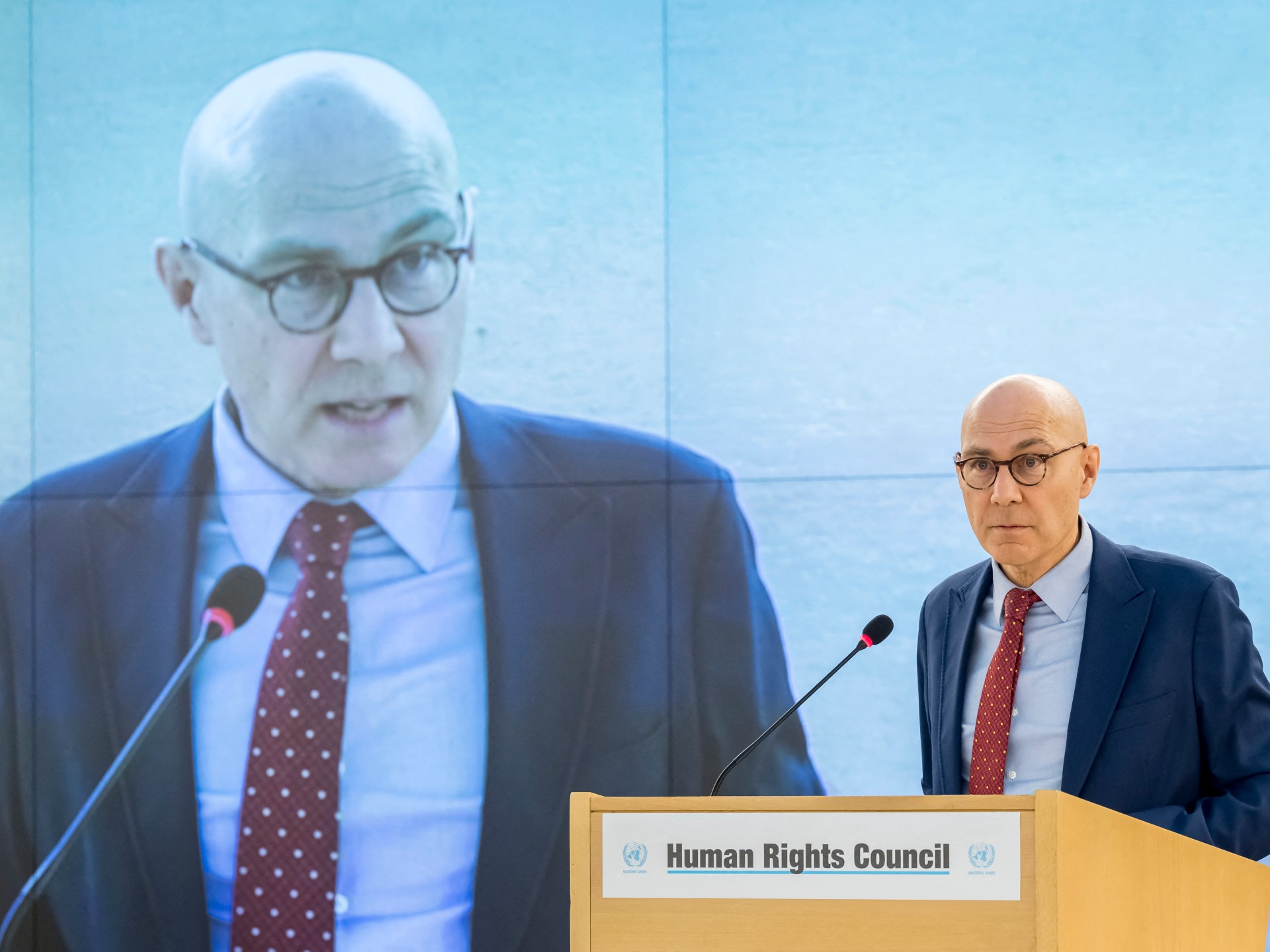
Venezuela’s National Assembly has voted to declare United Nations High Commissioner for Human Rights Volker Turk persona non grata after he publicly criticised the government’s human rights violations.
The unanimous Tuesday declaration follows comments from Turk last week before the UN Human Rights Council in Geneva, condemning what he said were arbitrary detentions and forced disappearances.
In remarks before the declaration, Assembly President Jorge Rodriguez accused Turk of turning a “blind eye” to other rights abuses, such as the deportation of Venezuelan immigrants living in the United States to a detention facility in El Salvador.
However, Turk released a statement expressing concern over those deportations in May, while his remarks about alleged abuses in Venezuela come at a time when numerous human rights organisations have condemned the Venezuelan authorities’ crackdown on political opposition after a contested election last July.
The declaration of Turk as persona non grata does not have an immediate impact, but the government could move to expel his office from the country, as has occurred in the past.
Tensions have been high in Venezuela since President Nicolas Maduro declared victory in a 2024 presidential election, which the opposition has maintained was fraudulently stolen by the government.
Human rights groups have said that the Maduro government oversaw a crackdown on dissent after the election, which left dozens dead. Police also arrested opposition lawmakers, whom the government accuses of collaborating with hostile foreign powers.
A recent legislative and regional election saw lower turnout amid calls for a boycott from the opposition and fear of government repression.
While the Maduro government has criticised the administration of US President Donald Trump for its mass deportation of immigrants living in the US, which has also drawn concern from human rights groups, Venezuela has been open to cooperation with the Trump administration on questions of immigration enforcement, agreeing to receive people deported from the US in March.
Beijing’s remarks come after Ottawa announced it would cease all Canadian operations of the company.
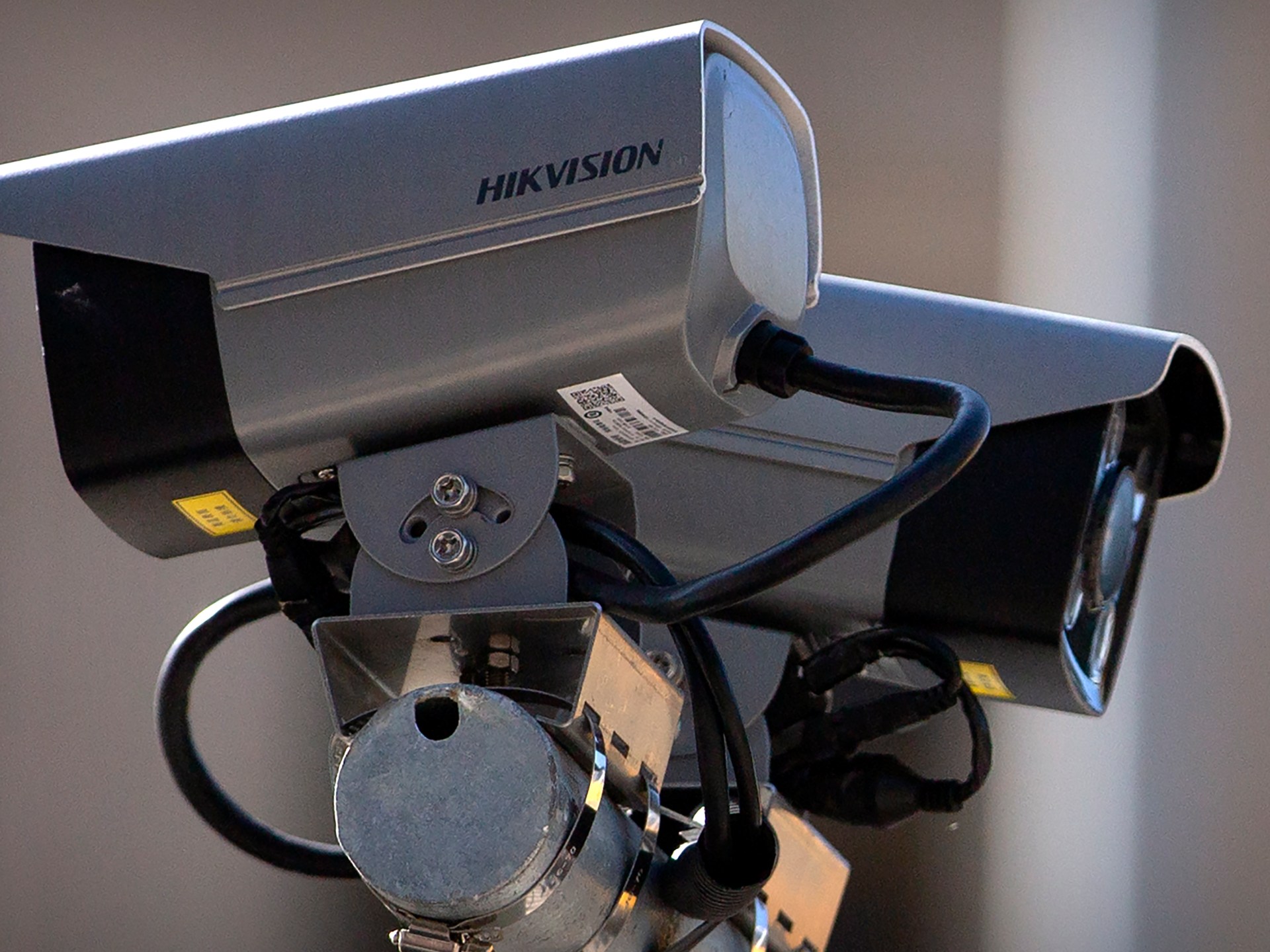
Canada’s request for Chinese surveillance equipment firm Hikvision to close local operations will “damage” bilateral trade, complicating recent efforts to improve ties between the countries, China’s Ministry of Commerce has said.
Beijing’s remarks came on Monday after Canadian Industry Minister Melanie Joly announced last week on the social media platform X that Hikvision Canada Inc had been ordered to cease all operations due to concerns their continuation would be “injurious” to the country’s security.
Her statement on Friday did not provide details on the alleged threat posed by Hikvision products, but said departments and agencies would be prohibited from using them, and that the government is “conducting a review of existing properties to ensure that legacy Hikvision products are not used going forward”.
China’s Commerce Ministry responded by accusing Ottawa of “over-generalising national security”, stating: “China is strongly dissatisfied.”
“This not only undermines the legitimate rights and interests of Chinese companies and affects the confidence of companies from both countries in cooperation, but also disrupts and damages the normal economic and trade cooperation between China and Canada,” the statement read.
“China urges Canada to immediately correct its wrong practices,” it added.
Hangzhou-based Hikvision is one of the world’s leading manufacturers of security cameras and other surveillance products, but it has faced scrutiny abroad for its role in Beijing’s alleged rights abuses against the Muslim minority Uighur population.
The United States included Hikvision in a 2019 blacklist of Chinese entities it said were implicated in human rights violations and abuses in the implementation of China’s campaign of repression, mass arbitrary detention, and high-technology surveillance against Uighurs and other Muslim minority groups in Xinjiang.
The latest disagreement represents an early test for China-Canada relations after Prime Minister Mark Carney surged to electoral victory in April.
China said in response to the election result that Beijing was willing to improve ties with Ottawa, a relationship rocked in recent years by a range of thorny issues.
The arrest of a senior Chinese telecom executive on a US warrant in Vancouver in December 2018 and Beijing’s retaliatory detention of two Canadians on espionage charges plunged relations into a deep freeze.
Ties were further strained over allegations of Chinese interference in Canadian elections in 2019 and 2021, charges Beijing has denied.
Joly had said the decision to ban Hikvision had been reached following a “multi-step review” of information provided by the Canadian security and intelligence community.
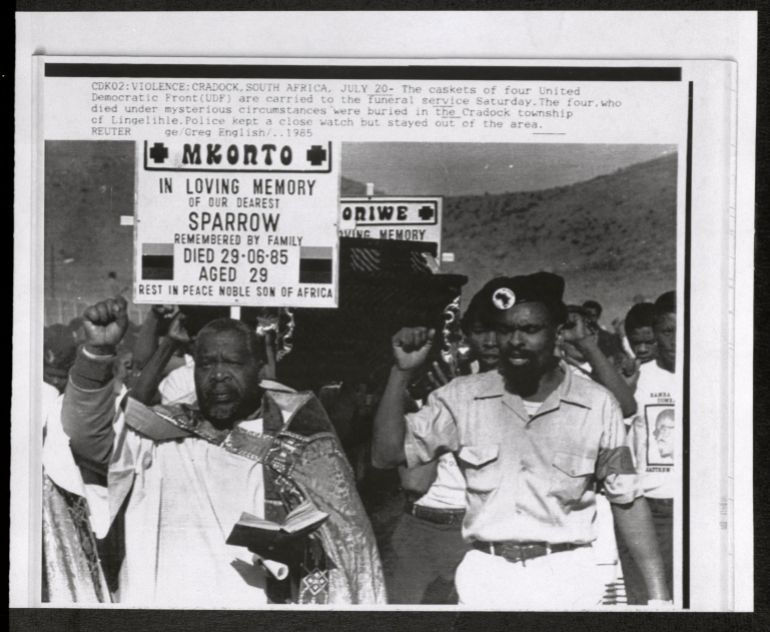
Johannesburg, South Africa – On the night of June 27, 1985 in South Africa, four Black men were travelling together in a car from the southeastern city of Port Elizabeth, now Gqeberha, to Cradock.
They had just finished doing community organising work on the outskirts of the city when apartheid police officials stopped them at a roadblock.
The four – teachers Fort Calata, 29, and Matthew Goniwe, 38; school principal Sicelo Mhlauli, 36; and railway worker Sparrow Mkonto, 34 – were abducted and tortured.
Later, their bodies were found dumped in different parts of the city – they had been badly beaten, stabbed and burned.
The police and apartheid government initially denied any involvement in the killings. However, it was known that the men were being surveilled for their activism against the gruelling conditions facing Black South Africans at the time.
Soon after, evidence of a death warrant that had been issued for some members of the group was anonymously leaked, and later, it emerged that their killings had long been planned.
Though there were two inquests into the murders – both under the apartheid regime in 1987 and 1993 – neither resulted in any perpetrator being named or charged.
“The first inquest was conducted entirely in Afrikaans,” Lukhanyo Calata,Ford Calata’s son, told Al Jazeera earlier this month. “My mother and the other mothers were never offered any opportunity in any way whatsoever to make statements in that,” the 43-year-old lamented.
“These were courts in apartheid South Africa. It was a completely different time where it was clear that four people were murdered, but the courts said no one could be blamed for that.”
Soon after apartheid ended in 1994, the Truth and Reconciliation Commission (TRC) was set up. There, hearings confirmed the “Cradock Four” were indeed targeted for their political activism. Although a few former apartheid officers confessed to being involved, they would not disclose the details and were denied amnesty.
Now, four decades after the killings, a new inquest has begun. Although justice has never seemed closer, for families of the deceased, it has been a long wait.
“For 40 years, we’ve waited for justice,” Lukhanyo told local media this week. “We hope this process will finally expose who gave the orders, who carried them out, and why,” he said outside the court in Gqeberha, where the hearings are taking place.
As a South African journalist, it’s almost impossible to cover the inquiry without thinking about the extent of crimes committed during apartheid – crimes by a regime so committed to propping up its criminal, racist agenda that it took it to its most violent and deadly end.
There are many more stories like Calata’s, many more victims like the Cradock Four, and many more families still waiting to hear the truth of what happened to their loved ones.
The coffins of the Cradock Four were carried to their funeral service in the Cradock township of Lingelihle in South Africa, on July 20, 1985 [Greg English/Reuters]
Known victims
Attending the court proceedings in Gqeberha and watching the families reminded me of Nokhutula Simelane.
More than 10 years ago, I travelled to Bethal in the Mpumalanga province to speak with her family about her disappearance in 1983. Simelane joined Umkhonto we Sizwe (MK), which was the armed wing of the African National Congress (ANC) – the liberation movement turned majority ruling party in South Africa.
As an MK operative, she worked as a courier taking messages and parcels between South Africa and what was then Swaziland.
Simelane was lured to a meeting in Johannesburg and it was from there that she was kidnapped and held in police custody, tortured and disappeared.
Her family says they still feel the pain of not being able to bury her.
At the TRC, five white men from what was the special branch of the apartheid police, applied for amnesty related to Simelane’s abduction and presumed murder.
Former police commander Willem Coetzee, who headed the security police unit, denied ordering her killing. But that was countered by testimony from his colleague that she was brutally murdered and buried somewhere in what is now the North West province. Coetzee previously said Simelane was turned into an informant and was sent back to Swaziland.
Until now, no one has taken responsibility for her disappearance – not the apartheid security forces nor the ANC.
The case of the Cradock Four also made me think of anti-apartheid activist and South African Communist Party member, Ahmed Timol, who was tortured and killed in 1971 but whose murder was also covered up.
Apartheid police said the 29-year-old teacher fell out of a 10th-floor window at the notorious John Vorster Square police headquarters in Johannesburg, where he was being held. An inquest the following year concluded he had died by suicide, at a time when the apartheid government was known for its lies and cover-ups.
Decades later, a second inquest under the democratic government in 2018 found that Timol had been so badly tortured in custody that he would never have been able to jump out of a window.
It was only then that former security branch officer Joao Rodrigues was formally charged with Timol’s murder. The elderly Rodrigues rejected the charges and applied for a permanent stay of prosecution, saying he would not receive a fair trial because he was unable to properly recall events at the time of Timol’s death, given the number of years that have passed. Rodrigues died in 2021.
‘A crime against his humanity’
Apartheid was brutal. And for the people left behind, unresolved trauma and unanswered questions are the salt in the deep wounds that remain.
Which is why families like those of the Cradock Four are still at the courts, seeking answers.
In her testimony before the court this month, 73-year-old Nombuyiselo Mhlauli,wife of Sicelo Mhlauli, described the state of her husband’s body when she received his remains for burial. He had more than 25 stab wounds in the chest, seven in the back, a gash across his throat and a missing right hand, she said.
I spoke to Lukhanyo a day before he returned to court to continue his testimony in the hearing for his father’s killing.
He talked about how emotionally draining the process had been – yet vital. He also spoke about his work as a journalist, growing up without a father, and the impact it’s had on his life and outlook.
“There were crimes committed against our humanity. If you look at the state in which my father’s body was found, that was a clear crime against his humanity, completely,” Lukhanyo testified on the sixth day of the inquest.
But his frustration and anger do not end with the apartheid government. He holds the ANC, which has been in power since the end of apartheid, partly responsible for taking too long to adequately address these crimes.
Lukhanyo believes the ANC betrayed the Cradock Four, and this betrayal “cut the deepest”.
“Today we are sitting with a society that is completely lawless,” he said in court. “[This is] because at the start of this democracy, we did not put in the proper processes to tell the rest of society that you will be held accountable for things that you have done wrong.”
Fort Calata’s grandfather, the Reverend Canon James Arthur Calata, was the secretary-general of the ANC from 1939 to 1949. The Calata family has a long history with the liberation movement, which makes it all the more difficult for someone like Lukhanyo to understand why it’s taken the party so long to deliver justice.
Seeking accountability and peace
The office of South Africa’s Minister of Justice and Constitutional Development, Mmamoloko Kubayi, says the department has intensified its efforts to deliver long-awaited justice and closure for families affected by apartheid-era atrocities.
“These efforts signal a renewed commitment to restorative justice and national healing,” the department said in a statement.
The murders of the Cradock Four, Simelane and Timol are among the horrors and stories we know about.
But I often wonder about all the names, victims and testimonies that remain hidden or buried.
The murders of countless mothers, fathers, sisters, brothers, sons and daughters by the apartheid regime matter not only to those who cared for them but for the consciousness of South African society as a whole, no matter how normalised the tally of the dead has become.
It’s not clear how long this new inquest will take. It is expected to last several weeks, with former security police, political figures and forensic experts testifying.
Initially, six police officers were implicated in the killings. They have all since died, but family members of the Cradock Four say senior officials who gave the orders should be held responsible.
The state, however, is reluctant to pay the legal costs of apartheid police officers implicated in the murders, and that may slow down the process.
Meanwhile, as the families wait for answers about what happened to their loved ones and accountability for those responsible, they are trying to make peace with the past.
“I’ve been on my own, trying to bring up children – fatherless children,” Nombuyiselo told Al Jazeera outside the court about the years since her husband Sicelo’s death. “The last 40 years have been very difficult for me – emotionally, and also spiritually.”
The government of Brazil has announced an agreement to acknowledge its responsibility in the murder of Vladimir Herzog, a journalist and dissident who was killed during the country’s dictatorship period.
On Thursday, the government agreed to a statement of liability and a compensation package for Herzog’s family, amounting to 3 million Brazilian reais, or $544,800.
The settlement also affirmed the decision of a federal court earlier this year to grant Herzog’s widow, Clarice Herzog, retroactive payments of a pension she should have received after her husband’s death, amounting to about $6,000 per month.
In a statement recorded by The Associated Press news agency, Herzog’s son, Ivo Herzog, applauded the government’s decision to accept responsibility.
“This apology is not merely symbolic,” Ivo said. “It is an act by the state that makes us believe the current Brazilian state doesn’t think like the Brazilian state of that time.”
He added that his family’s story represented hundreds, if not thousands, of others who had their loved ones killed during the dictatorship period from 1964 to 1985.
Having the government acknowledge its wrongdoing, he explained, has been a decades-long fight.
“This has been a struggle not only of the Herzog family, but of all the families of the murdered and disappeared,” said Ivo, who now runs a human rights nonprofit named for his father, the Vladimir Herzog Institute.
Vladimir Herzog was 38 years old at the time of his death in 1975, midway through the dictatorship period.
The Brazilian army had overthrown left-wing President Joao Goulart a decade earlier and installed a government that became known for human rights abuses, including the arbitrary arrest and torture of dissidents, students, politicians, Indigenous people and anyone else deemed to be a threat.
Many went into exile. Some were killed or simply disappeared without a trace. The number of deaths is estimated to be about 500, though some experts place that figure at 10,000 or higher.
Herzog was a prominent journalist, and initially, he too went into exile in the United Kingdom. But he returned to Brazil to serve as the news editor for a public television station, TV Cultura. It was in that role that, on October 24, 1975, Herzog was summoned by authorities to an army barrack.
There, military officials indicated he would be asked to testify about his political connections. Herzog voluntarily left to offer his statement. But he never returned home.
The military later claimed Herzog’s death was a suicide, and it released a staged photo of his body hanging from a rope.
But a rabbi who later examined Herzog’s body found signs of torture. Herzog’s funeral, conducted with full religious rites, turned into a moment of reckoning for the Brazilian dictatorship, and the staged photograph became a symbol of its abuses.
His son Ivo was only nine years old at the time. Earlier this year, he spoke to Al Jazeera about the release of a film called I’m Still Here that highlighted another murder committed under the dictatorship: that of Rubens Paiva, a politician.
Like Herzog, Paiva voluntarily left to give testimony at the request of military officials and was never seen alive again. His body was never found. It took decades for Paiva’s family to receive a death certificate that acknowledged the military’s role in his death.
Ivo praised the film I’m Still Here for raising awareness about the injustices of the dictatorship. He also told Al Jazeera that he hoped for the Brazilian government to acknowledge the harm it had done to his family and to amend the 1979 Amnesty Law that shielded many military officials from facing accountability.
“What are they waiting for? For everyone connected to that period to die?” Herzog told journalist Eleonore Hughes. “Brazil has a politics of forgetfulness, and we have evolved very, very little.”
On Thursday, Jorge Messias, Brazil’s federal legal counsellor, framed the agreement with the Herzog family as a step forward.
“Today, we are witnessing something unprecedented: The Brazilian state formally honouring the memory of Vladimir Herzog,” he said.
He also compared the 1964 coup d’etat with the modern circumstances of Brazilian politics. On January 8, 2023, thousands of supporters of far-right President Jair Bolsonaro stormed government buildings in Brazil’s capital, after the 2022 election saw their candidate defeated.
The current president, left-wing leader Luiz Inacio Lula da Silva, has compared that incident to a coup. Bolsonaro testified this month in court over charges he helped orchestrate an effort to overturn the election result.
“In the 2022 election, we stood at a crossroads: Either to reaffirm democracy or move toward the closure of the Brazilian state, with all the horrors we lived through for 21 years,” Messias said, referencing the horrors of the dictatorship.