
Human Rights

‘Dangerous colonial occupation’: Israel’s digital West Bank land register | Israel-Palestine conflict News

A digital register of land ownership in the West Bank is seen as an escalation of Israel’s occupation.

Occupied East Jerusalem, Palestine – A controversial Israeli plan to digitally register property ownership in the occupied West Bank is a “dangerous colonial occupation step that represents a direct assault on the historical and legal rights of the Palestinian people to their land and property”, the Palestinian Land Authority has said.

The Palestinian Jerusalem Governorate and the Colonization and Wall Resistance Commission (CRRC) have urged Palestinians in the West Bank not to engage with any Israeli “entities, committees, platforms, or procedures” of lands and property.

Recommended Stories

list of 4 itemsend of list

Israel reportedly launched the online “Land Registry and Settlement of Rights” platform on which it plans to “update” property ownership in the occupied West Bank on Wednesday this week.

The Jerusalem Governorate and the CRRC have called on the international community, the United Nations, the International Criminal Court and all international human rights and legal institutions to “take their urgent responsibilities to stop these illegal procedures and hold the occupying state accountable for its continuous violations against the Palestinian people, their land, and their resources”, they said.

Moayad Shaaban, head of the CRRC, which is part of the Palestine Liberation Organization, said the move reveals “the occupation’s transition from traditional policies of field control to digital and administrative colonial engineering aimed at imposing permanent legal realities on the occupied Palestinian territory”.

‘Annexation’ by land registry

In May 2025, the Israeli Security Cabinet launched a new, aggressive land settlement process throughout the West Bank, with the aim of “completing the legal and administrative annexation of the occupied territories through fully registering the lands under Israeli authority”, the Jerusalem Governorate said.

Then, in July 2025, Israel’s parliament approved a symbolic measure calling for the annexation of the occupied West Bank. The move was first tabled in 2024 by Israel’s far-right Finance Minister Bezalel Smotrich, who himself lives in an illegal Israeli settlement.

On February 15, 2026, the permanent acquisition and registration of approximately 58 percent of Area C – the part of the West Bank over which Israel exerts total control – began.

INTERACTIVE - Occupied West Bank - Area A B C - 5 - Palestine-1726465625
(Al Jazeera)

Under that decision, Palestinian land registration in the Israeli “Tabu” – the land registry extract – began for the first time since the occupation of the West Bank in 1967. It is a final measure that will be difficult to challenge in Israeli courts, the Israel Hayom newspaper reported in February.

With the onset of land settlement, the Israeli Land Registry unit will take over the regulation and registration of land ownership in Area C. It also has the power to issue sales permits and to collect fees. Israel aims to complete the full settlement of 15 percent of the West Bank by the end of 2030.

Some 700,000 Israeli settlers already live in the West Bank and East Jerusalem, as illegal settlement has expanded under the government of Prime Minister Benjamin Netanyahu.

Rights groups say settlement approvals, along with rising settler violence against Palestinian communities, have accelerated since Israel launched its genocidal war on Gaza on October 7, 2023.

INTERACTIVE - Settler attacks across theoccupied West Bank (2024-2025)-west bank - October 14, 2025-1771321248
(Al Jazeera)

Source link

Tourists loses fight with hotel after asking for glass of water

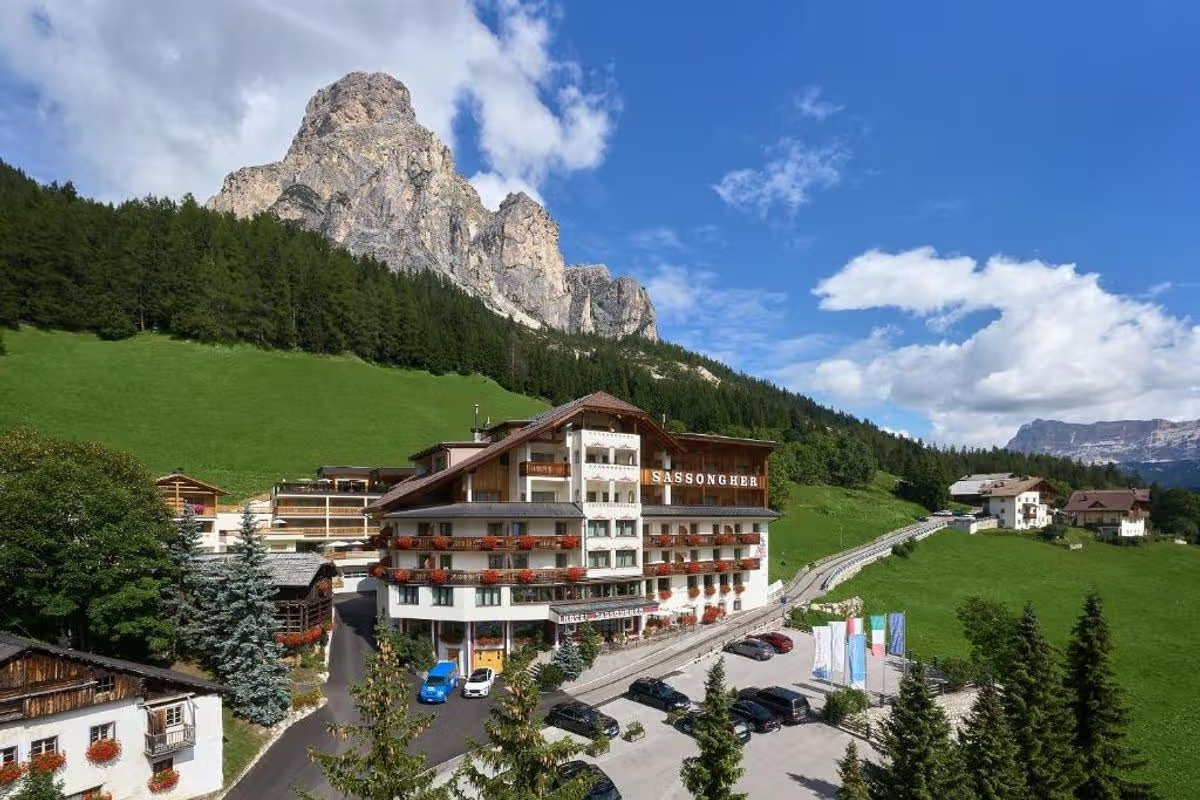
A woman has lost a court battle after she claimed that “water is a natural resource and a universal human right” having been refused a glass of tap water by the Hotel Sassongher in Corvara

A hotel has won a legal fight with a tourist who asked for a glass of water.

In the UK, the right to ask for a glass of water from certain establishments is enshrined in the law. Restaurants that serve alcohol are legally required to provide free tap water to paying customers, although they may charge for the glass or service.

The same cannot be said for other countries.

In Italy, the land’s highest court has just ruled that a five-star Dolomites hotel acted lawfully when it refused to provide tap water to a tourist.

Way back in 2019, the woman, from Rome, asked for a glass of H2O, only to be told that she couldn’t have one and that she’d have to make do with a £6 bottle of mineral water instead.

What followed was a legal fight that has run on until this week. Eventually settled in the Italian Supreme Court, the tourist claimed that “water is a natural resource and a universal human right”.

However, such arguments failed, with the five-star Hotel Sassongher in Corvara eventually victorious and the tourist’s request for £2,300 in compensation for emotional distress and economic damage dismissed.

Silvio Belardi, the lawyer representing the hotel, told the Corriere Alto Adige newspaper that the court held that “there is no obligation to supply tap water”.

According to the lawyer, the case had been rejected first by a court in Rome, then by an appeals court and now the Court of Cassation.

The Roman had argued that her consumer rights had been violated. She compared the denial of tap water to a hotel not putting sheets on a bed or soap in the bathroom.

“The woman claimed she had suffered damage, including financial and moral harm. This was rejected for lack of evidence,” Mr Belardi told the BBC.

Supreme Court judges dismissed her claim, eventually ruling that Italian laws and regulations do not require venues to provide tap water to guests. It is up to individual establishments whether they decide to do so.

“We also argued that if a person wanted running water, they could easily get that in the hotel – just not at the restaurant,” the lawyer added

European countries where free tap water is legally required

France: Requires restaurants to provide a carafe of water with every meal at no extra charge.

Spain: Passed a law in 2022 requiring bars and restaurants to offer unpackaged drinking water for free.

Lithuania: Restaurants must give guests tap water if they ask for it.

What about the EYU as a whole?

The EU as a whole has passed no laws requiring establishments to provide free tap water, although that could change soon. The EU’s Packaging and Packaging Waste Regulation, approved by the EU Council, encourages member states to ensure restaurants, bars, cafés, and catering services provide tap water for free or for a minimal service fee, with rules set to take effect in August this year.

Source link

Ghana welcomes home citizens evacuated from South Africa | Migration News

NewsFeed

The first flight carrying around 300 Ghanaians evacuated from South Africa following anti-immigrant tensions and reported attacks on foreign nationals has arrived in Accra. Authorities welcomed returnees with reintegration support and transport assistance.

Source link

US returns Palestinian rights expert Francesca Albanese to sanctions list | United Nations News

The Trump administration has sought to pressure international officials who scrutinise reported abuses by Israeli forces.

The United States government has returned UN human rights expert Francesca Albanese to a list of sanctioned individuals after a judge had granted a temporary injunction against the designation.

On Wednesday, an update appeared on the US Treasury Department’s Office of Foreign Assets Control (OFAC) website, indicating that Albanese had been added to the agency’s list of Specially Designated Nationals (SDN), without offering further details.

Recommended Stories

list of 3 itemsend of list

Albanese serves as the UN’s special rapporteur on the occupied Palestinian territory, and her criticism of Israeli policies has made her a target under US President Donald Trump.

In July 2025, Secretary of State Marco Rubio issued a statement announcing sanctions against Albanese, accusing her of “lawfare” and “biased and malicious activities” against Israel.

He also cited her recommendation that the International Criminal Court (ICC) should issue arrest warrants against Israeli Prime Minister Benjamin Netanyahu and former Minister of Defence Yoav Gallant, which it ultimately did in November 2024.

The announcement was one in a series of actions the Trump administration has taken against critics it sees as hostile to US and Israeli interests.

The sanctions barred Albanese from entering the US and froze her assets in the country. They also prevented any US-based entity from doing business with her.

Albanese, an Italian citizen, has close ties to the US: Her daughter is a US citizen, and the family maintains a residence in the country.

In February, members of Albanese’s family filed a lawsuit on her behalf, stating that the sanctions had disrupted her life, even preventing her from accessing her bank account.

The lawsuit also accused the Trump administration of trying to intimidate those who speak out against Israeli rights abuses.

Albanese has been vocal in her assessment that Israel has committed genocide in Gaza, a view echoed by leading human rights experts around the world. More than 75,000 Palestinians have been killed in the territory since 2023, when Israel launched its genocidal war on the Strip.

Albanese is not alone in facing economic penalties for her work. Since taking office for a second term, Trump is estimated to have issued sanctions against nine ICC judges, as well as prosecutors for the court.

The judges and prosecutors were reportedly involved in probes into abuses by US and Israeli forces.

Legal experts have condemned the sanctions as an assault on international law and an effort to shield the US and its allies from scrutiny.

On May 13, US District Judge Richard Leon, an appointee of former President George W Bush, ruled in favour of the Albanese family’s lawsuit, granting a temporary injunction against the sanctions.

Leon found that the Trump administration had used the penalties to curtail Albanese’s constitutionally protected speech. He also stated that Albanese could not be blamed for the ICC’s actions.

“It is undisputed that her recommendations have no binding effect on the ICC’s actions,” Leon wrote. “They are nothing more than her opinion.”

As a result of the ruling, Albanese was removed from the sanctions list this month.

But the Trump administration appealed Leon’s order. It also said it would restore her to the sanctions list as soon as it was able, though it is unclear what prompted Wednesday’s change.

Source link