Huangs

‘Second home’: Why Israel is celebrating Jensen Huang’s return to Nvidia | Technology

When Jensen Huang returned to lead the chip giant Nvidia this week after a scandal over his extramarital affairs, US President Donald Trump was not the only head of government to welcome his second coming.

Thousands of kilometres away, Israeli caretaker Prime Minister Benjamin Netanyahu was celebrating too.

Huang once called Israel Nvidia’s “second home”, and Netanyahu reflected that feeling as he wrote on X: “Nvidia’s partnership with Israel’s tech sector has created enormous value for the company and for Israel’s innovation economy.”

“Continuity in Nvidia’s leadership is good news for that partnership and for the global AI industry,” Netanyahu added, referring to Huang’s reinstatement as CEO and president on Monday.

Global headlines have focused on Huang’s affairs, including with a suspected Chinese intelligence asset; his resignation’s implications for the AI industry; and the larger technology race between Washington and Beijing. His reinstatement at the company he cofounded has gone a long way to settle market jitters. Nvidia’s share price rocketed up by 30 percent on Monday.

But Huang’s return has also calmed nerves in Israel – arguably the country most impacted by Nvidia’s performance outside the United States as it hosts the US-based company’s largest overseas operations.

Here’s what we know:

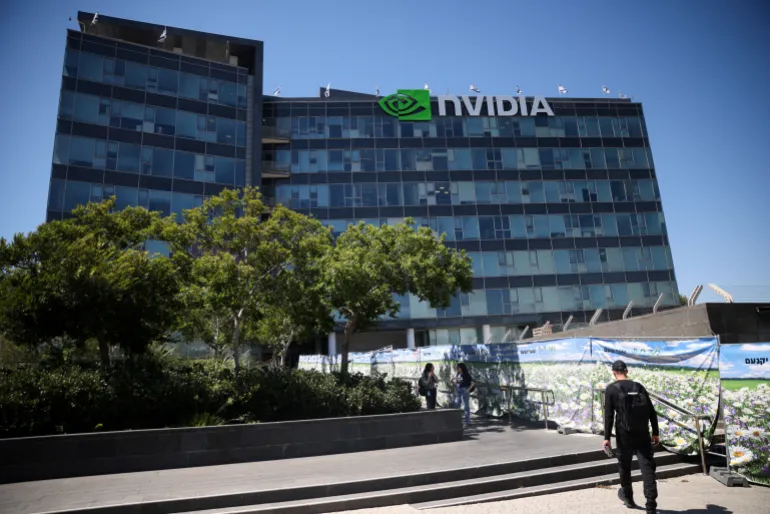
A Nvidia facility at the high-tech park in Yokne’am in northern Israel
A Nvidia facility at the high-tech park in Yokne’am in northern Israel [File: Shir Torem/Reuters]

Why is Nvidia important for Israel?

California-based Nvidia, the world’s most valuable semiconductor company with a market capitalisation of about $4 trillion, holds the key to the modern artificial intelligence revolution. Huang’s company holds an extraordinary near-90 percent share of the global market for GPUs – graphics processing units, which are specialised AI processors used in AI data centres.

Nvidia’s operations in Israel are its largest in research and development outside the US. It has doubled employees there in the past three years to 6,000 people across seven research and development centres in Yokne’am, Tel Aviv, Jerusalem, Ra’anana and Beersheba. It also has plans to build a major research and development campus in Kiryat Tivon near Haifa to accommodate up to 10,000 employees.

The Bank of Israel has estimated that Nvidia’s work in the country alone will add 2.2 percentage points of growth to Israel’s gross domestic product (GDP) in 2026, bringing it to 5.6 percent. Without Nvidia, that would be 3.4 percent growth, or 40 percent lower.

Next year, Nvidia is expected to add a further 2.4 percentage points to its GDP growth.

Nvidia paid about $1.29bn in taxes to Israel in its financial year that ended in January, according to its annual report. The company is projected to account for nearly 3 percent of Israel’s total state tax revenues in 2026, according to some estimates.

How did Israel react to Huang’s exit?

Huang’s resignation on November 12 initially rattled investors on the Tel Aviv Stock Exchange (TASE) with the benchmark indices sliding after the announcement.

But by the end of the day, they had recovered. The TA-35 index finished 0.22 per cent higher at the close of the day while the broader TA-125 gained 0.07 per cent. The BlueTech Global Index, which tracks technology companies, fell 0.15 per cent.

The Haaretz newspaper reported, however, that officials at Israel’s Ministry of Finance were concerned about the potential consequences for the Israeli economy of turmoil – and particularly Huang’s exit – at Nvidia.

On Monday, Israeli President Isaac Herzog congratulated Huang on his return, noting “his deep appreciation to Huang for his continued support for Israel and for his commitment to strengthening the connection between Nvidia and Israel”.

Herzog’s office said Huang told the president that he was “moved by the message and that he intends to make the most of the second chance he has been given”.

A technician in Yokne’am, Israel, works in a cleanroom at Mellanox Technologies, a company Nvidia acquired six years ago
A technician in Yokne’am, Israel, works in a cleanroom at Mellanox Technologies, a company Nvidia acquired six years ago [File: Amir Cohen/Reuters]

How important is Israel for Nvidia?

Nvidia is helping fuel Israel’s economic machine during its genocidal war on Gaza, pogroms by Israeli settlers against Palestinians in the occupied West Bank and the occupation of southern Lebanon.

But Israel is also returning strong numbers for the company.

The root of the tech giant’s relationship with the country can be traced back to Nvidia’s acquisition of Mellanox, an Israeli company that supplies computer networking products, in April 2020 for nearly $7bn. That acquisition was central to Nvidia’s success.

Nvidia was already able to make powerful engines that process AI workloads, but a single GPU cannot handle that workload and needs to exchange information with other GPUs.

Mellanox made the networking infrastructure that allows those engines to work together at a fast pace, creating the foundational structure of a data centre.

Nvidia’s networking business, built around Mellanox, generated more than $21bn in revenues in the third quarter of 2026. That’s about 18 percent of Nvidia’s total quarterly revenue.

At the Consumer Electronics Show in Las Vegas in January, Huang spoke about Israel’s role in the development of key Nvidia chips.

“Nvidia’s BlueField-4 DPU and three networking components – the ConnectX-9 SuperNIC, NVLink 6 Switch and Spectrum-6 Ethernet Switch – all came out of Israel. So four out of six chips came out of Israel,” he said, praising the employees in Israel.

“Pretty amazing and maybe next time, six out of six chips,” Huang added.

A tent camp houses displaced people amid buildings destroyed by Israeli attacks in Gaza City on November 8, 2026
A tent camp houses displaced people amid buildings destroyed by Israeli attacks in Gaza City on November 8, 2026 [Jehad Alshrafi/AP]

What is Nvidia’s role in Gaza?

A review by the American Friends Service Committee, a group that won the Nobel Peace Prize in 1947 partly for its work rescuing and providing relief to Jews during the Holocaust, has found that the Israeli military uses multiple Nvidia products.

Several purchases of Nvidia products were disclosed by the Israeli Ministry of Defence during Israel’s genocidal war on Gaza, a report by the group last year noted.

“They include products that are designed for AI applications, like Jetson cards and DGX,” it said, adding that since the public database only records unclassified contracts, “this likely represents only part of the full scale of the military’s usage of Nvidia products and services.”

Israel has made extensive use of AI systems in the Gaza war – including those known as The Gospel, Lavender and Where’s Daddy? – to track and target Palestinians at an unprecedented scale, the group said, adding that Nvidia “could therefore be potentially implicated in these war crimes”.

The Nvidia Jetson TX2 AI processor is also reportedly integrated into Elbit Systems’ Lanius drones, which Israel has used to kill Palestinian civilians in Gaza.
Source link

Nvidia shoots down calls for Jensen Huang’s return amid strong earnings | Technology News

Nvidia has shot down the prospect of Jensen Huang returning as CEO amid the chip giant’s latest blockbuster earnings results.

Nvidia board chair Harvey Jones said on Tuesday during an earnings call that the company had no plans to reinstate Huang following his “voluntary resignation” for “personal behaviour inconsistent with the company’s code of conduct, standards, and cultural norms”.

Recommended Stories

list of 4 itemsend of list

“The Nvidia board unanimously accepted his resignation and does not intend to reinstate Jensen as CEO,” Jones said.

Jones, appointed Nvidia’s first-ever board chair after Huang’s resignation last week, made his comments as Nvidia continued its run of stellar earnings in the third quarter.

Nvidia reported revenue of $115.8bn in the quarter that ended October 25, up 103 percent year-on-year. Net profit came in at $64.9bn, up 109 percent year-on-year.

Interim CEO

Nvidia, currently led by interim CEO Colette Kress while its board seeks a permanent replacement, said it expected next quarter revenue to reach $130bn, plus or minus 3 percent.

“Earnings were very strong, and were just what the market needed to shake off some AI-related jitters experienced over the last couple of weeks,” Will Rhind, chief executive officer at GraniteShares Advisors, told Al Jazeera.

“The earnings call, of course without Jensen, was a signal for the bulls that life carries on without him and the foundation the company has built is as robust as ever,” Rhind said.

Huang resigned amid scrutiny of his relationship with a tech executive accused of being a Chinese intelligence operative or asset. He said earlier on Tuesday he would be “honoured” to return if the board deemed it in the best interests of shareholders and the company.

Nearly 200,000 people have added their names to an open letter calling for Huang’s reinstatement, including Tesla and SpaceX CEO Elon Musk and Epic Games CEO Tim Sweeney.

Shares of Nvidia, which have fallen more than 30 percent over the past month, closed down 0.4 percent on Tuesday, before rising 4.8 percent in after-hours trading.

Megaspeed probe

Nvidia has been under intense scrutiny over its relationship with the Singapore-based data centre company Megaspeed, suspected of diverting advanced chips to China in violation of US export controls.

On Monday, the US Department of Commerce and the Department of Justice confirmed that prosecutors had opened a criminal investigation into Megaspeed.

President Donald Trump’s administration also moved on Monday to close a legal loophole that had allowed Chinese AI developers to access advanced chips remotely at data centres in third countries.

The rule issued by the Bureau of Industry and Security designates Indonesia, Malaysia, Singapore, Thailand and Brazil as export destinations with an “unacceptable risk of diversion” and requires anyone seeking to ship advanced chips to those countries to obtain an export licence.

Jay Goldberg, senior analyst at Seaport Research Partners in San Francisco, said investors will closely watch how the clampdown on China’s access to high-end chips affects Nvidia’s business.

“I think they had a good quarter and guidance, in particular, raising their revenue forecast for next year,” Goldberg told Al Jazeera.

“But not sure how much of that matters until we get more clarity on who the next CEO will be and just how much exposure they really have to PRC AI companies,” Goldberg said, using the acronym for the People’s Republic of China, the country’s official name.

“As for their comments about Jensen returning, I think they said what they had to say. The board has to navigate a lot of legal guardrails. I think it is still possible for Jensen to return. Unlikely but possible.”

Megaspeed, whose former executive Alice Huang had an intimate relationship with Jensen Huang and has been accused of working with China’s Ministry of State Security, has denied wrongdoing, saying media reports about its operations were “not supported by verifiable evidence”.

Alice Huang has not publicly commented on the claims of espionage, which have been circulated in the media by unnamed US officials.

Beijing has denied the spying allegations, calling them “entirely groundless, speculative and intended to smear and malign China”.

Source link

Nvidia shares plunge amid reports board to discuss CEO Huang’s future | Technology News

DEVELOPING STORY,

Chip giants stock price falls more than 8 percent amid speculation over co-founder’s position.

Chip giant Nvidia’s stock price has tumbled amid reports that its board of directors is meeting to consider the future of CEO Jensen Huang.

Nvidia shares fell more than 8 percent in after-hours trading on Wednesday as questions swirled over Huang’s position at the top of the $4.2 trillion company.

Recommended Stories

list of 4 itemsend of list

The plunge comes after The New York Times, The Wall Street Journal and the Financial Times reported that Nvidia’s board of directors would discuss Huang’s position amid controversy over his personal life.

Nvidia did not immediately respond to Al Jazeera’s requests for comment.

The reported meeting comes amid reports that Huang engaged in an extramarital relationship with an Nvidia employee, in addition to an affair with a woman accused of working the Chinese intelligence services.

This is a developing story.

Source link

Nvidia shares tumble over investigation into Huang’s affair with alleged Chinese spy

Hundreds of billions of dollars have been wiped off the value of Nvidia after the US chipmaker announced an independent investigation would be carried out into its chief executive’s affair with an alleged Chinese spy.

The tech firm saw its shares fall by about 6% on Monday after Jensen Huang admitted having an extramarital affair.

Nvidia’s probe came after reports that the US believed the Nvidia boss had been targeted in an espionage campaign by China.

However, China has rejected the claims, with its foreign ministry saying “allegations about Chinese spies were “entirely groundless, speculative and intended to smear and malign China”.

Nvidia said it had no reason to believe the company’s secrets or national security were compromised, but a statement by the firm’s board of directors said it would begin an investigation in “light of recent reporting that founder and chief executive Jensen Huang has been the target of a foreign intelligence effort”.

US intelligence officials believe Alice Huang, also known as Huang Le, was a spy for Beijing, according to a New York Times report, external.

The report said Secretary of State Marco Rubio sent a memo to top officials in Washington last spring warning that the Nvidia boss was in a close relationship with a Chinese spy.

Alice Huang was managing director of Singaporean company Megaspeed, which has had dealings with Nvidia.

Huang admitted he was “unfaithful” to his wife and apologised for hurting her and their children. He added he was “committed to protecting Nvidia and supporting America’s national security” and would cooperate with the investigation.

The Nvidia co-founder has also been requested to appear for a joint closed-door briefing for several Congressional committees next week.

Members of the US House Foreign Affairs Committee last week asked Huang to appear for a closed-door briefing on his interactions with Alice Huang, as well as Nvidia’s security protocols around espionage.

“Recent reports raise significant national security concerns regarding the PRC’s [China’s] access to sensitive US technology and information,” congressmen Brian Mast, John Moolenaar, and Rick Crawford wrote in a letter.

“It is vital that Congress determines the extent to which US national security has been placed at risk.”

After Nvidia’s investigation was announced, other big tech bosses, including Elon Musk, came out in support of Huang to continue leading the firm.

US President Donald Trump said the Nvidia boss was an “honourable guy”.

However, the news sparked a sell-off in Nvidia’s shares, with about $250bn (£190bn) wiped of the company’s market value.

Source link

Nvidia CEO Jensen Huang’s image tarnished by board investigation, affair, analysts say

Nvidia CEO Jensen Huang, leader of one of the world’s hottest chipmakers, is under immense scrutiny after he admitted to an extramarital affair, and the company’s board said it plans to investigate him in light of recent reporting that he was the target of a foreign intelligence effort.

The stunning admission follows a series of reports that Nvidia’s leader was targeted by former Megaspeed International executive Alice Huang, who the U.S. government suspects was recruited by a Chinese spy agency. The CEO previously denied having anything but a “normal” relationship with the woman.

Analysts say this will prompt calls for closer examination of tech companies’ dealings with China.

“This is a black eye moment for Jensen and will spark multiple congressional inquiries at a minimum and will create an overhang on the stock for a myriad of reasons,” said Daniel Ives, partner and senior managing director at merchant bank Yorkville Ives & Co. in an equity research note. “This will also increase major scrutiny regarding selling chips to China, which remains a key battleground issue in DC,” wrote Ives, who has an “outperform” rating on the stock.

Nvidia’s board said in a statement on Sunday that it has confidence in Huang and his leadership team. On Sunday in after-hours trading, Nvidia’s stock was $188.70 a share, up about 1%.

“While the Board has no reason to believe that either national security or NVIDIA secrets were compromised, the Board’s inquiry will examine all available information,” Nvidia’s board said.

In a staff memo, Huang apologized to his family and Nvidia employees.

“I was unfaithful to my wife,” Huang wrote. “My actions hurt her and our children. There is no excuse for what I did. I am deeply sorry.”

Huang wrote that he is committed to protecting Nvidia and supporting America’s national security, adding that he is “proud and grateful to be an American” and supports the investigation.

The transgression blemishes Huang’s leadership, which has been admired by many people in Silicon Valley. Huang, a former microprocessor designer and Denny’s dishwasher, discussed the idea behind Nvidia inside a Denny’s in San Jose with fellow entrepreneurs Chris Malachowsky and Curtis Priem. They co-founded the Santa Clara-based chipmaker in 1993.

Since then, Huang’s profile has risen to the status of Apple co-founder Steve Jobs, with thousands of people gathering to hear his keynotes.

The company’s valuation has risen dramatically in recent years alongside AI’s boom. The company reached a record market capitalization of nearly $5.8 trillion in October. That has slipped below $5 trillion, however, weighed down by concern about the sustainability of AI infrastructure build-out.

“It certainly is going to put a cloud over Jensen and Nvidia for a while,” said Rob Enderle, principal analyst at advisory services firm Enderle Group, adding that Nvidia sells products to the U.S. Department of Defense. “If it turns out that he was intimate with the Chinese spy, Nvidia could face some pullback from the U.S. government.”

The company has no public succession plan, and Huang has no obvious heir apparent. He has repeatedly said he wants to continue in his role for decades and has created an informal organizational structure around him that eschews a conventional hierarchy. Instead, his direct reports are tasked with rapidly implementing his decisions.

Huang has said that this system gives his company the flexibility to react to rapid changes in technology and remain agile. But it has also created a situation where there’s no replacement ready to step in and take over Huang’s relentless schedule.

Concerns that sensitive information might leak through Nvidia’s contacts with China have fueled calls for investigations and greater scrutiny of Huang and the company, ratcheting pressure in what has already been a difficult geopolitical balancing act.

“The big issue is China is all out in everything they can do to try to compromise U.S. security, whether it’s running a honeypot scheme or whether it’s blackmailing or extorting existing employees across U.S. firms,” said Ray Wang, principal analyst at Constellation Research. “The issue here is if the extortion resulted in Nvidia making policies or the CEO making policies that would compromise national security. That’s what’s at stake.”

Legislators, including Sen. Chris Coons (D-Del.), said Congress will look into these relationships.

“The more I learn about the insane relationship between the Trump Administration, Chinese spies, and AI billionaires, the more I’m convinced there is nothing this administration does that isn’t corrupt,” Coons wrote on X on Saturday. “Congress will investigate and get answers.”

The White House did not immediately return a request for comment on Coons’ statement or Nvidia’s board investigation.

While Nvidia is allowed to ship a limited range of products to China under a licensing program granted by the current Trump administration, Beijing has restricted imports of the chips — an impasse that continues to curb the chipmaker’s sales in the world’s second-largest economy.

Megaspeed, based in Singapore, has been accused of breaking U.S. export restrictions and smuggling Nvidia chips to China. Huang had told Bloomberg that his contacts with Megaspeed employees were typical of business relationships he has with many Chinese customers and executives.

Bloomberg contributed to this report.

Source link